


Hello and welcome to Sync #565!
The leak of Claude Code’s source code capped off a rough March for Anthropic. We’ll take a closer look at what the leak revealed about the company’s coding tool as the main topic of this week’s issue.
Elsewhere in AI, OpenAI raised a massive $122 billion at a valuation of $852 billion. Meanwhile, Iran has threatened Nvidia, Apple, and other tech giants with attacks; Anthropic plans to charge more for those who use Claude Code with OpenClaw; and the tenth xAI co-founder has left the company. There was also a wave of new model releases this week, including Gemma 4, Veo 3.1, Cursor 3, three new models from Microsoft AI, and Qwen3.5-Omni.
Over in robotics, Physical Intelligence and Shield AI raised $1 billion and $1.5 billion, respectively, while Chinese robotics company Agibot celebrated the delivery of its 10,000th humanoid robot.
In biotech, Insilico Medicine secured a $2.75 billion drug collaboration with Eli Lilly, the FDA approved Eli Lilly’s GLP-1 pill, and we’ll explore what happens when you clone mice for 20 years straight.
Beyond that, this week’s issue of Sync also features a stealthy start-up that pitched brainless human clones, a man making music with a BCI, how TurboQuant works, the story of how DeepMind chose Google, and more!
Enjoy!

Claude Code got “open sourced”
On 31 March 2026, Anthropic pushed version 2.1.88 of its Claude Code package to npm, a package repository from which developers can download and install Claude Code. This is a routine kind of update that happens constantly in software development. But this one included a source map file that linked back to the full, unobfuscated source code. Within hours, the entire codebase—nearly 2,000 TypeScript files and more than 512,000 lines of code—was being downloaded, forked, and dissected by thousands of developers.
To be clear, what leaked was Claude Code, the command-line coding tool, not the AI models themselves. No model weights, no training data, no customer information. What was exposed was the harness—the software scaffolding that tells the model how to behave, what tools to use, and where its limits are. Anthropic called it a packaging error caused by human error, not a security breach.
Some developers marvelled at the sophistication. Some laughed at the mess. Others pointed out that OpenCode, an open-source competitor, achieves comparable functionality in roughly 30,000 lines of clean Go. Either way, the code revealed just how much engineering goes into making an AI model useful as a coding agent—and why Claude Code has been so hard for competitors to replicate.
The code showed a four-layer system for managing long sessions. When a conversation grows too large for the model's context window, it compresses older messages into summaries so the model does not lose track. A caching trick splits the system prompt into two halves: one static (shared across all users) and one dynamic (personalised per session), so Anthropic does not have to reprocess the expensive parts every time. Internal Anthropic engineers get a different version of Claude Code from the one shipped to customers—their version includes extra guardrails against hallucinations and a verification agent that double-checks changes before reporting them as complete. There is an "undercover" mode that strips all mentions of Claude and Anthropic from outputs when the tool publishes code to public repositories. Feature flags hint at unreleased capabilities, including voice mode and autonomous background agents. Developers also unearthed 187 hardcoded spinner verbs—the words that flash on screen while Claude Code works—ranging from the mundane "thinking" to the delightful "hullaballooing" and "razzmatazzing." And there is even a Tamagotchi-style pet called Buddy.
Anthropic, of course, was not happy with Claude Code becoming accidentally open source. The company moved quickly to contain the spread, issuing DMCA takedown notices via GitHub. The initial request caught roughly 8,100 repositories—including legitimate forks of Anthropic's own public Claude Code repo. Boris Cherny, the head of Claude Code, acknowledged the over-reach, and Anthropic narrowed its request to 96 forks.
But the cleanup raised its own awkward question. DMCA takedown notices require the filer to hold copyright over the work in question, and under US law, copyright requires human authorship—a principle the Supreme Court effectively reinforced on 2 March 2026 by declining to hear the Thaler v. Perlmutter appeal. AI-assisted works may still qualify if a human substantially shapes the output, but the more the AI generates autonomously, the weaker the claim. Cherny has said publicly that he has not written a single line of code since November 2025, and an Anthropic spokesperson told Fortune that between 70% and 90% of code company-wide is written by AI, with Claude Code's own codebase at roughly 90%. If that figure is accurate, the legal basis for those takedown notices is, at a minimum, uncertain. Developers were quick to find a workaround. Within days, some had used AI tools (maybe even Claude Code itself, for maximum irony) to rewrite the leaked functionality in different languages, producing versions that are legally distinct from Anthropic's codebase.
However, the leak was not an isolated stumble. It was the culmination of a rough month for Anthropic.
Days earlier, Fortune had reported that Anthropic accidentally left nearly 3,000 internal files publicly accessible, including a draft blog post describing an unannounced model. Throughout March, Claude's reliability took a hit. Outages struck Claude Opus 4.6 and Sonnet 4.6 on multiple occasions, and some users reported hitting rate limits far faster than expected—a problem Anthropic said it was investigating. The surge in demand is partly a consequence of Anthropic's own success—user growth has been explosive in early 2026, and the infrastructure has not kept pace. For a tool that developers and businesses increasingly depend on for daily work, that is a problem regardless of the reason.
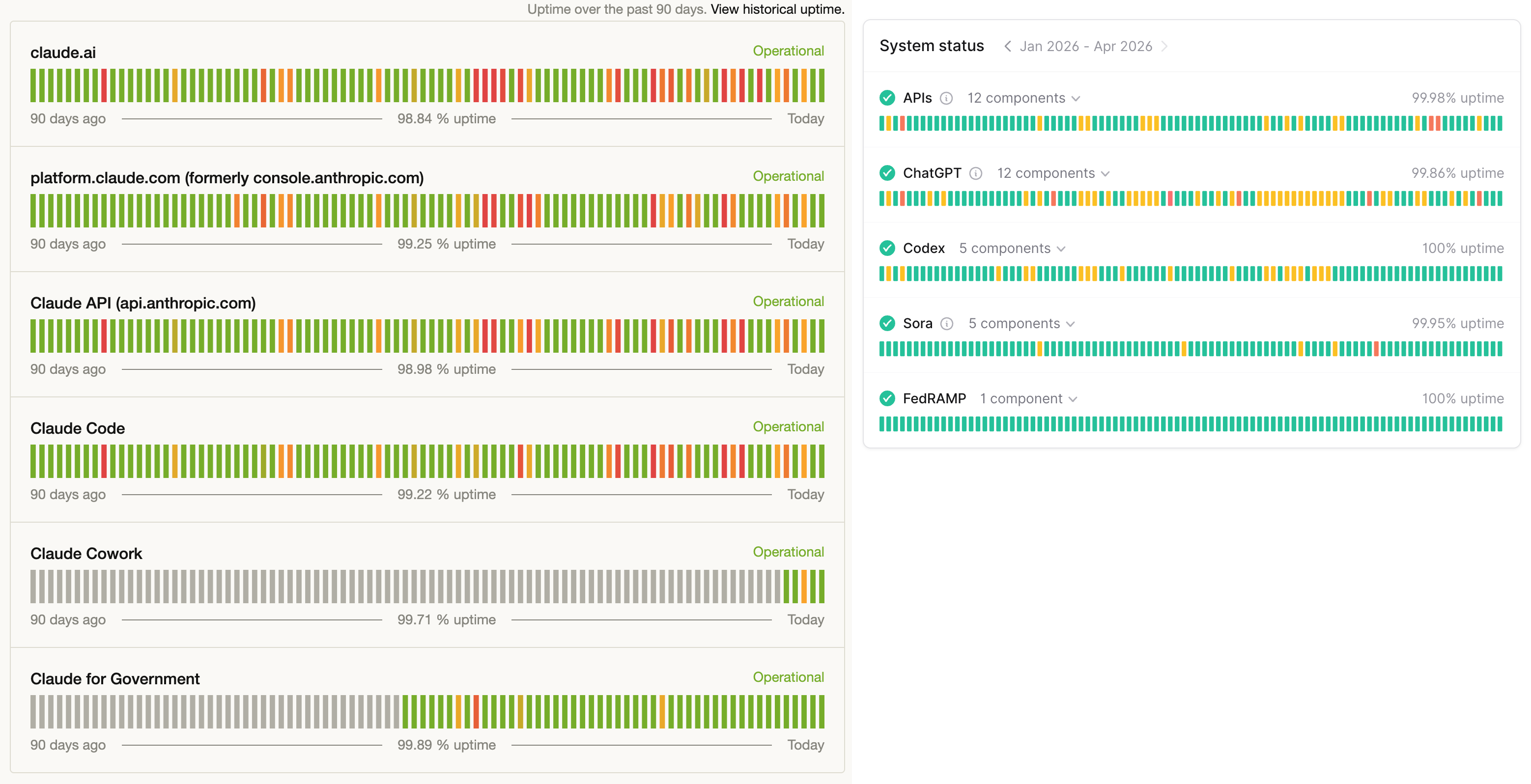
None of those issues is existential for Anthropic. But they are embarrassing, and they are eroding the image of a careful, safety-conscious AI company that the company has spent years building. The leaked codebase is already a gift to competitors and open-source projects alike. Architectural patterns that took Anthropic years to develop are now public knowledge, free to be studied and adapted. Meanwhile, Anthropic's own engineers face the less glamorous task of finding and fixing any security vulnerabilities that the leak may have exposed, since bad actors now have a detailed map of the tool's permission system, guardrails, and validation logic. If Anthropic wants to be the infrastructure layer that developers and businesses build on, it will need to start running like one. The IPO rumoured to happen later this year would be a good deadline.

If you enjoy this post, please click the ❤️ button and share it.
🦾 More than a human
Inside the stealthy startup that pitched brainless human clones
A California startup called R3 Bio says it’s making brainless monkey bodies for medical testing, but an MIT Technology Review investigation found its founder has been privately pitching a much bolder idea: growing brainless human clones as a source of spare organs or even replacement bodies for people seeking to live far longer. The project has real backing from Silicon Valley investors, though no human or primate cloning has actually been done. Scientists and ethicists have raised serious concerns, and the legal and technical hurdles remain vast.
Meet the Man Making Music With His Brain Implant
In this interview, Galen Buckwalter, a 69-year-old quadriplegic and research psychologist, explains how he uses a brain implant to make music just by using his thoughts. He has already used these brain-generated sounds in a song with his punk band, and hopes to eventually compose entire tracks straight from his mind. He also argues that BCI developers should look beyond restoring basic abilities and explore how the technology can support creativity, which he believes is key to making people genuinely want to use it.
A woman’s uterus has been kept alive outside the body for the first time
Researchers in Spain have built a machine called "Mother" that kept a donated human uterus alive outside the body for a record 24 hours. Their aim is to keep uteruses functioning for up to 28 days so they can study fertility problems, particularly why embryos fail to attach to the womb during IVF. The team's ultimate hope is that the technology could one day support a full pregnancy outside the body.
🧠 Artificial Intelligence
OpenAI raises $122 billion to accelerate the next phase of AI
OpenAI has raised a record $122 billion at a valuation of $852 billion. Investors include Amazon, Nvidia, and SoftBank, as well as individual investors who were able to participate for the first time, contributing over $3 billion. The company also extended its revolving credit facility to roughly $4.7 billion. Additionally, OpenAI revealed that ChatGPT now has over 900 million weekly users and generates $2 billion in monthly revenue. OpenAI plans to use the funds to expand its computing power and build a single “superapp” that combines its various AI tools. Despite this impressive growth, the company is still losing money and faces pressure to prove it can deliver returns as it moves towards a potential IPO.
Iran threatens Nvidia, Apple and other tech giants with attacks
Iran's Revolutionary Guard has threatened to attack 18 major US tech companies, including Nvidia, Apple, Microsoft, and Google, calling them fair targets in response to US and Israeli strikes on Iran. The threat follows an earlier Iranian strike on AWS data centres in the region in early March, which knocked out apps and services across the UAE. Security experts warn that tech infrastructure like data centres is now being drawn into the conflict as a strategic target, not just a bystander.
Anthropic says Claude Code subscribers will need to pay extra for OpenClaw usage
Anthropic is stopping Claude Code subscribers from using their subscriptions with third-party tools like OpenClaw, meaning users will now have to pay extra for that access. The company says this is about managing costs, but critics see it differently—OpenClaw’s creator, who recently joined OpenAI, accused Anthropic of copying open-source features and then shutting out competitors. Anthropic denies this and is offering refunds to affected users.
America’s AI Build-Out Hinges on Chinese Electrical Parts
Nearly half of enormous AI data centres in the US face delays or cancellation due to critical shortages of electrical equipment—transformers, switchgear, and batteries. American factories can't keep up with demand, so builders are forced to import from China. Some companies are finding workarounds, like pre-ordering equipment or making their own, but the core problem remains: the US can't produce enough of the everyday hardware needed to plug it all in.
Gemma 4
Google has released Gemma 4, its latest family of open-weight AI models. Gemma 4 comes in four sizes—from ultra-compact E2B and E4B models designed for mobile and edge devices to the larger 31B dense and 26B mixture-of-experts models suited for personal computers and workstations. All models can work with text, images, video, and audio, and they show big improvements over the previous generation in maths, coding, and reasoning tasks. According to Google, Gemma 4 offers the best performance in its size category. All models are available with open weights for commercial use via Kaggle, Hugging Face, and other platforms.
Meet the new Cursor
Cursor has launched Cursor 3, a revamped interface designed around AI coding agents. Instead of writing code line by line, developers can now run multiple AI agents at once across different projects, moving tasks between their own machine and the cloud as needed. The update also adds a built-in browser, a plugin marketplace, and tools for reviewing and merging code changes more quickly.
Today we’re announcing 3 new world class MAI models, available in Foundry
Microsoft AI has launched three new models: MAI-Transcribe-1 for converting speech to text, MAI-Voice-1 for generating realistic voices from short audio clips, and MAI-Image-2 for creating images. According to Microsoft, all three are faster, more accurate, and cheaper than competing offerings from other major cloud providers.
Update on the OpenAI Foundation
The OpenAI Foundation is committing at least $1 billion over the next year to ensure AI delivers broad public benefit. The money will go towards using AI to fight diseases like Alzheimer’s, addressing AI’s impact on jobs, and making AI systems safer—especially for children. The Foundation is also assembling a leadership team spanning philanthropy, finance, and operations, and is searching for an executive director to oversee the effort as it scales.
The Inside Story of the Greatest Deal Google Ever Made: Buying DeepMind
This excerpt from Sebastian Mallaby's upcoming book tells the behind-the-scenes story of how Google and Facebook competed to acquire DeepMind in 2013–14, when it was still a small London startup chasing artificial general intelligence long before it was cool. Hassabis chose Google after concluding Zuckerberg didn't truly grasp AI's importance, leading Zuckerberg to recruit Yann LeCun to build Facebook's own AI lab instead. Google closed the deal for $650 million, granting unusual concessions on safety and independence, and went on to invest billions in DeepMind's research.
A 10th cofounder is leaving xAI. Elon Musk has just one more left.
xAI cofounder Manuel Kroiss has left the company, making him the tenth of eleven cofounders to depart since January, leaving only Ross Nordeen alongside Elon Musk. Musk has acknowledged the company "was not built right first time around" and is restructuring it with staff from Tesla and SpaceX, while the organisation prepares for a widely anticipated IPO that could value SpaceX at $1.5 trillion.
Build with Veo 3.1 Lite, our most cost-effective video generation model
Google has launched Veo 3.1 Lite, a budget video generation model costing less than half the price of Veo 3.1 Fast while matching its speed. It supports text-to-video and image-to-video at up to 1080p in landscape or portrait, with adjustable clip lengths up to eight seconds. Additionally, Google is also reducing the price for Veo 3.1 Fast.
Qwen3.5-Omni: Scaling Up, Toward Native Omni-Modal AGI
Alibaba has released Qwen3.5-Omni, a multimodal AI model that processes text, images, audio, and video in a single system and responds with both text and real-time speech across 113 languages. The flagship variant claims top scores on 215 audio and audio-visual benchmarks, outperforming Gemini 3.1 Pro on audio understanding and beating ElevenLabs and gpt-audio on voice stability. It also introduces voice cloning, smart interruption handling, built-in web search, and Audio-Visual Vibe Coding—a novel ability to write working code simply by watching and listening to screen recordings. The model is available in three sizes (Plus, Flash, and Light) through Alibaba Cloud's offline and realtime APIs, and can be used via Qwen Chat on web, mobile, and desktop.
Mistral AI raises $830M in debt to set up a data center near Paris
French AI startup Mistral AI has borrowed $830 million to build a data centre near Paris, set to open in mid-2026. This is part of a wider European expansion, including a $1.4 billion investment in Sweden. Arthur Mensch, Mistral CEO, says the goal is to give European customers their own AI infrastructure rather than relying on US cloud providers.
▶️ TurboQuant Explained (11:21)
Last week, researchers from Google published a paper introducing TurboQuant, a new method of compressing LLMs and vector search that promises to improve the efficiency of serving AI models at scale. This video from Caleb Writes Code (a good YouTube channel explaining various concepts in AI) explains how TurboQuant works in an approachable way.
OpenAI is throwing everything into building a fully automated researcher
MIT Technology Review speaks with OpenAI’s chief scientist Jakub Pachocki about the company’s new top priority: building an AI system that can carry out research on its own. The plan starts with an “AI research intern” by September and aims for a fully automated researcher by 2028, capable of solving big problems in science, maths, and policy. Pachocki points to early wins with coding tools like Codex but acknowledges real risks, including misuse and too much power in too few hands.
OpenAI acquires TBPN, the buzzy founder-led business talk show
OpenAI has bought TBPN, a popular daily tech talk show, in its first move into media. The show will keep its brand and supposedly make its own editorial choices, but it will report to OpenAI’s top political strategist, Chris Lehane, raising clear questions about independence.
An exclusive tour of Amazon’s Trainium lab, the chip that’s won over Anthropic, OpenAI, even Apple
Techcrunch got a chance to visit Amazon’s AWS chip lab in Austin, where Trainium, Amazon’s AI chips used by both Anthropic and OpenAI, are being designed and tested. 1.4 million Trainium chips are deployed across three generations and Anthropic alone using over a million, yet demand still outstrips supply. The lab also designs the full server stack—sleds, Nitro virtualisation hardware, and cooling systems—giving Amazon end-to-end control over cost and performance in a bid to loosen Nvidia’s grip on the AI infrastructure market.
New computer chip material inspired by the human brain could slash AI energy use
Researchers have created a brain-inspired chip component that could cut AI energy use by up to 70% by processing and storing data in the same place. Their design uses a novel hafnium oxide memristor that switches states far more reliably and at currents roughly a million times lower than existing alternatives. The main hurdle is that fabrication currently requires temperatures too high for standard chip manufacturing, but the team is working to address this.
CERN Uses Tiny AI Models Burned into Silicon for Real-Time LHC Data Filtering
CERN has built tiny AI models etched directly into silicon chips to filter the enormous data stream from the Large Hadron Collider, which produces around 40,000 exabytes of data per year. These chips evaluate particle collisions in under 50 nanoseconds, keeping only about 0.02% of events for scientific analysis and permanently discarding the rest. The approach is the opposite of the current AI trend towards bigger models, focusing instead on making the smallest, fastest, and most efficient systems possible.
Introducing TRIBE v2: A Predictive Foundation Model Trained to Understand How the Human Brain Processes Complex Stimuli
TRIBE v2 is an open-source model from Meta that simulates how the human brain reacts to what we see, hear, and read. It was trained on brain scan data from over 700 people and is 70 times more detailed than its predecessor, allowing researchers to test ideas about brain function without needing human subjects for every experiment. The model and code are freely available to help speed up neuroscience research and the search for better treatments for brain disorders.
🤖 Robotics
AI Robotics Lab in Talks to Raise $1 Billion at $11 Billion Valuation
Physical Intelligence, a two-year-old robotics startup, is looking to raise around $1 billion in new funding, which would value the company at over $11 billion—double what it was worth just four months ago. The company builds AI software that helps robots learn physical tasks like folding clothes and making coffee.
AGIBOT rolls out 10,000th humanoid robot
Chinese humanoid robotics company AGIBOT announced it has shipped 10,000 robots, claiming to be one of the first to hit that number. The company claims it went from 5,000 to 10,000 units in just three months and says its robots are now working in shops, warehouses, schools, and factories across multiple continents.
Defense startup Shield AI lands $12.7B valuation, up 140%, after US Air Force deal
Shield AI, a defence startup building autonomous military drones, has raised $1.5 billion in Series G funding at a $12.7 billion valuation—a 140% jump in one year—driven largely by the US Air Force selecting its Hivemind autonomy software for the Collaborative Combat Aircraft drone programme.
Generalist has unveiled GEN-1, a new AI model designed to control robots across a range of physical tasks. According to Generalist, GEN-1 succeeds 99% of the time on simple tasks like folding clothes and packing items, a big jump from its predecessor's 64%, and works about three times faster than previous leading models, all while needing only around an hour of robot-specific training data. The company says the model can also improvise when things go wrong, though it acknowledges not every task hits these high marks yet.
Sanctuary AI’s robotic hand demonstrates zero-shot in-hand manipulation
Sanctuary AI has shown its robotic hand can repeatedly rotate a small cube to match a target position using only its fingertips. This kind of precise in-hand manipulation is one of the hardest problems in robotics. The hand’s hydraulic design and large number of independently moving joints give it capabilities beyond most competing systems. Notably, the control policy was learned entirely in a simulated environment and worked straight away on the real hardware.
30 Years Ago, Robots Learned to Walk Without Falling
This piece shares the story of Honda P2, the first robot to achieve autonomous bipedal walking without losing balance in 1996. The robot was capable of dynamic walking—maintaining balance through continuous adjustment—and could climb stairs, push carts, and operate autonomously using an onboard computer and battery. Honda’s P2 is a milestone in robotics development, the legacy of which can be seen in today’s humanoid robots.
▶️ Billions Are Flowing Into Robots That Don’t Work Yet (49:00)
In this conversation, Erik Nieves, co-founder and CEO of Plus One Robotics, a warehouse automation company based in San Antonio, makes the point that business customers don’t care what a robot looks like—they only care whether it can hit performance targets like speed and reliability. The conversation also touches on the hype in robotics, why it is important to keep humans in the loop, and how robotics could end labour arbitrage and reshape where manufacturing happens.
🧬 Biotechnology
Insilico Medicine secures $2.75 billion drug collaboration with Eli Lilly
Insilico Medicine, an AI drug discovery company, has signed a deal with Eli Lilly worth up to $2.75 billion, with $115 million paid upfront. Under the agreement, Lilly gets exclusive rights to develop and commercialise preclinical oral drug candidates from Insilico for selected disease areas, including a GLP-1 diabetes drug.
FDA Approves Eli Lilly’s GLP-1 Pill
The US FDA has approved Foundayo, a daily weight-loss pill from Eli Lilly, making it the second such pill on the market after Novo Nordisk's oral Wegovy. In trials, people on the highest dose lost around 12% of their body weight over 18 months. Notably, the FDA reviewed Foundayo in just 50 days under a new pilot programme to fast-track high-priority drugs, well below the usual six-to-ten-month timeline.
What happens when you clone mice for 20 years straight?
As the title suggests, this article tells the story of an experiment involving repeatedly cloning a mouse over more than 20 years, resulting in 58 cloned generations, and what scientists have learned from it.
💡Tangents
SpaceX Files to Go Public, Setting Stage for Huge I.P.O.
SpaceX has confidentially filed for an IPO this week with plans to debut on the stock exchange in June, according to sources quoted by the New York Times. SpaceX, now valued at over $1 trillion, also includes Elon Musk's AI company xAI and the social network X after a recent merger. If the valuation holds, Musk could become the world's first trillionaire.
Amazon is in talks to buy Globalstar for $9 billion
Amazon is in advanced talks to buy satellite company Globalstar for around $9 billion, the Financial Times reports. A successful deal would give Amazon valuable radio frequencies and existing infrastructure to speed up its effort to compete with SpaceX’s Starlink. The deal is complicated by Apple, which owns 20% of Globalstar and depends on its network for the iPhone’s Emergency SOS feature. No agreement has been signed, and the key challenge is finding terms that work for both Amazon and Apple.
Philly courts will ban all smart eyeglasses starting next week
Philadelphia has banned smart glasses from all its courthouses, saying that people could secretly record witnesses and jurors. Anyone caught with them could be turned away or even arrested, unless a judge has given written permission beforehand. The ban comes as affordable smart glasses have become popular. A handful of other US court systems have brought in similar rules.
Thanks for reading. If you enjoyed this post, please click the ❤️ button and share it!
Humanity Redefined sheds light on the bleeding edge of technology and how advancements in AI, robotics, and biotech can usher in abundance, expand humanity's horizons, and redefine what it means to be human.
A big thank you to my paid subscribers, to my Patrons: whmr, Florian, dux, Eric, Preppikoma and Andrew, and to everyone who supports my work on Ko-Fi. Thank you for the support!
My DMs are open to all subscribers. Feel free to drop me a message, share feedback, or just say "hi!"