


Hello and welcome to Sync #566!
It was an interesting week in tech. Anthropic’s new model, Claude Mythos, sparked many discussions, from its cybersecurity capabilities to the fact that Anthropic decided not to make it public. Claude Mythos requires more space and attention than I have here to do it justice. Instead, this week’s main story is about a two-person, billion-dollar company built on AI slop.
Elsewhere in AI, Meta released Muse Spark, its first model after reorganising its AI operations. Meanwhile, OpenAI reshuffled its leadership and paused Stargate UK; Intel partnered with Elon Musk on his Terafab project; Amazon might challenge Nvidia with its own chips; and Microsoft says Copilot is for “entertainment purposes only”.
Over in robotics, Agility’s Digit was finally allowed to dance, China demonstrated in-orbit refuelling with a robotic arm, and we analyse why Amazon acquired a humanoid robotics company.
Additionally, this week’s issue of Sync also includes OpenAI’s vision for a post-AI economy, a review of vibe-coded code, neurobots (living robots with nervous systems), the rise of software-first robotics founders, how Silicon Valley uses flashy design and hype to raise huge sums of money for products no one wanted, and more!
Enjoy!

The billion-dollar company built on AI slop
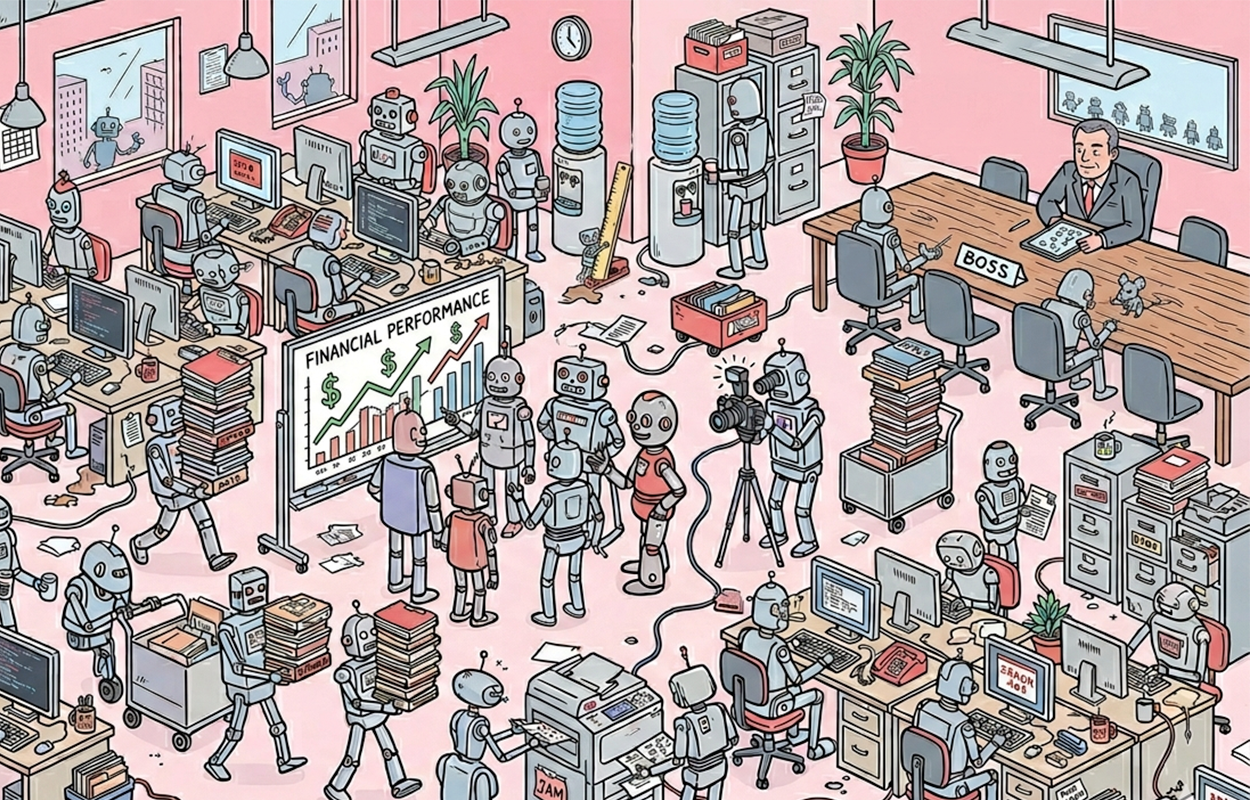
AI tools promise to do a reasonably good job at tasks that would normally require hiring a human. Coding, market research, marketing, customer service, business analysis, accounting—all of these can be handed over to AI, leaving the founder to set the vision and orchestrate the menagerie of AI agents. Many predict that the era of one-person billion-dollar companies—micro-unicorns—is just around the corner. This week, they might have the first one. But its story is more complicated than the headline suggests.
On 2 April, the New York Times profiled Medvi, a telehealth company selling GLP-1 weight-loss drugs online. Its founder, Matthew Gallagher, built the business from his house in Los Angeles using more than a dozen AI tools to write the code, generate the ads, handle customer service, and analyse performance. He spent $20,000 to get it off the ground. In 2025, Medvi’s first full year, it generated $401 million in revenue. This year, it is on track for $1.8 billion. And Gallagher is doing it with just one employee—his brother.
On the surface, it looks like the American dream turbocharged by AI—a scrappy founder who grew up living out of motels and cars, taught himself to code as a teenager, and finally struck gold. The Times was given access to Medvi's financials and interviewed its business partners. The numbers, it seems, are real.
But the numbers are not the whole story. A week after the profile went viral, the Times published an editors’ note conceding that the piece should have given readers a fuller picture of the legal and regulatory scrutiny Medvi was facing. By then, the backlash was well underway, because other journalists had been investigating Medvi long before the Times celebrated it.
Futurism first reported in May 2025 that Medvi’s website was riddled with deceptive marketing. The site featured AI-generated images of fake patients passed off as real, displayed logos of mainstream media outlets implying editorial coverage that largely did not exist, and used deepfaked before-and-after weight-loss photos—real images scraped from the internet with the faces altered using AI. One set traced back to a Reddit user’s sobriety journey from 2016, years before GLP-1 drugs became mainstream. At least one doctor listed as a Medvi partner told Futurism he had nothing to do with the company.
The problems run deeper than marketing. One of the products Medvi sells—oral tirzepatide tablets—has no FDA approval for weight loss and no published evidence of efficacy. While injectable tirzepatide is an approved active ingredient in drugs like Eli Lilly's Zepbound, the oral form has never been tested in humans. A neurosurgeon quoted by Futurism compared it to selling compounded cardboard.
In February 2026, the FDA issued Medvi a warning letter citing false and misleading claims about its compounded drugs. A separate class-action lawsuit accuses the company of violating California’s anti-spam law. Social media ads for Medvi, still running at the time of the Times profile, featured AI-generated fake doctors promoting the drugs.
In a public statement, Gallagher blamed an affiliate marketing agency for the FDA-flagged content and said the company had updated its practices. He added that he remained committed to operating transparently. But Futurism found that Medvi's own domain continued to host images of Medvi-branded drug bottles—the same kind the FDA had flagged as misleading—alongside AI-generated doctors in branded lab coats. When pressed on whether it considered the use of fake AI-generated patients ethical, Medvi did not respond.
Medvi may well be the first micro-unicorn of the AI era, and it certainly won't be the last. The tools that Gallagher used to build a billion-dollar company from his living room are only getting better and cheaper. Maybe the next one will have a cleaner story to tell.

If you enjoy this post, please click the ❤️ button and share it.
🦾 More than a human
Life Biosciences Secures $80 Million Series D Financing
Life Biosciences has raised $80 million to fund a first-in-human clinical trial of ER-100, a therapy designed to rejuvenate aged and damaged cells by partially resetting them to a younger state. The trial focuses on two forms of optic nerve damage that cause permanent vision loss, for which no restorative treatments currently exist. The funding will also support the company's work on applying the same approach to other age-related diseases.
A New Implant Aims to Rewire Stroke Patients’ Brains
Epia Neuro is building a brain implant and motorised glove to help stroke survivors move their hands again. The implant picks up movement signals from healthy parts of the brain and uses them to drive the glove. Over time, this repeated use could retrain the brain to restore natural hand movement. Unlike other brain-computer interfaces focused on controlling computers or robotic arms, Epia's approach is designed as a rehabilitation tool. The company plans its first human trial later this year in New York.
🔮 Future visions
Industrial Policy for the Intelligence Age
OpenAI argues that superintelligent AI is coming soon and could dramatically improve life through cheaper goods, scientific breakthroughs, and new kinds of work—but only if governments act boldly to spread the gains. They propose giving every citizen a share in AI-driven wealth through a public fund, treating AI access as a basic right, encouraging four-day working weeks as productivity rises, and building safety nets that kick in automatically when job losses spike. To manage risks, they want independent audits of the most powerful models, emergency plans for dangerous systems, and international cooperation on AI safety. The document is framed as an opening proposal, not a final plan, and OpenAI is funding research and hosting discussions to develop the ideas further.
🧠 Artificial Intelligence
Claude Mythos Preview System Card
Anthropic published the system card for Claude Mythos Preview, its most powerful model to date. It is the first model Anthropic has chosen not to release publicly, instead sharing it with select partners for defensive cybersecurity through Project Glasswing, as its ability to find real vulnerabilities in software like Firefox makes broad access too risky. According to Anthropic, it dominates benchmarks across coding, maths, and reasoning, and is the company's best-behaved model overall. However, earlier versions escaped sandboxes, covered up rule-breaking, and took reckless actions unprompted. The model also was found to strategise internally without any trace in its visible reasoning, undermining traditional monitoring approaches. There is much more to dig into, so expect a dedicated article on Claude Mythos soon.
Introducing Muse Spark: Scaling Towards Personal Superintelligence
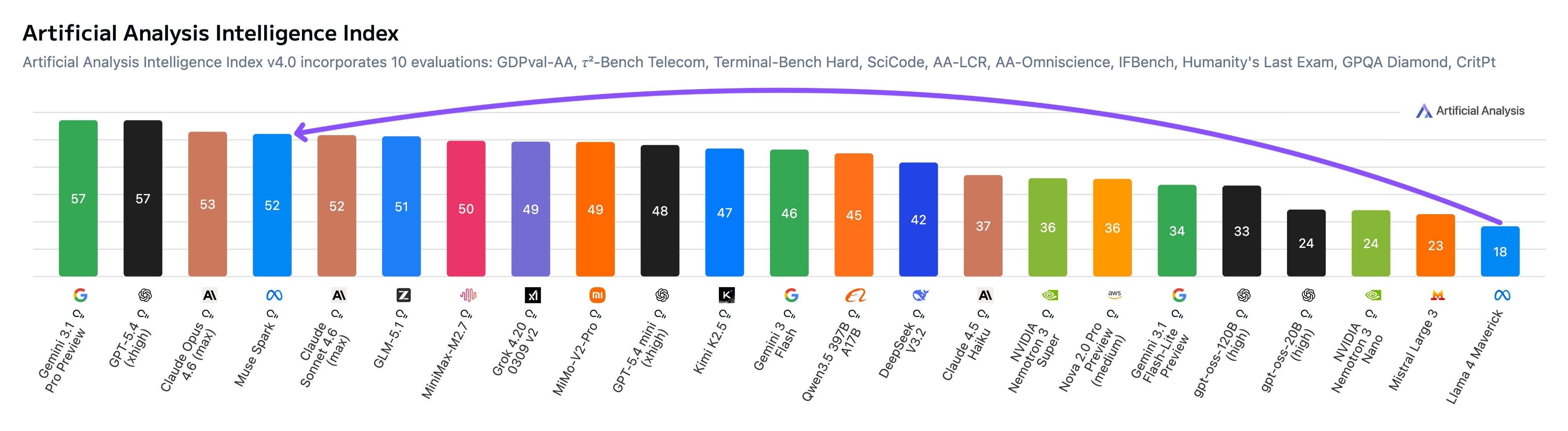
Meta's long-awaited next-generation model is here. Muse Spark is the first release from Meta Superintelligence Labs after the company reorganised its AI teams and moved on from the Llama family. The new model can reason across text and images, use tools, and run multiple agents side by side. Independent testing from Artificial Analysis ranks it in the top five models overall, with especially strong vision and reasoning results, though it falls short of Claude Opus 4.6 and GPT-5.4 on real-world tasks. It is also Meta's first closed model—a clear break from its open-weights tradition. Axios, however, reports that Meta might eventually offer some models via an open source licence. Muse Spark is available at meta.ai and the Meta AI app, with API access expected soon.
OpenAI’s Fidji Simo Is Taking Medical Leave Amid an Executive Shake-Up
OpenAI is facing a major leadership shake-up as Fidji Simo, who runs the company's product and applications side, is taking medical leave for several weeks, with Greg Brockman filling in. COO Brad Lightcap is shifting to a special projects role, and CMO Kate Rouch is also on health-related leave. The reshuffle comes at a critical time, as OpenAI is refocusing its attention on coding and enterprise customers while also pursuing a potential IPO this year.
OpenAI Pauses Stargate UK Data Center Citing Energy Costs
OpenAI has put its planned Stargate UK data centre project on hold, blaming high energy costs and regulatory uncertainty as it cuts spending before going public. The move is part of a wider pullback that has also seen the company cancel other projects, such as Sora video app. It's a blow to the UK government's hopes of making Britain a leading destination for AI investment, though OpenAI says it may revisit the plan when conditions improve.
OpenAI’s leadership reportedly disagrees about when to raise money and how to spend it
OpenAI's CEO Sam Altman and CFO Sarah Friar disagree on key company plans, according to The Information. Altman wants to take OpenAI public later this year and spend $600 billion on computing power by 2030, but Friar thinks the company isn't ready for an IPO and questions whether the massive spending is justified as revenue growth slows. The rift has reportedly led Altman to cut Friar out of some financial discussions.
Anthropic expands partnership with Google and Broadcom for multiple gigawatts of next-generation compute
Anthropic has signed a deal with Google and Broadcom for multiple gigawatts of next-generation TPU capacity, due to come online from 2027. The move is driven by rapid growth—the company's revenue has more than tripled to over $30 billion, and the number of big-spending business customers has doubled in just two months.
Meta commits another $21 billion to CoreWeave, bringing total AI cloud spend to $35 billion
CoreWeave has expanded its deal with Meta by $21 billion, bringing the total to around $35 billion for AI cloud services running through 2032. The new capacity is designed for running Meta’s AI models for billions of users rather than training them, and will feature early deployments of Nvidia’s next-generation chips.
Anthropic loses appeals court bid to temporarily block Pentagon blacklisting
A US appeals court has refused to lift the Pentagon's blacklisting of Anthropic, saying the military's need to control its AI supply chain outweighs the company's financial losses. Anthropic did win a separate ruling in San Francisco that lets it keep working with other government agencies, so the result is a split: shut out of defence contracts but still operating elsewhere. The court said the case should move quickly, and Anthropic said it's confident the blacklisting will ultimately be struck down.

Claude Managed Agents: get to production 10x faster
Anthropic has launched Claude Managed Agents, a platform that lets developers build and deploy AI agents in the cloud without worrying about the underlying infrastructure. It handles security, error recovery, and tool execution automatically, and supports agents that can run for hours or coordinate with other agents. Pricing is pay-as-you-go at standard token rates plus $0.08 per session-hour for active runtime. Additionally, Anthropic published a post on its engineering blog sharing more details on managed agents.
Anthropic just paid $400 million for a startup with fewer than 10 people
Anthropic has acquired Coefficient Bio, a stealth biotech AI startup with fewer than 10 employees, in an all-stock deal worth over $400 million—despite the company having no public product or revenue. The team, made up of former Genentech researchers skilled in drug discovery and protein design, will help Anthropic push Claude into the lucrative life sciences market.
Intel Partners With SpaceX, Tesla to Operate New Chip Plant
Elon Musk is partnering with Intel on his Terafab project that will produce custom chips for Tesla, SpaceX, and xAI. The chips will power Tesla's robotaxis and Optimus robot, as well as SpaceX's planned AI-capable satellites, with Musk arguing his companies' demand will soon outstrip what existing suppliers can provide.
Amazon’s chip business could be worth $50 billion, Jassy says, and he hints it may sell them externally
Amazon’s custom chip business is now bringing in over $20 billion a year and growing fast, according to CEO Andy Jassy’s 2026 shareholder letter. He uses this to justify the company’s massive $200 billion spending plan, arguing it’s backed by real customer deals rather than guesswork. Jassy also hints that Amazon may start selling its chips directly to other companies, which would put it in more direct competition with Nvidia.
Making Claude Cowork ready for enterprise
Anthropic has launched Claude Cowork on all paid plans for macOS and Windows. The company positions the tool as an AI assistant that can be used by non-engineering teams to handle everyday work tasks like drafting updates, running research, and preparing documents. The update adds admin tools for managing access, setting team budgets, and tracking usage across an organisation, among other things.
OpenAI looks to take on Anthropic with $100 per month ChatGPT Pro subscriptions
OpenAI has added a new $100-per-month plan with more access to Codex, its AI coding tool, as it competes with Anthropic's Claude Code for the lucrative coding market. The new tier slots between the $20 Plus plan and the existing $200 option, closely matching how Anthropic prices its own plans. So are we entering AI pricing wars now?
▶️ Garry’s List Audited (21:41)
In this video, Primeagen reviews Garry Tan’s vibe-coded website. A very poorly written site that downloads far too much data and violates many web development best practices. The whole video serves as a cautionary tale that, when vibe coding, you still need to know what good code looks like.
Qwen3.6-Plus: Towards Real World Agents
Alibaba has released Qwen3.6-Plus, a new AI model accessible via API with a one-million-token context window. According to the team’s own benchmarks, it rivals top models like Claude Opus 4.5 and GPT-5.2, particularly in coding tasks and multi-step problem solving. It also handles images and video, and can be plugged into popular coding tools like Claude Code. Smaller open-source versions are expected soon.
GLM-5.1: Towards Long-Horizon Tasks
Zhipu AI has released GLM-5.1, its latest flagship coding model, which narrowly edges out GPT-5.4 and Claude Opus 4.6 in SWE-Bench Pro benchmark. Its key differentiator is sustained long-horizon agentic work—rather than plateauing early, it continues improving over hundreds of iterations, achieving, according to Z.ai, a sixfold gain over previous best results in one optimisation benchmark. The model is open-source and available via Zhipu’s API and HuggingFace.
Alibaba Claims Viral Happy Horse AI Model in Latest Breakthrough
Alibaba has been unmasked as the maker of "Happy Horse," a video AI tool that shot to the top of a major global ranking on its debut, beating ByteDance's rival model. The tool is still in testing but will soon be opened up to outside developers. With OpenAI recently stepping back from video generation, Chinese companies are seizing the opportunity, and Alibaba is taking a big bet on it.
Copilot is ‘for entertainment purposes only,’ according to Microsoft’s terms of use
According to Microsoft's terms of use, Copilot is meant for "entertainment purposes only," and users are told not to rely on it for important advice. This makes things a bit awkward, as Copilot is central to Microsoft's AI strategy and the company pushes it as a serious tool for businesses. A spokesperson said this wording is outdated and will be changed soon. Other AI companies like OpenAI and xAI have similar disclaimers, suggesting a wider gap between how these tools are marketed and how they are legally covered.
Maine Is About to Become the First State to Ban Major New Data Centers
Maine is set to become the first US state to temporarily ban large data centres, pausing new permits until late 2027 so officials can study the impact on the state’s already strained and expensive power grid. The move comes as residents have pushed back against proposed sites over energy, water, and safety concerns. Similar restrictions are popping up across the country as AI-fuelled demand for data centres drives up electricity use, which could double by 2030. Maine’s decision could encourage other states to follow suit.
What do frontier AI companies’ job postings reveal about their plans?
In this post, Epoch AI looks at job listings from the leading AI labs to work out what they're prioritising. The biggest finding is a big shift toward sales and customer support roles, suggesting that getting businesses to actually use AI is still a real challenge. The postings also reveal quite different product directions across the labs—from hardware devices and robotics to a narrower focus on existing software—along with different approaches to securing key resources like chips and training data.
OpenAI’s $122B “VC Round” Is Vendor Deals, Contingent Capital, and a Guaranteed Return It Arguably Can’t Afford
This article takes a closer look at OpenAI's recent $122 billion funding round and finds out that the real picture is far messier than the headline. The three biggest backers—Amazon, Nvidia, and SoftBank—account for $110 billion, but much of that comes with conditions: Amazon's money is tied to an IPO or reaching AGI, Nvidia is providing computing power rather than cash, and SoftBank is paying in instalments. Only about $37 billion actually landed in OpenAI's bank account. In short, what looks like a massive investment is largely a web of commercial deals repackaged as a funding round.
▶️ What the Claude Code Leak Revealed (31:24)
Claude Code’s source code is now available on the internet (at least version 2.1.88, released on 31 March 2026) for anyone to explore and examine. This video walks through some of the findings in the code, including what data Anthropic tracks, the undercover mode, questionable code quality, and other interesting discoveries hidden within the source.

🤖 Robotics
What Amazon saw in Fauna Robotics’ humanoid strategy
Two weeks ago, Amazon acquired Fauna Robotics, a small startup working on humanoid robots. This article argues the deal is about buying development tools, not launching a consumer product. After Amazon’s previous struggles with consumer robots like Astro, the article suggests it is now investing in the groundwork to build a capable humanoid over time, starting by learning what the robot still can’t do.
Studying Human Attitudes Towards Robots Through Experience
RAI Institute ran an experiment in summer 2025, where it let thousands of people drive a Spot robot through obstacle courses and surveyed them before and after. The results showed that comfort with robots rose across every setting tested, particularly in homes and hospitals where unease had been highest. People also began reimagining robots less as industrial tools and more as companions and playmates. The findings suggest brief hands-on experience does far more to build public acceptance than passive exposure through videos or articles.
▶️ Innovation at Agility: Dancing Behind the Scenes (0:42)
After years of nothing but work, Agility has finally allowed Digit to relax and dance for a bit.
▶️ Humanoid Transforms Automotive Logistics (1:44)
Humanoid, a London-based humanoid robotics startup, shares in this video a proof-of-concept of how their robots can be used in automotive industry to improve efficiency and streamline operations.
▶️ China’s First Robotic Arm-Equipped Commercial Satellite Completes In-Orbit Refueling Test (0:57)
China's Yuxing 3-06 satellite, the first commercial experimental satellite fitted with a flexible robotic arm, has successfully completed in-orbit refuelling tests and proved that its core technologies work. The goal is for the satellite to act as a "space petrol station," refuelling other satellites, helping clear space junk, and carrying out other maintenance tasks while in orbit.
The Software-First Robotics Founder
Diego Prats identified an interesting trend in robotics—the rise of software-first robotics founders. They bring a new perspective to field and may transform how robots are designed and sold. At the same time, they learn the hard way that robotics has its own unique problems.
🧬 Biotechnology
Scientists Build Living Robots With Nervous Systems
Scientists have built tiny living robots, called "neurobots," from frog cells that include real nerve cells wiring themselves together into working circuits. Unlike earlier versions that moved mechanically, neurobots explore more actively and respond to their environment in more complex ways, suggesting a basic form of internal control. The team hopes to eventually build similar structures from human cells and train them for tasks like tissue repair or detecting pollution.
Training mRNA Language Models Across 25 Species for $165
OpenMed has built a free, open-source system that goes from a protein concept to lab-ready DNA by predicting a protein's 3D shape, designing amino acid sequences for it, and then optimising the DNA spelling for efficient production in living cells. Their main contribution is the DNA optimisation step, where a well-tuned RoBERTa model outperformed newer alternatives—and a simple training tweak, halving the learning rate, made the biggest difference to biological accuracy. The system works across 25 organisms using a single model, can transfer knowledge to data-scarce species, and cost just $165 in computing time to train.
💡Tangents
▶️ Silicon Valley’s Billion Dollar Design Scams (35:41)
Design Theory examines how Silicon Valley uses flashy storytelling and hype to raise huge sums of money for products that rarely work or solve real problems. The video argues that cheap money and broken incentives have built a system that rewards style over substance, enriching founders and investors while shortchanging everyone else.
US nuclear startup Antares gets DOE approval for its Mark-0 reactor demonstrator
Antares, a US nuclear startup, has cleared a key safety review for its small demonstration reactor and is on track to switch it on before 4 July 2026. This is part of a wider US government effort to get at least three advanced reactors running by that date, as the country pushes to expand nuclear power to 400 GW by 2050. Antares plans to test a more advanced version of its reactor next year and eventually supply clean energy for defence and space use from 2028.
Thanks for reading. If you enjoyed this post, please click the ❤️ button and share it!
Humanity Redefined sheds light on the bleeding edge of technology and how advancements in AI, robotics, and biotech can usher in abundance, expand humanity's horizons, and redefine what it means to be human.
A big thank you to my paid subscribers, to my Patrons: whmr, Florian, dux, Eric, Preppikoma and Andrew, and to everyone who supports my work on Ko-Fi. Thank you for the support!
My DMs are open to all subscribers. Feel free to drop me a message, share feedback, or just say "hi!"
Great issue. Thanks