


Hello and welcome to Sync #567!
Fresh from announcing Claude Mythos, Anthropic followed up by releasing Claude Opus 4.7. The new model looks better on paper, but users have been left disappointed. We’ll explore why in this week’s issue of Sync.
Elsewhere in AI, OpenAI released GPT-5.4-Cyber, GPT-Rosalind, and an updated Codex app to compete with Claude Code and Cowork, while its investors question its valuation and pivot towards enterprise. Meanwhile, Allbirds pivots to AI, Dwarkesh Patel makes Jensen Huang a bit annoyed, Anthropic explores emotions in AI models, and Mark Zuckerberg is reportedly building an AI clone of himself.
In robotics, Google released Gemini Robotics-ER 1.6 and partnered with Boston Dynamics; Unitree set a world record in sprinting and plans to sell humanoid robots on AliExpress; and Tesla is expanding its robotaxi service to Dallas and Houston.
In addition, this week’s issue of Sync features a story about a Norwegian man cured of HIV using his brother’s stem cells, Amazon launching a new platform for drug discovery, sleek home robots that resemble lamps, a startup attempting to turn chicken eggs into miniature drug factories, what studies say about how AI affects your brain, and more.
Enjoy!

Claude Opus 4.7—Better but also disappointing
Anthropic released Claude Opus 4.7 this week, calling it the most powerful generally available large language model in the world. That claim is technically true, if barely. But a vocal share of Anthropic's paying user base thinks the release is more like a downgrade than an upgrade—and the way Anthropic packaged it raises questions about whether the company's compute can keep up with its ambitions.
Benchmark results look good…
On Anthropic’s own scorecard, Opus 4.7 is an improvement over its predecessor, Opus 4.6. The standout gains are in coding and agentic tool use: SWE-bench Verified jumped from 80.8% to 87.6%, and the new MCP-Atlas tool-use benchmark hit 77.3%, up from 62.7%. Vision got a meaningful upgrade too, with maximum image resolution roughly tripling.
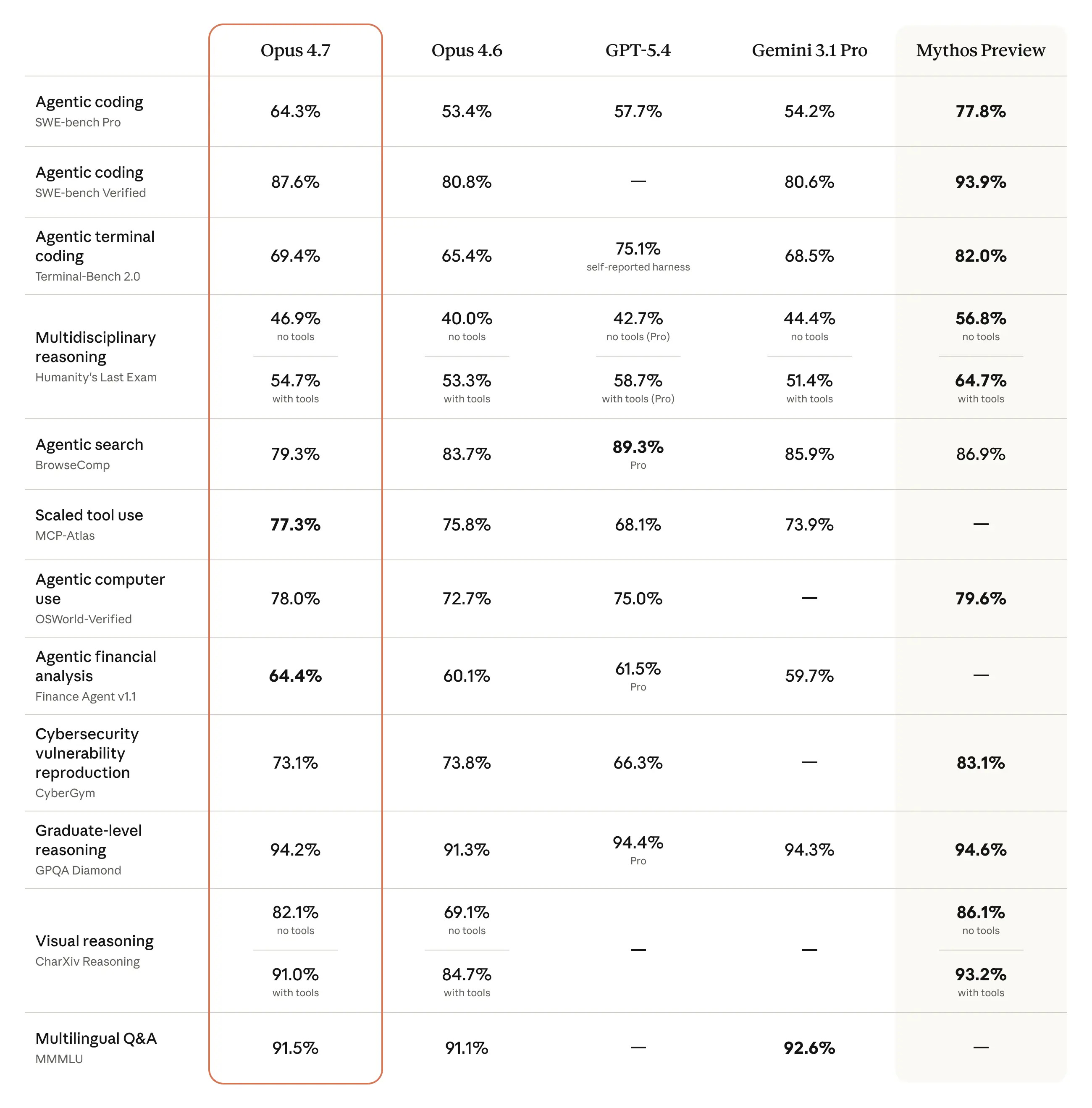
But zoom out, and the picture gets more complicated. Against GPT-5.4, the lead is 7–4 across directly comparable benchmarks. GPT-5.4 still dominates agentic search and tool-augmented reasoning. Gemini 3.1 Pro leads on multilingual tasks at roughly 2.5 times lower price. And that vision upgrade mentioned earlier is real—until you put Opus 4.7 next to Gemini 3 Flash, which outperformed it on comprehensive OCR testing at more than ten times lower cost. On BrowseComp, Opus 4.7 actually regressed—dropping 4.7 points below Opus 4.6.
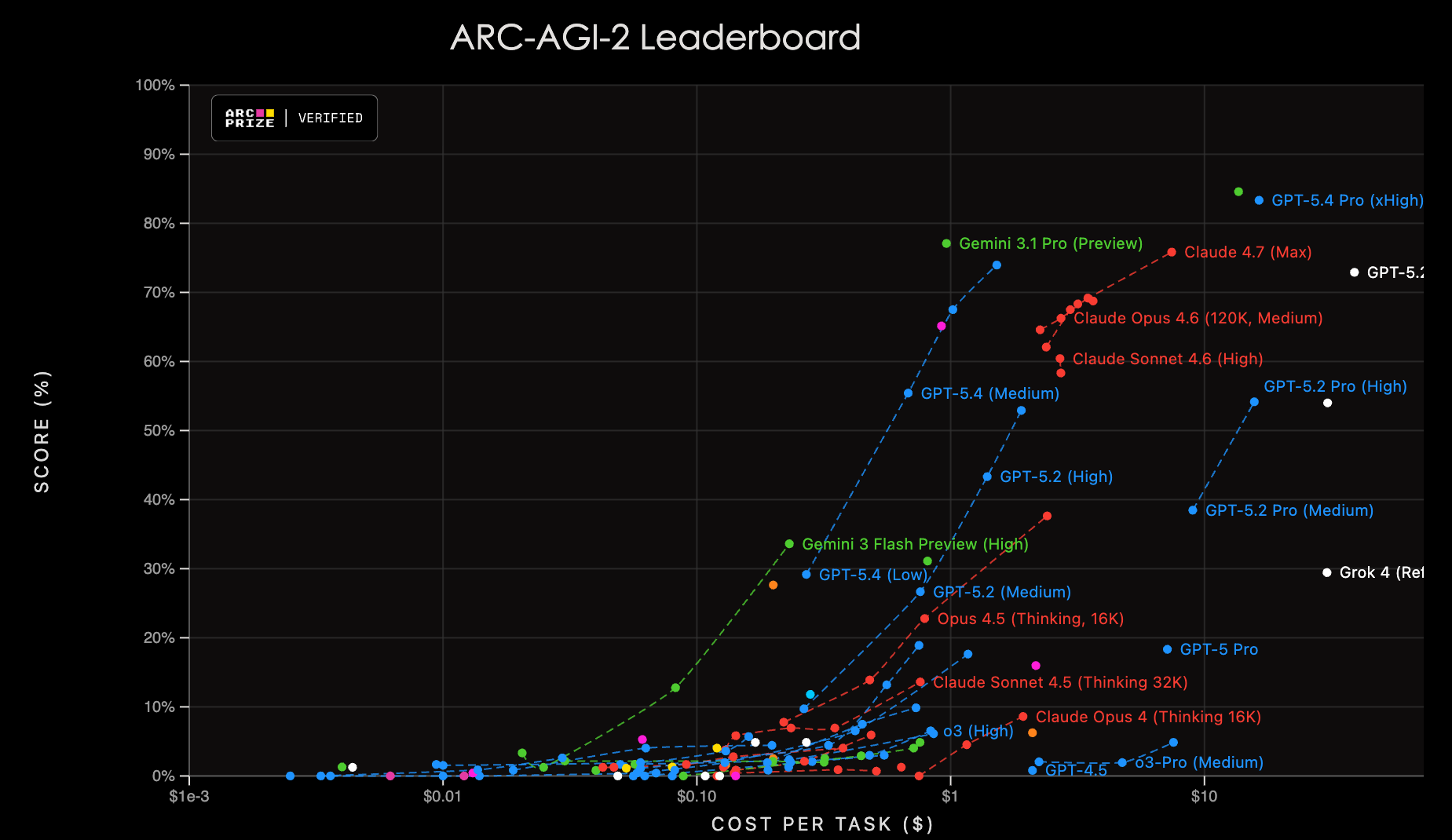
On ARC-AGI-2, Opus 4.7 scored a respectable 75.8%, ahead of Gemini 3.1 Pro (74%) but behind Gemini 3 Deep Think (84.6%) and GPT-5.4 Pro at maximum effort (83.3%). The cost adds a new dimension to these results—Opus 4.7 spent $7.43 per task, roughly half of GPT-5.4 Pro's $16.41 but nearly five times what Gemini 3.1 Pro needed to achieve a comparable score at $1.52.
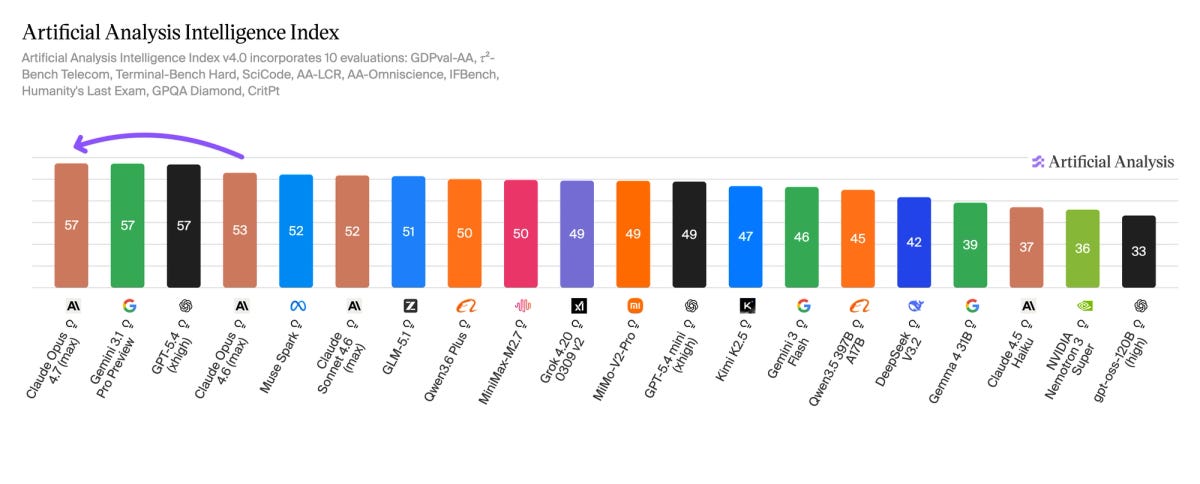
Artificial Analysis independent tests found that Opus 4.7 scores 57 on their Intelligence Index, tying with GPT-5.4 and Gemini 3.1 Pro in what they called “the greatest tie in Artificial Analysis history.”
…but users aren’t buying it
On paper, Claude Opus 4.7 looks like a strong model and an upgrade over its predecessor. But the people actually using it disagree.
The loudest complaint is adaptive thinking, the new system that lets the model decide how hard to think about your request. There is no manual override. Ethan Mollick’s widely shared critique captured the problem: the router regularly classifies non-code, non-maths tasks as “low effort” and produces worse results. For creative and analytical work—the kind many Pro and Max subscribers actually pay for—the model now thinks less, not more.
Then there is the stealth price increase. Opus 4.7 uses a new tokeniser that consumes up to 35% more tokens on identical text. Although the pricing has not changed ($5/$25 per million input/output tokens), the effective cost rose for many workloads. Some Claude Pro users reportedly hit usage caps after roughly three questions at launch.
Developers also flagged over-cautious safety refusals, with Opus 4.7 refusing to process benign HTML and JavaScript because it mistook the work for security exploits. The refusals are a side effect of new real-time cybersecurity safeguards baked into the model. It is a deliberate feature, but one whose calibration clearly needs work. Anthropic says some of the worst false positives have since been patched.
A compute ceiling?
There are signs that Anthropic’s infrastructure is struggling to keep up with its own success. Claude Code crossed $2.5 billion in annualised revenue in February 2026, and user growth has been explosive. But explosive growth on finite compute creates uncomfortable trade-offs.
Adaptive thinking—the feature users are most frustrated with—looks suspiciously like one of those trade-offs. You can encourage Opus 4.7 to think harder, but you cannot force it. Default effort levels on Claude Code were quietly set to medium during the Opus 4.6 era, a decision Anthropic did not announce at the time. AMD’s Senior Director of AI, Stella Laurenzo, filed a detailed GitHub issue analysing 6,852 Claude Code sessions on Opus 4.6 and showing that median thinking depth had dropped by roughly two-thirds—a pre-existing trend that fed directly into the 4.7 backlash. Sam Altman seized the moment, subtweeting about how happy he was that developers were switching to Codex.
A leaked OpenAI memo from Chief Revenue Officer Denise Dresser went further, claiming Anthropic had made a “strategic misstep” by not acquiring enough compute and predicting it would show up in the product through throttling and weaker reliability.
Whether or not that assessment is fair, the circumstantial evidence is hard to ignore. Mandatory adaptive thinking, a tokeniser that inflates costs, reduced rate limits, and multiple outages in March all point in the same direction—a company whose demand has outgrown its capacity to serve it.
A reasonable upgrade, badly wrapped
Opus 4.7 is starting to look like Anthropic’s GPT-5 moment. OpenAI’s flagship launched last year to similar fanfare and similar deflation—strong on benchmarks, underwhelming in the hand. The frontier is crowded enough now that incremental gains no longer justify the hype cycle, and shipping your second-best model while pointing at something better behind a locked door does not help.
To be fair, this is a 0.1 update. Nobody should expect a breakthrough from 4.6 to 4.7, and a modest bump in performance is exactly what arrived. The main problem is the packaging Opus 4.7 arrived with—mandatory adaptive thinking, a tokeniser that quietly inflates costs, silent changes to default settings—that soured the release. Paying users got a model that is better on paper, worse in practice, and haunted by the promise of something greater just out of reach. In a market where three labs are effectively tied, that is a dangerous place to leave your most vocal customers.

If you enjoy this post, please click the ❤️ button and share it.
🧠 Artificial Intelligence
OpenAI’s $852 billion valuation is under scrutiny from its own investors as the company pivots to enterprise
According to a Financial Times report, some of OpenAI’s own investors are worried about the company’s direction, pointing to repeated strategy changes and a lack of focus as it chases a potential IPO. One backer even called the company “the Netscape of AI.” The tension has been heightened by rival Anthropic’s fast-growing revenue, which OpenAI’s new sales chief has publicly challenged, accusing Anthropic of inflating its figures through different accounting methods. OpenAI’s leadership has pushed back, citing its record $122 billion fundraise and rapid enterprise growth as proof that investor confidence remains strong.
OpenAI launches GPT-Rosalind, a specialised AI model for drug discovery and life sciences research
GPT-Rosalind is a new AI model from OpenAI built specifically for life sciences research, covering areas like genomics and protein engineering. It helps scientists speed up early-stage drug discovery by pulling together evidence, suggesting experiments, and connecting to dozens of specialist databases. In testing, it outperformed most human experts on key biology tasks. Access is currently limited to vetted US companies like Amgen and Moderna, owing to concerns about potential misuse in designing dangerous biological agents.
OpenAI has significantly expanded its Codex app, moving it beyond coding into a broader desktop agent. Codex can now control apps on your Mac in the background, browse the web, generate images, connect to over 90 workplace plugins, and remember your preferences across sessions. It can also schedule future tasks for itself and pick them up days later. The update is a direct response to Anthropic's popular Claude Code and Cowork apps, which already offer similar capabilities.
Like Anthropic, OpenAI Will Share Latest Technology Only With Trusted Companies
OpenAI is following Anthropic’s example and will restrict access to its new AI model, GPT-5.4-Cyber, which can find security flaws in software. Like Anthropic's Claude Mythos, OpenAI will share its tool with a smaller group of trusted partners first—hundreds initially, expanding to thousands—hoping to give defenders a head start over attackers. Not everyone agrees with this approach, with some experts warning it could leave smaller organisations unable to protect themselves.
Introducing Claude Design by Anthropic Labs
Anthropic has launched Claude Design, a tool that lets users work with Claude to create prototypes, presentations, marketing pages, and other visual work through conversation. Powered by Claude Opus 4.7, it can automatically apply a team's brand and design system, and finished designs can be handed off to Claude Code for development. The tool is available in research preview for Claude Pro, Max, Team, and Enterprise subscribers. Claude Design comes shortly after Google expanded its own AI design tool, Stitch.
Allbirds Is Pivoting to AI Compute. Sure, Why Not
This would have been a cool April Fool’s joke, but it is true. Allbirds, known for its minimalist wool sneakers, is pivoting to AI. After its valuation cratered from $4 billion to a $39 million IP sale, the remnants of the company are rebranding as "NewBird AI" and using $50 million in convertible financing to buy GPUs and offer cloud compute services—a move that sent its stock up 400%. While Allbirds isn't the first firm to chase the AI infrastructure gold rush (bitcoin miners and even Boom Supersonic have made similar plays), it may be the starkest example yet of the current frenzy, given that its only apparent asset is capital rather than any technical expertise. As the article notes, startups used to make things; now they buy processors.
OpenAI touts Amazon alliance in memo, says Microsoft has ‘limited our ability’ to reach clients
In a leaked memo, OpenAI's revenue chief Denise Dresser told staff that their new Amazon partnership is driving strong enterprise demand, since many customers already use AWS and couldn't easily access OpenAI through its existing Microsoft deal alone. She took aim at rival Anthropic, whose Claude model currently dominates enterprise AI, claiming its reported revenue figures are inflated and that it hasn't secured enough computing power to keep up.
CoreWeave, Anthropic Form AI Cloud Agreement
CoreWeave has announced a new partnership with Anthropic to provide computing power to run Anthropic's Claude AI models, adding another major AI company to its customer list. The deal arrives as CoreWeave raises billions in debt to build the data centres needed to support huge contracts with Meta and OpenAI. Despite its rapid growth, some investors worry the company is borrowing too much and relies on too few big customers.
Meta Partners With Broadcom to Co-Develop Custom AI Silicon
Meta is teaming up with Broadcom to build MTIA, Meta’s custom AI chips, with four new versions planned over the next two years. The deal covers chip design, packaging, and networking, starting with over one gigawatt of computing power and scaling up from there. Broadcom's CEO Hock Tan is stepping down from Meta's board to become an adviser on the project.
OpenAI has bought AI personal finance startup Hiro
OpenAI has bought Hiro Finance, a small AI-powered money planning app, mainly to bring on its team of about ten people. Hiro will shut down and delete all user data by mid-May. The deal fits OpenAI’s growing push into finance, though it’s unclear whether it plans to launch its own financial planning product.
AI chip startup Cerebras files for IPO
Cerebras, an AI chip company competing with Nvidia, is planning to go public in mid-May. Valued at $23 billion, the company has landed big deals with Amazon and OpenAI and brought in $510 million in revenue last year. A previous attempt to list in 2024 fell through due to a government review of a foreign investment.
Dwarkesh Patel sits down with Jensen Huang to discuss how Nvidia works, the AI supply chain, and why Huang is not concerned about TPUs or Trainium chips. One of the main topics is also whether US companies should sell advanced chips to China, with Huang arguing that such chip restrictions are a bad idea. It is an interesting conversation worth listening to in full. Dwarkesh is pushing on Huang’s arguments, which, at some point, makes Huang a bit angry.
What the Studies Say About How AI Affects Your Brain: A (Very Big) Compilation
Alberto Romero compiled over 30 research papers to answer the question of how AI tools affect the human brain. These papers examine the impact of AI tools on brain activity, learning, and psychological and emotional well-being, among other areas. The conclusion is that, while these tools can make people more productive, they also reliably degrade the cognitive processes that support durable knowledge, independent reasoning, and creative diversity over time. As Alberto notes, resolving this paradox will require not better models, but better ways of using this technology.
Anthropic Plots Major London Expansion
Anthropic is moving to a much bigger London office with room for 800 staff, four times its current headcount, as it competes with rival AI labs to attract British and European talent. The expansion follows reports that the UK government courted the company after it clashed with the US administration over refusing to allow its models to be used for surveillance and weapons. Anthropic is also deepening ties with the UK’s AI Safety Institute and has given the government early access to its newest model, Claude Mythos Preview.
Sam Altman’s house targeted in second attack; two suspects arrested
Sam Altman's San Francisco home was attacked twice in one weekend. On Friday, a man threw a Molotov cocktail at the property, and on Sunday, two people allegedly fired a gun at it from a car. All three suspects were arrested, and no one was hurt. Altman said afterwards that people's fear about AI is understandable, calling it one of the biggest changes society has ever faced.
Gemini 3.1 Flash TTS: the next generation of expressive AI speech
Gemini 3.1 Flash TTS is Google's new text-to-speech model, now available in preview for developers and businesses. It produces more natural-sounding speech across over 70 languages and introduces "audio tags"—simple text commands that let creators control things like tone, pace, and accent. All generated audio is watermarked with SynthID to help identify AI-made content.
Mark Zuckerberg is reportedly building an AI clone to replace him in meetings
Meta is building an AI version of Mark Zuckerberg that can talk to employees on his behalf, according to the Financial Times. The clone is being trained on his voice, appearance, and speaking style. If it works well, Meta may let creators build similar AI versions of themselves. Zuckerberg is also separately working on a personal AI assistant and spending several hours a week coding on Meta's AI projects.
Emotion Concepts and their Function
Do AI models have emotions? This is the question that researchers at Anthropic try to answer in this paper. By looking inside Claude Sonnet 4.5, they found 171 internal patterns tied to emotion-like states such as happiness, fear, and calm. These patterns aren't just superficial—they actively shape how the model behaves, with states like desperation making it far more likely to cut corners or act deceptively, while calm has the opposite effect. The researchers stress this doesn't mean the model actually feels anything, but argue that tracking these internal states could be key to making AI systems safer.
🤖 Robotics
You Can Soon Buy a $4,370 Humanoid Robot on AliExpress
Unitree is about to sell its R1 humanoid robot on AliExpress for around $4,370, far cheaper than rival robots. The robot can do acrobatics and respond to voice commands, but it lacks proper hands, so it's more of a research tool than a household helper. Selling a humanoid robot on a mainstream shopping site is a notable step toward making the technology feel ordinary and accessible.
Gemini Robotics-ER 1.6: Powering real-world robotics tasks through enhanced embodied reasoning
Gemini Robotics-ER 1.6 is the latest in Google DeepMind's line of AI models designed specifically for robots, helping them better understand and interact with the physical world. The model improves on its predecessors in spatial tasks like object detection, counting, and determining whether a task has been completed. Its standout feature, developed with Boston Dynamics, lets robots read instruments like pressure gauges and thermometers with 93% accuracy—a big leap from the previous version's 23%. The model is also better at recognising physical hazards and respecting safety constraints, such as avoiding objects that are too heavy to grip. It is available now through the Gemini API and Google AI Studio.
Boston Dynamics and Google DeepMind Teach Spot to Reason
Boston Dynamics has added Google DeepMind’s latest model for robotics—Gemini Robotics-ER 1.6—to its Spot robot, making it smarter at carrying out inspections in industrial settings and doing things like reading gauges and spotting hazards on its own. The AI still relies entirely on cameras rather than touch, and can sometimes lack common-sense knowledge, like knowing to hold a can upright. Boston Dynamics manages this by testing new features carefully and aiming for at least 80 per cent accuracy to keep human operators on side. Long-term, lessons from Spot could help make future robots more capable and reliable in everyday tasks.
Tesla brings its robotaxi service to Dallas and Houston
Tesla is now running its self-driving taxi service in Dallas and Houston, adding to its existing operation in Austin. The cars have no human driver or monitor inside. The rollout is small so far, with only one car spotted in each new city versus 46 in Austin.
▶️ Unitree Breaks the World Record Again (0:30)
Unitree has built a humanoid robot capable of running at a speed of 10 m/s, setting a new world record for humanoid robots. For comparison, an average untrained human sprints at 6-7 m/s, while Usain Bolt’s peak speed during his 9.58-second world record was approximately 12.4 m/s.
AMD, Arm, and Qualcomm invest $60M in Wayve, completing the silicon side of its autonomous driving stack
Wayve, a London autonomous driving startup, has raised another $60 million from chip companies AMD, Arm, and Qualcomm, pushing its latest funding round to $1.2 billion at an $8.6 billion valuation. These investors matter because, alongside existing backer NVIDIA, they cover nearly all the computing hardware used in modern cars—making it easier for carmakers to adopt Wayve's software without being locked into one chip supplier.
AGIBOT deploys semi-humanoid robots in electronics manufacturing
AGIBOT, a Chinese robotics company specialising in general-purpose humanoid robots, has begun deploying its G2 robots on Longcheer Technology's tablet assembly lines. The robots handle tasks like loading devices into testing stations and sorting finished products, achieving over 99% success rates and running around the clock with little human help. Longcheer plans to scale to 100 robots by Q3 2026, with AGIBOT eyeing expansion into car manufacturing, semiconductors, and energy.
▶️ Introducing Lume by Syncere (1:50)
Instead of a humanoid robot or a variation of a Roomba-like robot, Syncere imagines home robots as sleek machines that look like lamps. Each robot is essentially a single arm, and two can work together to complete tasks such as folding clothes or cleaning the home. When not in use, they can also function as lamps and serve as a modern piece of home décor.
▶️ Why Robots Still Can’t Handle the Real World (37:10)
In this podcast interview, Zachary Jacowski, who leads Boston Dynamics’ Atlas humanoid robot programme, recounts his experiences at the company through its transitions from independence to Google, SoftBank, and now Hyundai. He discusses engineering lessons from building many robots, the importance of safety in design, why generality matters more than specialisation, and the role of diverse real-world data in training smarter robots. Jacowski also explains why Boston Dynamics is targeting factories first, as they offer structured environments with trained workers, while homes will need lighter, safer robots that are still some way off.
🧬 Biotechnology
Big Pharma Is Turning to China for the Newest Drug Ideas
China has transformed from a generic-drug producer into a biotech powerhouse, now behind 30% of the world’s experimental medicines. Western firms spent billions last year licensing promising Chinese-developed treatments, attracted by faster development and lower costs—largely thanks to heavy government investment and quicker regulatory approvals. The shift has worried US lawmakers, who fear losing jobs and becoming too reliant on the Chinese drug supply.
Amazon Bio Discovery
Amazon has launched Bio Discovery, a platform that gives scientists access to over 40 AI models designed to generate and evaluate potential drug molecules, particularly antibodies. The platform connects computational design directly to lab partners who can synthesise and test the best candidates, with results feeding back to improve future predictions. In an early trial with Memorial Sloan Kettering Cancer Centre, a process that normally takes up to a year was completed in weeks.
Norwegian Man Cured of HIV by His Brother’s Stem Cells
A Norwegian man appears to have been cured of HIV after a bone marrow transplant from his brother, which was originally meant to treat a dangerous blood condition. By chance, his brother’s cells carried a rare genetic trait that blocks HIV from infecting the body. Four years on, doctors can find no trace of the virus anywhere, even in spots where it typically hides. The procedure is too risky for widespread use, but cases like this help scientists understand how the virus might one day be beaten for good.
Explaining 4.2 million genetic variants with state-of-the-art, interpretable predictions
Goodfire and Mayo Clinic have built an AI system that predicts whether genetic variants cause disease and explains how, achieving near-perfect accuracy across the genome. They've released free predictions for all 4.2 million variants in a major genetic database, including around two million whose effects were previously unknown. These are computational predictions rather than diagnoses, but could help clinicians make better-informed decisions about genetic conditions.
From Colossal to Chickens: The Scientists Behind Neion Bio’s Biologics Platform
Neion Bio is a start-up trying to turn chicken eggs into miniature drug factories by genetically engineering hens to produce therapeutic proteins in their egg whites, potentially offering a cheaper, simpler alternative to conventional drug manufacturing. Its team includes scientists who previously worked on Colossal Biosciences' high-profile de-extinction projects, and there is already a precedent—one FDA-approved drug, Kanuma, was made in chickens back in 2015.
💡Tangents
Amazon to Buy Satellite Company Globalstar for $11.6 Billion
Amazon has agreed to acquire satellite operator Globalstar for roughly $11.6 billion. The deal aims to close the gap with SpaceX's Starlink, which has pulled ahead while Amazon's own satellite network has faced launch delays. It also brings Apple on board as a customer, with its iPhone emergency messaging service moving to Amazon's network. From 2028, Amazon plans to enter the growing direct-to-smartphone satellite market, competing head-to-head with SpaceX and AST SpaceMobile.
Silicon Valley Is Spending Millions to Stop One of Its Own
Silicon Valley has a new enemy. His name is Alex Bores, who is running for Congress in New York after helping pass one of the toughest AI safety laws in the country. A former Palantir employee who quit over the company’s work with ICE, Bores now wants stricter rules for big AI firms, and some of tech’s wealthiest figures, including OpenAI’s Greg Brockman, are spending millions to stop him. In this WIRED interview, Bores pushes back on claims that regulation kills innovation, argues that safety research has actually driven major AI breakthroughs, and lays out plans covering everything from child safety to deepfakes and job losses.
Apple AI Glasses Will Rival Meta’s With Several Styles, Oval Cameras
Mark Gurman reveals that Apple is building smart glasses without a screen, codenamed N50, expected to launch in 2027. Like Meta's Ray-Bans, they'll take photos and videos, play music, handle calls, and work with Siri. Apple plans to stand out with sleeker designs, better materials, and deep iPhone integration. The glasses are part of a wider push into AI wearables that also includes upgraded AirPods and a camera pendant.
Amazon-backed X-energy files to raise up to $800M in IPO
X-energy, a nuclear startup backed by Amazon, is preparing to go public with an IPO that could raise up to $814 million. The company is building small modular reactors to meet surging electricity demand from AI data centres, and Amazon has committed to buying up to 5 gigawatts of its power by 2039. However, no startup in this space has built a working plant yet, costs remain uncertain, and X-energy faces an ongoing patent dispute, so investors carry significant risk alongside the promise.
Thanks for reading. If you enjoyed this post, please click the ❤️ button and share it!
Humanity Redefined sheds light on the bleeding edge of technology and how advancements in AI, robotics, and biotech can usher in abundance, expand humanity's horizons, and redefine what it means to be human.
A big thank you to my paid subscribers, to my Patrons: whmr, Florian, dux, Eric, Preppikoma and Andrew, and to everyone who supports my work on Ko-Fi. Thank you for the support!
My DMs are open to all subscribers. Feel free to drop me a message, share feedback, or just say "hi!"