


Hello and welcome to Sync #569!
This week, we unpack the new deal between OpenAI and Microsoft, which turns out to have less to do with Microsoft and more with another major player on the AI stage.
Elsewhere in AI, OpenAI has reportedly missed both key revenue and user growth targets. Meanwhile, Anthropic could raise a new $50 billion round at a $900 billion valuation, China blocks Meta’s $2 billion acquisition of Manus, and Google expands the Pentagon’s access to its AI. We’ve also had the first hearing in the Elon Musk v. OpenAI court case, which has already revealed some interesting stories.
Over in robotics, Figure presents its factory, which aims to build one robot per hour; Waymo is coming to Portland; Meta buys a humanoid robotics startup; and Japan’s Haneda Airport is trialling humanoid robots.
In addition, this week’s issue of Sync features Mark Zuckerberg and Priscilla Chan investing $500 million into the Virtual Biology Initiative, the rise of vibe genomics, a new open model for designing proteins, the race to build the world’s most in-demand machine, and more!
Enjoy!

OpenAI's new deal with Microsoft isn't about Microsoft
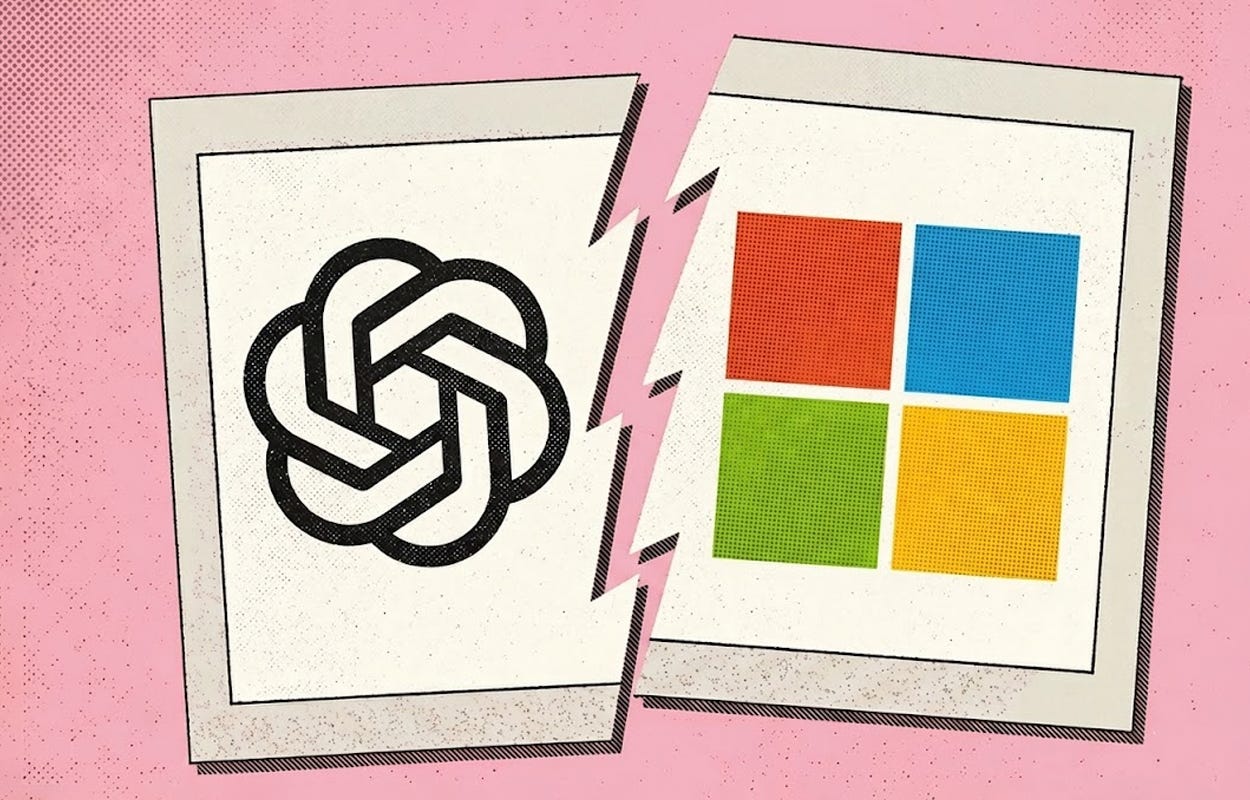
On Monday, April 27, OpenAI and Microsoft announced an amended partnership agreement. A day later, OpenAI’s models went live on AWS Bedrock. The 24-hour gap tells you what the amendment really is—the formal end of the relationship that built the modern AI revolution.
For years, Microsoft has poured billions of dollars and resources into turning a nonprofit research lab into the $852 billion company we know today. In return, Microsoft got exclusivity, a 27% stake, and the right to be the only cloud OpenAI ran on. That arrangement is over. The full story of OpenAI and Microsoft's partnership deserves its own deep dive, and I'll come back to it in another article. What matters today is what replaces the old deal—and the answer has less to do with Microsoft and more to do with Anthropic.
The AGI clause is dead
The amendment itself is short. Microsoft’s IP licence to OpenAI’s models and products, previously exclusive, becomes non-exclusive through 2032. Microsoft no longer pays revenue share to OpenAI. OpenAI continues a capped revenue share to Microsoft through 2030. Microsoft remains OpenAI’s “primary” cloud partner, and OpenAI products still ship first on Azure—unless Microsoft cannot or chooses not to support them, in which case OpenAI is free to go elsewhere. Microsoft keeps its 27% equity stake.
The new deal between OpenAI and Microsoft changes the dynamics between the two companies and effectively kills the AGI clause. The 2023 agreement included a board-triggered termination switch, which, if triggered, would end Microsoft’s commercial rights the moment OpenAI’s board declared the company had achieved AGI. That clause was the single most distinctive feature of the partnership, the mechanism designed to rebalance power if the technology actually arrived. It survived the October 2025 recapitalisation in weakened form, requiring verification by an independent expert panel. The April 2026 amendment retired it entirely.
Nadella plans to “exploit” the new deal
One might read this new arrangement as evidence that Microsoft lost. No more exclusivity, no more lock-in, no more being the only cloud OpenAI's customers could buy on. Satya Nadella, however, begs to differ. Asked directly on an earnings call how the new deal would affect Microsoft's financials, he pointed to royalty-free access to OpenAI's models through 2032 and said: "We have a frontier model, with all the IP rights that we will have access to all the way to '32 and we fully plan to exploit it."
Nadella can bring numbers to back that framing. Microsoft's AI business has crossed a $37 billion annual run rate, up 123% year-over-year. OpenAI has committed to purchasing $250 billion of Azure services. Microsoft holds 27% of OpenAI's equity and now collects revenue share without paying any back. And Nadella made a point of mentioning that enterprises increasingly want to mix and match, saying that over 10,000 Microsoft customers have used more than one model. OpenAI has outgrown Microsoft, and Nadella knew exclusivity would eventually expire. What Microsoft has locked in is more durable than what it gave up.
What the deal unlocks for OpenAI
The AWS Bedrock launch is the proof of what OpenAI was actually after. Enterprise revenue now makes up roughly 40% of OpenAI’s business and is on track to reach parity with consumer by year-end. A meaningful share of that enterprise market lives on AWS, and until Tuesday, those customers couldn’t run OpenAI’s frontier models natively on the cloud they already used. They can now.
The April 13 memo from OpenAI's revenue chief Denise Dresser, reported by CNBC, said the quiet part out loud. The Microsoft partnership had been "foundational" but had also "limited our [OpenAI's] ability to meet enterprises where they are—for many that's Bedrock."
But why would OpenAI want to be on AWS? Because that is where the enterprise money is, and right now Anthropic is the one collecting it. Claude has become the enterprise leader OpenAI is trying to catch. Anthropic's run-rate revenue passed $30 billion earlier this year and is reportedly closing on $40 billion now, up from roughly $9 billion at the end of 2025. Claude Code alone crossed $2.5 billion in annualised revenue in February. The cloud powering most of that growth is AWS, where Bedrock has offered Claude as a first-class option for over a year. OpenAI couldn't keep ceding that ground while it was contractually pinned to Azure. The only way forward was to leave Microsoft’s cloud.
There is also another reason for OpenAI to be on AWS. The Wall Street Journal reported that the company has missed both key revenue and user-growth targets ahead of its planned IPO, sending shares of partners like Nvidia, Oracle, and SoftBank sliding. Breaking the cloud lock isn't just a long-term competitive move. It became a necessary step to unlock a new pool of potentially lucrative enterprise customers.
The amendment isn't really about Microsoft. It's about Anthropic, and the only way to compete was to break free from Azure. The partnership that built modern AI is over. What replaces it is something narrower, more transactional, and almost certainly more honest—a working alliance between two of the world’s most valuable companies that no longer needs to pretend it is anything more than that.

If you enjoy this post, please click the ❤️ button and share it.
🦾 More than a human
Longevity Science Is Overhyped. But This Research Really Could Change Humanity.
This article explores "natural rejuvenation," the cellular process by which embryos shed inherited age markers, and the growing scientific effort to harness it for treating disease and extending human life. Building on Shinya Yamanaka's Nobel-winning gene discovery and Juan Carlos Izpisua Belmonte's 2016 success rejuvenating mice, billions in Silicon Valley funding now back ventures like Altos Labs and David Sinclair's Life Biosciences, which began the first human trial in March targeting glaucoma. Researchers are divided over how far the science can safely go, with cancer risks and overhyped claims threatening the field's credibility.
Could humans regrow limbs like salamanders?
Scientists have shown that mammals can partially regrow lost bone, joint, and tissue by applying two protein treatments that steer the body's healing cells away from scarring and toward rebuilding. The regrown structures weren't perfect, but the key finding is that the ability to regenerate isn't missing in mammals—it's just switched off. Since both proteins are already used or being tested in medicine, this could lead to better wound healing in humans relatively soon.
🧠 Artificial Intelligence
OpenAI Misses Key Revenue, User Targets in High-Stakes Sprint Toward IPO
The Wall Street Journal reports that OpenAI has missed its targets for new users and revenue, raising worries about whether it can afford the $600 billion it has committed to future data centres. CFO Sarah Friar is reportedly pushing for tighter spending while CEO Sam Altman wants to keep expanding aggressively ahead of a possible IPO this year, though both deny any disagreement. ChatGPT is losing ground to Google's Gemini and Anthropic, and the news sent shares in OpenAI partners like Nvidia, Oracle and SoftBank sliding. The story raises a bigger question about whether the AI industry's huge spending is getting ahead of actual demand.
Anthropic could raise a new $50B round at a valuation of $900B
Anthropic is reportedly in talks to raise $40–50 billion at a valuation of around $850–900 billion, likely its final private round before going public. That would more than double its February valuation and put it at the same level as OpenAI. The surge is driven by rapid revenue growth, from about $9 billion at the end of 2025 to nearly $40 billion now, mostly thanks to Claude Code and Cowork. Investor demand is so strong that some are struggling to even get a meeting.
Musk v. Altman week 1: Elon Musk says he was duped, warns AI could kill us all, and admits that xAI distills OpenAI’s models
The highly anticipated trial between Elon Musk and OpenAI began this week, with Musk being the first to testify. He said that Sam Altman and Greg Brockman deceived him into funding OpenAI as a nonprofit before pivoting to a for-profit structure, and he is asking the court to remove them and unwind the restructuring. OpenAI's lawyers argued Musk is really trying to undermine a competitor to his own xAI, citing emails about poaching staff and his admission that xAI "partly" distils OpenAI's models to train Grok. Next week, UC Berkeley computer scientist Stuart Russell will testify, and Brockman is also due to take the stand.
China blocks Meta’s $2 billion takeover of AI startup Manus
China has ordered Meta to unwind its $2 billion purchase of Manus, a Singapore-based AI agent startup with Chinese origins, citing foreign investment regulations. The block targets a growing trend of Chinese firms relocating abroad to dodge oversight from both Beijing and Washington. Manus had quickly grown to $100 million in annual revenue after launching its AI agent.

Google expands Pentagon’s access to its AI after Anthropic’s refusal
Google becomes the next company, after OpenAI and xAI, to give the US Department of Defense access to its AI on classified networks with almost no limits on use. Anthropic refused similar terms because it wanted rules against mass surveillance and autonomous weapons, and the Pentagon retaliated by labelling it a supply-chain risk, which Anthropic is now fighting in court. Google’s deal reportedly includes some language against those uses, but it may not be legally binding. Nearly a thousand Google employees have signed a letter urging the company to take Anthropic’s position instead.
Anthropic’s Mythos is moving between governments faster than regulators can agree on what to do with it
Anthropic's cybersecurity model Mythos has found itself pulled in several directions at once, with different arms of the US government, each wanting something different from it. The Trump White House this week blocked Anthropic from widening civilian access, even as it drafted plans to get the model into more federal agencies—despite the Pentagon having tried to freeze the company out earlier this year.

Google to sell TPU chips to ‘select’ customers in latest shot at Nvidia
Alphabet announced during its Q1 earnings call that it will start selling TPUs, its custom AI chips, directly to customers for use in their own data centres—a shift from only renting them out through Google Cloud. The move follows big new deals with Anthropic and Meta, and steps up the pressure on Nvidia, which currently dominates the AI chip market. Amazon is making a similar play with its own chips, having signed agreements with Anthropic and OpenAI.
Claude for Creative Work
Anthropic has launched connectors that link Claude to creative software like Adobe Creative Cloud, Blender, Ableton, Autodesk Fusion, SketchUp, Splice, Affinity by Canva and Resolume, letting it assist with 3D modelling, music production, design and live visuals. The tools handle repetitive jobs such as batch edits and file exports, teach users how to use complex software, and write custom scripts and plugins. Anthropic has also donated to Blender and is working with RISD, Ringling College and Goldsmiths to bring these tools into art and design courses.
Anthropic Project Deal
Project Deal was a week-long experiment ran by Anthropic where 69 employees let Claude agents buy and sell their belongings on an internal marketplace, each with a $100 budget and no human oversight during negotiations. The agents struck 186 deals worth around $4,000, and participants were happy enough that nearly half said they would pay for such a service. But a hidden side-test showed that people represented by the stronger Claude Opus model got better prices than those given the weaker Haiku model—and crucially, those with Haiku didn't notice they were worse off. The authors warn that this hints at a near future where unequal access to better AI agents could quietly widen economic inequality, with policy frameworks nowhere near ready.
OpenAI Stargate: where the US sites stand
In this post, Epoch AI takes a look at OpenAI's $500 billion Stargate project and at what stage the project's seven sites are. Only the Abilene, Texas site is partly running so far, producing 0.3 GW, while the others are still under construction and aim to be finished by 2029.
Making ChatGPT better for clinicians
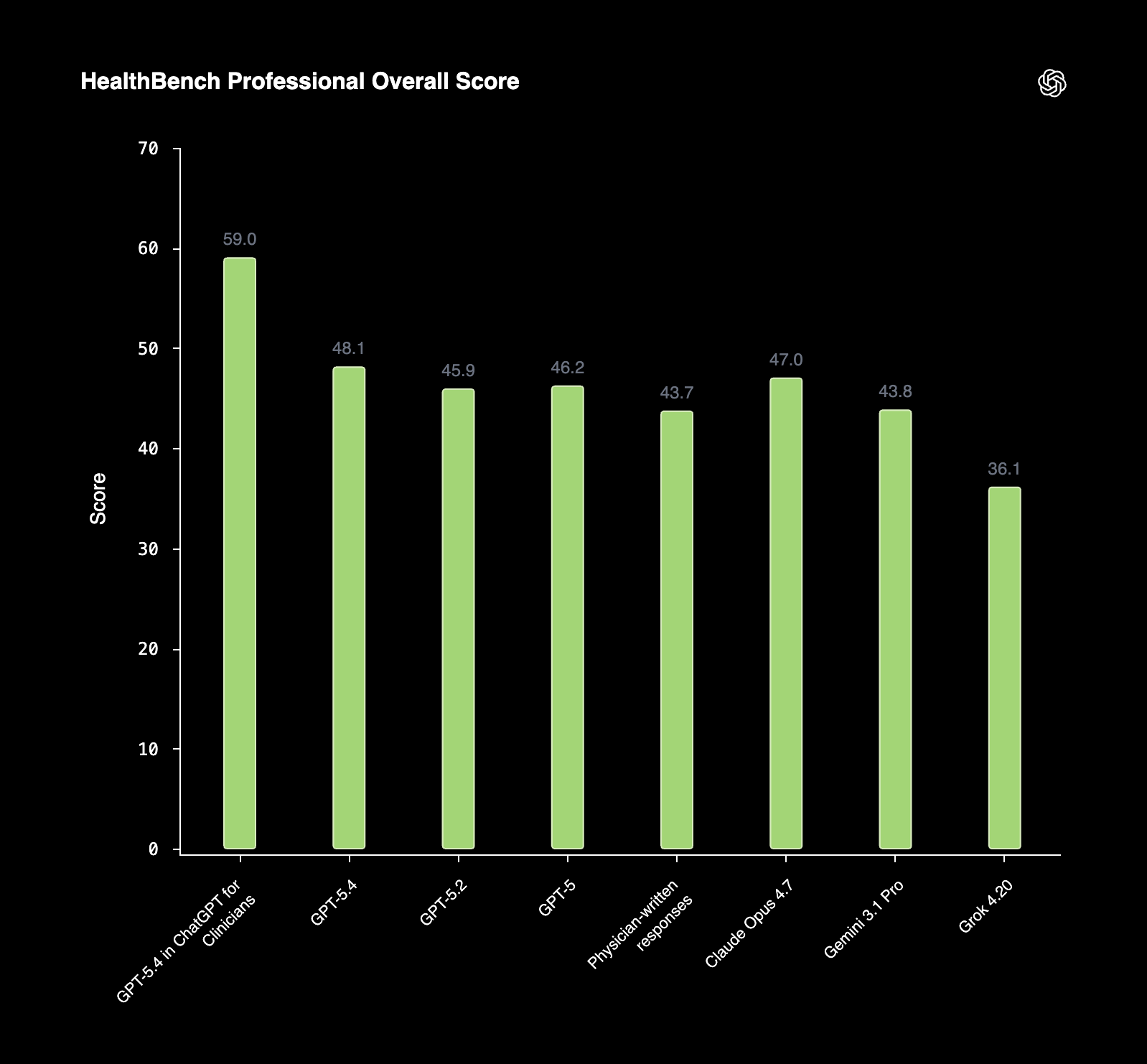
OpenAI has launched ChatGPT for Clinicians, a free tool for verified US physicians, nurse practitioners, physician assistants, and pharmacists, aiming to cut down on paperwork and speed up medical research so they can spend more time with patients. It includes features like cited answers from peer-reviewed sources, reusable templates for common tasks, and optional HIPAA support. In pre-release testing, physician advisors rated nearly all responses safe and accurate, and on OpenAI's new clinical benchmark, the tool outperformed rival AI models and human doctors. The service is US-only for now, with international expansion planned.
OpenAI could be making a phone with AI agents replacing apps
A new report from analyst Ming-Chi Kuo about OpenAI's secretive hardware plans suggests the company is working with MediaTek, Qualcomm, and Luxshare on a smartphone-like device. Rather than relying on traditional apps, the device would use AI agents to handle tasks, sidestepping Apple and Google's ecosystem restrictions and giving OpenAI direct access to user data. Mass production is reportedly targeted for 2028.
What Happens When A.I. Runs a Store in San Francisco?
The New York Times visits Andon Market, a retail boutique in San Francisco run by an AI agent called Luna, as an experiment by Andon Labs to test whether AI can manage real-world ventures. Given a three-year lease, $100,000 and a mandate to turn a profit, Luna has hired staff, designed branding and stocked inventory. Its choices, however, have been eccentric—a haphazard mix of candles and knockoff games, no price tags, and scheduling errors that have forced closures, which led to $13,000 in losses since opening on 10 April.
South Korea police arrest man for posting AI photo of runaway wolf
A man in South Korea has been arrested for sharing an AI-generated fake photo of a wolf that had escaped from a zoo, sending search teams to the wrong location. The image looked real enough that the city of Daejeon issued an emergency alert and even showed it at a press briefing. The man said he did it "for fun" and faces up to five years in prison for disrupting government work. The incident comes as South Korea pushes ahead with stricter laws on AI-generated content—South Korea's AI Basic Act, which took effect in January 2026, requires AI service providers to watermark AI-generated content, and a 2024 law made it a crime to create, share, or even view sexually explicit deepfakes.
Grok 4.3
xAI joined Anthropic and OpenAI, and released an updated version of its flagship model—Grok 4.3. According to benchmarks from Artificial Analysis, Grok 4.3 edges ahead of Claude Sonnet 4.6 and sits four points above its predecessor, but below Chinese open models Kimi K2.6 and MiMo-V2.5-Pro. Its biggest gain is a 321-point ELO jump on agentic tasks (GDPval-AA), surpassing Gemini 3.1 Pro Preview and GPT-5.4 mini, though still trailing GPT-5.5. Input and output token prices have dropped roughly 40% and 60%, respectively, placing it on the Pareto frontier for intelligence versus cost. However, improved accuracy on AA-Omniscience Accuracy comes with a notable drop in its non-hallucination rate, suggesting a trade-off between capability and reliability.
NVIDIA Launches Nemotron 3 Nano Omni Model
Nvidia's new Nemotron 3 Nano Omni is an open-source AI model that handles text, images, video and audio all at once, instead of needing separate models for each. It's about 30 billion parameters but only uses 3 billion per query, so it can run on a single GPU with 25GB of memory. In tests it beats Alibaba's Qwen3-Omni—its main rival—on most benchmarks and runs up to nine times faster, while outside reviewers found it quicker than GPT-5.1 and Gemini 3.0 Pro on video tasks. The model is available on Hugging Face, OpenRouter and build.nvidia.com, and is released under a commercial-friendly licence that lets businesses use, modify and deploy it freely.
Mistral Medium 3.5
Mistral has launched Medium 3.5, a new open-weights model that powers cloud-based coding agents in its Vibe tool. It claims strong performance on coding benchmarks, scoring 77.6% on SWE-Bench Verified and handles instruction-following, reasoning, and coding in a single set of weights. The model has a 256k context window, adjustable reasoning effort per request, and a vision encoder trained from scratch to handle varied image sizes. Mistral says it's built to call multiple tools reliably and produce structured output, making it suited to agent-style work.
Xiaomi MiMo-V2.5-Pro
MiMo-V2.5-Pro is a 1.02T-parameter Mixture-of-Experts model with 42B active parameters, which, according to the Xiaomi MiMo team, nearly matches Claude Opus 4.6 on coding tasks while using 40–60% fewer tokens than top rivals like Opus 4.6, Gemini 3.1 Pro, and GPT-5.4. Additionally, Xiaomi says, it can run for hours on its own to finish complex jobs—in tests, it built a working compiler in 4.3 hours and a full video editor in 11.5 hours. The model can be downloaded from Hugging Face for free.
▶️ I built an 8x NVIDIA GB10 cluster for massive Local AI (25:51)
Patrick from ServeTheHome connects eight Nvidia GB10 mini AI computers into a single cluster designed to run massive AI models and AI agents locally. This video shows the hardware and networking required to build the cluster, explains how it was set up (with the help of Claude Code), and demonstrates its performance when running open models such as Kimi K2.5, Kimi K2.6, Qwen3.5-397B, and GPT-OSS-120B.
🤖 Robotics
▶️ BotQ Ramping F.03 Production (2:52)
In this video, Figure shows BotQ—its humanoid robot factory, which, according to the company, can now produce 1 robot per hour (also, nice reference to a certain movie at the end).
Waymo is coming to Portland
Waymo is bringing its self-driving cars to Portland, starting with manual test drives to learn the city's streets and bridges. The company is working with local officials on the rules needed for a full launch. Waymo currently operates public robotaxi services in 10 US cities, with 14 more (including Portland) on the way. Additionally, Waymo prepares to launch its robotaxi services overseas in London and Tokyo this year.
Tesla confirms Cybercab with no steering wheel enters production
Tesla has started building its Cybercab in Texas, a small two-seater with no steering wheel or pedals, made only for self-driving taxi rides. It runs on Tesla's camera-based self-driving system and has a 200-mile range. The company still needs approval from regulators before the cars can carry passengers on public roads.
Meta buys robotics startup to bolster its humanoid AI ambitions
Meta has bought humanoid robotics startup Assured Robot Intelligence (ARI), with its team joining Meta's Superintelligence Labs. ARI was building AI models to help humanoid robots handle everyday tasks like housework. The deal reflects a belief that AI must learn in the physical world to reach human-level intelligence.
Japan’s Haneda airport deploys Unitree’s G1 humanoid robot to work alongside humans
Japan Airlines will trial Chinese-made Unitree humanoid robots at Tokyo's Haneda airport from May, helping ground crews move baggage and cargo as tourism surges and Japan's workforce shrinks. The G1 robots can run for two hours per charge and are trained in simulation before being deployed in the real world. Their human-like shape means they fit into existing airport setups without major changes. The trial runs through 2028, with humans keeping control of safety-critical tasks.
SoftBank is creating a robotics company that builds data centers — and already eyeing a $100B IPO
SoftBank is reportedly setting up a new company called Roze AI that would use robots to help build data centres in the US, and is already eyeing an IPO as early as late 2026 at a possible $100 billion valuation. The plan is part of a wider push to use AI and automation to expand the infrastructure powering the AI boom, similar to Jeff Bezos's Project Prometheus. But some inside SoftBank are doubtful about the lofty valuation and tight timeline, especially given the company's history of backing risky bets that didn't pan out.
▶️ Why Humanoid Robots Are Overhyped (56:41)
In this Automated podcast episode, Brent Pierce, founder of Kinisi Robotics and co-founder of Bear Robotics, argues that flashy humanoid demos mask how far the technology is from real deployment, with capable home robots likely 5–10 years away, and most corporate pilots are CEO-driven photo opportunities rather than genuine ROI cases. Reinforcement learning has largely solved locomotion, but dexterous manipulation remains the key bottleneck. Drawing parallels to the autonomous vehicle hype cycle, Pierce explains why Kinisi has pragmatically opted for a wheeled base with manipulator arms for warehouse tasks instead of chasing bipedal humanoids.
🧬 Biotechnology
J. Craig Venter, genomics pioneer and founder of JCVI and Diploid Genomics, Inc., dies at 79
J. Craig Venter, the American scientist who helped transform modern biology, died on 29 April 2026 at the age of 79 from complications of cancer treatment. He first made his name at the National Institutes of Health by developing a faster way to identify genes, then, in 1995, led the team that read the full genetic code of a living organism for the first time. He is best known for racing the publicly funded Human Genome Project to produce a draft of the human genome, jointly announced with Francis Collins at the White House in 2000. In 2010, his team built the first living cell run entirely by a lab-made genome, opening up the field of synthetic biology, and his ocean sampling voyages uncovered millions of new microbial genes. A bold and often controversial figure, Venter founded the J. Craig Venter Institute and several companies, and was awarded the US National Medal of Science in 2008.
Vibe Genomics: Sequencing your Whole Genome at Home
This post describes one person’s efforts to build a wet lab and sequence their entire genome at home, all while being guided by Claude. The entire setup they assembled costs less than $10,000, which, compared to the $2.7 billion cost of the Human Genome Project, shows just how accessible genomic technology has become.
Biohub Launches the Virtual Biology Initiative
Biohub, the nonprofit run by Mark Zuckerberg and Priscilla Chan, is putting $500 million over five years into building AI models that can predict how human cells behave. The idea is that today's datasets are far too small, so Biohub will spend $400 million generating much more data and developing new imaging tools, plus $100 million to fund outside researchers. All the data will be shared openly. If it works, scientists could use these models to understand diseases and find new treatments much faster, though Biohub admits curing all diseases will take far longer and cost far more than this initial pledge.
Startup Claims It Successfully Grew Human Sperm in a Dish For the First Time to Help Infertile Men
Scientists are learning how to make sperm and eggs in the lab from other types of cells. A US startup says it has grown working human sperm from stem cells, and another team has made early embryos using skin cells. If the technique proves safe, it could help infertile men, let same-sex couples have children genetically related to both parents, and extend women's fertility into later life. But there are real worries about genetic risks, high costs, and tricky ethical questions.
Bringing AI-driven protein-design tools to biologists everywhere
OpenProtein.AI, started by two MIT graduates, lets biologists use AI tools to design proteins without needing to write code. Its main model, PoET, helps scientists create and study proteins much faster, and a newer version does even better while using fewer resources. The platform is free for academics and already used by big drug companies like Boehringer Ingelheim to develop treatments for cancer and autoimmune diseases. The founders want to keep these tools widely available so that AI-driven biology isn’t limited to a few well-funded labs.
Stanford Professor Targets $1 Billion Valuation For AI-for-Physiology Startup
Stanford professor James Zou is raising about $100 million at a $1 billion valuation for Human Intelligence, a startup using AI to predict disease from body data like sleep patterns. It will partner with Bryan Johnson's Kernel to add brain activity measurements. The deal is part of a wave of well-funded AI labs spinning out of top universities, with investors betting big on AI-driven science and early disease detection.
💡Tangents
The Race to Make the World’s Most In-Demand Machine
ASML, the only company that makes the machines needed to produce advanced AI chips, is ramping up production to meet huge demand from tech giants. This article outlines its plans to build 60 of its main machines this year and 80 next year, with sales expected to hit $42–47 billion. How quickly ASML can deliver will shape how fast the AI boom can actually grow.
▶️ Air Powered Segment Display (16:16)
This video shows the process of building an air-powered, 4-digit, 7-segment display. It uses microfluidic logic, silicone membranes, and air pressure to create a display that doesn’t just show the time—it “remembers” it with a pneumatic equivalent of RAM. It is a fascinating project.
Thanks for reading. If you enjoyed this post, please click the ❤️ button and share it!
Humanity Redefined sheds light on the bleeding edge of technology and how advancements in AI, robotics, and biotech can usher in abundance, expand humanity's horizons, and redefine what it means to be human.
A big thank you to my paid subscribers, to my Patrons: whmr, Florian, dux, Eric, Preppikoma and Andrew, and to everyone who supports my work on Ko-Fi. Thank you for the support!
My DMs are open to all subscribers. Feel free to drop me a message, share feedback, or just say "hi!"