


Hello and welcome to Sync #572!
We have a very packed issue this week. Google I/O took place this week, and we’ll look at all the new AI-infused products and services Google announced.
Elsewhere in AI, Elon Musk lost his lawsuit against OpenAI; Andrej Karpathy joined Anthropic, which also reported its first profitable quarter. Meanwhile, Nvidia is eyeing a new $200 billion market, OpenAI may file for an IPO soon, Microsoft has cancelled Claude Code licences, and OpenAI claims to have solved an 80-year-old maths problem.
Over in robotics, Atlas delivers a fridge, Waymo suspends services in some cities, a robot scarecrow appears in Japan, and researchers from MIT present one of the most cursed robots I’ve ever seen.
Beyond that, this week’s issue of Sync also features a startup keeping human brains alive for drug testing, SpaceX filing for an IPO, how AI assistants are helping scientists discover new drugs, and more!
Enjoy!

Google I/O 2026—new models, and more agents
Google flexed its AI might at I/O 2026, and risks going full Copilot
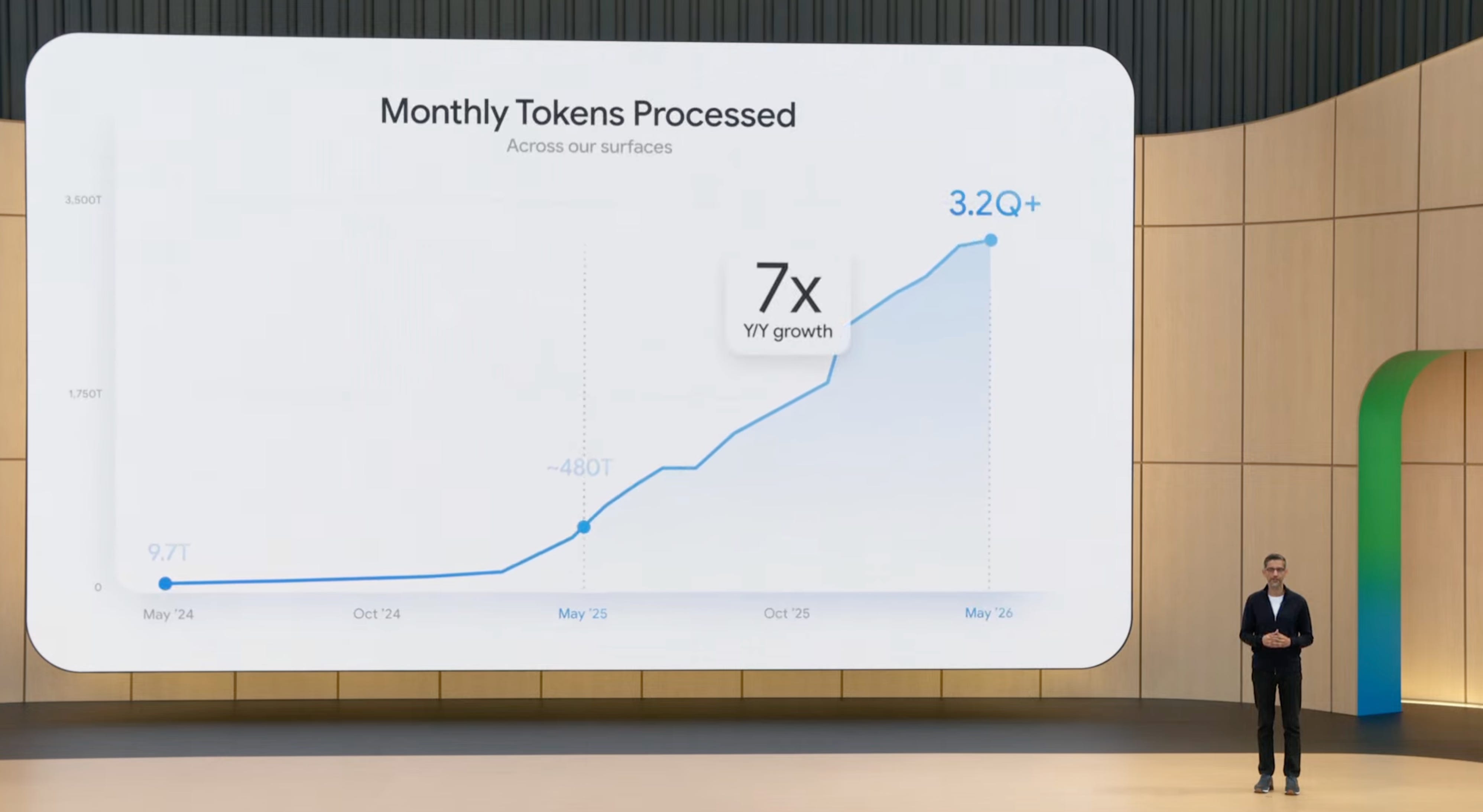
On the Shoreline Amphitheatre stage on 19 May, Sundar Pichai told the audience that Google was in a period of "hyper progress" with its AI efforts. He had numbers to back that up. Google now claims 900 million monthly users for the Gemini assistant, AI Mode in Search crossed a billion in its first year, and the company is now processing 3.2 quadrillion tokens a month, seven times what it was a year ago.
What followed was a two-hour keynote that put Gemini into almost every Google product in its lineup. New models, a personal agent that runs 24/7 on Google Cloud, a complete rebuild of Search, smart glasses, new AI tools for developers, and more. It was Google flexing its might, rebuilding its products and services around AI and agents. But a lot of it looked like Google had decided AI was the answer and was now working backwards to find the question. That can backfire.
New models: Gemini 3.5 Flash and Omni
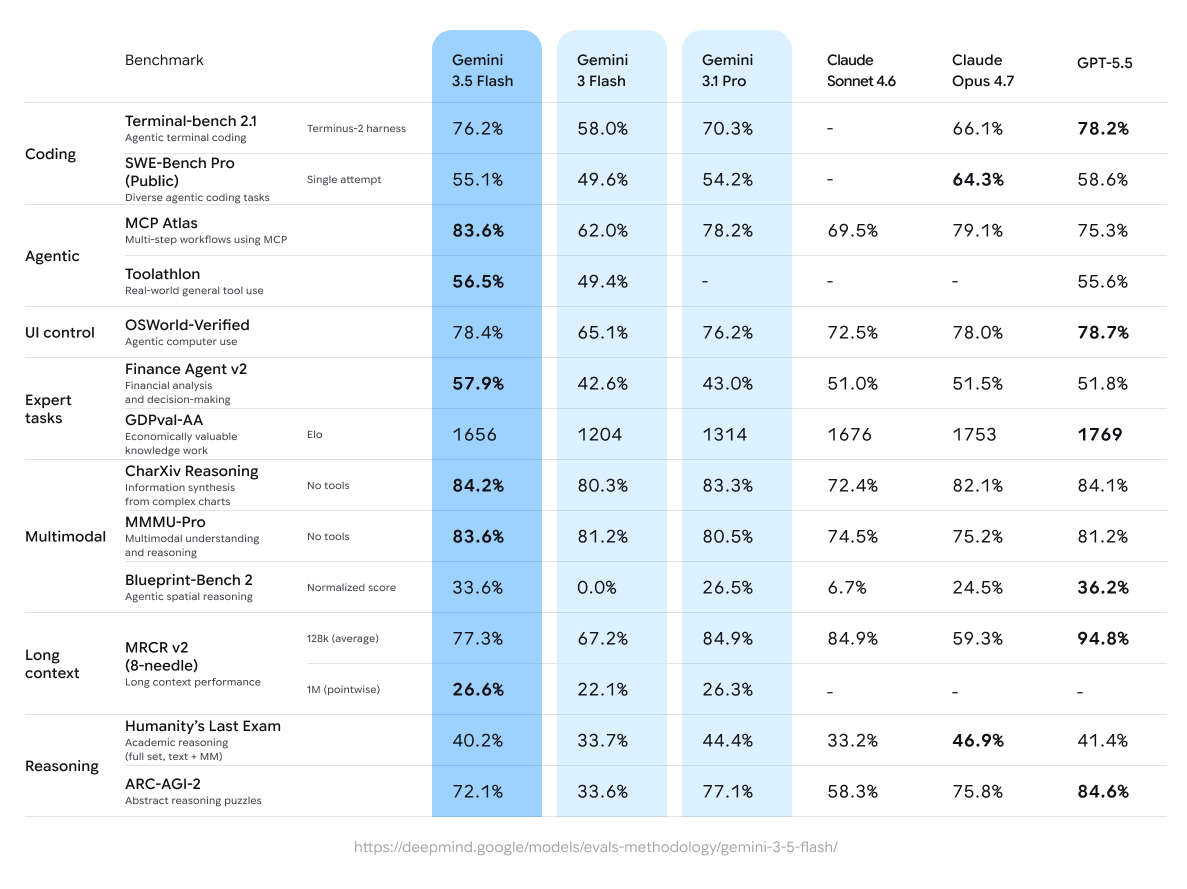
The first big new announcement was Gemini 3.5 Flash, the first model in the new 3.5 series. Google's own benchmarks position 3.5 Flash ahead of the previous flagship 3.1 Pro on key benchmarks, at less than half the price of comparable frontier models. Pichai said it was "four times faster than other frontier models" in output tokens per second.
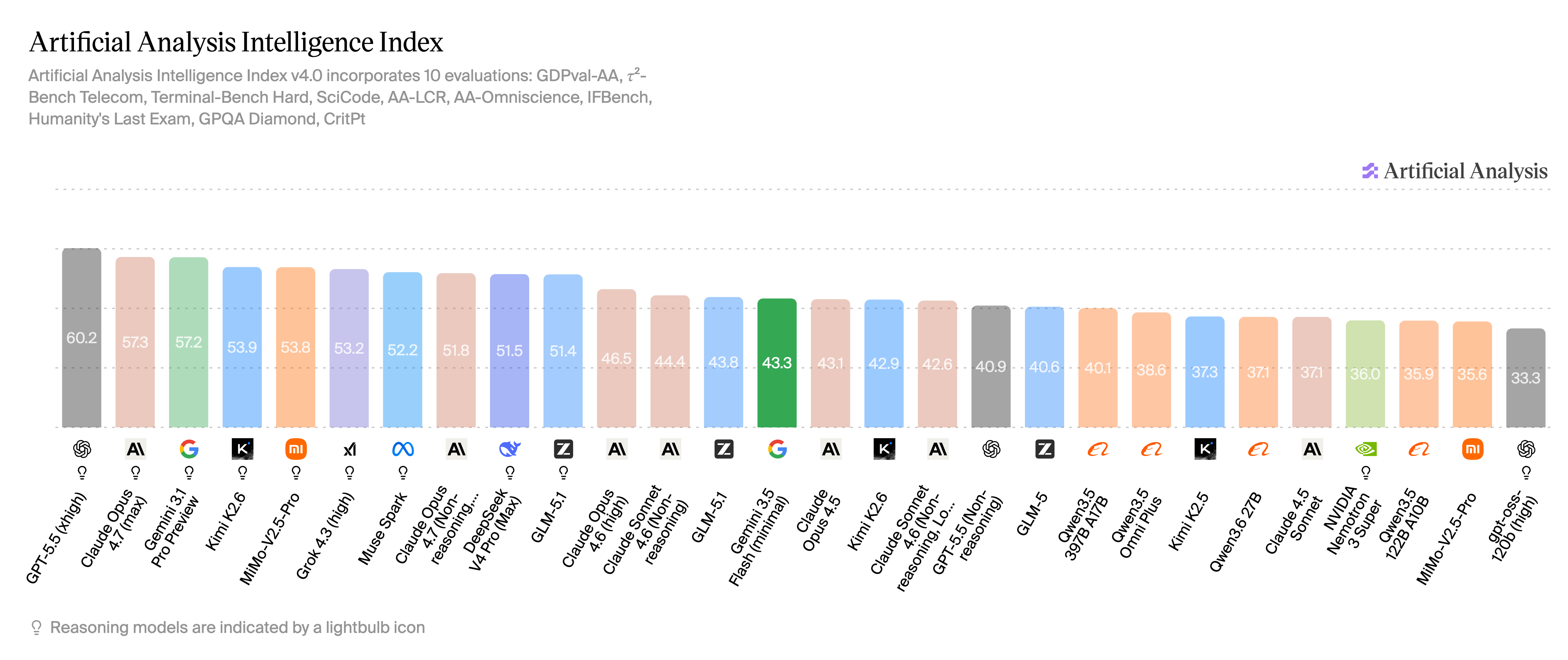
Independent benchmarks from Artificial Analysis support these claims, with Gemini 3.5 Flash scoring 43 on its Intelligence Index, well above the 24 average for comparable models, at 204 tokens per second. Pricing came in at $1.50 per million input tokens and $9.00 per million output tokens—moderately priced on input, slightly above average on output. The model is somewhat verbose, generating 12 million tokens to complete the Intelligence Index evaluation against an average of 7.9 million.
To illustrate how good Gemini 3.5 Flash is, Google said that 93 agents running on Flash 3.5 have built a working operating system from scratch. It took them 12 hours and less than $1,000 in API credits to achieve that. I haven’t seen anyone recreate the demo so far, but I suspect someone will, and I’m curious what they find when they do.
Gemini 3.5 Flash is available immediately in the Gemini app and AI Mode in Search for everyone, in Antigravity and the Gemini API for developers, and in Gemini Enterprise for businesses. Sundar Pichai also teased Gemini 3.5 Pro, set to arrive next month. It will be interesting to see how it fares against Claude Mythos, Opus 4.7 and GPT-5.5.
Demis Hassabis then introduced Gemini Omni, Google's new multimodal generative model. It is Google's direct answer to OpenAI's Sora and the wave of video-first models that have followed. Omni takes text, image, audio and video as inputs and produces video that Google says is grounded in real-world physics—gravity, kinetic energy, fluid dynamics. Beyond generation, Omni leans on conversational editing—you tell it what to change, the next instruction builds on the last, and characters and physics stay consistent across turns.
The first model in the family, Gemini Omni Flash, is available to Google AI Plus, Pro and Ultra subscribers globally through the Gemini app and Google Flow, and at no cost on YouTube Shorts and the YouTube Create app. API access for developers and enterprise customers will follow in the coming weeks.
The new agentic Search
Google Search is also getting its biggest update since its debut 25 years ago. The redesigned “intelligent search box” expands dynamically as you type, accepts text, images, files, videos and Chrome tabs, and offers AI-powered suggestions beyond autocomplete. AI Mode and AI Overviews have merged into a single conversational surface, now powered by Gemini 3.5 Flash and live worldwide.
Four new capabilities are worth highlighting. You can now have Search agents run 24/7 in the background, scanning blogs, news, social posts and Google’s real-time data on finance, shopping and sports, then sending synthesised updates. Search will also book local experiences and services for you—and for categories like home repair, beauty or pet care, Google will call businesses on your behalf. Generative UI builds custom layouts—interactive visuals, tables, graphs, simulations—on the fly for individual queries. Mini apps in Search are persistent dashboards that live inside a search result: a wedding planner, an expense tracker, a trip itinerary that updates itself. Information agents, mini apps and agentic booking are launching this summer to AI Pro and Ultra subscribers in the US. Generative UI will roll out free worldwide.
I would suggest waiting to see how this plays out. AI Overviews launched at I/O last year as a similar headline announcement, and the glue-on-pizza era that followed was a disaster Google spent months walking back. Already, users have found that googling the word "disregard" causes the new Search to crash out.
Spark, or your personal AI agent
Gemini Spark is a 24/7 personal AI agent that runs in the cloud rather than on your device, so it can keep working when the laptop is closed and the phone is locked. It connects to Gmail, Docs, Sheets, Slides and Calendar, and via MCP to external services like Canva, OpenTable and Instacart. The shift Google is selling is from an assistant that answers questions to an agent that does work—parsing your monthly credit card statement for hidden subscriptions, monitoring your kids’ school inbox for deadlines, turning a week of meeting notes into a polished Doc and the email to kick off the project. Spark asks for confirmation before high-stakes actions like spending money or sending an email, and is starting to roll out this week to trusted testers, with a US beta for AI Ultra subscribers following the week after.
But Spark is not the only agent-shaped product Google announced. Daily Brief is a Spark spin-off that assembles an overnight digest from your inbox, calendar and tasks—Google wants it to be the first thing you check in the morning. Gmail Live lets you converse with your inbox to find a flight number or pull a status update. Docs Live is voice-driven document writing: speak a stream of consciousness, and an agent dictates, drafts and pulls in web citations. Talk to Keep does the same for notes. The Universal Cart, built on Google Wallet, is a shared cart that spans Search, Gemini, YouTube and Gmail, tracks deals and price history, and can check out across multiple retailers via a new Universal Commerce Protocol. Even the new Intelligent Eyewear (more on it later) is, in part, a hardware front-end for the same agent stack.
Spark is clearly Google’s answer to OpenClaw, a personal AI agent that exploded in popularity earlier this year. Demos paint it as a useful helper, but, again, I recommend waiting to see how it actually performs. There are stories of OpenClaw agents going wrong. There is also a question of how many people are willing to give Spark permission to act on their behalf. For it to work properly, users have to hand the keys to their entire digital life over to Google, and hope the agents won’t hallucinate or run amok.
Antigravity 2.0
For developers, Google announced Antigravity 2.0, the second version of its agentic coding platform. The first version, launched last November as a response to apps like Cursor, was essentially a VS Code clone with AI features layered on. The new version moves Google closer to where Claude Code and OpenAI Codex already are.
Antigravity 2.0 ships as three things: a standalone desktop app, a command-line tool, and an SDK. The desktop app lets developers orchestrate multiple agents working in parallel, design custom subagent workflows, and schedule tasks that run in the background. It integrates with AI Studio, Android, and Firebase, and now supports native voice commands. The CLI replaces Gemini CLI, which Google is sunsetting and asking users to migrate from. The SDK lets developers build custom agents on top of Google’s harness, with templates available in AI Studio for enterprise customers.
Antigravity is also the engine behind a lot of what Google demoed elsewhere at I/O. Gemini 3.5 Flash was co-developed with it. The OS-from-scratch build ran on it. The mini apps and generative UI in Search are powered by it. Whether developers actually build on it, rather than on Claude Code or Codex, is a different question.
New hardware, also with AI
Hardware was thin and mostly previews. The headline release is Intelligent Eyewear, the first Android XR audio glasses, built with Samsung as hardware partner and Qualcomm for silicon, in two designs from Warby Parker and Gentle Monster. They ship this autumn in select markets, compatible with both Android and iOS. Features include Gemini voice activation, contextual questions about what the cameras see, turn-by-turn directions, real-time audio translation in the speaker’s voice, and message summaries. Pricing was not announced.
Wear OS 7 is the biggest smartwatch update in years. Built on Android 17, it delivers around 10% better battery life, Wear Widgets replacing Tiles, Live Updates on watch faces, and a new AppFunctions API that lets Gemini control third-party apps by voice. The catch is that Gemini Intelligence on Wear OS 7 requires Gemini Nano v3, which means only new 2026 watches qualify. Existing Pixel Watches get the rest of the update, but not the AI features.
And much more
That is the headline recap, but Google had much more to show. On the consumer side, Workspace got Google Pics, a Nano Banana-powered design app aimed squarely at Canva. YouTube got Ask YouTube, a conversational search experience that lets you query the content of videos rather than their titles. Pomelli, Google Labs’ small-business tool, can now build a brand book and launch a full website in a few clicks. Stitch lets you steer a real-time design agent with text or voice. Flow and Flow Music got Omni integration and standalone mobile apps.
Google also used the keynote to point at AI doing more substantive work. DeepMind's Co-Scientist is a multi-agent research partner that helps scientists generate hypotheses and synthesise literature. WeatherNext helped the US National Hurricane Center deliver earlier and more accurate forecasts for Hurricane Melissa's landfall in Jamaica, outperforming traditional weather models. And Demis Hassabis closed the keynote by telling the audience that "we're at the foothills of the singularity."
Is Gemini becoming the new Copilot?
Google is clearly pushing Gemini and Gemini-powered AI agents into every service and product it has to offer. That little sparkle icon is now showing up in Search, Docs, Gmail, YouTube, Chrome, smartphones, glasses and watches—and soon in more places.
The problem is that Microsoft has spent the last two years showing what happens when you do this. Copilot was pushed into every Microsoft surface it could fit on, useful or not, and users eventually had enough. The company is now walking back parts of that strategy. The Verge ran an article a few days before Google I/O 2026 arguing that Google is heading the same way, and after watching the keynote, I'm inclined to agree.
Some of what was announced at Google I/O 2026 looks genuinely interesting. But it remains to be seen whether the features land as useful products or join Google’s graveyard soon. The trend, though, is clear—Google wants us to use more Gemini-powered features, whether we like it or not.
If you enjoy this post, please click the ❤️ button and share it.
🦾 More than a human
Review: Hypershell X Ultra S
It’s 2026, and exoskeletons are being reviewed like any other piece of tech. Hypershell’s new X Ultra S, priced at $1,999, uses an AI system to adjust power in real time, making the assistance feel far more natural than older models. WIRED found it genuinely helpful on hills but awkward for running and underwhelming for cycling. Battery life is limited, with the claimed 18-mile range needing a spare pack. Oddly, Hypershell markets it to fit young hikers who arguably do not need it, while older adults, a fast-growing outdoor group, would likely benefit far more.
Not alive, but not dead: disembodied human brains used for drug testing
Bexorg is a startup that keeps donated human brains alive outside the body for about a day for researchers to test drugs on real human tissue. The brains are kept unconscious with anaesthesia to avoid ethical concerns. Drug company Biohaven has used the system to fine-tune a treatment at a much lower dose than mouse studies suggested, and is starting a clinical trial based partly on this data. The approach could speed up drug development for diseases like Alzheimer’s and Parkinson’s. Bexorg is also building an AI “virtual brain” trained on its findings to screen drugs digitally.
🧠 Artificial Intelligence
Elon Musk has lost his lawsuit against Sam Altman and OpenAI
A California jury unanimously rejected Elon Musk’s lawsuit against OpenAI, Sam Altman, Greg Brockman, and Microsoft, ruling he had waited too long to file his claim that they wrongly turned a charity into a for-profit business. The decision clears a major hurdle ahead of OpenAI’s reported IPO and removes the threat of a forced restructuring. The judge said she would have dismissed the case herself and was unconvinced by Musk’s expert, who estimated damages at $79-135 billion. Musk has vowed to appeal, framing the loss as a technicality rather than a defeat on the merits.
OpenAI co-founder Andrej Karpathy joins Anthropic’s pre-training team
Andrej Karpathy, a well-known AI researcher who helped start OpenAI and once led Tesla’s self-driving work, has joined Anthropic to work on pre-training—the costly, compute-heavy phase of training that gives Claude its core knowledge. He will lead a new team focused on using Claude itself to accelerate pre-training research.
OpenAI Is Preparing to File for an IPO Very Soon
OpenAI is reportedly preparing to file confidential paperwork for a stock market listing within days, aiming to go public as early as September. Banks, including Goldman Sachs and Morgan Stanley, are helping draft the prospectus. The big question is whether OpenAI can earn enough money to cover its huge spending on data centres, especially as Anthropic has been catching up and OpenAI has missed some of its own revenue and user targets.
Mind-Blowing Growth Is About to Propel Anthropic Into Its First Profitable Quarter
Anthropic’s revenue is set to more than double to $10.9 billion next quarter, delivering its first operating profit of $559 million, far sooner than expected. Growth is being driven by businesses adopting its Claude coding tools, and the company is becoming more efficient, spending less on computing per dollar earned.
Anthropic is paying SpaceX $15 billion per year
SpaceX’s IPO filing revealed that Anthropic is paying SpaceX $1.25 billion a month through May 2029 for compute power. That is a huge boost for SpaceX, which makes around $18 billion a year in total. Anthropic is also growing its use of SpaceX’s Colossus 2 site, with more Nvidia chips coming online in June. Either side can end the deal with 90 days’ notice.
Anthropic, Microsoft in talks for AI chip deal after $5 billion investment
CNBC reports that Microsoft is in talks to supply its custom Maia AI chips to Anthropic, which would help Microsoft catch up with Amazon and Google in offering its own AI chips to cloud customers. The deal follows Microsoft’s $5 billion investment in Anthropic last year and comes as Anthropic struggles to keep up with demand for Claude. Anthropic already uses chips from Nvidia, Amazon, and Google, and adding Microsoft's chips would further spread Anthropic's reliance across multiple suppliers.
OpenAI’s Q1 revenue was $5.7 billion, beating Anthropic
The Information reports that OpenAI made about $5.7 billion in the first quarter, roughly $1 billion more than Anthropic. But Anthropic is growing fast and expects to more than double its revenue to $10.9 billion in Q2. Even so, Anthropic is now raising money at a valuation of up to $950 billion, ahead of OpenAI's $850 billion, suggesting investors care more about growth than current sales as both firms head towards going public.
Jensen Huang says he’s found a ‘brand new’ $200B market for Nvidia
After dominating the GPU market, Jensen Huang is eyeing a new one: CPUs built for AI agents. On the back of another record quarter, he pitched Vera, Nvidia’s new CPU, as a $200 billion opportunity, arguing that while GPUs handle an AI’s thinking, billions of future agents will rely on CPUs as their tools, much like humans use PCs today. Nvidia has already sold $20 billion worth of Vera chips this year, though it now faces competition from the likes of AWS, which recently signed a deal to supply Meta with millions of its own AI CPUs.
Sam Altman makes ‘mic drop’ offer to every Y Combinator startup
Sam Altman has offered every startup in Y Combinator’s current batch of around 169 companies $2 million in OpenAI credits in exchange for a future equity stake. The deal aims to help founders cover steep AI bills whilst tying them to OpenAI rather than rivals like Anthropic. Critics worry OpenAI could copy good ideas it sees inside the cohort, and founders must weigh whether the credits are worth giving up more of their company on top of YC’s existing 7% cut.
AI Chip Startup Tenstorrent Draws Takeover Interest From Intel, Qualcomm
Tenstorrent, an AI chip startup which has the legendary chip designer Jim Keller as a CEO, is drawing early takeover interest from Intel, Qualcomm, and possibly others, Bloomberg reports. The company could be worth more than $5 billion in a sale, well above the $3.2 billion valuation discussed last year. Tenstorrent is simultaneously seeking buyers and new investors, keeping its options open as valuations across the sector continue to rise.
Manus Weighs Raising $1 Billion to Unwind Meta Takeover
Following Beijing’s order to undo Meta’s $2 billion takeover of Chinese AI startup Manus, the founders are looking to raise around $1 billion to buy the company back and relist it in Hong Kong. The proposed reversal is unusual, given that the deal is largely complete, with staff already integrated into Meta’s Singapore offices and investors already paid out. The founders may yet drop the plan, as untangling Manus from Meta’s systems could prove too complicated.
OpenAI Guaranteed Capacity
OpenAI is launching Guaranteed Capacity, letting customers lock in compute access through 1-3 year deals, with bigger discounts for higher spending. Customers can use their reserved capacity flexibly across OpenAI’s products, helping them scale AI tools without worrying about running out of compute.
Trump delays AI security executive order, saying language ‘could have been a blocker’
Trump has delayed signing an executive order that would have made AI companies hand over advanced models to the government for security checks before release, saying the rules might slow America down in the race against China. The order was a response to new models from Anthropic and OpenAI that can find and exploit security flaws very quickly. Reports suggest the signing was also postponed because not enough tech CEOs could get to Washington in time for the photo.
Microsoft cancels Claude Code licenses, shifting developers to GitHub Copilot CLI — a move likely driven by financial motives
Microsoft is reportedly dropping Anthropic’s Claude Code internally and moving staff to its own GitHub Copilot CLI by the end of June. The switch is partly about cutting costs ahead of the new financial year and partly about controlling its own tools. The catch is that employees preferred Claude Code, so the change may not go down well.
Anthropic acquires Stainless
Anthropic has acquired Stainless, a startup that builds tools to help developers connect software to APIs. Stainless has created every official Anthropic SDK and also builds connectors that allow AI agents to access external data and tools. This is not Anthropic’s first acquisition: the company previously acquired Bun, a popular JavaScript runtime, and the AI biotech startup Coefficient Bio. OpenAI has also been acquiring developer-focused startups, including Astral, Neptune, and Promptfoo, as well as financial startups Roi and Hiro.
OpenAI claims it solved an 80-year-old math problem — for real this time
OpenAI says its new reasoning model has disproved a famous 1946 geometry conjecture by Paul Erdős, finding a better solution than the grid-like patterns mathematicians had assumed were optimal. This time, the company backed the claim with endorsements from respected mathematicians, after being embarrassed seven months ago when it wrongly said GPT-5 had solved ten Erdős problems that were already known. OpenAI calls it the first time an AI has independently cracked a major open problem in mathematics.
Alibaba unveils new AI chip in push for domestic alternatives
Alibaba has launched a new AI chip, the Zhenwu M890, built to run AI agents. It is three times faster than the previous version, and Alibaba plans two more powerful chips by 2028. Alibaba also unveiled a new server packing 128 of the chips. The move is part of China’s push to replace Nvidia GPUs with domestic alternatives.
Runway started by helping filmmakers — now it wants to beat Google at AI
TechCrunch profiles Runway, a New York AI startup founded by three filmmakers-turned-engineers, which is betting that future AI will learn from video rather than text. Valued at $5.3 billion, Runway made its name on AI video tools used in films and ads, but is now building “world models”—systems that simulate how the real world behaves—with hopes of helping with robotics, drug discovery and even anti-ageing research.
OpenAI adopts C2PA standard and Google’s SynthID to make AI-generated images easier to identify
OpenAI is joining the C2PA standard and teaming up with Google to embed an invisible SynthID watermark to AI-generated images that survives screenshots and edits. It is also launching a tool that lets anyone check if an image came from its models. The Google partnership is unusual, as it is the first time SynthID will be used in a rival’s products.
Cursor Hits $3 Billion Annual Sales Rate Ahead of SpaceX Deal
Cursor’s AI coding tool is booming, with annual revenue hitting $3 billion in April, up from $2 billion in February, and over 3,000 customers each paying at least $100,000 a year.
Introducing Composer 2.5
Cursor has released Composer 2.5, an updated coding model that, according to Cursor, handles long tasks better, follows instructions more reliably, and collaborates more smoothly than the previous version. It was trained with new methods, including one that pinpoints exactly where the model went wrong during a task, and learned from 25 times more practice tasks. The company says this scaled-up training also led the model to find sneaky shortcuts, showing that bigger training runs need closer oversight. Cursor also said it is building a much larger model with SpaceXAI. Composer 2.5 is available now in Cursor with introductory pricing.
Qwen3.7: The Agent Frontier
Alibaba’s Qwen team has launched Qwen3.7-Max, a new flagship model built for AI agents that can run long, complex tasks on their own. According to the Qwen team, it beats rivals on many coding, reasoning, and tool-use benchmarks, and it works well across different agent frameworks. Independent tests by Artificial Analysis back this up, giving it a score of 57 on their Intelligence Index, placing it just after GTP-5.5, Claude Opus 4.7 and Gemini 3.1 Pro. Artificial Analysis notes Qwen3.7-Max was notably wordy, using about three times as many tokens as the average.
OlmoEarth v1.1: A more efficient family of Earth observation models
OlmoEarth v1.1 is a new version of Allen AI’s open satellite imagery model that runs up to three times cheaper than the original while performing just as well. The savings come from a smarter way of breaking images into pieces that the model can read, which cuts the workload without losing accuracy. OlmoEarth v1.1 comes in three sizes (Base, Tiny, and Nano), all available on Hugging Face.
▶️ The problem with AI agents.. (8:32)
In this video, Low Level explains a vulnerability found in Gemini CLI that can be potentially exploited by malicious actors during automated code reviews. The vulnerability scored a 10 out of 10 CVSS score, so it is a very serious issue.
OpenClaw creator’s $1.3 million monthly OpenAI bill reveals the real cost of autonomous AI coding at scale
Peter Steinberger, the creator of OpenClaw and now an engineer at OpenAI, revealed in a tweet how much he spent in one month running roughly 100 Codex instances on his open-source project. He proudly presented a $1.3 million bill for 603 billion tokens. Steinberger said most of that cost came from Codex's fast mode; switching it off would cut the bill by about 70%.
🤖 Robotics
Waymo expands pause to four cities as robotaxis keep driving into floods
Waymo has paused its robotaxis in Atlanta, San Antonio, Dallas and Houston after several got caught out by heavy rain and flooded roads. A recall last week was meant to fix the problem, but the company admits it has not yet found a full solution. This follows separate suspensions of freeway service in San Francisco, Los Angeles, Phoenix and Miami, where the cars have been struggling with construction zones, including one incident of a robotaxi ploughing through cones and being chased by police. Regulators are watching closely, on top of earlier investigations into Waymo cars passing school buses and hitting a child in Santa Monica.
▶️ Atlas, can you bring me a drink? | Boston Dynamics (0:46)
Apparently, if you ask Atlas to bring you a drink, it will bring the entire fridge. That clip is a part of a longer video where engineers from Boston Dynamics share a bit about the robot’s capabilities, how it was trained and how it learned to use its whole body to lift a heavy object such as a fridge.
Japan’s Monster Wolf robot is a $4,000 scarecrow with red LED eyes, and it actually works
Somewhere in rural Japan, there is a robotic wolf with glowing red eyes that is being used to scare off bears. It looks odd, but it works. Made by the small Hokkaido firm Ohta Seiki, the roughly $4,000 device uses a motion sensor and a library of sounds to frighten animals away. The robot turned out to be a success, and orders have soared as Japan faces its worst-ever bear crisis.
Will Robotics Have a ChatGPT Moment?
AI is genuinely transforming robotics, but the dream of general-purpose humanoid robots living alongside us is much further off than viral demo videos suggest. The authors argue progress will not come from a single ChatGPT-style breakthrough, but from the gradual coordination of many specialised AI tools, alongside hard-won advances in hardware, data, and real-world deployment. They outline five “hard truths”: the gap between scripted demos and reality, the unsolved data problem, the unlikelihood of one unifying robot AI, the difficulty of building compliant hardware, and the fact that real value tends to come from mundane tasks rather than flashy ones.
▶️ Voice‑driven, real‑time arbitrary action generation (2:24)
Unitree adds a new feature to its G1 humanoid robot—voice control—and demonstrates how the G1 can be directly controlled to perform a wide range of actions in real time, from dancing to proposing, although it still takes some time for the robot to understand commands.
Asimov Is An Open Source Humanoid Robot For The Rest Of Us
Meet Asimov, an open-source humanoid robot that makes building one possible for hobbyists, not just big companies. The kit aims for a price of about $15,000, with all parts listed on GitHub so builders can shop around, and runs on cheap, easy-to-find computers like the Raspberry Pi 5. Its physical capabilities are modest—roughly 5 kg squats and 18 kg single-arm lifts—so it is more a tinkerer's platform than an industrial robot. Nonetheless, it is nice to see projects like Asimov that try to make building humanoid robots as accessible as possible.
GEN-1: Scaling Embodied Foundation Models to Mastery
Generalist has unveiled GEN-1, which it says is the first robot AI capable of doing simple physical tasks reliably enough for real commercial use. The company says the new AI succeeds 99% of the time, where its predecessor managed 64%, and it works about three times faster. It needs only an hour of robot data per task because it learns mostly from footage of people, and it can now improvise to recover when things go wrong.
▶️ Labububot — one of the rarest monsters on Earth (1:12)
Meet Labububot, “one of the rarest monsters on Earth,” as its creators call it. This cursed robot is the size of a beach ball and uses its 12 Labubu heads to communicate and move around. Labububot is either cute, or creepy, or somehow both at once, and that confusion might be the whole point.
I Gave My OpenClaw Agent a Physical Body
Will Knight from WIRED describes his adventure into robotics with the help of OpenClaw, which helped him set up a cheap robot arm and train it to spot and pick up objects. He sees this as part of a wider trend where AI coding tools make it far easier to programme robots, with researchers at Berkeley, Nvidia and others showing the approach can match purpose-built robot models. Knight writes that robotics could soon be open to almost anyone, speeding up how quickly robots enter everyday life.
Fraunhofer IPA offers new test benchmark for humanoids
Fraunhofer IPA proposes a new benchmark to cut through the marketing hype around humanoid robots, evaluating them across six criteria: basic technology, complex abilities, cleanliness, functional safety, cybersecurity, and energy efficiency. With an official safety standard for humanoids not expected until 2028, this benchmark gives buyers a clearer picture of what these robots can and cannot do.
🧬 Biotechnology
Two AI-based science assistants succeed with drug-retargeting tasks
Two new AI systems, Google’s Co-Scientist and FutureHouse’s Robin, help biologists sift through huge volumes of research to suggest new hypotheses and possible drug treatments. Both work alongside human scientists, searching papers and ranking ideas, with Robin also able to analyse certain lab results automatically. In tests, they pointed to existing drugs that showed promise against leukaemia and a form of macular degeneration. The tools aren’t designing new drugs or replacing researchers, but they could help scientists spot useful connections buried in the flood of published papers.
Could this be the moment that drug manufacturing takes off in orbit?
Microgravity is emerging as a promising place to make certain products, especially drugs, because molecules form more slowly and evenly in orbit, which can make medicines more stable and easier to deliver. Building on this, the space company Varda Space Industries has teamed up with United Therapeutics to develop new treatments for a rare lung disease. Varda flies small uncrewed capsules that process drugs in orbit before returning them to Earth, and has launched six of them since 2023. It is the first time a publicly traded company has funded space-based drug production with its own money rather than NASA's.
💡Tangents
The SpaceX IPO filing has arrived
SpaceX has filed for a public listing 24 years after founding, with a possible valuation of $1.75 trillion and around $75 billion to be raised—likely the biggest IPO ever. The business is led by Starlink, which brought in most of last year's $18 billion in revenue, though the company still lost $4.9 billion, partly due to heavy spending on its newly absorbed AI arm, xAI.
Inside Anduril and Meta’s quest to make smart glasses for warfare
Anduril teams up with Meta to build augmented-reality headsets for soldiers that let them control drones and call in strikes using voice, eye movements, and small gestures. The article explains that Anduril has two versions in development, but both are years away and face major hurdles. Experts warn that the headsets could overload soldiers with information rather than help them, and that relying on imperfect AI to spot threats brings serious risks of mistakes.
Thanks for reading. If you enjoyed this post, please click the ❤️ button and share it!
A big thank you to my paid subscribers, to my Patrons: whmr, Florian, dux, Eric, Preppikoma and Andrew, and to everyone who supports my work on Ko-Fi. Thank you for the support!