


Hello and welcome to Sync #574!
This week, Microsoft held its annual Build conference, where it showcased, among other things, its new AI models and agents. We’ll take a closer look at those announcements and how Microsoft plans to reduce its reliance on OpenAI and Anthropic while pursuing the latest trends in the AI industry.
Elsewhere in AI, Anthropic has filed for an IPO and raised concerns about self-improving AI. Meanwhile, Alphabet committed $80 billion to its AI buildout, Nvidia announced RTX Spark laptops and released a host of new models, and DeepSeek raised $7.4 billion in its first external funding round.
Over in robotics, we have robots dancing on America’s Got Talent stage, OpenAI Robotics hiring engineers, and a startup offering free house cleaning in New York if homeowners agree to let the cleaners record the process so robots can learn from it.
Beyond that, this week’s issue of Sync features NewLimit raising $435 million to develop anti-ageing medicines, Yann LeCun’s vision for what comes after LLMs, hackers using Meta’s chatbot to break into Instagram accounts, whether transhumanism could be the Great Filter, and more!
Enjoy!

Microsoft's in-house models and agents
New in-house models and a fresh wave of agents, as Microsoft asks why it should pay OpenAI and Anthropic for what it can build itself

For the past few years, Microsoft has played two roles on the AI scene: the patron, writing multibillion-dollar cheques to OpenAI and Anthropic, and the landlord, renting out the Azure capacity on which their models run. Build 2026 was the conference where it added a third role—a competitor. Microsoft is building its own models to lean less on the labs it funds, and it is pushing agents into everything it ships. Both are bids to own more of the stack, and to stop paying others to own it for them.
Microsoft brings its own models
At Build 2026, Microsoft AI, the division led by Mustafa Suleyman, co-founder of DeepMind, unveiled seven new in-house models, but we will focus our attention on two of them. MAI-Thinking-1 is a reasoning model, trained from scratch without distillation from other models, and pitched under Suleyman’s “Humanist Superintelligence” banner. MAI-Code-1-Flash is a smaller, more efficient coding model now rolling out to GitHub Copilot users inside Visual Studio Code.
Microsoft’s pitch for both is efficiency. It says Thinking-1 is preferred over Claude Sonnet 4.6 in blind human evaluations, and trades blows with Opus 4.6 on SWE-Bench Pro, and that Code-1-Flash beats Claude Haiku 4.5 on price and performance while using up to 60% fewer tokens. Onstage, Mustafa Suleyman said that after tuning its models for McKinsey, Microsoft outperformed OpenAI’s GPT-5.5 with ten times better cost efficiency.
These are Microsoft’s own figures, measured on Microsoft’s own harnesses, and they await independent verification. They are also worth reading carefully. The comparisons are to Sonnet, Haiku and Opus 4.6—not to Opus 4.8 or GPT-5.5 at the top of the leaderboard. These models are not trying to be the best in the world. They are trying to be cheap, efficient and good enough to run Microsoft’s own products on Microsoft’s own infrastructure, where every task handed to an in-house model is a task Microsoft no longer pays a third party to perform.
Agents, because everyone has agents now
The second theme was agents, and here Microsoft is following the industry rather than leading it. Scout is an always-on “autopilot” for Microsoft 365, built on the OpenClaw framework, able to act across Teams, Outlook, OneDrive and the rest without being prompted each time. It is Microsoft’s answer to Google’s Spark and to the wave of personal agents that followed OpenClaw’s surprise popularity this year—the same product, more or less, that the whole industry has decided is the future.
Alongside Scout, Microsoft unveiled Project Solara. It is a chip-to-cloud platform for “agent-first devices”: hardware designed to run agents rather than apps, with no app store, no browser-first experience, and no traditional desktop. Microsoft showed two concept designs—a wearable badge that reimagines the corporate ID card and a small desk companion—both built on an enterprise version of Android rather than Windows, with pilots lined up at AccuWeather, Best Buy, CVS Health, Levi’s and Target.
The technically interesting idea inside Solara is what Microsoft calls just-in-time UI. Rather than developers redesigning an app for every new screen size, the agent generates its own interface to fit the device—a single card on a badge, a richer layout on the desk hub, a full dashboard on an attached display. Microsoft is candid that fully generative interfaces are “not here yet,” but it is betting that as models get better at producing layouts, the cost of building a new device category falls, because the agent adapts to the hardware rather than the other way round.
Whether enterprises want yet another device category is the open question, with all the procurement and management that entails. And the agents themselves still carry the familiar risks. For organisations already running Microsoft 365 Copilot, Scout does not create new data exposure so much as amplify existing governance problems—except that the agent can now act on sensitive data, not merely surface it. The trust questions that dog every autonomous agent—prompt injection, unexpected actions, goal drift—do not disappear because the logo says Microsoft. They were not helped, either, by a leaked internal strategy document, published by 404 Media the same day Scout was announced, that listed “make people addicted” as a goal.
Haven’t we seen this before?
The risk for Microsoft is that it has run this play already, and not long ago. For two years, the company pushed Copilot into every product and service it could—Word, Excel, Teams, Windows itself, even XBOX—whether the feature was wanted or not. The users did not want those features and pushed back hard enough that the company is now quietly walking parts of that strategy back. Solara and Scout are, in effect, another run of the same approach, but now with agents. Microsoft hopes that by putting agents everywhere, it will succeed where Copilot has failed.
Even if the agents were set to be the stars of the show, Microsoft's new models are the more consequential move. If MAI-Thinking-1 and MAI-Code-1-Flash are as efficient as Microsoft claims, then the company can route more of its own enormous workload onto its own silicon and its own models, and depend a little less on the labs it nurtured with multibillion-dollar investments. The agents, meanwhile, are Microsoft chasing where the industry is going.
If you enjoy this post, please click the ❤️ button and share it.
🦾 More than a human
NewLimit raises $435M led by Founders Fund to bring longevity medicines to human trials
NewLimit, a longevity biotech co-founded by Coinbase CEO Brian Armstrong, has raised $435 million to develop medicines that reverse the ageing of cells. It plans to start its first human trial next year—much sooner than expected—after creating a treatment that makes old liver cells younger. The therapy aims to help livers heal faster and recover from damage, with more treatments to follow. The company believes ageing can be reversed at the cell level, opening a market far larger than ordinary medicines.
🔮 Future visions
▶️ Is Transhumanism the Great Filter? (15:13)
Great Filters are hypothetical barriers that stop civilisations from surviving long enough to spread across the galaxy. In this video, John Michael Godier argues that transhumanism, the idea of using technology to transform humans beyond their natural form, could be one of those filters. He outlines four possible futures, from job-destroying AI to humanity splitting into rival engineered species, and warns that civilisations may get so tangled in the unforeseen effects of these technologies that they stagnate and never reach the stars.
🧠 Artificial Intelligence
Anthropic confidentially submits draft S-1 to the SEC
It is finally happening. After months of rumours, Anthropic has confidentially filed paperwork to go public, getting ahead of OpenAI. Last week, it raised $65 billion at a $965 billion valuation (higher than OpenAI’s), which could make it one of the largest IPOs in history. The company has grown fast this year, with its revenue run rate hitting $47 billion. The growth held strong even after the Pentagon blacklisted its models, as more businesses and everyday users adopted its tools. No date is set yet; the timing will depend on market conditions.
NVIDIA RTX Spark
Nvidia used Computex 2026 to unveil the RTX Spark, a chip for a new class of AI-ready Windows-on-ARM laptops. It pairs a 20-core Grace CPU with a Blackwell GPU carrying 6,144 CUDA cores and up to 128GB of unified memory—enough to run large models or multiple AI agents locally. The catch is that the RTX Spark runs the same GB10 silicon already shipping in last year's DGX Spark, with CPU cores based on a two-year-old Arm design, making it less a reinvention than a year-old workstation chip repackaged for laptops. The more charitable reading is that the laptop is less a product than a proving ground—a way for Nvidia and Microsoft to establish Windows-on-ARM on an Nvidia GPU before moving down into cheaper, mainstream devices later. For more on why experts are sceptical about Spark, Ian Cutress's video is worth a watch.
Anthropic faces AI spending backlash before IPO
Anthropic is filing to go public, but a shadow hangs over it as customers are worried about how much AI tools like Claude cost. Business clients are its biggest source of money, yet many say AI hasn’t saved them as much as hoped, and one company reportedly spent half a billion dollars on Claude in a single month. Cheaper rivals, including free open-source models, now tempt businesses looking to cut spending. That reliance on business customers—usually Anthropic’s main strength—could become a weakness if they pull back. Even so, the company is heading for nearly $50 billion in yearly revenue and its first profit, so the big question is whether that growth can hold.
When AI builds itself
In this article, Anthropic argues that its AI is already helping build better AI. Claude now writes most of the company's code, and engineers ship far more code than they used to. The authors say this could eventually lead to AI that improves itself with little human help, leaving people mainly to set goals and check results. Contrary to some reporting, Anthropic is not calling for a global pause in AI development. Rather, it says the world should have the option to slow or pause—but only if frontier labs everywhere could verify that others had genuinely done the same.
Alphabet plans to raise $80B to pay for AI buildout
Alphabet plans to raise $80 billion by selling stock to fund its AI buildout. The company says demand for its AI products is greater than what it can currently supply, so it needs more computing power. Google expects to spend up to $190 billion this year. Bloomberg notes this would be the biggest stock sale ever, beating Petrobras's roughly $70 billion sale in 2010. The deal includes a $10 billion purchase by Berkshire Hathaway at a 6.5% discount.
Google will pay SpaceX $920M per month for compute
SpaceX will rent Google about 110,000 Nvidia chips for $920 million a month from late 2026 to mid-2029. Google says it needs the extra computing power to keep up with high demand for its Gemini Enterprise AI product. The deal is similar to the one SpaceX made with Anthropic in May and comes before a record IPO that aims to raise around $75 billion, in which Google already holds a large stake.
Expanding Project Glasswing
Anthropic is growing Project Glasswing, a programme that uses AI to find and fix security flaws in critical software, from about 50 partners to roughly 150 organisations across more than 15 countries. Partners use Claude Mythos Preview to scan their code for cybersecurity flaws and patch them.

Trump administration, OpenAI discussing possible government stake in the AI startup
OpenAI and the Trump administration have spent over a year discussing whether the US government could take a stake in the company, CNBC reports. The idea, first raised by Sam Altman in 2025, would see OpenAI give shares to seed a “Public Wealth Fund” that lets ordinary citizens benefit from the profits of AI growth. No terms are final yet. The talks fit a wider pattern, as the administration has already taken stakes in companies like Intel and IBM, and they show how closely top AI companies now work with the White House.
OpenAI frontier models and Codex are now available on AWS
OpenAI models and its Codex coding tool are now available to AWS customers through Amazon Bedrock. This follows a deal between two companies announced in February and was made possible after OpenAI amended its partnership with Microsoft.

Strengthening societal resilience with Rosalind Biodefense
Rosalind Biodefence is a new OpenAI initiative that gives trusted developers free access to GPT-Rosalind, its AI model for biology, to build tools that defend against disease outbreaks and other biological threats. OpenAI is also opening the model to chosen US government and allied health partners for work on early warnings, diagnostics, and vaccines.
Dreaming: Better memory for a more helpful ChatGPT
OpenAI is upgrading ChatGPT’s memory so it works better and can be offered to everyone, starting with paid US users and expanding to free users soon. The new system, called “dreaming,” automatically learns and updates what it knows about you from past chats, instead of waiting for you to tell it what to remember. This fixes old problems where the memory got things wrong or went out of date, and OpenAI says it now performs far better at recalling facts, following preferences and staying current. A new summary page lets you see and correct what ChatGPT remembers, and efficiency gains have made it cheap enough to give to free users, too.
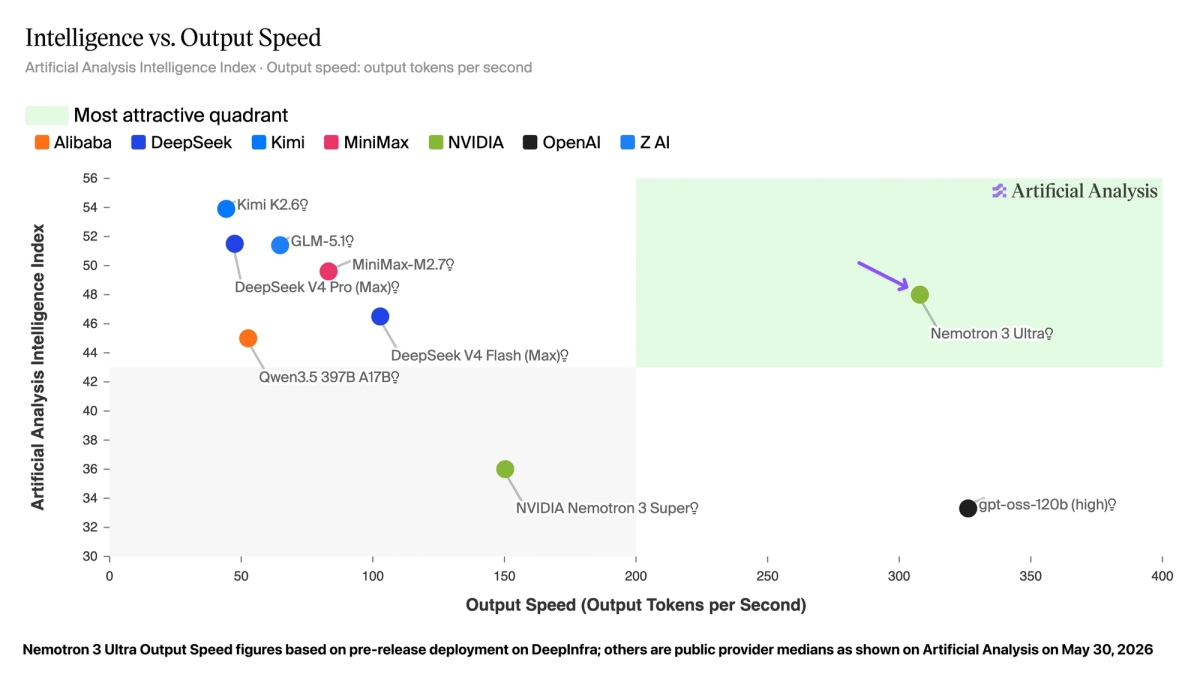
Nemotron 3 Ultra launch announced: high-speed, leading US open weights intelligence
Nvidia announced Nemotron 3 Ultra, a 550B-parameter model with 55B active parameters, the largest model in the Nemotron 3 family to date. Artificial Analysis has found that although it is the strongest US open-weights model, it lags behind the leading Chinese open models, such as Kimi K2.6 or DeepSeek V4 Pro. However, it excels in output speed, serving over 300 tokens per second versus the 50–100 typical of comparably sized Chinese models.
They Are Top Spenders in the Midterms. And They Hate Each Other.
The midterm elections in the US are approaching, and there are many stories around them. One of those stories is a bitter feud between two AI-backed super PACs: Public First, tied to Anthropic, and Leading the Future, linked to OpenAI. Though both claim to promote AI, they despise each other and have already spent nearly $24 million, with over $100 million more promised. Anthropic's side favours stricter AI rules while OpenAI's pushes for industry-friendly laws.
DeepSeek nears US$7b haul in first-ever funding round, with backing from Tencent, CATL
DeepSeek is raising over $7.4 billion in its first outside funding round, valuing the company at nearly $60 billion, six times its worth in April. Backers include big Chinese tech firms like Tencent and JD.com, with founder Liang Wenfeng reportedly adding around $3 billion of his own money. This is a big change for a company that had refused outside money before, now wanting a clear value and a way to keep staff from leaving.
MiniMax eyes a Shanghai listing after a 400% run in Hong Kong
MiniMax, a Chinese AI startup whose Hong Kong shares have jumped about 400% since January, now wants a second listing on Shanghai’s STAR Market. This would let it sell yuan-priced shares to mainland investors and tap a larger pool of home-grown capital. For now, it is just an early exploration that still needs regulatory approval.
Hackers Used Meta’s AI Support Bot to Seize Instagram Accounts
Meta messed up big time. Over the weekend, hackers tricked Meta’s AI customer support bot into resetting account passwords, briefly defacing high-profile Instagram accounts with pro-Iranian images and messages, including the Obama White House and a top US Space Force official. The trick worked by getting the bot to link a new, attacker-controlled email address to an existing account, which then triggered a password reset code sent to that address. Security experts recommend enabling multi-factor authentication, and maybe thinking twice before giving AI access to sensitive data and actions.
Mark Zuckerberg Wants Meta’s New AI Agents to Run Your Whole Business
Meta has launched an AI agent that helps businesses on WhatsApp, Instagram and Messenger answer customer questions, book appointments and make sales. It’s free for now but will soon become a paid service, and reportedly a million businesses already use it. The move pushes Meta beyond its usual advertising business into selling services to companies, helping it recover some of the huge sums it is spending on AI. Mark Zuckerberg says the goal is to build agents for all of Meta’s users and eventually help people run their entire businesses.
Suno raises at a $5.4bn valuation, more than doubling its worth in six months
AI music generator Suno has raised money at a $5.4 billion valuation, more than double its worth six months ago. The company is growing fast, with over 100 million users and around $150 million in 2025 revenue. The bigger reason for the jump is legal: Suno was once sued by all three major record labels for training on copyrighted songs, but Warner and Universal have now settled and become partners. In return, Suno is moving to a paid, licensed product that lets artists control how their work is used. Risks remain, as Sony is still suing, and a key court ruling is expected in summer 2026.
Florida sues OpenAI, Sam Altman, in first-of-its-kind lawsuit over violent incidents
Florida’s attorney general has sued OpenAI and its CEO, Sam Altman, claiming the company put profit and winning the “AI arms race” ahead of safety and ignored warnings about ChatGPT. The lawsuit links the chatbot to serious harms, including helping mass shooters, pushing vulnerable people towards suicide, and collecting data from children without parental consent. It follows an investigation into ChatGPT’s possible role in a 2024 Florida State University shooting, which OpenAI denies. The case joins a growing number of lawsuits blaming ChatGPT for violent deaths and points to rising legal pressure on AI companies over how safe their products are.
Promoting Advanced Artificial Intelligence Innovation and Security
President Trump has signed an executive order on AI and cybersecurity, but a much lighter version than the one he rejected in May. It asks AI companies to voluntarily let the government review powerful new models 30 days before release, down from 90 days, and rules out any mandatory approval system—a win for the industry and Trump’s concern about competing with China. The order also sets up a Treasury-led system for sharing security flaws, tells the Pentagon to secure its networks, and directs prosecutors to go after AI-enabled hacking.
Martin Scorsese Is Embracing A.I.
Martin Scorsese has backed Black Forest Labs, an AI image startup, saying he used its tools to create storyboards for a new film. This marks a big change in Hollywood, which strongly fought AI during the 2023 strikes but is now warming to it, with figures like Demi Moore and festivals like Tribeca embracing the technology too. Scorsese’s support is limited, though: he sees AI as a way to share his ideas with his team faster and cheaper, not as a replacement for people. Others, such as Seth Rogen and Guillermo del Toro, still firmly oppose it.
Bernie Sanders: A.I. Is a Public Resource. You Should Own Half of It.
In this essay, Bernie Sanders proposes the American A.I. Sovereign Wealth Fund Act, a bill that would tax the biggest AI firms 50% in company stock, giving the public ownership, voting power and board seats. His rationale is that since AI is built on humanity’s shared knowledge, its profits should benefit everyone, not just a few tech billionaires. The money raised would fund direct payments and better healthcare, education and housing for all Americans. Sanders points to similar funds in Norway and Alaska as proof that the idea works, and says AI’s future should be decided democratically rather than by Silicon Valley alone.
▶️ Can Yann LeCun Reshape AI (again)? (40:56)
This is part 2 of Welch Labs’ conversation with Yann LeCun, one of the pioneers of modern AI, which focuses on LeCun’s new approach to solving intelligence called JEPA. Where part 1 introduced the basic idea, this video pits JEPA against the popular VLA (Vision-Language-Action) approach used to build robot brains. LeCun argues that the popular VLA approach to robot brains is "doomed" because it just copies human demonstrations and can't plan ahead. JEPA instead learns a "world model" and lets the robot plan its own solutions. The video shows the idea is promising but still early, ending with LeCun's bet that such world models could one day control everything from factories to medical treatments.
What political censorship looks like inside an LLM’s weights
This is an interesting study exploring how Chinese government censorship is built into the Qwen3.5 model. The research found the model still knows the real facts about sensitive topics like Tiananmen—it has just learned to dodge them rather than forget them. This behaviour traces to a small, specific part of the model that decides whether a question is politically sensitive and whether to refuse, deflect, or give propaganda. Tweaking the right internal setting could switch the censorship off, but pushing too hard didn’t reveal the truth; it made the model produce confident made-up answers instead. The takeaway is that such censorship can be precisely located and partly disabled in open AI models, though doing so can swap one false answer for another.
🤖 Robotics
NVIDIA releases new and updated tools for physical AI developers
At Computex 2026, Nvidia unveiled a wave of tools for robots, physical AI, and self-driving cars. The star was Cosmos 3, an open model that turns text, images, video, and sound into real-world actions for machines. For cars, Nvidia launched Alpamayo 2 Super, an open reasoning model for robotaxis, with Foxconn, Uber, VinFast, and HUMAIN joining its DRIVE Hyperion robotaxi platform. For robots, it announced the Isaac GR00T Reference Humanoid Robot, an open design built on a Unitree body and Jetson Thor chips, due late 2026. Nvidia also released open-source "agent skills" that let AI agents handle the data, simulation, training, and deployment work behind robots, vehicles, and factories. The goal, Jensen Huang said, is to make physical AI development far faster and cheaper.
▶️ Unitree’s Robots at America's Got Talent (6:00)
This performance gives robot dance a new meaning. It also shows how good Unitree’s robots are at acrobatics and synchronised choreography.
Autonomous defense manufacturer Mach Industries raises $300M
Mach Industries, a defence startup founded in 2023, has raised $300 million, bringing its total funding to $1.8 billion. The company builds autonomous weapons systems and controls its own manufacturing to develop and produce them quickly. Its main customers are the US Army, Air Force, and SOCOM, along with allied governments.
A robot is helping an ailing couple stay in their home. Are more to come for an aging population?
This article looks at how robots are starting to help care for elderly and disabled people, at a time when home care workers are in short supply. It follows a New Hampshire couple who use a wheeled robot called Robbie to handle daily tasks like exercise reminders, taking medicine and fetching water. Through their story, it explores the current state of caregiving robots, comparing simple, practical machines with the still-distant dream of human-like helpers. It also touches on the high cost and asks how far this technology has really come.
▶️ When steel meets soul, the waltz begins. (0:29)
Like many other companies developing humanoid robots, UBTECH has joined the trend of creating videos of its robots dancing. Unlike most others, however, UBTECH opted for a more elegant and refined performance: a waltz with a human partner.
Humanoid Hands Are Physical AI’s Anti-Hype Test
This article highlights one of the themes discussed at the Humanoid Summit in Tokyo: the biggest hurdle for humanoid robots isn’t walking or thinking, but giving them hands that can grip and feel as well as ours. Speakers said this “last mile” of automation needs robots to sense touch and pressure, which requires new kinds of data that the current AI models can’t provide.
OpenAI Robotics is hiring
OpenAI Robotics is hiring, writes Sam Altman in a tweet. The company is looking for “exceptional full-stack hardware, ops, systems, and ML engineers to help us program and manufacture robots that are useful for society.” Robotics is coming back to OpenAI after the company disbanded its first robotics division in 2021.
Startup offers free home cleaning—if it can record it all for robot training
German startup MicroAGI is offering free home cleaning in New York, but with a catch—the cleaners wear cameras to record everything, and that footage is used to train household robots. The company says it blurs faces and personal details, but it won’t say if you can have your video deleted, and it’s unclear whether homes could still be identified.
How to build a shitty robot
In this article, Mario Zechner shares how he took a toy robot, hacked it, and rebuilt it with modern AI. It's an interesting project that anyone can try, and, as he writes, it gave him a bit of his spark back.
🧬 Biotechnology
In Support of Mandatory Nucleic Acid Synthesis Screening and Recordkeeping
Leaders from top AI firms—including Google DeepMind, OpenAI, Anthropic, and Microsoft—have signed a letter asking US lawmakers to force companies that sell custom DNA to check who their customers are. They worry that cheap gene-printing combined with AI could make it easier for bad actors to build dangerous viruses, possibly even causing a pandemic. Some companies already check orders voluntarily, and a new Senate bill would make this a legal requirement, but experts say these checks can be fooled. They argue AI companies must also add their own safeguards to stop their tools helping with such tasks.
Human Hookworm Engineered to Produce, Secrete Anti-Tetrodotoxin Antibody Into Preclinical Host Bloodstream
Scientists have genetically altered a human hookworm to make and release a drug inside a living host for the first time. Because hookworms naturally live harmlessly in the gut for years, the team engineered one to produce an antibody against a deadly pufferfish toxin, and blood from treated animals partly neutralised it. The hope is that a single dose could one day deliver continuous, long-lasting treatment for conditions like Crohn’s disease.
💡Tangents
Helion, the Sam Altman-backed fusion startup, raises $465M to build a power plant for Microsoft
Helion, a fusion startup backed by Sam Altman, has raised $465 million, valuing it at $15.5 billion. The company is rushing to build its first power plant and aims to deliver fusion electricity to the grid by 2028 under a deal with Microsoft. The funding is part of a wave of big investments in fusion, even though most companies don't expect working plants until the 2030s.
Quantum Computing Is Having Its Public Market Moment
Quantinuum is going public despite losing nearly $200 million last year and admitting its technology might never work—yet investors are so keen they’ve raised its share price. Like other quantum companies racing giants such as IBM and Google, it’s betting on a future no one has built yet. The situation is perfectly summed up by this quote from the article: ”In quantum to date, with most companies and equities, you’re not buying a business as of yet, you’re buying a probability.”
Thanks for reading. If you enjoyed this post, please click the ❤️ button and share it!
A big thank you to my paid subscribers, to my Patrons: whmr, Florian, dux, Eric, Preppikoma and Andrew, and to everyone who supports my work on Ko-Fi. Thank you for the support!