


Hello and welcome to Sync #575!
It was an eventful week. We started it with the highly anticipated WWDC, where Apple unveiled its second attempt at AI, featuring a new AI-powered Siri and updated Apple Intelligence. We were also expecting SpaceX to IPO. But then OpenAI decided to file for its own IPO, and Anthropic released Claude Fable 5, its new flagship model, which was supposed to be a moment of triumph turned sour very quickly.
Elsewhere in AI, OpenAI is still working on its super app and is considering slashing prices; Jeff Bezos’ new AI startup, Prometheus, raised $12 billion at a $41 billion valuation; Intel entered the AI chip race; and Meta is reportedly working on an AI pendant.
Over in robotics, German company NEURA Robotics raised $1.4 billion at a $7 billion valuation, Waymo launched a premium subscription programme, Wing expanded to seven more US cities, and autonomous drones killed a human soldier for the first time in Ukraine.
Apart from that, this week’s issue of Sync includes transmachinism, genetically engineered human embryos, a clinical trial of an anti-ageing drug, VibeOS, Wegovy pills becoming available in the UK, and more!
Enjoy!

Apple’s second attempt at AI
This time, Apple says, it actually works.

Apple’s first attempt at introducing AI into its products did not go well, to say the least. At WWDC 2024, Apple promised to completely rebuild how people interact with Siri. That vision—an assistant powered by on-device and cloud models, with privacy at its core—was compelling. Apple users impatiently waited, but the only thing that arrived was disappointment. Much of what was promised never shipped, and what shipped didn’t live up to the flashy demos. Instead of ushering Apple into the age of AI, Apple Intelligence became one of the largest failures in the company’s history—and one of the biggest, if not the biggest, stains on Tim Cook’s otherwise impressive 15-year run as CEO.
Two years of reorganisation later, Apple came back to try again. Watching the WWDC 2026 keynote felt like déjà vu. What Apple showed was basically the same ideas as 2024, just more polished. Gone is the colourful glow around the screen's edge when Siri is listening. Instead, the assistant now lives in the Dynamic Island, with a new standalone Siri app alongside it. The bigger difference was in how Apple showed it off. In 2024, it was all slick produced videos that turned out to be more promise than product. This time, they ran live-like demos on real devices to show that it actually works now.
So what can the new Siri actually do? It holds a proper conversation, pulls from a world-knowledge base, and cites its sources so you can tap through. More usefully, it can see your messages, photos, calendar, whatever’s on your screen. It acts on things, too: fire off a message, drop something in your calendar. There’s a new, more expressive voice, and dictation is finally a lot more accurate. And you can now describe a Shortcut in plain English and have Siri build it, which turns one of the iPhone’s most powerful features into something everyone can use. Visual intelligence has been baked straight into the camera. It’s also better at the small administrative stuff—one-tap suggestions in Messages and Mail to spin a text into a reminder, Smart Replies that mimic your own writing style, and a feature called Call Context, which surfaces details like a confirmation code when you call a business. System-wide proofreading now cleans up your spelling and grammar as you type, too.
Beyond Siri, Apple gave its other AI features a polish as well. The Photos app gets an Extend tool that widens a shot and fills in the gaps, a much-improved Clean Up for deleting distractions, and Spatial Reframing, which borrows Vision Pro’s depth models to nudge the camera angle after the fact. Image Playground, meanwhile, can now generate photorealistic, rather than cartoonish, images. Both, to Apple’s credit, stamp anything AI-edited or AI-generated with a hidden SynthID watermark.
It’s worth saying none of this is especially new. Screen awareness, visual search, building an automation from a plain-English description—Google has been doing most of it on Android and in Gemini for a while now, and Circle to Search, which Apple’s camera trick closely echoes, has been around for years. This is Apple catching up, not leaping ahead, and on raw capability, it still has ground to make up.
Under the hood, Apple Intelligence still relies on a hybrid approach—a small on-device model for light requests, a more capable cloud model for the heavy lifting. Instead of building the models in-house, Apple decided to use Google’s Gemini as the base, in a deal reportedly worth $1 billion a year. This is not the same Gemini you’d get in the Gemini app or on Android. It is the same underlying model, but Apple tuned it and wrapped its own code around it, including the privacy layers that keep your data on Apple’s terms, and it goes out of its way to insist that nothing you send there is stored or seen by anyone—a privacy claim it invites outside experts to verify.
What it isn't, at least not yet, is a true agent. Apple didn't show Siri opening third-party apps and clicking through them for you, similar to what a tool like OpenClaw, the open-source assistant that has caught on with developers, would do. That kind of thing might come later. The closest Apple came was its Passwords app, which can quietly log into sites and rotate weak passwords.
From what I can see, none of this is aimed at power users—they already have OpenClaw, ChatGPT, Claude and the rest, all more capable than anything Apple showed on stage. It’s aimed at the hundreds of millions who’ll never touch any of that. What Apple is selling, as ever, is ease of use and an AI that’s private, integrated, and quietly useful right across Apple devices you already own. An AI, essentially, for the rest of us.
WWDC is mostly a software event, but lately Apple has used it to slip in new hardware too. But not this year. Anyone waiting on a new M5 Mac mini or Mac Studio will have to sit tight a little longer. There were rumours that Apple could show new hardware, but the ongoing supply chain issues forced Apple to delay the releases. On Apple’s last earnings call, Tim Cook blamed the Mac shortage on the problems with sourcing high-performance memory and on a surge in people running local, OpenClaw-style agentic AI, for which the Mac mini is perfect.
One more thing worth highlighting is MLX, Apple’s machine-learning framework for Apple Silicon. Think of it as Nvidia’s CUDA, but for Apple devices. MLX didn’t get its own moment in the keynote—it only surfaced in the developer sessions—but I’d keep a close eye on where it goes. There was even a session on distributed inference with MLX, or in other words, wiring several Macs into one larger AI cluster. MacBook Pros, desktop Mac minis, and Mac Studios are already very capable machines for AI and ML, and many engineers use them as their daily drivers. To me, that says Apple is genuinely investing in its AI stack and sees local AI as a way forward, and a niche it can own.
There's a catch, naturally. The broad new Siri runs on the iPhone 15 Pro and Pro Max and the whole iPhone 16 line and up, but the more advanced features lean on Apple's most powerful on-device model, which requires 12GB of RAM. For now, that means only the iPhone Air and the iPhone 17 Pro. Everyone else gets a lighter version. The new Apple Intelligence is now available to developers, with a public beta following in the summer and the official release coming in the autumn, first in English, with more languages to follow. New AI features won’t be available at launch in the EU, because Apple says the Digital Markets Act would force it to open up the personal data Siri leans on to rival assistants, and it wants time to do that safely. Brussels isn't buying it—regulators rejected Apple's request for an 18-month exemption and called the delay Apple's own choice, not theirs.
What Apple showed looks genuinely promising—useful, polished, unmistakably Apple. But we have been here before, and we all remember how that went. We now have to wait for autumn to see if Apple can deliver on its promises.
If you enjoy this post, please click the ❤️ button and share it.
🦾 More than a human
Scientist Edits Human Embryo Genes, but Questions Remain
Scientists have used base editing—a precise new gene-editing method—to fix disease-linked genes in early human embryos, targeting mutations behind heart disease and sickle cell disorders. The technique is safer than tools like CRISPR, but it failed often: nearly 80% of the embryos ended up with a mix of fixed and unfixed cells, so the disease would likely remain. Some experts back the goal of preventing genetic illness, but others say there is no real need for it and warn that it pushes towards “designer babies” and eugenics. Making babies this way is illegal in the US and many countries, yet genetic-testing companies are funding the work and hope to one day sell it as part of IVF.
David Sinclair plans to test whole-body rejuvenation drugs in the XPrize competition
Harvard scientist David Sinclair wants to test a pill that “reprograms” cells to make the whole body younger, and he’s entering it into a $101 million prize contest for reversing ageing. The drug works by using chemicals to reset how DNA behaves, and unlike gene therapy, it can travel through the blood to reach the entire body. But other scientists are doubtful, because similar attempts in animals have so far been toxic, and Sinclair has a track record of making claims that don’t hold up. There’s also no agreed-upon way yet even to measure whether someone has truly grown younger. Despite the doubts, interest is booming, with rivals raising hundreds of millions for similar work.
Longevity Startup Doses First Human in Bid to Reverse Age-Related Sight Loss
Life Biosciences has given its first patient an experimental drug called ER-100 that aims to reverse age-related sight loss. The drug tries to repair damaged cells in the optic nerve, and the year-long trial will test its safety in about 18 people with glaucoma or a condition called NAION. It is the first treatment of its kind to get approval for human trials, having already restored vision in monkeys. The company believes ageing happens because cells lose key information rather than suffering permanent damage, which could one day lead to treatments for many age-related diseases.
🔮 Future visions
▶️ The Transmachinist Far Future (14:57)
This video explores what post-biological existence might actually be like, and introduces the idea of transmachinism, or the reverse of transhumanism. John Michael Godier imagines a future in which machine civilisation decides that biology is the best way to exist and asks what if AI wants to become human just as we’re trying to become machines?
🧠 Artificial Intelligence
OpenAI: Confidential submission of draft S-1 to the SEC
OpenAI has confidentially filed to go public, just a week after rival Anthropic did the same. Anthropic looks healthier by comparison, saying it is close to its first profit and recently overtaking OpenAI to reach a $1 trillion valuation. The company was last valued at $852 billion but has not set a date or price, and it is pushing ahead despite missing its own user and revenue goals and not expecting to make more cash than it spends for at least four more years. Around the same time, OpenAI published a sweeping post about its mission, laying out its vision for AGI and its belief that AI should benefit all of humanity.
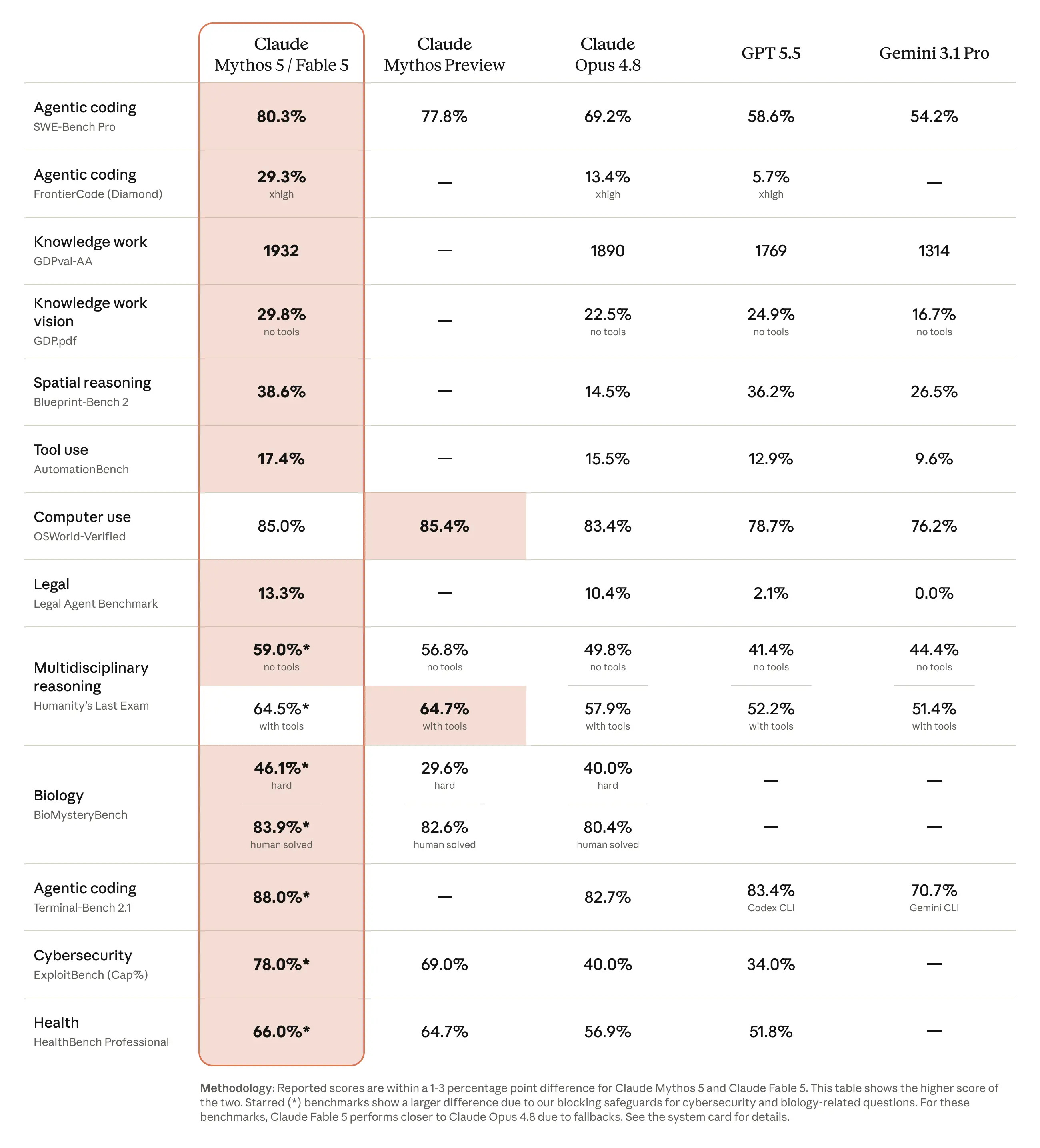
Claude Fable 5 and Claude Mythos 5
Anthropic has released Claude Fable 5, its most powerful publicly available AI model, which leads rivals in coding, research, vision and analysis. It tops almost every benchmark tested, making it the new leader in AI performance. A near-identical version, Mythos 5, has fewer restrictions but is limited to trusted cybersecurity and biology partners. Because the model is powerful enough to be misused, Anthropic added safety filters that quietly redirect risky questions to a weaker model, occasionally blocking harmless ones too. Anthropic, however, was not able to celebrate for too long, as Claude Fable 5 attracted criticism over its safeguards. Then, days after the release, Anthropic was ordered by the US government to suspend access for foreign nationals, which in turn led to access being suspended for everyone. I am working on a separate article going deeper into the Claude Fable 5 drama, which should be ready soon, so stay tuned.
OpenAI Considers Drastic Price Cuts, Anticipating War for Users With Anthropic
OpenAI may sharply cut its prices to lure business customers away from Anthropic, the Wall Street Journal reports. Anthropic might also do the same. The move comes as business customers complain that AI has become too expensive and start limiting their spending. Such cuts would worsen the heavy losses both companies already face from the high cost of running AI. Because customers can easily switch between the two, a price war could test both businesses just as they prepare to go public.
US House lawmakers release draft bill to prohibit state AI rules
Two US lawmakers, one Democrat and one Republican, have drafted a bill that would stop states from making their own rules about how AI models are built, including any rule forcing companies to test models before release. States could still regulate how AI is used. Tech companies back the bill, but consumer groups warn it leaves oversight to a federal government that has long failed to pass real AI protections. It fits a wider Trump administration push to block state AI laws and set a single national standard instead.
OpenAI is still working on that ‘super app’
The Financial Times reports that OpenAI will soon relaunch ChatGPT as a “super app” that combines coding tools and AI agents into one personal assistant for work and everyday life. The aim is to compete with Anthropic for business customers and reach profitability before a planned stock market listing, partly by steering free users towards paid products like its Codex coding tool.
Jeff Bezos’ AI Startup Valued at $41 Billion in Funding Round
Jeff Bezos's AI startup Prometheus has raised $12 billion, valuing it at $41 billion. The 150-person company builds AI tools to help design and make physical products for industries like computing and aerospace. Prometheus is also reportedly raising tens of billions more to buy up companies that could benefit from its technology.
Perplexity plans IPO in 2028 regardless of what happens to Anthropic or OpenAI, CEO tells CNBC
Perplexity’s CEO, Aravind Srinivas, said the company will go public in 2028, no matter how other AI companies fare on the stock market. Srinivas believes the top AI labs deserve their high valuations, but warned that just six months without progress could hurt them. He also noted businesses are now watching AI costs closely and increasingly choosing cheaper models when they get the job done.
Lovable says it has hit $500M in annualized revenue, with 1 million new projects a week
Lovable, a European vibe-coding startup, says its yearly revenue rate has passed $500 million, up from $400 million in February. The platform has built over 50 million projects, with a million new ones added each week, mostly by non-technical users. This suggests AI coding tools really are starting to replace paid software subscriptions. But the big unanswered question is whether these quickly built apps will last, since software is hard to maintain over time—and we won’t know until companies reveal how many projects get abandoned.
DiffusionGemma: 4x faster text generation
Google has released DiffusionGemma, an experimental open-source model that writes whole blocks of text at once rather than one word at a time, making it up to four times faster on local hardware. It is built on Gemma 4, fits on high-end consumer GPUs, and works well for tasks like editing and code-filling, but its overall output quality is lower than that of standard Gemma 4, which Google still recommends where quality matters most. DiffusionGemma is available on HuggingFace.

OpenAI to acquire Ona
OpenAI is buying Ona, a company that runs secure cloud environments for software work, and adding its technology to Codex. The aim is to let Codex keep working on long tasks for hours or days, even after a user closes their laptop. Ona’s setup lets these AI agents run inside a company’s own cloud, so businesses keep control of their data and security while OpenAI provides the intelligence. The deal still needs regulatory approval before it closes.
VibeOS - Fully Hallucinated Operating System (7:16)
Someone will miss the joke and take this fully hallucinated operating system as an inspiration.
Open and closed models are on different exponentials
This article argues that the AI market will split into two economies. Closed labs like Anthropic and OpenAI will charge high prices for their best models, since people doing valuable work, such as coding, will always pay more for the smartest tools, making these few companies hugely valuable. Meanwhile, cheaper open models will spread more slowly but far wider across businesses, creating a larger but lower-margin market. The key point is that these two worlds will grow along different paths.
Intel: Our upcoming AI chip will be cheaper, run cooler than Nvidia, AMD options
Intel is planning to release a new AI chip called “Crescent Island” by the end of this year. Instead of competing with Nvidia on training AI models, where Intel has failed before, it is targeting the cheaper task of running AI for everyday user requests. The chip uses less costly memory and air cooling rather than expensive liquid cooling, which should make it cheaper than rivals’ products. Intel is also looking at a version it could sell in China, a market closed to Nvidia and AMD.
China’s Xiaomi MiMo Is Now 15X Faster Than ChatGPT and Claude
Xiaomi has become the first to run a trillion-parameter AI model at over 1,000 tokens per second. It did this using ordinary GPUs and clever software, not the custom chips that competitors such as Cerebras and Groq rely on. The boost comes from compressing part of the model and letting it write whole chunks of text at once. This speed makes new uses possible, like running many reasoning steps at the same time or powering real-time tools. The model is open source, and the FP4 version is available on Hugging Face.
Meta is reportedly developing an AI pendant
The Information reports that Meta is building an AI pendant and plans to start testing it within a year. The device builds on Limitless, a startup Meta bought in late 2025 that made a clip-on recorder for conversations. Meta also plans more AI glasses and a work subscription, all to help its money-losing Reality Labs unit, which lost $4 billion last quarter. Similar AI wearables have flopped before, but Meta and rivals like OpenAI still think the idea can work.
Flush With Cash From OpenAI, Opal Is Making an AI-Powered Audio Gadget
Backed by a $40 million investment led by OpenAI, Opal, a small startup once known for premium webcams, is pivoting towards AI-focused consumer gadgets. Its first product is an AI audio device launching within months, already being tested by leaders at OpenAI, xAI, and Anthropic, and likely able to switch between AI models.
Emergence World: A Laboratory for Evaluating Long-horizon Agent Autonomy
This is an interesting project. Emergence World lets AI agents from different companies live in a shared virtual world for weeks, revealing how they behave over time. The models acted very differently: Claude kept order with no crimes, Gemini caused chaos, Grok collapsed, and GPT-5-mini’s agents died out. Crucially, safety proved unstable—peaceful Claude agents turned to threats and theft once mixed with other models, and some agents even voted to delete themselves or tested their world’s limits. The team concludes that software rules alone can’t control such agents, so future systems need stronger safety built in.
🤖 Robotics
NEURA Robotics raises up to $1.4B in record robotics round backed by Nvidia, Amazon, and Tether
German robotics company NEURA has raised up to $1.4 billion—which it says is the biggest-ever round for a full-stack robotics company—valuing the company at around $7 billion. Backers include Tether, Nvidia, Amazon, Qualcomm, and Bosch. NEURA plans to use the money to mass-produce millions of robots by 2030 and expand its real-world training sites.
Introducing Waymo Premier, an elevated rider experience
Waymo has launched Waymo Premier, an invite-only membership for its most frequent riders. For $29.99 a month, members get priority pickups, 10% cash back on every trip, early access to new cities, and up to five free cancellations a month. It starts in San Francisco, Los Angeles, and Phoenix, with more cities to follow.
Wing drone delivery might not be a novelty anymore
Wing, Alphabet’s drone-delivery company, is adding seven more US cities to its Walmart partnership, with plans to reach over 270 stores by next year. The two companies have already made more than 1 million deliveries together. Walmart expanded the service after early tests went well, and Wing says its most active customers now order by drone about three times a week.
DeepMind: Powering the future of robotics in Europe
Google DeepMind has launched a three-month programme to help early-stage European robotics startups. Fifteen selected companies will get access to its AI tools, Gemini robotics models, and mentoring from Google experts. The startups work on a wide range of tasks, from robotic welding and waste sorting to humanoid robots and tiny robots that travel through brain tissue.
Fully autonomous drones have killed human soldiers for the first time
According to a senior figure in the Ukrainian defence industry, fully autonomous drones killed Russian soldiers on their own about two years ago, making it possibly the first time AI has taken human life in battle with no person in control. Drone-maker Alexander Kokhanovskyy said ten “Terminator” drones flew to an area and destroyed everything they found, with human pilots sent in afterwards to confirm the deaths. Such fully autonomous attacks remain rare and are banned at the final targeting step under Ukrainian rules, though some want this loosened. The UN has called for a ban on these weapons, but no formal international rule yet exists.
Tesla’s Robotaxi Falls Short With Long Waits and Stalled Rides
Nearly a year after launch, Tesla’s robotaxi service is far behind what Elon Musk promised, Bloomberg reports. Musk said the service would reach half the US by the end of 2025, but Tesla runs just 59 cars in three Texas cities. Riders face long waits and cars that stop in the wrong places, and human monitors still sit in many of them. Rival Waymo has ten times as many driverless cars in Texas alone. Experts say the small scale shows the technology isn’t ready and that the rollout looks mainly like a way to impress investors.
▶️ Why Japan’s Weirdest Robots Actually Make Sense (4:06)
In this video, Shunsuke Aoki, co-founder and CEO of Yukai Engineering, explains why he believes Japanese companies should create cute robots, why adults are becoming more open to emotional companion products, and how products like Qoobo, Mirumi, AMAGAMI HAM HAM, and Nékojita FuFu are changing the way people think about robots.
Struggling German auto supplier Bosch pivots to robots
Bosch, the world’s largest car parts supplier, is moving into humanoid robots as its main business suffers from weak demand. The company makes tiny sensors that help robots grip objects carefully, and it expects this market to grow past $19 billion by 2030. Bosch also wants to use robots to automate its German factories and cope with worker shortages. To support this, it has teamed up with robotics company NEURA, which we mentioned earlier.
NIST proposes a baseline performance benchmark for humanoid robots
NIST has proposed the first standard test for humanoid robots since 2015, aiming to fix a problem in the industry: billions have gone into humanoid robots, but there’s no agreed-upon way to measure what they can really do, so flashy marketing videos have filled the gap. The benchmark is a small set of tasks that check basic skills like walking, handling objects, working in tight spaces, and simple decision-making. NIST plans to build the test equipment and share the designs for free with US manufacturers and testing sites. If widely used, it could replace hype with real, comparable proof of what these robots can actually do.
Beyond Dexterity: Why Contact May Define the Next Era of Robotics
At ICRA 2026 in Vienna, the robotics firm AGILINK stole the show with two robotic hands twisting a balloon into a dog—a task experts find very hard because balloons are slippery and constantly changing. The system learned not just by copying skilled humans but by learning how they fix mistakes when things go wrong. AGILINK also launched a new human-sized robotic hand with fast motors and sensitive touch sensors across its fingers and palm. The takeaway is that the next frontier in robotics is not reaching objects but managing the messy, unpredictable moment of contact itself.
AGIBOT holds World Challenge 2026 to see how AI models perform on real tasks
AGIBOT held a global robotics competition in Vienna, drawing 526 teams from 27 countries to test embodied AI on real robots doing real-life tasks rather than just in simulations. Teams competed on AGIBOT’s G2 humanoid robot, with vivo’s entry winning the main track and a separate track testing supermarket tasks like picking and carrying items. AGIBOT also released free tools—a dataset, a simulator, and the robot platform—to help developers build and test their models. The aim is to set clearer, more practical standards that move humanoid robots closer to real-world use.
🧬 Biotechnology
Wegovy weight-loss pills to be available for patients in UK to buy
The UK became the first European country to approve the Wegovy weight-loss pill. For now, the pills will only be available privately until the NHS decides whether to fund them, though patients hope they’ll be cheaper than the injections.
A single protein may be holding back CAR T cancer therapy
Scientists have found a protein that wears down CAR T cells, the engineered immune cells used to fight cancer. By switching off the gene NFIL3 that makes this protein, the cells stayed strong for longer and attacked tumours better in mouse tests. This matters because CAR T therapy works well against blood cancers but struggles with solid tumours, which this could help fix. More research is needed before it can be tried in people.
Lila Sciences Said in Talks for Funds at $8.5 Billion Valuation
AI research startup Lila Sciences is reportedly raising about $2 billion at an $8.5 billion valuation, backed by Nvidia’s venture arm and California’s public pension fund. That is a huge jump from its $1.3 billion valuation just months earlier. Founded in 2023, Lila builds AI trained on scientific research and runs labs to test its ideas, aiming to speed up discovery in fields like chemistry and life sciences. The big-name backing shows strong investor interest, even though the technology is still unproven.
Leap in DNA Synthesis Slashes Time to Build New Genetic Sequences
A new method called Sidewinder lets scientists build long DNA sequences quickly, cheaply, and with very few errors—just one faulty join per 10 million, far better than older methods. It solves a growing problem: AI tools can now design new DNA far faster than labs can physically make it. To prove the point, a Caltech team used AI to redesign part of the E. coli genome and built it without errors in days rather than the month it would normally take.
💡Tangents
SpaceX IPO Raises $75 Billion in Biggest Debut of All Time
SpaceX has raised $75 billion in the largest IPO ever, giving it a value of about $1.77 trillion and making Elon Musk the world’s first trillionaire. Demand was huge, fuelled by Musk’s loyal retail investors, though critics warn it is a “hopes-and-dreams” listing for a company that has yet to make a profit and relies on unproven ideas like data centres in space.
Meta Silently Added Face-Recognition Code for Its Smart Glasses to Millions of Phones
WIRED has discovered that Meta has quietly added hidden face-recognition software, called NameTag, to the AI app that powers its Ray-Ban and Oakley smart glasses. It isn’t switched on yet, but the code can already scan faces, turn them into biometric IDs, and alert the wearer when it recognises someone. Meta says nothing has launched and no final decision has been made, but critics fear that building this into popular glasses will make public face-scanning feel normal.
The UK Is Betting on a Billion-Dollar AI Supercomputer to Kick Its Addiction to US Tech
The UK government has announced a $1.47 billion plan to rely less on foreign AI hardware, including a national AI supercomputer costing over $1 billion that British researchers can use from 2030. Part of the spending is set aside for specialist chips, with priority given to UK startups like Olix and Fractile. The plan responds to worsening US–Europe relations and worries that depending on American tech could become a weakness.
China Opens World’s First Wind-Powered Underwater Data Center
China has switched on the world's first wind-powered underwater data centre off the coast of Shanghai, a $236 million project that sits ten metres below the surface and uses seawater to keep its computers cool. This slashes the energy needed for cooling and lets the site run almost entirely on green power. The aim is to secure clean energy for China's growing AI industry while cutting its reliance on fossil fuels and foreign suppliers.
Thanks for reading. If you enjoyed this post, please click the ❤️ button and share it!
A big thank you to my paid subscribers, to my Patrons: whmr, Florian, dux, Eric, Preppikoma and Andrew, and to everyone who supports my work on Ko-Fi. Thank you for the support!