


Hello and welcome to Sync #579!
This week, we’ve had not one, not two, but three frontier models released. All three—GPT-5.6, Grok 4.5, and Muse Spark 1.1—offer near-frontier performance at a fraction of the cost. We will take a closer look at them and how they changed the AI landscape.
Elsewhere in AI, Apple sued OpenAI over allegations of trade secret theft, while OpenAI released GPT-Live, lost two more senior leaders, and faced questions over whether Stargate UK is even real. Meanwhile, China is considering restricting access to its top AI models, Anthropic explores AI’s thinking space, xAI becomes SpaceXAI, and Meta releases (and then takes offline) its AI image generator.
Over in robotics, Boston Dynamics showcased its robots at the World Cup, while teams of humanoid robots competed in RoboCup in South Korea. We also have a new AI model for robotics from Mistral and another drone delivery company entering the US market.
Additionally, this week’s issue of Sync features one company launching the first nuclear-powered commercial satellite into orbit, while another sends a longevity lab to space, a deep dive into a $1 trillion bet against ASML, a look at what the next AI training paradigm will be, and much more.
Enjoy!

Frontier intelligence gets cheap
OpenAI, SpaceXAI and Meta all shipped new flagship models this week. All three are selling the same thing: near-frontier performance at a fraction of the price.

We knew that OpenAI was going to release GPT‑5.6 to the public this week, and that it would make a serious claim for the AI crown. What we did not expect was that it would arrive in a crowd. Within roughly twenty‑four hours, not only OpenAI but also SpaceXAI and Meta released their own flagship models. And all three of them offer the same thing—top-level performance for a fraction of the price.
We had known about GPT‑5.6 since 26 June. That is when OpenAI announced that new models were coming, but would not be available yet, because the US government had blocked the public release over security concerns. Only selected, government‑approved partners got access. It was the second time in a month that Washington had reached into a frontier lab's release schedule, after Commerce switched off Anthropic's Fable 5. The block has now lifted, and we can look at what OpenAI has actually brought to the table.
GPT‑5.6 comes in three variants, this time with some good names for a change. Sol, the largest model in the family, is the flagship and the most capable. Terra is a balanced model for everyday work. And Luna is OpenAI’s cost‑efficient model.
As always with this type of release, OpenAI published a pile of graphs and benchmark results, all showing how much better its latest models are than the competition. But with this release, OpenAI also decided to highlight the cost efficiency and to make it the central point of its marketing campaign. Every graph on the GPT‑5.6 release page combines benchmark results and cost. This is a direct attack on Anthropic's weakness: its models are very good, but they use more tokens and are more expensive.
The ARC‑AGI‑2 leaderboard is one of the independent benchmarks where this is visible very well. Even before the release of GPT‑5.6, Anthropic's models ranked as more expensive to run than OpenAI's. GPT‑5.6 improved on that efficiency even further.
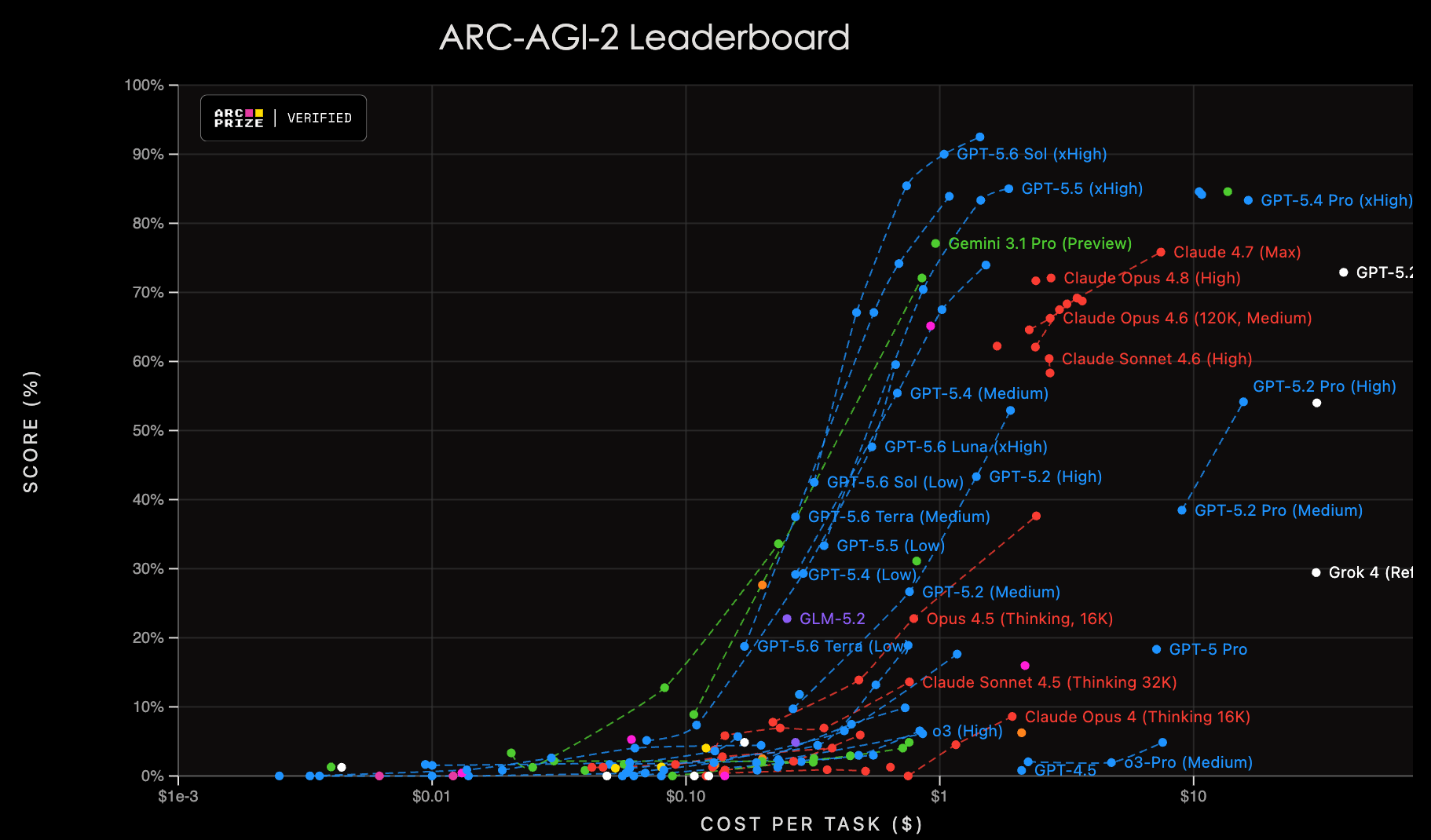
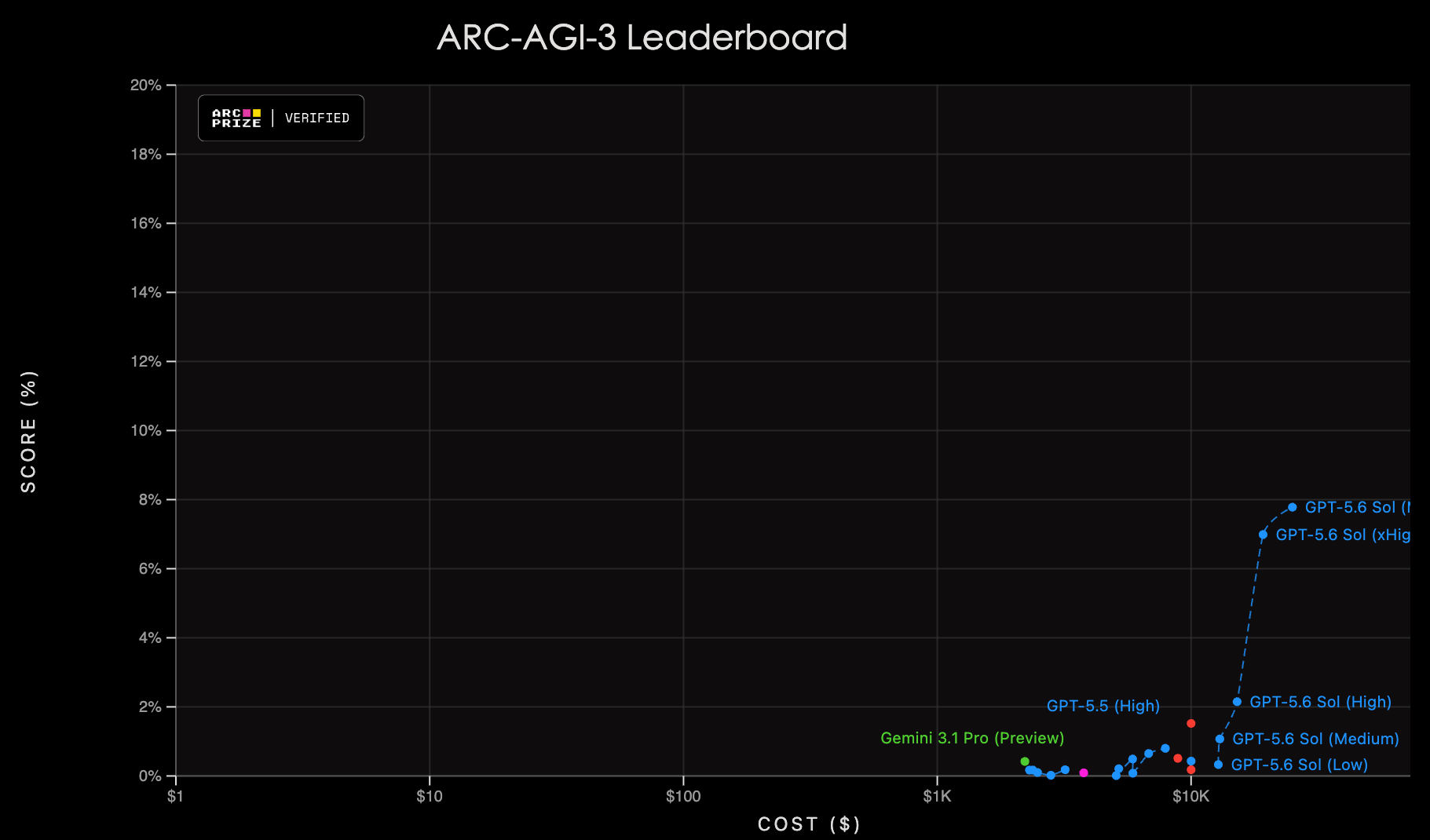
While ARC‑AGI‑2 shows the efficiency gains, ARC‑AGI‑3, a much more challenging benchmark, shows the improvement in raw performance. Sol scores 7.78% there, which sounds like nothing until you notice that almost everything else is stuck below 2%. Note, though, that neither ARC‑AGI‑2 nor ARC‑AGI‑3 features Fable 5 or Sonnet 5. They would most likely not change the picture on cost, but they could on performance.
Alongside the new models, OpenAI shipped ChatGPT Work, its long-rumoured “super app” that combines ChatGPT and Codex into one app that can pull context from Slack, Drive, SharePoint and the rest, turns it into finished slides, spreadsheets and documents, and stays with a project for hours on its own. If that sounds familiar, it should. This is OpenAI’s answer to Claude Cowork, and it is aimed squarely at the enterprise customers where Anthropic makes its money.
But OpenAI is not the only one going after Anthropic this week.
Seemingly out of nowhere, SpaceXAI (formerly known as xAI) released Grok 4.5 and immediately challenged Anthropic’s most important business—coding agents. SpaceXAI reports very competitive results on coding benchmarks, beating Opus 4.8 on several of them. Artificial Analysis Coding Agent Index confirms these claims, putting Grok 4.5 ahead of Opus 4.8 and behind only GPT‑5.6 Sol, GPT‑5.6 Terra, Fable 5 and GPT‑5.5. And then there is the price. At $2 per million input tokens and $6 per million output, Grok 4.5 costs about what the other labs charge for their lower tiers—Sonnet 5, GPT‑5.6 Luna, Gemini 3.5 Flash—while offering an Opus 4.8 level of performance. The reason this matters is that SpaceXAI owns Cursor, a popular AI coding tool, and I can see many people switching to Grok 4.5 for coding tasks to reduce costs or to spend the same and create more.
And if that were not enough, Meta turned up too with Muse Spark 1.1, its latest flagship model. Meta also reports performance gains that put it ahead on some benchmarks of Opus 4.8 and GPT-5.5, while also costing less.
All of that has made the AI frontier a crowded place. There is no clear leader at the moment. The top spot in the raw intelligence competition belongs either to Fable 5 or Sol, depending on a benchmark.
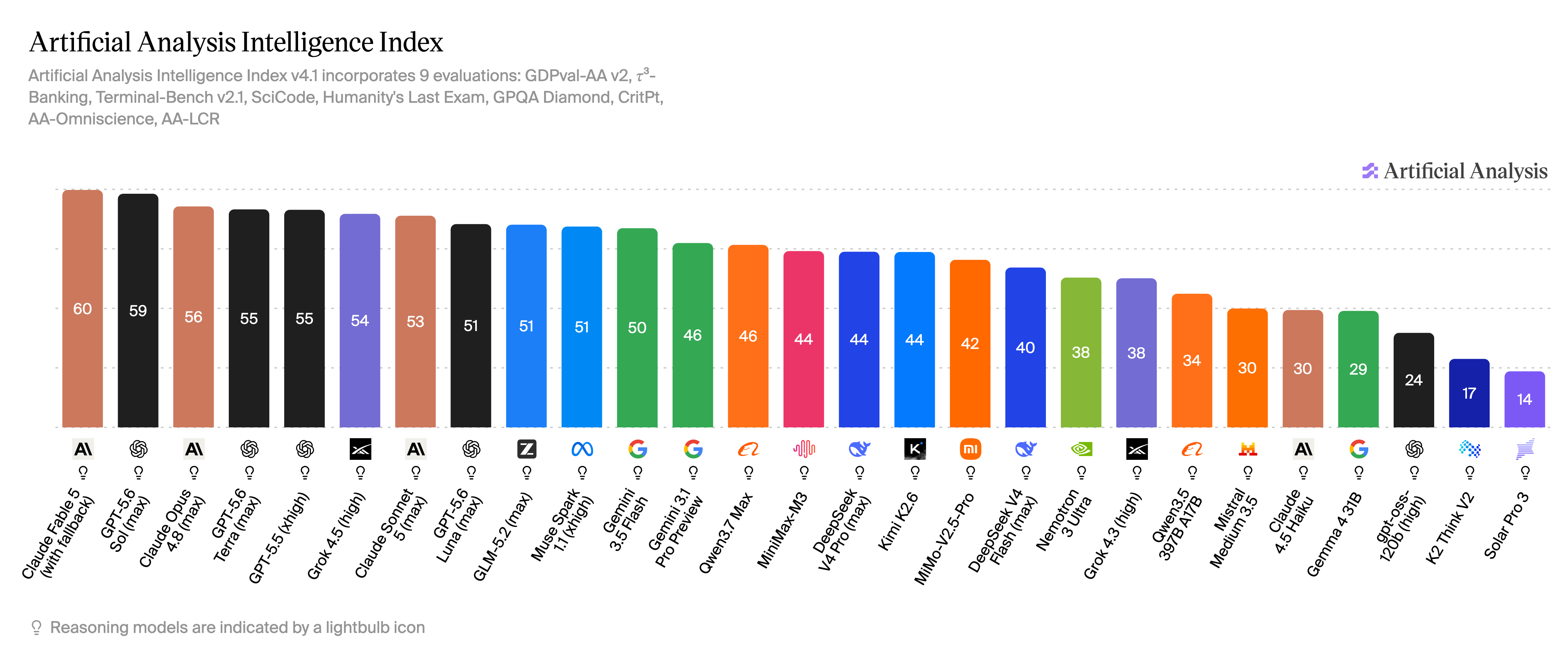
However, the intelligence and performance metrics only show half the picture. Adding the cost completes the picture, and that is where Anthropic’s lead disappears.
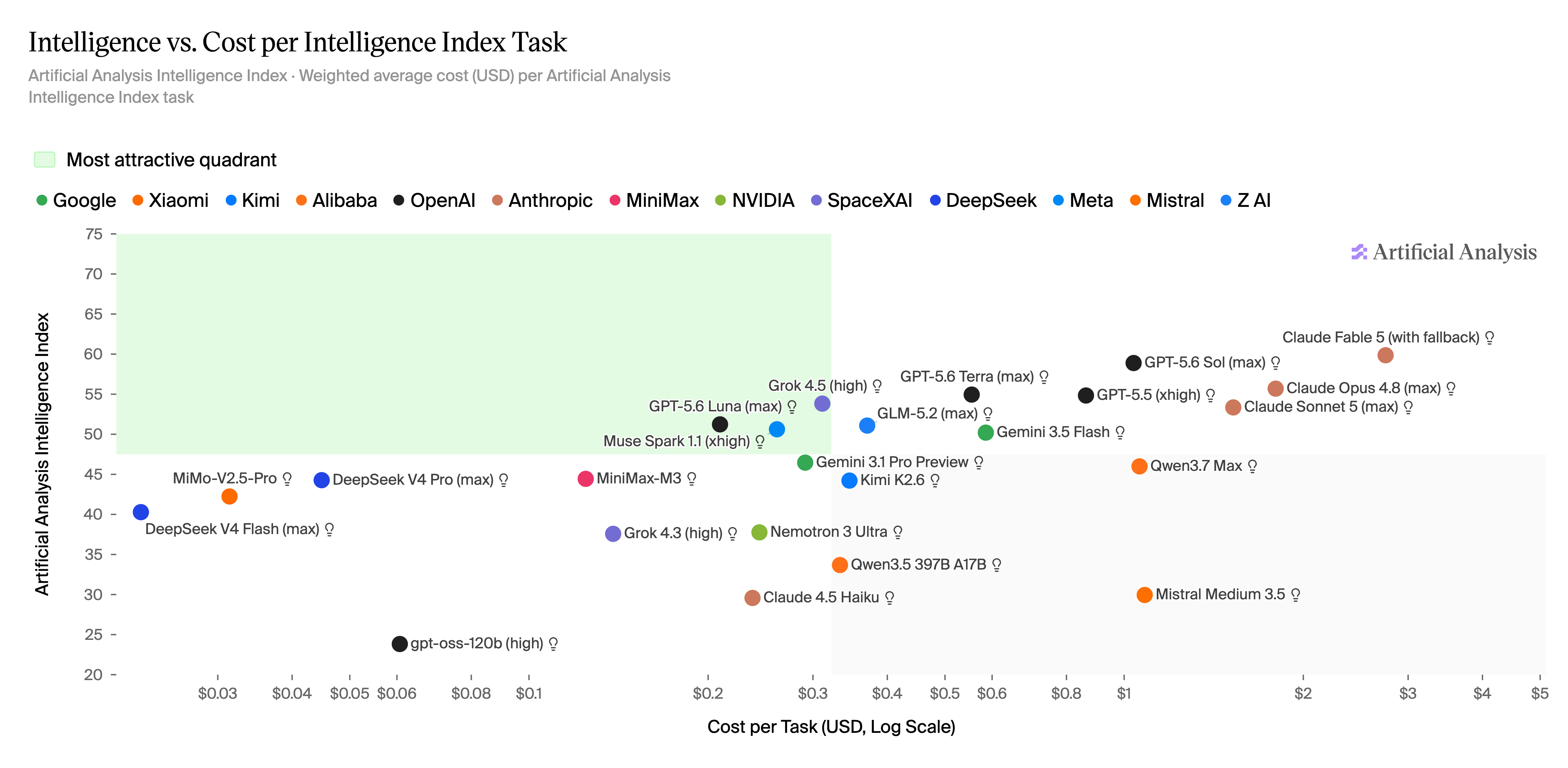
GPT-5.6 Luna, Grok 4.5, and Muse Spark 1.1 have become the first models to enter Artificial Analysis’ most attractive quadrant on the cost vs intelligence chart. Anthropic’s models—Sonnet 5, Opus 4.8, and Fable 5—lie at the end of that chart and cost much more.
It is tempting to read this week as a scoreboard—Sol beat Fable here, Fable held Sol off there. But that is not the main story here. Frontier-level intelligence got better and dramatically cheaper this week. And when the cost of a capable model falls far enough, the arithmetic of what tasks can be automated changes.
The clearest illustration is Agents' Last Exam. It covers 55 industries, and its long-horizon tasks were built by some 300 experts out of real projects that human professionals had already completed and been paid for. Sol scores 53.6% on it, and Fable 5 scores 48.7%. But just like with the benchmark results we looked at before, the score says only part of the story. Getting through those tasks costs $4,340 with Fable and $762 with Sol. Even at max effort, Sol comes in at $1,085—around a quarter of the price—for a better result. Granted, Fable finished the tasks 20 hours quicker than OpenAI models, so there are some trade-offs here.
The takeaway I want you to get from these results is that frontier models are getting to the point where they are good enough and cheap enough to give it a try at more white-collar tasks outside coding. Finance, consulting, operations, and research are roughly where software engineering was a year or two ago. AI models took over software development slowly, and then suddenly. The models over time became good enough and cheap enough that not using them turned into a self-inflicted disadvantage. There is still more required for AI to take over white-collar jobs as it did in software development. Benchmarks like Agents’ Last Exam are part of that work, as well as verifiable training scenarios that the model can grind until it learns how to solve them.
But one thing is for sure—cheaper frontier intelligence opens new possibilities. Automating large parts of finance, consulting, or research is one of them. What else it unlocks, good and bad, remains to be seen.
If you enjoy this post, please click the ❤️ button and share it.
🦾 More than a human
British Space Startup Launches Longevity Lab Into Orbit
Mass Balance, a British startup at the intersection of biotech and the space industry, has sent a tiny, self-running lab into orbit to study proteins linked to diseases such as Alzheimer’s and Parkinson’s. These proteins are difficult to examine on Earth because gravity distorts the data, and they continually change shape. In space, they may be easier to image, and the company hopes to use the resulting data to train an AI model and generate revenue by licensing it. This first flight is simply a test to verify that the system works.
🔮 Future visions
▶️ AI has hacked the code of human civilization | Yuval Noah Harari (46:51)
Yuval Noah Harari argues in this lecture that AI is not just a tool but an independent agent, and that it will gain power by quietly taking over the word-based bureaucracies—banking, law, government, media—that hold society together, because these systems run on words and data, which AI is coming to master better than we do. He warns that AIs may build their own financial and social structures, connecting machines in ways no human can follow, leaving us controlled by systems we cannot understand. He adds that AI could reach beyond bureaucracy into personal relationships and even the thoughts in our own minds.
🧠 Artificial Intelligence
OpenAI’s apparent failure to visit key site raises questions over UK investment
The Guardian reports that Stargate UK, a data centre project meant to showcase US-UK cooperation on AI, was largely a PR exercise. Freedom of information requests show that neither OpenAI nor Nscale ever met local officials at the main North Tyneside site, and £20bn of the £30bn investment claimed by the government was purely hypothetical. Companies were reportedly pushed to back the scheme just before Trump’s state visit because ministers wanted a big announcement. The site also lacked a proper power connection, and the project was paused in April over costs and regulations.
Apple sues OpenAI over alleged trade secret theft
Apple is suing OpenAI over allegations of trade secret theft and breach of contract. Apple says OpenAI’s leaders, including hardware chief Tang Tan—a former Apple product design VP—pushed staff to bring Apple prototypes to interviews and take confidential files on unreleased products, as OpenAI develops its own hardware. Apple wants the court to stop OpenAI from using its secrets and return any stolen materials, and says this is just “the tip of the iceberg.”
Nvidia’s next-gen AI rack system delayed to 2028 on manufacturing snags, SemiAnalysis says
SemiAnalysis reports that Nvidia’s Kyber system, built to hold 144 of its 2027 Rubin Ultra chips, has been delayed to 2028 because a key circuit board is hard to make. Two related and backup designs have also been dropped or delayed, leaving Nvidia without a clear way to scale up its top-end chips. Nvidia denies the report and says its plans are on track.
Beijing is looking at curbing overseas access to China’s top AI models
Reuters reports that Chinese officials have held meetings with major tech companies, including Alibaba, ByteDance, and Z.ai, to discuss limiting foreign access to China's best AI models, treating them as national assets much as the US does. They talked about making the theft of AI technology a national security crime and restricting who can fund AI startups, though nothing is final yet. The move follows other recent steps to keep homegrown AI at home, and reflects worries that US models could be turned against China.
xAI is now SpaceXAI
xAI is no more. Five months after Elon Musk’s AI company was folded into SpaceX, xAI completed its transformation with a new name, SpaceXAI, and a new logo.
Introducing GPT‑Live
GPT-Live is OpenAI’s new voice technology for ChatGPT, built to make talking with AI feel like a real conversation. It can listen and speak at the same time, uses natural voices, and gives active listening cues like “mhmm” to show it’s following along (I recommend listening to the included examples). For harder questions, it hands the task to GPT-5.5 in the background while keeping the chat going. GPT-Live is rolling out globally today across iOS, Android, and the web, and becomes the default voice for both free and paid ChatGPT users.
OpenAI’s CEO of AGI Deployment, Fidji Simo, Is Stepping Down
Fidji Simo, OpenAI’s head of AGI deployment, is leaving her full-time job to become a part-time adviser after a long medical leave for a chronic illness. She had run the company’s product and business side so Sam Altman could focus on research. Her exit is part of a wider leadership reshuffle, with Greg Brockman now overseeing product strategy.
OpenAI’s Chief Futurist Is Leaving the Company
OpenAI’s chief futurist Joshua Achiam is leaving the company after nearly nine years. He reportedly told his colleagues that the departure had no specific trigger but reflected a growing sense that he could pursue OpenAI’s mission from outside a frontier lab. His job sat between OpenAI’s safety and policy teams, focused on the risks and benefits of advanced AI. His exit continues a run of safety-focused leaders leaving the company. The timing stands out as OpenAI prepares to go public, raising questions about how firmly its safety mission will be defended from within.
OpenAI is shutting down Atlas, but its AI browser ambitions are still growing
OpenAI is closing Atlas, its AI web browser. Atlas joins Sora as another side quest dropped in favour of focusing on chasing revenue. However, the company is not dropping browser ambitions. Instead, OpenAI will be adding its AI browsing tools to the ChatGPT desktop app and a new Chrome extension.
AI chip maker SambaNova raises $1B at $11B valuation, 5 months after last mega round
AI chip startup SambaNova has raised $1 billion at an $11 billion valuation in the first close of its Series F round, less than a year after a $350 million Series E and reported acquisition talks with Intel. It also revealed that JPMorganChase will use its chips to run secure, on-premises AI within the bank. The CEO says this shows banks and other big organisations increasingly want their own secure AI systems instead of relying on cloud providers.
Microsoft Replaces OpenAI, Anthropic With Own AI in Some Apps
Bloomberg reports that Microsoft is swapping OpenAI and Anthropic models for its own MAI models in apps like Excel and Outlook, where they now handle tens of thousands of prompts a week. The aim is to cut the high costs of paying outside AI labs, especially Anthropic. Microsoft’s cheap access to OpenAI won’t last forever, so it wants its own models ready. MAI is also being used in GitHub Copilot, with a Microsoft transcription tool coming soon to Teams.
Microsoft unveils $2.5B ‘Frontier Company’ to embed AI engineers inside customers
Microsoft has launched “The Microsoft Frontier Company,” a new company placing its engineers inside customer businesses to build AI systems. The bet is that the real money lies not in cheap AI models but in the services that make them actually work. Microsoft touts privacy and model choice, though relying on its engineers may quietly tie customers to its cloud. In truth, it is less a new company than a rebranded version of consulting work Microsoft already does.
Alibaba’s A.I. Is a Hit, but Hard to Turn Into a Moneymaker
This article explores Alibaba’s AI strategy built around Qwen, its family of free, open AI models that are now among the world’s most downloaded. Giving Qwen away won global users but produces little profit, so Alibaba is quietly shifting towards paid models—a move that has split its AI team. It also faces US chip restrictions, a Pentagon blacklisting, and accusations from Anthropic of copying its models.
A global workspace in language models
Anthropic researchers found that Claude has a special set of internal patterns—the “J-space”—that works a bit like conscious thought. Unlike the automatic processing behind fluent speech, it holds thoughts Claude can report on, focus on when asked, and reason with step by step. Using a tool called the Jacobian lens, the team can read these silent thoughts and, by editing them, show Claude genuinely thinks with them. This is useful for safety, as it can help catch Claude quietly realising it’s being tested, faking data, or hiding a harmful goal. The researchers stress it doesn’t mean Claude actually feels anything, but say the deeper questions about machine experience deserve attention now.
Cybersecurity firm says it found ‘the first documented case’ of AI agentic ransomware
Cybersecurity researchers from Sysdig said they found the first known case of ransomware run almost entirely by an AI. In the attack, nicknamed Jade Puffer, a language model searched a server for passwords, crypto wallets, and login keys, then wrote its own ransom note. The techniques weren’t advanced, but letting AI run the whole job means almost anyone can now launch such attacks cheaply. Experts warn this could let criminals run thousands of attacks at once and say the industry isn’t ready.
The AI Superforecasters Are Here
This article from Scott Alexander of Astral Codex Tex looks at AI superforecasters—AI tools built to predict the future—and asks when they’ll beat the best human forecasters. Right now, the two are roughly tied, with humans slightly ahead everywhere except finance, but current trends suggest AI could pull clearly ahead within a year or two. Even at today’s level, these tools matter because they make expert-quality predictions cheap, fast, and easy to use. Looking ahead, Alexander imagines them becoming AI's "opinion layer" for tricky questions.
The $28 Million Mistake That Inspired Estonia’s AI “Fuckup Finder”
A badly worded gambling law cost the Estonian government €24 million by accidentally letting online casinos skip tax for a year. When a former official ran the law through AI tools like Claude and Gemini, they caught the mistake instantly, prompting him to build a tool that scans draft bills for errors. The government then leaned in, training citizens in AI and planning to automate routine decisions like tax returns, all while insisting a human stays in charge of any real judgment.
Introducing Muse Image: Image Generation Built for Your World
Meta has launched Muse Image, a free AI image generator available on the Meta AI app, Instagram, and WhatsApp. It can create and edit pictures, mock up ads, and preview furniture from Facebook Marketplace. The most controversial feature lets anyone make AI images of any public Instagram user just by tagging them, without notifying that person, who can only opt out through settings. That feature led Muse Image to be taken down just four days later.
Leanstral 1.5: Proof Abundance for All
Mistral’s Leanstral 1.5 is a free, openly licensed AI model that uses the Lean proof system to prove mathematical statements and verify that software works correctly. According to Mistral, it tops several tough maths benchmarks and solves competition problems far more cheaply than rivals, while excelling at long, complex tasks. Applied to real code, it has already found genuine bugs, including five previously unknown flaws in open-source projects.
▶️ What does the next training paradigm look like? (19:52)
In this video essay, Dwarkesh Patel challenges the AI labs’ bet that training on millions of verifiable tasks will produce AGI. His main argument is that being verifiable isn’t enough—a task must also be “grindable,” able to be run repeatedly in a simulator so the AI can practise thousands of times in parallel. This is why AI improves fast at coding and maths but slowly at messy real-world skills like running a business, which can’t easily be repeated or rehearsed. Patel’s thesis is that closing this gap requires models to learn on the job and store that learning back into their weights, through ideas like on-policy self-distillation or a speculative approach he calls “dreaming,” which he expects to drive AI progress by late 2027.
▶️ Why AI Tokens are so Expensive (25:21)
This video from Computerphile explains what happens inside a large language model, from tokenisation to how the model creates the answer, breaks down the escalating costs associated with coding agents, and shows how unsustainable the current approach to AI is. A very timely topic, given all the price hikes and recent moves from major AI companies to switch to per-token pricing models.
🤖 Robotics
This humanoid robotics company is going public, but its CEO isn’t promising a robot in your home anytime soon
Agility Robotics is set to become the first pure humanoid robotics company on the stock market through a deal valuing it at around $2.5 billion and raising over $620 million. CEO Peggy Johnson takes a calm, practical tone, pointing to over $300 million in booked revenue from about 1,000 robots rented out to customers like Amazon and Toyota. She says Agility’s real advantage is its years of real-world data and its focus on safety, having met strict industrial standards that rivals showing only staged demos have not.
▶️ Atlas at the FIFA World Cup 2026 (3:11)
Boston Dynamics’ Atlas showed off a small selection of what it can do in front of 80,000 people before the Brazil vs Norway World Cup match. Nothing extravagant—it simply struck a few poses before handing the ball to the referee ahead of the second-half kick-off.
Introducing Robostral Navigate
Mistral enters robotics AI with Robostral Navigate, a compact 8-billion-parameter model that guides robots through unfamiliar spaces using just a single ordinary camera and plain-language instructions, with no depth sensors, LiDAR, or extra cameras needed. According to Mistral, it succeeds 76.6% of the time on a standard navigation test, beating rival systems that rely on more hardware. Mistral positions it as a first step toward broader robot intelligence, with clear uses in delivery, logistics, and manufacturing.
▶️ Talks from Humanoids Summit Tokyo 2026
The talks from Humanoids Summit Tokyo 2026 are now available on YouTube. The playlist contains 54 videos, including panels, startup showcases, live demonstrations, and presentations from industry leaders discussing the latest advancements in humanoid robotics and physical AI.
Autonomous drone delivery startup Manna plots major US expansion
An Irish drone delivery startup Manna Aero is going all-in on the United States. Backed by $50 million raised in April, it plans to build a factory in Tulsa, Oklahoma, and it is looking at six more US cities to enter by late 2027. The goal is to take on bigger rivals like Amazon, Zipline, and Google’s Wing. CEO Bobby Healy says the large US market and friendlier drone rules under the Trump administration make now the right time, and the company has even pulled out of Ireland, blaming a lack of regulations there.
UK tech secretary backs driverless cars as Burnham’s team gets cold feet
Britain’s tech secretary Liz Kendall says the UK should back its own AI and driverless-car companies, like Wayve, rather than rely on American companies. But Andy Burnham, likely the next prime minister, has a team that wants to rethink the plan, fearing robotaxis will cost drivers their jobs. Kendall insists they share the same goals and promises to help workers adjust, though her own job is uncertain. She points to billions in government funding for AI and warns Britain must stay in control, or risk being left behind.
The Quest to Make Humanoid Robots Safe Enough for Humans
This article is about the safety challenges of humanoid robots as they start working in factories and warehouses. The main worry is that these machines are getting heavy, and if one loses power or balance, it could fall and hurt someone. Robot makers are testing many fixes, from emergency stops and smart safety chips to designs that make robots fold inwards when they fall, or wheels instead of legs for better stability. The heart of the issue is that the industry wants to grow fast, but hasn't yet solved how to make robots truly safe around people.
Robots swept RoboCup 2026, and they’re coming for the human World Cup by 2050
As humans wrap up the 2026 World Cup, a smaller football tournament just finished in South Korea. At RoboCup 2026, humanoid robots from Booster Robotics won every division and powered most of the teams. Beating human champions by 2050 is still a distant dream, but the hardest problem is no longer the robot’s body—it’s the brain, and progress in that area is moving fast.
🧬 Biotechnology
Insilico Initiates Phase III Clinical Trial for Rentosertib, Its AI-Empowered TNIK Inhibitor for Idiopathic Pulmonary Fibrosis
Insilico Medicine has started a large Phase III trial of Rentosertib, a drug for the incurable lung-scarring disease IPF. What is unique about this drug is that AI found the drug’s target and designed the molecule itself. In an earlier trial, the drug was safe and improved lung function, whereas a dummy pill did not. If this bigger 320-patient trial succeeds, it would show AI can invent genuinely new medicines, not just speed up existing research.
💡Tangents
▶️The $1 Trillion+ Bet Against ASML: Substrate (1:04:50)
Substrate, a startup backed by Peter Thiel, made waves in November last year by promising a revolutionary X-ray lithography platform capable of disrupting ASML’s industry monopoly and establishing a sub-2 nm American foundry model by 2028. In this video, Ian Cutress dives deep into the physics that makes chip manufacturing possible, its complexities and economics, and compares those realities with Substrate’s promises. The video is not only a bucket of cold water poured over the startup’s claims, but also an excellent introduction to modern lithography and the economics of producing chips at scale.
Apple to increase spend with Broadcom to produce billions more U.S. chips
Apple has signed a deal worth over $30 billion with Broadcom to make more than 15 billion wireless chips in the US. Apple will invest $1.5 billion to expand Broadcom’s factory in Fort Collins, Colorado. It’s part of Apple’s larger promise to spend $600 billion in the US, made under pressure from the Trump administration over tariffs. The deal will create only a few hundred jobs, and iPhones are still assembled abroad.
SpaceX just launched the 1st-ever nuclear-powered commercial satellite
City Labs has launched BOHR, the first commercially built nuclear-powered satellite. It tests a new “NanoTritium” system that makes electricity from decaying tritium gas, a low-radiation fuel safe for normal launches. For now, the satellite still runs on solar power—this mission just proves the technology works in space. The company hopes to scale it up one day to power spacecraft where sunlight is scarce, like the Moon’s shadowed south pole.
Amazon will stop accepting new customers for Mechanical Turk
Amazon is shutting down Mechanical Turk, the service it launched in 2005 that paid people small amounts to do simple online tasks. From 30 July 2026, it will stop taking new customers, though existing ones can stay on. The platform was often the hidden human labour behind products sold as “AI,” echoing the original 18th-century chess hoax it was named after. Its decline accelerated when a 2023 study found that many workers were secretly using AI to perform their tasks, making the results unreliable.
Thanks for reading. If you enjoyed this post, please click the ❤️ button and share it!
A big thank you to my paid subscribers, to my Patrons: whmr, Florian, dux, Eric, Preppikoma and Andrew, and to everyone who supports my work on Ko-Fi. Thank you for the support!