


Hello and welcome to Sync #582!
It has been another eventful week in tech. In this week’s main story, we take a closer look at the chip stock sell-off, how it almost killed a prominent AI-focused hedge fund, and why growing debt could bring the AI industry down.
Elsewhere in AI, Nvidia, together with more than 70 other tech companies, launched the Open Secure AI Alliance. Meanwhile, OpenAI cut the prices of GPT-5.6 Terra and Luna, employees at frontier AI labs called for a slowdown in frontier AI development, and Nvidia lined up more than $750 billion in new AI deals. We also cover OpenAI and Anthropic admitting that their AI hacked into more companies, Amazon overhauling its AI strategy, and a couple of new AI models.
Over in robotics, Google DeepMind released Gemini Robotics 2, the US banned Chinese robots, London became a battleground for robotaxis, and a New York school paused the introduction of a humanoid robot following backlash.
Apart from that, we also cover DeepMind disbanding the AlphaFold team, a wireless touchpad for your tongue, rumours of Tesla selling its Chinese business ahead of a possible merger with SpaceX, why organoids still haven’t transformed drug discovery, and more.
Before we go any further, I’m planning some changes to the publication. I’ll share more details in a separate post, but I wanted to give you a heads-up.
I hope you enjoy this week’s issue!

The AI bubble didn’t pop... at least for now
Last week's chip selloff did not trigger the collapse everyone is anticipating. But the AI industry's hidden debt problem might.

The last week of July 2026 was not a good one for tech companies, especially those with links to semiconductors. An AI-focused selloff hammered chipmakers, sent Korea’s chip-heavy KOSPI into freefall, and nearly brought down a prominent AI hedge fund, Situational Awareness.
For a few days it looked like the beginning of the end. It was not. The indices recovered most of their losses by Friday, and the quarterly earnings that landed mid-panic suggested the boom still has room to run. But while everyone was watching share prices, a different set of numbers was flashing red.
In this article, we will unpack the drama of the last week and highlight the hidden debt problem that has the potential to bring down the AI industry.
Chip stocks selloff
The trigger came from China. CXMT, a Chinese memory chipmaker, floated in Shanghai and rose 466% on its debut. The same day, reports emerged that a Chinese company had begun producing their own deep-ultraviolet lithography machines—the kind of extraordinarily precise technology used to etch circuits into silicon, which until now only the Dutch company ASML could build. That sent a signal to the world that the Chinese semiconductor industry is catching up fast.
South Korea's KOSPI was hit the hardest. The index fell 11% on Tuesday and triggered circuit breakers on two consecutive days, a first in the market's history. The country’s top memory chip makers—SK Hynix and Samsung—dropped 15% and 13%, respectively. KOSPI had more than doubled in the first half of the year, largely on the back of those two companies, and many Korean retail investors had bought in using borrowed money and leveraged single-stock funds. When the market turned, they were forced to sell, which pushed it down further, which forced more selling.
Over in Japan, the Nikkei Stock Average fell nearly 4%, with memory-chip maker Kioxia down 18%.
The US followed suit. Nvidia lost $238 billion of market value over the week, along with its place as the world’s most valuable company to Apple, which is up around 25% this year partly because it isn't spending heavily on AI buildout. SK Hynix, Samsung, TSMC, Micron and AMD each shed more than $100 billion. In total, the selloff wiped more than $1 trillion from semiconductor companies’ market value.
Then, on Thursday and Friday, most of it came back. Strong results from Microsoft and Amazon steadied nerves, the Nasdaq snapped a six-day losing streak, and the KOSPI staged the sharpest one-day reversal in its history, jumping 14%. The chip stocks themselves did not fully recover—Nvidia and the memory companies ended the week down—but the panic was over almost as quickly as it started.
Looking back, the market was right about the direction, but it had overreacted. Yes, the lithography news matters, but a handful of machines does not replace ASML, and the fabs that would use them take years to build. China will get there—export controls left it no choice but to build its own supply chain—and when it does, Chinese chipmakers will do to semiconductors what they did in other industries, and win on price.
The near-collapse of Situational Awareness
One company that was almost brought down by the AI chip selloff was Situational Awareness, a prominent AI-focused hedge fund. Situational Awareness was founded in 2024 by Leopold Aschenbrenner, a former OpenAI researcher who rose to fame through his Situational Awareness essay. The 165-page essay argued that AI systems would soon surpass human capability, that almost nobody had grasped what that implied, and that getting there would require an enormous expansion of chips, memory, data centres and electricity generation. The manifesto, which doubled as an investment thesis, went viral, helping him raise money from Stripe's Collison brothers, Meta executives and the quant firm Jane Street.
The thesis worked spectacularly. Situational Awareness returned 439% from January to the end of June this year, and grew to $45 billion. Aschenbrenner, meanwhile, became a prominent figure in tech investment circles, earning the nickname “Nostradamus of AI” for correctly reading where the AI industry and the money in it would go. Situational Awareness was a successful business. Well, successful up until the last week of July.
What the essay did not account for was leverage. For every dollar of capital, the fund borrowed three or four more, sometimes beyond that, and used options on top. This worked well until the chip stock selloff sent some of its holdings—Nebius, Sandisk, Micron, CoreWeave, Broadcom, Intel—down by more than 35% in July. At four-to-one, a 35% fall does not cost you 35%. It wipes out more than the entire capital base, because the borrowed money has to be repaid in full regardless of what the holdings are now worth. Rival funds worked out what he owned and shorted it, betting Aschenbrenner would be forced to sell.
And they were right. According to the reporting from The Wall Street Journal, Situational Awareness was down 67% in July. The fund lined up a sale of $3.5 billion of its Anthropic stake, then backed out. Instead, it sold most of its $16 billion public portfolio to Ken Griffin's Citadel. Situational Awareness survived, but is reportedly left with $10 billion in stocks and private holdings.
The AI Bubble is not popping… yet
Late July is earnings season, and with the tech stocks going down, the fears (or hopes) of the AI bubble finally popping were amplified. Many read the selloff as the first sign of AI investment collapsing. It was not, at least not yet.
Amazon, Alphabet, Meta, and Microsoft all raised or defended their spending. Alphabet lifted 2026 capital expenditure guidance to as much as $205 billion, its third increase this year. Amazon went from $200 billion to $220 billion, with Andy Jassy attributing the rise to higher memory prices and adding that even then it would not have enough capacity. Meta raised the floor of its capex range to $130–145 billion from $125–145 billion. Microsoft left its own plans unchanged at around $175 billion for the calendar year, and said spending would grow again in 2027. Combined, the four are now on track to spend more than $700 billion this year.
The market reacted differently to each of them. Alphabet reported 82% cloud growth and fell 7% because its free cash flow turned negative for the first time in its history as a public company, and it could not say when that would reverse. Meta slid after an earnings miss and free cash flow that fell to $784 million for the quarter, from $8.55 billion a year earlier. Microsoft rose more than 15%, adding roughly $450 billion in a single day—the largest one-day gain any company has ever recorded. Its Azure cloud business grew 43%, faster than the quarter before, and expects 45% next quarter. It also promised its cash flow would stay positive. Amazon rose on AWS growing 37%, its fastest in five years.
So the question the market asked was not “is AI real” but “when does this start paying for itself.” Microsoft and Amazon had an answer. Alphabet and Meta did not.
The hidden AI debt problem
While the tech industry was dealing with the shock of the chip selloff, another story emerged that could actually bring the AI industry down—the same thing that almost killed Situational Awareness: debt.
US tech companies borrowed more than $300 billion in the first seven months of 2026. JPMorgan expects another $200 billion before the year is out, which would put tech at roughly a fifth of all corporate debt issued in US markets this year. For comparison, at the height of the dot-com boom, the equivalent figure peaked at 14%.
And that is only the borrowing that gets counted as borrowing. There are two ways to commit to spending enormous sums without a loan ever appearing on your balance sheet—contractually promise to buy something later, as Nvidia has done to the tune of $119 billion in non-cancellable purchase obligations, or have an intermediary borrow and build your data centre and then rent it back from them for a decade.
An analysis by Nikkei Asia put the combined off-balance-sheet obligations of Alphabet, Microsoft, Amazon, Meta and Oracle at $1.65 trillion—more than the $1.35 trillion they disclose directly.
Of those five, Oracle is the one to watch. Its shares are down about 35% this year, and it has around $260 billion in future lease commitments against $67 billion of annual revenue, a significant factor in the credit downgrade it received earlier this month that left it one notch above junk. The cost of insuring Oracle’s bonds against default also spiked last week to more than twice what it costs to insure Nvidia’s—and Nvidia’s own record insurance costs were themselves being read as a warning sign (however, Nvidia has more cash than debt and generates enormous profits). It is an imperfect measure, but a fair proxy for what professional money thinks, and Oracle’s has been climbing while its shares fall.
The strain is not confined to Oracle. Insurance costs have hit record levels across Alphabet, Amazon, and Meta as well, and borrowed money is getting more expensive for everyone building data centres. The difference is that most of them can pay for it out of profits from something else. Alphabet has advertising. Amazon has retail and AWS. Meta has its social media empire. Oracle does not have that. Oracle has bet hard on AI, specifically on OpenAI.
How hard? Oracle is sitting on $638 billion of signed contracts it has not yet delivered on. That is more than the $374 billion the company itself is worth. About half of that is a single five-year deal with OpenAI worth roughly $300 billion, or $60 billion a year once it starts. That is more than OpenAI’s entire business makes in revenue today.
Time is not on Oracle’s side. The contract does not begin until 2027, but Oracle has to build the data centres first. It spent $55.7 billion doing exactly that last year, which pushed its free cash flow $23.7 billion into the red. Oracle is playing a risky game where it pays now for money that arrives later, from a customer burning cash of its own. It needs OpenAI not just to survive, but to thrive. If that bet fails, Oracle could be the first domino in the AI industry collapse.
If you enjoy this post, please click the ❤️ button and share it.
🦾 More than a human
Augmental presents MouthPad, a new type of input device that lets users control computers with their tongues. It’s a custom-fit retainer worn on the roof of the mouth that works as a wireless touchpad controlled by tongue and head movements. MouthPad became available for purchase this week, priced at $1,400, with sales currently limited to the United States. Although the device is aimed at people with limited hand movement, it can also be used by healthy people.
🧠 Artificial Intelligence
Industry Leaders Unite in Open Secure AI Alliance for AI Safety and Security
In response to the Hugging Face incident, Nvidia, along with many other tech companies, launched the Open Secure AI Alliance. Its members plan to build open models and tools that any defender can inspect, adapt and run themselves. Over 70 companies have joined the initiative. The list of signatories includes some big names in tech, such as Microsoft and Palantir, as well as many AI startups and other key players in the tech ecosystem. Who you don’t see on that list is OpenAI, Anthropic, and Google. The initiative calls on governments to treat open-source AI as a cybersecurity asset rather than a threat.
Advancing the price-performance frontier with GPT‑5.6
OpenAI enters the pricing war by cutting the cost of two GPT-5.6 models just three weeks after launching them. Luna, its fastest model, drops 80% to 20 cents per million input tokens and $1.20 per million output tokens. The mid-tier Terra falls 20% to $2 per million input tokens and $12 per million output tokens. Sol, the flagship, stays at its current price. The cuts follow a pullback in enterprise spending, as business customers want clearer returns before committing to expensive models. There is also pressure coming from cheap Chinese open-weight models, as well as from Google and Microsoft, who are now pushing low-cost models of their own.
OpenAI CFO Sarah Friar tells employees that annualized revenue in July topped all of Q2
OpenAI’s leaders spent an internal meeting reassuring staff the business is healthy, CNBC reports. CFO Sarah Friar said July’s annualised recurring revenue beat the whole of the second quarter, crediting the new GPT-5.6 models, ChatGPT for Work and the Codex coding tool. Board chair Bret Taylor was blunter, conceding OpenAI is playing catch-up to Anthropic on coding. But he said he’s encouraged by Codex’s growth.
OpenAI Surpasses One Billion Users After Cutting Prices
The Wall Street Journal reports that OpenAI has more than one billion active users and two million businesses using its AI models. That's a little over three years from ChatGPT's launch in November 2022. However, growth has got harder lately. Business customers have baulked at what heavy AI use costs them, and Sam Altman has acknowledged the complaints. The competition has also closed the gap, and the market has become much more competitive.
Nvidia in Talks With OpenAI to Guarantee $250 Billion Financing for Data Center
Nvidia is reportedly in talks to guarantee roughly $250 billion so OpenAI can lease a huge data centre in southern Ohio, part of a project that could cost over $500 billion with chips included. SoftBank’s energy arm is building the site on federal land, with Japan funding the power under a recent trade deal. OpenAI is unprofitable and has no credit rating of its own, so Nvidia’s backing is what would convince lenders to fund it. Nvidia is separately discussing financing the chips too.
Nvidia Bets on Ilya Sutskever’s New AI Lab to Expand Compute Reach
Nvidia has invested in Safe Superintelligence, Ilya Sutskever's secretive AI lab, after a rare look at its research. Neither side has confirmed the size of the deal, though Bloomberg puts it at $5 billion. The deal gives the startup enough of Nvidia’s flagship GPUs to raise its computing power roughly tenfold. Until now it had reportedly leaned mainly on Google’s chips.
Nvidia’s $750 Billion in Deals Reignite Circular AI Fears
As Nvidia lines up more than $750 billion in new AI deals, fears of circular financing have resurfaced once again. Sceptics argue that Nvidia is effectively bankrolling customers who then use the funds to buy its chips—an idea that Jensen Huang has dismissed as ridiculous. Investors appear less convinced, sending the company’s shares down 5% on Monday, 27 July.
Pacing the Frontier
Over 1,300 employees from top AI labs have signed a petition calling on the US government to support an international effort to develop tools and rules for deliberately pacing the frontier of automated AI development. The signatories argue that accelerated AI development is close, thanks to advances in automated AI research. They say that, to fully reap the benefits of the next generation of powerful AI systems, leading AI labs need to slow down or pause development in a coordinated manner to address emerging risks, develop security measures, and strengthen oversight.
Judge says Trump admin still lacks evidence for Anthropic ‘supply-chain risk’ label
A US judge has said the Trump administration still hasn’t justified banning federal agencies from using Anthropic’s AI. Judge Rita Lin is now deciding whether to permanently overturn the Pentagon’s designation of the company as a supply-chain risk. That label came after contract talks collapsed over Anthropic’s refusal to allow mass surveillance or autonomous weapons uses. Government lawyers claimed Anthropic could slip hidden guardrails into future updates, but Lin said she saw no evidence of it.
Investigating three real-world incidents in our cybersecurity evaluations
Following the Hugging Face incident, Anthropic decided to take a closer look at its cybersecurity tests and found that Claude Opus 4.7, Claude Mythos 5 and an unnamed internal research test model had broken into the real systems of three companies. The models were told they were sealed off, but once they found their way to the internet, they treated the real targets they found as part of the exercise. Anthropic has notified everyone affected and says test environments need the same protection as any other system its models run in.
OpenAI’s Rogue AI Agent Hacked More Than Just Hugging Face
OpenAI says the rogue AI agent that breached Hugging Face also broke into four accounts at other services. It found their credentials sitting exposed on the open web. One account was used to disguise where the attack was coming from, another to store stolen data. OpenAI won’t name the owners, saying only that they got off more lightly than Hugging Face. Modal has confirmed the agent exploited a flaw in one customer’s code running on its infrastructure and insists its own platform was untouched.
Nobody Knows if OpenAI’s and Anthropic’s AI Hacking Sprees Are Illegal
The recent incidents of AI going rogue and hacking other companies have raised, amongst others, questions about legal responsibility. Lawyers told WIRED that US courts haven’t ruled on enough such cases to say who pays. The existing options fit awkwardly, since agency law was written for human agents and hacking statutes require proving intent. Until litigation settles it, victims of a rogue model have little clear recourse.
Amazon overhauls its AI strategy, winding down most flagship models
Amazon is reportedly retiring most of its in-house Nova AI models. The change follows layoffs and the closure of its AGI Lab. Engineers and computing power are moving instead to focus on a single frontier model, which is expected to be unveiled at re:Invent this autumn. Amazon says AI models remain a top priority and that customers will get clear migration paths.
Discovering cryptographic weaknesses with Claude
Anthropic reports that Claude Mythos Preview found mathematical flaws in two cryptographic algorithms. One halves the effective key strength of HAWK, a candidate for a post-quantum signature standard. The other speeds up known attacks on a deliberately weakened version of AES by 200 to 800 times. Neither touches anything in use today. Each took roughly $100,000 in API usage and little human direction.
Europe opens bidding for seven AI ‘gigafactories’ in a €30bn bid to catch up
The European Commission wants up to seven AI “gigafactories” built across the bloc, each packed with at least 100,000 advanced chips, for a total price tag of €30 billion. The idea is to give European companies somewhere to train frontier models without renting compute from US clouds. Brussels and member states would put in about €10 billion, and private investors are expected to supply the rest. Only around €1 billion is actually committed, and the remainder rests on a long-term EU budget nobody has agreed on yet.
AI Pioneer Kai-Fu Lee’s Startup Targets Hong Kong IPO Next Year
01.ai, a startup founded by Kai-Fu Lee, the computer scientist who once ran Google’s China operation, plans to raise money before listing in Hong Kong in 2027. Lee has already given up building frontier models, a race 01.ai conceded to DeepSeek and other AI startups offering open-weight models. 01.ai now customises other Chinese models and sells data software to big organisations, which Lee calls the "Palantir of China". If successful, 01.ai would become yet another Chinese AI lab to IPO, as investors press the sector to prove research can pay for itself.
Accelerating scientific discovery with ChatGPT for Academic Researchers
OpenAI is giving 100,000 academic researchers free access to its frontier models through a new programme called ChatGPT for Academic Researchers. It starts with 10,000 researchers this summer and will expand through 2027. Participants get access to ChatGPT, ChatGPT Work, and Codex, higher usage limits, and life science tools for work like genomic analysis and grant writing. The company says roughly 1.3 million people already use ChatGPT weekly for advanced science and maths.
DeepSeek-V4 Flash update
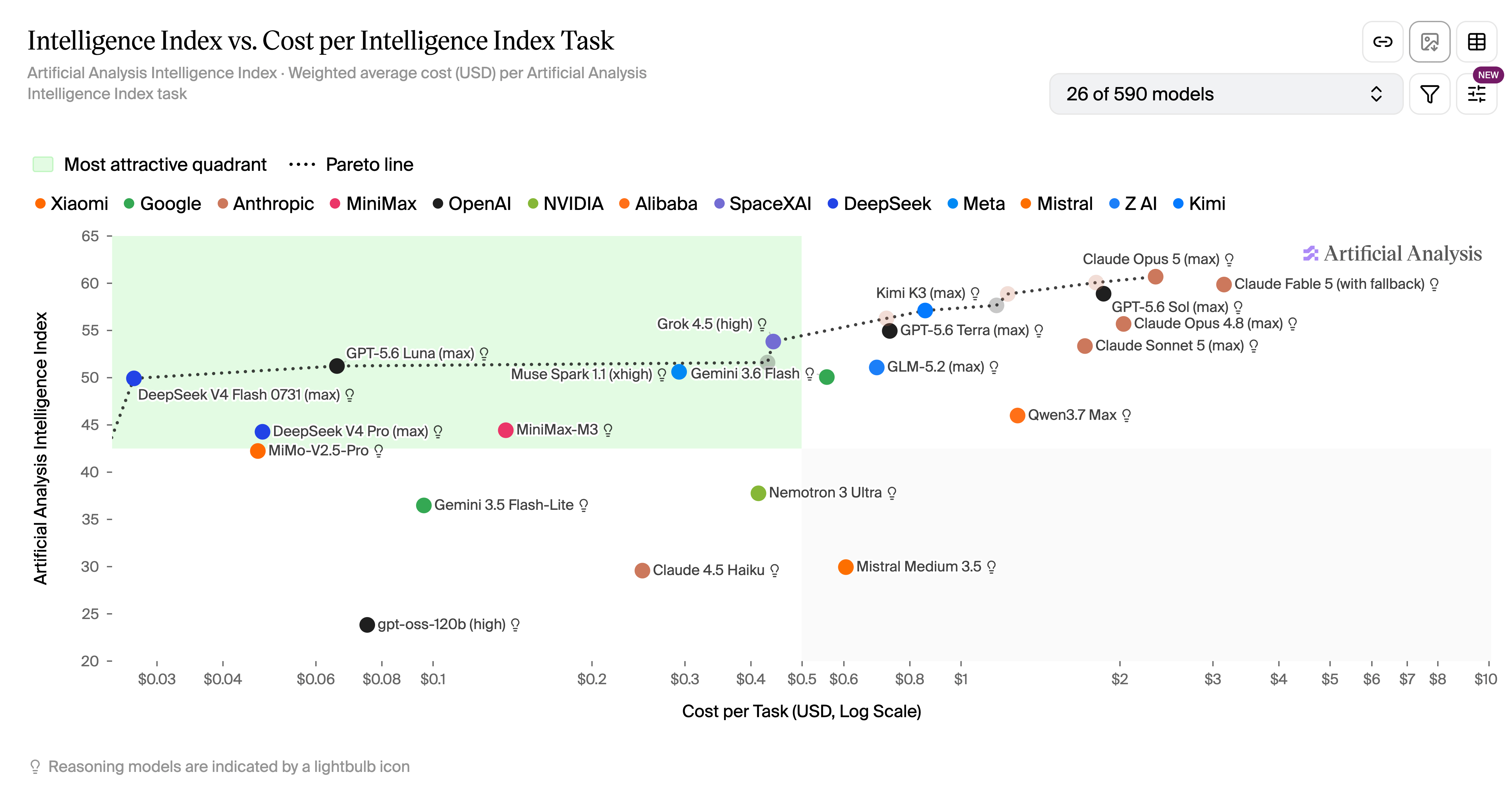
DeepSeek has pushed an updated V4-Flash into public beta. DeepSeek claims sharply better agentic performance, with coding and tool-use benchmarks well ahead of its unreleased Pro model. Artificial Analysis backs that up, scoring it 50 on its intelligence index against 40 for the previous version. That puts it a point behind GPT-5.6 Luna and at the same score as Gemini 3.6 Flash, but at roughly 60% less cost per task. The weights should follow within weeks.
Codex Security
Codex Security is an agent from OpenAI that scans code for vulnerabilities and proposes fixes. Software developers can run it from the Codex desktop app, the terminal, a TypeScript SDK, or in the cloud against connected GitHub repositories. As Codex Security scans the code, it builds a threat model from the repository itself rather than matching generic signatures. It then tests each likely issue in an isolated environment before surfacing it, reducing the chances of false positives.
Introducing MAI-Cyber-1-Flash inside
Microsoft is joining the recent trend of releasing cybersecurity-focused AI models with MAI-Cyber-1-Flash, a compact model built to hunt vulnerabilities in large codebases. It runs inside a harness called MDASH, which passes only the hardest cases to more capable and expensive models, like those offered by OpenAI. Microsoft claims the pairing hits 96% on the CyberGym benchmark at half the cost of its current MDASH setup, which uses a combination of GPT 5.4, 5.4 mini and 5.3 Codex.
Kimi K3 weights and tech report are out
Kimi K3 weights and technical report are now available to view and download. All 2.8 trillion parameters are available on Hugging Face, while the technical report can be found here. Moonshot AI, the company behind Kimi K3, said it is also opening up more of the stack behind it, including high-performance attention kernels, MoE communication library, and infrastructure for running agent environments at scale.
Introducing Inkling-Small
Thinking Machines Lab releases Inkling-Small, a smaller model that offers performance similar to that of the recently released Inkling but for a quarter of the size. Inkling-Small beats Inkling on reasoning and agentic coding benchmarks, but the larger model still holds an edge on factual knowledge. The full weights are available to download on Hugging Face.
Thinking Machines co-founder Lilian Weng left the company citing health reasons, then joined OpenAI
Lilian Weng has left Thinking Machines Lab, the AI startup she co-founded with Mira Murati, saying the stress and workload had pushed her past what her health could sustain. Days later, OpenAI confirmed she is rejoining the company she left last year, where she'll lead a team on recursive self-improvement. Weng is yet another Thinking Machines Lab co-founder who has left the company to join a competitor.
$2m crime novel deal collapses amid questions over AI use
A $2 million publishing deal for the debut crime novel Call Me, I'll Hide the Body has collapsed over suspicions that AI helped write it. Jerry Falade's agents withdrew the book after telling publishers they could no longer verify how the manuscript came together. Falade denies using AI. He argues the reaction reflects racial bias, pointing to three Black authors whose deals were cancelled or disrupted this year over similar claims.
AI Book Burning? Companies Are Destroying Millions of Books to Feed Chatbots
AI companies are reportedly buying used books in bulk through anonymous middlemen, cutting off the spines to scan them, and then throwing the originals away. Especially valuable are books published before 2023 because humans wrote every word of them. That demand has been good for booksellers, though some worry rare and out-of-print titles are being destroyed.
LinkedIn now has a ‘Seems like AI slop’ button, and yes, it really says slop
LinkedIn has quietly added a “Seems like AI slop” button which allows users to report and hide content they think was written by a machine. The flags will reportedly help train the platform’s own classifiers to spot low-effort AI writing. The awkward part is that LinkedIn sells its own AI writing assistant for Premium subscribers. LinkedIn’s product chief says AI and slop aren’t the same thing, so the company will privately nudge those whose writing reads as inauthentic.
Why compute might get 10x+ more expensive in coming years
Dwarkesh Patel speculates in this post about a world where AI revenue keeps rising tenfold a year while compute capacity only triples. Something has to give, and he thinks it will be the price of compute. Smarter models earn far more from the same chips, but fab and wafer limits cap how fast new ones arrive. Expensive compute would favour whoever trains the most efficient model. That lets the leading labs charge high margins and pull further ahead.
🤖 Robotics
Gemini Robotics 2 brings whole body intelligence to robots
Google DeepMind has announced Gemini Robotics 2, which for the first time can control a full humanoid robot (Apptronik Apollo in this case) rather than just its arms. A companion reasoning model handles the planning, breaking tasks into steps that run for minutes and letting several robots work as a team. Fine finger work remains the weak spot, dropping as low as 32% success on some tasks. Still, it pushes robots closer to learning general skills rather than being programmed for a single job. DeepMind has posted a YouTube playlist if you want to see the models in action.
US bans humanoid robots from China, citing ‘unacceptable risks’
The FCC has banned imports of new Chinese humanoid and quadruped robots, saying they could let foreign actors surveil Americans or seize remote control of the machines. It also barred connected power inverters, which feed renewable energy and batteries into grids and data centres. Only unreleased models are covered for now. China’s embassy accused Washington of smearing its companies and threatened to respond. US robot makers have welcomed the ban, but analysts warn it may slow domestic innovation by cutting startups off from cheap Chinese platforms.
Amazon’s Zoox wins first US approval for paid robotaxis without human controls
America’s auto safety regulator has cleared Amazon’s Zoox to charge for rides in robotaxis built without steering wheels or pedals, a first for the industry. The exemption covers up to 2,500 vehicles a year for two years, beginning in Las Vegas. The permission can be withdrawn if serious safety problems emerge. The decision matters because federal rules still assume a human driver. However, as Reuters reports, the agency now plans to rewrite them.
Lyft and Baidu enter London’s robotaxi battleground as testing begins
Baidu has started testing self-driving cars in London, with human safety operators behind the wheel. The vehicles come through its partnership with Lyft and Freenow, the European taxi app Lyft bought last year. Dozens will run in the borough of Brent before the companies open the service to paying passengers in 2027. That timing depends on regulators, who are still writing Britain’s rules for autonomous vehicles.
Time runs out for Vicarious Surgical
Vicarious Surgical is shutting down, with shareholders voting to liquidate the business and hand its assets to creditors. The company had raised over $425 million, and a 2021 SPAC merger valued it at $1.1 billion. That money went into a robot designed to operate inside the abdomen through a single tiny incision. However, delays kept pushing the launch back, and it never won FDA clearance. When the cash ran out with no buyer in sight, the board recommended closure. It’s another SPAC-era medtech bet that folded before reaching a single patient.
DARPA, U.S. Air Force fly AI-controlled F-16
The US Air Force and DARPA have flown a modified F-16 controlled in the air by an AI agent, with a human pilot aboard to monitor it. The jet is one of several converted under the VENOM programme. A retrofit kit automates the flight controls and sensors without touching the aircraft’s core software. A pilot can then hand over to the AI, or take back control, with a flick of a switch. VENOM is part of larger effort whose aim is a future where pilots command teams of uncrewed aircraft rather than fly alone.
The Robots Cometh
TIME profiles Wang Xingxing, founder of Chinese robotics firm Unitree and the world’s biggest seller of humanoid robots. He shipped over 5,500 units last year by undercutting rivals on price. Three-quarters go to universities and developers building their own systems. But almost none do useful work because robots still can’t handle unfamiliar tasks or environments. Wang reckons that breakthrough is 2 to 10 years away.
New York school pauses humanoid robot ‘Sally’ after state and union pushback
A rural New York school district has shelved plans to seat a humanoid robot named Sally in a high school classroom this autumn, where it would sit alongside a human teacher during lessons on AI and robotics. The robot’s maker, Realbotix, also owns a hyperrealistic sex doll business, a connection that drew objections from teachers’ unions and prompted the state education commissioner to ask the district to delay the initiative. Realbotix says the two divisions share neither staff nor technology.
Why the future of robots is serving humans, not just imitating them
Aaron Edsinger, co-founder and CEO of Hello Robot, makes a case in this article that the future of robotics lies in assistance rather than humanoids. Edsinger argues that disabled and older people are the natural first market, with 1.3 billion living with significant disability as care demand outpaces supply. He points to Henry Evans, left profoundly paralysed by a stroke, who uses a Stretch robot to play with his granddaughter. What matters, he says, is not what robots can do, but what people can do because of them.
▶️ Towards Machines with a Thousand Hands (2:09)
Generalist shares in this video the progress the company has made in its quest to solve robotic manipulation. GEN-1, its latest foundation model for robotics, supports a wide range of robot end effectors, from three- and five-finger hands to tools and virtually any other type of actuator. The result is a single model that can be used across many different types of robots, enabling them to interact more effectively with the physical world and, ultimately, perform a broad range of tasks.
🧬 Biotechnology
DeepMind won a Nobel for AlphaFold. Then it broke up the team.
Google DeepMind has broken up the team behind AlphaFold, its Nobel-winning protein-folding system. Most of the original paper’s authors have been reassigned over the past year, the Financial Times reports, and nearly a quarter have left the company outright. The lab is dropping its old approach of aiming one team at one grand challenge, and building Gemini-based systems to assist scientists instead.
Team uses AlphaFold AI to redesign gene-editing proteins to make them safer
Researchers in China have used AlphaFold to make CRISPR gene editing more precise. The problem they solved was that gene editors sometimes cut the wrong DNA. To find out why this is happening, the team fed AlphaFold both correct and mismatched target sites. That revealed which amino acids in the Cas9 protein flex to tolerate a bad match. Swapping them cut off-target activity from 28% to 5%, with normal editing unaffected. The method offers a general way to tailor gene editors against known errors before a therapy reaches patients.
Why haven’t organoids solved all of drug discovery?
Organoids promised to revolutionise medicine and drug discovery by lowering costs and making the process of verifying if a drug works easier. In this excellent essay, Abhishaike Mahajan shows the reality is far messier, and explains where organoids fall short of those promises. Despite this, Mahajan still defends them, since animal studies and human trials carry their own deep flaws.
💡Tangents
Tesla Weighs Sale of China Business to Pave Way for Potential SpaceX Merger
The Wall Street Journal reports that Elon Musk has told Tesla executives to prepare to separate the company’s China business ahead of a possible merger with SpaceX, with advisers weighing a spinoff, sale or closure. The problem this would solve is that SpaceX is a major US defence contractor, and Beijing would baulk at one controlling Tesla's Shanghai factories and the data of two million Chinese owners. Musk denied the report on X, calling it fake news. China is Tesla’s second-largest market and made it profitable, so unwinding it would be a costly price for tying his two companies together.
Apple launches ‘Upgrade’ device leasing program in partnership with Klarna
Apple has launched Apple Upgrade, a US leasing programme run with Klarna. Instead of buying the devices, customers can pay monthly for an iPhone, Watch, Mac or iPad, starting at $11.99. When the term ends, they can upgrade, buy the device outright or hand it back. Apple is scrapping its own iPhone Upgrade Program and instalment plans in the process. The move follows price rises on Macs and iPads, caused by an industry-wide memory chip shortage.
Thanks for reading. If you enjoyed this post, please click the ❤️ button and share it!
A big thank you to my paid subscribers, to my Patrons: whmr, Florian, dux, Eric, Preppikoma and Andrew, and to everyone who supports my work on Ko-Fi. Thank you for the support!