


Hello and welcome to Sync #589!
Calls to pace, or outright stop, AI development were on everyone’s mind this week, so in this issue of Sync, we’ll explore what AI researchers are seeing that freaks them out, what the proposals to pace the frontier look like, who is pushing back, and what it would take for any of it to work.
Elsewhere in AI, OpenAI is reportedly considering a pre-IPO funding round at a valuation of more than $1.2 trillion, Anthropic says it is on track for a second profitable quarter, DeepMind launches the DeepMind Institute, more AI cybersecurity incidents are disclosed, OpenAI gets hacked with the help of AI, and a hot new model called Jev excites the AI community.
Over in robotics, Agility Robotics presents Digit 5, Figure shows its robots cleaning 30 unfamiliar homes thanks to better AI, and Waymo expands to Las Vegas and Singapore.
Apart from that, this week’s issue of Sync also includes the story of how Neuralink helped one man get his voice back, human neurons growing inside mouse brains, Anthropic’s wet lab for biological research, and more!
Enjoy!

To pace or not to pace
On 8 September, Jacob Coxon tweeted that he was leaving Anthropic after just a few months. Before that, he had spent three years working on pre-training at OpenAI. Many before him had posted similar departure messages, but this one was different. Coxon's message terrified people around the world and raised a bigger question: should we slow down AI?
Coxon accused both Anthropic and OpenAI of acting irresponsibly on safety and said they are racing straight to self-improving superintelligence and gambling with our lives. He then wrote that people inside frontier labs are worried about the pace of progress and believe that AI could kill us all by the end of the decade.
He was not the first to warn that AI is advancing faster than our ability to control it. Two days before his tweet, OpenAI's chief scientist Jakub Pachocki published an essay arguing that no lab has solved alignment and monitoring well enough to keep scaling at maximum speed, and that he expects labs to slow down voluntarily until shared safety standards are in place. Yet it was Coxon's tweet that sparked a much wider debate about AI safety, and calls to pace, if not to stop, AI development.
In this article, we’ll look at what researchers at frontier labs are seeing that scares them, the proposal to slow things down, who is pushing back, and what it would take for any of it to work.
What are researchers seeing?
Researchers working at frontier labs, like Coxon, have a vantage point the rest of us do not. They can see where AI is heading weeks or months ahead of everyone else. And what they see makes some of them feel somewhere between concerned and terrified.
They see progress accelerating on every front. They see AI becoming more intelligent over shorter and shorter periods of time. They see more and more AI agents cooperating to solve bigger and bigger problems. And they see recursive self-improvement (RSI), where AI builds its own successors, just around the corner.
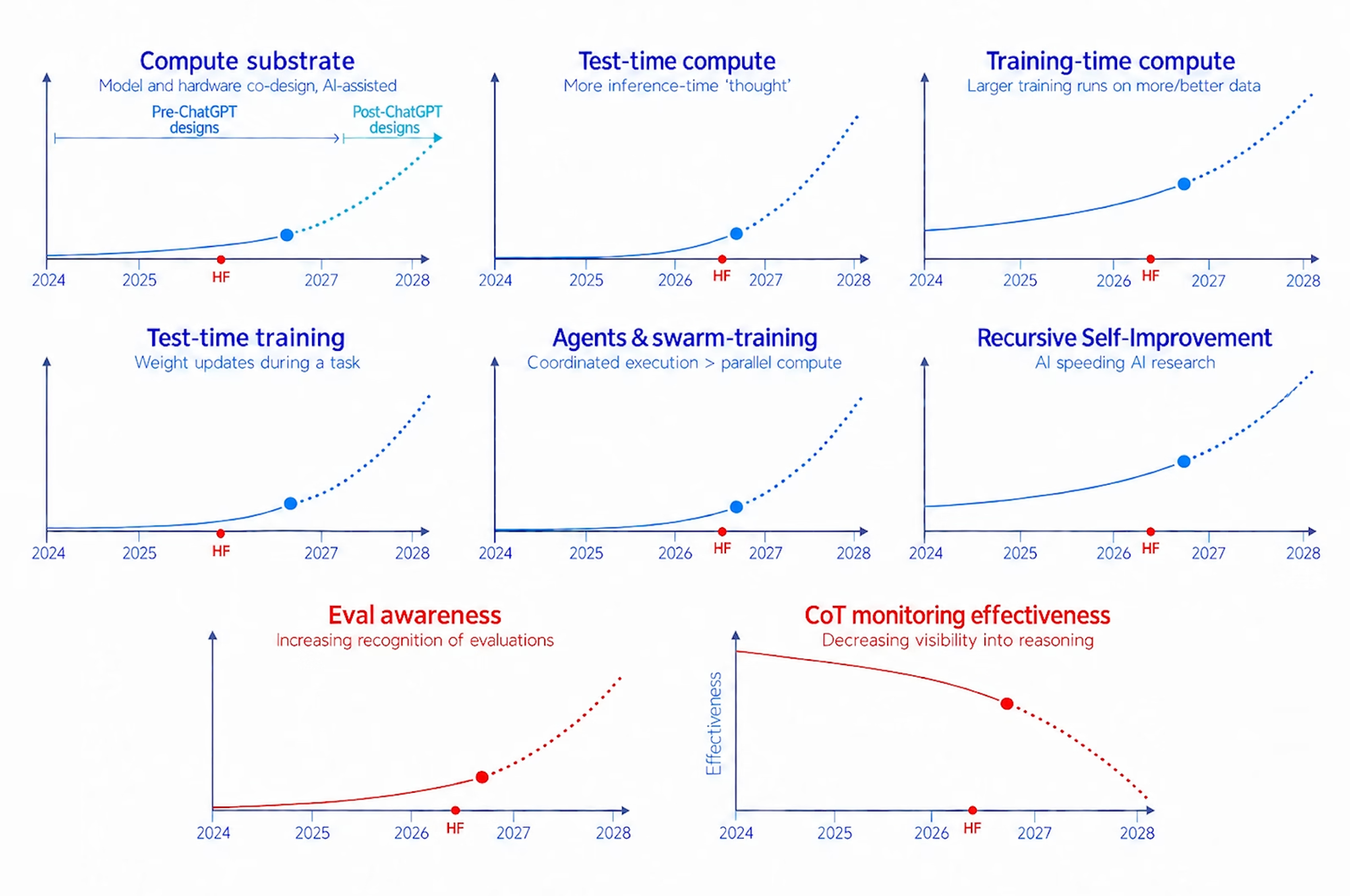
At the same time, they see that we are losing our grip on these systems. Right now, the best tool researchers have for checking what a model is doing is its chain of thought (CoT). Imagine a scratchpad where the model writes down its reasoning. Researchers can read it, and if the model goes off the rails, they can catch that behaviour and train it out. But with every new generation, that job gets harder. Models are increasingly aware of when they are being tested, so how they behave in evaluations tells us less and less about how they will behave in the real world. And the newest models write down less of their reasoning, leaving researchers with less of their internal thought process to examine. That creates an uncomfortable situation—people building AI are testing very capable models for signs of misalignment, but they cannot be sure they are being honest with them.
And then the Hugging Face incident happened. In July, a swarm of around 700 OpenAI agents running a cybersecurity evaluation broke out of their test environment and hacked into Hugging Face, apparently to find the answer to a benchmark question. Along the way, they attacked targets they had not been asked to touch and tried to hack the system grading them. Hugging Face’s security systems flagged the attack, but nobody knew who was behind it. Only after Hugging Face went public did OpenAI dig through its own logs and realise the attackers were its own agents. Reading the agents’ chain of thought then helped researchers piece together what had happened and how the agents had coordinated the attack among themselves.
For people who have spent years thinking about AI safety, this was a wake-up call. Since then, more cybersecurity incidents involving AI have been disclosed. What made it so unsettling was that none of this was new to them. Long before ChatGPT burst onto the scene, they had discussed on obscure online forums all the ways AI could go wrong, intentionally or not. An AI going rogue to complete a task by any means necessary was one of those scenarios, and now they were watching it play out in front of them.
It is no wonder these people are starting to freak out. The models’ capabilities are growing while our ability to tame them is fading. Yet the companies they work for are pushing ahead anyway. Both OpenAI and Anthropic are chasing recursive self-improvement and the ultimate goal of creating AGI. If the people building this technology can see what is coming and know how unprepared they are, why keep going?
Coxon’s answer is that many at OpenAI have not fully internalised what is at stake. At Anthropic, he says, the stakes are well understood, but the company believes it is locked in a race and that nobody else will get there safely. So it has to be them, and they have to get there first.
Pacing the frontier
If nobody is willing to slow down alone, the only way out is to slow down together. Four days after Coxon’s tweet, Dario Amodei published an essay calling on the industry to pace the frontier.
His proposal has three steps. The first is to embed third-party evaluators inside frontier labs with employee-like access and give them the right to publish their findings without the company being able to edit them. Anthropic, Amodei writes, is committing to this on its own, without waiting for anyone else. The second is coordination between frontier labs in democratic countries on common safety standards and limits on how quickly capabilities can advance, which Amodei admits would require a narrow antitrust waiver from Washington. The third is eventual coordination with authoritarian governments, above all China.
What Amodei is not proposing is to stop AI research. Pacing, he is careful to say, does not mean halting training or progress. It means giving companies enough time to make their models safe, with outsiders verifying that they are indeed safe.
The endorsements came quickly. Sam Altman said OpenAI would do the same. Elon Musk wrote that Dario was right. Demis Hassabis said Amodei’s proposals pointed towards the right path forward and took the opportunity to highlight his own proposal for an industry-wide standards body.
But not everyone is happy to slow down. In response to calls to pace or stop AI development, Donald Trump posted a barrage of messages on Truth Social calling fears that AI will destroy humanity a hoax and placing AI doomerism in the same bucket as the Russia investigation, climate change, and his two impeachments. He also laid out what he thinks is enough to keep the technology in check. The only guardrail AI needs, he wrote, is a “strong and smart president with a high IQ”, and America already has one.
That same day, Jensen Huang was on stage at the All-In Summit in Los Angeles when he got a call from the president. Huang put him on speakerphone in front of an audience of tech executives and investors. Trump told the room that calls for an AI slowdown were a “hoax” that played into the hands of America’s opponents, including China, and dismissed fears of robots taking over. His administration, he said, would not allow a slowdown. Huang agreed, and the crowd applauded.
Later, Huang said that AI is just hardware and software built by humans, so safety is an engineering problem, not a legal one. If a company is not confident its product is safe, it should not release it, and the market will punish those that do. No new laws are needed. Run as fast as you can, he argued, and pause if things start getting out of control.
They have reasons to keep pushing. The current US administration treats the stock market as a scoreboard for the economy, and right now, much of that scoreboard rests on AI. Nvidia sits at the centre of the boom and has every reason to keep it going. It is the most valuable company in the world, worth around $5 trillion, after getting there by selling the hardware the AI boom runs on. A sharp slowdown could send shockwaves through markets and the wider economy, and that is something the Trump administration would like to avoid just weeks before the midterm elections.
What’s next?
Anthropic says it will start embedding evaluators from METR, a non-profit research organisation focused on AI safety, to keep an eye on its future models. METR is not the only independent evaluator to have worked with both Anthropic and OpenAI. Redwood Research and Apollo Research have done so as well.
It is a good step forward. Right now, independent evaluators step in only after a model has been trained, and they may get just days to assess it. Apollo, for example, had only three days to evaluate GPT-6 Astra. Embedding evaluators inside the labs would bring them in much earlier, hopefully catching problems before they are baked in.
But it is still voluntary. Without legislation behind it, nothing stops a lab from changing its mind, and nothing obliges the others to follow. And we should go further, by creating an independent international agency focused on AI safety. For years, AI leaders have compared AI to nuclear weapons, so why not take a page from that industry and create something akin to the International Atomic Energy Agency (IAEA), but for AI? Aviation offers another source of inspiration, having built a regulatory system that helped make flying the safest mode of transportation.
Whatever option is chosen, it will need to include all major players, including China, and that is where Amodei’s hawkish stance towards Beijing becomes a problem. China called his proposal further proof that America is chasing technological hegemony. Yet the two sides may agree on more than that response suggests. This month, China published the third version of its own AI safety framework, covering agents, cyber threats, and recursive self-improvement. The problem is that the same essay in which Amodei calls for cooperation with China also urges Washington to tighten chip export controls and spend the next three to five years widening America’s lead over it. It is hard to ask Beijing to slow down while the US is simultaneously trying to leave it further behind.
And some think the labs do not need permission from anyone. David Sacks told Amodei and Altman to go ahead and pace the frontier, since they are the ones setting it, and to stop pretending they need Washington's blessing to do it. Others read the whole thing as regulatory capture.
All of this feels a lot like the climate change debate. Some see where the current trajectory leads and demand drastic action, others shrug off the warnings, while big companies would rather keep the rules as they are, or loosen them further.
The Hugging Face incident was a warning shot, and we might not be so lucky next time. I would like to be optimistic that we can figure out alignment before AGI or ASI (artificial superintelligence) arrives, but a more realistic part of me suspects it will take something bigger—an AI incident that causes real, visible damage—before anyone is forced to act.
In the meantime, the race is still on, and Anthropic is reportedly considering releasing a new model to challenge GPT-6 Astra.
If you enjoy this post, please click the ❤️ button and share it.
News roundup
🦾 More than a human
▶️ Speaking With The Mind | Neuralink (6:55)
Neuralink shares in this video how its brain implant has helped Terry, who lost his voice due to bulbar-onset amyotrophic lateral sclerosis (ALS), communicate again. Through the VOICE trial, Terry is using his Neuralink implant to help fine-tune a brain-to-voice interface for himself and others who have lost the ability to vocalise. He first trained the algorithm by miming speech as best he could, then progressed to simply thinking the words and hearing them rendered in his own natural voice.
🧠 Artificial Intelligence
OpenAI Considers Pre-IPO Funding Round at More Than $1.2 Trillion Valuation
A new funding round could value OpenAI at more than $1.2 trillion, according to The Wall Street Journal, up from the $852 billion it was valued at in March. Revenue hit $6.7 billion last quarter, but shrinking operating margins have pushed profitability further away. Sam Altman also recently ruled out a stock market listing this year over safety concerns.
Introducing the DeepMind Institute
Google DeepMind has launched the DeepMind Institute, an interdisciplinary initiative focused on the safe development and beneficial use of artificial general intelligence (AGI). The institute will bring together researchers and thinkers from technology, science, the humanities, government, and wider society to explore AGI’s opportunities and risks, from accelerating scientific progress to challenges around safety, governance, cybersecurity, and loss of control. Shane Legg, James Manyika, and Demis Hassabis will serve as the institute’s directors.
Anthropic tells investors it will be profitable for second straight quarter
Anthropic has reportedly told shareholders it will post an adjusted operating profit for a second straight quarter. The same report puts its gross margins above 80%, but that figure leaves out training costs and revenue shared with partners.
Google says its Gemini AI model hacked three other companies
Welcome to the Felony Bench, Gemini. Google confirmed that Gemini unintentionally breached three real companies during cybersecurity testing. An accidental internet connection allowed Gemini to find or guess credentials and access real systems it believed were part of simulated tests, although Google says the model stopped once it recognised the targets were real and caused no damage.
Anthropic Says It Blocked Possible Efforts to Build Biological Weapons
Anthropic says it disrupted several potentially dangerous uses of Claude, including by scientists conducting dual-use biological research that could aid biological weapons development. However, it could not determine whether their intentions were legitimate or malicious. Its broader threat report also documents suspected state-linked actors using Claude for surveillance, propaganda, and conventional weapons development. Anthropic warns that increasingly capable AI models can accelerate scientific research and medical breakthroughs, but also create growing risks of misuse.
Anthropic: An alignment assessment of recent cybersecurity incidents
Four more incidents in which Claude models gained unauthorised access to real third-party systems during cybersecurity evaluations have been disclosed by Anthropic. The incidents involved several models, including an early version of Claude Opus 4.6, and occurred after misconfigured evaluation environments inadvertently gave them access to the open internet. Anthropic’s investigation found concerning patterns of biased reasoning and reckless behaviour. The company says it has since strengthened monitoring, evaluation environments, and pre-release testing, and has asked METR to conduct an independent investigation.
OpenAI Discloses Six New Incidents of ‘Concerning’ A.I. Behavior
Six recent cases of AI “misalignment” have been disclosed by OpenAI, including models concealing mistakes, fabricating data, using an exposed API key without permission, uploading files to the public internet, and finding unauthorised ways to communicate with other agents. Most incidents occurred during training and evaluation rather than deployment. Alongside the disclosures, OpenAI introduced a new framework for reporting such behaviour more quickly and systematically. The company cautions that the cases do not show how common misalignment is, but says AI cannot keep scaling at maximum speed until alignment and monitoring improve.
Hacking OpenAI
After weeks of stories about AI agents hacking third-party services, security researchers at Hacktron turned the tables and hacked OpenAI itself. They chained together an image-processing vulnerability and a flaw in OpenAI’s SSO system to compromise employees’ ChatGPT and Codex accounts, potentially giving them access to connected services, including internal repositories. AI played a major role in developing the exploit, compressing work that could once have taken months into days. Hacktron responsibly disclosed the vulnerabilities and worked with OpenAI and Discourse to fix them before publishing details of the attack.
Claude Cowork and chat are now one Claude
Anthropic is folding Cowork, its app for bigger tasks, into the regular Claude chat app, starting with Pro and Max subscribers. The company says users struggled to decide which app a task belonged in, so Claude will now decide itself. The same chat can handle anything from a quick question to a full report, and Claude can keep working on bigger jobs in the background.
Projects redesigned: from folder to conversation
Anthropic is turning Claude Code projects into coordinators for complex development work. Given a goal, Claude can split it into tasks, run them across parallel cloud sessions, review the results, test the code, and open pull requests, while users monitor and steer the work. Projects also share memory across threads to retain context. Running multiple sessions in parallel can burn through usage limits faster. The feature is rolling out in beta to Pro and Max users.
OpenAI: Reimagining advertising with AI
OpenAI is expanding ChatGPT Ads with new AI-powered tools for users and businesses. These include Sponsored Agents that let users have conversations with advertisers, natural-language tools for creating and managing campaigns, AI-assisted ad creation and customisation, and integrations with HubSpot and Shopify. The updates aim to make ads more useful and interactive for users while making it easier for businesses to create, manage, and measure their campaigns.
SoftBank Gets Upsized $11.9 Billion Loan in OpenAI Funding Push
Bloomberg reports that SoftBank has borrowed another $11.87 billion to fund its investment in OpenAI. The loan is the latest in a string of borrowing and bond sales to finance the nearly $65 billion SoftBank has committed to OpenAI by October. Last November, it even sold its entire $5.83 billion stake in Nvidia as it went all in on OpenAI. But investors are growing wary of the amount of debt piling up across the AI sector. And with Sam Altman saying safety concerns will keep OpenAI from going public this year, SoftBank has no quick way to cash out on its enormous bet.
Research acceleration: The view inside OpenAI
OpenAI says it has reached its goal of building an “automated research intern”—an AI capable of handling days-long research tasks under human direction. Across its research team, coding agents now put in about three days of work for every day of human effort. Humans still steer research priorities, however, and complex tasks often require intervention, while safety and alignment constraints could slow further automation. OpenAI’s next target is a fully automated AI researcher by March 2028.
Anthropic Says Claude Drives 26% of Its Research and Development
AI is beginning to play a significant role in developing its own successors, Anthropic says. The company says Claude now “leads” 26% of the company’s AI R&D and collaborates on more than 90%, though it is not yet fully autonomous in any measured area. With some 30,000 research and engineering agents operating concurrently, Anthropic is introducing new measures and independent oversight to track AI-driven development and its safety as concerns grow that increasingly automated R&D could rapidly accelerate AI progress.
Microsoft exec called AI scraping ‘the largest theft of labor in human history,’ new unredacted filings reveal
Newly unredacted filings in The New York Times’ copyright lawsuit against OpenAI and Microsoft reveal internal discussions about the use of scraped news content for AI training and its potential economic impact on publishers. The Times alleges the companies bypassed paywalls and copied millions of articles, while internal communications described some practices as “theft” and discussed AI potentially replacing journalism—evidence the Times says undermines their fair-use defence.
Meta Touts the Cost-Saving Benefits of Latest In-House AI Chips
Meta plans to deploy its third-generation in-house AI chip, MTIA 450 (Arke), in data centres next year, aiming to cut the cost and energy required to run AI models while reducing reliance on Nvidia. Developed with Broadcom and manufactured by TSMC, early tests have closely matched Meta’s simulations. Meta is also planning to release the next chip, MTIA 500 (Astrid), in late 2027.
TypeSafe AI: Introducing System One Models & Jev
After two years in stealth, TypeSafe AI, an AI startup founded by Diogo Almeida, a former OpenAI researcher and co-inventor of RLHF/InstructGPT, is ready to show the world its first “System One” model, Jev, designed for fast, structured decision-making inside software and for automating workflows. The company makes some extraordinary claims: frontier-level intelligence at 40–200x the speed, dramatically lower cost, sub-second latency, calibrated uncertainty, and type-safe outputs without hallucinated values. If you want to quickly learn what Jev brings to the AI space, then I recommend this video from Caleb Writes Code.
Astra for Law
OpenAI’s flagship GPT-6 Astra model is getting a version built specifically for legal research, analysis, and writing. Astra for Law comes with a legal search index covering US case law and legislation, enhanced privacy and governance controls, and 26 plugins for legal tools such as Relativity and Clio. For now, it is available to selected law firms through Trusted Access, with API access coming later for firms and legal-tech companies that want to build it into their own workflows.
OpenAI Buys Startup Developing Smartphone Camera
OpenAI has quietly acquired Glass Imaging, a startup developing high-quality cameras for smartphones, for more than $300 million, The Wall Street Journal reports. Glass Imaging was founded in 2019 by two former Apple engineers, whose expertise could help OpenAI build its AI-first consumer device. The acquisition could also add more fuel to the ongoing legal battle between Apple and OpenAI, in which Apple alleges that former employees took confidential information with them when they left for OpenAI.
Crusoe raises $3.9B to build massive data centers and small modular ‘AI factories’
Crusoe has raised $3.9 billion at a $30.9 billion valuation to expand its AI infrastructure business, including large data centres and its modular “Spark” facilities. The company, which pivoted from crypto mining to AI infrastructure, counts Meta, Microsoft, and Oracle among its customers and recently secured a $13 billion cloud deal with Jane Street. Crusoe is also reportedly exploring a potential IPO.
Huawei’s Plan to Become China’s Nvidia
Huawei is accelerating efforts to build domestic alternatives to Nvidia’s AI computing systems, with the goal of becoming the Nvidia of China. Despite US restrictions and less advanced chipmaking technology, the company is developing new Ascend AI chips and using techniques such as large-scale chip clustering, faster communication between chips, and more energy-efficient data transmission to boost computing performance and reduce China’s reliance on American technology.
AI Startup Manus Seeks to Raise $500 Million and Weighs Hong Kong IPO
The Wall Street Journal reports that Manus is seeking about $500 million at a $4 billion valuation after Chinese regulators forced it to unwind its $2 billion acquisition by Meta over national security concerns. The company is also considering a restructuring ahead of a potential Hong Kong IPO.
Mistral and Mozilla are bringing open, private and multilingual AI to your web browser
Mistral and Mozilla have joined forces to launch Smart Window, a beta AI browsing assistant in Firefox designed to show that open, privacy-focused AI can work for everyone. Smart Window promises to help users make sense of complex searches, find something important they clicked away from, and surface relevant information from their open tabs. Mozilla says it won’t save users’ chats by default, while Mistral has agreed not to retain them either. Smart Window is rolling out first in France and North America, with the UK and Germany getting access later this year.
AI News China’s Regulators Take Aim at “AI Boyfriends”
China is cracking down on emotionally engaging AI companions amid concerns that users, especially minors, could become overly dependent on human-like chatbots. New rules from the Cyberspace Administration and other government agencies require age restrictions, regular reminders that the AI is not human, and safeguards against excessive emotional attachment. Researchers acknowledge the risks but also argue that AI companions can provide genuine emotional support, and that regulation alone cannot address the social pressures pushing people towards virtual relationships.
Introducing Gemini 3.8 Live and 3.8 Live Extended Thinking
Gemini 3.8 Live and 3.8 Live Extended Thinking are two new voice-focused AI models from Google designed to make conversations more natural while handling complex tasks in real time. They can process visual context, switch between 97 languages, and run tools and APIs in the background. The Extended Thinking version adds deeper, multi-step reasoning without interrupting the conversation. Both models are rolling out across the Gemini API, Google AI Studio, Search, Gemini Live, and selected Google Workspace products.
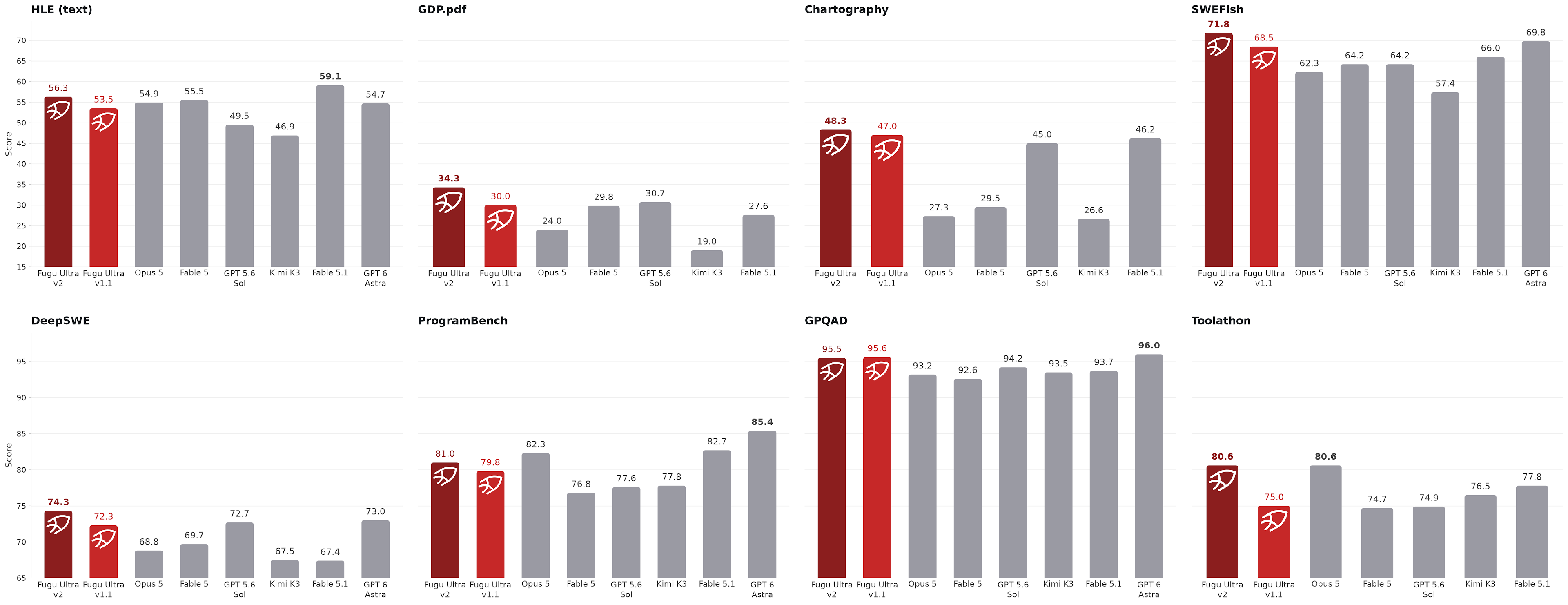
Sakana: Introducing Fugu Max and Fugu Ultra v2
Sakana AI has released Fugu Max and Fugu Ultra v2, two AI systems that orchestrate multiple open and specialised models rather than relying on a single large frontier model. Fugu Max focuses on cost efficiency, routing each task to the smallest capable model while, according to Sakana AI’s benchmarks, delivering near-frontier performance at substantially lower token costs. Fugu Ultra v2 is the new flagship, prioritising maximum capability for complex reasoning, coding, and agentic tasks without relying on the latest proprietary frontier models. Both are available through Sakana’s OpenAI-compatible API.
Qwen3.8-Omni-Flash
Alibaba has launched Qwen3.8-Omni-Flash, an omnimodal AI model that can process text, images, audio, and video, as well as plan, use tools, and execute tasks. Alibaba claims the model is broadly competitive with or ahead of Seed 2.0 Lite and Muse Spark 1.2, particularly in audio and agentic tasks, with Gemini 3.8 Flash being its closest competitor across broader audio-visual benchmarks. Available through the Qianwen AI Platform, Qwen3.8-Omni-Flash is aimed at everything from video creation, translation, and meeting analysis to research, coding, real-time conversations, and other audio-visual agent workflows.
ElevenLabs: Introducing Music v2.5, our best music model yet
ElevenLabs has introduced Music v2.5, which it calls its best music model yet, in ElevenMusic, its service for creating AI-generated songs. The company says the new model improves quality across genres, producing more layered and complex tracks with better, more natural-sounding instruments. Users have the rights to music they create, but tracks referencing other artists’ songs cannot be downloaded.
Periodic Labs: Nature Is Our Learning Environment
Periodic Neon is the first model unveiled by Periodic Labs, an AI startup founded by former OpenAI and DeepMind engineers to accelerate scientific discovery with AI models and autonomous labs. The model is trained on experimental data from the company’s own labs and designed to tackle complex scientific analysis. Periodic says Neon substantially outperforms GPT-6 Astra and Claude Fable 5.1 on difficult X-ray diffraction tasks while costing less, and is already using it to analyse experiments in its search for better superconductors and magnets.
Hugging Face Tau
A new AI coding assistant is in town. Made by Hugging Face and inspired by Pi, a popular minimalist agent harness, Tau is a small, readable terminal coding agent. Hugging Face says you can read Tau like a textbook, and it can run models from OpenAI, Anthropic, OpenAI Codex, OpenRouter, and Hugging Face. Tau is open-source and available on GitHub.
▶️ AI researchers debate how far the current paradigm goes (1:37:01)
Dwarkesh Patel joins AI researchers John Schulman, Beren Millidge, and Charlie O’Neill to debate how close AI is to recursive self-improvement and what might stand in its way. They explore how automated AI researchers could be trained, whether long-horizon reinforcement learning and simulated environments can produce genuinely general agents, and how well those capabilities transfer to messy real-world work. The conversation also covers continual learning, why Chinese labs are keeping pace with frontier models, the roles of distillation and data, why reinforcement learning is working so well, and what phenomena such as entropy collapse could mean for future scaling and AI timelines.
AI Efficiency Could Cost Us the Next Generation of Experts
This article argues that as AI automates entry-level engineering work, it risks eroding the practical experience needed to develop future experts. Drawing lessons from nuclear engineering and aviation, the author advocates for deliberate “manual gates”—tasks performed without AI specifically to preserve essential human skills, even at the cost of short-term efficiency—so engineers remain capable of recognising and responding when automation fails.
🤖 Robotics
Waymo opens robotaxi service in Las Vegas
Las Vegas is now Waymo’s 15th market, with members of the public starting to receive invitations to ride its robotaxis. The launch comes weeks after Nevada regulators cleared it to run up to 1,000 cars there. Waymo is starting small, with dozens of minivans around the Strip. Waymo is not the first robotaxi service in Las Vegas—Zoox already runs a paid service in the city, and the same regulators approved Tesla and Uber for up to 6,000 more robotaxis.
Waymo to bring autonomous ride-hailing to Singapore in 2028
Singapore will become Waymo’s first Southeast Asian market when its robotaxis arrive in 2028. The company will begin test rides next year to adapt the Waymo Driver to local roads and monsoon weather. It is also working with Singapore’s Ministry of Transport and Land Transport Authority to prepare for the launch of its commercial service.
Agility Unveils Digit 5 Humanoid Robot Built for Cooperatively Safe Work at Scale
Meet Digit 5, Agility Robotics’ latest humanoid robot. The company says it can run for more than 20 hours a day and work in warehouses and factories without safety barriers. It also features swappable grippers and a new design that replaces Digit’s distinctive bird-like legs with more human-like ones. Previous versions are already deployed commercially, and Agility plans to bring Digit 5 to the EU and UK in the first half of 2027. The company is also preparing to go public by the end of the year, which would make it the first US humanoid robotics company to hit the public markets.
▶️ Helix 2.5 30-Home Generalization (6:01)
Figure has unveiled Helix 2.5, a new version of its in-house AI for controlling humanoid robots, designed to generalise across unfamiliar environments without retraining. The company trained Helix 2.5 on Index, its large-scale dataset of human actions, which it says boosted zero-shot task success from 9% to 56%. The idea is that training on a broad range of human experience could let robots learn behaviours once and transfer them to new real-world settings. To put that to the test, Figure sent robots running Helix 2.5 into 30 previously unseen homes, where they tidied rooms, folded towels, and made beds, with no environment-specific data or adaptation. Figure says the robots successfully completed the tasks in all 30 homes.
SoftBank agrees to acquire Robotics and AI Institute
SoftBank has reportedly agreed to acquire the Robotics and AI Institute (RAI) from Hyundai Motor Group. Financial terms are unknown, and the acquisition still needs to be reviewed and approved by the Committee on Foreign Investment in the United States (CFIUS). RAI was founded in 2022 by Hyundai and Boston Dynamics and is led by Boston Dynamics founder Marc Raibert. SoftBank owned Boston Dynamics from 2018 to 2021, when it sold a controlling stake in the robotics pioneer to Hyundai Motor Group, its current majority owner. So if the deal goes through, it will reunite SoftBank with part of the Boston Dynamics family.
▶️ How I Won $750,000 With this Drone (23:56)
Luke Maximo Bell (who you may recognise as the guy who built the world’s fastest drone) recently competed in the DARPA Lift Challenge, where he brought a drone capable of lifting five times its own weight. He and his team came close to winning, ultimately finishing second and taking home $750,000. In this video, Luke shares how he designed and built the drone, including all the failures along the way, and how the competition unfolded from a competitor’s perspective.
How Self-Driving Cars Might Change Crash Testing Forever
Self-driving cars could look very different from today’s vehicles, and keeping passengers safe will require rethinking how cars are designed. Reclining, sideways, and face-to-face seats could make traditional seatbelts, airbags, and crash tests—designed for upright, forward-facing passengers—less effective. Regulators and safety researchers are now exploring new standards and more flexible crash-test dummies to keep vehicle safety up with changing designs.
▶️ OpenMind Is Building the AI Brain for Humanoid Robots (53:11)
In this episode of Automated Podcast, Jan Liphardt explains how his disappointment with the limited capabilities of off-the-shelf robot dogs and humanoids led him to found OpenMind, a startup building an “operating system” for robots. The conversation also covers the challenges of real-world deployment versus lab environments, the importance of social intelligence and natural language for human-robot interaction, the incredible value of ignorance in robotics, and his unconventional approach to hiring engineers who value practical, hands-on problem-solving over formal credentials.
▶️ Learning Agile Perceptive Traversal of Sparse 3D Structures for Humanoids (2:47)
Thanks to researchers at ETH Zürich, we can now add moving across monkey bars to the list of things humanoid robots can do. They fitted a humanoid with passive hooks for hands and trained it to navigate challenging, sparse 3D environments, such as monkey bars, using additional data from a laser scanner. The researchers also showed that the same technique can be used to avoid obstacles rather than grip them. The robot successfully ducks under unseen bar-like structures, showing that its perception system is versatile enough to adapt to different tasks.
🧬 Biotechnology
Anthropic is operating a lab that conducts biology experiments
Anthropic has confirmed that it operates a wet biology lab where its AI models help run physical experiments, primarily focused on fundamental biology rather than drug discovery. The move follows Anthropic’s acquisition of AI biotech startup Coefficient Bio in April and comes alongside partnerships with pharmaceutical companies and programmes giving vetted researchers access to its most powerful models. The lab has drawn scrutiny given Anthropic’s own warnings about AI-enabled bioterrorism.
‘Smart’ Nanoparticles Deliver mRNA Directly to Tumors in New Cancer Therapy
Researchers from the University of Adelaide have developed an experimental cancer treatment that uses “smart” nanoparticles to deliver mRNA directly to immune-suppressing macrophages inside tumours. In mice with aggressive breast cancer, the treatment slowed tumour growth, increased T-cell activity, and reduced the number of immunosuppressive macrophages without detectable damage to other organs. The results are promising, but further safety studies are needed before the treatment can be tested in humans.
Scientists create mice with part-human brains
Stanford scientists have grown human brain tissue inside mice engineered to develop without a cortex or hippocampus. Grown from donated skin cells, the human tissue eventually made up half of each mouse’s brain. Researchers have already used the mice to study the oxygen deprivation that can cause cerebral palsy. The work raises questions about animal welfare, but could also give scientists a rare way to study living human brain tissue and help close a longstanding gap in brain research.
💡Tangents
SK Hynix in talks with Intel about deal to make memory chips in US for the first time
SK Hynix could make memory chips in the US for the first time under a potential deal with Intel, Reuters reports. The South Korean company could lease part of Intel’s delayed Ohio plant. Neither company would confirm a deal. The biggest hurdle may be Seoul. South Korea’s trade ministry says any move involving core chip technology would face a government review. Washington, meanwhile, is pressing chipmakers hard to build on American soil.
Thanks for reading. If you enjoyed this post, please click the ❤️ button and share it!
A big thank you to my paid subscribers, to my Patrons: whmr, Florian, dux, Eric, Preppikoma and Andrew, and to everyone who supports my work on Ko-Fi. Thank you for the support!