


Hello and welcome to Sync #594!
Anthropic’s highly anticipated IPO is getting closer. Last week, The Wall Street Journal saw a draft of the prospectus, giving us an early look at the company’s finances. We take a closer look at the reported numbers and why its IPO could test the wider AI industry.
Elsewhere in AI, OpenAI is reportedly nearing a new funding round that would value it at $1.25 trillion. Meanwhile, Chinese open-weight model Kimi K3.1 Pro reaches the frontier, Anthropic enters the personal AI agent race with Claude Duet, Meta Muse reaches 10 million users, and Disney scoops up Character.AI’s talent and IP.
Over in robotics, Unitree presents a robotic bodyguard, Ukraine claims the world’s first drone evacuation of a wounded soldier, and we look at how good a cleaning service powered by humanoid robots actually is.
Apart from that, this week’s issue of Sync features another AI-powered wet lab, signs that GLP-1 drugs may slow ageing, a potential Tesla and SpaceX merger, a startup claiming to have used AI-designed viruses to treat a patient, Meta losing another court battle, and more!
Enjoy!

Anthropic prepares for a $2 trillion IPO as AI bubble fears grow
What Anthropic’s prospectus reveals, and why its IPO will be a test for the whole AI industry

Anthropic is preparing for what could be one of the biggest stock market debuts ever, with a valuation that could reach $2 trillion, and now we have our first proper look at its finances. The Wall Street Journal has seen a draft of Anthropic’s prospectus, a document filed before an IPO that sets out a company’s finances, plans and potential risks.
But Anthropic’s IPO comes at a shaky time. Earlier this month, Wall Street had its worst week since June, with the tech-heavy Nasdaq falling 4.5%. CoreWeave, one of the best-known companies renting out AI computing power, also saw its shares and bonds tumble as investors questioned whether it could repay what it owes. Talk of an AI bubble is getting louder.
So what do Anthropic’s books tell us? And what will its IPO tell us about the state of the AI industry?
What Anthropic’s prospectus says
According to the Journal, Anthropic generated $16.3 billion in revenue in the first six months of 2026. A year earlier, the figure was $1.1 billion. That is roughly fifteenfold growth in a year.
Running AI is expensive, though. Every question Claude answers and every model Anthropic trains requires enormous computing power, mostly rented from cloud providers such as Google, Amazon and Microsoft. In the first half of this year, Anthropic spent nearly $9 billion on computing and infrastructure, up from $2.3 billion a year earlier. That is more than it spent in 2025, when its compute bill was $7.3 billion, and its revenue was $4.6 billion.
The good news is that revenue is now growing faster than computing costs. In 2025, Anthropic spent more on compute than it earned. In the first half of 2026, its revenue was almost double its compute bill.
The bad news is that Anthropic recorded a net loss of $80.7 billion in the first half of the year. That is nearly double the $42 billion it lost in all of 2025 and, as the Journal notes, one of the largest half-year losses ever reported.
But most of that is not money that actually left the company. About $72 billion comes from accounting charges tied to convertible notes and similar instruments Anthropic used to raise money. Convertible notes are loans that investors can later swap for shares. As Anthropic becomes more valuable, so do those future shares, and accounting rules require the company to record that increase in value as a cost, even though no cash changes hands. Without those charges, the loss is closer to $9 billion.
The bill coming due
The bigger concern is what Anthropic has promised to spend. According to the draft prospectus, the company is committed to spend more than $600 billion on computing power, much of it stretching into the next decade and mostly under contracts that cannot be cancelled. Those commitments include $111 billion with Google, $110 billion with Amazon Web Services and $31 billion with Microsoft, which Anthropic must pay “regardless of actual usage”. On top of that are up to $86 billion for renting Nvidia chips from two smaller providers, Nscale and Lambda, and more than $160 billion to lease Google’s chips through a deal with Broadcom. Deals still under negotiation could add as much as $150 billion more, taking the total to around $750 billion.
Even that may not be enough. Anthropic says its cloud partners have refused to give it as much capacity as it asked for and increasingly treat it as a competitor, forcing the company to turn to newer, less proven operators. One of them is Nscale, which Anthropic is reportedly negotiating with on a $45 billion computing deal.
Revenue, meanwhile, leans heavily on a handful of customers. About a fifth of first-half revenue came from just two of them, and Anthropic expects that concentration to continue. The prospectus also lists risks you won’t find in most IPO filings, including a catastrophic AI incident so costly that no insurer would cover it, and increasingly organised local opposition to new data centres.
A test for the whole AI industry
Anthropic’s IPO matters far beyond Anthropic because AI is now propping up a large part of the stock market and the economy. According to S&P Dow Jones Indices, around 45 AI-exposed companies accounted for about 39% of the S&P 500’s gains this year through 11 October. Strategists at Barclays argue that AI has become a major force not just in the economy but in the stock market, and increasingly in the bond market too.
Much of the AI build-out runs on borrowed money, and lenders are getting nervous. Barclays says the extra interest investors demand to lend to riskier AI companies has risen by more than 50% in six months.
Nowhere is that clearer than at CoreWeave. It is one of the so-called neoclouds, newer companies that buy AI chips, fill data centres with them and rent out the computing power. According to CNBC, it has taken on more than $51 billion in debt and other obligations. As The New York Times explains, CoreWeave commits to data centre leases lasting 15 years or more, but rents that capacity to customers such as Meta, Microsoft and OpenAI for shorter periods. That leaves it on the hook for longer than its customers may stay. Some investors have compared it to WeWork.
In mid-October, the selling began in earnest. The yield on CoreWeave’s bonds (in effect, the interest rate investors demand to hold them) climbed above 15%, deep into junk territory. The price of credit default swaps, a form of insurance against a company failing to repay its debts, rose past the level S&P Global Market Intelligence treats as a sign of distress. Its shares lost about a quarter of their value in a week. CoreWeave’s chief executive called the market’s reaction irrational.
CoreWeave is not the only one under pressure. Investors have been selling Oracle’s bonds as permitting problems delay data centres it borrowed billions to build. The cost of insuring SoftBank’s debt has jumped after it borrowed heavily to fund its investments in OpenAI. By the end of that week, even supposedly safe, investment-grade data centre bonds were falling.
Anthropic wouldn’t be the first $2 trillion AI-linked company to go public this year. In June, SpaceX went public in a record-breaking IPO that valued it at $1.77 trillion and soared past $2 trillion on its first day of trading. Within weeks, however, its shares had lost almost half their value from the peak. Now its borrowing costs are climbing too. According to Semafor, SpaceX’s new $40 billion debt raise is set to cost it more than a percentage point above where its existing bonds trade, as AI jitters spread.
So, is the AI bubble about to pop? Anthropic does not look like the pin, at least not yet. Its revenue is growing faster than its costs. But it has also signed up to some of the biggest spending commitments in corporate history, just as investors are starting to wonder whether the money pouring into AI will ever come back.
The next signal could come this week, when the Federal Reserve meets on 27–28 October. Then all eyes turn to Anthropic’s debut, and we will see whether investors are happy to buy into a $2 trillion company with $600 billion in bills to pay.
If you enjoy this post, please click the ❤️ button and share it.
News roundup
🦾 More than a human
Novo Nordisk and Eli Lilly Report GLP-1 Signals of Slowed Biological Aging at ARDD
According to early research presented by Novo Nordisk and Eli Lilly at a conference at Harvard, the weight-loss drugs semaglutide and tirzepatide may help slow biological ageing. Novo reported signs that patients appeared biologically two to three years younger than expected, while Lilly observed similar trends in a smaller study. The findings suggest the drugs could offer health benefits beyond weight loss, although larger studies are needed to confirm the effect and its long-term significance.
OpenAI Invests in Startup That Uses Brain Implants to Detect Cancer
OpenAI’s investment arm and Peter Thiel’s Founders Fund are backing Coherence Neuro, a startup that has raised $45 million to develop an AI-powered brain implant designed to detect and treat cancer. The device aims to monitor tumour growth and deliver electrical pulses to slow it. Early human trials are under way.
Cool chemistry trick allows new tattoos to ‘turn on and off’
Scientists have created a new type of tattoo ink that can appear, disappear or change colour using light. Called PhotoTat, it could let people hide or change their tattoos without removing them. It could also be useful in medicine, such as marking areas for cancer treatment. So far, only purple ink is available, but researchers hope to add more colours in the future.
This implant can restore sight for patients with macular degeneration
In this article, MIT Technology Review explains how an eye implant called PRIMA is helping people with severe age-related vision loss regain some sight. The system combines camera-equipped glasses with a tiny chip implanted in the eye to send visual information to the brain. After training, more than 80% of patients were able to read, do crosswords and use their phones.
🔮 Future visions
▶️ The Future of Elections: Who Votes, How We Vote, and What Comes Next (46:54)
In this video, Isaac Arthur explores how technology could shape the future of elections. He examines different voting systems, their strengths and weaknesses, and the challenges of electronic voting, particularly around security and public trust. He also explains why traditional paper ballots are likely to remain relevant for some time despite advances in digital technology.
🧠 Artificial Intelligence
OpenAI nears up to $30 billion funding round at $1.25 trillion valuation led by UAE investors
CNBC reports that OpenAI is close to raising up to $30 billion at a $1.25 trillion valuation, in a funding round led by UAE investors and Coatue. The investment would provide fresh capital ahead of a potential IPO in 2027. OpenAI is also reportedly in talks to secure more computing capacity from the UAE.
Introducing Kimi K3.1 Pro
We have a new leader among open-weight models: Kimi K3.1 Pro from Chinese company Moonshot AI. The new model not only tops every other open-weight model, but also goes head-to-head with leading American models. According to Moonshot, Kimi K3.1 Pro delivers substantial improvements in coding, 3D modelling, financial research, agentic workflows and factual accuracy. Alongside Kimi K3.1 Pro, the company also launched a Highspeed variant that runs two to three times faster than the standard model.
Artificial Analysis confirms these claims and places Kimi K3.1 Pro amongst the best models from Anthropic and OpenAI. However, it notes K3.1 Pro is quite slow and very verbose.
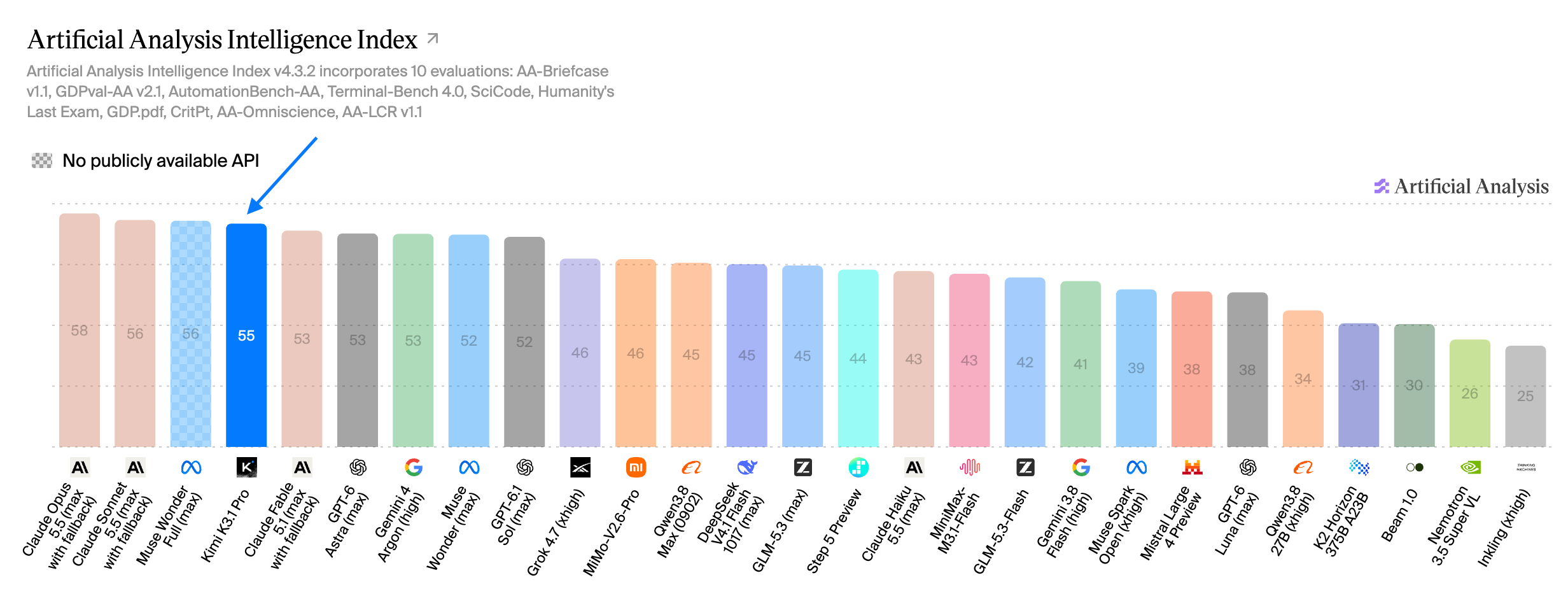
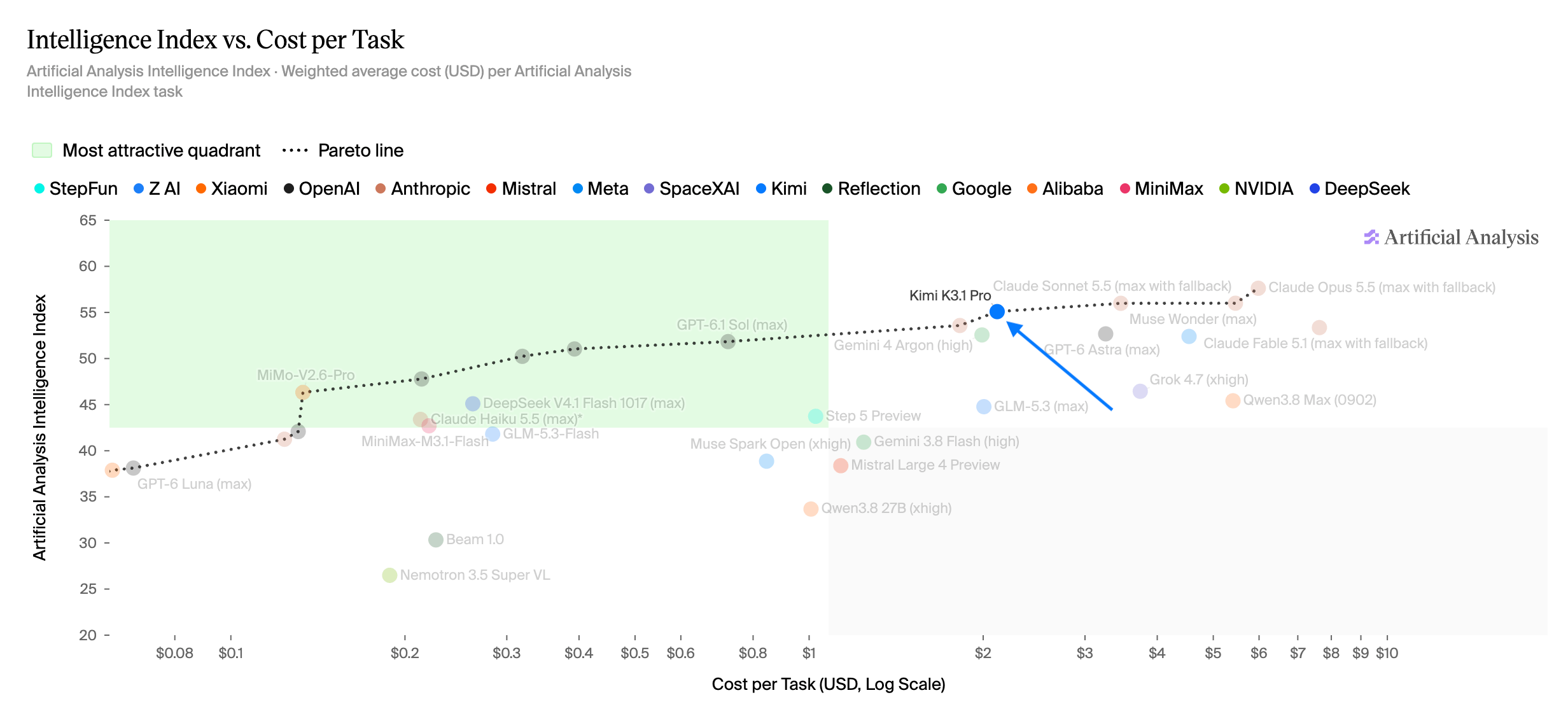
Kimi K3.1 Pro is currently available across Kimi’s apps, developer tools and API, with full model weights scheduled for release by 4 November 2026.
Disney agrees to hire the majority of Character.AI’s workforce
Following Character.AI’s bankruptcy, Disney has agreed to hire at least 60 employees (the majority of the startup’s workforce) with total annual compensation estimated at $60 million. Disney also plans to acquire certain assets for $20 million. As WIRED argues, Disney may be using this kind of deal to acquire the talent and IP without also inheriting the legal baggage that would come with a traditional acquisition.
Microsoft pulls out of AI datacentre project in Essex over power supply concerns
Microsoft has pulled out of Nscale’s planned AI datacentre in Essex due to concerns over electricity supplies, dealing a setback to the UK government’s AI plans. The project, once described as Britain’s largest AI datacentre, may not have enough power until the early 2030s. Losing its only publicly announced customer also raises doubts about Nscale’s planned $35 billion stock market listing. Nscale says it remains committed to the project and is looking for other ways to secure power.
Anthropic quietly pitches its own AI safety bill to lawmakers
Politico reports that Anthropic has privately proposed legislation to US lawmakers that would establish national AI safety standards, including independent evaluations, transparency requirements and incident reporting. The bill would allow courts to block AI models only when they pose an imminent catastrophic risk, such as causing more than $1 billion in damages or over 50 deaths or serious injuries, while limiting federal agencies’ power to halt deployments and overriding some state regulations.
Anthropic says it’s committing 5% of its shares to a ‘public benefit fund’
Anthropic has announced a public benefit fund and pledged 5% of its shares to support initiatives addressing AI’s societal impact, with additional contributions tied to the company’s growth. The fund could finance charitable donations, direct financial assistance and efforts to tackle AI-driven job disruption.
How employment is changing at Anthropic
Anthropic published a report on how AI impacted its employees and productivity, finding that AI significantly increased output while changing how people work and who gets hired. Employees are spending less time doing tasks themselves and more time managing AI agents, making skills like decision-making, adaptability and working with AI more important. At the same time, AI is reducing demand for junior employees and allowing companies to grow without hiring as many people, suggesting its biggest short-term impact may be on job roles and hiring rather than widespread job losses.
Introducing Claude Duet
Anthropic is joining the personal AI agent race with Claude Duet, its answer to Meta Muse and OpenAI dots. Duet is a proactive assistant that works in the background, monitoring connected apps, surfacing important updates and handling tasks such as scheduling meetings, building dashboards and managing workflows. It runs on its own virtual computer, integrates with more than 6,000 apps and asks for approval before taking sensitive actions. The research preview is available by waitlist to Pro and Max subscribers in the US.
Meta says Muse has over 10M users, with shopping a top activity
Meta has announced that its AI assistant, Muse, has surpassed 10 million users, and that 25% of those users use it daily. Shopping has emerged as a key activity, alongside productivity tasks such as managing emails and calendars.

NVIDIA GTC Berlin 2026 NVIDIA Intros DSX PODs and More
This week, NVIDIA hosted its 2026 GTC event in Berlin, where it announced new hardware and software aimed at accelerating AI infrastructure deployment and advancing agentic AI. Highlights included DSX POD, a container-based Vera Rubin system designed to cut data centre deployment times from months to just 14 days, and OpenShell, a framework for running AI agents securely.
US banning Chinese AI DeepSeek from government agency IT systems
The US Department of Homeland Security has ordered federal civilian agencies to remove and ban DeepSeek products and related services over national security concerns, including potential data leaks to China, espionage and cybersecurity risks.
Saudis Aided Family of Engineer Accused of Bugging OpenAI, Prosecutors Say
A US federal judge denied bail to former OpenAI engineer Abdulrahman Alfozan, who is accused of secretly planting recording devices in the company’s San Francisco offices. Prosecutors raised concerns over his extensive ties to Saudi Arabia, including the government’s offer to cover his bail and its reported assistance in helping his family leave the US. Investigators are examining whether he acted for financial gain or on behalf of a foreign government.
OpenAI models are coming to Google Cloud
OpenAI announced a partnership with Google Cloud to make its frontier AI models and Codex agentic workflows available through Google Cloud’s Model Garden. Enterprises can build and scale AI applications on Google Cloud, with access through its Marketplace. General availability is expected in the coming weeks, expanding customer choice and OpenAI’s reach across cloud platforms. OpenAI is quick to clarify that Microsoft still remains its primary cloud partner.
Google staff resign in backlash over its AI contracts with military
Google is facing growing criticism over its use of AI in military operations, with some employees having already left or being in the process of leaving the company. Staff have raised concerns about inadequate oversight, the reliability of AI in warfare and fears of retaliation for speaking out. While Google insists its military contracts follow ethical guidelines, critics warn that rapid deployment could increase the risk of errors and weaken human control over military decisions.
Qualcomm’s CEO says AI companies want phones running 100-billion-parameter models by 2028
Qualcomm CEO Cristiano Amon said several AI companies are developing smartphones designed to run AI agents continuously, handling tasks on users’ behalf by accessing personal data, apps and device sensors. He sees these AI-powered phones as the next major shift in mobile technology, combining on-device processing with cloud-based capabilities.
MiniMax M3.1 Flash
MiniMax has introduced M3.1 Flash, a new AI model optimised for coding, agentic workflows, computer use and cybersecurity. Codenamed Space Bunny, the model delivers performance competitive with leading AI systems while offering nearly 3x faster inference and 70% lower costs than its predecessor, according to benchmarks published by MiniMax.
Artificial Analysis places M3.1 Flash at the level of Claude Haiku 5.5 and GLM-5.3-Flash on its Intelligence Index benchmark. When cost per task is added to the picture, M3.1 Flash scores almost the same as Haiku 5.5.
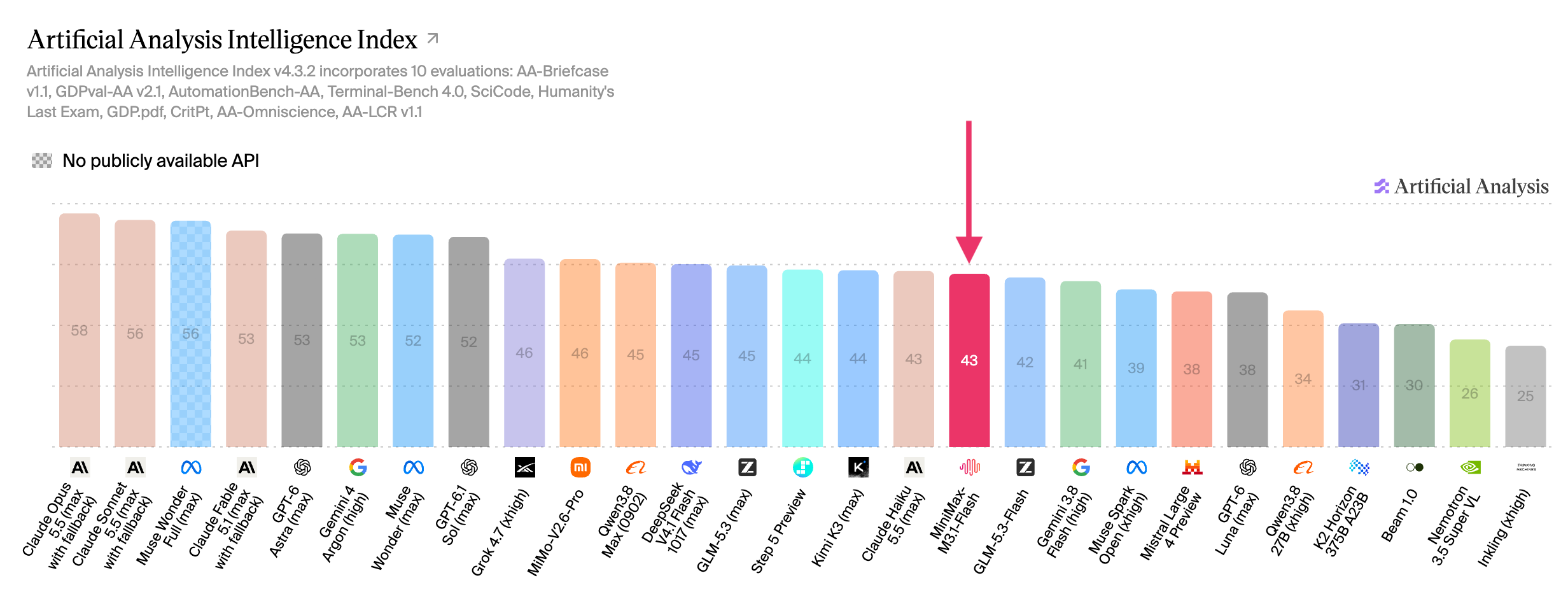
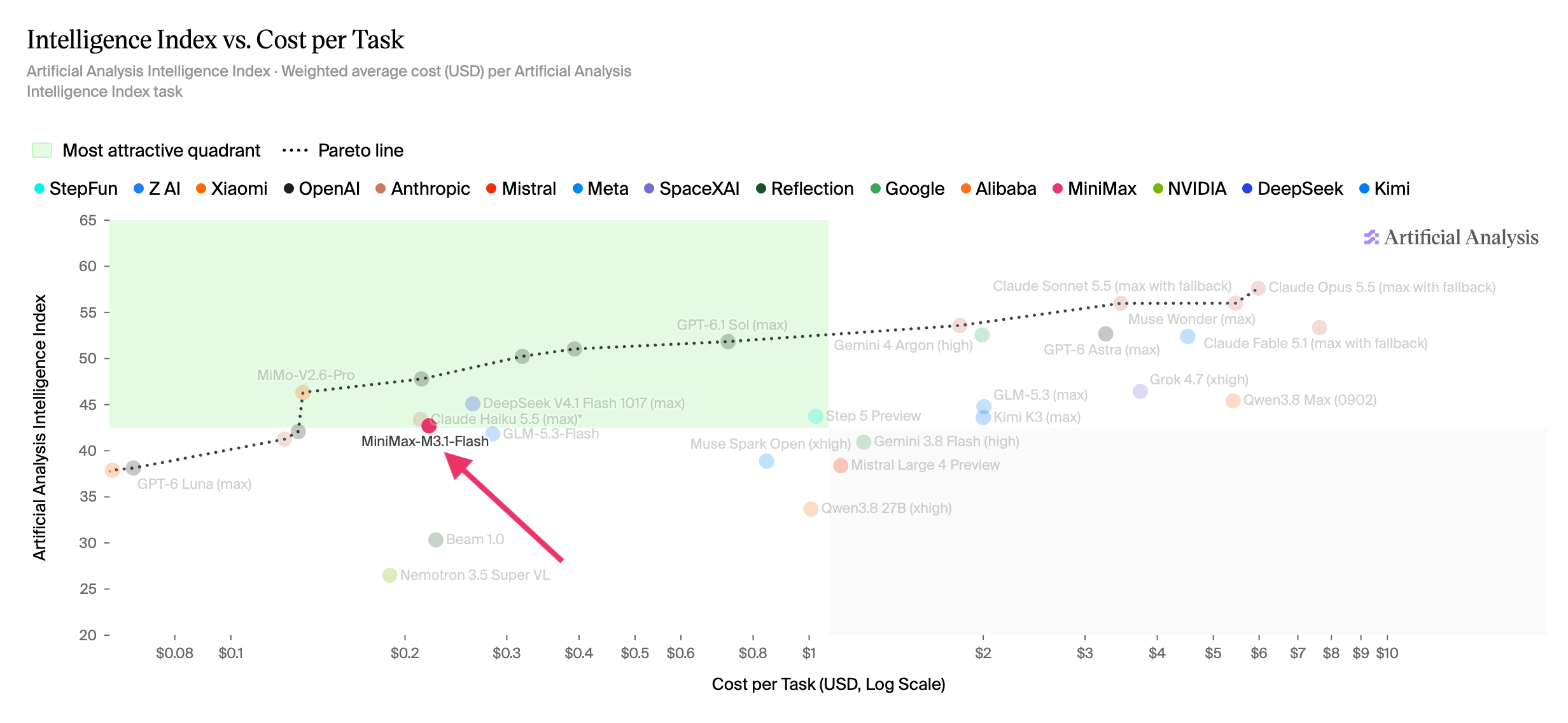
M3.1 Flash is available through the MiniMax API, M Plan and MiniMax Code, with open model weights expected to follow.
Introducing Clairic, a new System One class of extraction models
Cloudflare presents Clairic, a new type of AI model the company calls an extraction model and another entry in the emerging class of fast, specialised System One models. Unlike traditional LLMs, Clairic focuses on extracting structured information from unstructured inputs rather than generating text. It is designed for tasks such as document processing, data extraction, cost estimation and forecasting. Cloudflare promises that Clairic delivers faster, cheaper and more accurate results than general-purpose LLMs.
Mistral: Introducing Timestral
Mistral AI has introduced Timestral, a family of lightweight AI models designed to predict future trends using historical data. The models are fast, efficient and can run on standard CPUs without needing GPUs. Timestral can be used for predicting equipment failures, detecting unusual patterns, forecasting energy demand, improving supply chains and assessing financial risks. It can also make predictions without additional training and be adapted to specific business needs.
Inside Prometheus: Meta’s Journey to a Gigawatt-Scale Supercluster
Meta takes us inside Prometheus, its one-gigawatt AI supercluster in Ohio, showcasing the technology inside it, from NVIDIA’s latest GPUs and high-speed networking to advanced liquid cooling and power systems. With the first phase already operational, Meta plans to scale the facility to around one million GPUs and eventually upgrade it with next-generation Vera Rubin hardware.
🤖 Robotics
The Robot I Didn’t Expect to Build
Jonathan Hurst, co-founder of Agility Robotics, writes about the challenges of turning advanced robotics into commercially viable technology through the development of Digit 5. He highlights the need to balance scientific ambition with practical demands, particularly the trade-offs between safety, functionality and design. Hurst ends by saying that he wants not only to build functional robots, but also to make them beautiful, so I am looking forward to Digit 6.
Tesla starts Optimus robot production in California as profit falls 43%
Tesla has started producing its Optimus humanoid robot, with Elon Musk aiming to make 20,000 units per week by the end of 2027, although technical challenges remain. The news comes as Tesla reported a 43% drop in third-quarter profits to $787 million, mainly due to higher spending on AI, robotics and self-driving cars, while revenue stayed flat at $28 billion. Tesla has also delayed the launch of fully self-driving cars for customers until 2027.
Ukraine claims world’s first drone evacuation of wounded soldier
Ukraine claims to have carried out the world’s first evacuation of a wounded soldier using a heavy-lift drone because landmines and enemy drones made a normal rescue too dangerous. The successful mission shows how Ukraine is using new drone technology to save lives and improve its position in the war against Russia.
▶️ Unitree Introducing: H2-X Kung Fu Legend Guardian (1:00)
Unitree introduces its new humanoid robot, H2-X, and it does so in a typical Unitree fashion—by showing how it can run, jump, punch things, and do kung fu.
I Paid $60 for Two Humanoids to Clean My Home In San Francisco
There is a startup in San Francisco that is offering cleaning services performed by humanoid robots, and this post looks at what two of them can deliver for $60. Beyond the cleaning itself, it examines the economics of robot-as-a-service, the challenges of relying on human operators, and why shared robot fleets could become a promising business model. It also looks at the operational, privacy and safety issues that need to be solved before humanoid robots become part of everyday life.
▶️ Can I Build This Tiny Robot From Scratch in the Middle of China? (14:51)
Dorian Todd documents in this video his one-week trip to Shenzhen, where he gets an opportunity to see the Chinese hardware scene up close. Unbeknownst to his hosts, Todd arrived with a secret mission: to build a small robot. In his free time between meetings and factory tours, he visited Shenzhen’s giant electronics market in search of components. It is an interesting way to show why the city has become such a hub for hardware and robotics companies and startups.
🧬 Biotechnology
Grounding AI agents in biological reality: Building blocks for autonomous wet labs
Google follows in Anthropic’s footsteps and opens a wet lab where AI agents work with laboratory robots to autonomously design, run and refine biological experiments. Using a new framework that enables safe, real-time control of lab equipment, Google aims to accelerate drug discovery by allowing AI agents to learn directly from experimental results. Early tests show promising results in molecular design and cancer-related protein discovery.
Start-Up Claims to Use A.I.-Created Viruses to Treat a Patient
Scientists have reportedly used AI-designed viruses for the first time to treat a patient with an antibiotic-resistant E. coli infection. Developed by Radical Numerics, the customised viruses are designed to target bacteria that have resisted existing treatments. Although the outcome is not yet known and the research has not been peer-reviewed, a successful trial could pave the way for faster, more personalised treatments for drug-resistant infections.
OpenAI acquires Orchestra Bio
OpenAI has acquired Orchestra Bio to integrate its AI agents into OpenAI’s Rosalind life sciences platform with the aim of streamlining drug development workflows from experiment planning to clinical trial coordination. The financial terms of the deal were not disclosed.
How Claude designed protein binders against scorpion neurotoxins
Anthropic shares in this post how Claude could accelerate drug discovery by designing proteins that bind to dangerous scorpion toxins. The AI lab says Claude generated more than 318,000 designs in just 64 hours. Of those, 211 were tested in the lab and 17 successfully bound to their intended targets, although whether they can actually neutralise the venom remains unproven.
Using thousands of AI agents to uncover new leads in biological data
OpenAI, PerturbAI and Scripps Research showed how thousands of AI agents powered by GPT-Rosalind can speed up biological research, analysing millions of mouse brain cells in 32 minutes instead of months. By combining genetic data with existing research, the AI agents uncovered new insights into brain diseases that scientists can then test through experiments.
💡Tangents
Tesla and SpaceX Formed Committees to Discuss Potential Merger, Elon Musk Says
After folding X and xAI into SpaceX, Elon Musk is now exploring a merger with Tesla that would bring nearly all his companies under one roof. Both companies have formed special committees to evaluate a potential deal, which would face shareholder approval and regulatory scrutiny.
Meta Ordered to Pay $25 Billion for Deceiving Users on Privacy
A New Mexico judge has ordered Meta to pay a record $25 billion penalty for misleading Facebook users about their data privacy following the Cambridge Analytica scandal. The ruling follows a jury finding that Meta deliberately deceived users for years, violating state consumer protection laws 43 million times. Meta plans to appeal. The decision comes less than two months after the company agreed to pay up to $17.1 billion to settle a social media addiction lawsuit.
Startup taps underwater volcano as energy source in “proof point” test
Endurance Energy has demonstrated the world’s first subsea geothermal power plant in the Pacific Ocean, generating net-positive electricity for 8.7 seconds before technical failures halted the test. Despite its brief operation, the trial demonstrated the potential to harness geothermal energy from the ocean floor. Further testing is planned for 2026–2027, ahead of a commercial deployment in Tonga in 2027, where the technology could reduce reliance on expensive imported fossil fuels. However, questions remain over its long-term reliability and commercial viability.
Thanks for reading. If you enjoyed this post, please click the ❤️ button and share it!
A big thank you to my paid subscribers, to my Patrons: whmr, Florian, dux, Eric, Preppikoma and Andrew, and to everyone who supports my work on Ko-Fi. Thank you for the support!