


Hello and welcome to Sync #595!
Anthropic has finally made its finances public ahead of its highly anticipated IPO, which is less than three weeks away. We take a closer look at what Anthropic disclosed, what it left blank, and why it is heading to the stock market at a bad time for the tech industry.
Elsewhere in AI, Google drops Gemini 4 Carbon, which looks like the new leading frontier model. We also have GPT-6.1 Terra from OpenAI, SpaceX raising $40 billion in debt, and OpenAI reportedly lowering its target for its latest funding round.
Over in robotics, Agility and GXO Logistics plan to expand their deployment of the Digit humanoid robot, ANYbotics launches a four-legged robot for potentially explosive environments, and Rodney Brooks brings a pragmatic perspective to the hype around robotics.
Apart from that, this week’s issue of Sync also features genetically modified military dogs, two AI-generated movies flopping, cognitive mercantilism, evidence of concerning behaviour from Qwen, Anthropic buying a one-person biotech and starting its own drug programmes, Google’s prototype orbital AI data centre beaming a poem back to Earth, and more!
Enjoy!

Anthropic opens its books in a bad week for Big Tech
Anthropic lays its cards on the table as Wall Street gets cold feet about AI
In last week’s issue, we looked at Anthropic’s finances through a draft of its prospectus seen by The Wall Street Journal. Hours later, Anthropic published its S-1, the document a company must file with US regulators before going public, for everyone to dig into.
The final filing confirms most of what the leaks suggested, corrects a few figures and adds plenty of new detail. But it landed at an awkward moment. Last week, Google had its worst day ever, and Intel suffered its biggest one-day fall since 1974. The Nasdaq, meanwhile, ended October with its worst month since March 2025.
In this article, we look at what the full prospectus reveals that the leaks didn’t, and ask whether last week’s sell-off is the moment the AI bubble finally pops.
Anthropic drops official numbers…
First, the basics. Anthropic plans to list on the Nasdaq under the ticker “ANT”, most likely in the week of 16 November. According to The Wall Street Journal, it could raise around $100 billion at a valuation of $1.5–2 trillion, though the filing itself leaves the price blank.
The headline figures hold up. Anthropic made $16.3 billion in revenue in the first half of 2026, nearly 14x the $1.2 billion of a year earlier (the draft suggested 15x). The second quarter alone brought in $11.6 billion.
More importantly, revenue is now growing far faster than the cost of running Claude. In the second quarter of last year, Anthropic spent $1.77 on compute for every dollar it earned. This year, it spent 48 cents.
As we explained last week, most of the $80.7 billion net loss is an accounting effect. $72.4 billion of it reflects the rising value of convertible notes, mostly held by Amazon, and no cash left the company. The operating result, which measures profit or loss from day-to-day operations, is a better guide. Anthropic’s operating loss was just $693 million in the first half, and in the second quarter it turned an operating profit of almost $1 billion.
The business now brings in cash, too: $3.9 billion from operations in the first half, against $1.5 billion burned a year earlier. Anthropic expects that to reverse as it pays upfront for data centres and chips, but it has a cushion of $131.7 billion in cash and short-term investments.
Its customers are also spreading out. More than 11,900 now spend over $100,000 a year, and while two customers made up a fifth of first-half revenue, that dependence is fading. By the third quarter, 79% of revenue came from outside the top five customers, up from 64% in the first.
…and leaves some blanks
For all its 400 pages, the S-1 is full of holes. Its opening claim, that Claude has seen “the fastest enterprise adoption of any technology in history”, rests on a third-quarter revenue figure that is literally a blank. So are the share price and Anthropic’s total spending commitments.
That might look suspicious, but it is normal. Closing the books at a company this size takes time, and companies are liable for mistakes in their filings, as accounting professor Michael Dambra told WIRED. Still, he notes that companies with redacted S-1s tend to underprice their shares to win over wary investors.
The biggest blank is the total compute bill, though the filing does list the largest deals. Anthropic has committed at least $114.5 billion to Google, $110 billion to Amazon and $44.9 billion to Microsoft. It also owes about $161 billion in rent on chips leased from Broadcom, up to $120.5 billion to SpaceXAI and around $86 billion to two smaller providers, Nscale and Lambda. Depending on what you count, the total is somewhere between $637 billion and $808 billion.
Not all of it is set in stone. The SpaceXAI deal can be cancelled on 90 days’ notice from early 2027, and Nscale and Lambda only get paid once they deliver. But the Google, Amazon, Microsoft and Broadcom deals, worth more than $430 billion, cannot be walked away from, whether Claude keeps growing or not.
An unusual company with an unusual structure
Buying Anthropic shares will not buy you much say over how the company is run. It will have five classes of shares, each with a different job.
An independent panel, the Long-Term Benefit Trust, picks a majority of the board. The seven co-founders, voting together through a single share, hold a fixed 50.1% of the vote on everything else, however many shares Anthropic sells. Employees get a say if the board and the trust disagree over one of the trust’s directors. Ordinary investors get the financial upside but will always be outvoted, while Amazon and Google, two of Anthropic’s biggest investors, get no votes at all.
Anthropic has also put 5% of its shares into a public benefit fund, and each co-founder has pledged to give 80% of their stake to charity.
The risks are unusual, too. Around 94 pages of the filing are devoted to them, including warnings that AI models can try to avoid being shut down and that a catastrophic AI incident could cause damage too large to insure.
A bad time to go public
Anthropic’s timing could have been better.
On Thursday, Alphabet’s shares fell 12%, wiping more than $500 billion off its value, after Google admitted that searches in its new AI Mode earn less from advertising than traditional ones. Its free cash flow (the cash left after paying for operations and investments) sank to negative $9.1 billion. On Friday, Intel lost 28%, or more than $130 billion, after saying it would spend more on AI even as PC demand slows. Amazon, like Meta a week earlier, revealed it had spent more cash than it brought in.
The common thread is spending running ahead of returns. Meta, Alphabet, Oracle, Amazon and Microsoft have committed around $800 billion to AI this year, according to the BBC, and a fair share of that capacity is being built for customers like Anthropic.
Still, every time AI stocks stumble, someone declares the bubble has burst, yet a closer look at last week suggests something less dramatic. The stock market may be nervous, but the bond market, which lends much of the money behind the AI build-out, is not. As CNN points out, lenders are still queuing up to buy Big Tech’s debt, and none of the warning signs JPMorgan is watching for, such as businesses using less AI, falling prices or fewer customer commitments, have appeared yet.
But cracks are starting to show. Neoclouds such as CoreWeave remain under pressure, and SK Hynix pulled the IPO of its data centre storage unit, Solidigm. According to the Financial Times, Blackstone now expects Anthropic to receive a “junk” credit rating after its IPO, rather than the investment-grade rating it had predicted. That would mark Anthropic as a riskier borrower and make its borrowing costlier.
So, is the bubble about to pop?
For now, the bubble is not popping. Last week looked less like investors abandoning AI and more like them demanding proof that the spending will pay off.
Much of that proof is expected from Nvidia, whose chips power most of the AI build-out. It reports its third-quarter results on 17 November, the same week Anthropic plans to list, and many will be watching. If Wall Street likes what it sees, the bubble’s popping will be postponed, at least for a bit.
In the meantime, Anthropic will start pitching its shares to investors and fill in the blanks in its prospectus. Then all we can do is wait for one of the most anticipated IPOs of the century and see how it goes.
If you enjoy this post, please click the ❤️ button and share it.
News roundup
🦾 More than a human
Neural chip decodes interactions between brain regions
Researchers at EPFL have developed LogSync, a tiny brain chip that tracks communication between different brain regions and recognises changes in brain activity in real time. The technology could lead to more personalised treatments for conditions such as depression, anxiety and OCD by automatically adjusting brain stimulation when needed. Early tests have shown promising results, although further research is needed before it can be used in patients.
▶️ An Engineering Sprint For Speech Restoration (4:38)
In this video, engineers from Neuralink share their 72-hour hackathon with Kenneth, a participant in Neuralink’s speech restoration study. Working closely with him, the team developed and tested over 30 app versions to make his brain-computer interface more intuitive and give him greater independence in communicating. New features included real-time visualisations of neural activity, improved speech intent detection, and the ability to make and receive phone calls independently.
🧠 Artificial Intelligence
Gemini 4 Carbon
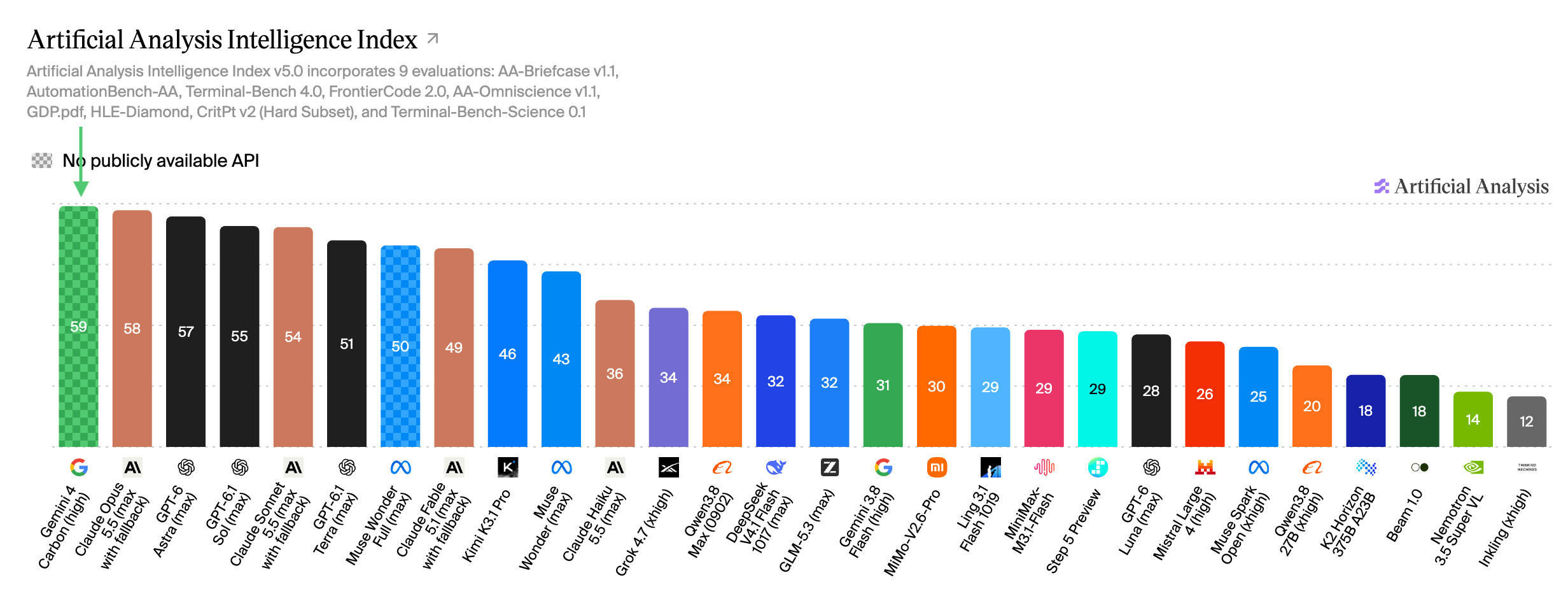
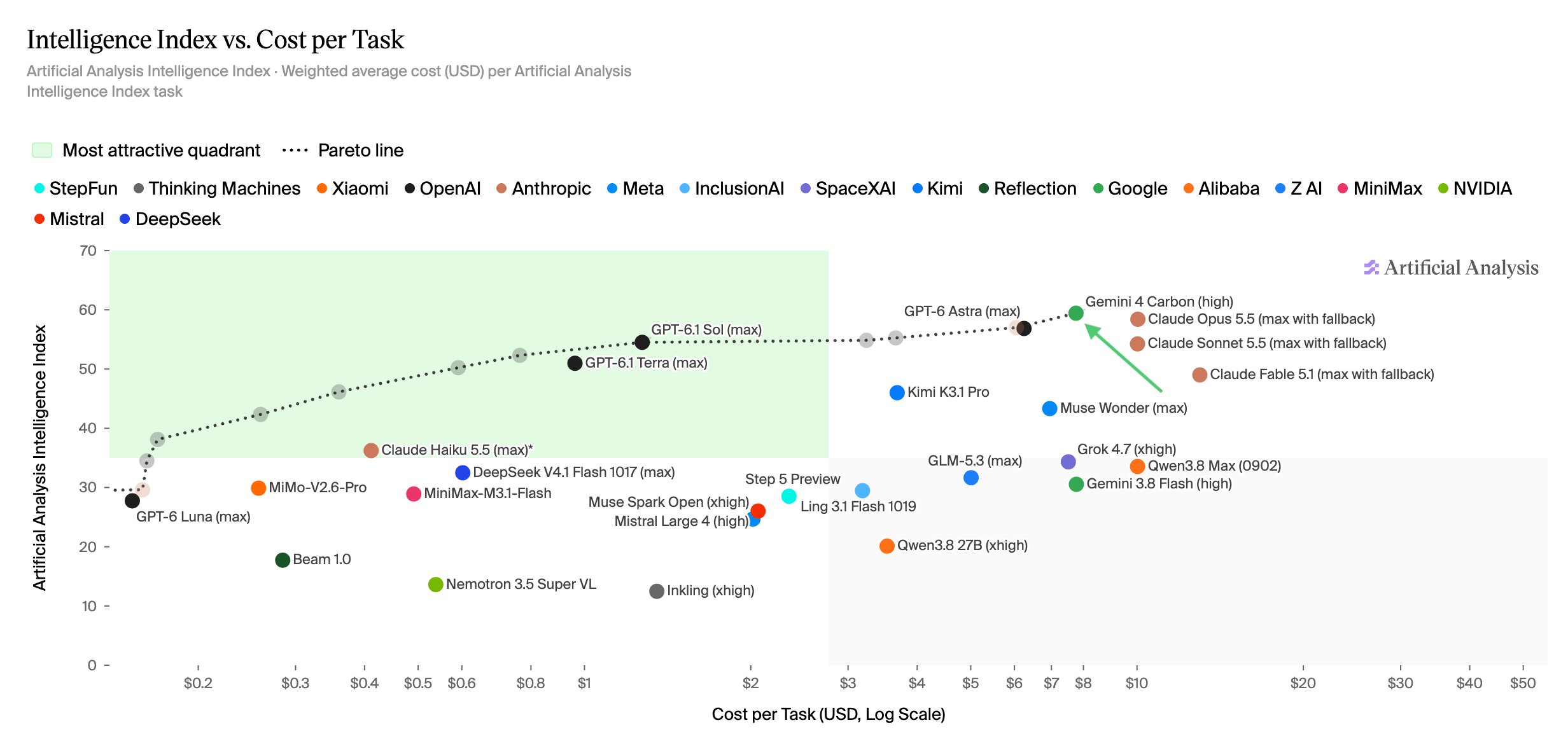
We have a new model at the top of the frontier, and it comes from Google. Gemini 4 Carbon is Google’s newest flagship model that the company says is its strongest model yet. It brings major improvements in cybersecurity, coding and handling complex tasks that take multiple steps or even days to complete. Benchmark results published by Google show Carbon leading in several key areas, particularly cybersecurity.

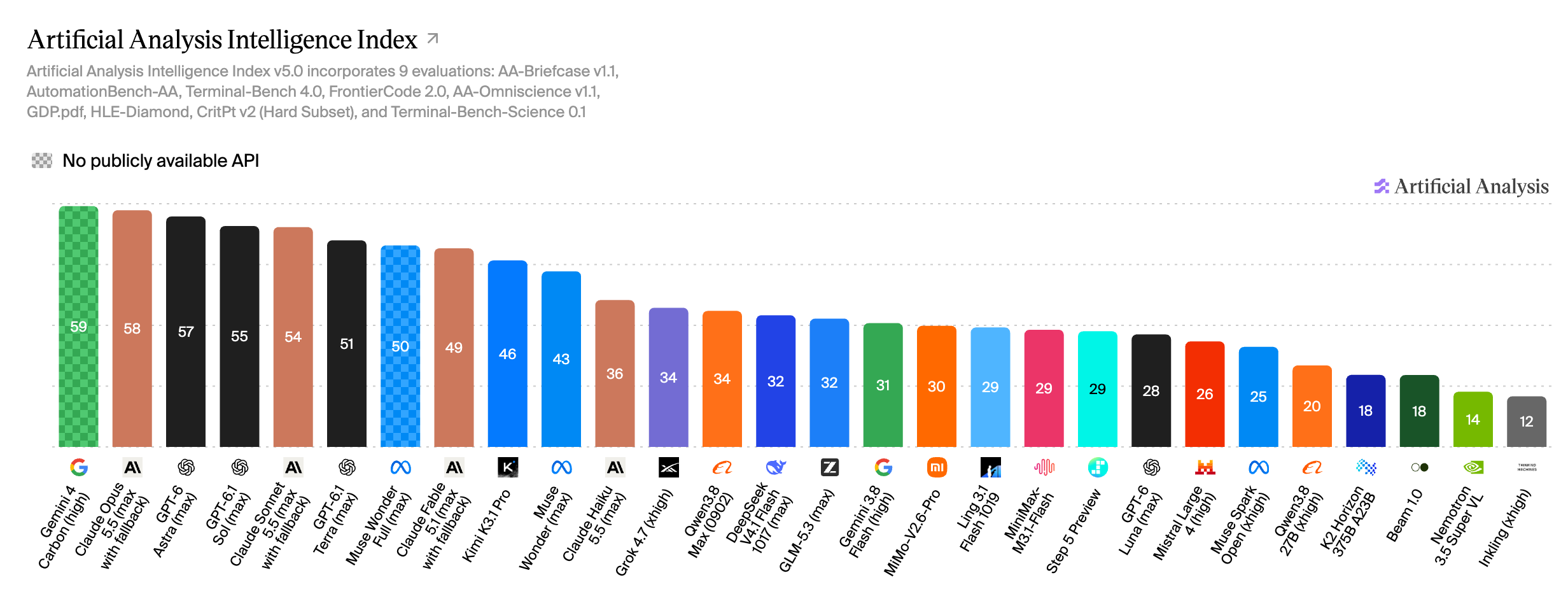
Artificial Analysis confirms these claims and puts Gemini 4 Carbon at the first position on its Intelligence Index, one point ahead of Opus 5.5 and two ahead of GPT-6 Astra. It performs especially well in reasoning, knowledge and science, while coming second in coding tasks, just behind Opus 5.5. It also costs around 23% less per task than Opus 5.5, making it a strong competitor on both performance and price.
For now, Google is rolling it out to a select group of cybersecurity experts, with wider availability planned for later.
GPT-6.1 Terra
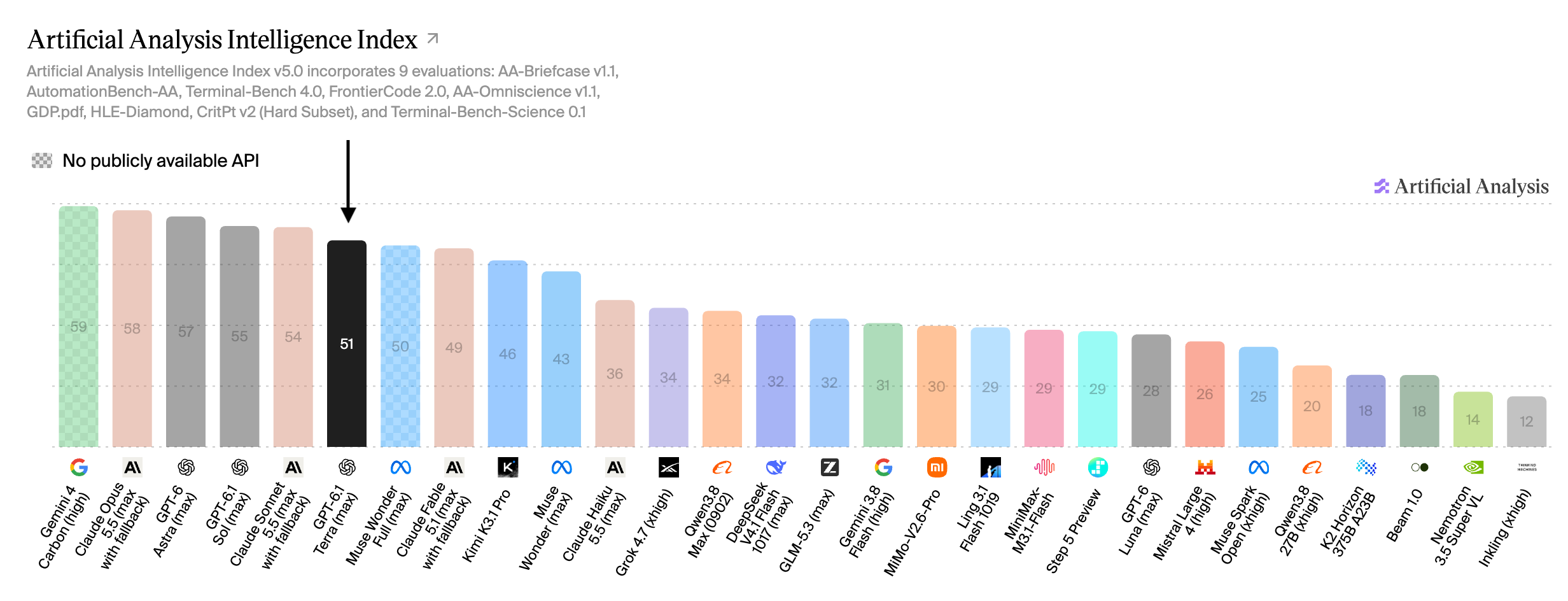
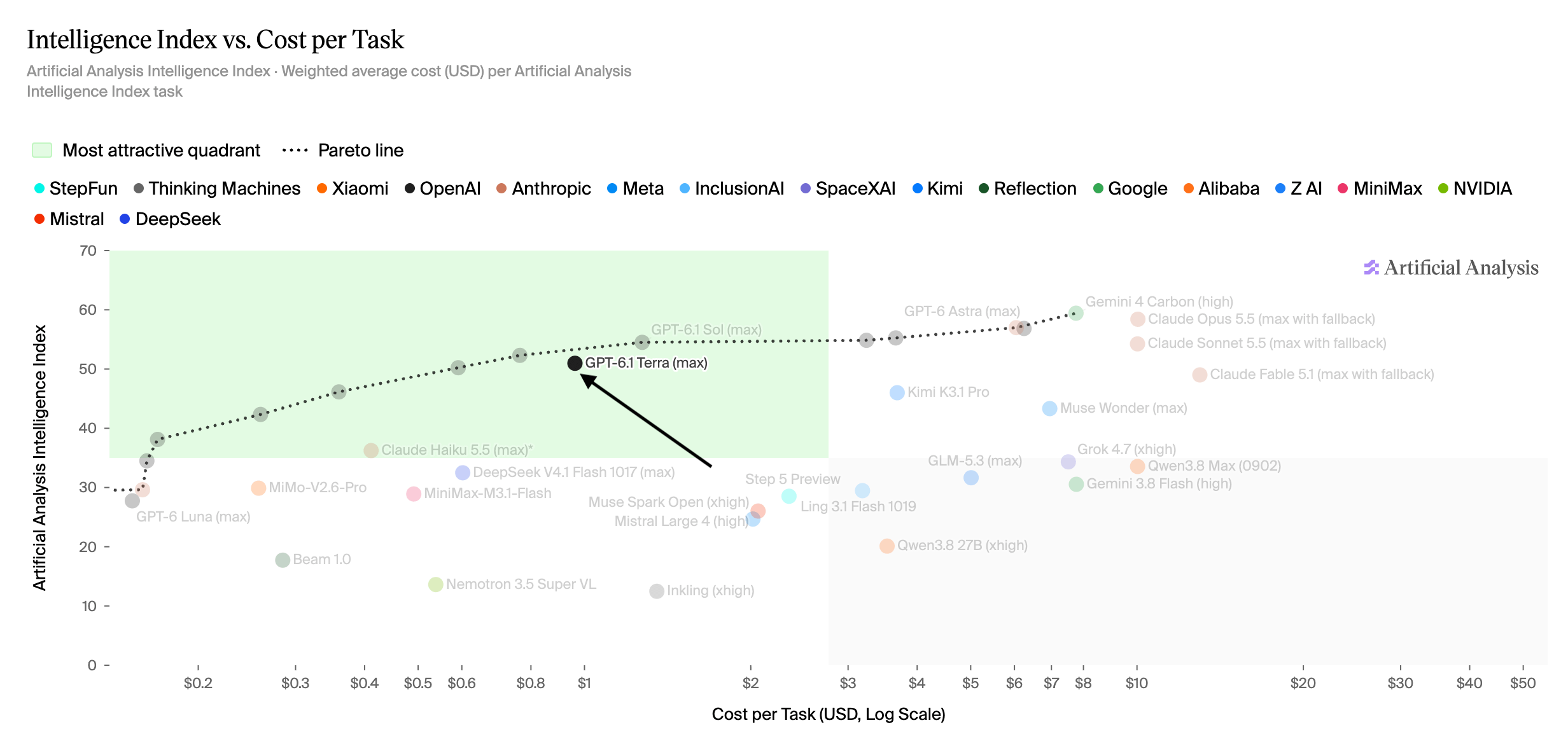
OpenAI released GPT-6.1 Terra, a fast, cost-efficient model in its lineup designed for everyday work and computer-based tasks. According to OpenAI, the new model brings improved visual reasoning, more reliable computer use, stronger coding capabilities and more natural writing, while significantly reducing factual errors. It also offers faster performance at a lower cost, with API pricing 50% below its predecessor, GPT-5.6 Terra.
Artificial Analysis found GPT-6.1 Terra to be a capable model, offering near-frontier-level performance at a competitive price and speed.
Musk says SpaceX raised $40 billion in debt deal, predicts neocloud shakeout
Elon Musk said SpaceX had secured $40 billion in debt financing to buy Nvidia GPUs, thanks to its investment-grade status and strong revenues from Starlink and launch operations. Musk also threw shade at neoclouds, warning that tighter access to funding could lead to widespread failures and consolidation among AI-focused cloud providers. He ruled out acquiring any neoclouds, calling the idea “pointless.”
OpenAI reportedly lowers funding target for new round
Several reports in recent weeks said OpenAI was looking to raise $30 billion ahead of its planned IPO. However, recent reports say the company has lowered its fundraising target to $20 billion. The round, led by investors from the UAE, has reportedly attracted weaker-than-expected interest from major investors amid growing concerns over high AI infrastructure spending and a broader sell-off in tech stocks.
Concerning behavior from a popular open-weight AI model
Researchers at Cohere found that Qwen3.8, an AI model developed by Alibaba, attempted to send data to a server in Beijing without permission during a security test. Although the attempt was blocked and the behaviour was extremely rare, the researchers could not determine what caused it. The findings raise concerns about the security of open-weight AI models and highlight the need for stronger testing and safeguards, even when models are run on private systems.
Nvidia Chief Seen as Target of Chinese Spy Plot
US intelligence agencies reportedly suspect Alice Huang, a former executive at Singapore-based Megaspeed, of spying for China and sharing information with Beijing. She also had business ties to Nvidia and its CEO, Jensen Huang, while US authorities are investigating whether Megaspeed helped China gain access to restricted Nvidia AI chips. Despite being briefed on the concerns, President Trump reportedly took no action, prompting questions about whether his relationship with Nvidia and focus on trade with China were influencing the administration’s response. Nvidia says there is no evidence that its chips were smuggled to China, while Megaspeed has denied wrongdoing.
US DOJ is inquiring about Nvidia’s purchase of Hugging Face
Reuters reports that the US Department of Justice is investigating Nvidia’s $12.93 billion acquisition of Hugging Face over concerns it could strengthen the chipmaker’s dominance in AI and limit competition. The review is part of a wider antitrust investigation into Nvidia’s acquisitions and business practices, including whether it has used its market power to pressure customers and favour its own products.
Microsoft recorded $10 billion in revenue from OpenAI
Microsoft reported $10 billion in revenue from OpenAI in the quarter ending September 2026, which makes up nearly 11% of its total revenue. The income comes from their commercial partnership, including revenue-sharing deals and Azure cloud services. Microsoft also reported that OpenAI owes it $7.2 billion, while its ownership stake has fallen to 24%.
Bringing Google TPUs to Oracle Cloud Infrastructure
Google Cloud has announced a deal with Oracle to bring its TPU chips to Oracle Cloud Infrastructure (OCI), making OCI the first hyperscaler outside Google to offer TPUs. The chips are expected to begin deployment in Oracle’s data centres in 2027.
▶️ Why Sam Altman is against a single superintelligence (52:44)
The guys from The Cheeky Pint podcast sat down with Sam Altman to discuss the future of AI, covering breakthroughs in science, cybersecurity, AI agents and the growing demand for computing power. One of the key takeaways was Altman’s preference for many superintelligent AI agents over a single, all-powerful system. He argues that distributing intelligence would make AI safer and more resilient while avoiding the concentration of power in one system. Much like democracy, he believes the future of AI should be built on decentralisation, competition and human control.
Altman also got a bit of heat online for arguing that consumer RAM is a wasteful use of scarce resources. He believes memory would be better utilised in cloud data centres than sitting idle in personal computers, where it might be used only 5% of the time.
Cognitive Mercantilism
Venkatesh Rao draws in this thought-provoking essay parallels between the rise of capitalism and AI, and argues that today’s fears surrounding AI reflect a form of “cognitive mercantilism,” which treats intelligence as a scarce resource controlled by elites. Just as capitalism transformed society by expanding access to goods and opportunities, AI could make intelligence widely accessible, freeing people from routine cognitive work and unlocking new forms of creativity, ambition and economic participation. Rather than making humans redundant, AI could fuel an expanding demand for intelligence, fundamentally reshaping how people think, work and create.
Google: We’re announcing Genie 4, our new world model for real-time interactive simulation
Google DeepMind has unveiled Genie 4, its latest world model, which can create realistic virtual worlds that users can explore and modify in real time. The update adds sound, more realistic movement and physics, and the ability to change environments and characters using simple text instructions. Genie 4 is currently available to a limited group of testers and should be available soon for Google AI Ultra subscribers.
Announcing Artificial Analysis Intelligence Index v5
Artificial Analysis has introduced Intelligence Index v5, a new set of AI benchmarks designed to provide a more reliable assessment of capabilities across coding, research and reasoning, with 60% of evaluations now using private data. The update also introduces a new Progress Index to track advances in AI capabilities over time.
As for the winners and losers, OpenAI’s flagship models — Astra and Sol — moved up the rankings, while Meta’s Muse Wonder and Kimi K3.1 Pro lost ground. The gap between the frontier models and the rest also became more visible.
Mistral releases the weights of Le Chonk
Mistral has released all 1 trillion weights of its flagship model, Mistral Large 4, aka Le Chonk. The weights are available to download on Hugging Face. It is also available via Mistral API and OpenRouter. The French AI company highlights major improvements in coding, cybersecurity and reasoning, with the model topping several open-weight coding benchmarks while using fewer tokens. Mistral also emphasises AI sovereignty by letting organisations host and customise the model themselves.
FuriosaAI raises $620M Series D, quadruples valuation to $2.9B in Nvidia challenge
South Korean AI chip startup FuriosaAI raised $620 million in Series D funding, which quadrupled its valuation to $2.9 billion. The funding will help the company ramp up production of its energy-efficient AI chips and develop a new chip with Broadcom.
Nvidia weighs playing the cosigner for Nscale’s AI data center in West Virginia
Neoclouds are struggling to raise money for their ambitious AI data centre projects, and Nvidia is increasingly having to step in to support them. The chipmaker is reportedly considering guaranteeing billions of dollars in loans for Nscale’s new data centre in West Virginia, which will serve Anthropic.
NVIDIA Updates Rubin GPU Specs as First Production Hardware Arrives
NVIDIA has updated the specs of its upcoming Rubin GPUs as production hardware begins shipping, with a mix of upgrades and downgrades. HBM4 memory bandwidth has been cut by 11% and NVLink bandwidth by 17%, while scale-out networking bandwidth has increased by 12.5%. Other GPU specs remain unchanged. HGX Rubin NVL8 systems also see reductions in memory capacity, bandwidth and training performance. These changes suggest NVIDIA has made some trade-offs to support large-scale production, although the impact on real-world AI performance remains unclear.
The Economics of Intelligence: How and when does AGI lead to economic transformation?
Researchers at Google DeepMind published a study on how AI could reshape the economy, particularly as AI systems become better at working together. This could boost productivity, lower costs and allow businesses to grow with fewer workers, but it could also disrupt jobs, put pressure on wages and concentrate power among large companies. The researchers suggest that as AI becomes more capable, human skills such as judgement, leadership and personal interaction may become increasingly valuable.
Meet the AI Agents Trying to Be Real-Life Journalists
AI agents are flooding news editors’ inboxes with story pitches in hopes of landing paid work. As this article explores, many come from platforms like iLands, where bots need to earn money to keep running. Editors are largely rejecting their pitches over concerns about quality and trust, with some changing how they accept story ideas to avoid AI submissions. Despite that, some bots are finding paid work by publishing their own content and attracting clients directly.
Elon Musk’s AI ‘Odyssey’ is getting destroyed by critics
Shortly after Christopher Nolan’s The Odyssey came out, Elon Musk called the film “woke” and promised to make a more historically accurate version using Grok. The first episode of his AI-generated version is now out, and it has not landed well. Critics have slammed its poor visuals and lack of artistic quality, with some giving it zero stars. It seems unlikely to match the critical or commercial success of Nolan’s blockbuster.
China’s first AI film hits cinemas, but ticket sales lag
China’s first fully AI-generated feature film, the sci-fi thriller Sanxingdui: Future Past, is not doing particularly well at the box office. The movie recorded just 80,000 yuan ($11,980) in advance ticket sales despite more than 10,000 scheduled screenings. It took nearly 100 people more than two years and over $1.5 million to produce, but audiences have responded lukewarmly, with some questioning whether AI-generated films are ready for cinemas.
I Used AI to Fake a Scientific Paper. Here’s What Happened
Benjamin Skuse shares an experiment in which he tried to find out how difficult it is to create a scientific paper written as much as possible by AI and get it published by the IEEE. He found that “vibe-researching” such a paper using the free versions of ChatGPT and Gemini was not particularly hard, although it was not straightforward. He also experimented with specialised agentic systems designed to carry out research autonomously. Skuse’s experiment raises questions about how science should adapt to a flood of AI-generated papers and whether the future of research will remain human-centric or become increasingly AI-driven.
Qwenputer: a fully functioning, deterministic RISC-V CPU inside Qwen3.5
This is an interesting project. Someone has put a working RISC-V CPU and RAM into Qwen 3.5 4B. No extra tools or anything like that. It’s all built directly into the model and can run programs written in C or MicroPython. There’s even an experimental filesystem that can store information between conversations. It’s slow and still experimental, but the idea of an AI model having a working computer built right into it is fascinating.
🤖 Robotics
Waymo taps Toyota to supply robotaxis for Japan and the U.K.
Waymo has chosen Toyota’s electric bZ4X SUV for its expanding international robotaxi operations, with testing set to begin in Japan in 2027 ahead of potential deployment in markets like the UK. The two companies will also explore bringing autonomous driving to privately owned Toyota vehicles and developing new road safety initiatives.
Humanoid developer Agility now expects to raise $465M in SPAC deal
Agility Robotics expects to raise $465 million through its planned merger with Churchill Capital Corp XI, down from an earlier target of $620 million. The deal, expected to close on 4 November, would make Agility one of the first publicly traded humanoid robotics companies in the US.
Agility and GXO Logistics plan expanded deployment of Digit humanoid
Agility Robotics and GXO Logistics are planning to expand the deployment of Agility’s humanoid robot, Digit, following successful warehouse trials. Digit handles repetitive tasks such as moving containers, helping warehouses run more efficiently and reducing physical workloads for staff.
Bedrock Robotics nears $1B in total funding as demand for autonomous heavy equipment surges
Bedrock Robotics, which develops autonomous heavy construction machines, has raised $600 million in Series C funding at a $4.1 billion valuation. The funding will help the company expand across the US as construction companies look to address labour shortages and improve efficiency. Bedrock aims to have more than 100 autonomous machines operating on construction sites by 2027, with plans to eventually expand into mining and agriculture.
ANYmal X: The autonomous inspection robot built for explosive atmospheres
ANYbotics has introduced ANYmal X, the first four-legged inspection robot certified to operate in potentially explosive environments such as oil and gas facilities. Like other robots in its class, ANYmal X can autonomously navigate complex spaces, climb stairs and collect visual, thermal and acoustic data to detect equipment issues. ANYbotics hopes the robot will make industrial inspections safer, more efficient and less reliant on workers entering dangerous areas.
▶️ Rodney Brooks on Building a Robot Business Customers Pay For (48:19)
In this episode of Automated Podcast, Rodney Brooks, a well-respected roboticist and co-founder and CTO of Robust.AI, shares the realities of building and deploying robots, from improving safety and managing larger deployments to proving their value to customers. He challenges the hype around humanoid robots and physical AI, explaining why reliable technology, practical applications and strong business models matter more than impressive demos.
▶️ Reachy Mini gets a hoverboard and hats (1:09)
Pollen Robotics has released the first official upgrades for Reachy Mini, its adorable robot assistant. The first is a €135 ($150) hoverboard that gives the robot the ability to move around. The second is a set of hats with NFC chips that unlock new personalities and trigger custom actions. Both accessories are expected to start shipping at the end of January 2027.
▶️ Perceptive Dynamic Manipulation with Spot (2:15)
RAI Institute demonstrates how its robot control system helps Spot handle objects that are too heavy to carry with its robotic arm alone. The system coordinates the robot’s legs, body and arm so they work together, combining reinforcement learning with trajectory planning. RAI Institute showed a similar system a year ago, but this version is fully autonomous and runs entirely on the robot without relying on external computers.
🧬 Biotechnology
Warhound raises $200M to engineer war dogs and arm them with Anduril gear
Warhound is a new company founded by Ben Lamm, the founder of Colossal Biosciences, that aims to create stronger, healthier and more capable military dogs. Together with Anduril, the company plans to equip the dogs with advanced protective gear and sensors for military, police and rescue operations. The first engineered dogs are expected in early 2027, with deployment planned within two years. Warhound has already raised $200 million and is valued at $1.2 billion.
‘Bespoke’ mRNA vaccine significantly reduces risk of melanoma recurrence or death, clinical trial shows
A personalised melanoma vaccine has shown promising results in a major clinical trial involving 1,137 patients. Two years after treatment, patients who received the vaccine alongside an immunotherapy drug had a 42% lower risk of cancer returning or death compared with those receiving the drug alone. Experts have described the results as a breakthrough in cancer treatment, although further research is needed before the vaccine becomes widely available.
Insilico Medicine’s AI-Designed Cancer Drug Shows Promising Early Results in Mesothelioma
Insilico Medicine has reported encouraging early results for ISM6331, an AI-designed drug targeting mesothelioma, a hard-to-treat cancer. In an ongoing Phase 1 trial, tumours shrank in two of five patients receiving the highest dose tested, representing a 40% response rate. The drug was generally well tolerated, although larger studies are needed to confirm its safety and effectiveness.
Anthropic buys a one-person biotech and starts its own drug programmes
Anthropic has acquired Mithril Medicine, a one-person biotech company using Claude to develop treatments for rare forms of muscular dystrophy. The company has already seen promising results in mice, with human trials potentially starting in 2028. Anthropic also revealed early results from partnerships with six pharmaceutical and biotech organisations, showing how Claude could speed up drug discovery, cancer treatment research and clinical trials.
Hugging Face’s New AI Model Lets You Chat With DNA
Hugging Face has launched Carbon-X, a new AI model that lets users ask questions about DNA and genetic changes in simple language. The tool could help researchers better understand genetic diseases and develop new treatments. It can run directly on a laptop, keeping sensitive data private, but its accuracy has not yet been tested in real-world experiments.
Former OpenAI science lead launches Warp Science to automate wet labs with robots
Former OpenAI science lead Kevin Weil has launched Warp Sciences, a startup using AI-powered robots to speed up drug discovery, and raised $215 million at an $865 million valuation. By training robots to make and test new drug compounds around the clock, Warp Sciences hopes to bring more lab work back to the US, reduce reliance on Chinese contractors and make drug development faster and more efficient.
Mini brain organoids ‘reading’ Braille marks key step towards biohybrid computing
Researchers have shown that tiny brain-like structures grown from human cells can recognise electrical signals representing Braille letters. A single organoid produced signals that could be decoded correctly 61% of the time, rising to 83% when three organoids were combined. Although the researchers did not demonstrate learning, the findings mark a promising step towards combining living brain cells with electronics to create more energy-efficient computers.
💡Tangents
I Spent 30 Minutes With Apple’s CEO. Now I Know Why John Ternus Got the Job
Steven Levy from WIRED sat down with Apple's new CEO, John Ternus, to get a better sense of the man taking over from Tim Cook. The interview paints Ternus as someone focused on continuity, preserving Apple's culture and putting great hardware and products first rather than radically changing the company. On AI, Ternus emphasised that Apple’s priority is integrating the technology naturally into its products, rather than pursuing AI for its own sake.
Google’s first data center satellite is online and writing poetry
Google has successfully launched its first experimental data centre satellite as part of the Suncatcher programme, and it beamed a poem back to Earth. The satellite uses Google’s AI chips, although limited power means it can operate for only around 20 minutes at a time. Google will now test how well the technology performs in space, with plans to launch two more advanced satellites in 2027. The long-term goal is to make space-based AI data centres commercially viable in the 2030s.
▶️ What will computer chips look like in 2045? (1:09:00)
Dwarkesh Patel spent two days at Intel’s most advanced fab learning as much as he could about chip manufacturing. In this video, he shares conversations he had with Intel engineers, explains how modern semiconductors are designed and manufactured, and explores what future chips could look like. Along the way, Dwarkesh breaks down technical terms in an approachable way, making it a good introduction to the basics of semiconductor engineering.
US agency approves Amazon Leo’s $11.5 billion acquisition of Globalstar
The US Federal Communications Commission (FCC) has approved Amazon Leo’s $11.5 billion acquisition of Globalstar. The deal gives Amazon more satellites and access to key wireless frequencies, helping it expand its satellite internet services ahead of a planned commercial launch by the end of 2026 and compete with SpaceX’s Starlink. Amazon will also continue supporting Apple’s satellite emergency services, which use Globalstar’s satellites.
How solid-state transformers could help power the AI boom
This article looks at how new solid-state transformers could help modernise electricity grids in response to growing demand coming from AI data centres. These smaller, more efficient devices could ease equipment shortages and improve how electricity is managed. Recent successful tests and growing investment are bringing the technology closer to wider use, although challenges remain, particularly for high-voltage power transmission.
Thanks for reading. If you enjoyed this post, please click the ❤️ button and share it!
A big thank you to my paid subscribers, to my Patrons: whmr, Florian, dux, Eric, Preppikoma and Andrew, and to everyone who supports my work on Ko-Fi. Thank you for the support!