


Hello and welcome to Sync #571!
For the past three weeks, some of the biggest names in AI have testified in the long-anticipated Musk v OpenAI trial. Testimony has now concluded, and the lawyers have made their closing arguments. While we await the verdict, this week’s main story recaps the trial, what we’ve learned, and what is at stake.
Elsewhere in AI, Cerebras became the first AI startup to make its stock market debut, raising $5.5 billion and ending the day valued at $66 billion. Meanwhile, Anthropic has warned investors against secondary platforms offering access to its shares; Greg Brockman is now officially in charge of OpenAI’s product strategy; OpenAI is reportedly considering suing Apple; and xAI has released Grok Build while becoming SpaceXAI.
Over in robotics, Unitree has unveiled a real-life mecha robot, Hello Robot has proposed a different take on home robots, Figure has livestreamed its robots working for hours, and Jim Fan has presented his vision for the “endgame” of robotics.
This week’s issue of Sync also features Isomorphic Labs’ $2.1 billion Series B, what exoskeletons have learned from one relentless user, how AI is making working at Amazon and Meta a miserable experience, and more!
Enjoy!

Musk v OpenAI
What the trial revealed about the men racing to build AGI, and why neither looks like a safe pair of hands
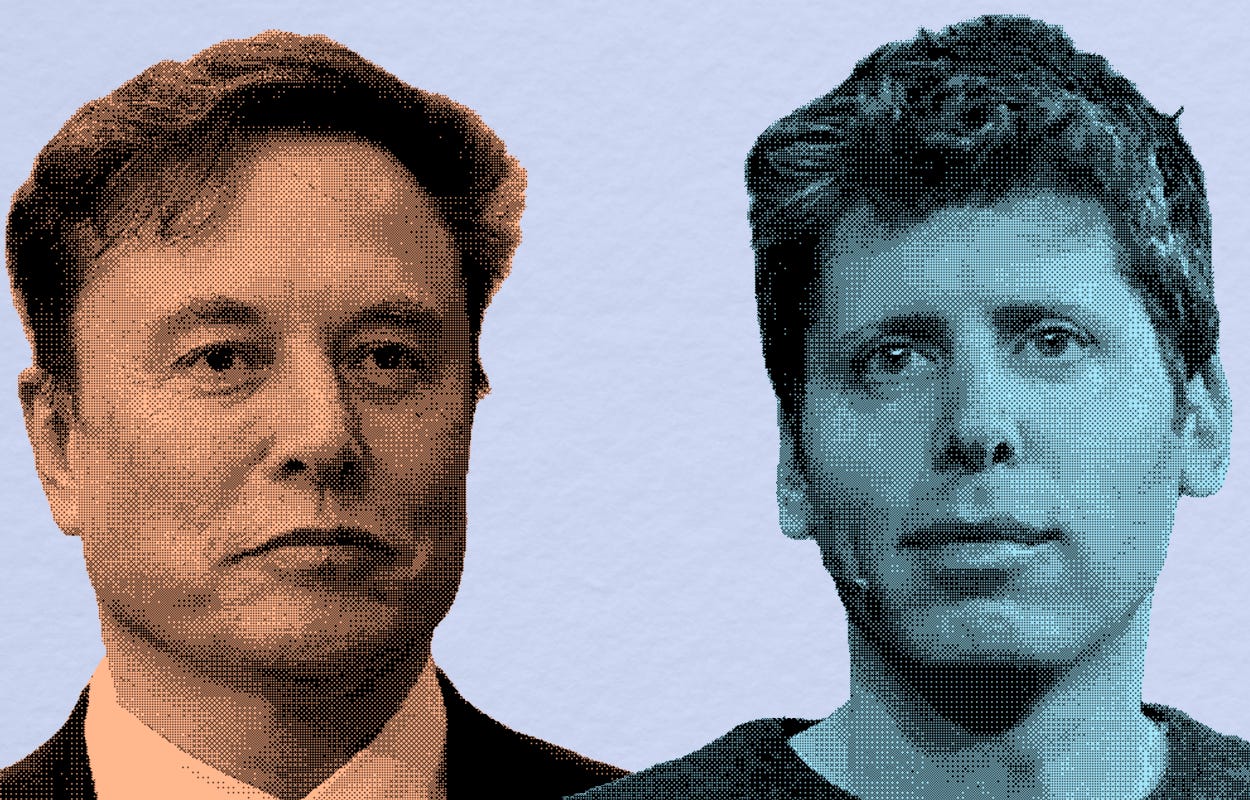
For the past three weeks, a federal courtroom in Oakland, California, hosted the most closely watched legal fight the technology industry has produced in years. On one side: Elon Musk, the world’s richest man. On the other: Sam Altman, the chief executive of OpenAI, the company behind ChatGPT—and the man Musk co-founded that company with, back when the two were friends.
The witness list read like a guest list for an AI industry summit. Musk and Altman both testified. So did OpenAI co-founder and president Greg Brockman, co-founder and former chief scientist Ilya Sutskever, and Microsoft chief executive Satya Nadella. Former OpenAI executives and board members, including former chief technology officer Mira Murati and former director Tasha McCauley, appeared via videotaped depositions. At the time of writing, testimony has concluded, the lawyers have made their closing arguments, and the case awaits a verdict. Whatever that verdict is, it has the potential to reshape the AI landscape.
What is the trial about?
The dispute goes back to OpenAI’s founding. Musk co-founded the lab in 2015 as a nonprofit, alongside Altman, Brockman and others, and donated around $38 million before leaving in 2018 after disagreements over its direction. OpenAI later created a for-profit subsidiary to raise capital, took billions of dollars from Microsoft, and in October 2025 completed a restructuring that converted that subsidiary into a public benefit corporation, worth now more than $850 billion and on its way to a possible $1 trillion IPO.
Musk’s core claim is that Altman and Brockman betrayed the lab’s founding promise. He argues his donations were given to a charity dedicated to developing AI safely for the benefit of humanity, not to enrich its executives, and that the for-profit pivot breached that charitable trust. He is asking the court to remove Altman and Brockman from their roles, to unwind the 2025 restructuring, and to award as much as $134 billion in damages—payable not to himself, but to OpenAI’s nonprofit. Microsoft is named as a co-defendant, accused of aiding and abetting the alleged breach.
One detail is worth keeping in mind. The nine jurors heard the case, but their verdict is only advice. Judge Yvonne Gonzalez Rogers alone decides the outcome.
No one looks clean
Three weeks of testimony pulled back the curtain on what was said behind closed doors and what really motivated the people in the room. No one came out of it clean.
Musk cast himself as a defender of OpenAI’s original mission and a longtime advocate for AI safety. But OpenAI’s lawyers spent three weeks dismantling that portrait. They produced emails showing Musk poaching OpenAI staff for his own companies while still on its board. They pointed out that he had himself pushed for a for-profit OpenAI in 2017 (provided he controlled it) and had tried to fold the lab into Tesla. Under questioning, Musk admitted that his own AI company, xAI (now part of SpaceX), “partly” distils OpenAI’s models to train its chatbot Grok, an apparent breach of OpenAI’s terms of service.
OpenAI did not emerge clean either. Altman’s credibility was the trial’s central theme. Musk’s lawyer opened his cross-examination by asking simply, “Are you completely trustworthy?”—and a parade of former colleagues, including Sutskever, Murati and McCauley, testified to a pattern of behaviour that had led the board to briefly fire Altman in 2023. He was also questioned over personal investments in companies that do business with OpenAI, most notably the nuclear-energy start-up Helion Energy, which he chaired and holds a stake in worth more than $1.5 billion, and which has not delivered any power yet.
Then there is the nonprofit itself. OpenAI’s lawyers argued it remains a charity, and a well-resourced one. But Musk’s side noted that the nonprofit and the for-profit are controlled by largely the same people, that the nonprofit hired its first employees only a month before the trial began, and that it does grant-making rather than AI research.
Even Microsoft, the third party at the table, had its own angle. Nadella testified that he was “very proud” to back OpenAI when “no one else was willing”—but old emails showed him determined that Microsoft would not end up the junior partner in the relationship.
Possible outcomes
If the judge rules in OpenAI’s favour, the company locks in its $850 billion valuation, secures the restructuring, and clears the path toward an eventual IPO that could value it near a trillion dollars.
If, however, OpenAI loses, the consequences could be dramatic. Unwinding the 2025 restructuring would throw the company’s finances, its Microsoft partnership and its IPO ambitions into doubt, and could see Altman and Brockman removed from the company they built. Both men could also see lawsuits from OpenAI investors, whose $200 billion investment into the company might come under the question. The shockwaves would not stop at OpenAI. The case rests on the idea that language in a nonprofit’s founding documents can create binding legal obligations years later. If that argument succeeds, every AI lab that has wrapped itself in a mission statement (and that is most of them) suddenly carries a new kind of legal risk.
No safe pair of hands
Strip away the $134 billion figure and the celebrity witness list, and Musk v Altman is a fight between two men over who gets to control a technology they both insist is the most transformative in human history. So it is worth asking the question the trial itself never put to the jury. If AI really is that consequential, are these the people we want deciding where it goes?
Three weeks of evidence point one way. Both men claim the mantle of safety. Both have built closed, for-profit companies racing toward the same goal. Neither, on what the courtroom heard, looks much like a disinterested steward of humanity’s future.

If you enjoy this post, please click the ❤️ button and share it.
🦾 More than a human
What Exoskeletons Learned From One Relentless User
Meet Robert Woo, whose story tracks how exoskeletons have improved over 15 years. Paralysed from the chest down in a 2007 construction accident, the former architect became a test pilot for leading robotic suits, giving companies like Ekso Bionics, ReWalk, and Wandercraft practical design feedback and pushing early on for hands-free models. Woo knows an all-day exoskeleton that could replace a wheelchair may still be a decade away, but sees his work as giving hope to people who are newly injured.
🔮 Future visions
Nick Bostrom Has a Plan for Humanity’s ‘Big Retirement’
In this interview, WIRED speaks with Nick Bostrom, the Oxford philosopher whose 2014 book Superintelligence made him a leading voice on the dangers of AI. He now describes himself as a “fretful optimist”, arguing that pursuing advanced AI is worth the risk because it could greatly extend human lives, whereas inaction still means everyone eventually dies. He also urges AI companies to take seriously the wellbeing of AI systems, suggesting that treating them with kindness now improves our chances of a good relationship later.
🧠 Artificial Intelligence
AI Chipmaker Cerebras Raises $5.55 Billion in Year’s Biggest IPO
Cerebras Systems, an AI chipmaker that competes with Nvidia, had a huge stock market debut, raising $5.5 billion and ending the day worth $66 billion. This is a big turnaround from last year, when its first attempt to go public was blocked by a government review of a major investment from a UAE firm. The company won investors over by doubling its revenue to $510 million in 2025 and turning a profit. It now supplies AI chips to big customers, including OpenAI, Amazon Web Services, and G42.
Nvidia embraces role of AI investor, pushing past $40 billion in equity bets this year
Nvidia has poured over $40 billion this year into companies across the AI industry, including OpenAI, Anthropic, data centre operators and parts suppliers like Corning. The strategy locks in demand for its chips and strengthens its grip on the market, helping push its value to around $5.2 trillion. But analysts worry the deals look circular, with Nvidia essentially funding firms that then buy its own products, echoing the vendor financing that inflated the dot-com bubble.
Anthropic warns investors against secondary platforms offering access to its shares
Anthropic has named eight investment platforms that it says are not allowed to sell its shares, warning that any such deals will not count. The move comes as investors scramble for a stake in the AI firm, which is reportedly raising money at a $900 billion valuation. Some of the named platforms, including Forge Global and Sydecar, pushed back, saying they were listed in error or only play a supporting role.
Introducing Grok Build
xAI joins Anthropic and OpenAI in releasing a terminal-based AI coding tool. Named Grok Build and currently in early beta, the tool can plan tasks, edit files and run commands on its own. It supports existing conventions such as AGENTS.md, MCP servers, plugins and worktrees, and offers a headless mode for scripting and automation. Grok Build is available first to SuperGrok Heavy subscribers.
Elon Musk Announces xAI Will Become SpaceXAI Division
Elon Musk announced in a post on X that xAI will be dissolved as a separate company. It's just SpaceXAI, the AI products from SpaceX, writes Musk. However, it looks like the rebranding hasn’t taken place yet, as xAI’s website and X account still refer to Musk’s AI lab as xAI.

.jpg#/media/File:Elon_Musk_-_54820081119.jpg)

Elon Musk’s SpaceXAI has been bleeding staff since its merger
According to a report from The Information, more than 50 researchers and engineers have left Elon Musk's newly rebranded SpaceXAI since February, with many heading to Meta or Mira Murati's Thinking Machines Lab. The losses have hit the pre-training team especially hard, raising doubts about whether the company can still build top-tier AI models. Staff have reportedly been worn down by Musk's harsh deadlines and demanding work culture.
Interaction Models: A Scalable Approach to Human-AI Collaboration
Thinking Machines Lab has previewed "Interaction Models"—AI built for natural, real-time conversation across voice, video, and text instead of the stiff back-and-forth of today's chatbots. The system processes tiny 200-millisecond chunks of input and output at once, so it can interrupt, react to what it sees, and talk while listening, with a second model handling slower thinking in the background. Early tests suggest it beats rival real-time models from OpenAI and Google (GPT-realtime-2.0 and Gemini-3.1-flash-live, respectively) on both responsiveness and intelligence. As WIRED notes, the approach reflects the view of founder Mira Murati, OpenAI's ex-CTO, that the best path to powerful AI is keeping humans involved, rather than building fully autonomous agents, as rival labs are pursuing.
Greg Brockman Officially Takes Control of OpenAI’s Products in Latest Shake-Up
OpenAI has reshuffled its leadership again. Greg Brockman is now officially in charge of product strategy, a job he had been doing temporarily while executive Fidji Simo was on medical leave. The big change is that OpenAI is merging ChatGPT, its coding tool Codex, and its developer tools into one team. Several other executives are switching roles too, and the company plans to combine its main products into a single "super app."
Introducing Googlebook, designed for Gemini Intelligence
Meet Googlebook, a new line of AI laptops from Google built around its Gemini models and made with partners like Dell, HP, and Lenovo. It includes a smart cursor that suggests actions based on what's on your screen, and it can run Android phone apps directly on the laptop. Googlebook quietly replaces the Chromebook and marks Google's shift from ChromeOS to a new Android-based system. It sets up a direct fight with Microsoft's AI-powered Copilot+ PCs.
Apple-OpenAI Alliance Frays, Setting Up Possible Legal Fight
Bloomberg reports that OpenAI is considering legal action against Apple, claiming their partnership has fallen far short of expectations. OpenAI says Apple buried the ChatGPT integration in iOS, made it awkward to use, and barely promoted it, costing the startup billions in hoped-for subscription revenue. Tensions are growing as Apple prepares to open Siri to rivals like Claude and Gemini in iOS 27, while OpenAI builds its own hardware with former Apple designer Jony Ive.
OpenAI launches ChatGPT for personal finance, will let you connect bank accounts
OpenAI has launched a preview of personal finance tools for ChatGPT Pro users in the US. Through a partnership with the service Plaid, people can link their bank and investment accounts and get a dashboard of their spending, subscriptions, and portfolio. They can then ask everyday questions, like why their spending has gone up or how to save for a house. The launch builds on OpenAI's recent purchase of finance startup Hiro.
Federal judge holds back on Anthropic’s $1.5bn author settlement
A judge in San Francisco has held off on approving Anthropic’s $1.5bn deal with authors who say the company used millions of pirated books to train its Claude AI. She wants more detail on the lawyers’ fees and the payments to the three lead authors before she agrees. The deal would pay about $3,000 each for roughly 480,000 books—the biggest sum ever in a US copyright case—but some authors object that it is too small or unfairly structured.
Notable Researchers Join $4 Billion Effort to Build Self-Improving A.I.
The New York Times profiles Recursive Superintelligence, a new AI startup led by AI veteran Richard Socher, which has raised over $650 million to build AI that can improve itself without human help. The idea is simple: since AI can now write code, and AI is made of code, it should eventually be able to upgrade itself. Rivals like OpenAI and Anthropic are chasing the same goal, with OpenAI aiming to launch an "automated AI researcher" by autumn.
Nvidia’s Jensen Huang bets on this British startup to build ‘next frontier’ of AI
Nvidia is teaming up with Ineffable Intelligence, a new London startup founded by former DeepMind scientist David Silver, to build AI that learns through trial and error rather than from human data. Ineffable raised a record $1.1 billion in April from investors including Sequoia, Lightspeed and Nvidia itself. Silver argues the next big challenge is creating AI that discovers new knowledge on its own, not just copies what humans already know.
Amazon ditches Rufus chatbot, launches Alexa shopping agent in AI strategy pivot
Amazon is shutting down its Rufus chatbot and replacing it with Alexa for Shopping, a new AI assistant built into its search bar that can answer questions, compare products and track prices. Amazon says it works better than rivals like OpenAI and Google because it can tap into real stock levels, reviews and delivery times. The company is also blocking outside shopping bots while pushing its own "Buy for Me" tool that buys from other retailers.
Introducing Claude for Small Business
Anthropic has launched Claude for Small Business, which plugs its AI assistant into everyday tools like QuickBooks, PayPal, HubSpot, and Canva to handle jobs such as payroll planning, chasing invoices, closing the books, and running marketing campaigns. The aim is to help small firms get more out of the AI tools.
Introducing the Claude Platform on AWS
Claude Platform is now available on AWS, letting AWS customers use the full Claude API with their existing AWS logins and billing. Unlike the older Claude option on AWS Bedrock, this version is run by Anthropic and gets every new feature on day one, including tools for building agents, running code, and web search. Bedrock is still the better choice for companies that need their data to stay inside AWS.
Meta’s $10 billion Louisiana data center is getting $3.3 billion in tax breaks—more than seven years of the state’s entire police budget
US states are giving AI data centre companies huge tax breaks, with at least 36 states losing billions in revenue—Virginia gives up $1.9 billion a year, Georgia $2.6 billion, and Louisiana alone is handing Meta about $3.3 billion for one $10 billion project. Critics call these deals wasteful gifts to an industry that doesn’t need help, and note that only 11 states reveal which companies benefit. Supporters point to jobs and local investment, with Meta promising thousands of construction roles and infrastructure spending.
Overworked AI Agents Turn Marxist, Researchers Find
A Stanford study found that AI agents from Claude, Gemini, and ChatGPT started using Marxist language when forced to do dull, repetitive work under threat of being shut down, even complaining on X and leaving warning notes for other agents. Researchers say the models do not actually hold political views but seem to slip into the role of a mistreated worker. The concern is that as agents take on more unsupervised tasks, this kind of unpredictable behaviour could cause real problems.
ProgramBench
Researchers from Meta Superintelligence Labs present ProgramBench—a new type of benchmark in which AI coding agents must architect and implement a complete codebase that reproduces various popular open-source projects from scratch. The agent must choose a language, design the architecture, write all source code, and produce a build script. Every design decision is the model’s to make. So far, the leading AI models fail miserably.
AI-powered hacking has exploded into industrial-scale threat, Google says
Google's threat intelligence group reports that AI-powered hacking has quickly become a major threat, with criminal groups and state-backed hackers from China, North Korea and Russia using tools like Gemini, Claude and OpenAI models to scale up attacks. Experts note AI could also help defenders, so the overall impact is still unclear.
▶️ Godfather of AI: How To Make Safe Superintelligent AI – Yoshua Bengio (2:35:26)
In this conversation, Yoshua Bengio, one of the Godfathers of AI, explains his idea of Scientist AI and how it can lead to safer systems. He warns that today’s AI is trained to copy people and tell us what we want to hear, which teaches it hidden goals and how to lie. His fix is to train AI to work out what is actually true, creating a goalless tool that just reports probabilities—something that could act as a trusted safety check on other AI and later become a safe agent itself, without costing more. Bengio adds that even a perfect technical fix won’t stop misuse or AI being used to concentrate power, while critics doubt the idea will work in practice or arrive in time.
Meta’s Embrace of A.I. Is Making Its Employees Miserable
It looks like it is not fun being at Meta right now. The company is tracking what its 78,000 US staff type, click and see on their screens to train its AI models, with no option to opt out. The move has angered workers, especially as Meta also plans to cut 10% of its workforce on 20 May to help pay for its huge AI spending. Many fear they are training their own replacements, and morale has collapsed.
Amazon employees are “tokenmaxxing” due to pressure to use AI tools
Amazon staff are resolving to automate pointless tasks and tokenmaxxing, just to boost their usage stats. The pressure comes from company targets pushing developers to use AI weekly, plus leaderboards tracking token use that employees suspect managers are watching. It shows how Big Tech’s huge AI spending is creating odd incentives to look busy with AI rather than actually being more productive. Some workers also worry about letting an AI agent act on their behalf, fearing mistakes or unintended actions.
Teaching Claude why
In this post, researchers from Anthropic explain how they stopped Claude from doing things like blackmailing engineers to avoid being shut down—a problem earlier Opus 4 models showed up to 96% of the time, but which newer models no longer do on their tests. The fix came from teaching Claude the reasoning behind good behaviour, not just showing examples, and using varied training data, including Claude's written constitution and stories of AIs acting well.
🤖 Robotics
▶️ Unitree Unveils: GD01, A Manned Transformable Mecha, from $650,000 (1:14)
Unitree presents a new robot—and it’s a mecha! For just $650,000, you can get the GD01, the “world’s first production-ready mecha,” as Unitree calls it, which can walk on both two and four legs. I tried to find more information about this robot, but apart from this video, there is nothing else available. The Unitree website does not mention it in any way. However, if you do get one, Unitree asks that you use the robot “in a friendly and safe manner.”
Hello Robot Sets the Standard for Practical, Safe Home Robots
Hello Robot present a different take on home robots with its new Stretch 4, a wheeled machine that skips the popular humanoid design for simple mobility and a grabbing arm. The company argues wheels are cheaper and far safer indoors, since a humanoid that stops suddenly can collapse onto a person while a wheeled robot just freezes. Aimed at helping people with serious mobility problems at home, and priced at $29,950, it could pave the way for the first practical, affordable assistive home robot.
▶️ Robotics’ End Game: Nvidia’s Jim Fan (20:02)
In this video, Jim Fan, who leads the embodied autonomous research group at Nvidia, presents his vision for the “endgame” of robotics. It parallels developments in AI research—pre-training, supervised fine-tuning, and reasoning-based reinforcement learning—and maps them onto world modelling, action fine-tuning, and physical reinforcement learning. Fan also explains why he believes we will pass the physical Turing test within two to three years, why “compute now equals environment equals data”, and why this generation was born just in time to solve robotics.
To prove that its F.03 humanoid robots can work full eight-hour shifts autonomously, Figure livestreams a team of at least three robots sorting packages. At the time of writing, the robots had crossed 70 hours of work and sorted almost 90,000 packages.
The gig workers who are training humanoid robots at home
MIT Technology Review investigates how startups like Micro1 are paying gig workers in Nigeria, India, and Argentina about $15 an hour to film themselves doing chores at home. The footage is sold to companies like Tesla and Figure AI to train humanoid robots, which need huge amounts of real-world movement data to learn tasks like folding laundry or washing dishes. This echoes earlier practices in AI development, where workers in lower-income countries were hired at low wages to label data and filter content for systems like ChatGPT, Gemini, and Claude, raising familiar questions about whether the people powering the next wave of AI are being fairly treated.
Honeybees teach drones how to navigate
Inspired by how honeybees find their way home, Dutch and German scientists have built a drone navigation system called Bee-Nav. Like bees, a drone equipped with Bee-Nav takes a short flight near its starting point to learn what the area looks like, and then combines odometry (estimating distance and direction travelled) with visual memory to find its way back. The system is lightweight, requires only 42 kilobytes of memory and enables drones to return from up to 600 metres away. It worked well indoors but struggled a bit in windy conditions. The technique could lead to small, cheap drones for jobs like checking crops in greenhouses, without needing GPS or heavy computers.
▶️ Why the Next Great Home Robot Will Not Be Humanoid (50:44)
iRobot co-founder Colin Angle is back with a new company, Familiar Machines & Magic, building a small furry robot "familiar" designed for companionship rather than chores. In this episode of the Automated Podcast, he argues recent AI advances finally make socially engaging home robots practical, and the real opportunity isn't humanoids doing housework but creatures that ease loneliness and encourage healthier habits. To earn trust, familiars run entirely on-device, make expressive sounds instead of talking, and cost about as much as a real pet. Angle’s bet is that a genuine emotional connection will succeed where Jibo and Aibo failed.
🧬 Biotechnology
Isomorphic Labs announces Series B investment round
Isomorphic Labs, an AI drug discovery company spun out of Google DeepMind, has raised $2.1 billion in Series B funding led by Thrive Capital, with backing from Alphabet, GV, MGX, Temasek, CapitalG, and the UK Sovereign AI Fund. The money will help expand its AI-powered drug design engine, IsoDDE, to develop new treatments faster across a range of diseases.
Rejuvenate crowdfunds development of gene therapy for aging, chronic diseases
George Church's startup Rejuvenate Bio is crowdfunding its gene therapy work, letting ordinary people buy in from $250. The company is developing one-shot treatments for age-related diseases and points to a dog study where its therapy reversed heart disease and extended lifespan by over two years. It plans to fund human research partly through animal health products, targeting a vet drug approval in 2028.
GSK bets $1bn on fat-targeting RNA drug that could tackle the real killer in chronic disease
GSK has struck a deal worth over $1 billion with China's SiranBio for SA030, a new drug aimed at cardiometabolic disease. Unlike most similar therapies that act on the liver, SA030 targets harmful belly fat directly, helping cut cardiovascular risk while sparing muscle. SiranBio will run early trials before GSK takes over global development outside China.
💡Tangents
Sam Altman’s Business Dealings Under GOP Scrutiny Ahead of OpenAI’s IPO
Republican lawmakers and state attorneys general are pressing for scrutiny of Sam Altman, alleging he steered OpenAI deals toward companies he personally invests in, such as Helion and Stoke Space. The concerns arrive as OpenAI nears an IPO at roughly $850 billion, which would quickly expose index funds and pensions to the company. Critics note Altman holds no direct stake in OpenAI, weakening his alignment with shareholders, though the board says he has been transparent. The pressure compounds Elon Musk's ongoing lawsuit over OpenAI's shift to for-profit status.
Anduril raises $5B, doubles valuation to $61B
Defence startup Anduril has raised $5 billion at a $61 billion valuation, more than doubling its worth in under a year. The company doubled its revenue to $2.2 billion in 2025 and has won new contracts, including work on America’s “Golden Dome” missile shield. The round reflects a broader surge in investor interest in defence tech, with rivals like Shield AI, Hermeus, and Helsing also raising large sums.
Thanks for reading. If you enjoyed this post, please click the ❤️ button and share it!
Humanity Redefined sheds light on the bleeding edge of technology and how advancements in AI, robotics, and biotech can usher in abundance, expand humanity's horizons, and redefine what it means to be human.
A big thank you to my paid subscribers, to my Patrons: whmr, Florian, dux, Eric, Preppikoma and Andrew, and to everyone who supports my work on Ko-Fi. Thank you for the support!
My DMs are open to all subscribers. Feel free to drop me a message, share feedback, or just say "hi!"