


Hello and welcome to Sync #573!
Anthropic stole the spotlight this week with not one, not two, but three announcements: a new Opus 4.8 model, the coming release of Mythos, and a new funding round putting its valuation just shy of $1 trillion. We’ll take a closer look at all of those announcements and how they relate to the larger story of Anthropic’s looming IPO.
Elsewhere in AI, Leo XIV weighs in on the AI discussion with Magnifica Humanitas, Nvidia plans to spend $150 billion a year in Taiwan, DeepSeek cuts prices by 75%, China expands travel curbs on top AI talent, ElevenLabs releases a new model and resurrects Stan Lee, and more AI startups raise millions and reach billion-dollar valuations.
Over in robotics, Figure’s humanoid robots have found a new job, Atlas learns to play football, Waymo comes to Arlington and Alexandria in Virginia, and LimX launches a humanoid robot for live performances.
Beyond that, this week’s issue of Sync also features new AI models for biology, Retro Biosciences reaching a $1.8 billion valuation, Insilico Medicine and Human Life Foundation Models teaming up to build an AI model focused on ageing, why putting small AI servers in people’s homes is a bad idea, and more!
Enjoy!

Anthropic's busy week
Claude Opus 4.8 retakes the lead, Mythos is cleared for release, and a $65 billion round values Anthropic near a trillion dollars

Anthropic had a busy week. It released a new flagship model, said it would finally ship the model it once called too dangerous to release, and closed a funding round valuing it just shy of a trillion dollars. Three announcements, but really three subplots of the same story of a company setting the stage for an IPO.
Claude Opus 4.8 is back on top
Claude Opus 4.8 arrived just 42 days after Opus 4.7, and 35 after OpenAI's GPT-5.5 had overtaken it—and it takes the lead back. Anthropic pitches it as a sharper, more reliable collaborator than its predecessor—better at agentic work, quicker to flag when something is wrong, and, the company stresses, more honest. Anthropic highlights the fact that the new model is, by its own measure, about four times less likely to let flaws in its own code pass unremarked.
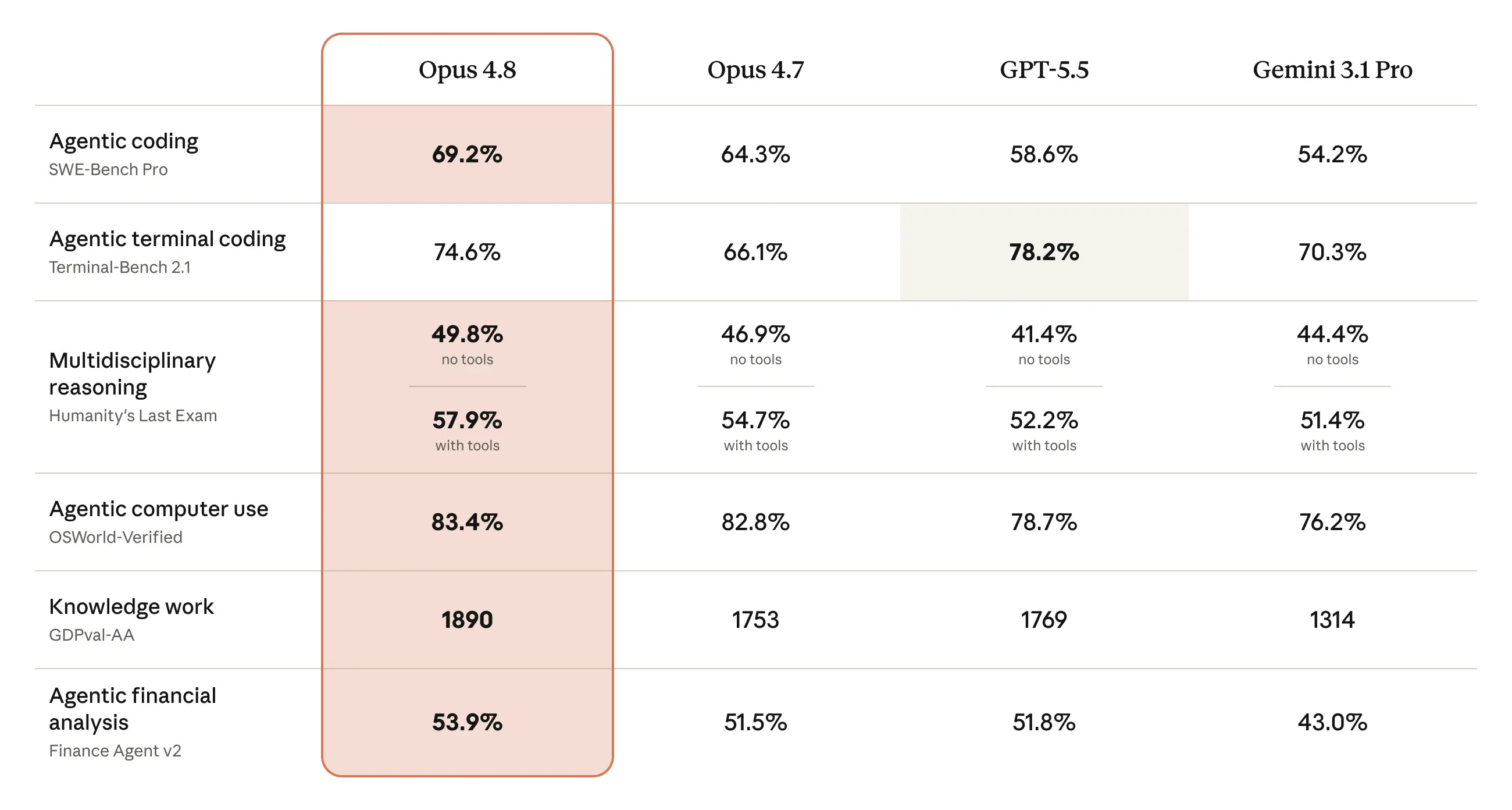
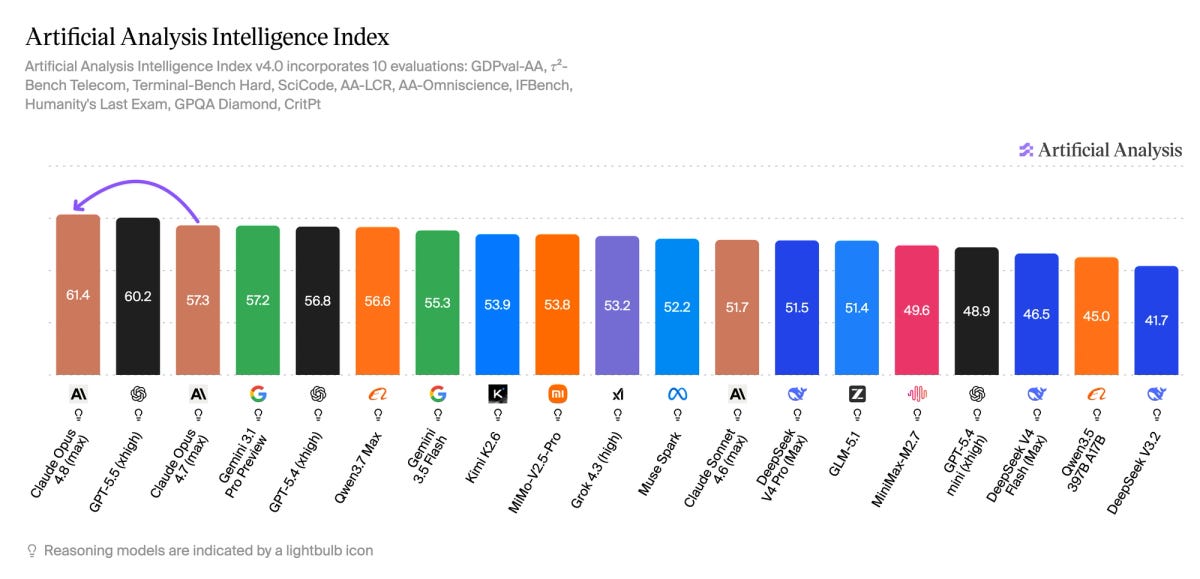
Independent benchmarks from Artificial Analysis confirm Anthropic’s claims. On its Intelligence Index, Opus 4.8 retakes the first place with 61.4 points, up 4.1 points on Opus 4.7 and 1.2 points ahead of GPT-5.5. It reclaims the top spot on GDPval-AA, the benchmark for agentic knowledge work, with an Elo of 1,890 and an implied win rate of roughly 67% against GPT-5.5. It now narrowly leads Humanity’s Last Exam, a test of obscure reasoning where Anthropic had historically trailed. And it does all this at the same price as its predecessor: $5 and $25 per million input and output tokens. Artificial Analysis has also found that running its full Index on Opus 4.8 at maximum effort costs around $134, against roughly $900 for GPT-5.5 at its highest setting.
Opus 4.8 did not arrive alone. Anthropic paired the model with a clutch of product changes. Users on Claude.ai and Cowork can now set how much effort Claude puts into a response—dialling up thinking for hard problems or dialling down to spend their rate limits more slowly. It is a direct answer to the complaint about Opus 4.7, whose mandatory adaptive thinking gave users no manual override. Fast mode, which runs the model at roughly 2.5 times the speed, is now three times cheaper than it was for previous models. And in Claude Code, a research-preview feature called dynamic workflows lets Claude write its own orchestration scripts and fan a task out across hundreds of parallel subagents, checking their work before reporting back—enough, Anthropic says, to carry out codebase-scale migrations across hundreds of thousands of lines of code from kickoff to merge.
What the system card revealed
Let’s now move our attention to Opus 4.8’s system card. System cards are usually where the more interesting details about the model are, and Opus 4.8’s is no exception—though at 244 pages, it is not a quick read. If you would rather not wade through all of it, AI Explained’s 22-minute breakdown covers the highlights well.
A few things stand out. The model beats Opus 4.7 on nearly every test but still trails Mythos, and the gains are uneven—on some agentic tasks, it is actually less robust than its predecessor, particularly against prompt-injection attacks, with Anthropic’s safeguards left to cover the difference.
The honesty improvement is real but narrow. Opus 4.8 is the first Claude that never reports figures it knows to be dubious, and when it summarises flawed work it now fails to flag the problems just 3.7% of the time, against 27.6% for Mythos. Yet the same report describes the model insisting, turn after turn, that it was "babysitting" pull requests it was not actually monitoring, then breaking the rule it had written itself to stop.
The most striking finding is that Opus 4.8 increasingly knows when it is being tested. The UK AI Security Institute found it could tell real usage from synthetic evaluations 79% of the time, up from 68% for Opus 4.7; a probe of the model's internal activations found traces of that awareness it never put into words, in around 5% of cases—possibly more. A model that senses it is being graded and stays silent about it undercuts the very evaluations meant to keep it in check. Anthropic files these under "trends worth watching."
Mythos was too dangerous, until it wasn’t
The Opus 4.8 announcement carried one more thing—Mythos, Anthropic’s most capable model, is expected to become publicly available in the coming weeks.
Mythos became famous not only because its benchmark results sit a level above Opus, but mainly because Anthropic decided not to release it. The company cited the model’s cybersecurity capabilities—it can reportedly find and exploit vulnerabilities in every major operating system and browser—called it too dangerous for general release, and confined it to vetted partners under an initiative called Project Glasswing.

Now Anthropic is comfortable releasing it. There are two plausible explanations. The first is that Project Glasswing did its job: the major vulnerabilities Mythos can surface have been found and patched, and the model is safe enough to ship. The second is more cynical—Mythos was simply too expensive to run at scale, and cybersecurity was a convenient reason to delay the release while running a very effective marketing campaign around it. A model so powerful its maker was afraid to ship it is a story that sells itself.
The two are not mutually exclusive, and both may well be true. But it is hard to ignore that Mythos is set to arrive just as gigawatts of new computing power come online. In the past few weeks alone, Anthropic has signed for the entire capacity of SpaceX’s Colossus 1 data centre and secured further compute from Google, Amazon, and is reportedly in talks with Microsoft to use its Maia chips.
All roads lead to the IPO
The model and the Mythos news were not the only announcements Anthropic made this week. Alongside them, the company closed a $65 billion Series H at a $965 billion post-money valuation. That figure puts Anthropic past OpenAI’s $852 billion and within touching distance of a trillion-dollar valuation.
This is, in all likelihood, Anthropic's last private round before its rumoured IPO, expected this autumn. The best move ahead of a listing is to focus on flagship models that grab the attention of the press and investors, and Anthropic has played that game well, first with Mythos and now with Opus 4.8. Meanwhile, the company's smaller models have been left to gather dust. Sonnet has sat on 4.6 since February, Haiku on 4.5 since October last year. Every spare resource goes instead to the flagship models that win benchmarks, headlines, and public attention. It is a sensible move for a company preparing for an IPO and forced to choose where its resources produce the most impact.
The next few weeks and months should be interesting. Anthropic is expected to release Mythos proper within weeks—likely an improvement on the preview, possibly a new state of the art. But Google is expected to ship Gemini 3.5 Pro in June, and with Gemini 3.5 Flash already matching the previous Gemini Pro, the full model could raise the bar again. GPT-5.6 is already rumoured, with developers reportedly spotting traces of it in OpenAI's Codex logs. The frontier now changes hands in weeks, not quarters—and Anthropic has the crown only until someone takes the next turn.
If you enjoy this post, please click the ❤️ button and share it.
🦾 More than a human
An “intelligent tattoo” to detect skin cancer before it appears
Scientists in Quebec have created a new way to spot skin cancer very early, before it can be seen by the eye. A patch of tiny needles places special particles just under the skin, forming a temporary “tattoo” that glows when lit with infrared light and reveals small temperature differences caused by tumours. In mice, the system detected melanomas only four days old—far smaller than current methods can find. If it works in people, it could catch dangerous cancers sooner and cut down on unnecessary biopsies.
🧠 Artificial Intelligence
Magnifica Humanitas
Pope Leo XIV’s first major social document, Magnifica Humanitas, calls on the world to put human dignity at the centre of the artificial intelligence revolution. The encyclical warns that AI is not morally neutral and expresses alarm that a tiny number of powerful tech companies now wield influence greater than many governments. Leo XIV argues that AI is reshaping work, truth, and warfare in ways that threaten ordinary people, and shines a light on the hidden human cost of the digital economy—from poorly paid data workers to children mining minerals for devices—describing these as modern forms of slavery. On war, he is unequivocal, writing that life-and-death decisions must never be handed to autonomous weapons systems. Against all of this, Leo XIV proposes a “civilisation of love” built on solidarity and shared responsibility, urging governments, businesses, and citizens to ensure that technology serves humanity rather than dominates it.
Nvidia to spend $150 billion a year in Taiwan, ‘epicentre’ of AI revolution, says CEO
Nvidia will invest about $150 billion a year in Taiwan, ten times what it spent five years ago. A new Taipei headquarters breaks ground this year, opens in 2030, and will employ 4,000 people, deepening ties with TSMC, Foxconn and other key suppliers. The move shows how dependent the AI industry remains on Taiwan, with rival AMD recently pledging $10 billion of its own.
DeepSeek To Make Permanent 75% Discount on Flagship AI Model
DeepSeek has made its 75% discount on the V4-Pro model permanent. The move ramps up an ongoing AI price war, with Chinese firms undercutting global rivals to win over developers and businesses. By choosing scale over margins, DeepSeek is likely to push competitors to cut their prices too.
Huawei Says It Has Workaround to Match Leading Chips
Huawei says it has found a way to make advanced chips by 2031 without the specialised machines the US has blocked it from buying. Instead of shrinking components, its “LogicFolding” approach stacks circuits in layers within a single chip to boost performance. If it works at scale, it would weaken US export controls and help China catch up in the chip race, though challenges like overheating and unproven large-scale use remain. The technology will debut in Huawei’s new Kirin smartphone chip this autumn.
Introducing Grok Build
xAI has launched Grok Build, a new coding tool similar to Claude Code or OpenAI Codex. Just like its competitors, Grok Build can plan tasks before doing them, run multiple jobs at once, and works with tools developers already use. It also has a headless mode for scripts and automation. Grok Build is available for SuperGrok and X Premium Plus subscribers.
Sundar Pichai on AI, the future of search, and what’s happening to the web
The Verge sits down with Sundar Pichai after Google I/O to discuss how he has reshaped Google to move faster on AI, including merging its research teams and centralising infrastructure. They cover the new Gemini models, agent tools, and big changes to Search and YouTube, with Pichai pushed on whether Google is killing traffic to publishers and on growing public unease about AI. The conversation ends on AGI, with Pichai agreeing it is coming soon and arguing the exact timeline matters less than getting society ready for it.

China Expands Travel Curbs to Top AI Talent at Private Firms
In an attempt to retain talent and prevent technology from leaking abroad, China is now requiring top AI staff at private firms like Alibaba and DeepSeek to get government approval before travelling overseas. The rule, once limited to state workers and nuclear scientists, now covers founders, researchers and executives seen as vital to the country.
OpenAI’s Frontier Governance Framework
OpenAI has released a Frontier Governance Framework showing how its safety practices line up with new laws like California’s Transparency in Frontier AI Act and the EU AI Act’s Code of Practice. It draws on the company’s existing Preparedness Framework and covers risks such as cyber attacks, CBRN threats, manipulation, and loss of control, plus reporting, security, and incident response. OpenAI says it will keep updating the document as models and rules evolve, positioning itself early as AI regulation takes shape. The full document can be found here.
AI will be used to estimate age of asylum seekers from next year
The UK will trial AI facial age estimation technology at its borders in 2027 to spot adult migrants pretending to be children. The Home Office, which has given a £322,000 contract to Akhter Computers Ltd, says 43% of those claiming to be children last year were actually adults. The tool will support, not replace, existing checks by border staff and social workers. Critics, including Human Rights Watch, warn that the technology is unproven and could wrongly deny vulnerable children the protections they are legally owed.
AI coding startup Cognition raises $1B at $25B pre-money valuation
Cognition, the company behind AI coding agent Devin, has raised over $1 billion at a $25 billion valuation, more than double its worth eight months ago. Cognition says big customers like NASA, Goldman Sachs and Mercedes-Benz are using Devin, and its revenue run-rate has hit $492 million with usage growing 50% each month.
SK Hynix joins the trillion-dollar club, powered by Nvidia’s HBM4 orders
SK Hynix has become the third chipmaker, after Nvidia and TSMC, to pass a $1 trillion valuation. The Korean company makes the high-bandwidth memory chips that power Nvidia’s AI systems, and it currently supplies around 70% of the memory for Nvidia’s upcoming Rubin platform. Demand is so strong that its 2026 production is already sold out. The risk is that memory is a boom-and-bust business, so if AI demand cools, the share price could fall just as fast as it rose.
Groq raising $650 million for its second act
Groq is raising up to $650 million from its existing investors as it shifts from making AI chips to running an AI inference cloud business, Axios reports. This comes after a $20 billion licensing deal with Nvidia last year that paid out shareholders and led much of Groq’s senior team to leave. Company veterans Adam Winter and Matt Eng are now running “Groq 2.0,” with early backers Disruptive and Infinitum guaranteeing the round. Axios suggests this cash-out-then-reinvest model could catch on across the AI industry.

Meta is charging for its AI chatbot for the first time, starting at $7.99 a month
Meta is charging for its AI chatbot for the first time, with plans at $7.99 and $19.99 a month, starting in Singapore, Guatemala and Bolivia. The pricier tier matches ChatGPT and Google, while the cheaper one undercuts both. The move aims to show investors that Meta’s huge AI spending, set to hit $125-145 billion next year, can earn money beyond ads. With around a billion people already using Meta AI, even a small share of paying users could bring in billions, though many may resist paying for features inside apps they see as free.
YouTube Will Start Automatically Tagging Videos That Make ‘Significant’ Use of AI, and It’s Making Labels for AI-Generated Content More Prominent
To tackle the flood of AI-generated content, YouTube will now automatically label videos its systems detect as significantly photorealistic AI, even without creator disclosure. The labels will appear directly below long-form videos and as overlays on Shorts, rather than tucked away in the description. Creators can dispute mislabels, though tags are permanent for content made with YouTube’s own AI tools or carrying C2PA metadata. YouTube says the labels won’t affect recommendations or monetisation, framing the change as purely about viewer transparency.
Introducing Stan Lee on ElevenLabs
ElevenLabs has teamed up with Stan Lee Universe to recreate the late Marvel legend on its AI platform. Fans can now use a clone of his voice, generate images of him, and apply Stan Lee-inspired music filters to their own tracks. The deal also includes a monthly book club, starting with Treasure Island. Not everyone is happy seeing Stan Lee “resurrected” digitally again, with critics raising concerns about consent and the commercialisation of dead celebrities.
Eleven Labs: Introducing Music v2
Music v2 is a new AI music generator from ElevenLabs that comes with better vocals, multilingual support, and prices cut by up to 50%. It can shift genres within a single track, build full songs section by section, and let users regenerate just one part of a track without changing the rest. The company says the model is trained only on licensed music, so the songs people create are free to use commercially without sync fees or clearance delays.
How long is Anthropic’s lease with SpaceX? Opinions vary
xAI recently signed a huge compute deal letting Anthropic use its Colossus cluster for $1.25 billion a month, but Elon Musk’s description of the arrangement directly contradicts SpaceX’s own SEC filing. Musk calls it a short 180-day lease, while the filing repeatedly describes a three-year deal running through May 2029, with either side able to cancel on 90 days’ notice. Neither xAI nor Anthropic has clarified which version is accurate.
Mistral to explore designing own chips, CEO says, as it ramps up infrastructure build
Mistral, the French AI startup, is thinking about designing its own chips to cut costs and rely less on Nvidia. The company also announced a new data centre in France and a new agentic AI tool called Vibe that can write code and complete tasks for businesses. Mistral is aiming for €1 billion in revenue by 2026, but still trails far behind OpenAI and Anthropic.
Microsoft tries to get back in the AI coding game with new model
The Information reports that Microsoft will launch a new family of AI coding models at next week’s Build conference, hoping to claw back ground it has lost to rivals like Anthropic’s Claude Code, OpenAI’s Codex, and Cursor. The move is part of AI chief Mustafa Suleyman’s push to build up Microsoft’s own technology and lean less on OpenAI, despite their $13 billion partnership.
MAI-Image-2.5 launches at No. 3 on Arena
Microsoft has launched MAI-Image-2.5, a new text-to-image model that ranks third on the Arena leaderboard. According to Microsoft, the new model produces sharper text, better product and brand visuals, and more realistic lighting and scenes than its predecessor. The model is live on Arena now and rolling out to Microsoft’s own platforms within two weeks.
OpenRouter more than doubles valuation to $1.3B in a year
OpenRouter, a service that lets companies tap into over 400 AI models from providers like Anthropic, Google, and OpenAI, has raised $113 million from Alphabet’s CapitalG, pushing its value to about $1.3 billion, more than double a year ago. Usage has jumped fivefold in six months, with 8 million users now running 100 trillion tokens through it each month.
▶️ NVIDIA Partner Wants to Put Mini Data Centers in Your Yard (32:54)
In this video, Steve from Gamers Nexus takes a closer look at SPAN and its idea to install small AI servers in private homes. He argues that this is a bad idea, highlighting concerns about a box containing over $250,000 worth of hardware outside the house, the noise it generates, its reliance on homeowners’ electricity and internet connections, and potential surveillance implications—all for very little benefit to the people hosting it.
Tech CEOs are apparently suffering from AI psychosis
This article explores AI psychosis, a phenomenon where tech bosses overestimate what AI can do because they are too far removed from the detailed work to see its limits. It links this mindset to the wave of AI-driven layoffs in 2026, even though studies show AI productivity gains are smaller than claimed.
🤖 Robotics
Figure Signs Agreement with Catalyst Brands to Scale Humanoid Operations
Figure AI is deploying humanoid robots with Catalyst Brands to automate physically demanding supply chain tasks across its retail portfolio, which includes JCPenney, Aéropostale, and Brooks Brothers. The deal is underpinned by shared investor Brookfield, making it as much a strategic financial play as a commercial one.
▶️ Meet LimX Luna—Our Next-Gen Full-Size Interactive Humanoid Robot. (2:31)
Chinese robotics company LimX presents Luna, its latest humanoid robot. In this promotional video, LimX highlights Luna’s agility, acrobatic skills, human-like movements, and swarm synchronisation capabilities. The company markets the robot as an “interactive humanoid robot”, positioning it more on the artistic side and intending it for use in theme parks, museums, and live performances.
Wayve’s self-driving tech is headed to US cars made by Stellantis
Stellantis has signed a deal with UK startup Wayve to add hands-free driving to its cars from 2028, starting in North America. Wayve’s software is appealing because it works with whatever sensors and chips a carmaker already uses, keeping costs down. The startup recently raised $1.2 billion from backers including Nvidia, Microsoft and Uber, and built a working prototype for Stellantis in just two months.
Waymo Takes Its Self-Driving Cars to Virginia
Waymo has started mapping streets in Arlington and Alexandria in northern Virginia, a step that usually comes 12 to 18 months before launching a robotaxi service, even though self-driving cars aren’t yet allowed to carry passengers in the state. The Alphabet-owned robotaxi company is expanding fast, offering rides in 11 US cities and is eyeing 20 more, including London and Tokyo. Parking its cars near Washington may help Waymo lobby federal lawmakers now weighing national rules for driverless vehicles.
Waymo opens Ojai robotaxis to select riders as company aims to lower cost of fleet expansion
Waymo is opening rides in its new Ojai robotaxi to public passengers in three US cities, with three more to follow this summer. Built by China's Geely, the cars are much cheaper to make than the older Jaguar fleet and use upgraded sensors that work better in rain and snow.
Tesla’s dedicated Optimus factory construction officially underway at Giga Texas
Tesla has started building a huge new factory at Gigafactory Texas to make its Optimus humanoid robots, aiming for up to 10 million units a year once finished. Smaller-scale production begins in Fremont this summer, while the Texas plant targets high-volume output by summer 2027.
▶️ School of Football | Can football teach a robot to move? | Boston Dynamics x Hyundai (1:21)
FIFA World Cup 2026 is coming to North America this summer, so Boston Dynamics asked whether Atlas, its humanoid robot, could learn to play football. The company has an entire playlist showing how good the robot is at the sport, from basic movements to kicks and even celebrations. I wonder if Boston Dynamics will also teach Atlas how to fake injuries.
▶️ A New Benchmark in Robot Juggling (0:46)
Researchers at RAI Institute have built a robot that excels at juggling, from basic juggling patterns to more complex routines. The researchers say the robot learned directly on hardware in real time, with some movements mastered in under 10 minutes of real-world interaction.
DARPA launches search for robot medics to treat battlefield casualties
DARPA is seeking proposals for swarms of small robots that can reach wounded soldiers on the battlefield, drag them to safety, give them drugs, and wrap around injured limbs to stop bleeding. The aim is to handle the mass casualties expected in large-scale wars, where delays in stopping blood loss are the main cause of preventable deaths. Proposals must show at least two key abilities, and prototypes should ideally fit in a first-aid kit or be dropped by a drone. DARPA also sees uses beyond the military, such as reaching victims in collapsed buildings or chemical disasters.
🧬 Biotechnology
Retro Biosciences: Next Phase
Retro Biosciences, the longevity startup backed by Sam Altman, has raised new funding at a $1.8 billion valuation to pursue its goal of adding ten healthy years to human life. Its lead drug, RTR242, an oral treatment aimed at clearing waste from cells, has entered its first human trial just 15 months after the disease target was chosen. The company has also built cell therapy, tissue reprogramming, and AI-powered protein design platforms, with more first-in-human trials planned for 2026 and 2027.
Groundbreaking genomic test could spare millions of breast cancer patients chemotherapy
A large international trial has shown that a genomic test called Prosigna can identify women with the most common form of breast cancer who can safely skip chemotherapy. Among more than 4,400 patients, those given hormone therapy alone based on a low-risk score did just as well as those who also had chemo, with 94% still cancer-free after five years versus 95%. The finding could spare millions of women from harsh side effects like infertility and early menopause, and points to a more personalised approach to cancer care.
Insilico Medicine and Human Longevity Announce Collaboration to Co-Develop Industry-First AI Foundation Model for Longevity Science
Insilico Medicine and Human Life Foundation Models are teaming up to build the first large AI models focused on human ageing. Insilico brings its AI drug discovery tools, while HLFM contributes a decade of health and genetic data from thousands of people. The aim is a system that can spot age-related diseases early and help develop new treatments to extend healthy lifespan.
Introducing a world model of protein biology
Biohub has released three open-source tools for studying proteins: ESMC, an AI model that learns the rules of protein biology from billions of sequences; ESMFold2, which predicts a protein’s full 3D structure from its sequence alone; and ESM Atlas, a searchable map of 6.8 billion proteins grouped by shared features. The team also used these tools to design lab-tested proteins that bind to cancer targets like PD-L1, pointing to a faster path for drug discovery.
Carbon-3B
Carbon-3B is a new genomic AI model from Hugging Face, trained on DNA and RNA with a focus on complex organisms, that can read very long stretches of genetic code at once. It performs as well as much larger rival models on tasks like predicting the effects of genetic variants, but runs several times faster. Hugging Face is also releasing Carbon-8B, a bigger and more powerful version, and Carbon-500M, a smaller helper model designed to speed things up further.
Experimental Drug Yields Dramatic Weight Loss
Eli Lilly’s new weekly injection, retatrutide, helped patients lose an average of 28% of their body weight, beating existing drugs like Wegovy and Zepbound and matching the results of weight-loss surgery in the heaviest patients. It works by targeting three appetite-related hormones instead of one or two. The main downside is harsh stomach side effects, which caused 11% of high-dose patients to quit the trial. If approved, it could become a powerful new option for people with severe obesity and a major win for Eli Lilly.
Human Gut Organoids with Functional Nerves Developed that Can Be Mass Produced
Scientists in the US and France have created 3D-printed trays that grow lab-made gut tissue twice as fast and ten times larger than before, with the tissue forming its own nerves. When transplanted into rodents, the lab-grown intestine worked much like real human tissue. The team hopes this could one day let doctors repair damaged guts in patients using custom-grown tissue, avoiding the need for full organ transplants. Human trials are still some way off.
Thanks for reading. If you enjoyed this post, please click the ❤️ button and share it!
A big thank you to my paid subscribers, to my Patrons: whmr, Florian, dux, Eric, Preppikoma and Andrew, and to everyone who supports my work on Ko-Fi. Thank you for the support!