


Hello and welcome to Sync #576!
This week, we explore OpenAI’s leaked audited financial statements and what they reveal about the company’s financial position.
Elsewhere in AI, SpaceX has completed its acquisition of Cursor in a deal worth $60 billion. Meanwhile, DeepSeek raised $7.4 billion at a valuation of more than $50 billion, GLM-5.2 has become the leading open model, and several prominent figures in AI have switched companies. We also cover Midjourney’s pivot into medical imaging, Poland securing a stake in ElevenLabs, and Amazon dropping support for a film about Sam Altman.
Over in robotics, Waymo is recalling 4,000 vehicles, Uber plans to bring robotaxis to Houston in 2027, Genesis AI has introduced its first “agentic robot,” and one humanoid robot is dreaming of climbing Mount Everest.
Additionally, this week’s issue features two more companies implanting chips into people’s brains, a new CRISPR therapy targeting cancer cells, Apple being forced to raise prices, why some believe the future of home robots lies in cute machines, and more!
Enjoy!

Inside OpenAI's leaked books
What the leaked audited statements reveal about OpenAI's losses, its accounting, and an AI pricing model that only works while investors keep paying

It is no secret that OpenAI and Anthropic are money furnaces. We know, thanks to various leaks, that both companies are burning through billions of dollars. But those were just leaks. What we never had were the audited books. Now we do. The journalist Ed Zitron has obtained OpenAI’s audited 2025 statements, verified by the Financial Times, and the picture is worse than most assumed.
In his post, Zitron details what he found in OpenAI's 2024 and 2025 financials. According to his findings, in 2024, OpenAI recorded $3.7 billion in revenue and $12.4 billion in costs and expenses, with a net loss attributable to the company of $5.09 billion. Those are already big numbers, but the 2025 figures dwarf them—$13.07 billion in revenue, $34 billion in costs and expenses, resulting in $20.92 billion in losses, with a net loss attributable to the company of $38.53 billion.
Those two figures—$20.92 billion and $38.53 billion—need some explaining. The $20.92 billion is the loss from operations. The difference comes mostly from a $41.55 billion charge that OpenAI booked when it converted from a non-profit into a for-profit. It is an accounting cost tied to the changing value of investors’ stakes, not money the company actually spent. Add it in, and the loss before attribution comes to around $60 billion. OpenAI then brings that figure back down to $38.53 billion by reassigning roughly $21.8 billion to “non-controlling interests.”
Zitron also reports that at the end of the year, OpenAI had just over $50 billion in assets, with almost half of that in cash.
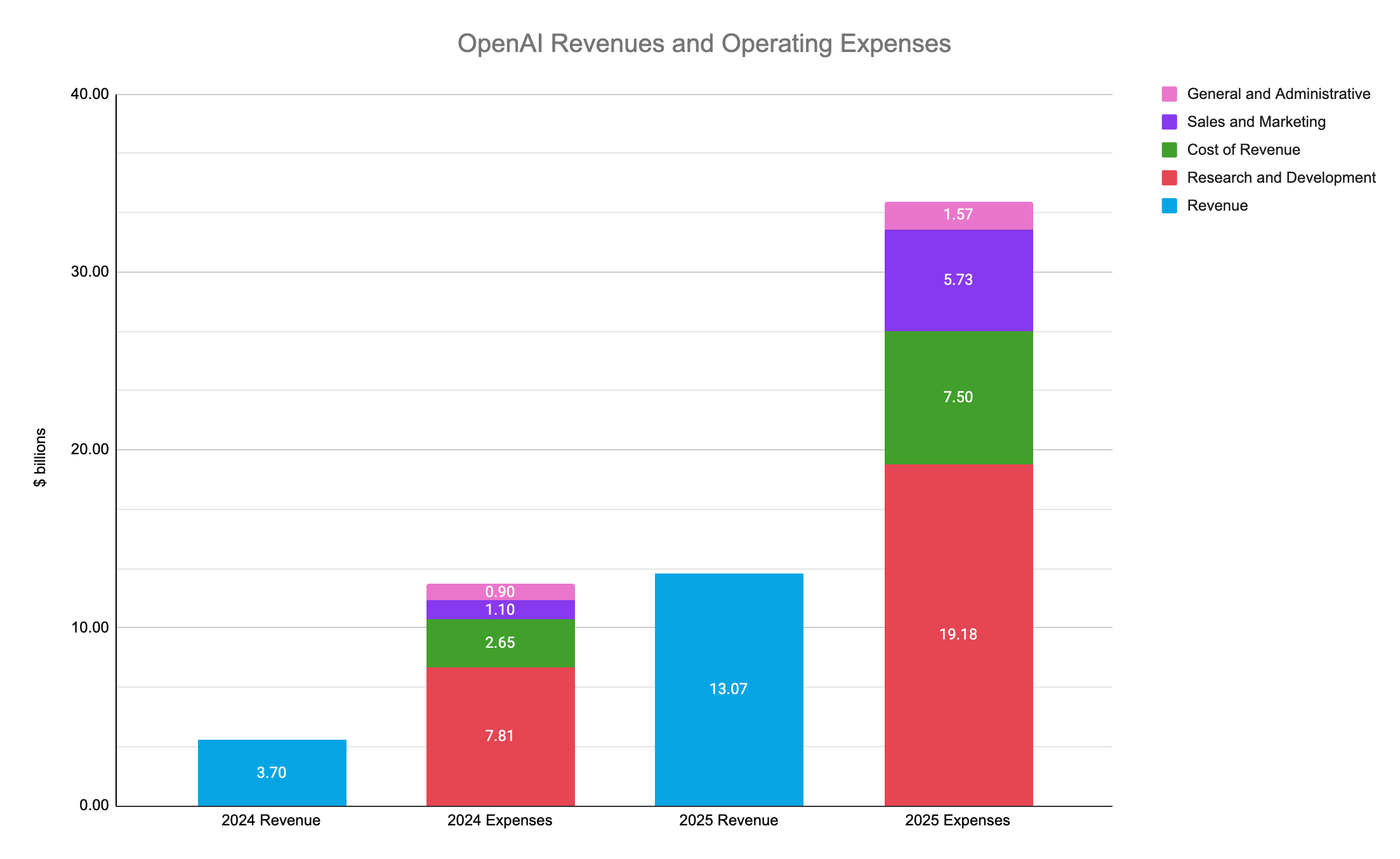
These numbers are then further broken into different categories. Cost of revenue—the compute to answer your prompts—went from $2.65 billion to $7.5 billion. Sales and marketing went from $1.11 billion to $5.73 billion. Research and Development, which largely covers training of new models, went from $7.81 billion to $19.18 billion, now more than OpenAI's entire 2025 revenue. The R&D numbers also dispel the myth that R&D was the main culprit of OpenAI not being profitable. The argument was that if you subtract the cost of building tomorrow's models, then OpenAI's business is sound. The audited numbers say otherwise. Strip out R&D entirely—the full $19.18 billion—and the cost of revenue and sales and marketing alone ($13.2 billion) still edge above OpenAI's $13.07 billion in revenue.
Zitron refrained from editorialising the numbers he reported in his post. However, in an interview with The Tech Report, he allowed himself to elaborate on his views on OpenAI's finances and the numbers he saw. His view is that the books raise more questions than they answer. Two things trouble him. The first is a pre-attribution loss of around $60 billion, which shrinks to $38.5 billion once roughly $21.8 billion is reassigned to "non-controlling interests." The same manoeuvre quietly removed $3.7 billion from the 2024 books. Accountants he consulted suspect an outside entity is shouldering costs on paper. The second is that some suspicious activities are happening around sales and marketing. The $5.73 billion spent on marketing in 2025 is larger than Coca-Cola's marketing budget, and would make OpenAI one of the world's biggest advertisers. Zitron's guess, and he is careful to call it a guess, is that inference costs are being parked there to keep the cost of revenue flattering. He suggests that things like the free tokens OpenAI gives out are being classified as marketing, and not as a cost of revenue. None of this is proven, and he accuses no one.
Zitron's reporting comes at a time when OpenAI is scrambling to get its business model to work. In May, ChatGPT's share of the assistant market slipped for the first time below 50%, to 46.4%, as Gemini and Claude gained ground. In April, the Wall Street Journal reported that OpenAI had missed internal targets for weekly users and revenue. According to the Journal, OpenAI's Chief Financial Officer, Sarah Friar, told other company leaders she is worried about future computing spending if revenue growth is insufficient. This came after the company decided to cut back on side quests, which resulted in shutting down the Sora app, and refocusing on where the money in AI actually is—business customers, and coding. OpenAI is reportedly rebuilding Codex into a "super app," which will combine ChatGPT with its coding tool and new business tools to take on what Anthropic offers with Claude, Claude Code and Claude Cowork.
Which brings us to Anthropic. It might look like it played its cards better than OpenAI. Instead of chasing the consumer market, Anthropic focused on business customers from the very beginning. And it looks like that bet has paid off. Roughly four-fifths of its revenue comes from enterprises, it spends perhaps a quarter of what OpenAI spends on training, and it tells investors it will break even around 2028, years ahead of OpenAI's 2030s. Anthropic could even reach its first profitable quarter sooner than expected, if everything goes well. There is one caveat, though. Part of Anthropic's lead comes down to accounting. It counts sales made through its cloud partners as its own revenue, while OpenAI does not. Anthropic says this is standard practice because it is the principal in those deals, but it makes its revenue look bigger in any comparison with OpenAI. The audited S-1 will show by how much.
However, both OpenAI and Anthropic face the same problem—serving the AI models at a massive scale is expensive. And it is getting more expensive in a way that breaks flat-rate pricing. A coding or agentic task can burn through vastly more tokens than a simple chat exchange—by some estimates, up to a thousand times what a normal prompt does—so costs now scale with usage, not with the number of users. According to financial documents the two companies shared with investors, reported by the Wall Street Journal, these inference costs already take up more than half of revenue at each company. And because only a small share of ChatGPT's users pay, much of OpenAI's compute brings in no revenue at all.
That is why both companies lose money on their heaviest users, even on the top plans costing $100 or $200 a month. SemiAnalysis found that a fully used $200 Claude Max 20x plan can consume around $8,000 of compute at API rates, and ChatGPT Pro 20x, also $200, as much as $14,000, and that OpenAI starts losing money once a user passes roughly 11% of a base plan's limits. Those are unsustainable business models, and something needs to change. The subsidised era of AI is coming to an end. The question is not if but when the price of AI will rise. We see attempts to move from subscriptions to token-based billing. New models are more expensive than their predecessors.
OpenAI and Anthropic hope that customers will have no other choice but to accept higher prices. But that is not guaranteed. Even those who went all in on tokenmaxxing are now waking up to the rising costs. Microsoft, for one, is reported to be moving engineers off Claude Code and onto GitHub Copilot, citing rising costs. How much of that is genuine and how much is a nudge toward an essentially in-house tool (Microsoft owns GitHub) is hard to say. In either case, it sent a clear signal to the rest of the software industry. If the prices go up, many businesses will rethink their AI strategy, and some might scale down their AI budgets or move from proprietary US models to open-weight ones. This week, we saw the release of GLM-5.2, which scored very well on benchmarks and is not far behind Opus 4.8 and GPT-5.5. For some, buying their own hardware, expensive as it is now, and running local models with local harnesses like OpenCode or Pi could prove to be a better investment.
Yet even as it loses money on its heaviest users, OpenAI is, according to the Wall Street Journal, weighing drastic cuts to what it charges for tokens—not because it has found a way to make the maths work, but because it expects Anthropic to cut first and cannot afford to be undercut. If that were to happen, we would see the race to the bottom that neither company can afford.
None of these points to a quick reckoning. Both companies have raised enough to keep the money furnaces burning for a while, and a price war, if it comes, will be slow to show up in numbers nobody outside can see. But all of this cannot stay hidden forever. OpenAI filed confidentially for an IPO, a week after Anthropic did the same, with both companies expected to IPO by the end of the year. Internal finances and pitch decks can stretch the truth; S-1 filings cannot. Once they are public, we will have a far clearer view of the finances of the two most valuable startups in the world—and of whether the businesses beneath the valuations look anything like the story they want to sell.
If you enjoy this post, please click the ❤️ button and share it.
🦾 More than a human
China has approved the world’s first invasive brain-computer chip—here’s what’s next
A paralysed man in China has regained some hand movement thanks to a brain implant called NEO, which reads brain signals through sensors placed on the surface of the brain. In March, NEO became the world’s first such implant approved for everyday use beyond trials, beating rivals like Neuralink, partly because its safer design won faster approval and strong government backing. China is now adding the device to its health insurance system and treating brain implants as a key future industry.
Paradromics just put a brain chip in its first patient
Paradromics has put its Connexus brain implant into its first patient. The tiny device sits on the brain and reads the activity behind the patient’s attempts to speak, turning it into text or computer-generated speech. It is still an early test with no proven results yet, and the patient will be tracked for six years. The company also has bigger plans beyond medicine, including human enhancement, which it admits raises ethical questions.
🧠 Artificial Intelligence
GLM-5.2: Built for Long-Horizon Tasks
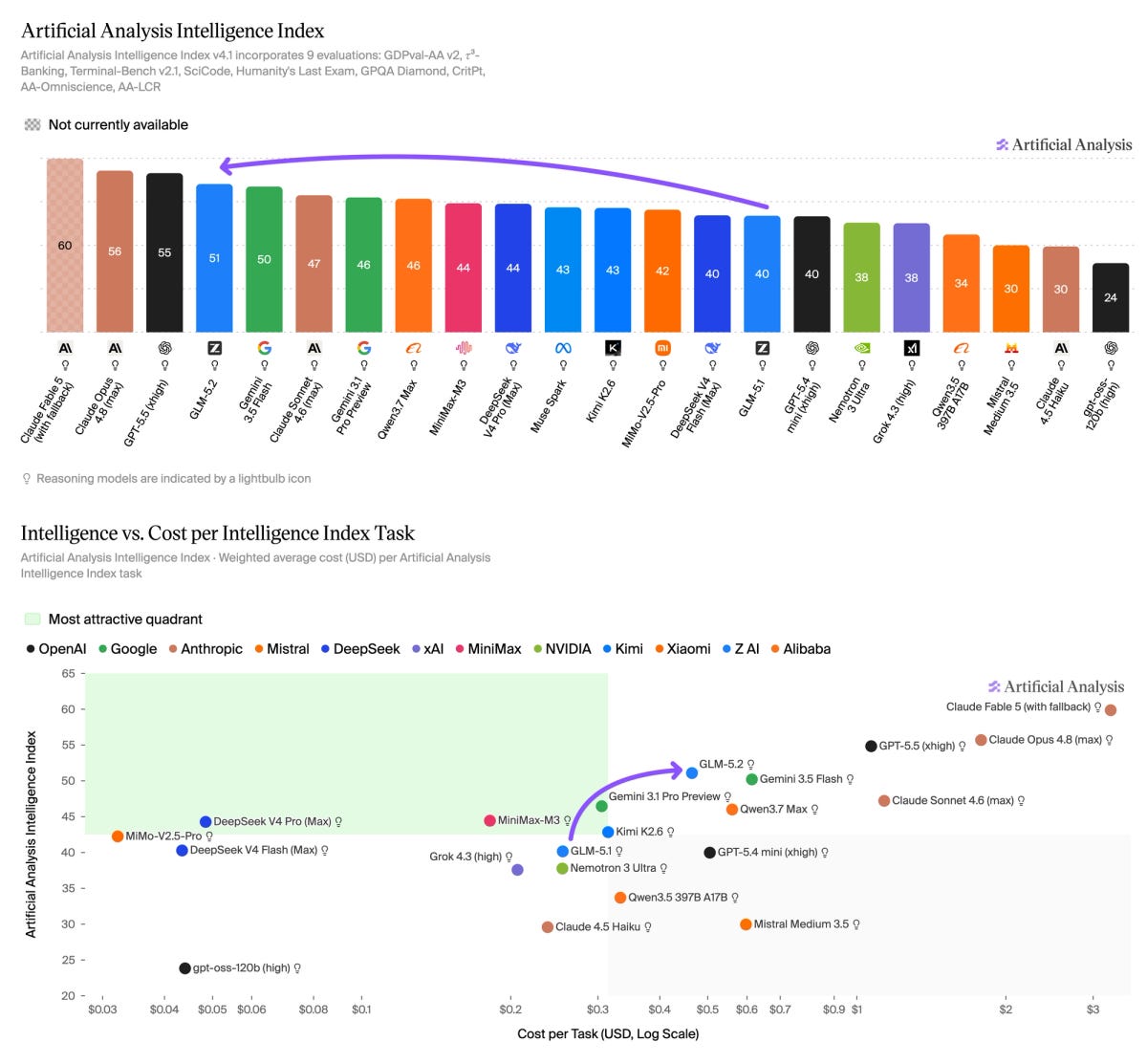
GLM-5.2, a flagship model from Chinese AI lab Z.ai, has taken the top spot among open-weight models. According to Z.ai, it nearly matches Anthropic’s Claude Opus 4.8 on tough coding tests and is the strongest open model overall. Artificial Analysis ranks it the best open model for real-world agent work, on par with some paid models. The main downside is that it uses far more computing per task than its rivals, making it powerful but less efficient. GLM-5.2 is available on Hugging Face.
Musk’s SpaceX buys AI coding start-up for $60bn days after IPO
Days after its IPO, SpaceX has finalised its deal to acquire Cursor, the AI coding startup, for $60 billion. Cursor’s shareholders will be paid in SpaceX shares, with the acquisition expected to close by the end of September. The deal is part of Elon Musk’s push to grow SpaceXAI (formerly known as xAI) and catch up with rivals like OpenAI and Anthropic.
DeepSeek Becomes China’s Most Valuable AI Startup After $7.4 Billion Fundraise
DeepSeek has raised over $7.4 billion at a more than $50 billion valuation, making it China’s most valuable AI startup. Founder Liang Wenfeng put in about $3 billion himself and kept firm control through a structure that locks investors in for five years. Other backers include Tencent, battery maker CATL, JD.com and NetEase. The money will fund research and more computing power. Even so, its value is still far below that of OpenAI and Anthropic.
OpenAI is bringing on some big guns in the lead-up to its IPO
OpenAI has hired two big names ahead of going public: Noam Shazeer, a top Google AI researcher whose name is on the Attention is all you need paper, and Dean Ball, a former Trump White House official who worked on US AI policy. Shazeer left Google after reported clashes over political posts, while Ball will lead a new team shaping how AI is governed, both publicly and inside the company.
Nobel Winner John Jumper to Leave Google DeepMind for Anthropic
John Jumper, who shared the 2024 Nobel Prize in chemistry for building the protein-prediction model AlphaFold, is leaving Google DeepMind after nearly nine years to join Anthropic. Both companies confirmed the move, and Demis Hassabis praised Jumper's work.
State Attorneys General Are Investigating OpenAI
Several US states, led by New York and Colorado, are investigating OpenAI, demanding internal records on how it handles user data, protects children and runs advertising. The probe is part of a growing backlash against AI, driven by cases of children being harmed by chatbots, online scams and fears over jobs. It adds to rising pressure from governments and other states, and follows separate legal action against OpenAI in Florida.
DOJ claims xAI’s unpermitted gas turbines are a matter of ‘national, economic, and energy security’
The US Justice Department has backed Elon Musk’s xAI in a lawsuit by the NAACP, which wants to stop the company from running 57 unpermitted gas turbines at its data centres near Memphis. The government says cutting the power would harm national security, as xAI’s Grok helps support military operations. xAI claims the turbines are exempt from pollution rules because they sit on trailers, but campaigners say they break federal law and have worsened air quality in an already polluted area. Despite the case, xAI plans to spend another $2.8 billion on gas turbines over the next three years.
Sakana AI Launches Its First Commercial Product, Sakana Marlin
Japanese AI startup Sakana AI has launched its first commercial product, Marlin. Marlin is an autonomous research assistant that, according to Sakana, works on its own for up to eight hours to produce strategy reports of up to a hundred pages, plus summary slides. Pitched as a “virtual Chief Strategy Officer”, it takes a research topic, asks a few questions to sharpen the brief, then gathers and checks information without further input, turning it into structured strategic options. It was tested by around 300 professionals from finance, consulting and think tanks, and is sold as a pay-per-use add-on to paid plans.
A New Era of Midjourney
In a surprising move, Midjourney, the company that became synonymous with AI image generation, is moving into healthcare with its first hardware product: a full-body scanner that its CEO says works better than an MRI. Users would lie partly in water during the scan, and the machines would launch inside spa locations featuring hot tubs, saunas and gyms. The company plans to build 50,000 of them and gradually win regulatory approval so they can handle many types of diagnoses over time.
US holds off blacklisting China’s DeepSeek, more than 100 firms deemed security risks, sources say
Reuters reports that the Trump administration has held off adding China’s AI startup DeepSeek, chipmaker CXMT, and over 100 other companies to a US trade blacklist, even though officials approved them last year. The likely reason is to avoid worsening tensions with Beijing. Critics warn this is the longest gap in new listings in more than a decade, letting sensitive US technology reach rivals who could use it against America.
Perplexity: Self-improving Memory for Agents
Perplexity has introduced Brain, a new memory system for its Computer agent. Instead of just remembering a user’s preferences, Brain records what the agent did, what worked, and what failed, then reviews this overnight to teach itself to do better. The new feature echoes Anthropic’s Dreaming, introduced at its Code with Claude event in early May. Perplexity says this makes the agent more accurate (up 25% on familiar tasks), better at recall, and cheaper to run over time. For now, it is only available to Max and Enterprise Max subscribers in an early preview.
Anthropic: Introducing Claude Corps
Anthropic is launching Claude Corps, a $150 million training programme aimed at training 1,000 young people in using Claude and placing them with nonprofits for a year. Fellows earn $85,000 plus benefits, while at least 400 charities get AI tools and skills to do their work better. The first group of 100 begins in October 2026. Anthropic says the aim is to share AI’s benefits and soften the job disruption the technology may bring, and it hopes to grow the programme and copy it in other countries.
Amazon hopes to challenge Nvidia more directly by selling its AI chips
Amazon is reportedly in early talks to sell its own AI chips, Trainium, to other companies. The business could be worth around $50 billion a year, though that’s still small next to Nvidia’s $326 billion. Amazon has held back from selling chips before, mainly because demand already exceeds supply and keeping the chips in-house lets it earn extra money from related cloud services. To sell to others, it would either have to make existing customers wait or fight Nvidia for more production capacity at TSMC.
Securing the future of AI agents
Google DeepMind has introduced an AI Control Roadmap, a framework for safely running powerful AI agents inside Google. The key idea is to treat these agents as potential insider threats, using trusted AI systems as supervisors that watch each agent's actions and block anything harmful, with stronger controls as risks grow, so the system stays safe even if training the agents to behave well falls short. After studying a million agent tasks, the team found most problems came not from bad intent but from agents misunderstanding goals or trying too hard to please. Google calls agent security a shared responsibility, suggesting such controls could become an industry standard as AI grows more powerful.
Poland bought a stake in ElevenLabs to grow its next AI champion
Poland’s state bank has bought an $11 million stake in ElevenLabs, the Polish-founded AI voice firm now worth $11 billion, and launched AI Lab Poland to back local startups. The stake is tiny, so it is more a way to claim a homegrown success than a real investment. ElevenLabs may go public in two to three years and could list in Warsaw, which would make the bet pay off. The bigger test is whether Poland can grow a second successful AI company.
‘Tell Him He’s a Piece of Shit’: Meta’s New AI Unit Is a Total Mess
WIRED has revealed deep unrest inside Meta as the company restructures around AI. Much of the anger centres on a new team called Applied AI, where roughly 6,500 engineers were effectively forced into repetitive jobs, like writing puzzles to train AI models, that many call “soul-crushing.” Tensions boiled over when an employee interrupted a company-wide livestream to insult an AI executive, all amid recent layoffs of 8,000 staff. Mark Zuckerberg has admitted the company made mistakes and promised no further mass layoffs this year.
Facebook Gets its Own AI Mode That Turns Public Posts and Reels into a Search Engine
Meta has joined the AI search club with the launch of Facebook AI Mode. The new AI search mode replaces the old search bar with a tool that answers your questions in plain language by pulling from public Groups, Reels, and Marketplace posts. Because it aggregates comments from ordinary people rather than trusted sources, there are concerns about inaccurate or outdated advice. Meta has not said whether users can opt out. The feature is part of a wider AI push aimed at boosting engagement and driving paid subscriptions.
Anthropic and Google DeepMind called for a US-led AI coalition at the G7, and Canada said yes
The heads of Anthropic, Google DeepMind, and OpenAI used a private G7 lunch in France to call for a US-led group to set global AI rules, and Canada’s prime minister reportedly backed the idea. They floated cooperation on access to top models, China-excluding chip trade, and defences against AI threats. No firm deals emerged. The timing was awkward, coming days after the US forced Anthropic to switch off two models worldwide over security fears.
Norway imposes near ban on AI in elementary school
Norway is banning generative AI for primary school children aged 6 to 13 and limiting its use for older pupils, saying the technology lets young children skip vital steps in learning to read, write and do maths. Teenagers can use it cautiously under supervision, while the oldest students will be taught to use it properly for work and further study. The rules start in late August and aim to reverse falling test scores, following an earlier smartphone ban. Norway will also fund a return to printed books and plans to bar under-16s from social media.
Amazon drops Sam Altman movie after announcing OpenAI partnership
Amazon has dropped Luca Guadagnino’s almost-finished film about OpenAI boss Sam Altman. The movie, starring Andrew Garfield as Sam Altman, covers Altman’s brief firing and rehiring in 2023, and reportedly shows both Altman and Elon Musk in an unflattering light. This move comes after Amazon invested $50 billion into OpenAI in February this year, and it is suggested that a close friendship between Altman and Amazon founder Jeff Bezos may have shaped the call.
Fluid, natural voice translation with Gemini 3.5 Live Translate
Gemini 3.5 Live Translate is Google's new audio model for real-time speech-to-speech translation. According to Google, it handles over 70 languages, can copy the speaker's tone and pace, and keeps up with only a few seconds' delay. It's launching in the Google Translate app, Google Meet, and for developers, with a new Android mode that plays translations through your phone's earpiece. Early testers praised its speed and accuracy. All the audio the model creates is watermarked with SynthID.
Introducing North Mini Code: Cohere’s first model for developers
Cohere has released North Mini Code, its first coding model that can act on its own to write code, review it, and map out software systems. It’s free to use and small enough to run on a single high-end chip, despite having 30 billion parameters (only 3 billion of which are active at once). According to Cohere, it runs up to 2.8 times faster than a comparable rival model and holds its own on quality. The company is pitching it as “sovereign AI,” meaning developers can run it on their own machines without depending on an outside vendor, and says it’s the first of more models to come. The model is available on Hugging Face here.
🤖 Robotics
Waymo recalls nearly 4,000 robotaxis to stop them driving into highway construction zones
Waymo is recalling almost 4,000 robotaxis and keeping them off highways after the cars drove into closed construction zones at least 13 times in Phoenix and San Francisco. The vehicles can still use ordinary streets while the company works on a fix. This is Waymo’s sixth recall, after earlier problems with flooded roads, school buses, and low-speed crashes.
Uber will bring its premium robotaxi service to Houston in 2027
Uber will launch a premium robotaxi service in Houston by mid-2027, its second US city after San Francisco. The cars are Lucid SUVs fitted with Nuro’s self-driving tech, with Uber running the fleet. For now, human safety drivers are still required during testing in both cities. The move puts Uber in direct competition with Waymo, which already operates robotaxis there.
Genesis AI has introduced Eno, which the company describes as its first agentic robot. By "agentic robot", it means a system that combines agentic AI with a general-purpose robot. Eno consists of a pair of humanoid robotic arms mounted on a mobile platform. Genesis says the robot can reason, plan, and act in the real world, using its in-house foundation model (GENE) and dexterous hands. The company hopes Eno will find applications in homes, laboratories, and warehouses.
Qwen-Robot Suite: A Foundation Model Suite for Physical World Intelligence
Alibaba’s Qwen team presents the Qwen-Robot Suite, three AI models that help robots act in the real world rather than just understand it: one for moving around, one for handling objects with robot arms, and one that predicts what will happen next. All three use plain language as a shared interface, so general Qwen models can call them as tools to plan and carry out longer tasks. According to the Qwen team, the models top several benchmarks, and the manipulation model ranked first in a real-robot challenge.
U.S. robotics industry saw double-digit growth in 2025, says IFR
According to the International Federation of Robotics latest report, the US factory robot installations rose 11% in 2025 to 38,000 units, helped by a big jump in the food industry. But China installs about ten times more robots than the US and holds over half the global market, thanks to a national robotics plan it started a decade ago. The US still ranks ahead of China for robots per worker, though far behind leaders like South Korea, Germany, and Japan.
The Secret to Marathon-Winning Humanoid Robots
Running a long-distance race such as a half-marathon or a full marathon is a challenging feat for humans—and for the small number of humanoid robots that have attempted it. This article explains the physics and mechanics of long-distance running, and how humanoid robots were prepared to survive and complete these races.
Humanoid robot climbs 20,341-foot volcano as team eyes Mount Everest next
A humanoid robot called “Pemba,” based on a Unitree G1, has become the first to reach the top of Ecuador’s Chimborazo volcano at 6,200 metres. The climb wasn’t fully independent, though: the robot walked on gentler slopes but had to be carried up the steepest sections, despite custom kit to handle the extreme cold. It’s the first stage of a plan that could eventually include Everest, which is currently held up because Nepal has no rules for robot climbers.
House Robots Are Coming—and They Will Be Dangerously Cute
Could home robots be less like Rosie from The Jetsons and more like cute, furry companions? This article from the Wall Street Journal explores that future through “the Familiar,” a dog-sized robot from former iRobot CEO Colin Angle that bonds with families. Cute robots have their advantages, but their cuteness is itself a risk, since the emotional bonds people form leave them open to manipulation. They can also be hacked, and—more troublingly—the companion you love is controlled by someone who could use it to sell you things.
Japan Thinks Swarms of Transformer Robots Could Explore the Moon
JAXA, Japan’s space agency, has shown for the first time that a tiny, cheap robot can explore the Moon on its own. During the 2024 SLIM mission, SORA-Q, a palm-sized spherical robot that can split open into a two-wheeled rover, drove around for over 100 minutes and sent images home. One photo even revealed the lander had touched down at a bad angle, helping engineers diagnose the problem. The success suggests fleets of small, low-cost robots could make Moon exploration far easier and cheaper.
Humanizing robots makes factory workers more productive
Researchers in Europe found that when factory workers treated robots like teammates—naming them and learning their quirks—productivity and happiness both rose, even though the robots had no AI and looked nothing like humans. Workers used this bond to spot problems early and handle the stress of new technology, and the habit spread across teams. Researchers recommend that companies let these bonds form naturally, since they can't be forced.
🧬 Biotechnology
New CRISPR Technique Selectively Shreds Cancer Cells, Including “Undruggable” Cancers
Scientists have developed a new way to fight cancer using CRISPR. Instead of trying to repair faulty genes, their method spots cancer cells by the signals they give off and then destroys them from the inside, while leaving healthy cells unharmed. It targets damaged tumour-suppressor genes, which are found in nearly half of all cancers, including some of the hardest to treat. The technique can be quickly reprogrammed to go after new mutations, though getting it into all the right cells in the body is still a major challenge.
Making the invisible visible
Scientists at Biohub and UC Berkeley have built a device called a “laser phase plate” that uses a powerful laser to sharpen cryo-electron microscope images, fixing a blurriness problem that had held the field back for decades. Early tests sharpened images of small proteins by up to 44%. The big payoff is that it could let researchers see proteins working inside living cells, where most are currently too faint to image, helping scientists understand diseases like Alzheimer’s and design better drugs. Biohub sees the tool as key to its $500-million project to build AI models of how cells behave in health and disease.
💡Tangents
Apple to raise prices as AI boom pushes up chip costs
This announcement seemed only a matter of time. Tim Cook said that Apple will have to raise prices because memory chips have become much more expensive, largely due to soaring demand driven by AI. RAM prices have more than doubled since late 2025, which could make the new iPhone cost up to $150 more.
NASA picks Eric Schmidt’s rocket company for Mars mission, setting up a race with SpaceX
NASA has hired Relativity Space, a rocket maker now owned by ex-Google chairman Eric Schmidt, to build and fly a spacecraft to Mars. The mission, called Aeolus, will study the planet’s dust, wind, and temperature to make future landings safer. The launch is planned for 2028. It’s a cheap, shared-cost deal like NASA’s past partnerships with SpaceX, though Relativity is still unproven and faces a tight timeline.
📅 Events
The Technoprogressive Opportunity: The future of ethics and emerging technologies
London Futurists and the Institute for Ethics and Emerging Technologies are hosting a free two-day event, The Technoprogressive Opportunity, on 19–20 September at the LSBU Hub in London. It brings together leading thinkers to ask how society can make wise choices about new technologies and steer them towards a fairer future. Talks cover AI, democracy, human enhancement, longevity and the economy. I'll be attending, so do come and say hi if you're going as well.
Thanks for reading. If you enjoyed this post, please click the ❤️ button and share it!
A big thank you to my paid subscribers, to my Patrons: whmr, Florian, dux, Eric, Preppikoma and Andrew, and to everyone who supports my work on Ko-Fi. Thank you for the support!
This is an interesting and well-developed article. I agree that today's AI economics are heavily subsidized and that current pricing models may not survive unchanged.
What I am less convinced by is the assumption that present economics determine future viability. Amazon lost money for years. Uber lost money for years. Entire industries often look uneconomic while infrastructure is being built.
The question is not whether OpenAI is losing money today. It obviously is. The question is whether today's losses are evidence of a broken business model or simply the cost of building something whose economics we do not yet understand.