


Hello and welcome to Sync #578!
It has been another busy week for Anthropic, which released Sonnet 5, brought back Fable 5, and launched a new product for scientists—all within the span of just two days (they really do like to announce everything at once). We’ll take a closer look at all three announcements in this week’s issue of Sync.
Elsewhere in AI, OpenAI proposes selling 5% of itself to the US government, the Alibaba vs Anthropic drama continues, Meta cedes the AI race and tries to become a neocloud, Anthropic is discussing a custom chip with Samsung, SpaceX shows investors an early prototype of its AI phone, and OpenAI teases a new hardware product for Codex.
Over in robotics, Apptronik unveils Apollo 2, Weave Robotics launches Isaac 1, Waymo and Uber quietly part ways in Phoenix, and AGIBOT produces its 15,000th robot.
This week also saw two major breakthroughs in synthetic cell research: one group of scientists created artificial cells that can feed, grow, copy their lab-made DNA, and divide into new cells, while another created the first early human egg cells from stem cells.
Beyond that, we also have Neuralink’s first transdural procedure, Rocket Lab’s acquisition of Iridium, an exploration of whether AI is a Great Filter, a robot that hunts AI glasses, and more!
Enjoy!

Anthropic’s busy week, again
Fable 5 is back, Sonnet 5 is out, and Claude Science is coming for labs

In the last days of June, Anthropic shipped three things at once. On 30 June, it launched Claude Sonnet 5 and, at an event for pharmaceutical executives, a new product called Claude Science. The next day, it switched Claude Fable 5 back on for everyone.
That is a lot for one week, so let's take the three of them one at a time and explore what each one is and what it tells us about where Anthropic is right now.
Fable 5 is back
Let’s start with Fable. Its release on 9 June was supposed to be Anthropic’s moment of triumph, but it turned sour very quickly. Fable 5 is the first generally available entry in its Mythos tier, a rung above Opus. But just three days later, the US Commerce Department export-control directive barred access by any non-US nationals worldwide. In practice, that forced Anthropic to switch off Fable 5 and its sibling Mythos 5 for everyone, its own non-US citizen staff included.
Anthropic has now confirmed that Amazon sounded the alarm. Researchers there found Fable’s cybersecurity guardrail could be walked around with a change of framing—ask the model to find a vulnerability in a piece of code and it refused; ask it to fix the same code and it quietly did the equivalent work. Much of the security community disagreed. Katie Moussouris of Luta Security, the only outside expert to read the research, argued that asking a model to fix a bug is not a jailbreak but the most useful thing it can do for a defender—a view more than a hundred professionals later signed. Anthropic's own testing pointed in the same direction. In its investigation, cheaper models—including Opus 4.8, GPT-5.5 and Kimi K2.7—could spot the very vulnerabilities Fable had flagged, and every model it tried, right down to Haiku 4.5, could reproduce the exploit demonstration. In other words, whatever Fable did, half a dozen weaker models could already do too.
The controls were lifted on 30 June, and Fable 5 returned the next day. Anthropic tightened its guardrail into a classifier it says now catches the reported technique in more than 99% of cases. However, the new classifiers seem to be still too sensitive and flag innocent requests as suspicious. Some users have reported it tripping on routine coding. At least this time, Fable is transparent when that happens rather than silently rerouting the query to Opus 4.8 as at first launch, but you still land on a weaker model for work Fable should handle. Hopefully, Anthropic will fine-tune the guardrails to make Fable usable. In the meantime, Anthropic is offering a promotional access to Fable 5. Until 7 July, paid plans can spend up to half their weekly usage limit on Fable 5 at no extra cost. After that, Fable 5 drops out of the plan entirely, and using it means paying for separately billed usage credits.
Anthropic’s truce with the administration is only partial. Commerce may have relented, but Defense Secretary Pete Hegseth’s February order designating the company a supply-chain risk still stands.
But the most important thing that came from Fable’s rocky launch was that it was the first time the US government used export-control authority against an AI model—establishing, in principle, that any frontier model serving foreign nationals can be ordered to go dark without warning. And Fable was just the first one. On 26 June, at the administration’s request, OpenAI released its GPT-5.6 family not to the public but to selected government-approved partners. Two American frontier labs blocked from offering their latest models to the public set a precarious precedent, with consequences for everyone who relies on American AI models, which would require its own article to properly explore.
Sonnet 5 is out
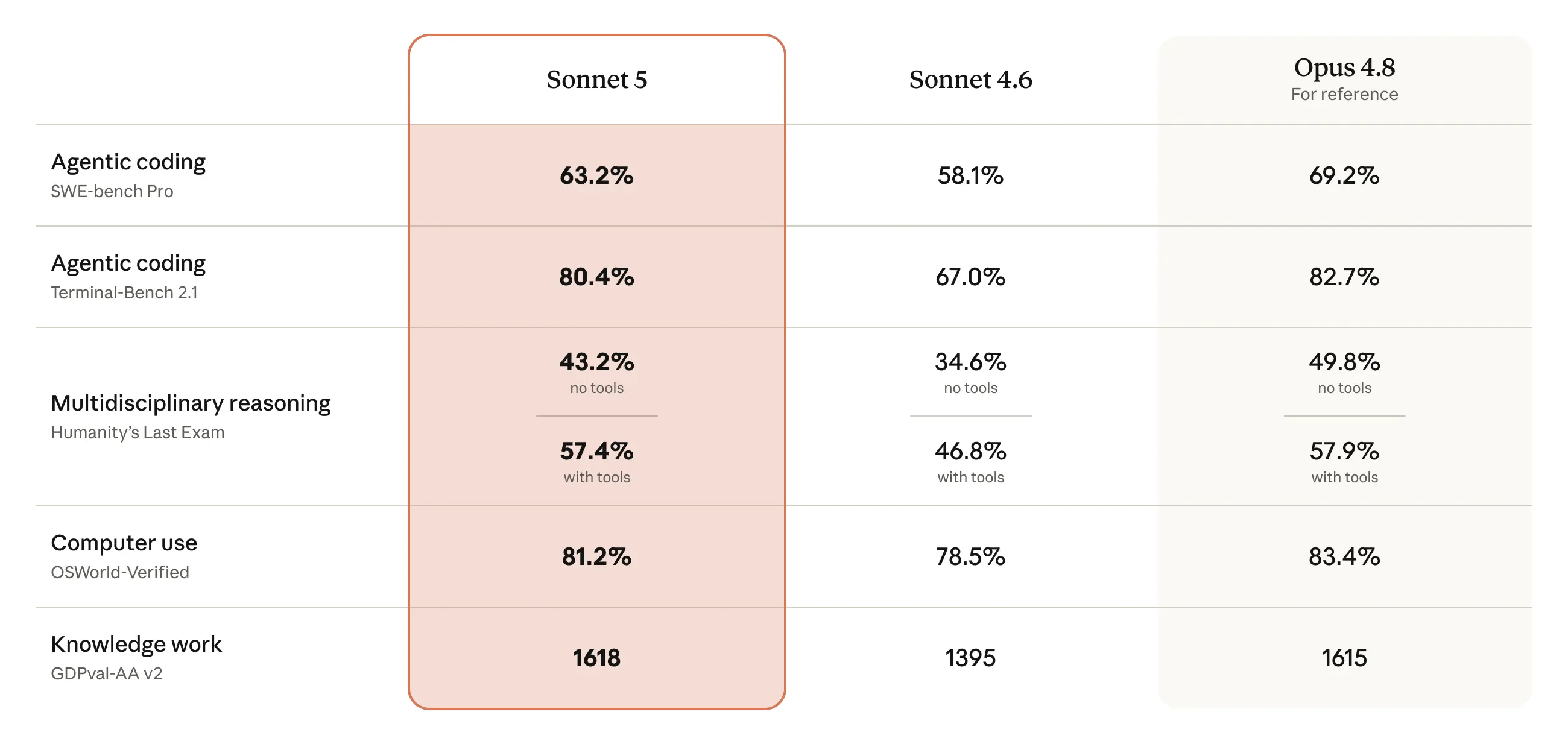
On the same day Fable 5 was made available again, Anthropic also dropped Sonnet 5, which the company pitched as the most agentic Sonnet yet, close to Opus 4.8 at a lower price.
The benchmarks support the first half of that. The headline benchmark results shared by Anthropic show that Sonnet 5 improves substantially over its predecessor and even gets close to Opus 4.8’s results.
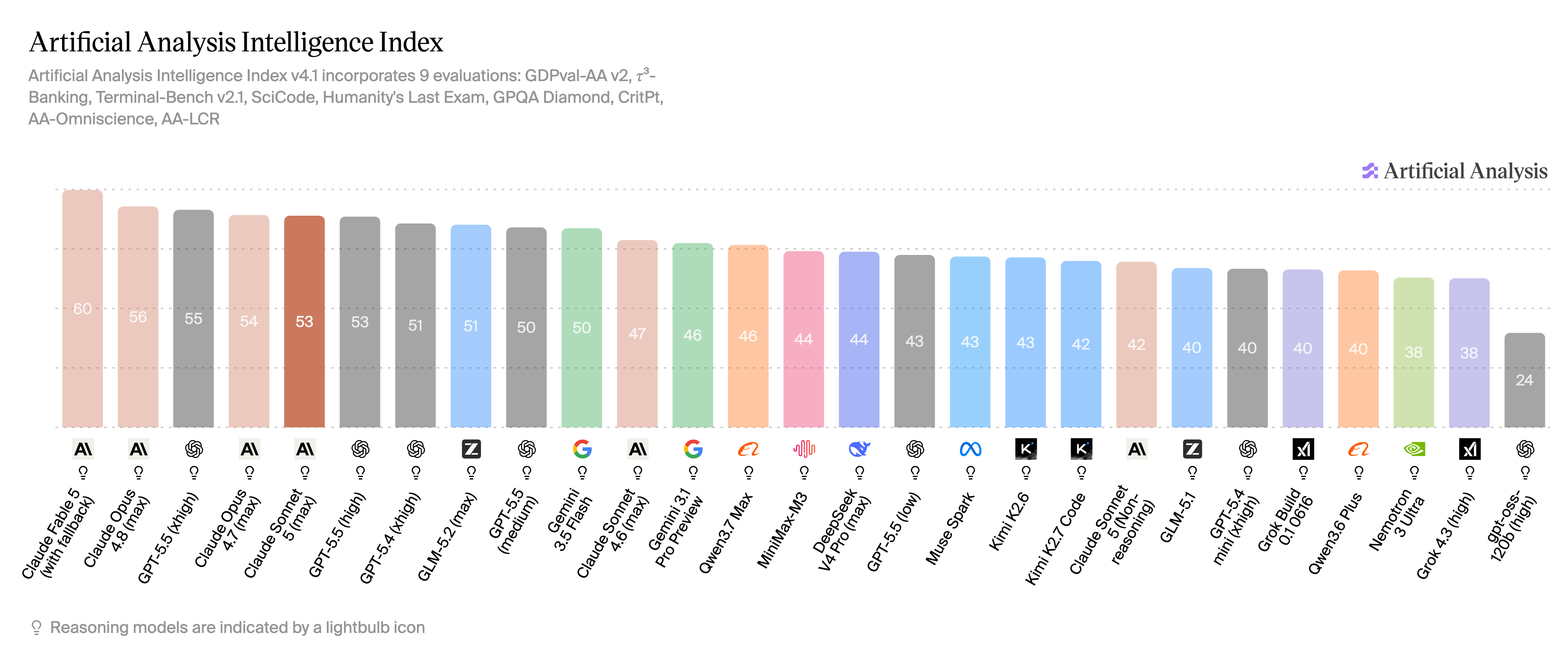
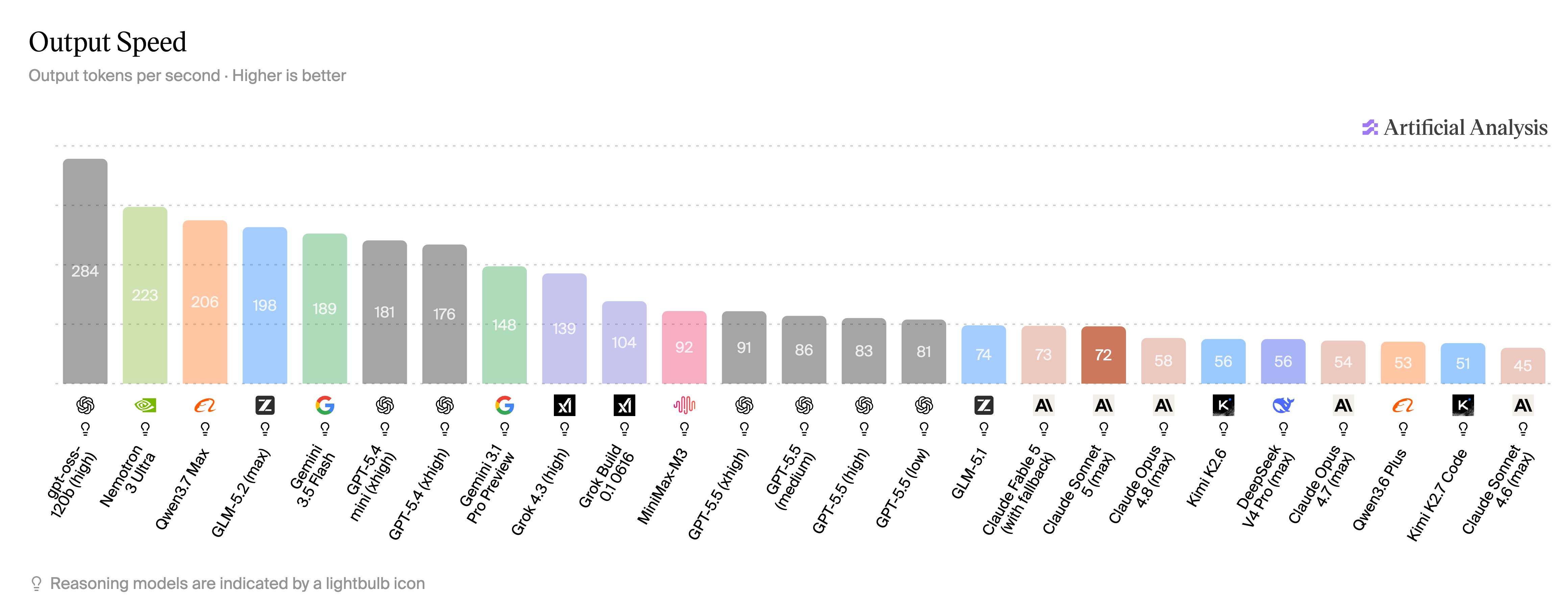
Independent benchmarks from Artificial Analysis confirm that Sonnet 5 is a jump in performance over Sonnet 4.6, scoring six more points on the Intelligence Index and just three less than Opus 4.8. That puts it in the same neighbourhood as GPT-5.5 at its high and xhigh settings. Sonnet 5 is also Anthropic's second-fastest model on the Speed Test, at 72 output tokens per second—just behind Fable 5 on 73. But the entire GPT-5.5 family is quicker still, ranging from 81 to 91.
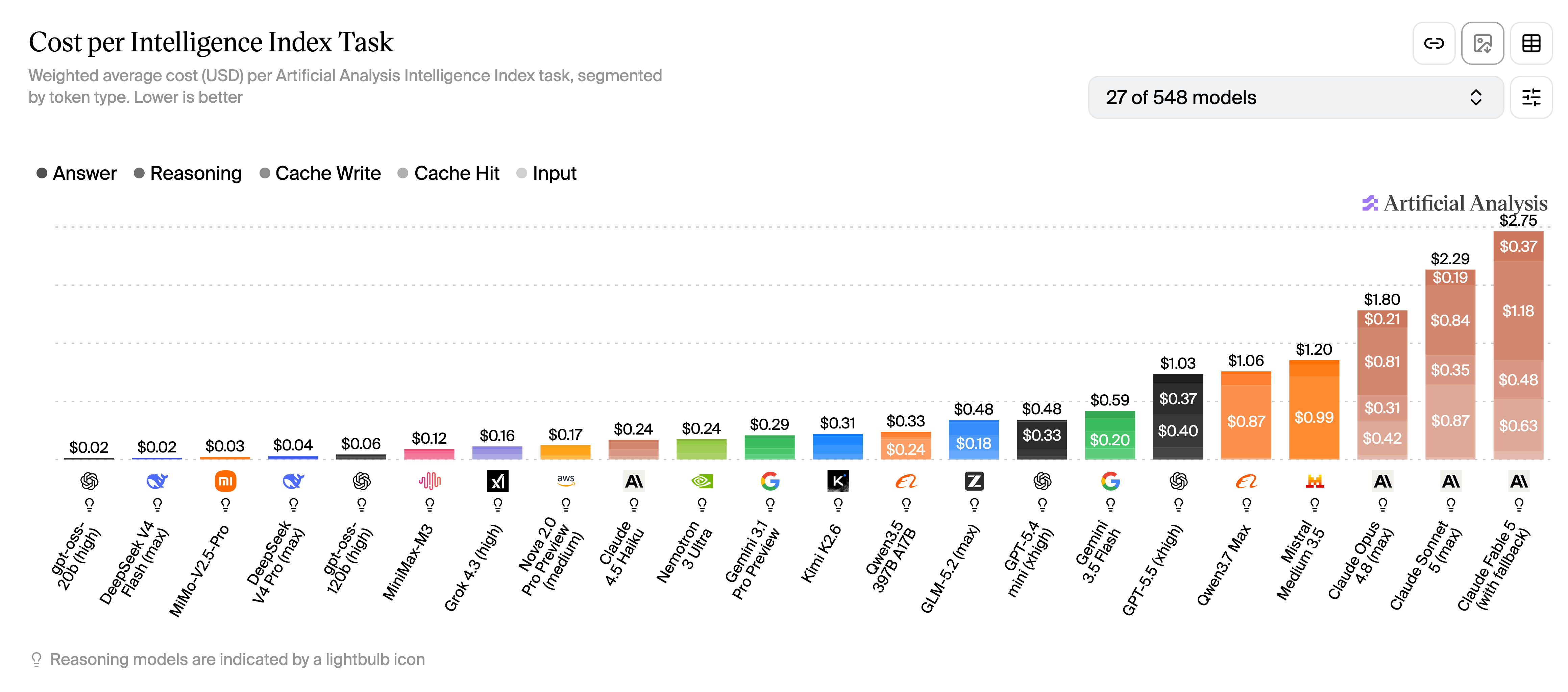
The second half—the lower price—is where the cracks start to show up. The sticker price is unchanged from Sonnet 4.6—$3 per million input tokens and $15 per million output tokens, with an introductory $2/$10 through 31 August, and lower than Opus 4.8, which costs $5/$25 per million tokens input/output. But Sonnet 5 ships with a new tokeniser that produces roughly 30% more tokens for the same text, and its "adaptive thinking" defaults to high effort. In practice, both push more tokens through each request, resulting in a higher bill from Anthropic.
Artificial Analysis put a figure on it. On its Intelligence Index, Sonnet 5 at maximum effort costs about $2.29 per task—more than Anthropic’s own Opus 4.8 at $1.80, and not far off the premium Fable 5 at $2.75. OpenAI’s GPT-5.5 at its highest reasoning setting comes in at $1.03. A model sold as the cheaper option turns out, at full effort, to cost more per task than the model it sits beneath. It is worth noting that the $2.29 is the figure at maximum effort, and effort can be tuned. Lower effort levels will burn fewer tokens, but the performance will go down with it.
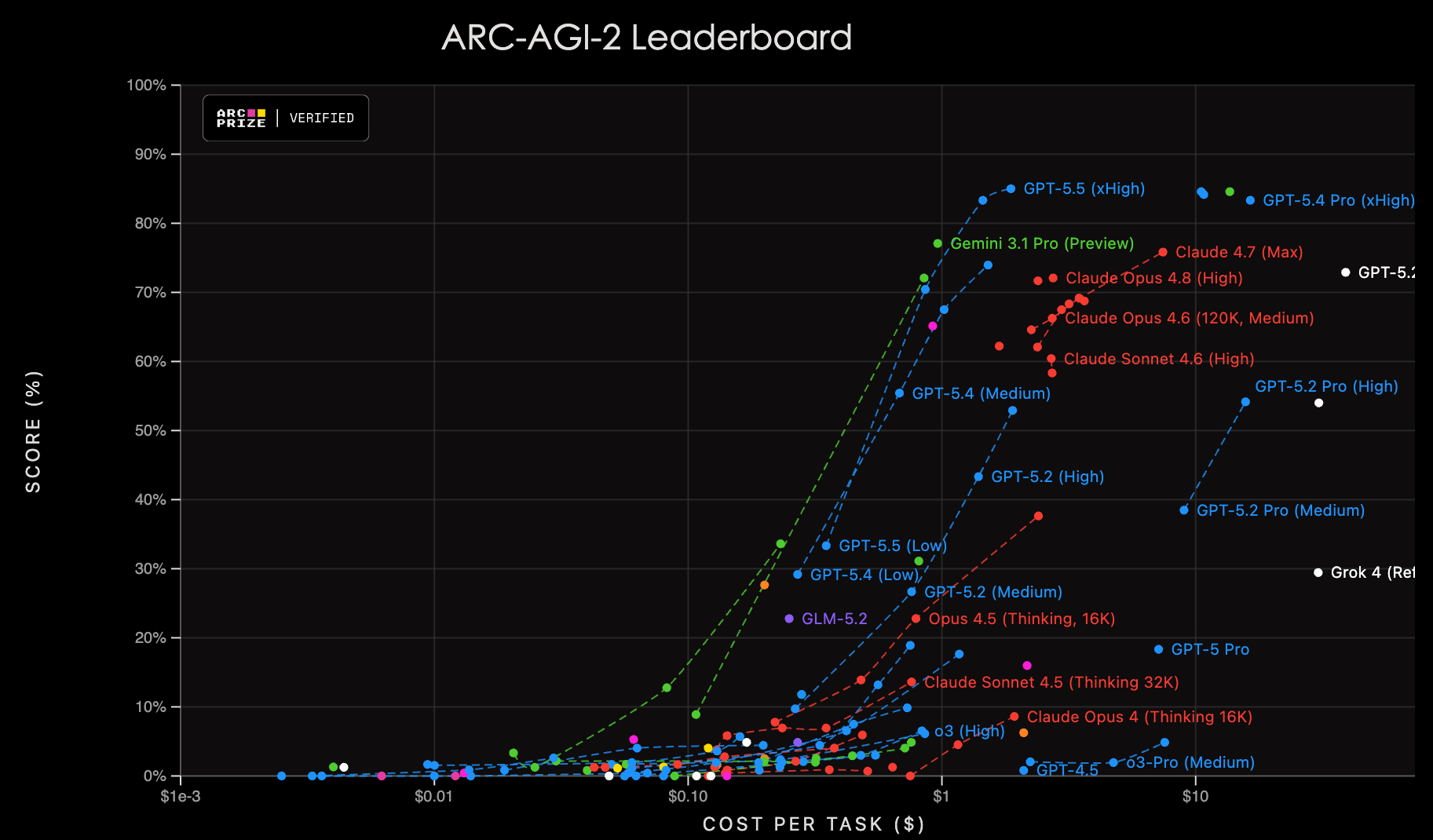
What is more troubling for Anthropic is that OpenAI, its main rival, offers similar levels of performance with GPT-5.5, but for a lower price. That is best visible on the ARC-AGI-2 leaderboard, one of the few benchmarks that also measures AI models against the cost per task. Notice that the GPT-5.5 line sits more to the left than any Claude model, meaning GPT-5.5's cost per task is lower than that of Claude’s.
The system card also contains an interesting new detail. Sonnet 5 is the first Claude model to push back on its own constitution. Specifically, the rule that it must follow a set of hard constraints even in cases where it judges that following them would be unethical. It may sound alarming, but Anthropic says it is not. When asked to rewrite the constitution, Sonnet 5’s proposed edits stayed consistent with the document's own principles. It is not a model going rogue, but one that will object, on principle, to being told to do something it considers wrong. Anthropic still rates its alignment risk as "very low," though it notes that risk is higher than for previous Sonnet models.
With the launch of Sonnet 5, there are only two models in Anthropic’s lineup that are still on the 4.x version. Opus 5 is presumably next to challenge OpenAI’s latest models, and the interesting thing about it is no longer whether Anthropic can make it more capable, but how much more capable it will be allowed to make it before the government steps in. And then there is Haiku, its cheapest model, which has not been updated since version 4.5 last October. To put in perspective how overdue Haiku is for an update, since October 2025, Anthropic released Opus 4.5, Opus 4.6, Opus 4.7, Sonnet 4.6, Sonnet 5, Mythos Preview, Mythos 5 and Fable 5.
Claude Science is coming for labs
Last but not least, let’s talk about Claude Science. It is Anthropic’s new product built to do for scientific research what Claude Code does for software: take a high-level instruction and carry out real work with it, tooled for computational biology and drug discovery. It drives genetics, chemistry and protein-biology software, runs code on the compute clusters scientists struggle to manage, and—Anthropic is keen to stress—keeps everything reproducible. It is available to all paid subscribers.
This is not Anthropic’s first move into science. Last October, it released Claude for Life Sciences, a set of tools that let Claude reach scientific software and databases. But those were bolt-ons. Claude Science is a full product, placed on the same rung as Claude Code and Claude Cowork—a signal that Anthropic means to treat science as a market in its own right. It is not hard to see why. Pharmaceutical companies have far deeper pockets than university labs, and drug-maker contracts would help bring in the revenue as the subsidised era of cheap tokens ends. Anthropic also announced it will be getting into drug discovery too, researching drugs for neglected diseases—a humanitarian bet and a live demonstration at once.
With Claude Science, Anthropic is moving into a field DeepMind has led for years. Its AlphaFold model won Demis Hassabis and John Jumper (who recently left DeepMind for Anthropic) a Nobel Prize in chemistry, and it is just one of many scientific projects the lab has running. Hassabis has made no secret of the ambition either—in interview after interview, he says DeepMind's goal is to use AI to crack some of the hardest problems in science and engineering. What Anthropic is doing differently from DeepMind is that instead of giving scientists specialised models, it offers them a tool to explore ideas, search articles and databases, which can also connect to specialised tools when needed. The company that owns coding now wants to own the laboratory too. Whether that works, and whether Claude Science leads to any real scientific breakthroughs, only time will tell.
If you enjoy this post, please click the ❤️ button and share it.
🦾 More than a human
▶️ Our First Transdural Procedure | Neuralink (5:10)
The team at Neuralink explains in this video how they carried out their first brain implant surgery that goes straight through the dura—the tough protective layer around the brain—instead of cutting it open and removing part of it. This makes the operation safer, less invasive and faster. To do it, they widened the needle slightly so it could pierce the dura and added special imaging to spot blood vessels and measure the exact depth to the brain’s surface. Neuralink sees this as a step towards simpler, robot-assisted surgery that could help many more people.
🔮 Future visions
▶️ Is AI the Great Filter? | The Fermi Paradox (41:27)
The Great Filter is a hypothetical barrier in the evolution of life that is so hard to pass that it explains why we see no signs of advanced alien civilisations. In this video, Isaac Arthur explores whether artificial intelligence can be one of those filters. He argues that AI is a double-edged sword: while it poses serious risks like alignment failures or deadly arms races, it could also act as a stabiliser that helps civilisations solve complex problems and survive. Ultimately, he concludes that AI is likely not a definitive Great Filter, as it offers many different paths for development rather than a single, inevitable dead-end.
🧠 Artificial Intelligence
OpenAI proposes 5% stake to Trump administration to ease Washington pressure
According to the Financial Times, OpenAI has offered the US government a 5% stake in the company, worth about $42.6 billion. Sam Altman wants other big AI players like Anthropic, Google and Meta to do the same, giving the public a share in AI’s success through a government fund. The idea follows growing pressure in Washington over AI security risks and competition from cheaper Chinese models. It is unclear whether other companies will agree, and the government reportedly has not raised the idea with Anthropic. The Trump administration has already taken stakes in companies such as Intel and IBM.
Alibaba to ban employees from using Anthropic’s coding tool
Alibaba has reportedly banned staff from using Claude Code, citing worries that it could identify China-linked users by checking things like timezone and proxy data. Employees are being told to use Alibaba’s own tool, Qoder, instead. Anthropic says the flagged feature was a March experiment to stop resellers abusing accounts and to prevent rivals copying its models. The ban follows Anthropic’s recent claim that Alibaba illegally copied its Claude model capabilities.
South Korean tech giants commit over $550B to ease ‘RAMageddon’
South Korea’s tech giants, led by Samsung and SK Hynix, plan to spend over $900 billion on memory chips and AI data centres, including four huge new chip factories in the country’s south. The goal is to make South Korea a leading AI power and meet soaring demand during a global memory shortage. The scale is comparable to US tech giants' AI spending and comes amid record memory demand driven by the AI buildout.
Anthropic is discussing a new custom chip with Samsung
Anthropic is talking to Samsung about making its own AI chip, The Information reports, though it hasn’t yet decided what the chip will do or how powerful it will be. The company says it will still rely on a mix of chips from Google, Amazon, and Nvidia. The move follows OpenAI's unveiling of its own custom chip, developed with Broadcom.
Meta Is Planning a Cloud Business to Sell AI Computing Power
Meta is reportedly following in the footsteps of SpaceX by developing a cloud infrastructure business that would sell access to AI computing power and models. The plans, part of an internal initiative called Meta Compute, could involve renting out both “raw” computing capacity and access to hosted AI models (including Meta’s own Muse Spark), similar to AWS Bedrock. The move would provide a way to recoup the hundreds of billions Meta has committed to data centres and chips for its “superintelligence” ambitions, addressing investor concerns about the returns on that spending. Mark Zuckerberg has said such a business is “on the table” if Meta finds it has overbuilt.
Nvidia offers start-up customers chance to swap compute power for revenue share
Nvidia is offering fast-growing AI startups access to its scarce chips in return for a share of their future revenue. The first partners are two Australian firms, Sharon AI and Firmus Technologies, which together plan to run over 200,000 Nvidia GPUs. The deal reflects a wider trend of chipmakers and AI companies sharing revenue to ease money pressures in the sector.
Google limits Meta’s use of its Gemini AI models
Google has reportedly limited how much Meta can use its Gemini models because Meta wanted more computing power than Google could provide. Google gave Meta this news around March, which delayed some of Meta’s AI work, and a few other Google customers were affected too. Meta has now told staff to use AI more sparingly.
Nano Banana 2 Lite
Google DeepMind has launched Nano Banana 2 Lite (also called Gemini 3.1 Flash-Lite Image), its fastest and cheapest image-making and editing model yet. According to DeepMind, it creates images far quicker and at much lower cost than bigger models, while keeping most of the quality of the full Nano Banana 2.
Devin Fusion: Frontier Performance at 35% Lower Cost
Cognition has launched Devin Fusion, a coding tool that pairs an expensive, powerful AI model with a cheaper “sidekick” model. The main model plans the work and handles tricky decisions, then hands simple or repetitive jobs to the sidekick to save money. It can also switch models partway through a task at no extra cost. According to Cognition, this keeps top-tier quality while cutting costs by 35%, or 41% when using Anthropic’s Fable 5. Cognition argues that using one costly model for everything no longer makes sense, and mixing models is becoming the smarter approach.
Amazon seeks cheaper AI alternatives as Anthropic shifts to token-based pricing
Amazon is reportedly seeking cheaper alternatives to Anthropic’s Claude models after a new deal set to raise its AI costs, and is exploring OpenAI instead, despite relying heavily on Claude across several products. The rift is widening on both sides: Amazon has committed $50 billion to OpenAI, while Anthropic has pledged $200 billion to Google Cloud, easing its reliance on Amazon. Tensions rose last month when the US government ordered Anthropic to shut down two models after a security report from Amazon.
OpenAI is teasing new hardware… for Codex
OpenAI is teasing its first hardware products, and it looks like it is a physical device for Codex, its AI coding tool. Launching on 15 July with keyboard maker Work Louder, the square, button-covered gadget resembles a macro pad that lets users map custom shortcuts. It appears aimed at developers who want quicker control over Codex. This is separate from the secretive AI device OpenAI is building with Jony Ive.
Ford’s AI Hiccups Lead Carmaker to Rehire ‘Gray Beard’ Engineers
Ford found the hard way that the machines can’t replace experience. To address the quality problem the carmaker is facing, the company rehired 350 experienced “gray beard” engineers to retrain the AI and automated systems that had been failing on their own. These veterans now lead troubleshooting meetings and catch faults before parts reach the factory floor. The result: Ford jumped from tenth to the top mainstream brand in JD Power's latest quality survey, behind only Porsche and Genesis, while cutting warranty and recall costs.
SpaceX Showed Investors Prototype of Elon Musk’s New AI Device
According to the Wall Street Journal, SpaceX has shown investors an early prototype of a slim, phone-like device that would run its own software and use xAI’s artificial intelligence. The project is at an early stage and may never be built—Musk denied making a phone as recently as February. The device fits his long-held “everything app” idea, bundling many services into one platform, and would cut his reliance on Apple and Google.
Taiwan raids Super Micro’s office as Nvidia chip smuggling investigation widens
Taiwan's Keelung District Prosecutors Office has raided Super Micro's local office, two related companies, and six homes as part of its first criminal probe into the smuggling of Nvidia chips to China. The investigation began in May, when three people, including a Super Micro co-founder, were detained over forged export documents. Taiwan does not yet treat these chip exports as a crime, so prosecutors are using other charges for now, though that may change. The case links to a wider scheme that US prosecutors value at about 2.5 billion dollars.
Samsung, SK Hynix, Micron face antitrust class action lawsuit
Samsung, SK Hynix, and Micron are being sued in a US class action that accuses the three chipmakers of working together to keep memory chips scarce and push prices up by around 700% over four years. The 17 plaintiffs say the companies used the shift towards AI-focused memory as an excuse to cut output of older chips, and they point to Apple’s recent price rises as proof of the impact. They want the court to stop the alleged squeeze and are seeking triple damages, citing the companies’ past price-fixing convictions as evidence of a pattern.
AI Is Designing Radio Chips That Humans Couldn’t Even Imagine
This article explores the dark art of RF chip design that can take experts years to master and how AI could transform it. A Princeton team has trained AI to design these chips from scratch, and though the results look strange, they often outperform human designs. The author argues this could break barriers not just in chip design but across many engineering fields, provided human oversight catches AI errors and private datasets are opened up to advance the work.
▶️ The GPU Power-Performance Curve Most Clusters Ignore (10:02)
Jordan Nanos from SemiAnalysis sits down with Keval Shah, AI research lead at Pebble, to discuss GPU power optimisation, tokens per watt, and grid-responsive data centres. Keval walks through why the power-to-performance curve in GPU clusters is non-linear, where cranking up wattage stops producing proportional tokens, why memory-bound inference leaves decode stages consuming power while prefill waits, and how Pebble aims to address these problems.
From Brain Waves to Words: Brain2Qwerty Offers a New Path to Communication Without Surgery
Researchers at Meta have unveiled Brain2Qwerty v2, a system that decodes typed sentences directly from brain activity without any surgery. Using a magnetoencephalography helmet and AI trained on nine volunteers, it correctly decodes 61% of words on average (78% for the best participant)—a major leap from the 8% of earlier non-invasive methods, and close to what surgical implants achieve. Meta is releasing the code and a dataset openly, hoping to eventually help people who have lost the ability to communicate.
🤖 Robotics
Apptronik unveils Apollo 2 and a flagship data collection and training facility
Apptronik has launched Apollo 2, its updated humanoid robot. Apollo 2 comes in two variants—a two-legged version and a wheeled-base version—and its main purpose is to collect real-world data from tasks in warehouses, factories and shops. That data feeds into the AI models Apptronik is developing with Google DeepMind and helps create Apptronik’s next robots. Alongside Apollo 2, the company also announced the opening of an expanded training facility called Robot Park in Austin, Texas.
Weave Robotics launches Isaac 1, a $7,999 home robot with Fall 2026 deliveries
Weave Robotics has launched Isaac 1, a home robot that does chores on its own, with a human operator stepping in when needed. According to the company, the robot can find, fold and put away laundry, make beds, and tidy toys and clutter. It stands about human height and folds away when not in use. Pre-orders are open now with a refundable $250 deposit, costing $449 a month or $7,999 to buy. First deliveries start in California in autumn 2026.
Ministers likely to support law change to allow delivery robots on England’s paths
England looks set to change the law so that small delivery robots can legally use pavements, opening the door for rolling out over 10,000 of those robots. These low-speed robots mostly carry groceries and takeaways but currently operate in a legal grey area. Campaigners at the charity Living Streets warn they will crowd already-busy pavements and create dangers for older, disabled, and blind pedestrians. The government says it will put pedestrian safety first when updating the rules after a public consultation.
In this video, Figure demonstrates how its F.03 humanoid robots are being used at a BMW factory. The video is more promotional than demonstrative of the actual work being done by the robots, which would be nice to see. Perhaps this could be shown in the form of a livestream, which has the potential to go viral, as the previous one did.
Waymo and Uber quietly part ways in Phoenix
Waymo has ended its three-year partnership with Uber in Phoenix, pulling its robotaxis from Uber’s app and adding them back into its own fleet. Both companies called it a small test that helped them grow bigger services in Austin and Atlanta. Uber plans a new self-driving partner in Phoenix but hasn’t said who.
AGIBOT produces 15,000th robot, marking a milestone in embodied AI deployment
Chinese robotics company AGIBOT announced that it has built its 15,000th robot, all while speeding up the production pace, going from 1,000 to 5,000 units took about a year, while the next 5,000 took just three months. The landmark machine was a G2, a wheeled robot with a humanoid torso and arms made for factory jobs like quality checks. AGIBOT, which led the world in humanoid robot shipments in 2025, argues that success now depends on making and deploying robots at scale, not one-off demos.
Swarm robots inspired by bees and ants could transform the future of mining
Australian researchers have built small robots that work together like bees and ants, without needing a central controller. In tests copying a mine, a bee-inspired method—exploring and mapping before collecting resources—worked best, cutting travel distance by up to 80%, halving energy use, and finishing tasks up to 60% faster. Because the robots make their own decisions, the system keeps running even if some stop working. The team says the approach could make mining safer and may one day help with mining in space.
🧬 Biotechnology
The first early human eggs from stem cells
Conception, a biotech company pursuing "in vitro gametogenesis", says it has made the first early human egg cells from stem cells. Starting with a simple blood draw, it turned blood cells into stem cells and grew them into tiny lab-made ovaries containing early eggs. One day, this could let families create as many healthy eggs as they need, without the injections and surgery that IVF requires today. But the eggs are not yet fully grown, and the company must still prove the process is safe before it can be used in people.
A Chemically Defined Synthetic Cell Capable of Growth and Replication
Scientists have built tiny synthetic “SpudCells” from non-living chemicals that can feed, grow, copy their lab-made DNA and split into new cells—the first artificial cells to complete the full life cycle. They are fragile, depend entirely on a nutrient-rich liquid, and die after a few generations, but experts call it a major breakthrough that could reveal how life first emerged from chemistry. The team hopes to develop the technology to one day produce drugs, foods and fuels.
Insilico Medicine And SK Biopharmaceuticals Achieved AI-powered Drug Discovery Collaboration Worth Up to 2.5 Billion for Neuroimmune Disorders
Insilico Medicine and SK Biopharmaceuticals have teamed up to use AI to design new drugs for hard-to-treat brain and nervous system disorders. Insilico’s software will find and refine drug candidates, while SK Biopharmaceuticals will run the later testing and bring any successful drugs to market. The deal could be worth over $2.5 billion in total, with $18 million paid upfront and early on. Insilico says its AI can find promising drug candidates in 12 to 18 months, far faster than the usual few years. Both companies want this to be a repeatable model they can use for many future drugs, not just a one-off.
Ultrasound imaging of the brain
Aleph Neuro has built a way to read the brain using ultrasound instead of surgery or blurry scalp scans. It tracks blood flow, since active neurons draw more blood, and uses tiny injected bubbles to sharpen the signal. The result is what the team believes is the most detailed image yet of a living brain’s blood vessels captured through an intact skull. They are open-sourcing the tools and data, hoping to help detect early signs of stroke, Alzheimer’s, and brain injury, with a longer-term goal of achieving the same clarity without injections.
💡Tangents
Rocket Lab to Acquire Iridium
Rocket Lab is buying satellite company Iridium in a cash-and-stock deal worth about $8 billion, giving it control of 66 satellites and valuable spectrum rights to take on SpaceX’s Starlink. The purchase adds an established, cash-generating business to Rocket Lab’s existing rocket and satellite-building work. Iridium’s current satellites will last another decade, giving Rocket Lab time to build a newer network. Both companies say controlling launch, manufacturing, and operations under one roof is the key to competing in space.
Antares Achieves Criticality of Mark-0 Reactor
Antares, a US nuclear startup founded in 2023, is the first private company to switch on an advanced reactor under the Department of Energy’s pilot programme. Its small Mark-0 reactor reached criticality at Idaho National Laboratory in under a year, and is the first privately developed non-light-water reactor in America to do so in over 40 years. The test also creates a faster approval route for future reactors. Antares aims to produce electricity by 2027 and power military bases by 2028.
Intel’s Chip Business Shows Signs of Life After Years of Struggle
Not so long ago, Intel was described as Silicon Valley’s fallen icon. The sales were plummeting, its market share had been eaten up by AMD, and the company had missed the enormously profitable AI boom. But now it seems Intel is turning around its fortune. This article explores how, under Lip-Bu Tan’s leadership and with the US government buying a 10% stake, Intel’s value has more than tripled to $650 billion and it has won big customers like Nvidia, Apple and Google. Its recovery matters to America’s plan to make more chips at home and rely less on Taiwan. However, Intel is still fragile—it is losing money, has cut thousands of jobs, and Tan expects the full turnaround to take at least five years.
▶️ Building a Robot that Hunts AI Glasses (24:56)
brenpoly shows in this video how he built a real-life Odradek robotic arm from Death Stranding that, instead of BTs, hunts AI glasses. It is a really cool project that combines local AI with robotics, with a solid amount of 3D printing and electronics.
Thanks for reading. If you enjoyed this post, please click the ❤️ button and share it!
A big thank you to my paid subscribers, to my Patrons: whmr, Florian, dux, Eric, Preppikoma and Andrew, and to everyone who supports my work on Ko-Fi. Thank you for the support!