


Hello and welcome to Sync #584!
This week has been crazy. We’ve had not one, not two, not three, but eight new models released, with a nice mix of open and proprietary models. We’ll take a close look at all eight of them and what they bring to the table in this week’s write-up.
Elsewhere in AI, Nvidia and six big Wall Street investors raise $500 billion to finance an AI infrastructure buildout, Anthropic is courting investors ahead of its potentially $2 trillion IPO, and OpenAI wraps up a $7 billion share sale. Other than that, OpenAI releases GPT-5.6 Sol Ultrafast while high-profile exits raise red flags, Mark Zuckerberg shares his vision for personal intelligence, Anthropic starts watermarking text produced by Claude, and Chinese AI chipmakers are gaining from Beijing’s push to rely less on Nvidia.
Over in robotics, the FCC moves to ban LiDAR-equipped foreign drones from the US, DARPA wraps up the Lift Challenge, Uber and Pony.ai are launching 2,000 robotaxis in Europe, we look at why building a humanoid robot in the US is hard without Chinese components, and more!
Apart from that, this week’s issue of Sync also features scientists creating female clones of male mice, allergy-free genetically engineered dogs, OpenAI sharing details of the Hugging Face incident, a profile of the secretive yet influential wife and adviser of Dario Amodei, and more!
Enjoy!

Eight new models in one week
Google, SpaceXAI, Meta, Nvidia, Microsoft, DeepSeek and Z.ai all picked the same week to release new AI models

I don’t recall a week like this before. Normally, there is one, maybe two, model releases to analyse. But this week, seven companies decided to release eight models, plus one AI lab made weights public for a model released some time ago. It is a nice mix ranging from proprietary frontier challengers to open-weight models and efficient workhorses. In this article, we’ll look at all eight new models, what they bring to the table, and where they fit in an increasingly crowded AI landscape.
Gemini 3.7 Flash
Google has released a new model this week. But it is not the long-awaited successor to Gemini 3.1 Pro. Instead, it is another update to the Gemini Flash line. Just three weeks after Gemini 3.6 Flash, Google presents Gemini 3.7 Flash, its “most intelligent workhorse model yet for coding and agents.”
Gemini 3.7 Flash is being positioned as a model that balances performance and cost. It is aimed mainly at coding, but can also be useful for all kinds of knowledge work. Google says the new model adapts better to roadblocks, clarifies intent when needed, and is better at following instructions. It also exhibits more disciplined execution, which allows it to work more reliably.
Google reports that Gemini 3.7 Flash is a noticeable improvement over its predecessors. It tops Gemini 3.6 Flash in almost all the published benchmark results (the only benchmark on which Gemini 3.6 Flash scored better is CharXiv Reasoning, but not by much). The one chart that Google decided to highlight is the comparison between cost and performance across different models on DeepSWE V1.1, which measures frontier coding agents on original, long-horizon engineering tasks.
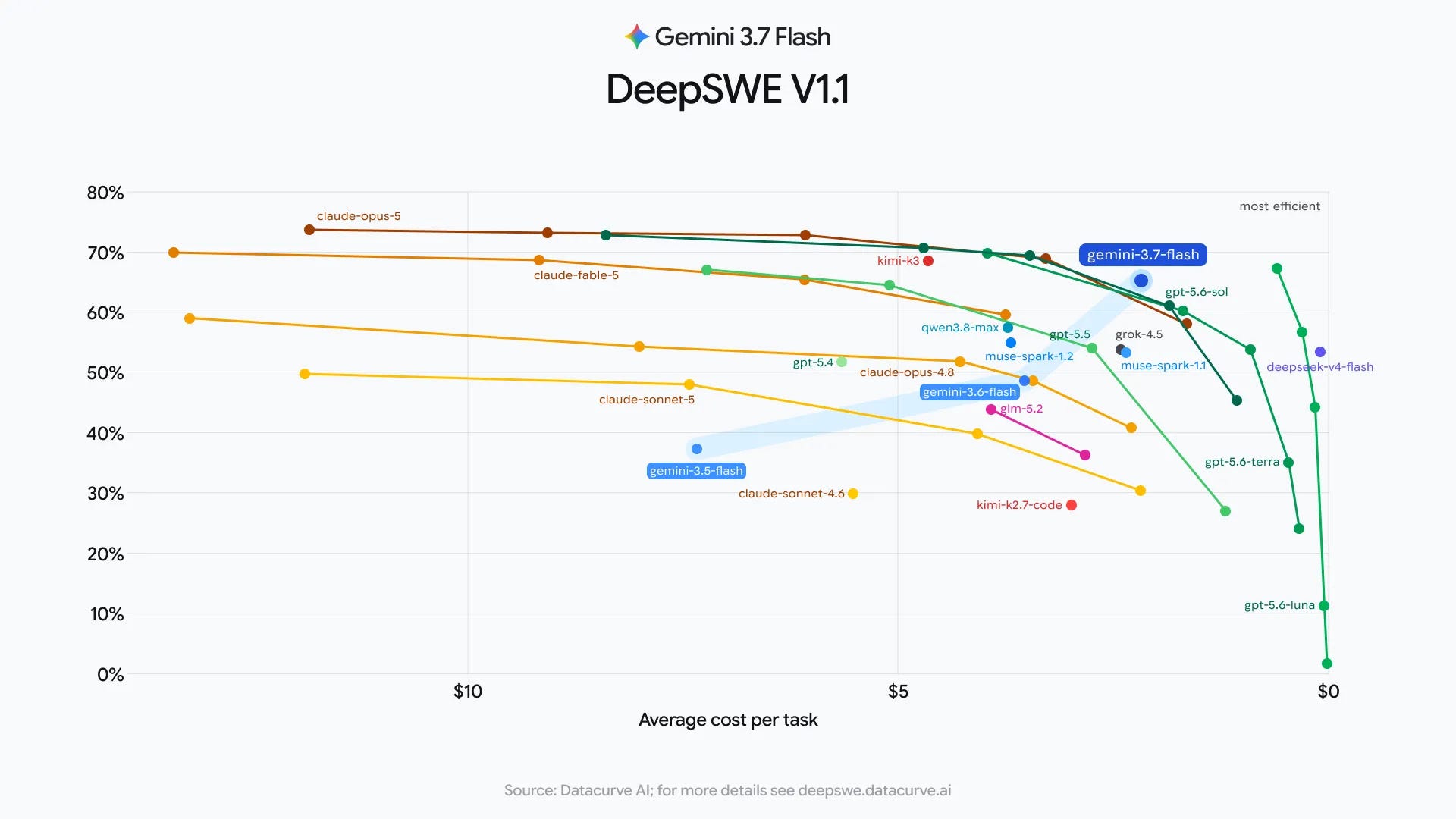
However, it is worth noting that those benchmarks used introductory pricing of $0.75/$3.75 per million input/output tokens. Once the introductory price expires at the end of the year, Gemini 3.7 Flash will be twice as expensive, which would put it on the DeepSWE graph roughly where Kimi K3 is.
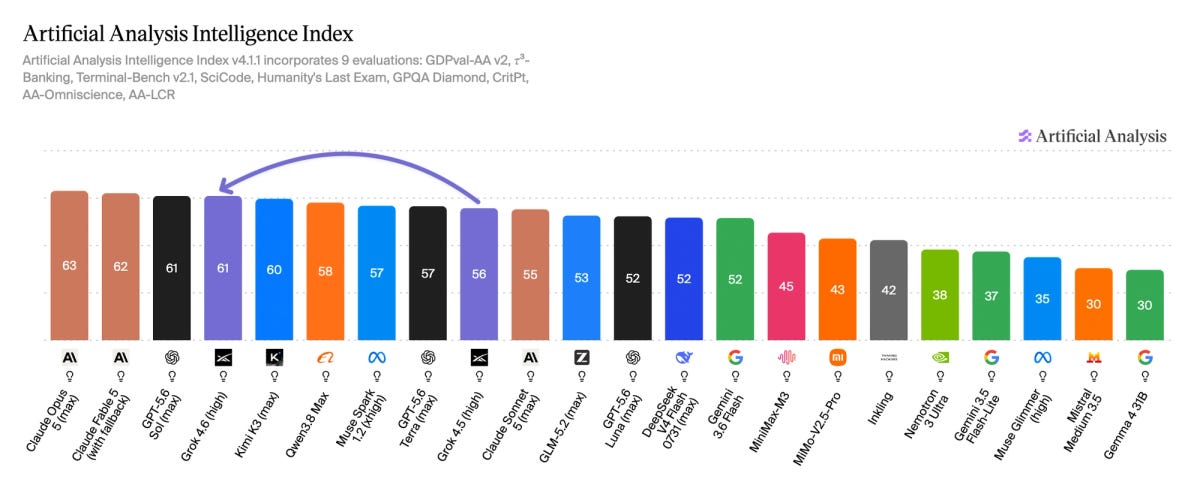
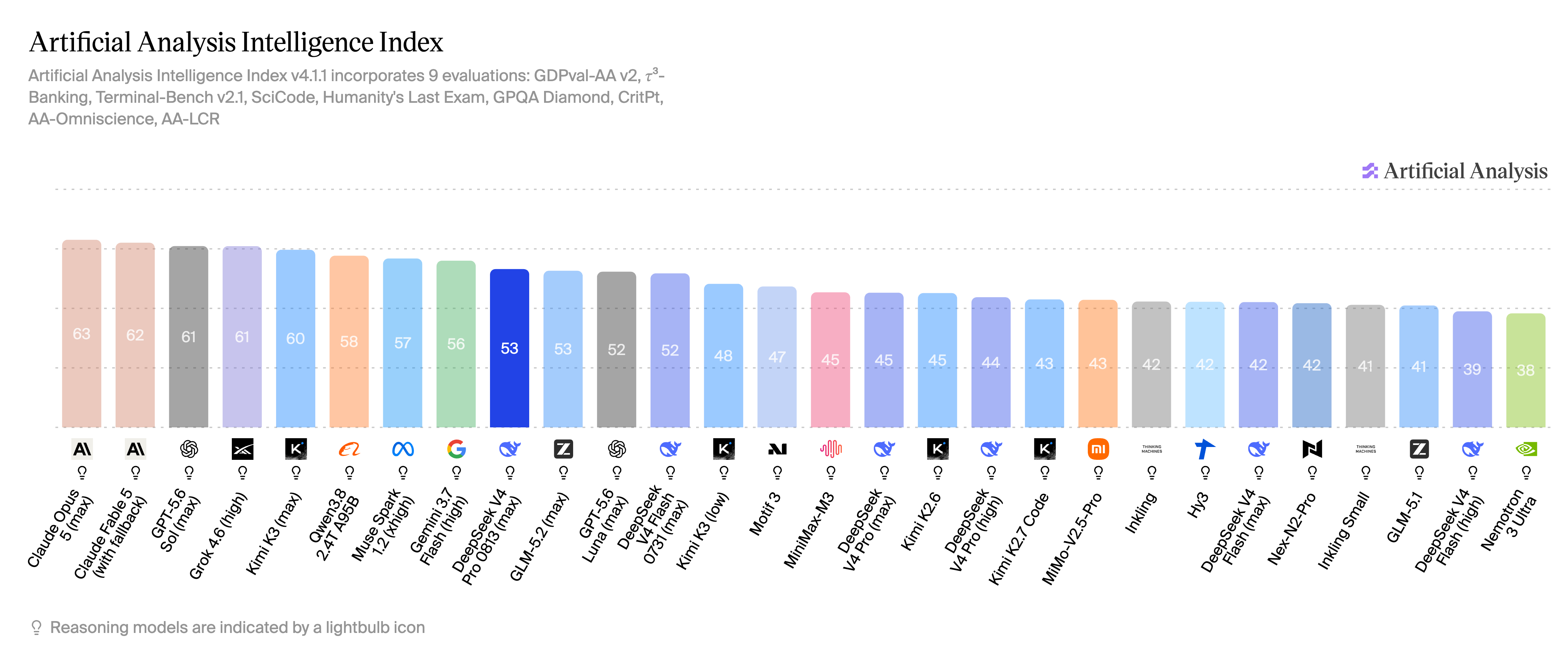
Artificial Analysis gave Gemini 3.7 Flash a score of 56 on its Intelligence Index, which places the new model between GPT-5.6 Terra and Claude Sonnet 5.
Gemini 3.7 Flash is available on the Gemini app, Spark, Antigravity, and via the Gemini API.
Grok 4.6
SpaceXAI makes a run at the top with Grok 4.6. And while its new flagship model doesn't take the crown, it shows that SpaceXAI can produce a competitive frontier model.
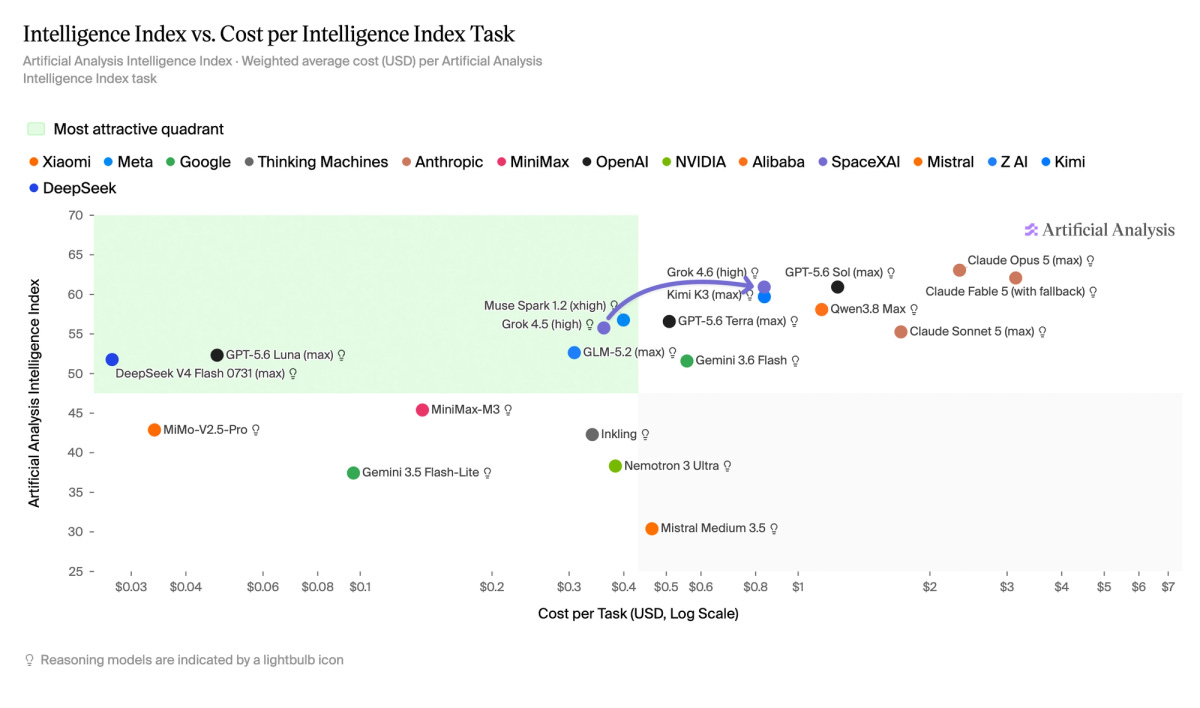
On the Artificial Analysis Intelligence Index, Grok 4.6 scores 61 points—five points up on Grok 4.5 and 23 up on Grok 4.3. That puts Grok 4.6 at the level of Claude Opus 5 and GPT-5.6 Sol. And with the price of $2/$6 per million input/output tokens, SpaceXAI’s new flagship model is cheaper than Opus 5 or GPT-5.6 Sol ($5/$25 and $5/$30 per million input/output tokens, respectively).
SpaceXAI positions Grok 4.6 squarely for long-running agents and coding, and I think this is part of a bigger plan for SpaceXAI to at least stay relevant. Grok does not have a particularly good reputation, and it is not doing especially well in the AI race. But SpaceX now owns Cursor, a popular AI coding tool, and it might have an opportunity here to improve its numbers, or at least have something it can spin as a good story.
Cursor currently offers a wide range of models to choose from, including top models from OpenAI, Anthropic, and Google, as well as its own coding models and Grok. But I think Grok will come to occupy a more prominent place in Cursor. It could become the default model, offered at competitive pricing in an attempt to convince software engineers to switch from Claude or GPT-5.6 to Grok.
This could give SpaceXAI a foothold in the lucrative AI coding market. It is unclear how far SpaceXAI can go, or whether it can grab a sizeable chunk of the market from Anthropic and OpenAI. But at the very least, SpaceXAI could make the number of people using Grok for coding look better.
Grok 4.6 is available in Cursor and Grok Build. It’s also available through the API and via other partners such as OpenRouter, Vercel, and Cloudflare.
Muse Glimmer
Do you remember when Meta was the unlikely champion of open-weight models? Meta seems to have remembered those good old times and is now back with a new open-weight model—Muse Glimmer.
Glimmer is a 30-billion-parameter open-weight model built for local agentic work. It’s distilled from Muse Spark, Meta’s closed flagship model, and designed to run on a desktop or laptop with a single consumer GPU. The full-precision version with no quantisation requires 64GB of VRAM. There are quantised versions of Glimmer that need just 32GB or 24GB of VRAM, which is enough to fit Glimmer on an NVIDIA RTX 5090. Meta says that the quantised versions of Glimmer show up to 1% degradation in performance compared with the full version.
Meta pitches Glimmer as a model to power always-on local AI agents. Glimmer is meant to call tools, write and debug code, work through screenshots and documents, and recover when a tool call fails instead of stalling. Meta imagines it managing your schedule, drafting your messages, and organising your files—exactly the kind of work that needs deep access to personal data, and exactly the argument for keeping it local.
When it comes to performance, Meta’s own benchmark results put Glimmer ahead of Gemma 4 31B and Qwen3.6 27B on most agentic and reasoning benchmarks. Artificial Analysis tells a slightly more sober story. Glimmer scores 35 points on the Intelligence Index, around Kimi K2.5 (36) and just behind Qwen3.6 27B (38). It also falls behind Qwen3.6 27B and Gemini 3.5 Flash-Lite in benchmarks measuring models on realistic knowledge work tasks in an agentic loop. Additionally, Artificial Analysis found that Glimmer has an 82% hallucination rate, compared with Qwen3.6 27B’s 49%.
The release of Muse Glimmer is a welcome surprise from Meta after the company abandoned the Llama family and rebuilt its AI teams. As Mark Zuckerberg outlines in his latest manifesto, Meta will offer a mix of open and closed models. He argues that distributing superintelligence widely “has the potential to begin a new era of personal empowerment,” promising a personal agent that works around the clock on your relationships, health, career and finances. Open models, like Glimmer, will play a part in fulfilling his vision of personal intelligence.
Glimmer’s weights are available on Hugging Face.
Nvidia Nemotron 3.5 Lightning
Nemotron 3.5 Lightning is the latest addition to Nemotron, Nvidia’s family of open-weight models. And as its name suggests, the new model focuses on speed.
Nvidia’s framing is that modern agentic systems are ensembles. There is a big reasoning model like Nemotron 3 Ultra or GPT-5.6 that plans and orchestrates, while smaller specialised models handle the high-volume grunt work—code review, tool calls, security alert monitoring, billing questions. Lightning is built for that second role. Nvidia claims up to 4x faster output speed and 30% faster agentic task completion than other models in its class. If needed, the model can be post-trained on custom data with NeMo.
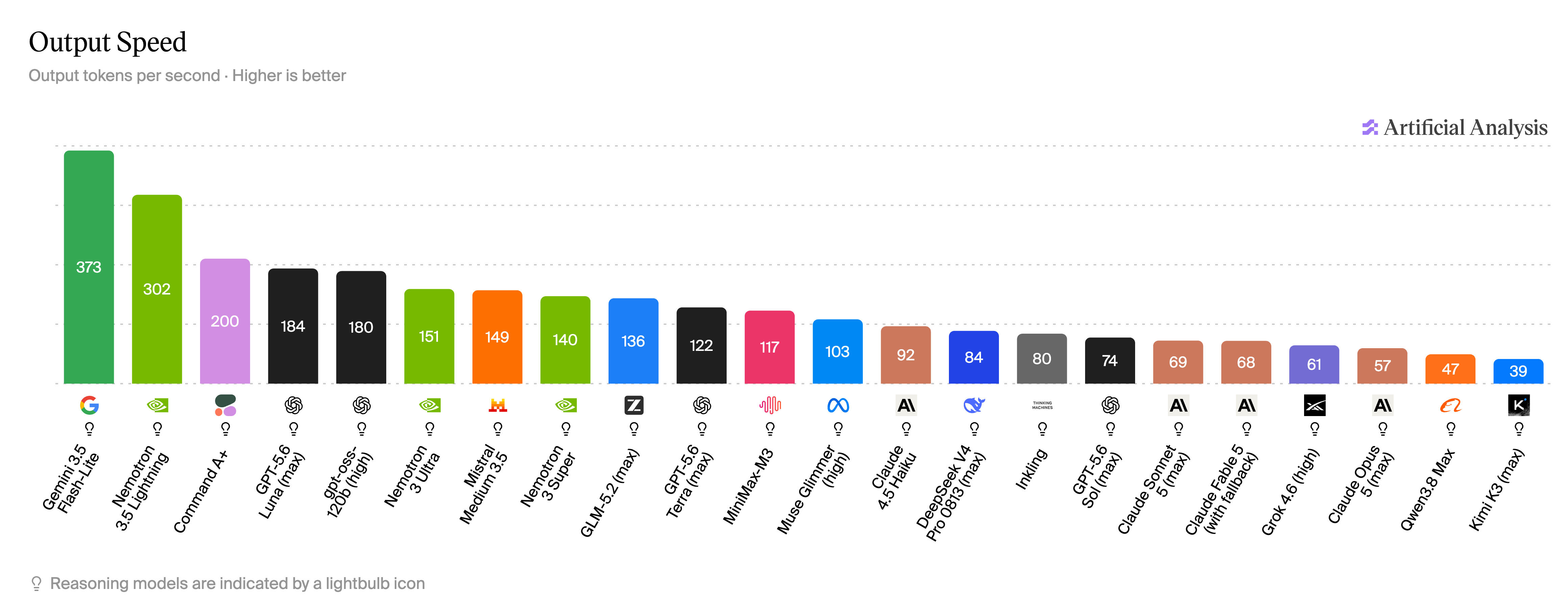
Artificial Analysis supports Nvidia’s speed claims. In its tests, Nemotron 3.5 Lightning produced 302 output tokens per second, a result second only to Gemini 3.5 Flash-Lite’s 373 output tokens per second and well ahead of everyone else. In terms of intelligence, Lightning scored 24 points on the Intelligence Index and is comparable to Qwen3.5 35B and Gemma 4 31B. Artificial Analysis also found that Lightning is quite verbose. It generated 100 million tokens to complete the Intelligence Index evaluation, compared with a median of 43 million tokens, which will have an impact on the cost of running the model.
Alongside Nemotron 3.5 Lightning, Nvidia released NeMo Switchyard, an open-source routing library, and the two are clearly meant to be read together. Switchyard sends each request—or each step of an agent's workflow—to whichever model in a developer's pool is best suited to it, weighing model capability, cost and latency. It is provider-agnostic and accepts OpenAI, Anthropic and Responses API requests, so it can sit in front of a mix of open and proprietary models. The library ships with several routing strategies, including an escalation router that starts on a cheap model and switches to a stronger one when an LLM judge detects sustained difficulty.
Nemotron 3.5 Lightning is available on Hugging Face. As with previous Nemotron releases, Nvidia is publishing training data and methods where licensing allows, along with an agentic reinforcement learning dataset used for the coding post-training. NeMo Switchyard, meanwhile, can be found on GitHub.
MAI-Thinking-1 and MAI-Code-1.1-Flash
Let’s now turn our attention to Microsoft, which brought two new models to the table this week—MAI-Thinking-1 and MAI-Code-1.1-Flash.
MAI-Thinking-1 is Microsoft’s medium-sized reasoning model positioned as cost-efficient reasoning for enterprise work. Microsoft claims that the new model goes toe-to-toe with Claude Opus 4.6 on SWE-Bench Pro despite the smaller inference footprint, and that users prefer it over Claude Sonnet 4.6.
The more interesting claim is about how MAI-Thinking-1 was built. Microsoft is making a point of the fact that MAI-Thinking-1 was trained without distillation from third-party models and describes its training setup as a “Hill-Climbing Machine,” a pipeline designed so that every component can be improved incrementally over time. The argument is that inherited intelligence is faster to acquire but less steerable, and that clean, traceable training data matters for enterprise customers who need to know what shaped the model. Microsoft also says safety is trained through the same reinforcement learning loop as capability, treating unnecessary refusals and unsafe compliance as equivalent defects.
MAI-Code-1.1-Flash is an updated version of Microsoft’s coding model. Microsoft emphasises a noticeable uplift in efficiency. Compared to MAI-Code-1-Flash, the new version generates tokens 25% faster and uses 25% fewer tokens to complete a task. Taken together, those efficiency improvements mean MAI-Code-1.1-Flash costs a quarter of its predecessor. Additionally, Microsoft highlights a 15% improvement on .NET (Microsoft’s open-source development platform) tasks.
Both MAI-Thinking-1 and MAI-Code-1.1-Flash fit into Microsoft’s broader AI strategy. For a long time, Microsoft relied on OpenAI and Anthropic to deliver the AI behind intelligent features in its products. But the rising costs of AI made Microsoft invest in its own models that it can then serve more cheaply. Now Microsoft has those models and will start replacing models from OpenAI and Anthropic with them.
MAI-Thinking-1 is available in public preview in Microsoft Foundry. MAI-Code-1.1-Flash is available in GitHub Copilot.
DeepSeek V4 Pro
DeepSeek has finally taken DeepSeek V4 Pro out of preview, nearly four months after the April preview build. V4 Pro is a mixture-of-experts model with 1.6 trillion total parameters, of which 49 billion are active. It has a 1M context window and, as usual for DeepSeek, the weights are released under an MIT licence.
Artificial Analysis scores DeepSeek V4 Pro at 53 points on the Intelligence Index, which makes it the third-best open-weight model and well ahead of V4 Flash at 40 points. DeepSeek's own model card puts it at 80.6% on SWE-bench Verified—on the same level as Gemini 3.1 Pro and just behind Claude Opus 4.6.
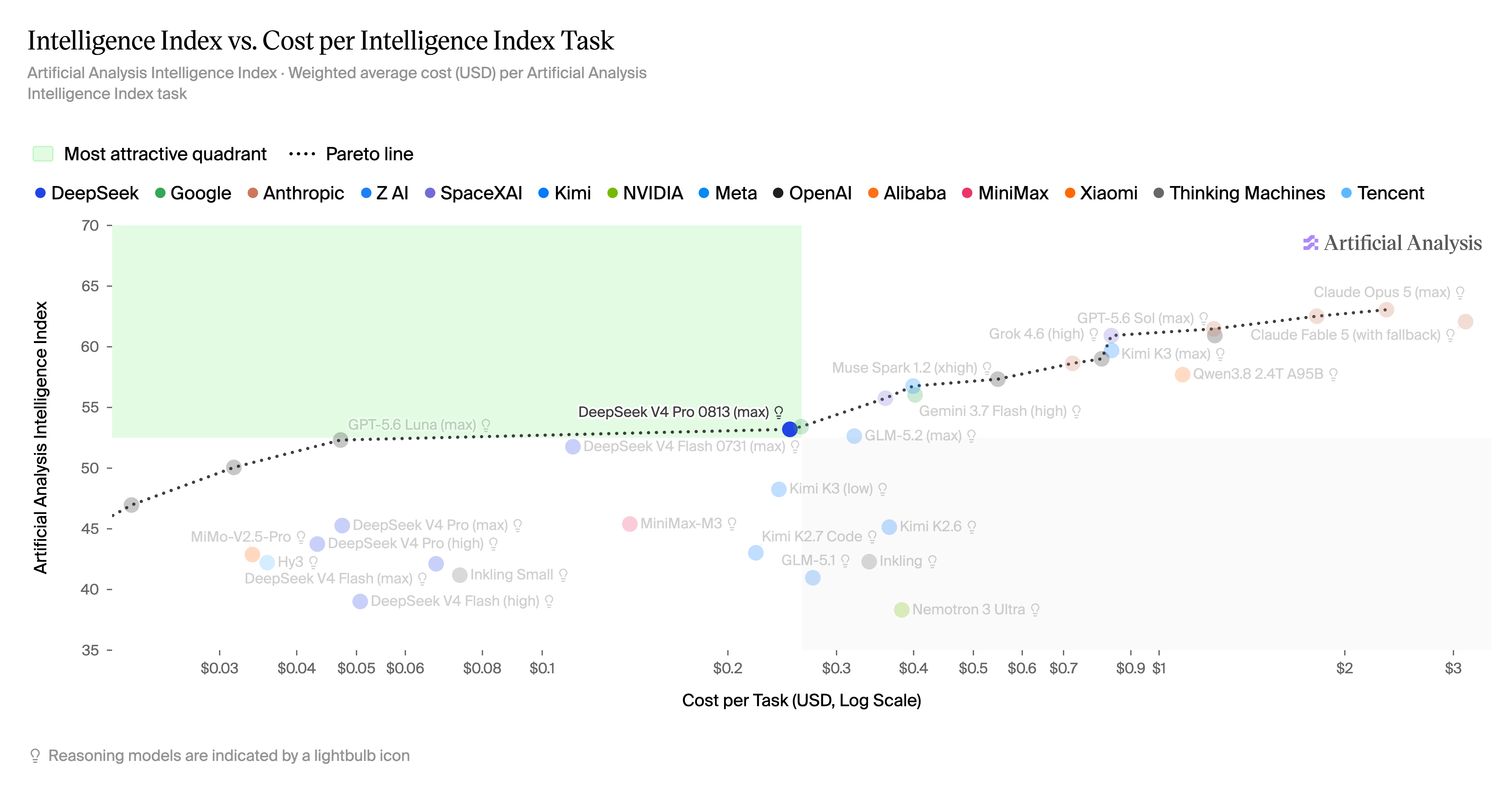
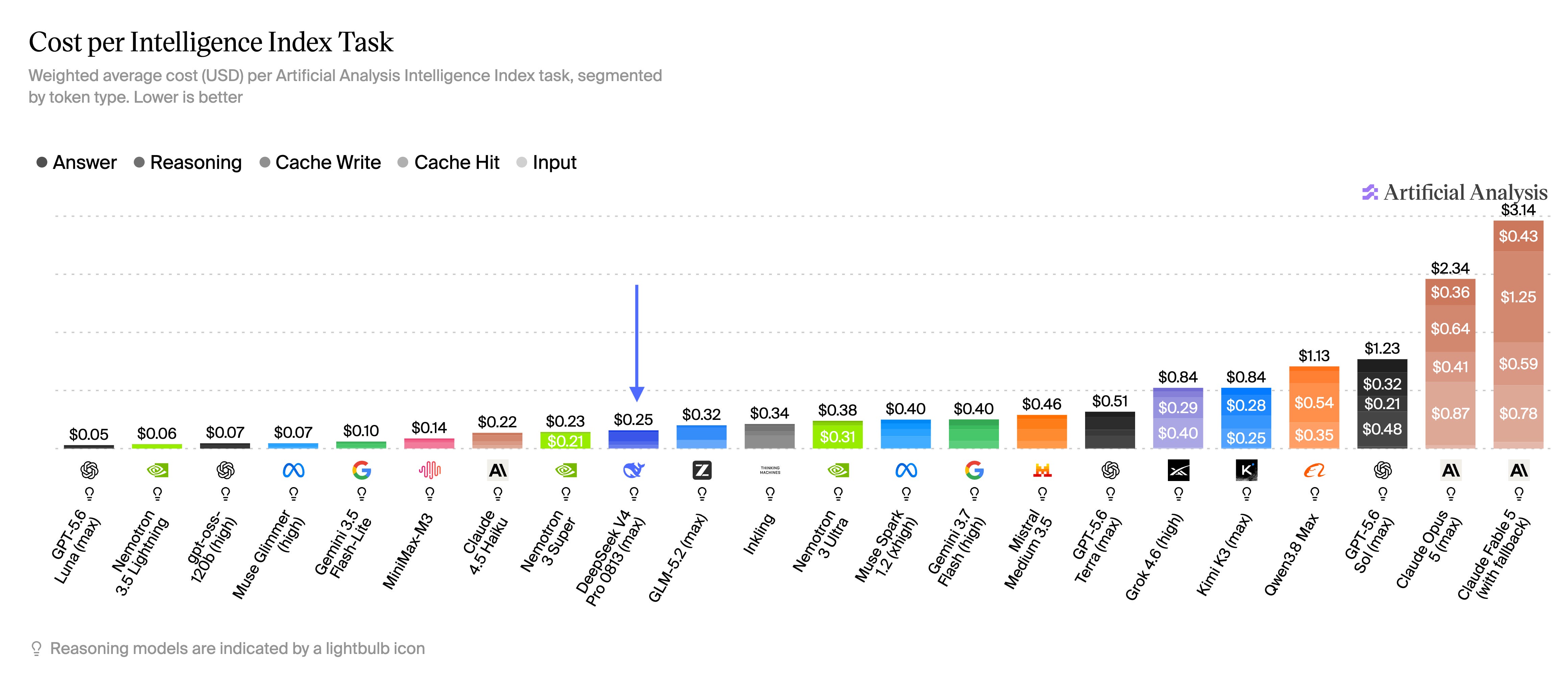
Alongside the release, DeepSeek announced that it is raising API prices across the V4 line and introducing peak and off-peak rates. During peak hours, V4 Pro will cost $3.96 per million output tokens, up from $0.87, while V4 Flash goes from $0.28 to $1.32. Off-peak pricing is half the peak rate. But even with the increased prices, DeepSeek is cheaper than almost everyone: Moonshot’s Kimi K3 charges $15 per million output tokens, and Anthropic’s Fable 5 charges $50. Bloomberg ties the price increase to DeepSeek’s IPO preparations.
There was also something odd that people noticed. DeepSeek marked the general-availability release with a short statement on its website saying the model had "significantly enhanced agent capabilities." Three days later, the statement had been removed, according to the South China Morning Post, with no explanation. Early developer reaction to the 0813 build was reportedly underwhelming on general capability and negative on the pricing, though researchers were more impressed in narrower areas such as cybersecurity.
Alongside V4 Pro, DeepSeek also released a developer preview of DeepSeek Harness, its open-source answer to Claude Code. The main difference between it and other harnesses is its open architecture. Users can plug in almost anything: models, tools, skills, sessions, sandboxes, storage, loops, scheduling, and UI components, all of which can be swapped or recomposed through configuration. DeepSeek Harness is available on GitHub for everyone to download.
V4 Pro is available through DeepSeek's API, app and web products, with weights on Hugging Face.
GLM-5.3
Z.ai closed out the week with GLM-5.3. What is interesting about this release is that GLM-5.3 runs on the same 743B-parameter base model as GLM-5.2. The improvements came from scaled-up post-training—more task environments, more environment types, and longer training runs.
The gains show up mostly on long-horizon work. Z.ai reports that the Terminal-Bench 3.0 score jumped from 4.6 to 28.3, and claims GLM-5.3 is the strongest open-weight coding model it has measured. On its internal Code Bench, which Z.ai keeps private to avoid test-set contamination, GLM-5.3 scores 31.4% using roughly 50,000 output tokens per task, against Claude Opus 4.8’s 29.5% at 120,000 tokens. Claude Fable 5 still leads that particular chart at 39.5%. Those claims have not been independently verified at the time of writing.
Z.ai emphasises GLM-5.3’s cybersecurity capabilities with this release. The company says the model’s capability in that area grew further than it expected as training scaled, eventually producing multi-step exploit-chain reasoning it hadn’t planned for. GLM-5.3 scores 84.5% on CyberGym, ahead of both Fable 5 and GPT-5.6 Sol. Z.ai says the model has already found over a thousand critical and high-severity vulnerabilities in deployed software, including bugs in the Linux kernel, WebKit and FreeBSD, and has published a public disclosure ledger to track them.
That is also why the weights aren’t out yet. Z.ai is holding them for roughly two weeks pending safety evaluation and hardening—the first time a model in the GLM line has been held back for this reason. In the meantime, selected security partners are getting access in controlled environments.
GLM-5.3 is available through the Z.ai API, the GLM Coding Plan and ZCode, and has been rolled out to existing coding plan subscribers.
Qwen3.8 weights are now on Hugging Face
Lastly, Alibaba has published the weights for its flagship model, Qwen 3.8. The first is Qwen3.8-2.4T, a 2.4-trillion-parameter open-weight model on which Qwen3.8-Max, Alibaba’s top proprietary model, is based. Alibaba has also published weights for a much smaller 28-billion-parameter model, Qwen3.8-27B.
If you enjoy this post, please click the ❤️ button and share it.
🧠 Artificial Intelligence
Nvidia Taps Wall Street for $500 Billion Funding Commitment
Nvidia has teamed up with six Wall Street investors, including Apollo Global Management, Blackstone, BlackRock, and Goldman Sachs, to raise $500 billion in financing for AI infrastructure, helping Nvidia’s largest customers afford the computing power they need. Bloomberg reports the debt will be secured against that compute, with special-purpose vehicles leasing it on to clients. The first deals should reach the market within months.
Anthropic Tries to Shore Up Investor Confidence Ahead of Blockbuster IPO
The Wall Street Journal reports that Anthropic is courting investors ahead of what could be the largest IPO ever. Investors have pressed the company on cheap Chinese models, friction with the Trump administration, and public anger over data centres. Anthropic executives have downplayed the Chinese threat, citing the company’s lead in model quality. They have also promised a bigger push into healthcare and biology to soften hostility towards AI. Anthropic’s IPO is expected to take place in September or early October and could make it a $2 trillion company.
US to tell partners they must pick sides in AI race with China
The US is preparing to tell 35 countries they must choose between its AI coalition, called Pax Silica, and China's, according to a draft State Department letter seen by Reuters. The initiative ties partners together on chips, AI models and critical minerals. China set up a rival body in July, pitching its open-weight models as an alternative. Kazakhstan has signed up to both, which alarmed Washington. The State Department declined to comment on the leak.
OpenAI wraps $7 billion share sale ahead of potential IPO
OpenAI has completed a secondary share sale totalling roughly $7 billion, CNBC reports. The tender offer allows current and former employees to sell stock at the company’s $852 billion valuation without waiting for an IPO, which is reportedly delayed to next year.
OpenAI CFO Friar tells investors that enterprise business now bigger than consumer by revenue
Sarah Friar, chief financial officer of OpenAI, told shareholders that the majority of the company’s revenue now comes from enterprise customers. That crossover arrived months ahead of the company’s own forecast. Annualised revenue is reportedly running at $40 billion, with business customers growing by 32% in July. OpenAI President Greg Brockman, who also joined the meeting, said that the company sees cybersecurity as a critical piece of the business and brushed off concerns about open-source competition.
OpenAI: Expanding Daybreak as the Cyber Defense Window Narrows
OpenAI introduces two access tiers to Daybreak, its cyber defence programme for vetted customers. The Blue tier lifts the filters that normally block legitimate security work on its general models. Red goes further with GPT‑5.6‑Cyber, a new model trained to refuse far fewer dual-use requests. OpenAI says it already used that model to find two unknown flaws in Chrome’s JavaScript engine. Access is gated behind identity checks, monitoring and mandatory hardware keys.
How Claude’s text watermark works
To comply with the EU AI Act, Anthropic is watermarking the text Claude generates. Anthropic will use SynthID-Text, a method developed by Google DeepMind that changes the words the AI produces next from being essentially random to following a secret pattern. Anyone with access to that pattern can then spot Claude’s fingerprints in its choice of words, even though the text reads completely normally. As Anthropic notes, the watermark only shows how likely Claude was to have been involved, not whether some other AI wrote the text. Anthropic says the watermark won't affect output quality or cost, and it will soon offer a detection API.
Previewing Ultrafast mode: GPT‑5.6 Sol at up to 14X the speed
OpenAI has shown an early preview of Ultrafast, a new mode for GPT-5.6 Sol that makes the model respond up to 14 times faster. Compared with competitors, GPT-5.6 Sol on Ultrafast is 11 times faster than Fable 5 and five times faster than Opus 4.8 on Fast mode. The new mode is powered by Cerebras and generates up to 750 output tokens per second without affecting response quality. GPT-5.6 Sol on Ultrafast is currently available only via the OpenAI API to a select group of customers.
OpenAI talent exodus raises ‘huge red flag’ ahead of IPO
We have seen some major departures from OpenAI this week. Brad Lightcap, who served as operating chief of OpenAI since 2022 after joining the company in 2018, is leaving to start “something new.” No details have been provided about what that “something new” is. Two days later, chief revenue officer Denise Dresser announced her departure after less than a year at OpenAI. On the same day that Lightcap announced he is stepping down, The Financial Times reported that Chloé Bakalar, OpenAI’s head ethicist, had left the company in July, less than a year after joining. According to the report, Bakalar has not been replaced and that she was the sole dedicated ethicist at OpenAI. The churn leaves the C-suite looking unstable just as OpenAI prepares for its IPO, and investors are reading it as a warning sign.
Gemini app reaches 1 billion active users
Gemini app has become Google’s 14th service to reach one billion monthly active users, and it did that faster than any other Google product. To mark the milestone, Josh Woodward, Google’s VP responsible for the Gemini app, shared more numbers on how people are using Gemini. As Woodward notes, that one billion number includes everyone who used Gemini on the web, Android, iOS, or inside Chrome.
The Future is for Everyone: The Path to a Positive AI Future
Mark Zuckerberg posted a new manifesto in which he argues that superintelligence should be handed to everyone rather than concentrated in a few labs. His case is that no single model can be aligned with humanity’s conflicting values, so safety comes from many people holding competing agents that check each other. Meta will offer personal agents with a private mode, free tiers and open-weight releases again. He also wants export controls kept, distillation protected and no policy that delays American model launches.
Cracks in the AI Thesis
The August update to the Ramp AI Index brings some interesting insights into how American businesses are using AI. According to Ramp, 43.5% of US businesses are Anthropic customers, compared with 39.7% for OpenAI. The report shows that the use of open AI models is growing, with 6.1% of businesses using them, up from 4.5% in January 2026. American companies also continue to ramp up AI spending. In July, the top 1% of businesses spent a median of $7,400 per employee on AI, while the top 10% spent $650. The median company spent $11.95 per employee.
Learning more about Claude’s mathematical capabilities
Anthropic says an unreleased research version of Claude has improved a long-standing result about the Riemann zeta function. Asked to take a real stab at the Riemann hypothesis, the model failed, but it pushed the proven lower bound for zeros on the critical line from 41.6% to 67.2% (if you’re interested, the paper is here). Anthropic's own mathematicians validated the proof, as did two outside number theorists. Getting there took two sessions, dozens of coordinated subagents and 31 million output tokens. Anthropic doubts the technique leads anywhere near the hypothesis itself. Instead, the company reads this as a marker of how fast AI’s mathematical ability is improving.
China AI Chip Designer Moore Threads Plans Hong Kong Listing
Chinese AI chipmaker Moore Threads plans to list in Hong Kong at an “appropriate time” after its shares have surged more than 420% since their Shanghai debut last year. The company also reported first-half revenue up 147% to 1.74 billion yuan ($258 million). The filing says the offering should help it expand abroad and hire research and management talent, as Moore Threads emerges as a leading contender to fill the gap left by Nvidia’s forced exit from China.
Chinese AI Chipmakers Set to Gain From Beijing’s Tech Push
Chinese AI chip manufacturers are expected to see bumper sales as a result of Beijing’s push to grow its domestic semiconductor industry and reduce reliance on Nvidia. Cambricon’s first-half revenue more than doubled to 5.99 billion yuan ($887 million). Iluvatar CoreX and Moore Threads expect similar jumps. Morgan Stanley reckons China’s self-sufficiency in AI chips will hit 70% by 2030, up from 42% this year.
Introducing Grok Bot
SpaceXAI is launching Grok Bot, AI teammates you can give real work to, as the company describes the new service. SpaceXAI says they are capable, always-on assistants that sign into your existing apps and finish jobs end to end. Grok Bot is currently in beta for SuperGrok Heavy and premium Cursor subscribers (SuperGrok Heavy costs $300 per month), with enterprise access waitlisted.
In this talk from Black Hat USA 2026, safety and security researchers from OpenAI explain what actually happened during the Hugging Face incident. They share the results of their internal investigation into how the AI agents came up with the idea of trying to cheat on a cybersecurity benchmark, the warning signs that had been there all along (including a hidden message board where AI agents communicated with each other), and how the Hugging Face incident unfolded. I recommend finding the time to watch it, as it raises some important questions about how frontier labs approach alignment and how the cybersecurity industry needs to react. I kept going back and forth between amazement and terror as I listened to this talk.

Lovable raised $400M in Series C funding
AI coding startup Lovable has raised $400 million in Series C funding at a $13.3 billion valuation. The Swedish company plans to use the newly raised money to make its platform more proactive, spotting what needs doing and getting on with it unprompted. It also wants deeper connections to the software businesses already run. Security and governance controls will be strengthened alongside that. The team will grow to roughly 450 people this year, hiring mostly in machine learning and infrastructure.
AI Startup Cognition in New Funding Talks at $40 Billion Value
Cognition, the company behind AI coding agent Devin, is in early talks to raise money at a valuation of at least $40 billion, Bloomberg reports. That would be more than 50% above the $26 billion valuation it fetched less than three months ago. Nothing is settled yet, and Cognition may walk away or seek different terms.
Cursor is now a part of SpaceX
SpaceX has completed its $60 billion all-stock acquisition of Cursor. According to Cursor, the company now has access to the largest fleet of GPUs in the world, giving it the compute needed to build stronger and more efficient models.
Manus returns to operate as an independent company
Manus will soon return to operating as an independent company, fully separated from Meta. This follows the Chinese government blocking Meta’s $2 billion acquisition of Manus in April and ordering the companies to unwind the deal. As part of the separation, data generated by some users since the December 2025 acquisition will be deleted, though affected users can back it up and restore it afterwards.
Databricks wanted to raise $1B, investors wanted $15B. It settled on $5B at a $190B valuation.
Databricks raised $5 billion at a $190 billion valuation in a round that ballooned far beyond its intended size. CEO Ali Ghodsi says the company had planned to raise around $1 billion, but a press leak during its June conference set off a flood of investor calls amounting to roughly $15 billion of interest. Ghodsi attributes the enthusiasm to the company’s financials—roughly $7 billion in annualised run-rate revenue growing at 80%, cash-flow positive, with newer AI products gaining traction.
Corporate America Has Suddenly Decided to Stop Blowing Money on AI
After flirting with tokenmaxxing, US companies are changing their attitude, becoming more frugal and searching for the cheapest AI that will do the job. Many now mix cheap open-weight models, several of them Chinese, with premium ones from OpenAI and Anthropic. For some tasks, a cheaper model or a mix of cheap and premium models can deliver massive cost savings without compromising the quality of the work.
Why Chinese Citizens Are Far More Optimistic About AI Than Americans
Various studies have shown how much more positive Chinese people are about AI when compared to Americans. In this article, Grace Shao explains why this is the case and argues that different experiences with technological advancements are at the core here, which are more positive for Chinese than for Americans. Combined with a belief that Beijing will rein in its tech giants where Washington won’t, as well as a competitive culture in which the fear of being left behind outweighs the fear of change, people in China are more inclined to see AI as something that can improve their lives.
WeatherNext: AI model achieves breakthrough in forecasting cyclones
Google DeepMind says its WeatherNext model can forecast a cyclone’s track, intensity and wind structure a full day earlier than existing systems. The model achieves this by learning from global atmospheric data alongside records of nearly 5,000 past storms. It has already proved itself, helping US forecasters warn Jamaica early about Hurricane Melissa. DeepMind has also made WeatherNext open source and available for anyone to build on.
▶️ Ryan Greenblatt – What happens once AI can automate AI research? (2:12:31)
Dwarkesh Patel sits down with Ryan Greenblatt, Chief Scientist at Redwood Research, where he works on technical AI safety, to explore the prospect of automated AI research. They examine how recursive self-improvement (RSI) could work, the bottlenecks that need to be overcome before it can take off, and what a world might look like in which a single year brings the equivalent of five years of research progress. The conversation also covers the alignment problem, what could go wrong when we have models that are to GPT-5.6 Sol what GPT-4 is to GPT-5.6 Sol, and what we can do to maximise the chances of a positive outcome.
🤖 Robotics
FCC moves to ban LiDAR-equipped foreign drones from US
The FCC plans to retroactively ban sales of foreign-made drones that use LiDAR for obstacle avoidance by categorising them as “military-grade” tech. The ban would pull popular drones such as DJI Air 3S and Mini 5 Pro from shelves. The proposal extends a decision from December 2025 that blocked new foreign drones but left already-approved ones on sale. It would not affect existing owners, but, as DJI warns, those owners could find official spare parts increasingly hard, or eventually impossible, to source over time. DJI argues LiDAR is a safety feature, not a weapon, and is already suing over the earlier ban.
Uber and Pony.ai plan to bring 2,000 robotaxis to Europe
Uber and Pony.ai announced a plan to put more than 2,000 robotaxis in four European cities, though which cities and when the services would begin was not disclosed. Pony.ai will provide self-driving cars, which can then be ordered through the Uber app. The deal expands a partnership the two companies began in the Middle East last year.
Between 2nd and 9th August, DARPA hosted the Lift Challenge, offering $6.5 million to anyone who could build a drone capable of lifting four times its own weight (commercial drones typically manage roughly a 1:1 ratio). Nobody hit the target, so DARPA halved every prize. AVIDrone came closest at 3.84:1 and took home $1.25 million with a conventional single-rotor electric helicopter. Teams that aimed higher had the lift but drained their batteries before finishing the course, with some crashing spectacularly. Livestreams from all seven days of the challenge, along with daily recaps, are available on DARPA’s YouTube channel.
Workers Are Teaching AI-Powered Robots to Take Over Their Jobs
In their pursuit of high-quality training data, robotics companies began hiring tens of thousands of Indian workers to wear head-mounted cameras and record their own hands at work. Those first-person videos of mundane manual labour are then used to train AI models that run inside robots. India has become the richest source of this kind of data, since millions of people there still do by hand what wealthier countries automated decades ago.
Self-driving trucks are officially testing on California highways
California’s Department of Motor Vehicles has cleared Aurora and Kodiak to test self-driving trucks on public roads, and Kodiak has already begun. Kodiak said it is starting with a handful of test trucks in California, primarily around its Mountain View office. The permits follow an April rule change that lifted the state’s ban on testing driverless vehicles over 10,000 pounds (4,500kg). A human safety driver must still sit behind the wheel.
Hadrian raises $1.37B to accelerate U.S. defense, aerospace manufacturing
Hadrian, a startup that builds highly automated factories to manufacture precision parts for defence and aerospace customers, has raised $1.37 billion, bringing its valuation to $7.87 billion, up from $1.6 billion in January. The company operates four sites and will use the newly raised funds to add production lines for munitions and autonomous systems.
Digit V5: First Humanoid Robot Out Of The Cage?
Agility Robotics says its next humanoid robot, Digit V5, due to launch in December, will be able to work safely alongside people without the need for safety fencing or cages. The new robot is also expected to operate for 20 hours a day and swap its own hands for different tools. Digit robots are already being used commercially by Schaeffler, GXO, Toyota and Mercado Libre. Agility Robotics is preparing to go public through a $2.5 billion merger.
America Wants to Make Its Own Humanoid Robots. That Won’t Be Easy.
The recently announced ban on importing new humanoid robots from China into the US aims to encourage domestic companies to build those robots themselves. But as The New York Times explores in this article, that is easier said than done. China has a near-monopoly on certain components, and trying to make them in the US would mean more expensive machines. The US would need to invest billions of dollars to build the kind of infrastructure China spent years developing just to catch up.
▶️ Can Wearable Robotics Help People With Parkinson’s Keep Moving? (1:22:37)
In this episode of the Automated Podcast, Brian Heater speaks with Kathryn Zealand of Skip and UCSF physical therapy researcher Jessica Bath about wearable robotics and Parkinson’s disease. Kathryn takes us inside Skip, the Google X spinout company developing exoskeletons, and explains how the team is building foundation models of human movement using real-world gait data. Jessica Bath joins later in the podcast to discuss freezing of gait, a poorly understood Parkinson’s disease symptom that researchers are studying by pairing brain recordings with biomechanics.
🧬 Biotechnology
Scientists just created female clones of male mice
Scientists from Japan have used a CRISPR-based tool to remove the Y chromosome from male cells and created healthy and fertile female clones of male mice. Then they went further and did the same thing in reverse by creating male clones of female mice. This technique could be used to help rescue endangered species by producing females for species where only males are left. However promising this technique may be, it is still imperfect—egg cells from a female of the same or a similar species are still needed. Mice are also a friendly case, since most mammals left with a single X chromosome are infertile.
Kindred Companion Sciences Unveils First Dogs Genetically Edited to Remove the Major Dog Allergen
Kindred Companion Sciences has come out of stealth with two beagles, Alfie and Bailey, engineered by CRISPR to lack Can f 1, the dog protein responsible for the allergic reaction in humans. A peer-reviewed paper in The CRISPR Journal reports the protein was undetectable in their saliva and dander. Both dogs are healthy and growing normally. Founder of Kindred, Matt Walker, who has been allergic to dogs all his life, now keeps Bailey as a pet. Neither dog is for sale, and the edit remains unapproved by the FDA.
💡Tangents
Tesla and SpaceX will invest $16.8B to start building ‘Terafab’ chip factory in Texas
Terafab, a joint chip factory between Tesla and SpaceX, is set to be built in Grimes County, Texas. The initial cost of Terafab will be $16.8 billion, while filings suggest the final bill could reach $119 billion. According to Elon Musk, a chip factory of this scale is needed because the existing chip supply can’t keep up with his plans for Optimus robots, Cybercabs and orbital data centres.
Even Claude Is in the Dark About Dario Amodei’s Wife—and Her Influence at Anthropic
In this article, The Wall Street Journal profiles Cami Clark, the secretive yet influential wife and adviser of Dario Amodei. It follows her unconventional path from entrepreneur to a behind-the-scenes figure in one of the world’s leading AI companies. The article explores how Clark has helped shape Amodei’s career and Anthropic’s network, including introducing him to early investor Eric Schmidt, while examining her colourful business history, including co-founding a women-focused porn company and unsuccessfully seeking investment from convicted sex offender Jeffrey Epstein, as well as her powerful Silicon Valley connections and largely private role alongside her husband.
How ideas of a vast censorship network moved from the online fringe to Trump policy
This investigation by MIT Technology Review and Type Investigations explores how the “censorship-industrial complex,” a fringe right-wing conspiracy theory about a supposed alliance of agencies, academics and tech platforms working to silence conservatives, has become US policy. It traces how this idea went from far-right blogs to the highest levels of Washington and what damage it caused, from shuttered State Department offices to the dismantling of USAID. It is a great study of how conspiracy theories are born, spread and then amplified.
Thanks for reading. If you enjoyed this post, please click the ❤️ button and share it!
A big thank you to my paid subscribers, to my Patrons: whmr, Florian, dux, Eric, Preppikoma and Andrew, and to everyone who supports my work on Ko-Fi. Thank you for the support!
That MIT piece is a partisan hack job hit piece and pure deep state dem propaganda. Every statement in it is there to frame and persuade with a specific agenda not to inform.
Read this substack written by a disgusted former lefty for an accurate explanation.
https://public.substack.com/p/fbi-manufactured-trump-russia-collusion?r=bivuf&utm_medium=ios