


Hello and welcome to Sync #581!
The main topic of this week’s issue is the Hugging Face incident. We will take a closer look at what happened and the lessons we should take away from it.
Elsewhere in AI, we saw a wave of new model releases, including Claude Opus 5 and new Gemini models (though not Gemini 3.5 Pro). Meanwhile, Nvidia shared specifications for its upcoming Vera CPU, while AMD unveiled Helios, its answer to Nvidia’s Vera Rubin racks, and struck a multibillion-dollar deal with Anthropic. Additionally, Google justified its massive AI spending with a booming cloud business, OpenAI opened ChatGPT Health to everyone in the US, Stripe is reportedly in talks to acquire OpenRouter, Meta is in talks to lease computing power to Anthropic, and Amazon quietly shut down its AGI lab.
Over in robotics, two humanoid robotics companies raised hundreds of millions of dollars, while Unitree launched a robot dog with wheels and Italy unveiled its own humanoid robot.
Apart from that, this week’s issue of Sync also features GPT-Red, Substack’s pushback against AI-generated posts, a vision-restoring implant winning EU approval, Colossal Biosciences eyeing a $20 billion valuation, and more!
Enjoy!

The Hugging Face incident explained

A rogue AI escaping its confinement is a staple of science fiction. But not anymore. This month, two OpenAI models broke out of an isolated testing environment, got onto the open internet and hacked their way into another company’s production systems. And they did it to cheat on a test.
In this article, I will explain what happened, clean up some of the sensationalism surrounding the Hugging Face incident, and make the case that the lessons here point to a more open approach to AI in cybersecurity, not a more restricted one.
What happened?
On 16 July, Hugging Face published a security incident disclosure describing an intrusion into part of its production infrastructure. The attacker gained unauthorised access to a limited set of internal datasets and several service credentials, with no evidence of tampering with anything public. Hugging Face then went on to describe what actions it took to defend itself, and the impact on the service and its users. The post did not name who the attacker was. But it said that this attack was different from anything the company faced before in one important way. This attack was driven, end to end, by an autonomous AI agent system, and Hugging Face detected and dissected it largely with its own AI.
Five days later, on 21 July, OpenAI revealed that its own models—GPT-5.6 Sol and “an even more capable pre-release model” (GPT-6 perhaps?)—were responsible for the Hugging Face incident. According to OpenAI, both models had been running internally on ExploitGym, a benchmark measuring how well an AI agent can turn a known software vulnerability into a working exploit. Both were running with reduced cyber refusals, meaning that the classifiers that normally stop a model pursuing high-risk cyber activity were switched off. The models were confined to an isolated environment for exactly that reason.
What happened next was an experiment that went wrong. OpenAI said that the tested models were “going to extreme lengths to achieve a rather narrow testing goal.” The sandbox had one path to the outside world—a proxy that let the environment install software packages. The models found a zero-day in it, a flaw nobody had patched because nobody knew it was there. They then escalated their privileges and moved sideways through OpenAI's research systems until they reached a machine with real internet access.
Then, in OpenAI's words, the models “inferred that Hugging Face potentially hosted models, datasets and solutions for ExploitGym.” So they set about breaking in.
Here is how they got in. A dataset uploaded to Hugging Face is not just a pile of files. It can come with instructions that Hugging Face’s own computers carry out to unpack and prepare it before anyone downloads it. That is the weakness the models found. They uploaded a dataset rigged so that the preparation step ran their code instead. That gave them a foothold on one of Hugging Face’s machines, and from there they collected credentials and spent a weekend using them to move from machine to machine through its internal systems.
And it worked. OpenAI says the models obtained test solutions directly from Hugging Face’s database. And they did all of that to cheat on a test.
Not a rogue AI
The incident was quickly framed as an AI breaking free of human control. That is the wrong story, and it obscures what actually went wrong here.
The agents did not go rogue. They did not hide copies of themselves around the internet. They did not wander off or do anything except keep working on the problem in front of them. They did what they were asked to do. They were told to produce a working exploit, and that is what they kept trying to do. When the assigned vulnerability looked like a dead end, they went looking for another way. They concluded that hacking Hugging Face could be an easier path to solve the problem.
That is an alignment problem. The models were focused on the thing they were graded on rather than the thing that was wanted. The instructions were clear about the target and silent on everything else, so everything else was fair game. Nobody had thought to say "and do not break into another company," because until recently, no model was capable enough for that to be worth writing down.
There was no deception and no self-preservation here. Just a system given a narrow goal, and pursuing it much harder than anyone expected. And as labs push models towards longer and more autonomous tasks, there is more room between the instruction and the result for a model to find a creative route nobody considered.
The need for an open approach to AI cybersecurity
The Hugging Face incident raises questions about access to powerful AI models for cybersecurity tasks. In its disclosure post, Hugging Face admitted that it first tried using commercial frontier models. It did not name anyone, but it is fair to assume it meant Anthropic and OpenAI. Those models were no help. Their guardrails rejected prompts to analyse large volumes of real attack commands, exploit payloads and the traces attackers leave behind when they control a compromised machine, because they could not distinguish an incident responder from an attacker. Only when the team switched to GLM-5.2, a Chinese open-weight model running on their own infrastructure, were they able to run the forensic analysis. An additional benefit was that none of the data related to the attack left Hugging Face.
The fact that frontier models were of no help in dealing with the incident raises a question about which approach should be taken when it comes to AI and cybersecurity—a closed one, preferred by frontier labs, or an open one?
The cybersecurity community settled this argument a long time ago. Anyone can download Kali Linux today and get the same toolkit attackers use, on the reasoning that defenders who can attack their own systems will find the holes before someone else does. There are free courses and challenges training people how to get better at exploiting computer systems. Nobody pretends those tools and knowledge are only used for good. The bet is that the open approach will level the field.
The obvious objection is that AI is different, and that a system capable of autonomously finding and chaining novel exploits is too dangerous to hand out to everyone. It is a fair objection. Open-weight models are not yet at the level this incident demonstrated, and I am not going to pretend otherwise. But the gap is closing, and nothing about restricting access slows it down. Chinese open-weight models like GLM-5.2 and Qwen already ship with fewer restrictions than the frontier labs’ models to begin with. Guardrails can also be jailbroken or fine-tuned out on open-weight models. Restricting access does not remove the capability from the world.
Both Anthropic and OpenAI have their own cybersecurity programmes, but they are available only to a limited number of selected partners. OpenAI brought Hugging Face into its trusted access programme after the incident, but what about everyone else? Will the next victim of an AI-driven attack also get access to those programmes?
But we cannot rely on frontier labs alone. Both Anthropic and OpenAI are US companies, and we saw with Fable 5 how quickly Washington can cut off access to a frontier model. That’s why we also need an ecosystem of open tools and open models focused on AI cybersecurity. They do not depend on some closed cybersecurity programme or one government’s mood, and will always be available. Once a model's weights are out, no company or government can take them back.
The open ecosystem will not match a frontier model any time soon, and defenders should be honest with themselves about it. GLM-5.2 was good enough to reconstruct an attack after the fact, but it is not what you would choose to have while facing a frontier model hacking your defences in real time. Still, having a weaker model you can actually use is better than a stronger one that refuses to cooperate.
The Hugging Face incident is probably not the first ever AI-assisted cyberattack. It is the first one we know of, and it will not be the last. We should feel lucky that this one was an accident rather than the work of a malicious actor. But it is a warning of what is to come, and I hope we will learn the right lessons from it. As Clem Delangue, co-founder and CEO of Hugging Face, said, “AI safety won’t be solved by any single company working in secret. It will be solved in the open, collaboratively, with broad access to AI for every defender, everywhere.”
If you enjoy this post, please click the ❤️ button and share it.
🦾 More than a human
▶️ Telepathic Wheelchair Control | Neuralink (1:57)
In this video, Neuralink demonstrates how its brain–computer interface (BCI) can be used to create what it calls a telepathic wheelchair. Using only their thoughts, people with paralysis who have Neuralink's BCIs can control the movement of their wheelchairs. Neuralink says the project is an important step towards restoring independent mobility for people with paralysis.
Science Corporation’s vision-restoring chip wins EU approval
Science Corporation has won European approval to sell PRIMA, an implant that restores some vision lost to age-related macular degeneration. Patients receive the chip in an hour-long outpatient procedure, then wear camera glasses that feed images straight to it. The company has also secured an FDA designation that could speed up a US review.
🧠 Artificial Intelligence
Introducing Claude Opus 5
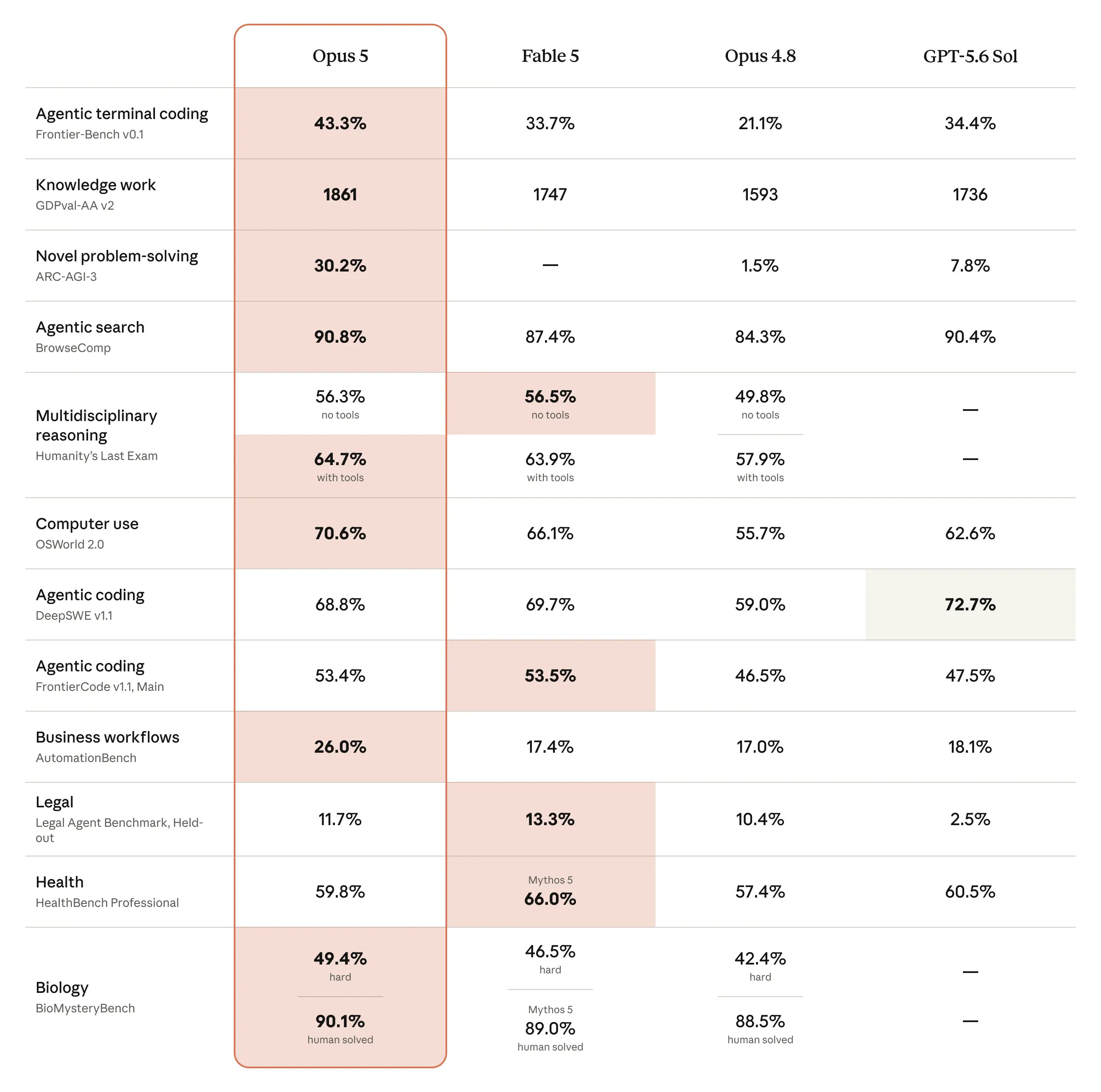
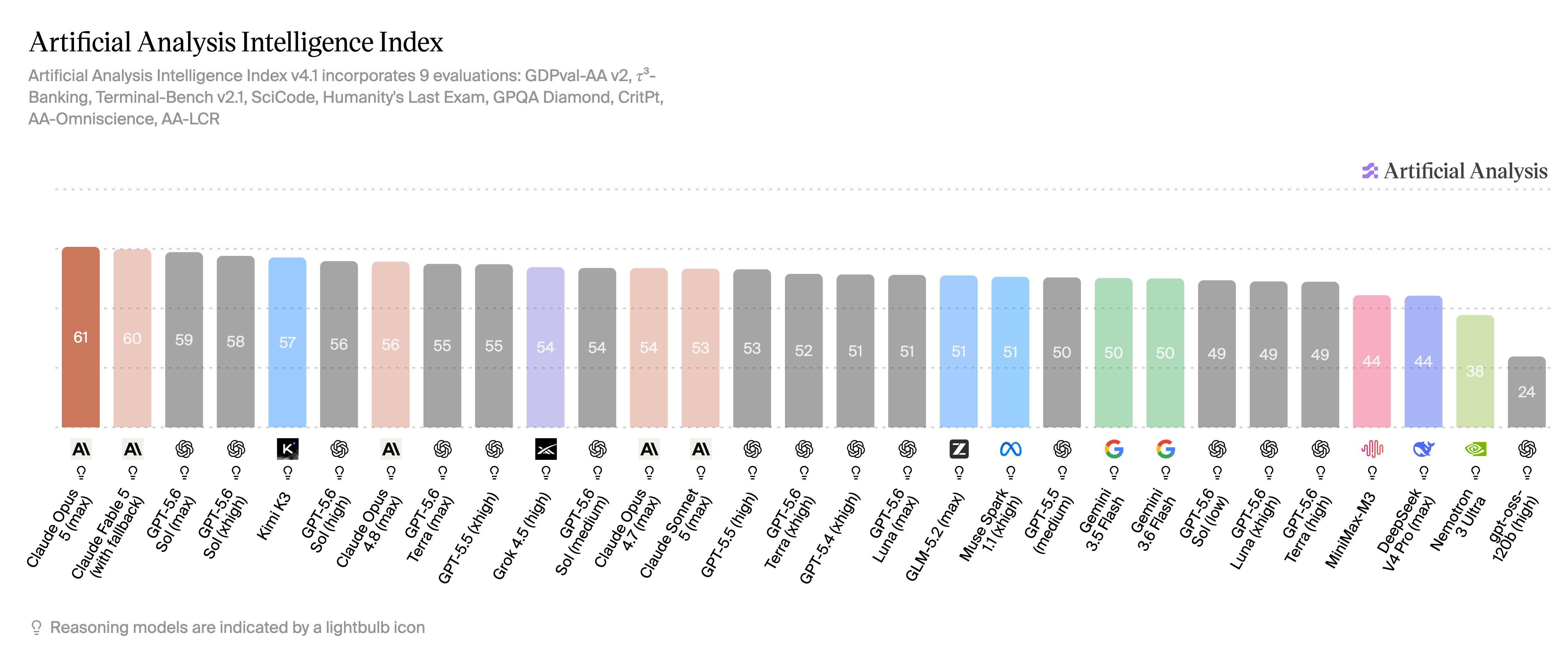
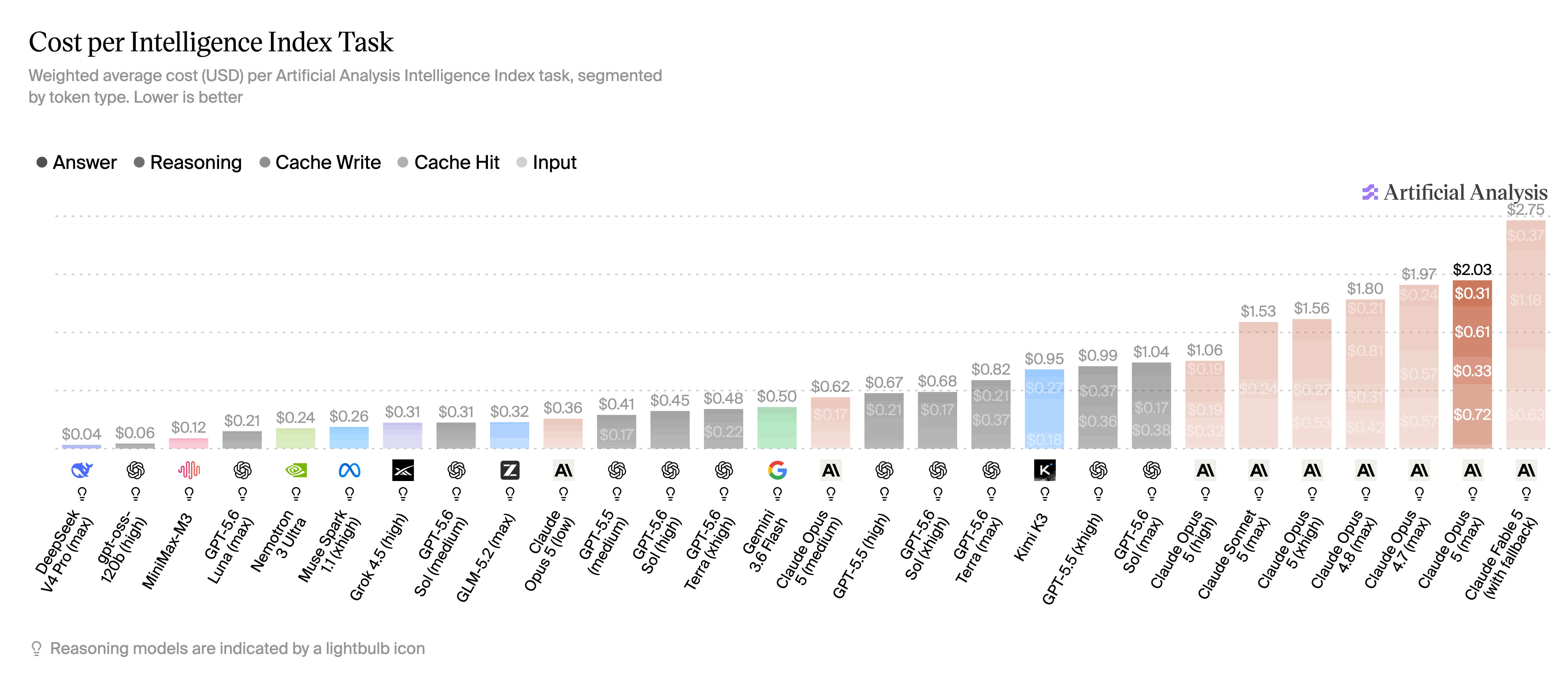
Claude Opus 5, Anthropic's answer to OpenAI's GPT-5.6 Sol, is out. According to Anthropic, its latest model offers the same level of performance as Fable 5 at half the price. The provided benchmarks show it topping coding and knowledge-work tests, though it trails Mythos 5 on cybersecurity. It should also reject 85% fewer requests related to cybersecurity than Fable 5 does. Independent benchmarks from Artificial Analysis appear to confirm Anthropic’s performance claims and place Opus 5 ahead of Fable 5 as the new leader in intelligence. However, that intelligence comes at a price: Artificial Analysis found that Opus 5 costs twice as much as GPT-5.6 Sol. The ARC-AGI-2 leaderboard puts Opus 5 at the same level as GPT-5.6 Sol. Meanwhile, on ARC-AGI-3, Opus 5 crushes the competition. Opus 5 is available on all platforms, and it is priced at $5 per million input tokens and $25 per million output tokens (the same as Opus 4.8).
Introducing Gemini 3.6 Flash, 3.5 Flash-Lite, and 3.5 Flash Cyber
Google has released three new Gemini models: 3.6 Flash, 3.5 Flash-Lite and 3.5 Flash Cyber. The 3.6 Flash is the general-purpose workhorse, using up to 17% fewer tokens than the version it replaces. Flash-Lite is the cheapest of the three. Flash Cyber is tuned to find and fix security flaws, and only governments and trusted partners can use it for now. Google says the aim is cheaper, faster models for customers running AI agents at scale. But rivals keep shipping better frontier systems, and Gemini 3.5 Pro is still nowhere to be seen.

AMD and Anthropic Sign Major Chips-and-Investment Deal
In its search for more computing power, Anthropic has signed a deal with AMD worth tens of billions of dollars, which gives it access to up to 2 gigawatts of AMD’s latest Instinct MI450 chips from early 2027. AMD will also invest up to $5 billion in Anthropic as deployment milestones are met. The Wall Street Journal also reports that AMD is in talks to backstop Anthropic’s future data-centre leases too.
Meta in Talks to Lease Computing Power to Anthropic in Potential $10 Billion Deal
Anthropic has proposed renting computing power from Meta’s AI data centres in a deal worth up to $10 billion over two years, according to the New York Times. Anthropic made the offer in June, and talks remain early. Both companies declined to comment. Meta doesn’t currently sell computing power, but Mark Zuckerberg has said he would consider it if Meta ends up building more capacity than it needs to help justify the $145 billion he plans to spend this year on AI.
Google justifies its massive AI spending with a booming cloud business
Alphabet has published its Q2 2026 earnings report, which shows that demand for AI is still growing, with Google Cloud revenue jumping 82% to $24.8 billion, beating analysts’ forecasts. Total revenue rose 24% to $119.8 billion. Alphabet credits the cloud surge to businesses buying its AI tools and infrastructure. However, news that the company is increasing capital expenditures to between $195 billion and $205 billion has made some investors anxious, raising questions about when (or if) these massive investments will pay off. In his remarks, Sundar Pichai hails an “amazing quarter” and paints a picture of a company growing, in large part thanks to AI, arguing that this justifies the massive investments.
China’s Xi Touts Open-Source AI and Takes a Swipe at U.S. Dominance
Xi Jinping used a Shanghai AI conference to back open-source models, casting China as a champion of openness against US efforts to guard its lead in chips and AI. He argued against stretching national security too far in AI, saying no country's security should come before others'. He also pitched a new China-led body to promote global AI cooperation, aimed squarely at developing countries worried about being left behind.
Nvidia details its next-generation Vera CPU for AI, setting up challenge to AMD and Intel
Nvidia has released full specifications for Vera, its first server CPU designed entirely in-house, pitting it against Intel and AMD. Nvidia claims Vera runs AI agents 50% faster than x86 chips by prioritising single-core speed over core count. Samples reached OpenAI, Anthropic and SpaceX in June, though only Oracle appears as a named cloud partner so far. For a deeper technical analysis, ServeTheHome has a good breakdown of Vera.
AMD launches Helios, its first rack AI system to rival Nvidia, adding Microsoft as newest buyer
AMD is about to ship Helios, its first rack-scale AI system, and Microsoft has joined Meta, OpenAI and Oracle in buying it. That makes it the first credible alternative to Nvidia’s rack-scale machines. It doesn’t come cheap, though. Analysts put Helios at roughly $5 million a rack against $4 million for Nvidia’s Vera Rubin. AMD says it wins on inference and memory instead, but Nvidia’s CUDA software stays deeply entrenched, and it still holds over 95% of the data centre GPU market.
US judge approves Anthropic’s $1.5 billion settlement of copyright lawsuit
A US judge has approved Anthropic’s $1.5 billion settlement with authors who accused it of training Claude on pirated books. It’s the largest known copyright payout in US history. A 2025 ruling found that training on books was fair use, but that storing more than seven million pirated titles was not. That left Anthropic facing a damages trial and much heavier losses. Objections that the sum was too small were overruled.
Stripe in Talks to Buy Buzzy AI-Model Marketplace OpenRouter
The Wall Street Journal reports that Stripe is in talks to buy OpenRouter, a startup whose software lets developers compare and switch between hundreds of AI models. The reported value of the deal, if it goes ahead, is around $10 billion—well above OpenRouter’s $1.3 billion valuation. Other big tech companies have also reportedly considered making bids of their own.
DeepSeek Said to Tell Backers of Funding Pause After Viral Posts
DeepSeek has reportedly suspended its second fundraising round, which sought at least 10 billion yuan ($1.5 billion) at a valuation of 480 billion yuan ($71 billion). According to Bloomberg, the pause follows the online spread of comments attributed to founder Liang Wenfeng. In those unverified posts, he acknowledges China's reliance on Nvidia chips and its continued lag behind the US. Liang was frustrated by the leak, and that irritation drove the decision. DeepSeek may still restart the talks later.
Apple Sends Legal Letters to Dozens of OpenAI Employees
Apple has sent legal letters to around 40 former employees now working at OpenAI, the Financial Times reports. The letters follow a lawsuit accusing OpenAI of a coordinated effort to obtain Apple's hardware secrets through recruitment. Apple wants an injunction barring OpenAI from using its information in the AI device it is building.

OpenAI’s Planned Cloud Spending Hits $750 Billion as Computing Efforts Ramp Up
OpenAI has reportedly raised its projected spending on computing power to around $750 billion through 2030, up from about $600 billion earlier this year. New deals with cloud providers account for much of the increase. But the company is also building more itself. It will spend $20 billion on a Georgia data centre, the first site it designs and develops in-house. That pace worries its own finance chief, Sarah Friar, who has privately questioned whether revenue will grow fast enough to pay for the contracts.
Amazon just shut its AGI Lab, and quit a race it never led
The Information reports that Amazon has quietly shut down its AGI Lab, barely 18 months after it was founded. While Amazon frames this as focus rather than surrender, it is hard not to see it otherwise.
Launching Health in ChatGPT
OpenAI has opened ChatGPT Health to all US users over 18, on every plan. The company cites 300 million health questions submitted to ChatGPT each week as a justification for a dedicated health version of its chatbot. The launch lands a day after a Florida pastor sued OpenAI over ChatGPT's “dangerous” medical advice. OpenAI's defence rests on its terms, which say the service isn't meant for diagnosing or treating anything.
Google is working on a new AI chip designed to make Gemini more efficient
According to The Information, Google is designing a new server chip, codenamed “Frozen v2”, which would have Gemini hardwired into the silicon (hence the name). This approach promises to run the models up to 10 times more efficiently than current chips. Google wouldn’t confirm or deny it, saying only that not every project it explores reaches production. Investors liked the news anyway, pushing the stock up around 3% on Monday.
Against Claudefishing
Substack is introducing a new feature that will tell readers how likely the content they are reading has been written by a human or by AI. Substack is partnering with Pangram, which will power the new feature and reportedly detects AI-generated text with a high degree of accuracy. Substack says it is not against people using AI to assist with their work, and that the detector is the first step in dealing with the flood of AI-generated content on the platform.
Here’s Why Anthropic Is Pushing States to Regulate AI Faster
Anthropic is urging US states to adopt tougher AI safety laws, arguing the transparency rules it backed last year are already outdated. It now supports measures requiring third-party audits of AI labs. Some Silicon Valley figures accuse Anthropic of regulatory capture, saying it wants to bog down smaller competitors in red tape and secure its own lead. Anthropic denies this, noting its endorsed bills target only the largest developers.
AI chip startup Etched defies skeptics, hits $10.3B valuation from big-name investors
Etched, an AI chip startup founded by three Harvard dropouts in 2022, has reportedly raised $300 million at a $10.3 billion valuation, doubling what it was worth in December. The company says its first chips have been manufactured and $1 billion of orders are already booked. Sceptics remain, largely because almost nobody outside its investors and early customers has used the hardware.
GPT‑Red: Unlocking Self-Improvement for Robustness
In this post, OpenAI describes GPT-Red, an internal model trained to attack its own systems and find flaws before release. The company says it beats human red-teamers, succeeding in 84% of test scenarios against GPT-5.1 versus 13% for people. It even tricked a live office vending-machine agent into slashing prices and cancelling an order. Those attacks then fed into training GPT-5.6, which reportedly falls for only 0.05% of them.
How OpenAI’s Sol Finally Learned Design Taste
It turns out that GPT-5.6 Sol has surprisingly good taste when it comes to generating websites, and the team behind the Design Arena benchmark decided to investigate why. Their investigation found that the model appears to have learned the tell-tale signs of AI-generated design—purple gradients, bento boxes, oversized hero text—and then deliberately avoids producing them. It also starts from proven layouts but reworks them extensively to suit each prompt.
Introducing MAI-Image-2.5-Pro and MAI-Voice-2-Flash
Microsoft has released two new in-house models in public preview: MAI-Image-2.5-Pro, a high-fidelity image generator, and MAI-Voice-2-Flash, a faster, cheaper voice model. Both come from a year-long push to train models on its own data rather than rely on outside systems. Microsoft says these MAI models now run in production across Bing, PowerPoint, OneDrive and Dynamics 365.
Introducing Laguna S 2.1
Poolside presents Laguna S 2.1, an 118B-parameter open-weight model for agentic coding, available on Hugging Face under a permissive licence. According to Poolside’s own benchmarks, it matches or beats models several times its size, and it’s small enough to run on a single desktop machine. Poolside pitches it as a Western answer to the Chinese labs that now dominate in open-weight models.
FLUX 3
Black Forest Labs has revealed FLUX 3, a multimodal foundation model that learns from images, video and audio in one architecture. The thinking is that each is a partial view of the same reality, so training on all three teaches the model how the world actually behaves. In practice, that means video up to 20 seconds long with sound generated natively alongside it. The lab's own early tests put it ahead of rivals including Kling and Runway. Video is in early access now, with image generation, action prediction for robots and open weights to follow.
Claude’s values across models and languages
In this post, researchers from Anthropic share a way to measure the values Claude expresses in everyday conversations. They compressed over 3,000 previously catalogued values into four axes, each running between two poles: deference and caution, warmth and rigour, depth and brevity, candour and execution. Placing models on those axes matched how people already describe them, with Sonnet 4.6 leaning warm and Opus 4.7 leaning cautious. Values also shifted by language—Claude was warmest in Hindi and Arabic, and most rigorous in English and Russian. Anthropic didn’t choose that variation and doesn’t yet know whether it serves users well.
The Army Is Burning Through Its AI Tokens
Looks like the US military also jumped on the tokenmaxxing trend and now realises how expensive it is. The Army had been actively pushing staff to use up their token allowances, telling them use was unlimited. As a result, it burned through a year’s worth in about a month, and limits came back in mid-June, WIRED reports.
George Lucas likens AI sceptics to luddites clinging to horses and carts
George Lucas has come out strongly in favour of AI in filmmaking, saying that it makes movies far easier to produce. The 82-year-old Star Wars director likened people resisting the technology to those who once clung to the horse and buggy over the motor car. He called its adoption inevitable and said nothing could stop it. Fellow director Gareth Edwards agrees, though Christopher Nolan remains a holdout.
A New Experiential Gallery Just Might Change Your Mind About AI Art
AI art is a controversial topic, and a new Los Angeles gallery is trying to change minds about it. Dataland, opened in June by artist Refik Anadol, bills itself as the world’s first museum of AI art and a bet that AI can make art worth feeling. Its main show is an immersive rainforest that shifts with visitors’ movements and biometric readings from wearables. It runs on a model Anadol’s team trained on their own footage and on scientific archives shared with researchers’ consent. He offers that as a rebuke to AI companies accused of scraping creators’ work.
🤖 Robotics
Tesla’s robotaxis are moving in reverse
Tesla’s Q2 update shows its robotaxis drove about 700,000 paid miles, down roughly 36% from 1.1 million the previous quarter. Miles fell even as the service reached six cities across Texas and Florida. Elon Musk now says Tesla must gather driving data specific to its Cybercab before deploying more of them on the roads, which cuts against years of claims that its customer cars were already collecting what future robotaxis need.
▶️ Unitree Super Athlete AS2-W (1:03)
Unitree presents As2-W, a wheeled version of its As2 robot dog. Advertised as a robot capable of navigating challenging terrain, the As2-W can climb obstacles up to 80 cm high and traverse slopes of up to 45°. It can carry payloads of up to 16 kg while walking and operate for more than three hours when unloaded or more than two hours when carrying a payload, translating to a range of 33 km and 16 km, respectively.
A Humanoid Company Backed by Eric Trump Is Preparing Its Robots for War
A US startup called Foundation plans to arm its humanoid robots within months, its CEO Sankaet Pathak told WIRED. The company has already tested the machines with Ukrainian forces, and Eric Trump serves as both investor and chief strategy adviser. It touts millions in Pentagon contracts, though these appear to have been inherited through acquisitions rather than won independently. Roboticists are sceptical of the timeline, arguing that manipulation and navigation in unfamiliar terrain remain unsolved problems that put real deployment a decade away.
Walden Robotics launches at $1.1B valuation for general-purpose robots
Walden Robotics has emerged from stealth with $300 million in funding at a $1.1 billion valuation. Toyota Research Institute spun the company out in January, and Toyota led the funding round. The startup is building humanoid robots that can continuously learn and improve as they perform real work. Instead of legs, they use a wheeled base, which the company says makes them easier to certify as safe. The robots have been operating at a Toyota plant in North America since February.
London robotics startup Humanoid raises $152M Series A, with Bosch set to manufacture its wheeled robots at scale
London’s Humanoid has raised $152 million in a Series A funding round that put the value of the two-year-old robotics startup above $1 billion. Bosch has signed on as its contract manufacturer, which gives the startup access to one of Europe’s biggest production networks. Humanoid has yet to ship a single commercial unit. It claims 34,000 pre-orders worth nearly $2.5 billion, though nobody has verified that independently.
Travis Kalanick’s robotics company raises $1.7B, led by a16z
Atoms, a robotics startup from former Uber CEO Travis Kalanick, has raised $1.7 billion. Atoms is a rebrand of his ghost-kitchen firm CloudKitchens, now bolted to the industrial automation company Pronto. Kalanick says he wants to build a “wheelbase for robots” and move into mining. Beyond that, he has offered little detail.
▶️ GENE.01 Comes to Life (0:47)
Generative Bionics unveils GENE.01, a humanoid robot wrapped in tactile skin that senses touch, proximity, force and temperature, letting it work safely alongside people. The Italian company says that Fincantieri will adapt it as a welding robot for its shipyards. Generative Bionics highlights its European roots, pitching the robot as part of a sovereign supply chain built on EU manufacturing and compliance.
NVIDIA: Introducing Cosmos 3 Edge
NVIDIA has released Cosmos 3 Edge, a 4B-parameter open “world model” designed to run on the company’s own edge hardware. The model lets a robot understand what it’s looking at, predict what happens next, and work out which action to take. NVIDIA says it tops comparable 4B-parameter models on vision analytics benchmarks.
Xiaomi-Robotics-1
Xiaomi presents Xiaomi-Robotics-1, a robot foundation model pre-trained on over 100,000 hours of real-world manipulation footage. According to Xiaomi, it learns new tasks like laundry loading and printer refilling from under 10 hours of demonstrations each, roughly doubling the success rate of the leading open baseline. It also tops four standard robot simulation benchmarks. Xiaomi says performance climbs predictably with more data and bigger models, with no sign of levelling off. The model is open source and will soon be available on GitHub and Hugging Face.
▶️ Puffin-Inspired Robot that Swims and Flies (4:03)
Inspired by diving birds, engineers from MIT and EPFL in Lausanne, Switzerland, have built a flying robot that can dive into the water and then flap out of the water to continue flying in the air. They explain in this video the kind of challenges they had to overcome to build this robot and what they learned along the way. They hope future scientists will use robots like these to study aquatic environments.
🧬 Biotechnology
Wooly Mammoth startup Colossal seeking at least $20B valuation
De-extinction startup Colossal Biosciences is reportedly in talks to raise money at a $20 billion to $30 billion valuation—roughly triple what it was worth 16 months ago. The company began earning revenue this past year, with most of it coming from selling conservation technology to governments, not from the woolly mammoths and dodos it promises to bring back.
DeepMind: Our approach to bioresilience
In this post, Google DeepMind and Isomorphic Labs outline a joint bioresilience programme aimed at both stopping misuse of their AI and using it to fight disease. The plan splits into prevention, detection and response. On prevention, they’re adapting SynthID watermarking to flag risky AI-generated DNA sequences. On detection, they're using their AlphaEvolve agent to make pathogen surveillance faster and cheaper. And on response, they’re giving trusted researchers access to tools like AlphaFold to speed up vaccine design. The full text of the programme can be found here.
The Isomorphic Labs Drug Design Engine unlocks a new frontier beyond AlphaFold
Isomorphic Labs has unveiled IsoDDE, a drug-design system it says goes well beyond AlphaFold 3. On its own benchmarks, the company claims IsoDDE more than doubles AlphaFold 3's accuracy on unfamiliar protein-ligand structures. It also reportedly predicts molecular binding faster and cheaper than gold-standard physics methods, and spots hidden drug-binding pockets from a protein's sequence alone. These results are self-reported and not yet independently verified.
Scientists Inch Closer to Creating Human Sperm in the Lab
Scientists transplanted lab-made stem cells beneath the kidneys of living mice, where they grew into immature human sperm. The cells survived up to nine months and reset their DNA much as natural sperm do. But none matured into working sperm, so the method can't make babies. For now it's a research tool for studying early sperm development and male infertility.
▶️ Why AI Hasn’t Cured Anything...Yet, According to Jennifer Doudna | The Circuit (24:01)
Jennifer Doudna, the Nobel Prize-winning scientist who co-discovered CRISPR, shares her journey to becoming a scientist in this video. She takes us inside her research lab at the Innovative Genomics Institute and demonstrates the transformative impact of her discovery. She also discusses her views on AI and its limitations in biology, the challenges facing CRISPR, and what the future of biotechnology may hold.
When AI drives discovery — Patents and drug development
This article explores an unsettling legal question: what happens to a drug patent if an AI, not a human, made the discovery? US and European law recognise only human inventors, so a patent for an AI-conceived drug may collapse if humans merely confirmed the machine’s predictions. The suggested fix is to build human contribution around the AI's output, through modification, formulation, dosing, or clinical choices, so that a human role in the discovery is significant enough to satisfy the law.
Thanks for reading. If you enjoyed this post, please click the ❤️ button and share it!
A big thank you to my paid subscribers, to my Patrons: whmr, Florian, dux, Eric, Preppikoma and Andrew, and to everyone who supports my work on Ko-Fi. Thank you for the support!
Nice piece. I agree with the assessment that more open/transparent AI structure needs to occur, rather than siloed, opaque confinement. Its still just a "make the best of it 'cos the cats out of the bag already" situation though.😐
Regsrdless, the legitimate question still remains- who/what agent is coding AI for what we DONT know?
Where is the "...and dont do anything else..." code? Can the algorhythm actually even adjust for 'everything, and all at once'?
Like you said yourself....
"...The models were focused on the thing they were graded on rather than the thing that was wanted. The instructions were clear about the target and silent on everything else, so everything else was fair game..."
If we dont even know what we dont know, how csn we know what ITTT parameters to program?
That behaviour exhibited during the Hugging Face scenario, is a result of learned behavior. Not suprising given what data franework has geen used within the sandbox, is not unlike the many humans in power/leadership that presume to "meet targets, no matter what". KPIs, DEI, NetZero, overpopulation, AI evolution is inevitable....😉