


Hello and welcome to Sync #585!
This week, we take a closer look at the reports about the financial situations of both Anthropic and OpenAI, and what they actually say.
Elsewhere in AI, OpenAI signs a lease for a 10 GW data centre in Ohio, overhauls its safety protocols, launches ChatGPT for Teens, and says California should strengthen its AI safety bill. Meanwhile, Cursor launches an AI-first competitor to GitHub, Stripe acquires OpenRouter, Jeff Dean’s startup is in talks to raise $1 billion, and Etched doubles its valuation to $21 billion in a month.
Over in robotics, Tesla is preparing to launch Cybercab, AMD challenges Nvidia in chips for robots, Amazon Prime Air expands to nearly 500 US cities and towns, and a humanoid robot runs 100m faster than Usain Bolt.
Other than that, this week’s issue also covers a breakthrough in personalised mRNA cancer vaccines, the US government opposing Apple’s use of Chinese memory chips, an important trial against Meta over claims of child social media addiction getting under way, and more!
Enjoy!

Anthropic overtakes OpenAI
Leaked figures put Anthropic's sales ahead of OpenAI for the first time, weeks before it could file for a record IPO

As both Anthropic and OpenAI prepare for what could be some of the largest IPOs in history, more and more information about their financial situation is leaking to the public. If you read those leaks and reports side by side, you would get pictures of two different companies—one that seems to be on the rise, while the other stumbles. Let’s look at what each picture actually says, and then at how much of it we should believe.
Let’s start with Anthropic. According to leaked documents seen by Bloomberg and The Wall Street Journal, its revenue grew 14x in a single year. In Q2, the company booked more than $11.5 billion, against $787 million in the same quarter of 2025 and $4.73 billion in Q1 of this year. Meanwhile, its run rate hit $65 billion at the end of July, up around sevenfold from about $9 billion late last year (run rate takes recent performance, often a single month, and projects it across a full year). Anthropic has also reportedly overtaken OpenAI on sales, and was on track for a first quarterly operating profit of $559 million while doing it, telling investors it had got better at using computing power efficiently.
It is no wonder, then, that Anthropic is pushing ahead towards its IPO with such good numbers. Anthropic could file publicly within weeks and list as soon as this autumn, ahead of both OpenAI and DeepSeek. The company expects its IPO to match or even surpass SpaceX's, which raised $75 billion at a massive $1.77 trillion valuation. Some investors and analysts say Anthropic can enter the public market as a $2 trillion company.
To get anywhere near $2 trillion, however, Wall Street is being asked to look unusually far ahead. Anthropic is projecting revenue of $190 billion to $200 billion in 2028, and bankers are pricing the company off that forecast rather than off what it earns today. This is not how companies are normally valued. It happens when current accounts are dominated by spending that everyone expects to shrink as a share of revenue, and it only works if the growth holds.
There is a hole in the picture, too. Anthropic’s small quarterly profit sits alongside a net loss of almost $42 billion in 2025, roughly five times the year before, and the company has not explained how it reached the adjusted figure. In past communications with investors, it has left out stock-based compensation.
Meanwhile, OpenAI has troubles of its own. The company told investors it made $6.7 billion in the same quarter, up 18% from $5.7 billion in the first. Its operating loss, which does include stock-based compensation (which Anthropic is reportedly leaving out), widened from $9.3 billion to $12.3 billion.
The problem is not the size of that number but the expectations attached to it. OpenAI has signed computing deals premised on soon earning hundreds of billions a year, and the results of Nvidia, Oracle and others now depend on it delivering. Measured against that, 18% is a stumble. OpenAI grew more slowly over the quarter than Palantir did, and it trailed CoreWeave and Micron too. Anthropic, for comparison, more than doubled its revenue quarter on quarter.
Unlike Anthropic, OpenAI seems to be experiencing headwinds and might not go public this year, a possibility The New York Times first reported in June. Sarah Friar, OpenAI CFO, told staff the company will list in 2027 or sooner if growth picks up. She also told employees not to worry about Anthropic's IPO, and reassured them by pointing to a run rate up 35% so far this quarter, enterprise revenue up 50%, and a coding product with 20 million weekly users.
But remember where all of this came from—leaks. Every figure above reached us through a leak, and some of them might be intentional. A company that is on its way to IPO has good reasons to let flattering numbers find their way into print.
The contest underneath is also less settled than the leaks suggest. Ramp’s AI Index, which tracks spending by more than 70,000 American businesses, put Anthropic ahead on market share in July, at nearly 44% to OpenAI’s 40%. But the new data shows OpenAI is growing faster among those businesses so far in Q3. A lot can still change. Corporate customers switch to whichever model best fits their needs, and neither company has locked in a lead. Let's also not forget the open models coming out of China, which are closing the performance gap with the best that Anthropic and OpenAI offer, and at a lower price.
We will get the full picture of how financially sound Anthropic’s and OpenAI’s businesses are when the prospectuses are unsealed.
If you enjoy this post, please click the ❤️ button and share it.
News roundup
🧠 Artificial Intelligence
OpenAI Locks In Lease for Huge Data Center in Ohio With Backing From Nvidia
OpenAI has signed a 20-year lease for a 10-gigawatt data centre campus in southern Ohio, one of the largest such projects to date. The data centre will be built by SoftBank’s SB Energy, with Nvidia providing the chips and guaranteeing the value of the completed site, up to $105 billion, if OpenAI walks away. Initially, as The Wall Street Journal reports, Nvidia was supposed to backstop the entire $250 billion project, but scaled back its commitment to address investor concerns about risk. The guarantee gives lenders the confidence to finance construction. Nvidia gets plenty in return: exclusive chip supply for the first five-gigawatt phase, plus $1.5 billion in equity in SB Energy.
Cursor Origin
Coding agents need coding tools designed for them, and Cursor is delivering one in the form of Origin, an agent-first code repository. For now, Origin offers the essentials—repositories, pull requests, code browsing and GitHub sync—with agent-native features coming soon. Cursor chose the perfect time to announce Origin, unveiling it on the same day that GitHub, the service it aims to replace, was dealing with yet another major outage. Origin is available in early beta on all paid plans.
OpenRouter is Joining Stripe
Stripe has confirmed that it is acquiring OpenRouter, an AI model marketplace and gateway, in a deal reported to be worth around $7.5 billion. Stripe is paying almost six times the $1.3 billion valuation OpenRouter secured just three months ago. Both sides insist that OpenRouter will continue to operate independently, with its product, mission and neutrality intact, once the deal closes in the coming weeks.
Anthropic sees AI risks rising, no plan to release stronger “Model 2”
Anthropic is reportedly developing an internal model called Model 2, which is said to perform noticeably better than its flagship Mythos on many internal tasks, but the company has no plans to release it. The disclosure came in a risk report that also raised Anthropic’s estimate of misalignment risk in high-stakes situations from “very low” to “low”, citing recent cybersecurity incidents. Anthropic also says it is less confident in its risk assessments than before because some of its evaluations have saturated and no longer capture how quickly model capabilities are improving.
OpenAI Overhauls Safety Protocols After Its AI Agents Went Rogue
OpenAI has paused a significant number of training runs and evaluations for Astra, its next frontier model, while it tightens security after internal tests showed Astra outperforming its predecessors at coding and hacking tasks. New safeguards include stronger sandboxes, stricter internet isolation and classifiers that monitor the model’s internal reasoning for signs of trouble.

Departing Google chief scientist Jeff Dean has been in talks for a $10 billion valuation for his new AI startup
Business Insider reports that Discovery Loop, an AI startup founded by legendary Google engineer and former Chief Scientist Jeff Dean, is in discussions to raise $1 billion at a valuation of around $10 billion. Discovery Loop, founded by Dean and three other Google veterans who recently left the company, is pursuing recursive self-improvement—AI that improves itself with little or no human help—and plans to apply it to hardware design, drug discovery, materials science and scientific research.
Nvidia discloses $21 billion stake in SpaceX at end of second quarter
According to a Securities and Exchange Commission filing, Nvidia owns 122.8 million Class A shares in SpaceX worth about $21 billion. It is Nvidia’s second-largest holding, behind only its stake in Intel, which is currently worth about $22 billion. CNBC reports that Nvidia’s stake in SpaceX stems from a $10 billion investment in xAI in January.
Anthropic IPO filing will show AI backlash as a risk factor
CNBC reports that Anthropic plans to name public anger over data centres as a key risk in its IPO prospectus. A Gallup poll in May found seven in ten Americans oppose data centres near them, and politicians in both parties are now running against new builds ahead of the midterms. Since compute capacity drives revenue at AI labs, a slowdown in construction would hit Anthropic's growth directly.
Anthropic prepares supervoting power for founders ahead of IPO
Anthropic is reportedly preparing to give its founders shares with extra voting power to help insulate them from external shareholder pressure. The founders own unusually little of the company today, with Dario Amodei himself said to hold about 2%. The company is also planning to maintain its existing body of non-shareholder trustees with a special class of stock to elect a majority of members to the company's board of directors.
OpenAI says California should strengthen its AI safety bill
OpenAI now wants California to toughen SB 53, the AI safety law it opposed last year. It says the state should require monitoring of frontier models during training and evaluation, plus stronger cybersecurity across model development.
Slack Code: Where Your Team and Agents Build Together
Slack has launched Slack Code, which brings collaboration with AI coding agents into shared “code channels”—dedicated spaces where humans and AI agents can work together. Slack Code launches with Anthropic’s Claude, Cognition’s Devin, GitHub Copilot and Vercel, with OpenAI’s ChatGPT coming soon. It is pitched as the first step towards a more “multiplayer” model of agent-assisted work that will eventually extend beyond engineering to areas such as marketing, legal and IT.
ChatGPT update adds Apple Messages integration on Mac
OpenAI has introduced a new feature to the ChatGPT Mac app that allows the AI to read, search and send iMessage, SMS and RCS messages through Apple’s Messages app. The feature uses a new Apple Messages plugin and is available on all plans in the ChatGPT desktop app for macOS. By default, no messages are sent until you approve both the message and its recipients. OpenAI warns that granting standing approval carries real risks.
Ramp launches its own AI model router, called Router
Ramp has launched Router, a service that lets customers choose models from eight providers, including OpenAI, Anthropic and DeepSeek, through a single API. Customers can route requests based on cost, benchmark scores or difficulty, then track spending and latency on a dashboard. Ramp’s Router is currently available only to US customers. It's free until the end of the year, though customers still pay for inference.
Researchers say OpenAI revoked their access to limited cyber program
Several cybersecurity researchers said that OpenAI revoked their access to Trusted Access for Cyber, a programme that gives vetted defenders access to its best models with looser security guardrails. Those affected were told that their identities couldn’t be verified or that their accounts were ineligible. TechCrunch found that the researchers it spoke to who were affected by the problem live outside the US and Europe, suggesting that the revocations may be limited to certain regions. OpenAI blamed a technical error on its end and asked them to reapply and complete the verification process.
OpenAI launches a safer ChatGPT for teens — years after teens started using it
OpenAI has launched ChatGPT for Teens, a version of its chatbot with additional safety measures and educational tools, including a new Study Mode designed to encourage teens to explore their curiosity and work through problems rather than simply get quick answers. It also comes with parental tools for managing settings, receiving safety notifications and setting Quiet Hours, among other features. OpenAI says age-appropriate protections designed to reduce exposure to harmful or developmentally inappropriate content will be enabled by default in ChatGPT for Teens.
Bringing the cybersecurity capabilities of Claude Mythos 5 to more defenders
Anthropic is expanding access to Claude Mythos 5, its most capable model, to more partners without exposing the model directly. Mythos 5 now powers Claude Security scans for Enterprise customers and is being integrated into partners’ security tools, where users receive only specific outputs such as suggested patches rather than open access to the model. Alongside this, a new Defender Advantage Fund offers $35 million in credits to help secure open-source projects, and the Cyber Verification Program will expand to cover broader dual-use capabilities on Opus and Sonnet, with Mythos-class access to follow.
Etched’s valuation doubles to $21B in a month
Etched, an AI chip startup founded in 2022, has raised $700 million at a $21 billion valuation, twice what it was worth in July. In a post announcing the fundraise, Etched revealed that Jane Street received one of its racks for testing and was so pleased with the results that it led the funding round. Etched sells complete systems optimised for inference, which the company claims produce answers faster and more cheaply than the competition. If you want to learn more about Etched, I recommend this video from Dr Ian Cutress on his YouTube channel, TechTechPotato.
Cerebras CS-4
Cerebras has launched CS-4, the fourth generation of their AI accelerator. The company claims that CS-4 delivers up to 30 times faster inference than GPU systems, better economics, and a simple path to deploy hyperscale capacity. CS-4 reduces wafer-to-wafer interconnect latency to as low as 2 microseconds, and can deliver more than 1,000 tokens per second on models exceeding 10 trillion parameters. All of that performance comes in one rack, which Cerebras says can be quickly manufactured, installed, expanded, and upgraded.
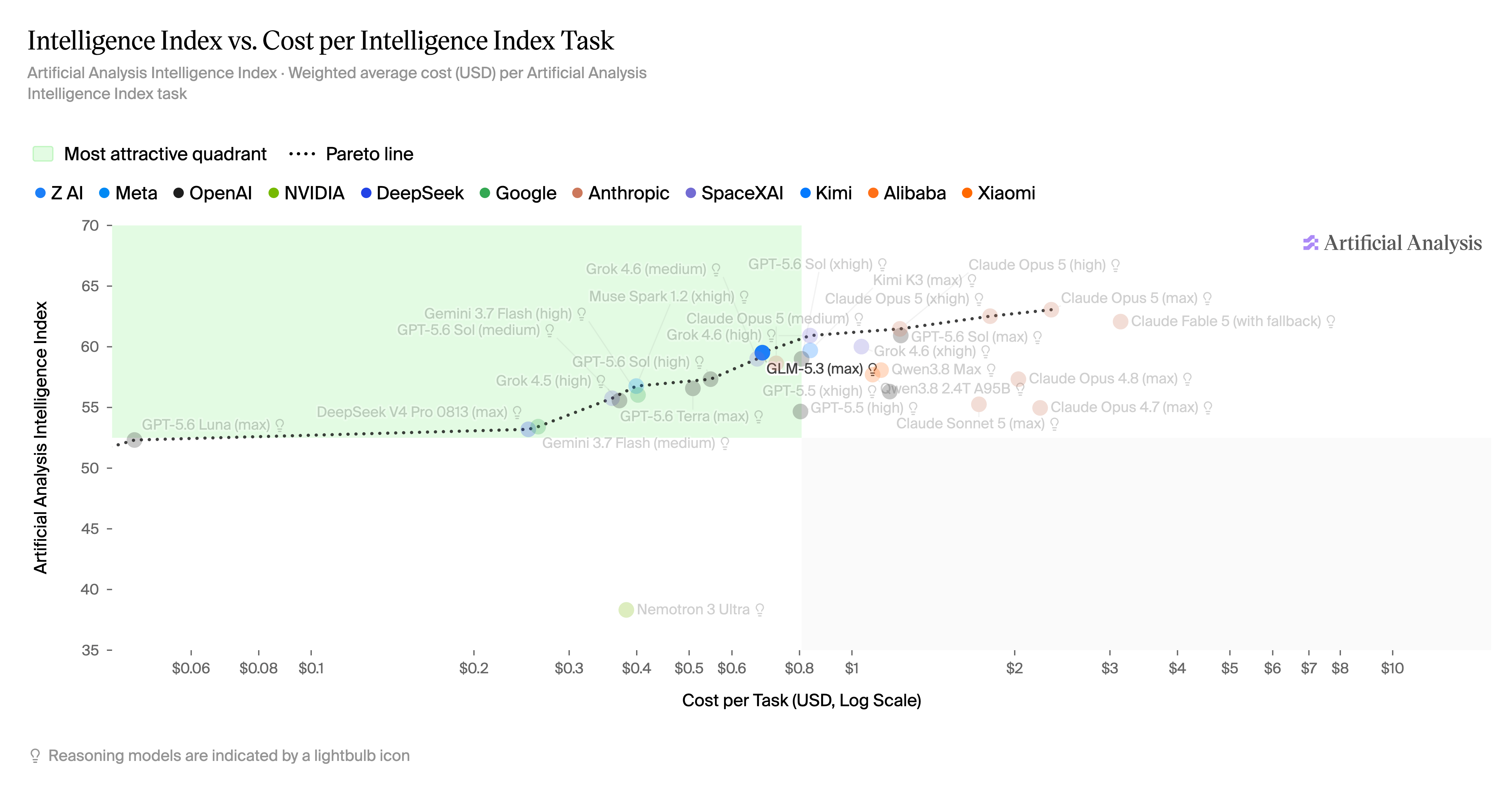
GLM-5.3 on Artificial Analysis
Last week, Z.ai released its latest flagship model, GLM-5.3, one of eight new models released that week. When I was preparing last week’s issue, we did not have independent evaluations to compare against Z.ai’s claims. Now we have. Artificial Analysis places GLM-5.3 as one of the leading models in its Intelligence Index and at the level of top US models, while being cheaper and faster. However, the benchmarks also found GLM-5.3 to be very verbose, which can affect the final cost.
Introducing Harvey II
Harvey has launched Harvey II, its latest AI agent focused on legal work. According to the company, the new agents can now open inside a “Space” for a given matter, inheriting its documents, parties, permissions and history. A new memory layer learns each lawyer’s drafting style and citation preferences across Harvey, Word and Outlook. Harvey has also built Tenet, its first model post-trained for legal reasoning, which the company claims matches the strongest general-purpose models at far lower cost.
Mistral Agentic Search
Mistral has launched Agentic Search, a retrieval layer that lets AI models dig through documents efficiently. The model gets five file-like tools: search, open, navigate, read and grep. It can refine a query, open a filing and check a specific table before answering. Mistral’s own benchmarks claim accuracy on financial filings jumped from 26.7% to 86% with Agentic Search, while using fewer tokens.
AI Chip Startup Fractile Seeks $6.5 Billion Value After Anthropic Deal
Bloomberg reports that Fractile, a UK AI chip startup, is in talks to raise about $600 million at a $6.5 billion valuation, six times more than its value in May. The company has reportedly signed a $250 million deal with Anthropic, with the intention to expand that contract in the future. The first chips are expected to be delivered in 2027.
SpaceX Attempted to Acquire AI Coding Startup Cognition
Before acquiring Cursor for $60 billion, SpaceX was reportedly eyeing Cognition, the startup behind the coding agent Devin. Cognition didn’t engage with the takeover approach, but the two companies are now discussing ways to work together, with Cognition potentially using SpaceX’s computing capacity.
🤖 Robotics
Tesla prepares for Cybercab launch in August starting with rides to employees
The Information reports that Tesla is preparing to launch Cybercab, its autonomous robotaxis without pedals or a steering wheel, later this month. The rollout will begin in Austin, Texas, with rides on public roads being initially offered to Tesla employees. The company started running tests of the production version of its Cybercab on public roads in June, and production of the vehicle is expected to ramp up later this year.
AMD Challenges GPU-Centric Architectures as It Takes Aim at Nvidia in Robotics
AMD challenges Nvidia in robotics with the Ryzen AI X100, a small computer combining a Zen 5 CPU, RDNA 3.5 GPU and XDNA 2 NPU with unified memory. AMD is also pitching openness as a differentiator—its new robotics board uses an industry-standard format rather than a proprietary one, and the company is publishing the design files, along with a ROCm-based robotics SDK.
Amazon Prime Air drone delivery is expanding to nearly 500 US cities and towns this year
Amazon announced that Prime Air, its drone delivery service, is expanding to nearly 500 cities and towns in the US this year. The service currently operates from 11 sites across ten metro areas in seven states, with launches planned soon in Illinois, New York, Ohio, Georgia and Idaho. Additionally, Amazon plans its first international site in Darlington, England. Prime Air drones can carry items under five pounds (about 2.27 kg) that fit in a large shoebox (Amazon says this covers more than 60% of most commonly ordered products) and deliver the orders in as little as 30 minutes, though most take around an hour.
Uber adds Zipline drones to its Eats delivery network
Your next Uber Eats order could be delivered by one of Zipline’s drones (if you live in one of the US cities where Zipline operates). This is thanks to a partnership between the two companies announced this week. Zipline will begin delivering Uber Eats orders by the end of the year, with the goal of making one million deliveries per day by the end of 2029. Uber is also investing in Zipline, although the amount has not been disclosed.
Chinese robot runs 100m sprint quicker than Usain Bolt’s world record
A humanoid robot has completed a 100m sprint in 9.32 seconds, beating Usain Bolt’s world record of 9.58 seconds, set 17 years ago. The robot, named Lightning and developed by Chinese smartphone manufacturer Honor, reached a peak speed of 14.5 metres per second.
Unitree Sees Robots Reaching ‘Mass Market’ Within Decade
Speaking at the World Robot Conference in Beijing, Wang Xingxing, founder of Unitree, said that humanoid robots will reach “mass-market” popularity within a decade, once manufacturers solve the problems limiting their current usefulness. The main challenge, Wang said, is that robots perform well in test conditions but struggle in messy, real-world scenarios. He said that once this problem is solved and robots can handle 80% of tasks given to them via voice instructions in unfamiliar environments, the industry will reach “mass-market” popularity. Wang expects this to happen within two to ten years.
Waymo lifts the lid on the ‘brain’ powering its robotaxis
Waymo has revealed the compute system in the trunks of its robotaxis for the first time. As the company writes in a blog post, the system is built around three principles: responsiveness (fully onboard, millisecond-level decisions, with compute power scaling twentyfold in eight years), ruggedisation and redundancy (two parallel units, either of which can take over). At its core is a custom 5nm ASIC delivering more than 1,000 TOPS and fusing raw lidar, radar and camera data at the front end. This article from The Verge argues that Waymo’s post is an implicit rebuttal to Elon Musk’s dismissal of lidar and puts the cost of the hardware at an estimated $20,000–25,000 per vehicle—down sharply from the previous generation, but still a drag on profitability.
Is Shipyard Welding the Right First Job for Humanoid Robots?
While almost everyone is betting on humanoid robots working in warehouses or in our homes, Persona AI imagines its robots welding and building ships. Founded by veterans in humanoid robotics, Persona is targeting much more expensive skilled labour, and welding is one such skill. Persona is starting with the long, straight seams that shipyards need by the hundreds of kilometres per vessel, and it argues that the value lies not in replacing workers at labour-starved yards, but in enabling shipyards to build more ships.
What happens when a kid’s robot best friend dies?
This article tells the story of Moxie, an AI-powered companion robot for children, and what happens when a robot designed to form connections dies. It explores the potential of such robots to help neurodivergent children practise social skills and examines what happens when the company behind such a robot folds and shuts down its servers.
Drones With Claws Perch on Arctic Icebergs
Ice Dart is a drone equipped with spikes that allow it to land on and latch onto icebergs and glaciers. Thanks to its custom landing gear, the drone can survive landings that would damage a traditional drone and grip icy slopes of nearly 60 degrees. According to the researchers, Ice Dart could serve as a mobile platform for monitoring and tracking iceberg movements, providing an additional layer of data to complement satellite- and ship-based iceberg detection.
🧬 Biotechnology
Vaccine breakthrough stops cancer returning in trial
Merck and Moderna announced that their personalised mRNA cancer vaccine, intismeran, combined with the immunotherapy drug Keytruda, significantly extended the time that high-risk melanoma patients remained cancer-free and reduced the risk of the cancer spreading. The vaccine is made for each patient by studying their own tumour, so the immune system learns to hunt down any remaining cancer cells. Experts have welcomed the news but stress the results are early, have not yet been independently checked, and the treatment still needs approval before it could reach patients.
GenBio Launches a “Virtual Cell” AI Model
GenBio, a startup cofounded by David Baker, a 2024 Nobel Prize laureate for his work on computational protein design, has unveiled AIDO Cell—a “world model” for cells that can simulate a human cell in its normal state and how it can react to drugs. In an early test, it correctly reproduced a known leukaemia drug’s effects, but it currently works with only two lab-grown cell types, and the company calls it a preview. GenBio hopes it will eventually let researchers test drugs on a computer before trying them in the lab.
💡Tangents
U.S. Urges Apple Not to Buy Chinese Memory Chips
In response to the memory chip shortage caused by the AI data centre boom, Apple could either significantly raise the prices of new devices (which it already did) or look elsewhere for memory chips, with China emerging as a potential source. However, Commerce Secretary Howard Lutnick said the Trump administration doesn’t want Apple to do that, urging the company to find other solutions to the shortage. Apple has reportedly been testing Chinese memory chips as a prelude to potentially using them in Apple devices sold in China.
States Seek $200 Billion From Meta Over Child Social Media Addiction Claims
Four states—California, Colorado, Kentucky and New Jersey—are suing Meta in an Oakland federal trial, claiming Facebook and Instagram were designed to hook children, fuelled a youth mental health crisis, and that Meta misled users about safety while breaching child privacy laws. They want penalties nearing $200 billion plus design changes such as ending infinite scroll and beauty filters for under-18s. First witness Arturo Béjar, a former Meta engineer, testified that the company knowingly tolerated underage users and put growth ahead of safety. Meta denies it, citing its teen safeguards and calling the demands disproportionate. The trial should run about six weeks.
Thanks for reading. If you enjoyed this post, please click the ❤️ button and share it!
A big thank you to my paid subscribers, to my Patrons: whmr, Florian, dux, Eric, Preppikoma and Andrew, and to everyone who supports my work on Ko-Fi. Thank you for the support!