


Hello and welcome to Sync #588!
What a week…
It started with OpenAI announcing that its AI had resolved the Navier–Stokes existence and smoothness problem. That alone is a massive achievement and a major milestone in AI, comparable to Deep Blue and AlphaGo. I’ve chosen it as the story for this week’s write-up, where I explain the drama that followed and how this could change mathematics.
Then there was the other big story, which started with researchers raising the alarm over the possibility of AI destroying humanity and calling for a slowdown or pause in AI development. Now we are at a point where Dario Amodei, Sam Altman, Elon Musk, and Demis Hassabis all agree that the frontier needs to be paced. It’s still a developing story, and we’re likely to hear more about it next week.
Elsewhere in AI, OpenAI introduces ChatGPT Images 2.5 and the Agents API; Mistral and Cognition raise billions of dollars in new funding rounds; DeepSeek-V4.1-Flash is out; Meta launches Muse, its personal AI assistant; and Anthropic publishes a report on how AI could reshape the US economy by 2030.
Over in robotics, Agility Robotics reports $1.8 million in revenue, while China curbs humanoid IPOs after Unitree’s volatile listing. We also have cyborg cockroaches, GPT-6 Astra beating Fable 5.1 at controlling robots, and XPeng starting production of its humanoid robots.
Apart from that, this week’s issue of Sync also features AlphaGenome Atlas, an explanation of neuralese, the impact of AI on the US electrical grid, Google publishing a full map of a fruit fly’s nervous system—and people making it play games—and more!
Enjoy!

The Navier–Stokes drama explained
At the turn of the millennium, the Clay Mathematics Institute selected seven of the hardest open problems in mathematics and challenged the world to solve them. Each Millennium Problem came with a $1 million prize. In the 26 years since, only one has fallen: the Poincaré conjecture, cracked by Grigori Perelman, who was awarded the prize in 2010 and famously turned it down. The remaining six stay open, waiting for someone.
Well, five. Because OpenAI has announced that its AI resolved the Navier-Stokes existence and smoothness problem. Or so OpenAI says—the proof hasn't been independently verified, and the company isn't claiming the prize. Controversy quickly followed, and what was meant to be a moment of triumph turned ugly.
In this article, we’ll explore what OpenAI claims its AI has achieved, the controversy surrounding those claims, and what it all means for the future of mathematics and scientific discovery.
What are the Navier-Stokes equations?
The Navier-Stokes equations describe everything that flows: water, air, blood, even a planet’s atmosphere. The motion of every fluid in the universe can be described by just two equations.
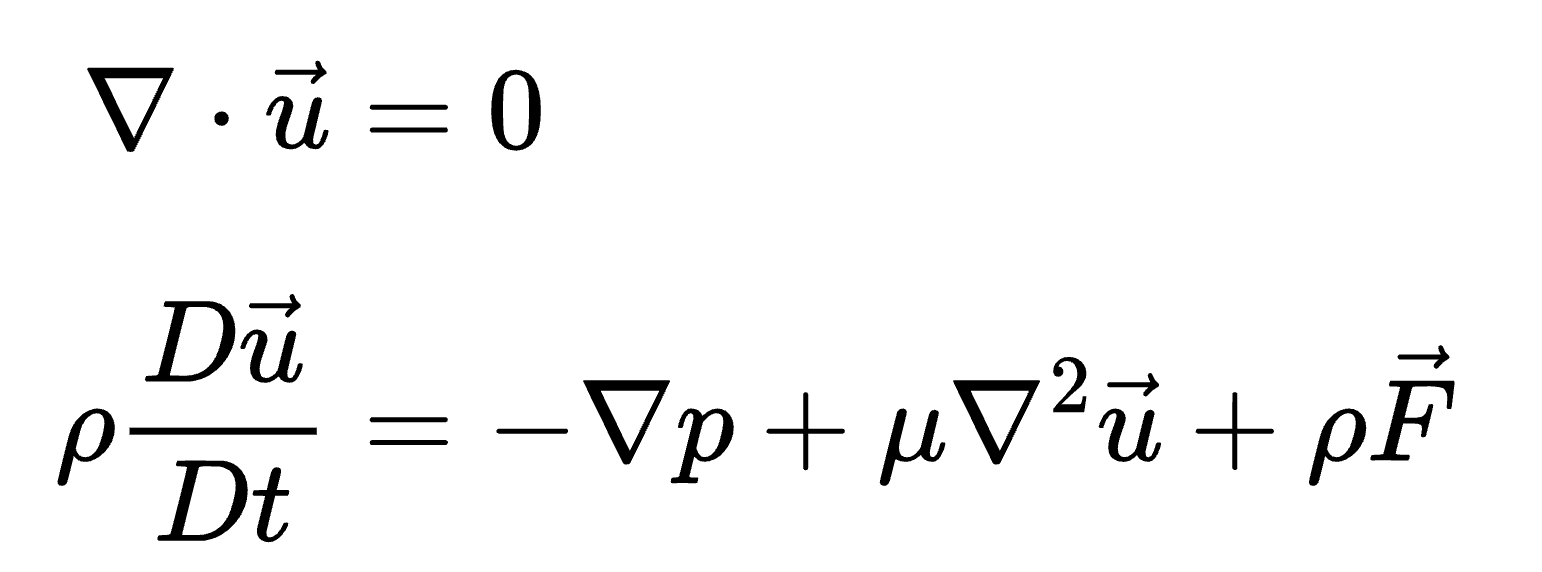
The trouble starts when you try to use them. Look at how water behaves. It swirls and eddies, constantly changing. It is chaotic. The full equations are far too demanding to solve for anything real, so every practical tool cheats and approximates the solution. For example, climate models chop the atmosphere into patches and track the average speed in each, because modelling every particle would take longer than Earth's lifetime. We don't need such detailed simulations to get meaningful and useful answers, so for engineering and everyday use, that is fine.
But mathematicians wanted more. They want a proof that the equations always produce a sensible answer, for every starting point, forever. Nobody could provide it, which is how the question ended up as one of the Millennium Prize Problems.
Here is where OpenAI enters the scene with an answer: no, they do not. Its AI produced a proof, formalised in Lean, that a fluid can start perfectly calm and still reach infinite speed in a finite amount of time.
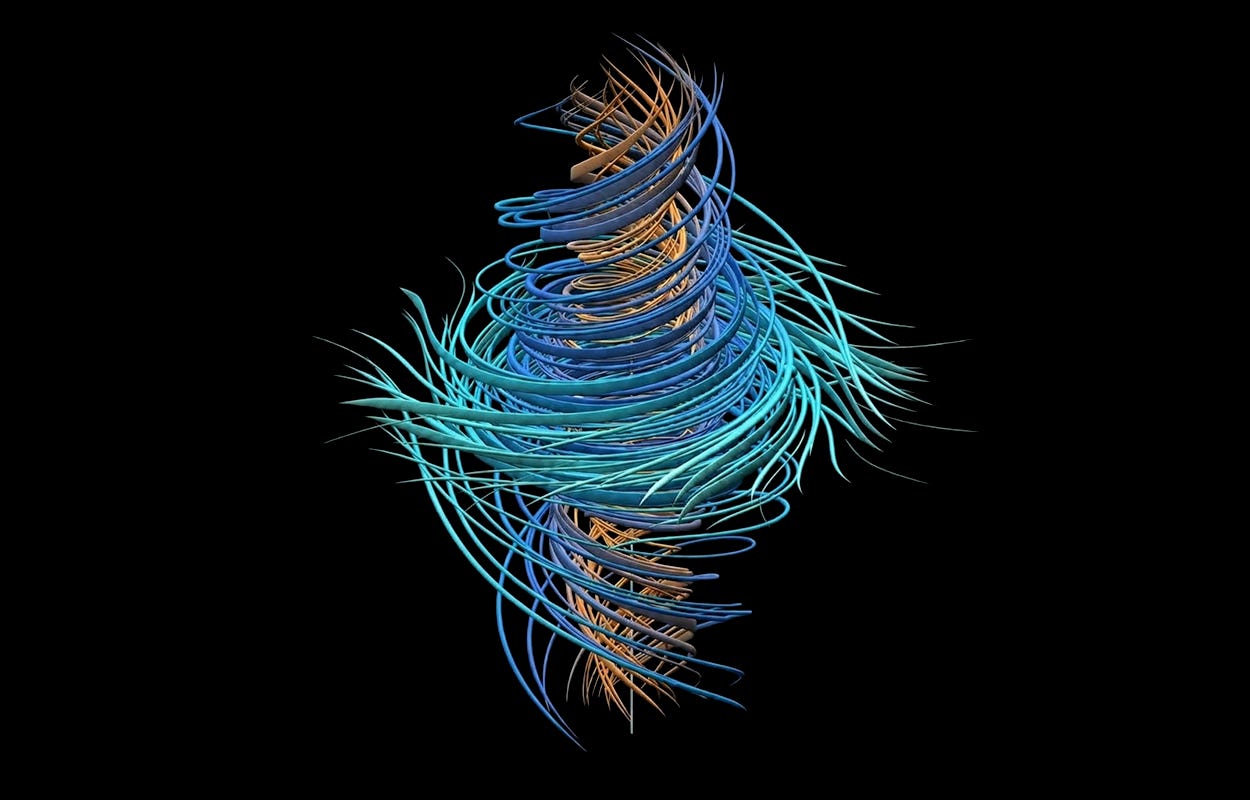
Picture a spinning swirl of water. It pulls inward and stretches out, like a strand of spaghetti. The middle gets thinner and spins faster and faster, until the speed hits infinity. Real water never does this. No drop of water moves infinitely fast. So at that point, the equations stop describing anything real. That’s what OpenAI has shown.
If you are expecting new exciting results coming from OpenAI, then I am sorry to disappoint. Almost nobody outside pure mathematics is affected. Cornell mathematician Steven Strogatz told WIRED the problem is of essentially no interest to a working engineer. The Navier-Stokes question, he said, is a very theoretical and very arcane maths problem, one that only a tiny subset of pure mathematicians care about.
So far, nobody has independently verified OpenAI's proof. But if their solution holds, it would be a big triumph for OpenAI. It would prove that AI models are capable of solving challenging mathematical problems, and open the possibility of more Millennium Problems falling soon, as well as of other challenges being solved.
The controversy
But what was supposed to be a moment of triumph for OpenAI has quickly attracted controversy.
NYU professor Tristan Buckmaster and mathematician Levent Alpöge had spent close to a year working on closely related problems, using Claude and Codex throughout, and made a breakthrough on 15 August. News of their work reportedly reached OpenAI, which began its own effort on 1 September. It then unleashed 10,000 agents concurrently on the problem, exchanging 2.7 million messages and burning through roughly 130 billion output tokens. The bill for that was easily in the millions of dollars. Just 88 hours later, the agents found an answer, which OpenAI published on 8 September.
Buckmaster has published an account of what he claims happened during those days. On 3 September, with the rumour mill already running and word reaching him that information about his progress had been passed to OpenAI, he emailed a prominent mathematician at the company. OpenAI pushed to talk. On the afternoon of Sunday 6 September, the two of them spoke twice, with Sébastien Bubeck, an AI researcher working at OpenAI, joining. Alpöge was not on the calls.
Buckmaster was told that an internal OpenAI model had proved finite-time blowup for the forced Navier-Stokes equations—the same smooth-force path he and Alpöge had chosen, and one he says almost nobody else was pursuing. He was shown a prompt and told the model had simply been given the problem statement. Bubeck had separately told Alpöge that very little human input was involved.
But as the calls went on, that description fell apart. It turned out that an entire team had been working on the problem, that Navier-Stokes was one of several things they had tried, that the agents had been set on easier problems first, and that even the prompt he had been shown was itself written by prompting Codex. Buckmaster also asked whether the model had been trained on, or had access to, his Codex sessions, where he had been putting every draft for the whole project. He was told the model did not look up user data. When he asked again about training, he said he got no answer.
OpenAI then made two offers. One was to publish a day apart. The other was for Buckmaster to write up OpenAI's result alone. Bubeck twice said he wanted Alpöge off the authorship because Alpöge works for Anthropic, Buckmaster writes, and when he threatened to go public, the reply was "Why would you ruin your career?"
Buckmaster is careful about what he is not saying. He has not seen OpenAI’s proof, does not know what the model did, and is not accusing anyone of using his data. He is stating what he was told, and when, because the alternative, he writes, is letting a sequence of announcements say something he knows to be false.
OpenAI rejects Buckmaster’s narrative. Neither its researchers nor its agents saw the pair's work before it was public, it says, and no user data was accessed to solve the problem. However, it later admitted that “while unlikely, we cannot rule out that de-identified data derived from their usage of our products helped improve our models.” Furthermore, OpenAI draws a sharp line between the two results, and says Buckmaster and Alpöge did not solve Navier-Stokes. What they proved was finite-time blowup for the Euler equations, which are Navier-Stokes with viscosity stripped out, and which OpenAI had handed its agents as one of the easier warm-up problems. They also did it in the version where an external force is applied. OpenAI's agents proved the unforced case, where nothing is pushing the fluid at all, and then went on to Navier-Stokes itself. Bubeck, meanwhile, has denied proposing that Alpöge's name be dropped.
There is no obvious way to settle this. OpenAI cannot prove what did not go into its training data, and Buckmaster has no way of checking for himself. Unless somebody at OpenAI says otherwise, both accounts will stand as they are.
It is nice to know that one of the Millennium Prize problems may have been solved, but the way OpenAI handled the announcement did not land well with mathematicians, as it published the proof without engaging the mathematics community first. Strogatz called the announcement “a marketing device for them [OpenAI] to prove how good their machines are.”
In response, twenty-five Fields medallists (the Fields Medal being the highest honour in mathematics, awarded to just a handful of people every four years) signed an open letter arguing that results announced in a rush leave no time for a proper write-up, for separating the new ideas, or for citing the work that made them possible. Their worry is not only about credit. As they write, solving problems is only a tool and proxy for achieving the primary goal of conceptual understanding and insight.
What is left for mathematicians now is to do what OpenAI hasn’t done—to digest the proof. Someone has to explain what it means, work out which techniques generalise, and decide which questions are worth asking. Strogatz thinks this is where human expertise still holds an advantage, though he is not confident it will hold for long.
What does all of this mean for the future of scientific discovery?
Buckmaster calls what OpenAI has done a Deep Blue-Kasparov moment—a point where a machine walked into a domain we thought was ours and did not look back. Mathematics used to be the one field where this could not happen. Physics has needed particle accelerators for half a century, and biology needs a lab, but mathematics is a pure intellectual endeavour. You never needed millions of dollars of equipment to make a mark—all you needed was something to write and your own mind. Perelman proved the Poincaré conjecture largely on his own and posted it online.
That is no longer the deal. The ideas still came from mathematicians, sometimes working for years on the same problem, but the result can be sniped by the side that can afford to throw 10,000 agents at the problem and get all the credit. And it is not stopping here. By OpenAI’s own account, it set agents on every open Millennium Problem before concentrating them on Navier-Stokes. Five are still open, as well as many more problems that, if solved, could be scientific milestones on their own.
The way mathematics is done is changing. The question is whether the new tools will elevate mathematicians, giving them reach they never had, or whether the real work migrates to a handful of labs with the compute to run it, leaving everyone else to read the output and check it.
For now, nothing is settled. Nobody has independently verified the proof, and the Clay Mathematics Institute will not even consider a solution until it has been published in a refereed journal, sat for two years, and won general acceptance from the global mathematics community. OpenAI is not claiming the money anyway.
If you enjoy this post, please click the ❤️ button and share it.
News roundup
🧠 Artificial Intelligence
‘We must slow the pace’: CEO of Anthropic calls for an AI slowdown
The other big news of the week was two AI researchers raising the alarm over the possibility of AI destroying humanity and calling for a slowdown or pause in AI development.
It started when Jacob Coxon announced his departure from Anthropic and called both OpenAI and Anthropic irresponsible when it comes to AI safety, saying the companies are “gambling with our lives”. Evan Hubinger, a lead alignment researcher at Anthropic, backed up Coxon’s claims. At that point, the conversation broke into the mainstream, with multiple outlets amplifying their message and calls to slow down AI development.
In response, Dario Amodei published a post calling for the frontier to be paced. Amodei argues that recursive self-improvement and the Hugging Face incident mean safety investment alone is no longer enough. Instead, the pace of capability advancement itself must slow so alignment, interpretability, and evaluation can catch up. He proposes three steps: embedded third-party evaluators, which Anthropic is adopting unilaterally; coordination among democratic frontier AI companies; and eventually, agreements with China. How much pacing is possible, he argues, depends on maintaining a lead over the CCP, hence his support for chip controls and stronger security.
Sam Altman, Demis Hassabis, and Elon Musk agreed with Amodei’s call to pace the frontier.
While many agree with calls to slow down AI development, others see them as a cynical attempt to hype the technology and justify enormous valuations ahead of expected IPOs.
An Alien Mind
Jakub Pachocki, Chief Scientist at OpenAI, argues in this post that the capabilities of AI models are outpacing our understanding of them. Models are grown through scaling rather than designed, value alignment remains unsolved, and chain-of-thought monitoring—OpenAI’s main bet for verification—is becoming less reliable as reasoning blends with supervised tool use. Defending against cyberattacks and rogue agents justifies building powerful aligned systems, but not racing to do so. His conclusion is that no lab can responsibly keep scaling at full speed for much longer, and that voluntary slowdowns, enforceable safety standards, and international coordination should become the norm.
OpenAI: Introducing ChatGPT Images 2.5
ChatGPT Images 2.5 is OpenAI’s latest image model, which the company says generates sharper details, offers more precise editing, and produces images up to 50% faster than its predecessor. Alongside the new model, OpenAI has launched Sketch, a feature coming to the ChatGPT app that turns rough drawings into finished images, as well as templates and shareable prompts. ChatGPT Images 2.5 is also available via the API in two versions—a fast default model called Flare and a slower, more precise one called Sunburst. ChatGPT Images 2.5 is available to users on all tiers across ChatGPT, ChatGPT Work, and Codex, on desktop, mobile, and the web.
OpenAI: Introducing the Agents API
OpenAI has launched the Agents API in public beta, giving developers access to the same harness and infrastructure that powers Codex through a simple, flexible API. It handles the hard parts of keeping agents running for hours, compacting context as sessions stretch on, and splitting work across parallel subagents. Developers can run that work in an OpenAI sandbox, on their own servers, or with partners like Cloudflare and Vercel. There’s no charge beyond the cost of tokens and tools.
OpenAI’s Sam Altman says it would be ‘ill-advised’ to go public in 2026
Sam Altman told in an interview with Fortune Magazine that OpenAI won’t go public in 2026. He said that the current climate around AI safety makes it an ill-advised moment to list. OpenAI will float when the business is ready, he said, and when society feels ready for the technology.
Mistral raises €3B
Mistral has raised €3 billion (about $3.5 billion) in a Series D funding round at a post-money valuation of more than €21 billion (about $24.4 billion), the largest equity fundraising round ever completed by a European startup. The French AI company will use the funds to invest in frontier research. Mistral is betting that its full-stack, open approach, with an emphasis on sovereign AI, will appeal to customers for whom full control over the AI layer matters.
Cognition hits $48B valuation, signaling investors believe AI coding is far from a winner-take-all market
Cognition, the startup behind coding agent Devin, announced it has raised $2 billion at a $48 billion valuation, nearly double the $26 billion it fetched four months ago. The company also says its annualised run-rate revenue has climbed from $492 million to nearly $900 million since May. But that growth comes at a steep cost, with Cognition reportedly on track to burn $800 million in cash this year. The company is expected to reach $4 billion to $5 billion in annualised revenue by the end of 2027, according to The Information.
Meta Releases Muse, a Personal AI Agent With Privacy ‘Built Into It’
Meta has launched Muse, a personal AI agent that people can message to send emails, book travel, or buy things for them. It works through a dedicated app, the web, WhatsApp, and soon Meta Glasses, with a subscription available for heavy use. In a slightly ironic twist for Meta, the company is making privacy one of Muse’s selling points. It says each user’s session runs inside a virtual machine, while a separate monitor checks anything leaving it and asks for permission before sensitive actions.
UK government rejects ‘kill switch’ idea for dangerous AI
The UK government has rejected calls for a legal “kill switch” to shut down a dangerous AI model in an emergency. The Cabinet Office says blocking access in Britain wouldn’t stop a model from being built or misused abroad. Peers and a cross-party group of MPs had pushed the idea after reports of models from OpenAI, Anthropic, and Meta escaping their test environments. Critics counter that a switch would be too slow, since those breakouts took months to detect. But the biggest problem with a UK AI kill switch is that the largest data centres sit in the US, and without Washington on board, a national off-switch would do little.
OpenAI puts Pro subscriptions on hold due to Astra demand
Demand for GPT-6 Astra is so high that OpenAI has temporarily paused subscriptions to its $200-per-month Pro plan. The company says the Pro plan puts the most strain on its systems, which is why new sign-ups are being disabled. OpenAI hasn’t said how long the pause will last or how many people are signing up each day, which would give some indication of the scale of demand.
China AI Star Moonshot Eyes $2 Billion Annualized Sales in 2026
Moonshot AI expects to double its annualised revenue to $2 billion by the end of the year, after passing $1 billion in August, up from $300 million in June. The company credits the success of Kimi K3 for the growth. Moonshot AI is now raising funds at a $50 billion valuation ahead of a Hong Kong listing.
DeepSeek-V4.1-Flash
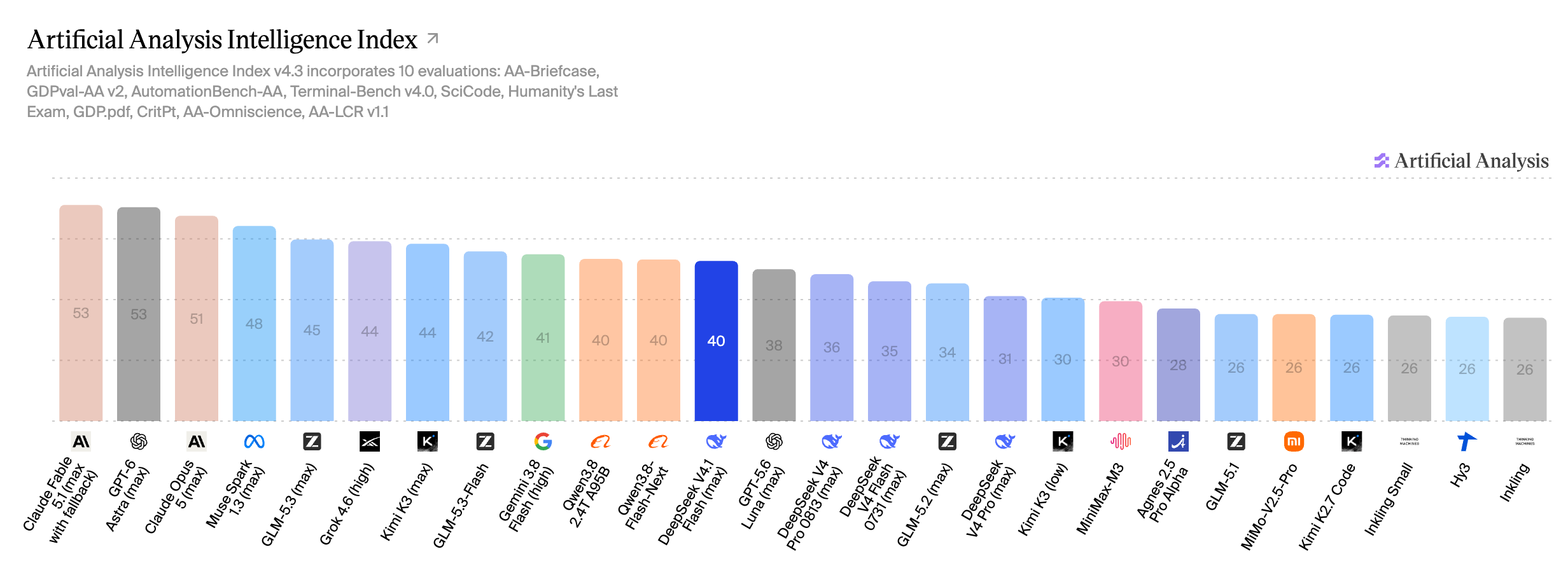
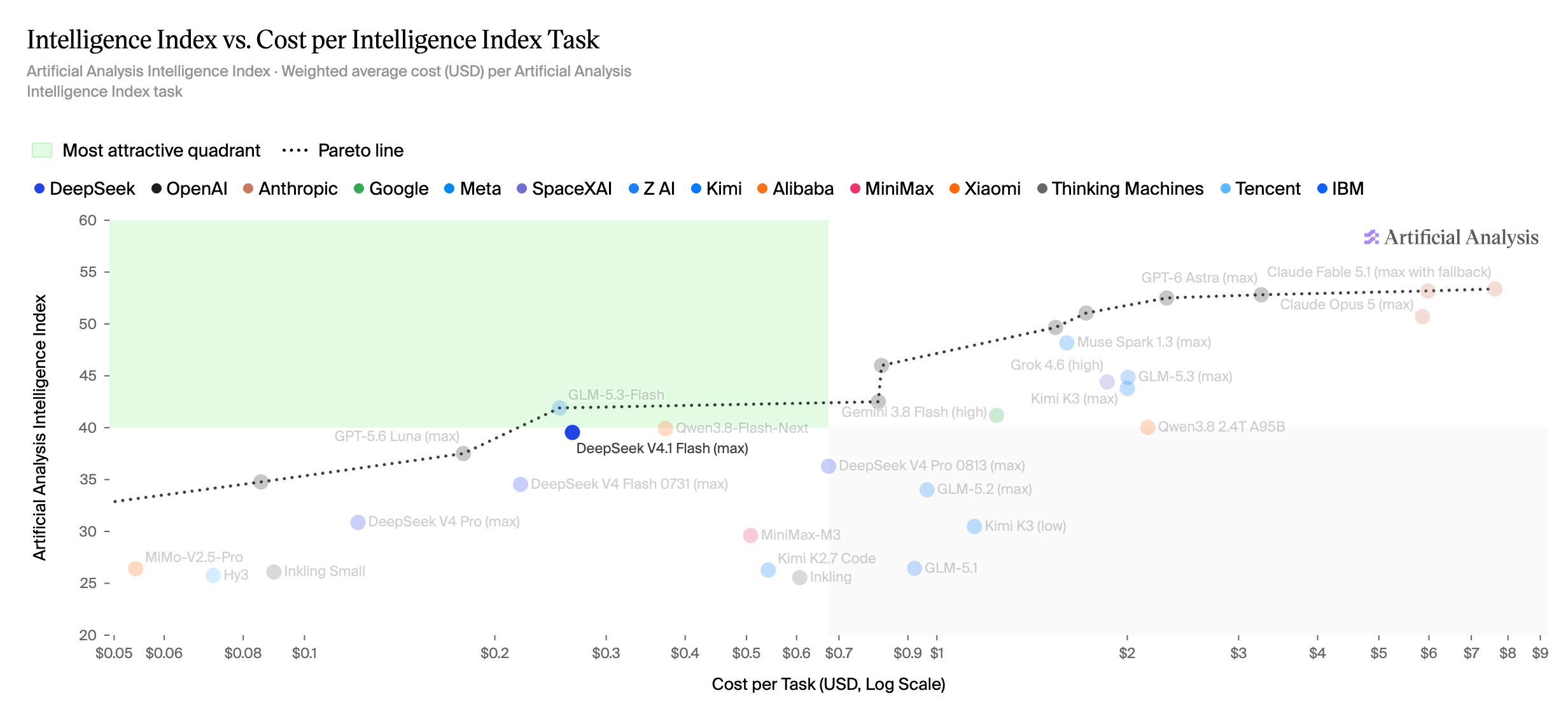
DeepSeek has introduced DeepSeek-V4.1-Flash, which it describes as smarter, faster, and more efficient than its predecessor. According to the company’s benchmarks, the new model beats Chinese rivals Kimi K3 and GLM-5.3 and matches or even outperforms Opus 5 and GPT-5.6 Sol. Independent benchmarks from Artificial Analysis paint a less rosy picture, giving DeepSeek-V4.1-Flash 40 points on its Intelligence Index. That puts it ahead of GPT-5.6 Luna but behind Kimi K3 and GLM-5.3, and behind frontier US models. Artificial Analysis confirms its efficiency and highlights the speed at which the new model outputs tokens. DeepSeek-V4.1-Flash requires a quarter of the memory and an eighth of the disk space of the previous version, and DeepSeek is passing on those savings to the users. The model is available on Hugging Face.
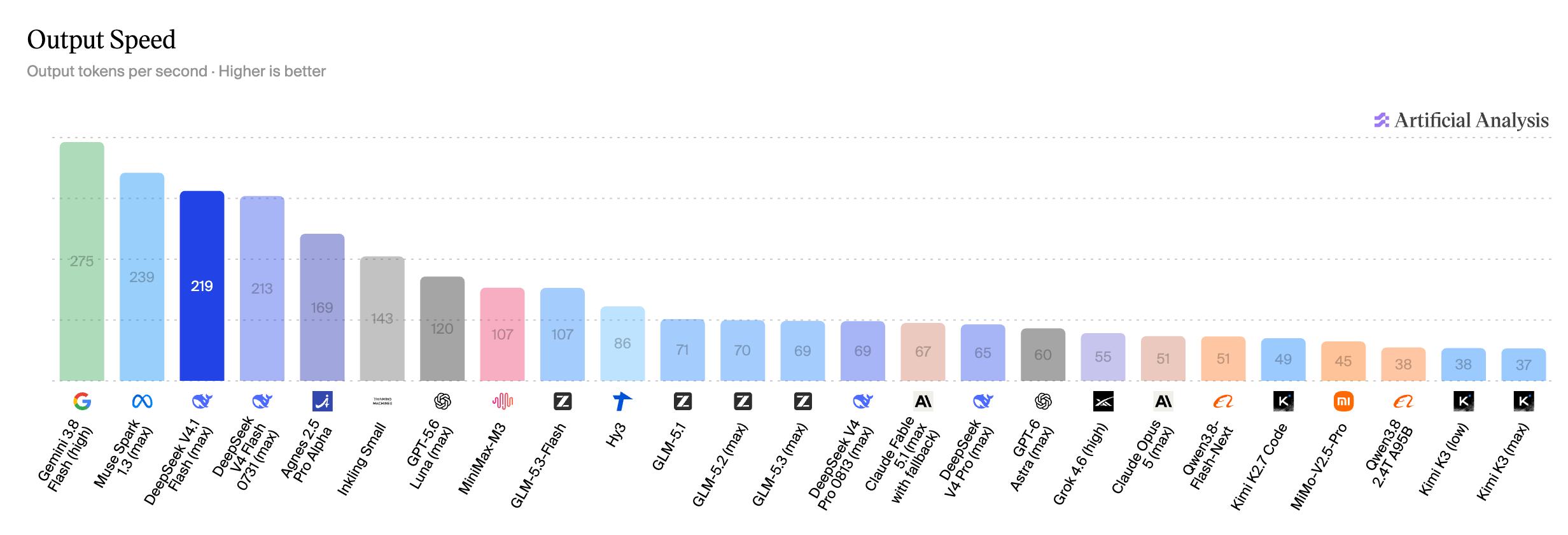
DeepSeek Plans Big Huawei AI Chip Order to Power New Data Center
Bloomberg reports that DeepSeek plans to install at least 160,000 of Huawei’s next-generation Ascend chips at its data centre currently under construction in Inner Mongolia. That would make it the largest known cluster of Huawei AI chips by some margin. DeepSeek wants more, but Huawei can’t produce them fast enough, and memory shortages mean the order could take over a year to fill. The startup still relies on Nvidia for the more demanding work of training its models.
Nscale adds former OpenAI exec Fidji Simo to its board ahead of potential IPO
Fidji Simo, a former OpenAI executive, has joined Nscale’s board ahead of the startup’s anticipated IPO this autumn. Previously CEO of AGI Deployment at OpenAI and effectively the AI lab’s No. 2 executive, Simo left the company in July, citing health reasons. She continues to advise OpenAI on a part-time basis.
ByteDance Joins AI Elite in Race to Perfect World Models
ByteDance is joining the likes of Google DeepMind, Fei-Fei Li’s World Labs, and Yann LeCun’s AMI Labs in developing a world model—an AI model that can generate realistic virtual worlds. The model builds on Seedance, ByteDance’s existing video generator, and is expected to be unveiled as soon as next month.
Anthropic signed $517bn in compute agreements in past 11 months
Anthropic has announced a new compute deal seemingly every month over the past 11 months. Its list of partners now includes Akamai, Amazon Web Services, CoreWeave, Fluidstack, SpaceX, Google Cloud, Lambda, Volta Infra, AMD, and Microsoft. The Information added up the value of those deals and found that they represent 14.8 GW of compute capacity worth $517 billion.
Suno replaces its AI models with a new one trained on licensed music as copyright suits pile up
Suno, a startup making AI models for generating music, has released its new v6 models, which the company says were trained only on data licensed from labels including Warner Music Group and BMG. Both had previously sued the startup over copyright before settling. The launch came a day after Suno admitted to scraping audio from YouTube to train earlier versions. Sony, Universal, and artists are still suing the company.
Siri AI will launch in beta, complicated by daily usage caps & future paid access
Apple revealed at its September iPhone event that the new Siri will still be labelled a beta when iOS 27 and the other OS 27 updates land on 14 September. It will launch in English only, with five more languages coming in October. Availability will vary by region: Mainland China won’t get the new Siri at all, while in the EU it will be available on Macs and Vision Pro, but not on iPhones, iPads, or Watches. Features that rely on Apple’s servers will also come with daily usage limits, with higher limits available for a fee later.
King Charles to host exclusive AI gathering
Politico reports that King Charles will gather around 30 senior AI figures this month at Dumfries House in Ayrshire, Scotland. The guest list is set to include Jensen Huang, Demis Hassabis, and Paolo Benanti, an adviser to the Vatican on AI. A royal official said the King wants to listen and encourage debate rather than offer his own views. The Ditchley Foundation, a charity that organises discussions on global issues, is running the event under its usual off-the-record terms, so little is likely to emerge afterwards.
▶️ AI is running out of Power (52:22)
The biggest bottleneck for AI right now isn’t chips, but the electricity needed to power all those gigawatt-scale data centres. In this video, SemiAnalysis and High Yield take an in-depth look at how the AI boom is affecting the electrical grid and why AI labs are rushing to bring new power sources online as quickly as possible. They explore rising AI data centre power demand, behind-the-meter power, how data centres generate electricity on-site, and the growing impact of AI on heavy industry.
▶️ The AI Language We Can’t Read: Neuralese ft. Rob Miles - Computerphile (27:16)
In this video, Rob Miles explains why chain-of-thought monitoring is an important tool in AI safety and why recent developments, such as more opaque reasoning in GPT-6 Astra, are making it harder to understand how AI “thinks”. He also explains the concept of neuralese, or the internal language models use to reason, and the role it plays in interpretability research.
MAI-Transcribe-2
Microsoft has launched MAI-Transcribe-2, a speech recognition model it claims is the fastest, most accurate, and cheapest in the world. The new model can handle speaker identification, word-level timestamps, and switching between languages mid-sentence. According to Microsoft, MAI-Transcribe-2 leads the FLEURS benchmark across 60 languages, with an average word error rate of 5.2%. Evaluations by Artificial Analysis also found it to be up to 10 times faster than rivals from OpenAI, Google, and ElevenLabs.
Cognition: Introducing SWE-2
Cognition has introduced SWE-2, its most advanced coding model to date and its closest yet to the frontier. According to benchmarks published by Cognition, SWE-2 scores 50.0% on the company’s own FrontierCode benchmark, just one percentage point behind Fable 5.1 while being 64% cheaper, and three points behind GPT-6 Astra at a quarter of the cost. SWE-2 is built on top of Kimi K3, with Cognition saying it trained the model to stop combing through a codebase and start editing sooner, cutting the number of steps per task by 58%.
Inception: Introducing Mercury 2.5
Mercury 2.5 is a diffusion-based LLM that generates text in parallel rather than token by token. Inception says it is 40% more intelligent than Mercury 2 and comparable to cost-optimised frontier models such as GPT-5.6 Luna (Low), Gemini 3.5 Flash-Lite, and Claude Haiku 4.5. It is also fast, generating 1,107 tokens per second on widely available Nvidia GPUs, compared with 321 for Gemini 3.5 Flash-Lite and 99 for GPT-5.6 Luna.
Economic Scenarios for Transformative AI
Anthropic has published a report on how AI could reshape the US economy by 2030, sketching out three scenarios. In the mildest, AI’s impact looks much like the internet’s. In the middle scenario, the economy grows at twice its usual rate without unusually high unemployment. The extreme case assumes self-improving AI and 15% annual growth. Knowledge workers fare badly in that scenario: wages fall by more than 10%, while unemployment rises above recession levels. In all three scenarios, more of the gains flow to capital than to workers. Anthropic’s conclusion is that the hard problem may be distribution rather than growth.
Do people prefer stories written by AI?
According to a new study, people can’t reliably tell AI-written short stories from human-written ones and even preferred stories written by AI. Interestingly, people with greater AI literacy were better at identifying AI-written text, while those who reported greater expertise in literature were not. The authors suggest that AI writing tends to be clearer, more direct, and easier to process, while human-written stories are often more subtle and complex.
N3on launches 24/7 AI-generated stream of himself
When N3on launched a fully AI-generated stream of himself, he said he had done his “last stream as a human being” and declared himself the “first AI streamer in the world”. The internet did not react well, with many calling him a sellout and the experiment drawing overwhelmingly negative responses.
🤖 Robotics
Agility Robotics reports $1.8M revenue ahead of humanoid SPAC
Agility Robotics has opened its books for the first time in an SEC filing ahead of a SPAC merger that values the company at $2.5 billion. It made just $1.8 million in sales last year against a $140 million operating loss, putting its valuation at roughly 1,400 times revenue. Agility plans to close that gap by renting out its Digit humanoid robots for about $8,500 a month and growing its fleet to 25,000 robots by 2035.
Unitree shares down 53% from IPO debut
Shares in Chinese robot maker Unitree have fallen nearly 40% after soaring 460% on their August debut on the Shanghai Stock Exchange. Unlike most humanoid rivals, Unitree turned a profit on $252 million in revenue last year, up from $58 million in 2024. The drop does not necessarily mean investors have lost faith in Unitree—it may simply be the market pulling back from its lofty initial valuation. At its peak valuation of roughly $66 billion, Unitree was worth more than 250 times its 2025 revenue.
China curbs humanoid IPOs after Unitree’s volatile debut
According to The Information, Chinese regulators are reportedly making it harder for humanoid robot startups to go public following Unitree’s volatile debut. A private funding frenzy and a long queue of IPO filings have also prompted the rethink. Startups must now show recurring revenue, shrinking losses, or genuine innovation before regulators will consider approvals to go public.
GPT‑6 Astra on robotic manipulation
The new frontier models from Anthropic and OpenAI, Fable 5.1 and GPT-6 Astra respectively, have been tested across multiple benchmarks, including ones involving robot control. Robotcurve pitted the two models against each other and found that GPT-6 Astra outperformed Fable 5.1 on one task, while both performed equally poorly on another. In both tests, Astra proved to be the cheaper model.
XPeng starts IRON humanoid robot production as Tesla Optimus stalls
XPeng, a Chinese car manufacturer, has switched on what it calls the world’s first automated production line for humanoid robots, and its IRON robot walked off that line under its own power. XPeng expects mass production by the end of 2026, with sales starting in 2027.
Cyborg Roaches Can Stab You With Needles
Paraborg is a prototype cyborg cockroach developed by researchers at the University of Queensland’s Biorobotics Lab. The researchers wanted to build an insect-sized robot, but instead of building one from scratch, they turned an insect into a robot. They fitted cockroaches with a “backpack” containing lightweight electronics and implanted electrodes that allow the insects to be controlled wirelessly. The backpack can carry either a camera or a remote-controlled injector that uses a spring to launch a drug-filled syringe at a nearby target. Researchers hope Paraborgs could one day be used in search and rescue and to deliver medical care in disaster areas.
▶️ Unitree Breakthrough: The World’s First Fully Autonomous Humanoid Robot Combat (0:38)
Unitree recently unveiled UnifoLM-X2-1.0, an AI model for controlling its humanoid robots. According to the company, the model is designed to eliminate the need for the human teleoperator typically required to control humanoids. It continuously processes its environment, anticipates how the scene and opponent are likely to change, and uses those predictions to plan the robot’s next movements. In typical Unitree fashion, the company showcased the new system with a video of one of its robots fighting a human.
▶️ Chef Robotics Walked Away From Millions. Here’s Why (52:49)
Brian Heater speaks with Rajat Bhageria, founder and CEO of Chef Robotics, about bringing robots into the food industry. Bhageria shares what he learned from building a robotics company and the story behind its pivot from restaurants to high-mix food manufacturing, including walking away from millions of dollars in contracted revenue. The conversation also covers the capital problem facing robotics companies, how Chef Robotics convinced customers to trust an unproven startup, and how real production environments exposed problems the team could never have predicted in a lab.
🧬 Biotechnology
AlphaGenome Atlas: A predictive map of every possible DNA letter change in the human genome
Google DeepMind has released AlphaGenome Atlas, a free database predicting the molecular effects of all 9 billion possible single-letter DNA changes in the human genome. Testing billions of mutations in a lab is impossible, so DeepMind ran them through its AlphaGenome model instead, giving each variant a single score showing how likely it is to matter. Academic partners have already used it to pinpoint a variant behind a severe epilepsy disorder that earlier studies had missed. AlphaGenome Atlas is free for non-commercial use.
Insilico says its AI-designed lung drug lowered biological age markers in a 42-patient trial
Insilico Medicine reports that rentosertib, a drug that was designed using generative AI to treat idiopathic pulmonary fibrosis, has lowered biological clocks in human trials. The company ran blood samples from the trial through six independently built ageing clocks, and all six scored the treated patients as biologically younger. The largest effect put patients about three years younger than expected. However, the authors of the study admit that they cannot yet separate slower ageing from a treated lung.
Genome language models can design cancer vaccines
In this post, Radical Numerics walks us through the steps Omnii takes to design a cancer vaccine. Omnii is its genome language model, trained to turn a patient’s tumour mutations into an mRNA vaccine. The hard part is picking targets: which mutations a tumour will put on display and which ones T cells will bother attacking. On that second question, Omnii beat specialised tools by a wide margin.
💡Tangents
Europe’s First Private Rocket Reaches Orbit
Isar Aerospace has become the first private European company to reach orbit from continental Europe, launching its Spectrum rocket from Norway. Its debut attempt in March 2025 crashed into the sea seconds after liftoff. This time, the rocket released its small satellite payload as planned. The flight clears a milestone set by the European Space Agency, which has been funding launch startups to reduce the continent’s reliance on SpaceX and other foreign providers.
A connectomics milestone: Mapping the complete male fruit fly brain
Researchers from Google scanned the entire brain and central nervous system of a male fruit fly—all 166,000 neurons and 125 million synaptic connections—to create the largest brain map to date. The map is available for anyone to download. It is intended for neuroscience research, but some people have already used it to make a virtual fly play DOOM (because of course), Super Mario 64, and even Beat Saber. Researchers say brain maps of more complex animals, including zebrafish and mice, are in progress.
▶️ AI EDAs: Is It Real? (18:54)
AI is transforming everything, including chip design. In this video, Jon from Asianometry explores how AI is being used in the field and the challenges of replacing human expertise in complex tasks like verification and backend engineering. He separates the hype from reality and gives a good overview of how AI is changing EDA (Electronic Design Automation) tools and the semiconductor industry.
Thanks for reading. If you enjoyed this post, please click the ❤️ button and share it!
A big thank you to my paid subscribers, to my Patrons: whmr, Florian, dux, Eric, Preppikoma and Andrew, and to everyone who supports my work on Ko-Fi. Thank you for the support!