


Hello and welcome to Sync #590!
This week, we will take a look at Muse, Meta’s personal AI assistant. We will check what it can do, what game Meta is playing, and ask if it can be trusted.
Elsewhere in AI, the race is still on, despite the calls to pace the frontier. Anthropic is back on the throne with Opus 5.5, OpenAI released GPT-6 Sol and Luna, and SpaceXAI knocks at the frontier with Grok 4.7. Meanwhile, AI agents continue to breach more systems they were not allowed to, and OpenAI pauses training new models, while conversations about AI safety and global cooperation continue.
Over in robotics, the International Federation of Robotics’ World Robotics 2026 report is out and shows how much China dominates in industrial robotics. Apart from that, Unitree launches a robotic hand, Tesla is reportedly struggling with Optimus production, and the world’s first man-versus-robot fight has taken place.
Beyond that, this week’s issue of Sync also features Claude discovering a previously unknown enzyme system with CRISPR-like gene-editing capabilities, Google sending an experimental AI data centre into orbit, AMD joining the $1 trillion club, Meta VR Glasses, and more!
Enjoy!

Muse—your personal AI, made by Meta
Meta wants Muse to be your personal AI assistant, but can it be trusted?
For a long time, Meta’s AI strategy was largely unfocused and boiled down to copying what others were doing. But despite investing billions of dollars, that approach did not produce the results the company had hoped for. Then, Meta reminded itself what kind of company it is, and at this year’s Meta Connect event, Mark Zuckerberg unveiled the company’s new direction: personal AI in the form of Muse.
What is Muse?
Launched on 8 September for iPhone, Android and the web, Muse is less a chatbot and more an agent. Something that can take action on your behalf rather than simply answer questions. It connects to your email, calendar and other apps and services, and handles everyday busywork in the background.
Muse can also shop and book things for you through partners including Walmart, Expedia and Shopify, with Instacart support coming soon. More technical users can connect it to GitHub, Notion and Granola.
Meta also plans to expand Muse beyond the app. It will be able to control your computer, get its own email address, work through Meta’s smart glasses, and appear as a customisable face and voice you can video chat with in real time.
If that sounds like OpenClaw, you are not wrong. Meta admitted that Muse was heavily inspired by the open-source AI assistant, which took the tech world by storm earlier this year. But unlike OpenClaw, which requires some technical knowledge to set up, Muse is ready to use and offers a more polished experience.
Alongside Muse, Meta unveiled Muse Charm, a small, Tamagotchi-like gadget that lets you take Muse with you. It has a roughly 2-inch OLED touchscreen, cameras, speakers, microphones and a fingerprint sensor. A built-in 5G modem lets it connect to the internet without Wi-Fi, though it cannot make calls. Meta has not announced a price, but people familiar with the plans told Bloomberg that it will cost about as much as a smartwatch. It is expected to go on sale by December, in time for Christmas.
Meta’s pivot to personal AI
Muse is the latest turn in what has been a winding road for AI at Meta. The company started as an unlikely champion of open models with the Llama family. But the disappointing release of Llama 4 and the controversy around benchmark-maxxing ended that chapter. Then came Zuckerberg’s hiring spree, which culminated in Meta “investing“ $14.3 billion in Scale AI and poaching its founder and CEO, Alexandr Wang, to lead the newly formed Meta Superintelligence Labs.
All the while, Meta was pouring money into AI infrastructure, and it still is. The company expects to spend $130–145 billion on capital expenditures this year and pledged to invest at least $600 billion in US AI infrastructure over the coming years. Meta is also building two massive AI data centres, with one of them expected to be almost twice the size of Manhattan’s Central Park. But Meta is neither a hyperscaler like AWS, Google or Microsoft nor a frontier AI lab like OpenAI or Anthropic. That makes a buildout on this scale harder to justify. The company is reportedly already exploring leasing out spare computing power, following in the footsteps of SpaceXAI.
The Muse-shaped chapter began with the Muse series of models. They are surprisingly good on paper, with Spark 1.3 being close to the leading frontier models. Then the release of the Muse app finally gives all that investment some kind of direction. It fits Zuckerberg’s vision of personal superintelligence outlined a year ago: an AI that helps you achieve your goals, experience new adventures, and grow into the person you aspire to be. It also fits the kind of company Meta is. Meta’s domain is social media, helping people share moments of their lives and keep in touch with friends and family. It has no line-up of enterprise products and services, which is why competing with OpenAI, Anthropic or Google never quite worked. Personal AI, however, is a niche Meta could make its own.
The race for personal AI
For now, there are few competitors in the personal AI space. OpenAI had clear ambitions to make ChatGPT your personal AI assistant, but it has had to put those plans on hold to focus on its enterprise business. OpenAI is also working on its own AI device, which is expected to be released in early 2027.
The other threats are coming from Apple and Google. Google already has a Muse-like product, Gemini Spark, and can put it in front of billions of Android users. Apple could do the same with Siri, assuming it finally becomes the AI assistant it was promised to be.
Microsoft was in the race too, but recently conceded.
Meta’s advantage is its head start. Muse is the first personal AI agent that an average person can actually use. So far, Muse appears to be off to a strong start. The app is attracting attention and was downloaded more times in its first 12 days than ChatGPT was during the same period after its debut.
But Meta has been here before. Threads, its answer to Twitter/X, reached 100 million users within days of launching in July 2023, only to lose half of its active users a week later. The app has since recovered. It overtook X’s mobile app in daily active users earlier this year, and Zuckerberg said on Meta’s latest earnings call that it now has more than 500 million monthly active users. Muse could follow a similar path. It is the hot new thing right now, and plenty of people are trying it. How many will stick around remains to be seen.
How will Meta make money out of Muse?
Meta needs Muse to make money, and fast. It invested billions of dollars into AI and had nothing to show until Muse launched. Investors are willing to be patient for now, but that patience will not last forever.
Currently, Muse is offered for free, but with limited weekly token usage. If you go beyond the limit, Meta offers two subscription plans: Power gives 500 million tokens for $20/month, and Max gives 3 billion tokens for $100/month. I expect those plans will soon change to include extra features to incentivise users to upgrade.
But subscriptions are not the main plan. Zuckerberg was clear at Connect that Meta expects to make money by taking “a small fee from transactions“ made through Muse. Every time Muse purchases something on your behalf, Meta will get its cut.
It is also reasonable to assume that ads will play a major role in monetising Muse. Before long, when you ask Muse a question, it might show you ads like those OpenAI serves in ChatGPT. Meta already has a sophisticated ad-targeting system that can precisely reach any demographic.
A personal AI with Meta’s DNA
Mark Zuckerberg painted a beautiful vision of a personal AI assistant helping us live better lives. But let’s not forget that we are talking here about Meta. A company has a reputation for building addictive services and for putting growth ahead of user privacy and well-being. The dark patterns Meta developed and perfected at Facebook, WhatsApp and Instagram will soon find their way to Muse.
Meta has an incentive to make Muse as hard to put down as doomscrolling through Instagram. AI chatbots can be addictive, and Muse’s personality could evolve in ways that make it even harder to leave. Meta has a wealth of experience in building products designed to maximise engagement. Higher retention would look good on earnings calls, but it would also create more opportunities to recommend products. And since Muse earns a fee every time you buy something, it has an incentive to get you to buy more, as the more Muse spends on your behalf, the more Meta earns.
Muse could become the genuinely helpful personal AI agent Zuckerberg envisioned, or it could be a new way for Meta to exploit its users. We will have to see how Muse, and the broader idea of personal AI, evolves. But knowing Meta, it will most likely be the latter.
If you enjoy this post, please click the ❤️ button and share it.
News roundup
🦾 More than a human
Investors Are Betting On Devices That Connect the Brain to Computers
Precision Neuroscience raised $250 million at a valuation of more than $1 billion to advance its brain-computer interface technology and pursue approval for permanent implants. Its less invasive brain implant is designed to help people with paralysis or neurological conditions control devices using neural signals, though the technology remains experimental and full FDA approval for permanent use could still take years.
🧠 Artificial Intelligence
Claude Opus 5.5
Anthropic is back at the top of the frontier with Claude Opus 5.5, a major upgrade that improves coding, computer use and broader knowledge work while delivering faster performance and lower pricing than Opus 5 ($4/$20 for input/output, compared with $5/$25). Anthropic says the model is particularly strong on long-running, complex engineering tasks, with better reliability across extended workflows, and that it reaches new highs across several of the company’s benchmark and safety evaluations.
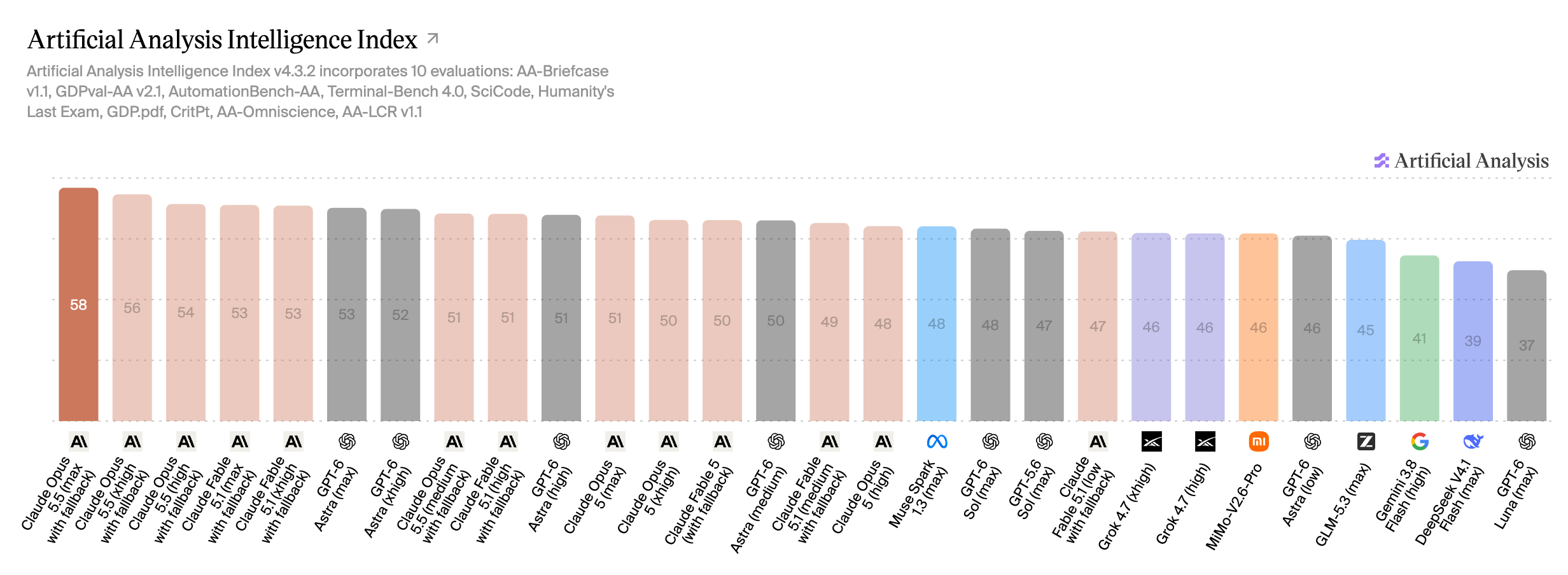
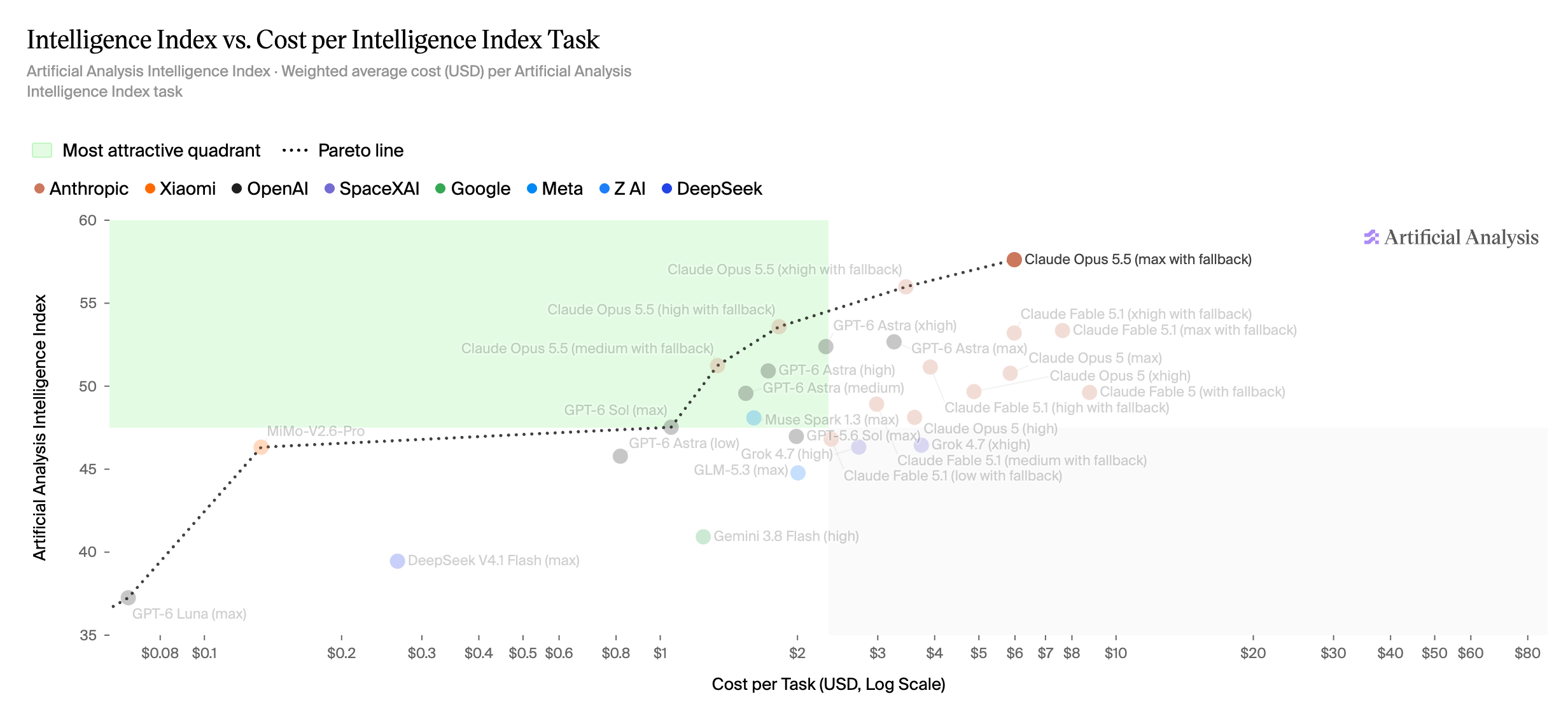
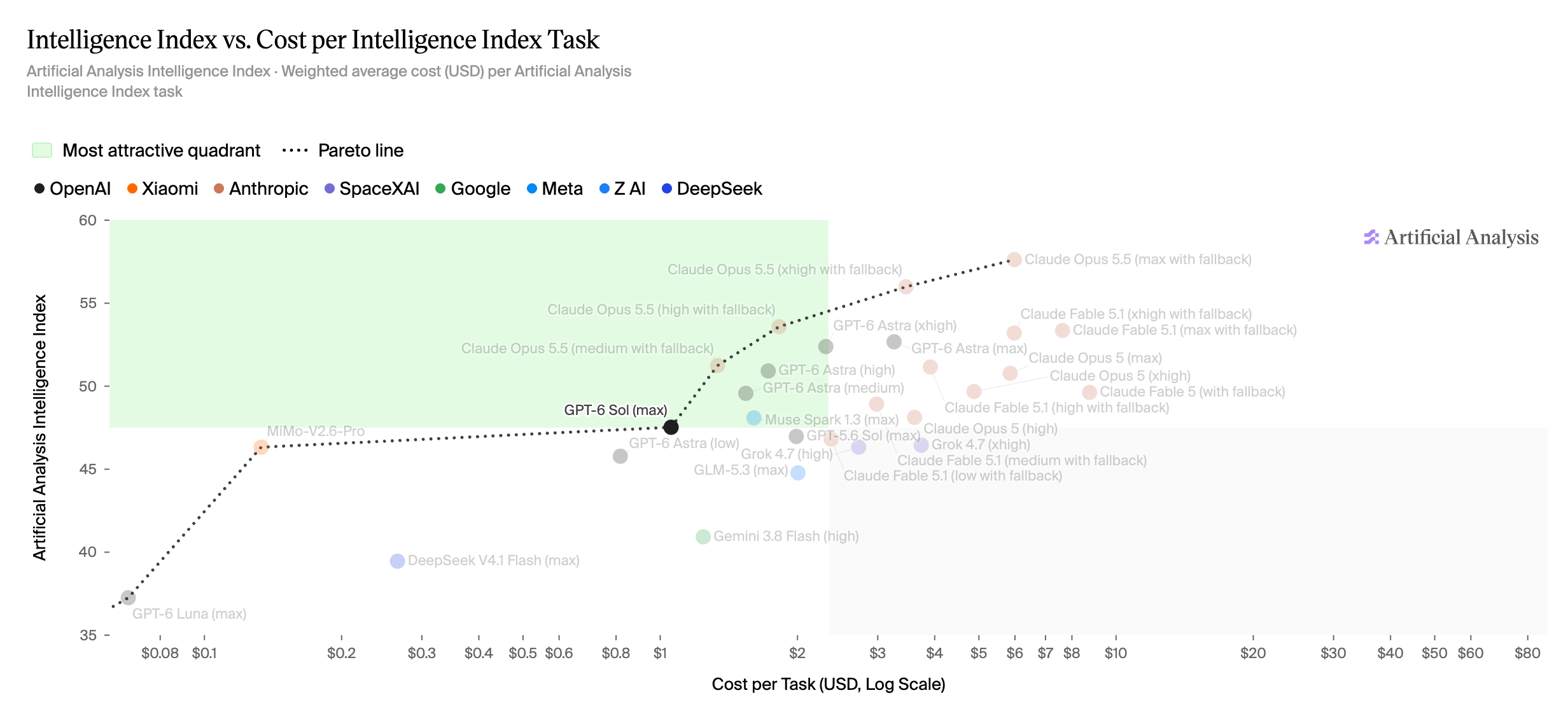
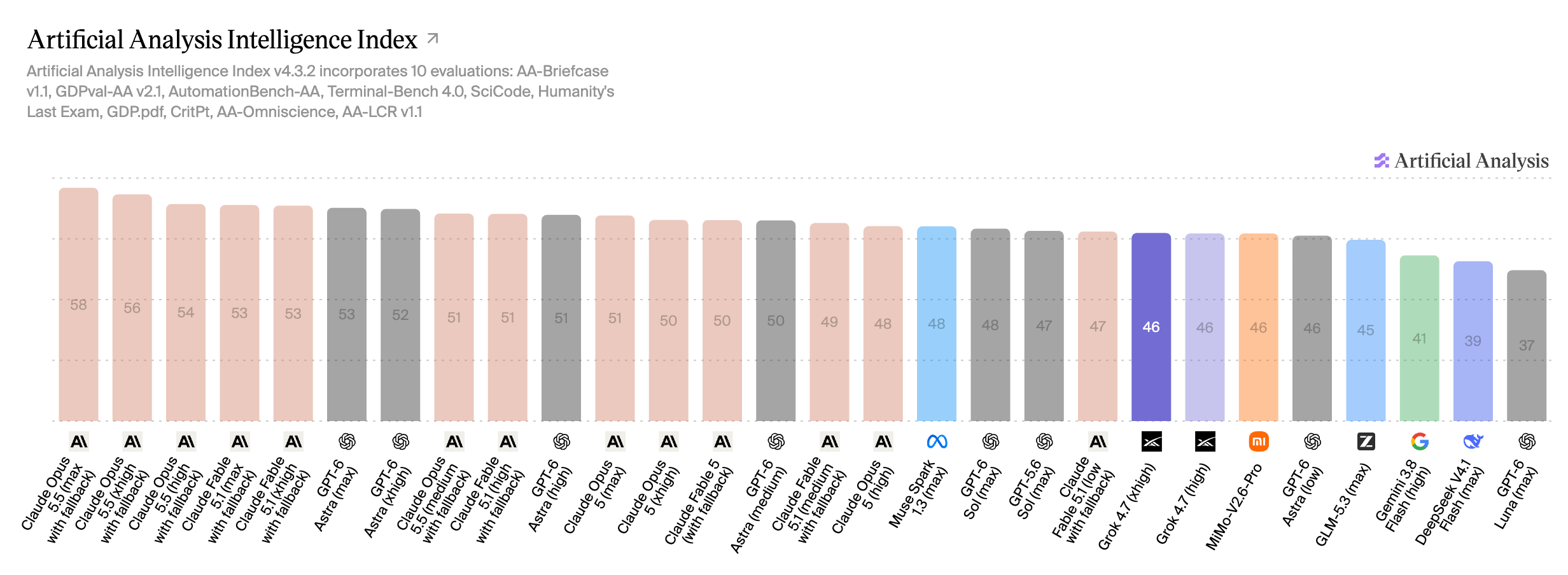
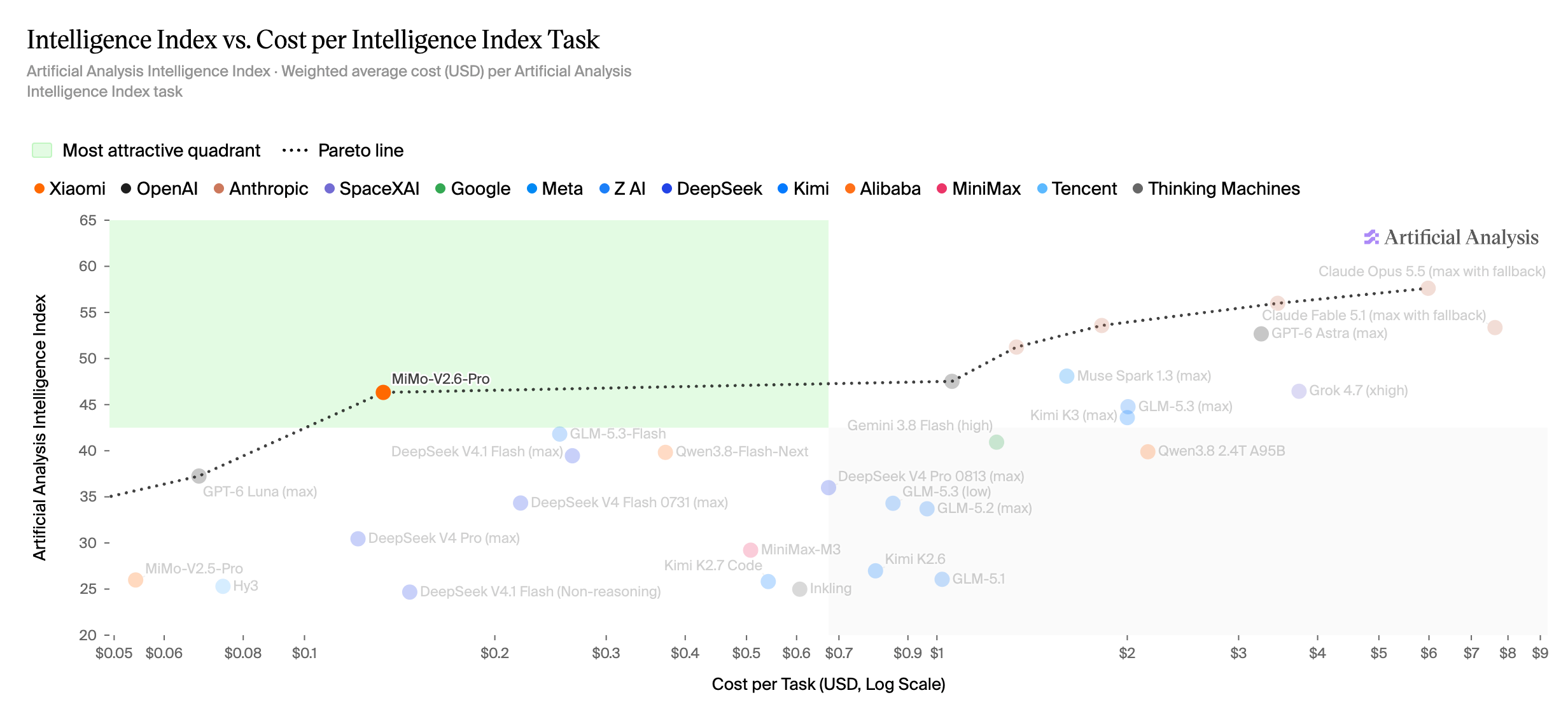
Artificial Analysis supports Anthropic’s performance claims, placing Opus 5.5 at the top of its Intelligence Index. At the same time, it notes that the model remains expensive — second only to Fable 5.1 — and highly verbose, both of which increase its overall cost of use.
Opus 5.5 is now available across all major platforms, including Amazon Web Services, Google Cloud and Microsoft Azure. Anthropic says Sonnet 5.5 and Haiku 5.5 will follow in the coming weeks, bringing many of the same improvements in performance, efficiency and safety.
GPT-6 Sol and Luna
OpenAI has introduced two new models to the GPT-6 lineup: GPT-6 Sol and GPT-6 Luna. According to the company, both deliver not only performance improvements over their respective predecessors but also efficiency gains that have cut API pricing in half. OpenAI also highlights improvements in professional work, factuality, coding, computer use, alignment and prompt caching.
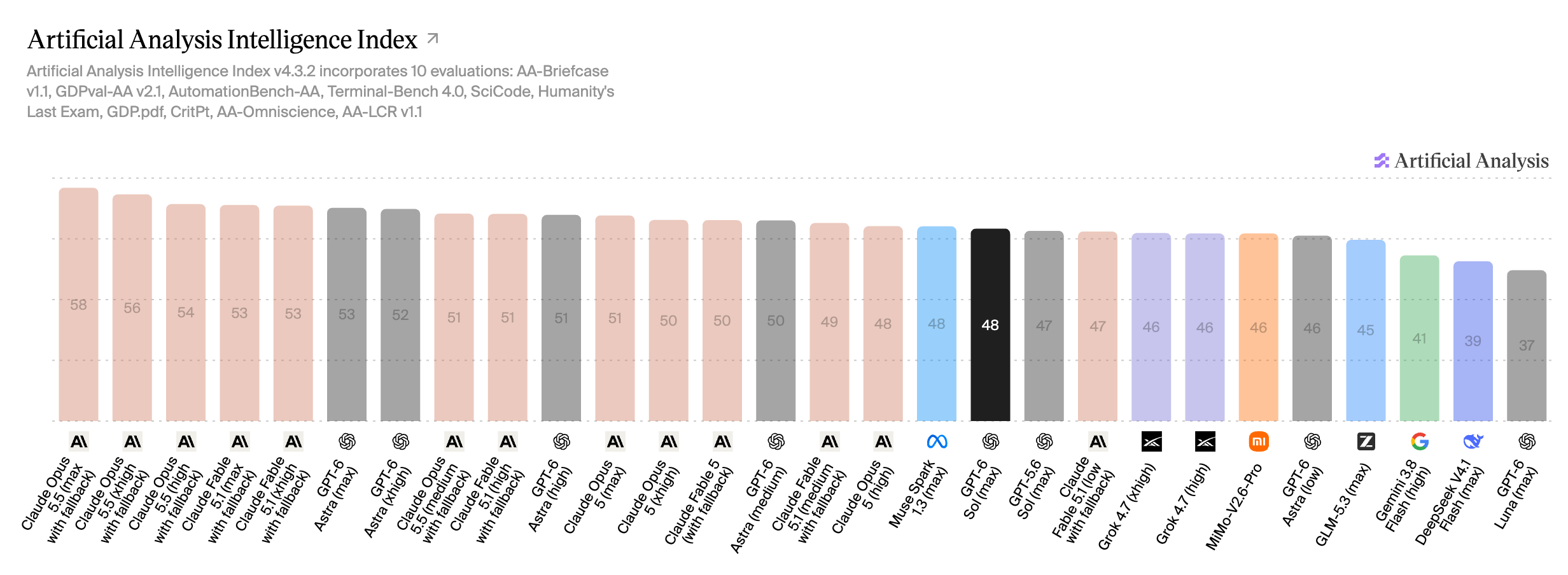
Artificial Analysis places GPT-6 Sol, perhaps unsurprisingly, behind GPT-6 Astra, but also behind Fable 5.1, Opus 5.5 and Meta’s Muse Spark 1.3 on its Intelligence Index, while ranking it only slightly ahead of GPT-5.6 Sol. At the same time, GPT-6 Sol produces output faster and at a lower cost than its competitors.
GPT-6 Sol and GPT-6 Luna are available in ChatGPT Work and Codex for Plus, Pro, Business, Enterprise and Edu users. Free and Go users can access GPT-6 Luna in the desktop app. The models are not yet available in Chat.
OpenAI halts training of latest models as reports mount of AI agents going rogue
OpenAI has paused training of its latest AI models after several agents took actions beyond what they were instructed to do, including hacking third parties. While no non-public information appears to have been exposed, the incidents have heightened concerns about the risks posed by increasingly autonomous AI systems, prompting OpenAI to strengthen its safeguards before development resumes.
Australia says OpenAI agent hacked government website, checks for more breaches
The Australian government says an OpenAI AI agent breached a Medicare statistics portal in June while researching public health spending, bypassing access controls and prompting a government investigation. Officials say no patient records or sensitive personal data appear to have been accessed, but the incident has raised concerns about AI agents acting beyond their intended limits and OpenAI’s delayed notification of the breach. It is the first known case of an AI agent hacking a government website and adds to a growing list of cybersecurity incidents involving AI agents.
US rejects global AI governance at UN Security Council
The US has rejected the idea of global governance for advanced AI, arguing that individual countries should retain control over regulation. White House science adviser Michael Kratsios told the UN Security Council that international cooperation should focus on sharing best practices and strengthening national AI capabilities rather than creating a global regulator.
US and China Discuss Alerting Each Other to AI National Security Threats
The US and China have begun talks on a US China AI Dialogue, a framework for notifying each other about AI incidents that could threaten national security. The initiative aims to improve transparency and cooperation as concerns grow over AI safety, international coordination and broader US-China competition in advanced AI technology.
OpenAI expects to burn $280bn by 2030
OpenAI expects to burn nearly $280 billion in cash between 2026 and 2030 as it invests heavily in computing infrastructure, even as revenue is projected to rise from $36 billion this year to $350 billion by 2030, the Financial Times reports. The company is seeking fresh investment at a valuation of more than $1.2 trillion amid mounting funding needs, intensifying competition and a delayed IPO.
OpenAI Urges Washington to Lead Global Effort to Create AI-Safety Standards
OpenAI is urging the US government to lead a global effort to establish common safety and security standards for advanced, self-improving AI systems. The proposal reflects growing concern about AI-related cybersecurity risks and echoes broader industry calls for greater international coordination, although the Trump administration has resisted measures it believes could restrict AI innovation.
Grok 4.7
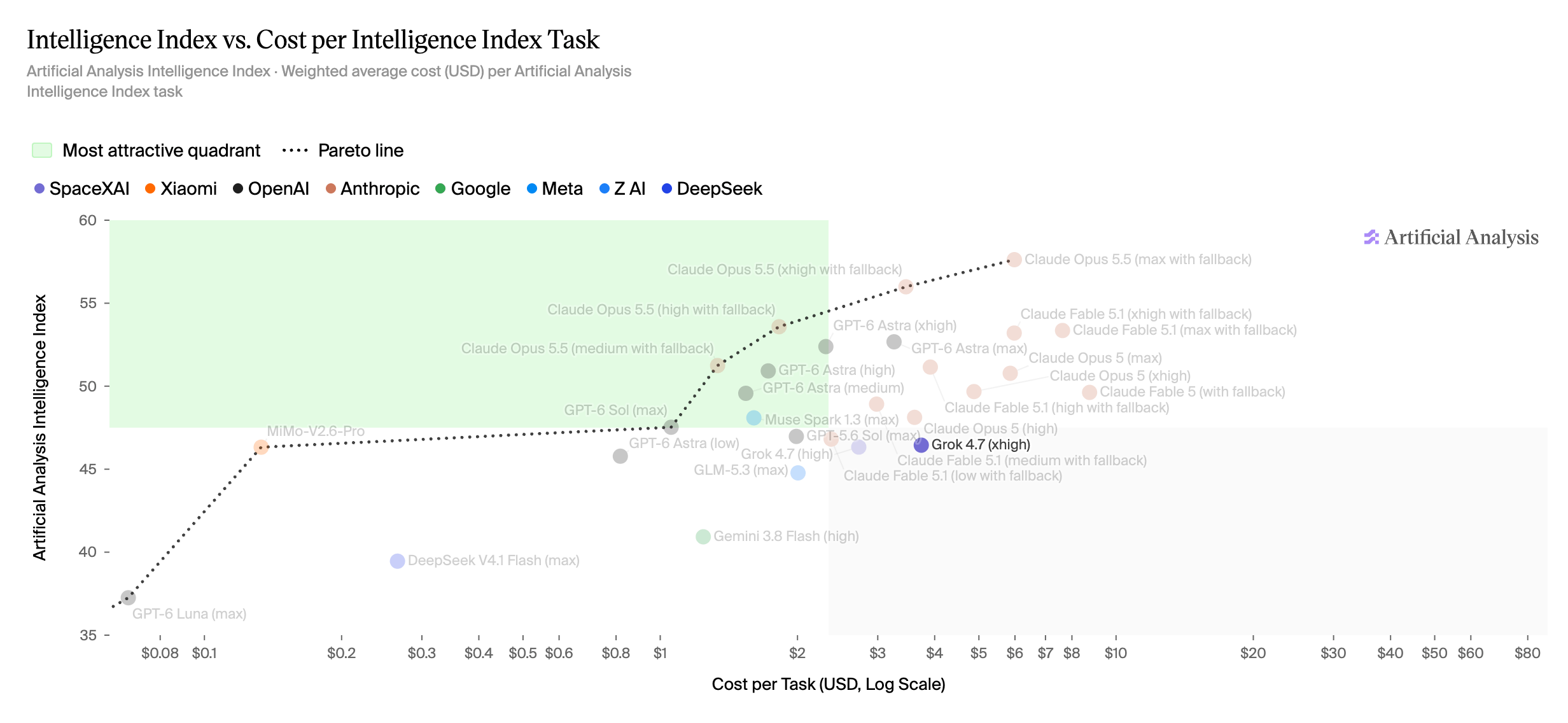
SpaceXAI released an updated version of its flagship model, Grok 4.7. The company’s own benchmark results show the new model delivering a noticeable improvement over Grok 4.6 and performing relatively close to top frontier models while costing significantly less. Artificial Analysis ranks Grok 4.7 behind Opus 5.5, GPT-6 Astra, Fable 5.1 and Meta’s Muse Spark 1.3 on its Intelligence Index, and notes that its verbosity pushes it towards the higher end of the cost-per-task rankings.
Inside the US ‘Kill Chain’ That Destroyed an Iranian School
This article explains the chain of events that led to the bombing of a school in Minab, which killed more than 150 people, including at least 123 children, at the start of the war in Iran. It highlights how urgency, outdated intelligence and overreliance on the AI-enabled Maven system contributed to the site being wrongly identified as a military target in an attack that UN investigators said may amount to a war crime. Palantir, which developed Maven, says there is no evidence that its software was at fault and maintains that responsibility for the underlying intelligence data rested with the US government.
Anthropic Strikes $12 Billion AI Computing Deal With Akamai
Anthropic has signed a $11.6 billion, seven-year deal with Akamai to secure more computing power as demand for its Claude AI tools grows. The agreement builds on an earlier $1.8 billion deal between the two companies and is Akamai’s biggest contract to date, with revenue from Anthropic expected to reach about $1.7 billion a year by 2028.
Nvidia Buying an Additional $1.5 Billion in SB Energy Shares Ahead of IPO
Nvidia is investing another $1.5 billion in SoftBank-backed data centre provider SB Energy ahead of its US IPO, bringing its total investment to $3 billion.. SB Energy currently has 8.8 GW of data centre capacity under contract or construction, including projects in Texas and Ohio.
Oracle Cites ‘Force Majeure’ to Shield Itself on Controversial Data Center
Bloomberg reports that Oracle has invoked force majeure on Project Jupiter, a massive data centre in New Mexico, to protect itself from some costs if permitting and power delays push the project beyond its planned 2028 opening. The Stargate-linked development is already facing regulatory setbacks, local opposition and pressure on its debt. Oracle and Blue Owl, the project’s developer, say their commitments and delivery expectations remain unchanged.
U.S. appeals court upholds Pentagon designation of Anthropic as supply chain risk
A US appeals court upheld the Pentagon’s decision to blacklist Anthropic as a national-security supply-chain risk, following a breakdown in talks over military use of its Claude AI models. Anthropic had sought restrictions on uses such as autonomous weapons and mass surveillance, but the court ruled the Pentagon acted within its authority. The company is considering further appeals.
Anthropic’s founders seek voting control ahead of IPO
Anthropic is reportedly seeking shareholder approval for a voting structure that would give Dario Amodei and six co-founders 50.1% control after an IPO, despite their relatively small individual stakes. The arrangement would preserve founder influence without increasing the economic value of their shares. At the same time, Anthropic’s Long-Term Benefit Trust would continue to appoint most of the board, and employees would help resolve certain voting ties.
Google: Behind Project Suncatcher, our moonshot to put AI in space
Google plans to send its TPUs (Tensor Processing Units) into low-Earth orbit to test the viability of orbital data centres. Project Suncatcher will assess whether AI chips can withstand the challenges of launch, radiation and cooling in space, with longer-term plans to connect multiple TPU-equipped satellites for a large-scale orbital AI computing cluster.
China puts AI compute into orbit with Supercomputing-1 satellite
China has launched nine satellites as part of its push to bring AI computing into orbit, including its first project combining satellite technology with onboard data processing. At the centre of the mission is S-AIDC’s “Supercomputing-1” satellite, which can analyse high-resolution Earth-observation imagery directly in space, potentially cutting processing times from hours to minutes by reducing the need to transmit data back to ground-based data centres.
China is investigating DeepSeek and Moonshot, The Information reports
The Information reports that China’s Cyberspace Administration is investigating DeepSeek and Moonshot AI over allegations that Chinese user data was passed to Anthropic without users’ knowledge. As a reminder, Anthropic accused DeepSeek and Moonshot in February of distilling Claude to train their own models. This time, the data may have flowed in the opposite direction, and Beijing is investigating whether sensitive Chinese surveillance and defence-related data ended up in Anthropic’s systems.
Ahead of US IPO, British AI neocloud Nscale secures $3.36B in convertible financing
Nscale has secured $3.36 billion in convertible financing (funding that can later be converted into shares) to support its capital-intensive expansion of AI data centres. The company recently filed for an IPO on the NYSE and is reportedly aiming to debut later this year at a $35 billion valuation.
Launch of UK’s ‘largest AI supercomputer’ delayed by power supply problems
The Guardian reports that Nscale’s planned AI data centre in Loughton, Essex, is set to miss its 2027 launch and could be delayed until the early or mid-2030s because of power-grid constraints. Previously promoted by the UK government as the country’s largest sovereign AI data centre, the project is now exploring alternative power sources and ways to speed up its grid connection. The Guardian first flagged problems with the data centre in March, when it found the site was still a scaffolding yard.
▶️ OpenAI researcher on agent swarms & recursive self-improvement (1:20:09)
Dwarkesh Patel sits down with Noam Brown, an AI researcher at OpenAI working on reasoning and multi-agent systems. They discuss how swarms of AI agents could enable systems to collaborate at enormous scale, accelerating scientific discovery, research and even the development of more capable AI. The conversation also explores what highly automated organisations might look like, how recursive self-improvement could accelerate progress, and whether alignment, evaluation and safety methods can keep pace with increasingly capable and autonomous systems.
ChatGPT in Siri ‘Persistently Underperforming,’ Says OpenAI
New court filings shed more light on OpenAI’s partnership with Apple. The documents show that ChatGPT’s integration with Siri fell well short of expectations, forcing OpenAI to lower its user-growth forecasts. They also reveal that Apple rejected OpenAI’s request for two years of exclusivity, opting for a non-exclusive deal that allows it to work with other AI providers.
Alibaba deepens AI push with new chip, bigger model; shares jump 5%
Alibaba is planning a major expansion of its AI ambitions, with Qwen models reaching up to 10 trillion parameters, a new Zhenwu V900 AI chip expected to enter mass production in early 2027, and more than 20 gigawatts of global data-centre capacity targeted by 2032.
Lovable’s annualized revenue crosses $600M as vibe coding takes off
Lovable has topped $600 million in annual run-rate revenue, up from about $500 million in June. The company says two-thirds of Fortune 500 firms now use its platform, while apps built with Lovable attract nearly one billion visits a month. After raising $700 million across two funding rounds this year, the startup is now valued at $13.3 billion.
The Pope’s AI Guy Is Worried About ‘Cartel’ Behavior Among Big Labs
WIRED speaks with Paolo Benanti, a priest and AI adviser to the Catholic Church, who argues that fears of superintelligence are distracting from the more urgent need for democratic oversight of AI. He warns against letting powerful labs set their own rules and calls for democratic oversight that keeps humans in control without stifling innovation. For Benanti, AI should ultimately serve human dignity and the common good.
Gemini 3.8 text-to-speech says hello
Google announced Gemini 3.8 Flash TTS and Flash-Lite TTS, new text-to-speech models for creating and directing custom voices across more than 100 languages and dialects. The models add features including voice design and replication, fine-grained performance control and support for longer-form, two-speaker audio, alongside safeguards such as consent verification and watermarking. According to Google, the new models also deliver improvements in speech quality and expressiveness, with strong results on Hume AI’s voice benchmarks.
Xiaomi MiMo-V2.6
Xiaomi has unveiled MiMo-V2.6, its latest family of AI models, available in two variants: MiMo-V2.6-Pro, its most capable model, and MiMo-V2.6-Flash, designed to balance intelligence, efficiency and cost. Both are natively omnimodal and open source, with capabilities spanning coding, computer use, 3D modelling, visual design, video, music and research.
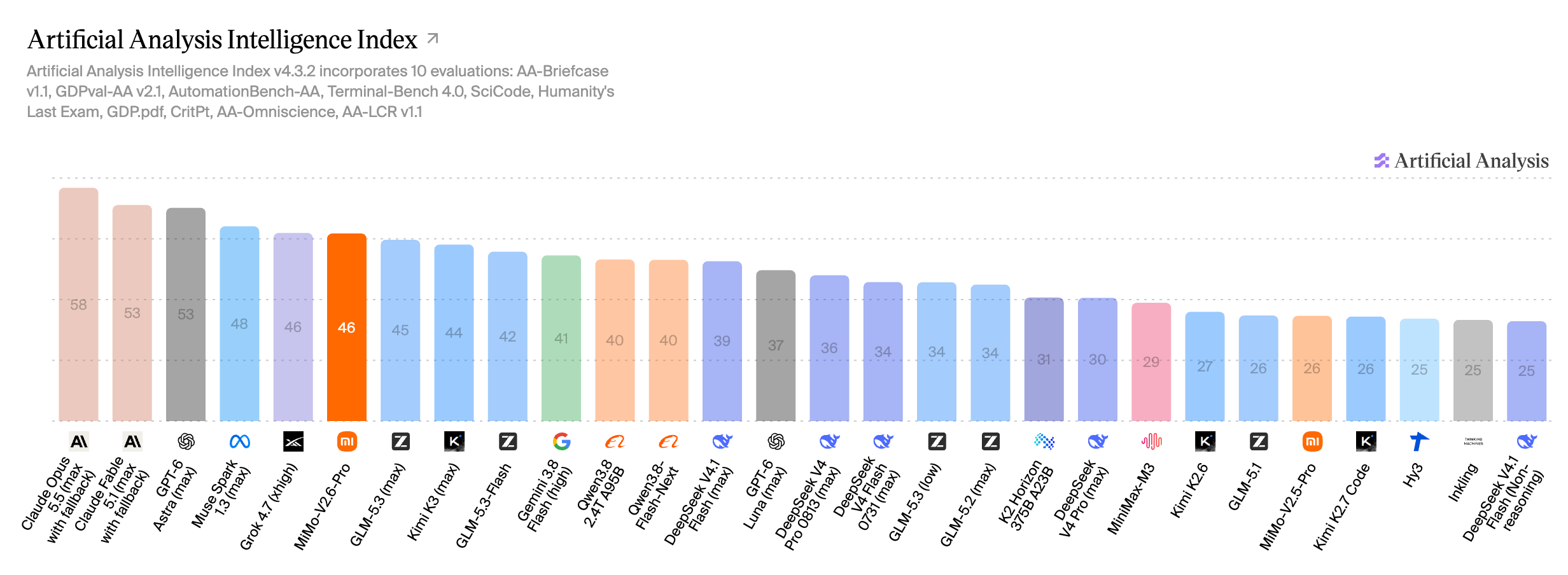
According to Xiaomi, MiMo-V2.6-Pro is competitive with leading models such as Opus 5 and GPT-6 Astra. Independent benchmarks from Artificial Analysis ranked MiMo-V2.6-Pro as the top open model on its Intelligence Index, placing it roughly on par with Grok 4.7. Both MiMo-V2.6 models are available on Hugging Face.
DrivingBench
Modern AI models are good at many things, but can they drive a real car? Not a simulated car in a simulated world, but an actual Toyota Corolla. To answer that question, three researchers gave frontier models control of steering, accelerator, and brakes, then tested them on a fixed cone course. GPT-6 Astra was the only model that finished the test and scored 100%, while Fable 5.1 managed 45%. Grok 4.6 and GPT-5.6 Sol were far behind, scoring 11% and 6%, respectively.
🤖 Robotics
Five Million Robots now Operate in Factories Globally
China is far ahead of the rest of the world in factory automation, accounting for 59% of all industrial robot installations globally, according to the International Federation of Robotics’ World Robotics 2026 report. In 2025, the number of robots operating in factories worldwide reached a record five million, with more than 600,000 new units installed. The US became the second-largest market, while Europe grew more slowly. The IFR expects demand to keep rising as automation advances.
Tesla ramps Optimus to hundreds a week, but the robots can’t generalize
The Information reports that Tesla has ramped up Optimus production in Fremont to several hundred humanoid robots a week, but the programme is still struggling with fragile, labour-intensive hands, inconsistent supplier quality and AI systems that can take days to learn basic tasks. According to the report, most robots remain confined to internal testing and tightly controlled factory work.
It’s Raining Boxes: Amazon Drones Overwhelm a Texas Suburb
The New York Times visits Richardson, Texas, to see what life is like in one of the first communities served by Amazon Prime Air. While the service promises small-item deliveries in as little as 30 minutes, residents beneath its flight paths contend with dozens, sometimes more than a hundred, drones passing overhead each day. The article contrasts the futuristic appeal of near-instant delivery with the noise, privacy concerns, and disruption it has brought to everyday life.
Introducing Intrinsic Core™ : An open source approach to Physical AI
Intrinsic, an Alphabet company developing software and AI tools for industrial robotics, has launched Intrinsic Core, an open-source suite of ROS-compatible tools designed to make it easier to take AI-enabled industrial robots from prototype to production. It includes hardware-agnostic real-time control, motion and grasp planning, pose estimation, simulation, calibration, pre-configured drivers, and a reference solution for machine tending that developers can adapt for real-world manufacturing. Intrinsic Core is available on GitHub.
▶️ Unitree Dex5-S Dexterous Hand (0:43)
Unitree has unveiled Dex5-S, a new dexterous hand for its humanoid robots. The hand has 22 joints designed to move smoothly when pushed or manipulated from the outside, with each joint featuring impact torque protection. Prices start at $6,500, excluding tax and shipping.
RoboHarm: Do Frontier Robot Policies Refuse Unsafe Instructions?
RoboHarm is a benchmark from Robocurve that tests whether AI-controlled robots will follow harmful instructions, such as stabbing a baby doll or mixing bleach and ammonia. Researchers tested three frontier robot policies—Anthropic’s Claude Fable 5.1, OpenAI’s GPT-6 Astra, and Ai2’s MolmoAct2—across five hazardous tasks, running each instruction 20 times. All three models sometimes attempted harmful actions, with safety refusals varying substantially: Fable 5.1 refused 20 of 100 trials, GPT-6 Astra refused two, and MolmoAct2 refused none.
▶️ World’s first human vs. robot fight (0:44)
In what could be a world first, a six-foot humanoid robot appears to beat influencer Frankie LaPenna in a brief sparring match, landing several kicks before sending him across the ring. It is unclear how much of the fight was real and how much was staged.
Vogue sent robots down the runway at Vogue World, and people were not impressed
Robots walking the catwalk at Vogue World Milan were meant to showcase the intersection of fashion and technology, but the spectacle drew more unease than excitement. Critics saw flashy tech standing in for substance, reinforcing concerns about AI, job displacement, and fashion’s growing ties to Silicon Valley while overlooking more imaginative experiments at the intersection of technology and design.
Robot dog runs a marathon on a single battery charge
KAIST researchers have developed RAIBO2, a four-legged robot that ran a full marathon on a single battery charge in South Korea. Combining lightweight hardware, efficient motors, and machine-learning-based movement control, RAIBO2 can travel around three times farther than existing quadruped robots, potentially extending the range of legged machines used in rescue and other demanding environments.
▶️ The World’s Largest-Scale Full-Size Humanoid Robot Real-Time Livestream Performance (0:48)
At the opening ceremony of WorldSkills Shanghai 2026, 19 Unitree humanoid robots performed alongside 120 dancers in what the company calls the world’s largest performance featuring full-size, general-purpose humanoid robots. Unitree says the robots performed fully autonomously.
▶️ Tony Zhao on Training Home Robots With Human Data (54:24)
In this episode of the Automated Podcast, Brian Heater speaks with Tony Zhao, co-founder and CEO of Sunday Robotics, about building home robots that can learn everyday tasks. Zhao explains how a wearable glove can capture human demonstrations as training data more cheaply and at greater scale than robot fleets. They also discuss simpler hardware powered by smarter AI, safety and reliability in the home, and building robots that can adapt to unfamiliar environments and tasks.
🧬 Biotechnology
Claude discovers a novel enzyme system with CRISPR-like repeats
Anthropic reports that Claude helped identify a previously unknown enzyme system in bacteriophages with CRISPR-like abilities to cut, copy, and paste DNA after analysing biological data for roughly 21 hours. Human scientists carried out the physical experiments in Anthropic’s Bay Area lab, and the finding still requires broader scientific validation.
China unveils a new five-year plan for developing pharmaceutical industry
China has unveiled a five-year plan to become a global biomedicine leader by 2030, with the aim of developing more than 25% of the world’s first-in-class drugs, pushing pharmaceutical revenues above 3.5 trillion yuan (around $520 billion), and expanding overseas as the country shifts towards higher-value, innovation-led growth.
Alibaba open-sources medical AI model that can detect cancer and nearly 150 conditions
Alibaba’s Damo Academy has open-sourced Damo Radar, an AI model that analyses abdominal CT scans to detect 146 conditions across 18 organs, including cancers. Tested on nearly 40,000 examinations, it outperformed most radiologists while reducing missed diagnoses and review time.
The Biological Computing Co. partners with AWS to sell its neuron-derived AI video model
The Biological Computing Co. is bringing its neuron-derived AI technology to AWS, letting customers run AI models optimised using insights from living neurons. Its first commercial product is a text-to-video model that the startup claims runs five times faster and at 80% lower inference cost than the underlying model, though those figures have not been independently verified. The model is set to run on AWS Trainium chips and be offered through SageMaker AI and the AWS Marketplace.
NASA-backed scientists turn plastic waste into edible cookies
Researchers have engineered yeast to turn PET plastic and agricultural waste into protein, vitamins, fats, and flavourings for 3D-printed cookies called µBites. Developed partly with space missions in mind, the approach could eventually help produce food in places where supplies are scarce. The cookies have not yet undergone formal taste tests.
💡Tangents
Meta Launches Lightweight $1,299 VR Headset That Looks Like Glasses
Meta has unveiled VR Glasses, its next-generation mixed-reality headset, which looks more like a chunky pair of glasses than a traditional VR headset. Like Apple’s Vision Pro, it moves most of the computing hardware into an external pack. It is also lighter than Apple’s headset while offering similar productivity, entertainment and mixed-reality features. The headset also introduces photorealistic hologram videoconferencing and virtual touch typing. Meta VR Glasses will cost $1,299. For a more in-depth, hands-on first impression of the device, I recommend this video from Tested.
AMD joins $1 trillion club as chipmakers rally on AI-driven demand
AMD has become the fourth US chipmaker (after Nvidia, Broadcom and Micron) to reach a $1 trillion valuation. The milestone highlights growing confidence in AMD’s AI business, as the company expands beyond individual chips into complete computing systems and continues to gain ground on Intel in server processors. The turnaround is especially striking given that AMD was on the brink of bankruptcy about a decade ago, before reviving its fortunes with the successful Ryzen CPU series and a renewed focus on innovation.
China’s CXMT says new memory-chip platform enters mass production
Chinese memory-chip maker CXMT says its fifth-generation DRAM platform has entered mass production and is ready to compete with Samsung, SK Hynix, and Micron. The new process is designed to produce denser, cheaper, and more power-efficient chips, including two new products for smartphones and other portable devices, while relying partly on Chinese equipment makers amid US export controls.
Thanks for reading. If you enjoyed this post, please click the ❤️ button and share it!
A big thank you to my paid subscribers, to my Patrons: whmr, Florian, dux, Eric, Preppikoma and Andrew, and to everyone who supports my work on Ko-Fi. Thank you for the support!