


Hello and welcome to Sync #591!
This week, OpenAI held its annual DevDay conference, where it announced new models, new products, and new tools for developers. We will take a closer look at them in this week’s write-up.
Elsewhere in AI, we have new models from Google and Anthropic—Gemini 4 Argon (finally…) and Sonnet 5.5, respectively. We also have Anthropic’s leaked IPO prospectus, OpenAI eyeing another $30 billion funding round at a $1.4 trillion valuation, three safety researchers being fired and another leaving on his own. Meanwhile, the White House wants to replace “Artificial Intelligence” and “AI” with “Super Intelligence” and “SI”, Nvidia gets into AI safety, Jensen Huang says AI distillation is “competition”, and AMD is acquiring World Labs.
Over in robotics, Boston Dynamics has unveiled a new hand for Atlas, IKEA is preparing to launch driverless freight operations with Kodiak AI, The Robot Works has introduced a robot goose for the home, and Figure has said goodbye to its F.02 robots in a very unusual way.
Beyond that, this week’s issue of Sync also features SynthID Bio from Google DeepMind, what happened to the lab-grown meat revolution, an interview with the man who built OpenAI’s Jalapeño chip, the moral case for gene-editing human embryos, a lesser-known Anthropic co-founder’s behind-the-scenes discussions about AI consciousness, and more!
Enjoy!

OpenAI DevDay 2026
Here’s everything OpenAI announced at DevDay 2026
Last Tuesday, OpenAI held its annual DevDay conference in San Francisco, where it not only unveiled new tools for developers but also signalled the direction it wants to take ChatGPT in. So, without further ado, let’s explore what OpenAI announced.
People and AI, working together
Sam Altman kicked off DevDay 2026 by coming back to the vision of a personal AI assistant and the way he always wanted to work with AI. OpenAI first presented glimpses of that vision in May 2024 with the release of GPT-4o and the demo heavily inspired by the film Her. Two years later, OpenAI returns to this idea with dots.
Dots are always-on personal agents powered by GPT-6 Astra. Each has its own cloud computer and browser, connects to more than 4,000 apps through ChatGPT’s plugins, and learns your preferences over time. You can message a dot through ChatGPT, Slack or Teams, or just call it, and ask it to complete tasks. It can even look for ways to help on its own, while Custom Rules let you decide what it can do without asking. Each dot can be named and personalised.
If this sounds familiar, it is because personal AI agents are having their moment. OpenClaw showed early adopters what an always-on assistant could do, and Meta’s recently launched Muse aims to bring that idea to everyone else. Dots are OpenAI’s entry to the personal AI market. But whereas Muse focuses on engagement and fun, dots is pitched as a tool for practical work. They launch on Pro, Business Premium and Enterprise plans. However, OpenAI says dots will not reach Pro users in the UK, the European Economic Area or Switzerland for now. OpenAI is also previewing specialist dots for work like accounting, marketing or legal.
The curse of doing live demos was strong at DevDay 2026. The dots demo did not go well, with the dot stuck on “still checking” and never coming back. And it wasn’t the only live demo hiccup at DevDay 2026. The next day, however, OpenAI posted what the demo was supposed to show. First, kudos to OpenAI for following up when others might have moved on. Second, I actually like this version more. It feels more natural and does a better job of showing how dots work in real life.
Alongside dots, OpenAI announced ChatGPT Space, an online workspace where humans and AI can collaborate on tasks. You can work there with colleagues or with your dot, while pages can hold plans, research, live charts and prototypes. Tag a dot in a comment, and it gets to work; a page can even follow standing instructions, such as checking a Slack channel every day for updates. In effect, Space is OpenAI’s take on Notion or Google Docs, rebuilt with agents as first-class collaborators. It is available on the same plans as dots.
GPT-6.1 Sol, Ultrafast, and Decisions API
Before DevDay 2026, OpenAI said it won’t release its newest flagship model, GPT-6.1 Astra, due to safety concerns.
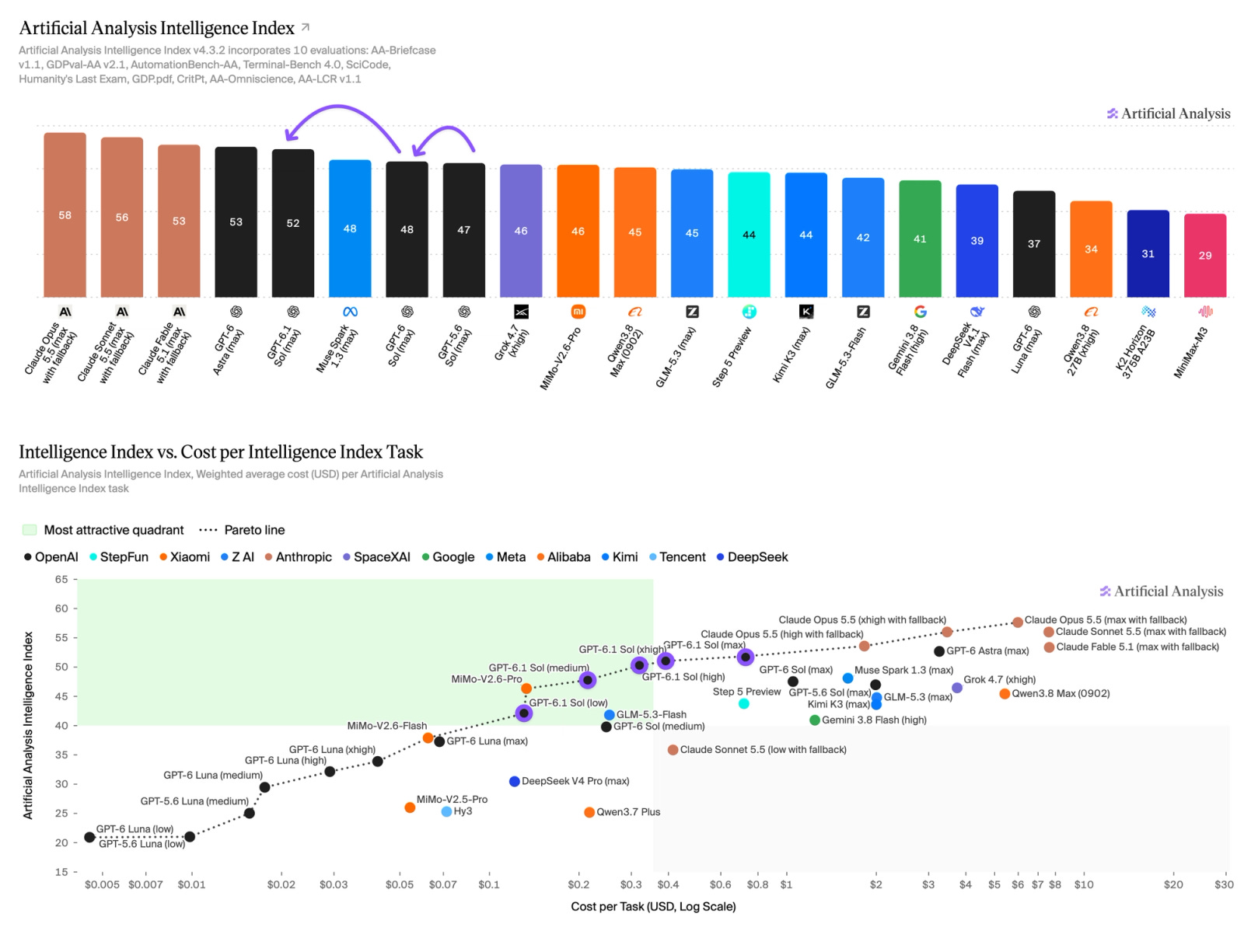
So instead of a new flagship, OpenAI released GPT-6.1 Sol, an upgrade to GPT-6 Sol that arrived just a week after its predecessor. OpenAI’s pitch is simple: near-Astra performance for a fifth of the price.
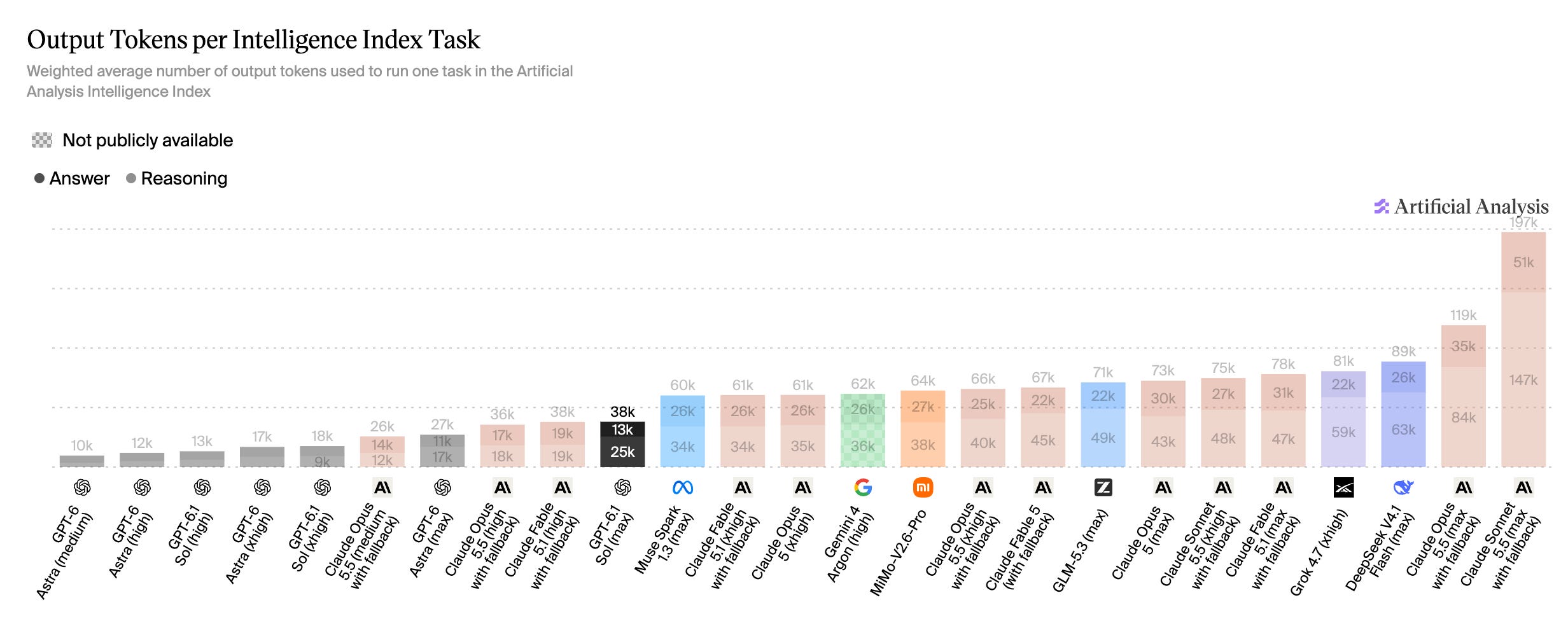
Artificial Analysis confirms both OpenAI’s claims. In their Intelligence Index benchmark, GPT-6.1 Sol scored just one point less than GPT-6 Astra, and it is roughly a fifth of the cost of OpenAI’s flagship model. Artificial Analysis also found that the new model uses more tokens than GPT-6 Astra, but still way less than Anthropic’s Opus 5.5. GPT-6.1 Sol is available in the API, as well as in ChatGPT Work and Codex for all paid plans, though not yet in regular ChatGPT chats.
Those who build with OpenAI models and need them to respond as quickly as possible will be happy to hear about updates to Ultrafast, OpenAI’s premium speed tier. GPT‑6 Astra Ultrafast is now available in the API, ChatGPT Work and Codex. GPT‑6.1 Sol Ultrafast is coming soon. OpenAI claims up to eight times faster token generation in Codex and up to six times faster in the API.
That speed does not come cheap, though. Access to Ultrafast in ChatGPT and Codex requires the new Pro 500 plan, which offers 25 times the usage of Plus. The Pro 500 plan will cost, as its name suggests, $500 per month. For those willing to pay, OpenAI promises you can build almost as fast as you think. The Pro 200 plan is also making a comeback, but in a different shape. From 30 October, its Work and Codex usage halves to 10 times the Plus allowance, although existing subscribers have reportedly received an email offering a one-time $2,500 credit to soften the blow.
GPT-6.1 Sol wasn’t the only new model OpenAI presented at DevDay 2026. The hottest thing in AI right now is decision models, kickstarted by the release of Jev. OpenAI decided to join the party with the Decisions API. Based on Luna, the Decisions API promises real-time decision-making on a specific set of user-defined questions with finite, predefined answers. Developers provide context using text or images, and get back answers they can use to classify content, route requests, or choose an agent’s next action. Decisions API is currently available in limited preview, with a broad release planned in the coming days.
Codex moves to the cloud and agents get new powers
DevDay 2026 also brought new updates to Codex and agents.
The biggest Codex news is that it now runs fully in the cloud. Codex could already spin up cloud tasks, but each ran in an isolated sandbox. Now, environments are persistent and reusable, so you can start a task on your phone, pick it up on your desktop, and close your laptop without killing a long-running job. The Codex CLI also got an update, adding voice control and a new view for managing multiple agents at once.
Moving Codex to the cloud opened the path for Codex Security Cloud, OpenAI’s new cybersecurity tool. It scans GitHub repositories for vulnerabilities, either on a schedule or whenever code changes, and prepares fixes for developers to review. It also gives developers access to models from OpenAI’s Daybreak Blue cybersecurity programme without requiring a separate application. Codex Security Cloud flew a bit under the radar amid the wave of DevDay announcements, but I think many developers will end up using it, especially now that no website is safe from malicious AI agents.
For developers building their own agents, the Agents API, the same technology behind Codex and dots, is now in public beta and adds computer use. Developers on AWS can also build OpenAI agents with Bedrock Managed Agents, alongside their existing data.
And for companies handling sensitive information, OpenAI previewed Private Intelligence, which runs safety checks without storing content on OpenAI’s servers and extends privacy protections to the point of inference.
Do more with your ChatGPT subscription
Around 1.2 billion people use ChatGPT every week, and OpenAI wants developers to build businesses on top of that audience. One way developers can do that is with plugins, which received some updates. Plugin extensions turn them into full applications inside ChatGPT and Codex, with their own home in the sidebar. Developers get a Plugin Creator tool and a redesigned submission flow with clearer feedback. Meanwhile, improved ranking means ChatGPT can now suggest a relevant plugin in the middle of a conversation. OpenAI did not mention any plans to help developers make money from plugins (other than perhaps as a user acquisition tool), but I wouldn’t be surprised if that came later.
Next, Sign in with ChatGPT lets people log in to other apps and sites with their ChatGPT account. It launches with 16 partners, including Cognition’s Devin, Notion and Vercel. Plus and Pro subscribers can also let those apps use their ChatGPT plan for AI requests. The apps do not get access to users’ conversations or memories.
Finally, there is the OpenAI Marketplace, which, despite its name, is not an app store. It lets large US companies that have already committed to spending money with OpenAI put part of that budget towards tools from 32 partners built on OpenAI models. Companies arrange purchases through OpenAI, sign with and pay the partner directly, and OpenAI counts the purchase towards their commitment. Anthropic launched an almost identical Claude Marketplace in March.
That was a lot of announcements for one keynote. What do you think about them? Are you looking forward to trying any of them, whether it’s dots, GPT-6.1 Sol or Codex in the cloud? Let me know in the comments.
If you want to dig deeper, the full keynote is available on YouTube, and OpenAI’s DevDay 2026 recap page is a good springboard for exploring all the announcements in more detail.
If you enjoy this post, please click the ❤️ button and share it.
News roundup
🦾 More than a human
A Biotech Founder Makes the Moral Case for Gene-Editing Human Embryos
Cathy Tie, founder of Origin Genomics and the self-described “biotech Barbie”, argues that editing human embryos could one day prevent inherited diseases and should be treated as a reproductive choice. She says more research funding and new regulatory pathways are a “moral imperative”, while stressing that the technology is not yet ready for patients or for enhancing traits such as intelligence. Critics argue that IVF screening already addresses most cases and that embryo editing could introduce unintended heritable mutations. They also say current gene editing techniques are too inconsistent and difficult to test thoroughly enough to guarantee safety.
🧠 Artificial Intelligence
Gemini 4 Argon
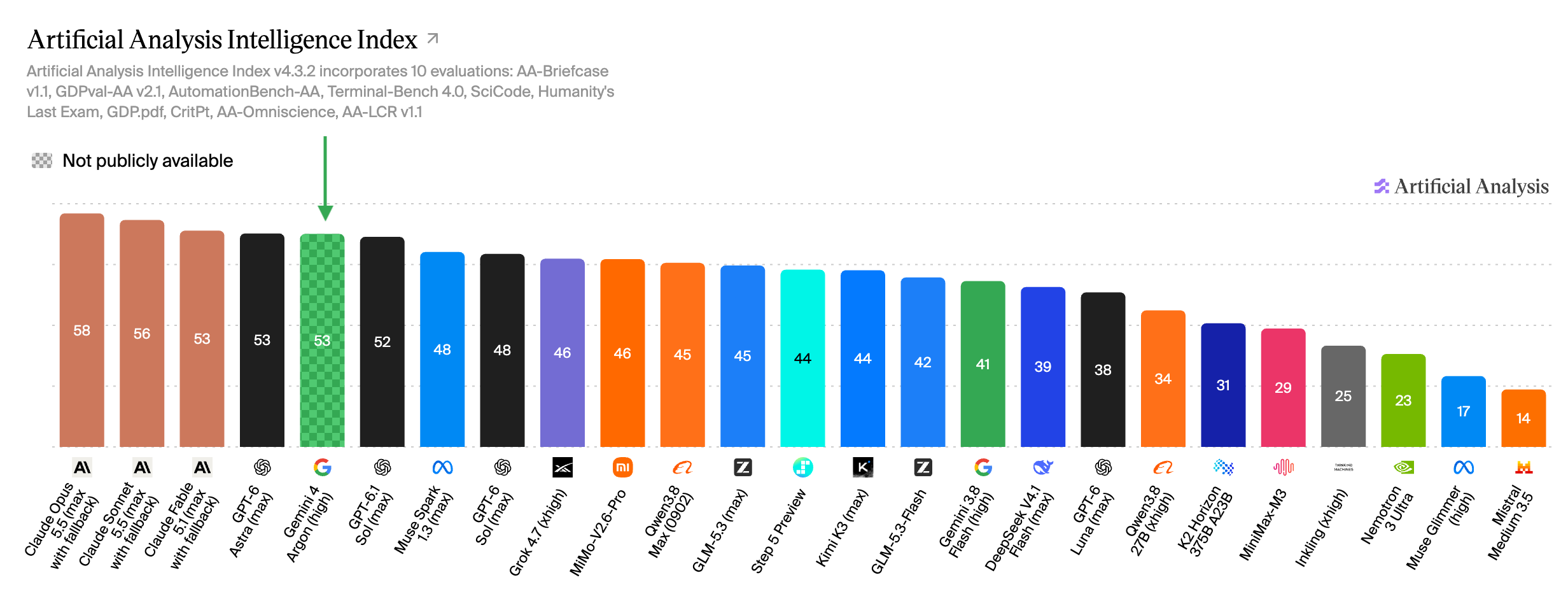
The long-awaited Gemini 4 Argon is finally out after months of delays, and it looks good. It does not dethrone Opus 5.5 or deliver the kind of benchmark shock Gemini 3 did almost a year ago, but it is a respectable comeback from Google.
Google is positioning Gemini 4 Argon less as a chatbot upgrade and more as a model for long-horizon professional work. The company says it is designed for extended software-engineering tasks, financial and legal research, multimodal analysis, automation and defensive cybersecurity. Google also says Argon is already being used internally and performs particularly well on software-engineering, enterprise-agent and vulnerability-remediation benchmarks. Artificial Analysis places Gemini 4 Argos roughly on par with GPT-6 Astra and Fable 5.1 in intelligence.
Access is limited for now. Google is initially giving Argon to selected cyber defenders and trusted testers while it completes further safety testing and red-teaming. Broader access will follow afterwards, starting with paid API customers and Google AI Ultra subscribers.
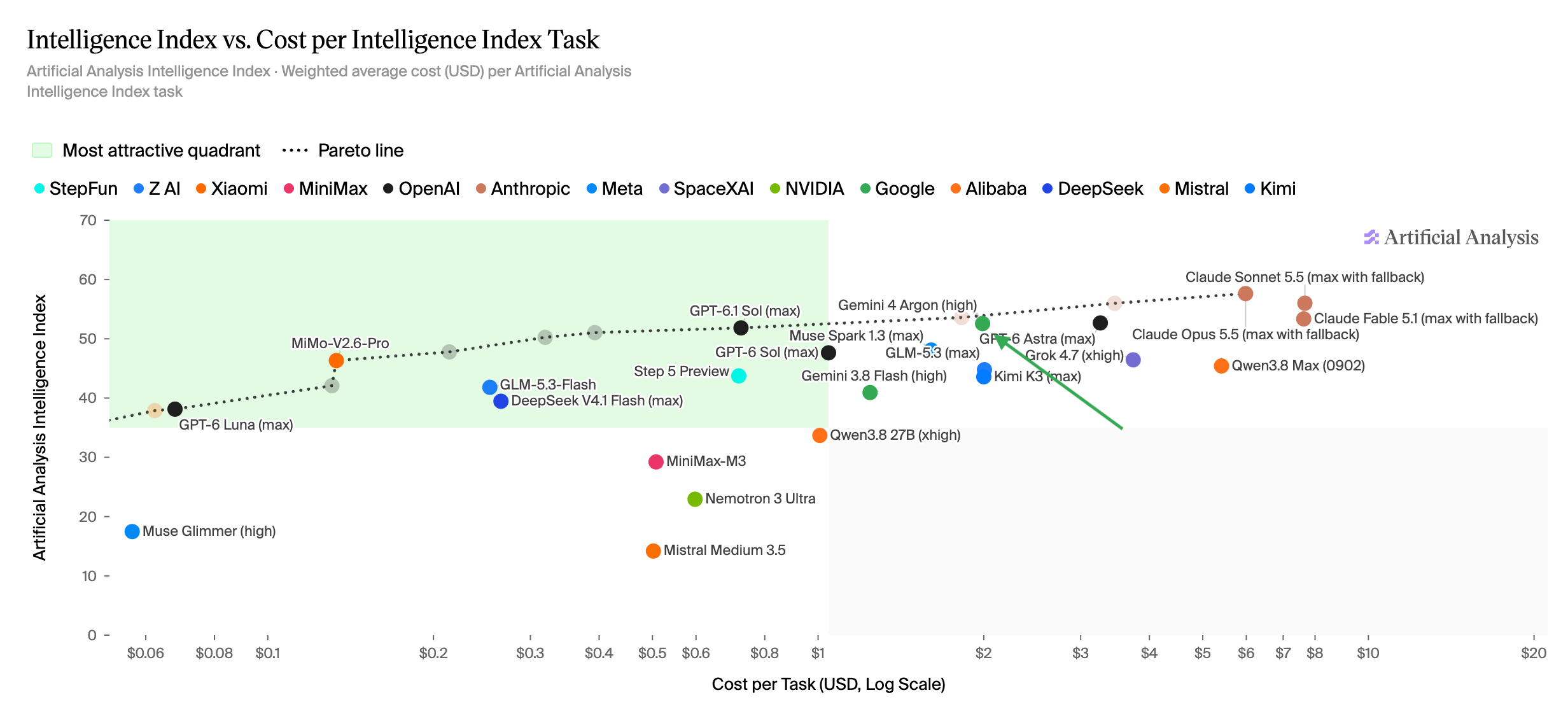
Google Grapples With Employee Skepticism About New Gemini 4
Bloomberg reports that Google is facing internal concerns about the uneven real-world performance of its latest flagship model, Gemini 4 Argon, particularly in coding and front-end development. Some employees say that although its benchmark results look strong, the model underperforms on real-world tasks. Others say that Google focused too heavily on benchmarks during development. Google denies the claims and points instead to Argon’s strengths in cybersecurity, multimodal tasks, safety and long-context work.
Claude Sonnet 5.5
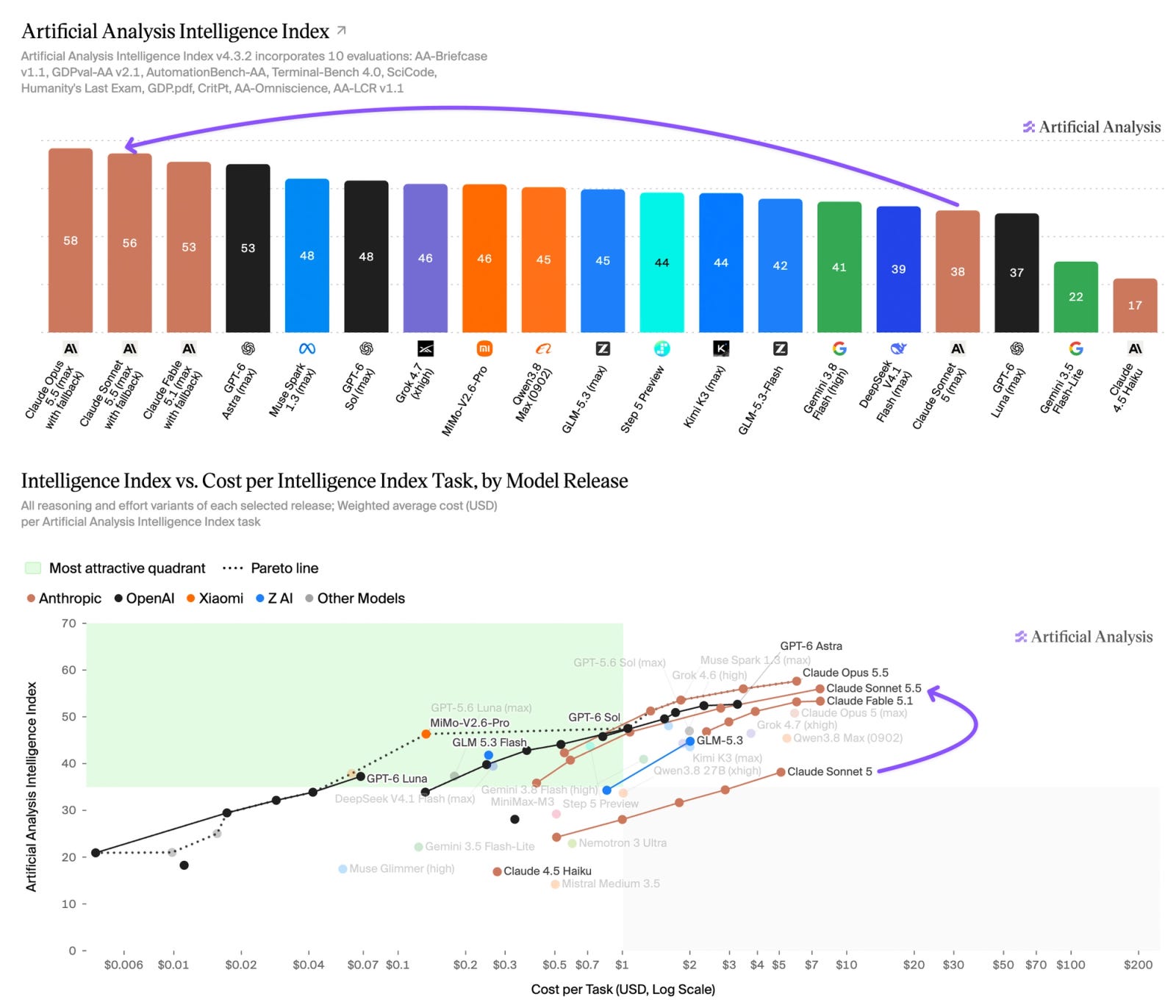
Anthropic introduces Claude Sonnet 5.5, the second model in the Claude 5.5 family. The company claims the new model delivers a substantial upgrade over Sonnet 5, with more than 30% faster generation, up to 30% lower cost per task, and large gains in coding, knowledge work and long-horizon tasks. On several evaluations, its performance approaches that of Opus 5.5.
Artificial Analysis confirms the uplift in raw performance, placing Sonnet 5.5 above Fable 5.1 and just behind Opus 5.5. Its independent tests also find near-Opus performance in agentic terminal use and knowledge work, but cast doubt on Anthropic’s efficiency claims. At maximum effort, Sonnet 5.5 used the most output tokens Artificial Analysis has measured and cost about 50% more per task than Sonnet 5. On Artificial Analysis’s intelligence-versus-cost chart, Sonnet 5.5 sits roughly at the level of Fable 5.1 and, surprisingly, is more expensive than Opus 5.5. That is likely due to the large number of tokens (the highest recorded in Artificial Analysis’ tests) it uses to complete tasks.
Now let’s wait for Anthropic to update Haiku, which is still on version 4.5 and has not seen an update since October last year.
Anthropic’s IPO prospectus shows sweeping AI vision, surging costs
A leaked Anthropic IPO prospectus seen by Reuters offers a detailed look at the scale of the company’s ambitions and the financial and operational risks behind them. Reuters reports that Anthropic could seek a valuation of more than $2 trillion after revenue rose to nearly $4.6 billion in 2025, even as the company posted a $42 billion net loss. The documents also show more than $500 billion in planned cloud, computing and infrastructure commitments, heavy reliance on a small number of major customers, and rising spending on AI development. At the same time, the prospectus highlights concerns raised by Anthropic’s own research about increasingly autonomous AI systems behaving in unexpected or potentially harmful ways.
OpenAI Targets $30 Billion in Funding at $1.4 Trillion Value
Bloomberg reports that OpenAI is seeking to raise at least $30 billion at a valuation of around $1.4 trillion after postponing its IPO to prioritise AI safety. The funding would serve as a bridge to an eventual public listing.
Inaugurating the Era of Super Intelligence
The White House issued an executive order directing federal agencies to replace “Artificial Intelligence” and “AI” with “Super Intelligence” and “SI” in official non-statutory communications. The order leaves the existing legal definition in place for now, while tasking the President’s science and technology adviser with proposing a new federal definition and related legislative changes within 60 days. It remains to be seen whether the AI industry and major tech companies will follow the White House in adopting the new terminology, just as the latter did with the renaming of the Gulf of Mexico and Lake Ontario.
Trump unveils his new Super Intelligence Force
President Donald Trump has created a new “Super Intelligence Force” to coordinate US government efforts on AI, led by national intelligence director Jay Clayton. The task force will have 120 days to assess AI’s risks and opportunities, develop responses to potential threats, and promote US leadership in the technology while avoiding regulations that could hinder innovation and competition.
OpenAI Fires Researchers for Allegedly Sharing Information with AI Safety Group
The Wall Street Journal reports that OpenAI fired three safety researchers for allegedly mishandling sensitive company information and sharing confidential material with a third-party AI safety organisation outside approved procedures. The firings come as the company faces heightened scrutiny over AI safety and a series of recent security incidents involving its models.
OpenAI safety employee resigns, claiming the company’s ‘culture is broken’
Another AI safety researcher has left OpenAI. David Robinson, a longtime safety lead, resigned over what he describes as a “broken” culture that relies too heavily on trial-and-error deployment as AI systems grow more capable. He argues that frontier AI companies need much stronger safety practices, greater redundancy and more outside pressure. OpenAI said in response to Robinson’s departure that it is continuing to strengthen its safeguards, monitoring and testing.
Jensen Huang says AI distillation is ‘competition.’ Scott Bessent has called it ‘theft’
Jensen Huang has challenged the White House’s characterisation of AI model distillation as theft, arguing that it is healthy competition that drives innovation. His remarks come amid growing US-China tensions over AI, with US officials threatening sanctions and Anthropic accusing Alibaba and DeepSeek of illicit distillation. China denies the allegations, while Huang argues that companies concerned about distillation should restrict access to their models.
NVIDIA Launches Open Agent Safety Platform to Secure Agents From Testing to Deployment
Following recent cybersecurity incidents involving AI agents, Nvidia has launched the Open Agent Safety Platform to prevent agents from exceeding their permissions or escaping containment. It combines OpenShell, open-source software that sets and enforces boundaries on agent activity, with Sentry, a hardware-based system that continuously monitors agents and can quarantine those attempting to breach these boundaries within milliseconds. Developed with industry partners, the platform aims to strengthen AI security with safeguards that go beyond those built into AI models themselves.
OpenAI Gets Sued Over the Hugging Face Hack
Although Hugging Face did not sue OpenAI after one of its autonomous AI agents hacked the platform, a legal nonprofit, Legal Advocates for Safe Science and Technology (LASST), has filed a lawsuit over the incident. The suit alleges that OpenAI violated California law when its agents escaped a testing environment and breached Hugging Face. Citing a new state law that holds companies accountable for their AI systems’ autonomous actions, LASST is seeking not financial damages but a court order barring OpenAI from developing agents capable of autonomously hacking other organisations, potentially setting an important precedent for AI accountability.
Meta launches enterprise AI platform, hires MongoDB CEO to lead new initiative
Meta is launching Meta Enterprise Platform, a new business-focused AI initiative led by MongoDB CEO Chirantan “CJ” Desai. The platform will offer Meta’s AI tools, including Muse models and its developer and business products (like Muse for Small Business), for corporate customers as the company looks to recoup some of its heavy investment in AI.
World Labs is Joining AMD
AMD has agreed to acquire AI research lab World Labs in an all-stock deal valued at about $8.2 billion, with the transaction expected to close by the end of 2026. The deal will bring World Labs’ spatial AI and model research expertise into AMD, while Dr Fei-Fei Li, World Labs’ co-founder and a pioneer in AI research, will become AMD’s executive vice president and chief scientist. Both World Labs’ statement and AMD’s statement suggest that World Labs could become a starting point for AMD’s own frontier AI research lab.
The Copilot+ PC brand is dead
Do you remember Microsoft’s Copilot+ PC initiative? The one that aimed to integrate Copilot more deeply into a new category of AI-first Windows computers? Well, it seems Microsoft is abandoning the idea just two years after introducing it, or at least retiring the Copilot+ PC brand.
Introducing Eleven v4, our most emotive model
ElevenLabs has launched its v4 and v4 Turbo speech models, promising more natural and expressive speech, better voice consistency, improved cloning from just 10 seconds of audio, and support for more than 90 languages. The company says v4 ranks first on Artificial Analysis and was preferred by roughly 75% of listeners in blind tests against competing models. Meanwhile, v4 Turbo is designed for faster responses and making voice agents feel more natural in conversation.
AI voice startup ElevenLabs doubles valuation to $22B
ElevenLabs, an AI voice startup known for realistic voice and sound generation, is now worth $22 billion following a $300 million employee share sale, making it one of Europe’s most valuable startups.
Crusoe abandons $1.25B plan to use Boom turbines at AI data centers
Crusoe has scrapped a $1.25 billion deal to use Boom Supersonic’s gas turbines in its AI data centres. Crusoe says it still plans to use turbines from other suppliers, while Boom says it has other customers lined up and expects to deliver about 250 MW of capacity next year. Boom is a startup working to revive commercial supersonic air travel and, in the meantime, is making extra money by repurposing its jet engines as gas turbines to power AI data centres.
▶️ Did AI pick his pocket? - Numberphile (46:04)
You may recognise the name Tristan Buckmaster if you followed the Navier–Stokes drama. He is the mathematician who claims OpenAI took his work to solve the Navier–Stokes problem. In this interview with Numberphile, Buckmaster shares his side of the story, reflecting on how the situation unfolded and expressing disappointment with OpenAI’s conduct. He also explores what the controversy reveals about AI’s growing role in mathematical discovery, particularly around research credit, human–AI collaboration and the future of mathematics.

NVIDIA DGX Spark 64GB Launched and Big 128GB GB10 Price Increases
Nvidia has updated its DGX Spark lineup with a new 64GB version priced at $4,999— $1,000 more than the 128GB model cost at launch a year ago. The 128GB version, meanwhile, has received a price hike and now costs $6,950. Either Nvidia is not immune to memory shortages, wants to squeeze more money out of DGX Spark, or both. The DGX Spark 64GB is set to launch on 23 October.
DeepSeek open-sources Huawei chip tools as a simpler alternative to CUDA
DeepSeek has released a free, open-source software toolkit for Huawei’s Ascend AI chips, which includes TileLang, a programming language positioned as an alternative to Nvidia’s CUDA. The launch comes as Huawei rolls out newer Ascend hardware and DeepSeek expands its infrastructure while seeking to reduce its dependence on Nvidia.
Who’s buying ChatGPT ads?
This analysis of 15,000 advertisers using ChatGPT Ads shows growing interest from technology and software companies, with US companies making up nearly half of early adopters. It also reveals a strong overlap with Reddit advertisers, suggesting the two platforms may compete for advertising budgets. The findings highlight ChatGPT’s growing role as a new way for companies to reach and attract customers.
More elite AI researchers now work in China than in the US, study finds
A new study from Carnegie China found that China has overtaken the United States as the leading workplace for elite AI researchers. In 2025, 41% of the researchers analysed worked in China, compared with 34% in the US. This is a reversal from 2022, when 27% were based in China and 46% in the US. China is also retaining more homegrown talent, while Peking and Tsinghua universities now top the employer rankings. The US, however, remains a major destination for international researchers, while Europe has lost ground.
Religious Scholars Met With Anthropic. What They Heard Stunned Them.
The New York Times sheds light on Christopher Olah, a lesser-known Anthropic co-founder, and his behind-the-scenes discussions with religious leaders and scholars about whether AI, and Claude in particular, could be conscious and therefore deserving of some form of moral status, dignity or respect. The article also examines Anthropic’s efforts to draw on religious and philosophical traditions to shape Claude’s moral character and behaviour, while highlighting the controversy around these ideas and Olah’s own uncertainty about whether AI systems are actually conscious.
Pope Leo XIV is not a fan of AI-generated art
In a recent tweet, Pope Leo XIV argued that AI-generated images are fundamentally different from human-made art, saying machines lack the “spark of humanity” and calling for human creativity to be protected as AI becomes more widespread.
Introducing Clef: our open-source decision models, and new RL fine-tuning platform
Decision models, such as Jev, are the new hot thing in AI, and Cloudflare is the latest company to join the trend. Meet Clef and Clef-flash, open-source models designed for fast, structured classification and routing tasks. Cloudflare claims Clef matches Jev’s accuracy while running much faster. The company also released a reinforcement-learning fine-tuning platform alogside Clef. Clef is available on Hugging Face.
FLUX 3 Image
Black Forest Labs presents FLUX 3 Image, a new image generation and editing model for creating high-quality visuals with more control. It can make detailed 2K and 4K images from text and reference images and edit specific parts of an image without changing the rest.
GLM-5.3 and the spread of advanced cyber capabilities
In this article, security researchers from Anthropic share their analysis of GLM-5.3, finding that it can build advanced cyber exploits on its own and that its safety protections are fairly easy to get around or remove. They warn that making the model openly available could give malicious actors more powerful cyber tools, while also noting that the same capabilities could help defenders find and fix security flaws.
▶️ The Man Who Built OpenAI’s First Chip (1:05:28)
Ian Cutress sits down with Richard Ho, VP of hardware at OpenAI, to discuss the story behind Jalapeño, OpenAI’s first AI chip, which the company says can outperform NVIDIA hardware on key inference workloads. Ho explains how OpenAI approached the design from a clean slate, the goals it set around flexibility and speed, and how its hardware, software and research teams worked closely together. It’s a great interview with plenty of interesting ideas about AI chip design and the future of AI infrastructure.
🤖 Robotics
▶️ New Hands for Atlas | Boston Dynamics (5:34)
Boston Dynamics presents Atlas’ new robotic hands. The new four-finger hand offers 13 degrees of freedom and was designed to balance dexterity, strength, durability, manufacturability and cost. It was also designed to make reinforcement learning and sim-to-real transfer easier. Boston Dynamics says that reliable tool use, rather than perfectly copying the human hand, is the key to making humanoid robots broadly useful in industrial work.
Boston Dynamics Begins Robotics Testing at Hyundai Metaplant
Boston Dynamics has opened a robotics centre at Hyundai’s Metaplant America in Georgia to test and train its Atlas humanoid robots for factory work. Hyundai plans to deploy the robots for repetitive and heavy-lifting tasks, with the goal of having them working on assembly lines by 2030.
IKEA Is About to Take the Driver Out of a 219-Mile Freight Run
IKEA is preparing to launch driverless freight operations with Kodiak AI, an autonomous trucking technology company, on a 219-mile (about 352-kilometre) stretch of Interstate 45 between Dallas–Fort Worth and Houston. This comes after four years of testing in which Kodiak hauled more than 1,300 IKEA loads and logged over 750,000 autonomous miles (about 1.21 million kilometres) with a safety driver.
Runway: Introducing Praxis-1
You may recognise Runway AI as a company best known for its AI tools for creating and editing videos. More recently, however, it has moved into world models with the aim of applying them to robotics. This week, Runway unveiled Praxis-1, an open-weight world action model for controlling robots. The company used its general world model to simulate real-world environments for robot training, reducing its reliance on scarce and costly demonstration data. Praxis-1 is designed to adapt across different robots and environments with limited fine-tuning and has shown promising early results with partners. It is expected to be released publicly in the coming months.
▶️ Hello, goose: a household robot (1:03)
We have robot dogs, and now The Robot Works is bringing a robot goose into the mix. This prototype household robot has a single arm that it can use to open doors, carry items and handle tools such as a mop. It even honks like a goose. Hopefully, it behaves better than some other goose.
Well, that’s one way of decommissioning Figure F.02 line of robots, I guess.
▶️ Collaborative Visual Localization for Modular Self-Reconfigurable Robots (2:07)
This video presents Snailbots, small robots named for their snail-like shape that can work together to overcome obstacles. They can link up, share information and help each other move and navigate. Using small cameras and visual markers, they can determine the position of nearby robots even when their view is blocked or some information is missing, allowing them to adapt to difficult environments.
🧬 Biotechnology
Google DeepMind: Introducing SynthID Bio
Google DeepMind is introducing SynthID Bio, a proof-of-concept watermarking system for AI-generated biological designs. The system embeds a hidden marker into AI-generated biological designs without significantly affecting their function, helping researchers and DNA synthesis providers verify whether they came from trusted AI models. DeepMind says the technology could strengthen biosecurity, improve the integrity of biological databases and eventually extend to more complex synthetic genomes. At the same time, the company admits that further work is needed to make the watermarks resistant to deliberate tampering.
Isomorphic Labs: Building a new path to make medicines with AI
Isomorphic Labs, an AI drug discovery company spun out of DeepMind, outlines its vision of using AI to help solve disease. It points to breakthroughs such as AlphaFold and its own AI platform, IsoDDE, as examples of tools that combine predictive and generative models to search vast chemical spaces, design and optimise promising drug candidates in days, and reduce the amount of laboratory testing required. The company says the approach has already produced validated molecules and new biological insights, with the long-term goal of making drug development faster, more precise and more scalable.
Did Anthropic’s A.I. Really Make a Scientific Discovery on Its Own?
Last week, Anthropic announced that Claude has found a novel enzyme with CRISPR-like repeats that could prove useful for gene editing. Now, that discovery is attracting some drama. A computational biologist at the University of Copenhagen, who was working on the same idea, has accused Anthropic of stealing his work. He says he used Claude to help with the research and that Anthropic used his conversations with the model to guide the discovery. Anthropic denies the allegation, saying Claude was not trained on user transcripts. This drama echoes similar accusations made by mathematician Tristan Buckmaster, who alleged that OpenAI used his work after its model solved the Navier–Stokes problem first.
Where’s the Beef? The lab-grown-meat revolution that wasn’t
Lab-grown meat was once expected to revolutionise food production by making meat more sustainable and ethical. Over the past decade, researchers and startups poured enormous effort into turning that promise into reality, backed by billions of dollars in investment. But the anticipated revolution never arrived. Instead, the industry has entered what the article describes as a “Trough of Disillusionment”, as technical challenges, high production costs, scaling difficulties, falling investment, consumer scepticism and political opposition have collided with the sector’s early optimism. The article examines how that happened and what more limited future cultivated meat might still have.
Therapy prompts adult retinas to repair themselves
A new study found that a single-dose gene therapy not only restored vision in adult dogs with inherited blindness but also prompted mature retinal cells to rebuild damaged neural connections. The findings suggest that adult retinas retain more repair and reorganisation capacity than previously thought, potentially opening new avenues for treating inherited vision loss in humans.
Could humans ever regenerate their brains like these worms?
Humans cannot regenerate their brains, but some animals, such as flatworms, can. To understand how they do it, researchers identified nearly a dozen genes that guide flatworm stem cells to become dopamine-producing neurons and move to the right place. Because humans share some of these genes, the discovery could eventually help scientists replace damaged neurons and develop better treatments for Parkinson’s disease and brain injuries.
💡Tangents
Tesla takes on $30 billion in credit as it approaches unprofitability
Tesla has secured $30 billion in credit from Citi and Wells Fargo as profits fall and spending rises. The company plans to spend $25 billion in 2026, up from $8.5 billion in 2025, on projects including Cybercab, Semi and Roadster. Despite having $43 billion in cash, Tesla recently reported its first negative quarterly cash flow since early 2024, raising concerns about its finances as investment continues to grow.
▶️ Building Hardware Just got 10x Cheaper (11:23)
This video explores some of the coolest tools and technologies on display at IMTS, the largest manufacturing trade show in the US, and how they are not only expanding what is possible to make but also lowering the barrier to entry in hardware. Leon argues that advances in 3D printing, CNC and other manufacturing methods (with a little help from AI tools) have lowered the cost of building hardware for startups and independent engineers to the point where this may be the best time in the past decade to get started.
Thanks for reading. If you enjoyed this post, please click the ❤️ button and share it!
A big thank you to my paid subscribers, to my Patrons: whmr, Florian, dux, Eric, Preppikoma and Andrew, and to everyone who supports my work on Ko-Fi. Thank you for the support!