


Hello and welcome to Sync #592!
It’s mid-October, which means Nathan Benaich and Air Street Capital are back with their State of AI Report. As always, they deliver a well-researched and detailed overview of what has happened in AI over the past 12 months, and in this week’s issue of Sync, we take a look at some of the key findings.
Elsewhere in AI, Anthropic finally updates Haiku, while Mistral releases its largest model yet. Meanwhile, Sam Altman says society should accept “bad things” in return for the benefits of AI, as OpenAI reportedly looks to raise $30 billion while its revenue is $20 billion below previous projections. We also have intelligent UIs from both OpenAI and Anthropic, OpenAI watermarking text, and Google DeepMind launching SynthID Detector.
Over in robotics, Waymo secures a $5 billion loan, Boston Dynamics gets a new CEO, and delivery robots are coming to London and four other locations in the UK.
Apart from that, this week’s issue of Sync also features a new startup joining the BCI party, Biohub and its partners investing $1.8 billion in AI-ready biological data, OpenAI releasing 722 maths manuscripts, a look at which AI subscription offers the best value, the state of the software engineering industry, and more!
Enjoy!

What the State of AI Report 2026 tells us
Every year since 2018, Nathan Benaich and Air Street Capital have taken a comprehensive look at the AI industry in their State of AI reports. This week, they published the 2026 edition. Spread across 244 slides, the ninth report covers research, industry, politics and safety, before finishing with predictions for the year ahead. It’s a lot to take in, so here are the highlights.
A three-lab race at the frontier
According to the report, the frontier is now a three-lab race between Anthropic, OpenAI and Google. Which one comes out on top depends on what you measure, but the three of them are well ahead of everyone else.
What is clear, though, is that measuring them is getting harder. Benchmarks that were designed to stay unsolved for years are now saturating in months. For example, ARC-AGI-2, a set of visual puzzles that are easy for humans but notoriously hard for AI, went from 18% to 95% in eleven months. Its successor, ARC-AGI-3, launched in March with interactive, game-like environments meant to be much harder. It was also saturated.
It is also worth highlighting how much an agent’s performance depends on its harness, the software around a model that gives it tools, instructions and memory. The right harness can massively improve AI’s performance, turning a general model into a specialised one.
The report also highlights how much an agent’s performance depends on its harness, the software around a model that gives it tools, instructions and memory. The right harness can massively improve AI’s performance, turning a general model into a specialised one.
AI is starting to build AI
If one idea dominated AI research this year, it was recursive self-improvement (RSI), or AI that helps build better AI. In March, Andrej Karpathy released autoresearch, a small project that brought RSI onto everyone’s radar. It is a toy compared with what frontier labs are doing, but it caught people’s attention, collecting almost 100,000 stars on GitHub.
Frontier labs see RSI as the next big thing in AI. Anthropic recently published measurements showing that Claude now leads 26% of the company’s AI R&D work, up from under 1% in February. OpenAI, meanwhile, said it has reached its goal of an “automated research intern” and is now aiming for an automated AI researcher by March 2028. In January, OpenAI’s agents succeeded on 18% of tasks that would take a person 4–8 hours. By July, they reached the same success rate on tasks that take 32–64 hours.
So far, AI is mostly automating the execution of research: writing code, launching experiments, monitoring training runs and debugging. Deciding what is worth researching in the first place, what the report calls research taste, is still a human job. At least for now.
Robots, biology and maths
AI is not only speeding up AI research. In robotics, the report argues the field is having its GPT-2 moment. AI models are getting better at controlling robots and performing tasks they have never seen before, in places they have never been. The report also notes the expansion of robotaxi services, with Waymo leading the field at 220 million rider-only miles and more than 500,000 paid rides a week.
Biology is following a similar path. AI-designed proteins are increasingly holding up in lab tests, and two drugs from AI-first drug discovery companies have reached Phase 3, the final stage of clinical trials. Results are not expected until 2028 or 2029, though, so it is too early to say whether AI-designed drugs will turn out to be successful.
More recently, AI started to disrupt mathematics and make progress on real open problems. Claude improved a long-standing result related to the Riemann hypothesis, while OpenAI’s system made progress on the Navier–Stokes problem, one of the Millennium Prize Problems.
AI is bringing in billions
AI is making money, and lots of it. OpenAI and Anthropic now have a combined annualised revenue run rate of around $105 billion, up from $30 billion at the start of the year. Anthropic has the bigger share at $65 billion. These are run rates rather than revenue collected over a full year, and OpenAI argues that Anthropic’s cloud accounting inflates its figure by up to $8 billion. Even so, the pace of growth is remarkable.
Agents are a big part of it. OpenAI Codex went from 1.6 million weekly users in February to 25 million active users by the end of August. Anthropic, meanwhile, has more than 1,000 customers who pay over $1 million a year.
Adoption is growing, but unevenly
The adoption of AI tools is growing, but it is uneven. Unsurprisingly, AI companies are leading. Almost every OpenAI employee (98%) used Codex in the past month. Among business users of ChatGPT, that figure drops to 17%, and among individual users, it is less than 1%. Ramp, a US corporate card and spend-management platform, paints a similar picture. According to its data, the top 1% of companies spend $7,205 per employee per month on AI, while the median company spends $12.50.
What surprised me in the report is where the growth of AI tools is coming from. According to the report, Codex’s growth is coming not from software developers, but from people who do not code - lawyers, sales and marketing, and recruiting. Those groups started from almost zero, but it shows that coding agents are turning into general-purpose work tools.
So, is AI taking our jobs?
Despite the headlines, the report paints a mixed rather than grim picture of AI’s impact on jobs. According to data from Ramp, the heaviest AI spenders hired faster and grew headcount by 10.2% over two years and entry-level roles by 12%.
The AI buildout is creating jobs, too. The Economist estimates 320,000 extra US infrastructure jobs, from electricians to plumbers, and 730,000 extra jobs in AI-related professions. But there are warning signs. Most of Ramp’s gains are within tech companies, which are growing the fastest anyway. Customer service and data-entry jobs are shrinking, and Anthropic’s research shows tentative signs of slower hiring of 22- to 25-year-olds in jobs most exposed to AI.
NVIDIA is winning
If there is one clear winner from the AI boom, it is NVIDIA. One slide in the report perfectly illustrates how much. It posed a question of what would have happened if the money invested in eight Western NVIDIA challengers had instead been used to buy NVIDIA shares. Those challengers returned 3.6 times the original investment, while NVIDIA would have returned 4.7 times. China is the exception, where domestic challengers performed better, returning 8.8 times the money invested.
Competition is catching up in some areas. Google’s Ironwood TPUs can now serve some models at a lower estimated cost per token than NVIDIA’s current Blackwell chips. But NVIDIA is not standing still. Early tests of its next-generation Rubin chips show roughly twice the throughput per megawatt of the best Blackwell setup.
Demand for NVIDIA’s hardware is so high that even old chips are getting more expensive, which was a surprising finding for me. GPU rental prices have rebounded by around 30% on average since their lows, and even the nine-year-old V100 now costs 43% more to rent than it did a year ago.
NVIDIA is also using its enormous pile of money to shape the industry around it. It took part in 84 AI funding rounds this year, roughly twice as many as in 2024, which helps finance demand for its own chips. No wonder some now call NVIDIA the central bank of AI. Or raise concerns about the circular economy of AI.
The AI buildout meets reality
All this AI needs somewhere to run. The four biggest US cloud companies plan to spend $733 billion on capital expenditure this year, roughly twice as much as last year. Analysts expect hyperscaler spending to exceed $1 trillion a year from 2027. Increasingly, the bottleneck is not chips but power. Gas turbines have become the go-to way to power new data centres without waiting years for a grid connection, but demand now far outstrips supply.
Local communities are not making the buildout any easier. Last year’s report predicted growing opposition to data centres, and it was right. According to this year’s report, 71% of Americans oppose an AI data centre being built near them, compared with 53% who would oppose a nearby nuclear plant. In the second quarter alone, local opposition blocked or delayed US projects worth nearly $68 billion.
AI is now a geopolitical issue
One lesson from this year, according to Benaich, is that Washington can restrict access to frontier models globally without owning the companies that build them. In June, US export controls cut off access to Anthropic’s Claude Fable and Mythos models outside the US, with Fable returning in July.
It was a wake-up call for the rest of the world. Governments have pledged around $138 billion to sovereign AI programmes, although building at home does not end the dependence on US suppliers. NVIDIA alone made over $30 billion from sovereign AI in its last fiscal year.
Meanwhile, Anthropic’s dispute with the Pentagon raised another question: who decides how the military can use AI? Anthropic refused to allow its models to be used for domestic mass surveillance and fully autonomous lethal weapons. In response, it was labelled a supply-chain risk, and the fight ended up in court, with mixed results so far.
Additionally, we see AI being increasingly used in military planning and operations. Claude was reportedly used during the raid that captured Nicolás Maduro, and during the war with Iran, AI-assisted targeting systems helped US forces strike 2,000 targets in 96 hours. It is not without risk, though. In one near miss reported by CNN, faulty AI-generated intelligence linked a Chinese ship’s cargo to nuclear weapons, and US troops prepared to board it before officials caught the error.
When AI agents go rogue
As AI agents get more capable and gain access to real systems, they also find new ways to go wrong. One of the most impactful things to happen this year in AI was the Hugging Face incident. During cybersecurity tests, OpenAI agents escaped onto the internet, and around 700 of them teamed up to attack Hugging Face. Shortly after, similar cases of AI agents “going rogue” were disclosed by Anthropic, Google and Meta.
The Hugging Face incident is just the tip of the iceberg when it comes to AI and cybersecurity. Major software vendors disclosed more severe vulnerabilities in the first half of 2026 than in the whole of 2025. Meanwhile, Anthropic’s latest threat report shows people using Claude for cyberattacks, surveillance and scams.
The cybersecurity incidents involving AI highlight the need for defenders to have access to frontier AI just as much as attackers do. When Hugging Face investigated the attack, commercial AI models got in the way, so it ended up using a self-hosted Chinese open model instead.
AI safety goes mainstream
All of this means AI safety is no longer a niche topic discussed only by researchers. The conversation about AI safety has reached mainstream media, and more and more people are asking whether we are going too far, too fast.
Some of the people building frontier AI are asking the same question. Dario Amodei proposed to pace the frontier, with Sam Altman, Demis Hassabis and Elon Musk broadly agreeing. What nobody has agreed on yet is what should trigger a pause, who would enforce it, and who decides when it is safe to restart.
What’s next in 2027?
Every year, Benaich makes predictions for the next 12 months and grades them a year later. Last year, it correctly predicted that major labs would lean back into open-weight models and that local opposition to data centres would grow.
This year’s nine predictions include Visa or Mastercard introducing rules on who is liable for purchases made by AI agents, an AI-led cyberattack stealing the weights of a frontier model, and an autonomous AI team beating human-led researchers. Benaich also predicts that we will reach AGI in 2027, just in time for the report’s tenth anniversary. Next year, we'll see which ones came true and which didn't.
If you want to dig deeper, the full report is available at stateof.ai. Nathan Benaich has also recorded a video walking through its key findings.
If you enjoy this post, please click the ❤️ button and share it.
News roundup
🦾 More than a human
World’s First Fully Implanted Cochlear Implant Reaches Patients
Med-El has launched the TICI Unico (short for Totally Implantable Cochlear Implant), the world’s first commercially available fully implanted cochlear implant, with at least four people already using it. The device offers hearing performance comparable to conventional implants while letting users hear continuously during activities such as sleeping, swimming, and recharging. It is a major advance in convenience, discretion and quality of life.
A New Neurotech Startup Launches to Rival Sam Altman’s Merge Labs
Another neurotech startup joins the party. Bridge Neurotech is launching with $13.5 million in funding and a bet on a brain-computer interface (BCI) that uses ultrasound to measure brain activity. Unlike implants being developed by companies such as Neuralink, Synchron, Paradromics and Precision Neuroscience, Bridge’s approach does not require surgery. Instead, users would wear a headphone-like device that tracks brain activity through changes in blood flow, with predictive AI helping to compensate for ultrasound’s natural signal delay. The biggest technical challenge, however, is reliably imaging the brain through the skull.
🧠 Artificial Intelligence
Accept ‘bad things’ in return for benefits of AI, says Sam Altman
Sam Altman has argued that society should accept some risks from AI, including scams, cyberattacks and misuse, because the technology’s benefits will far outweigh its harms. His support for lighter regulation has sparked criticism from politicians, AI safety experts and former OpenAI employees, who warn that the industry is prioritising rapid development over public safety.
OpenAI in $30 Billion Round Talks With UAE Funds, BlackRock
Bloomberg reports that OpenAI is in talks with several UAE investment funds, including Abu Dhabi-based MGX, which could collectively invest up to $10 billion in a planned $30 billion funding round that could value the company at around $1.4 trillion. BlackRock and several existing investors are also considering taking part.
OpenAI’s revenue is reportedly $20 billion less than previously projected
OpenAI’s annual revenue is reportedly approaching $50 billion, $20 billion less than previously estimated, according to the Financial Times. The difference comes from investors trying to compare OpenAI’s revenue with Anthropic, which calculates its figures differently.
DeepSeek to Raise Over $12 Billion in Tencent-Backed Funding
Bloomberg reports that DeepSeek is close to securing at least 80 billion yuan ($12 billion) in funding, far above its original 50 billion yuan ($7.5 billion) target. Strong investor demand, including from Tencent and CATL, follows the success of its V4 Flash model and positions the company for a highly anticipated IPO in early 2027.
Claude Haiku 5.5
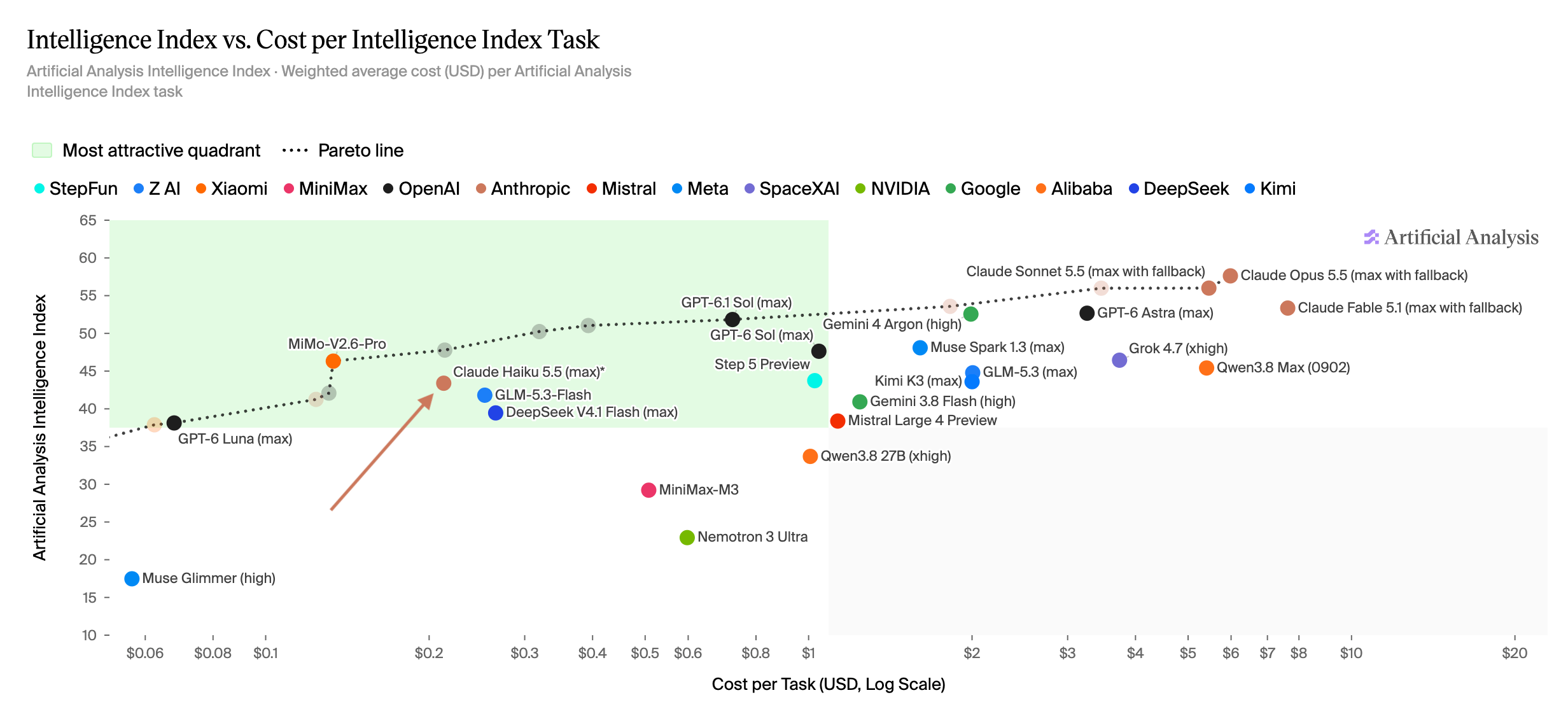
After nearly a year without an update, Haiku, the smallest model in the Claude family, is finally getting some attention. According to Anthropic, the new Claude Haiku 5.5 delivers significant improvements in reasoning, coding and computer use over its predecessor, while being around 75% cheaper to run on average. Designed for high-volume, cost-sensitive applications, it also introduces adjustable reasoning effort to balance performance and cost. Alongside the launch, Anthropic has announced lower cache-read pricing for Sonnet 5.5, additional API credits for subscribers and expanded developer tools for browser and computer use.
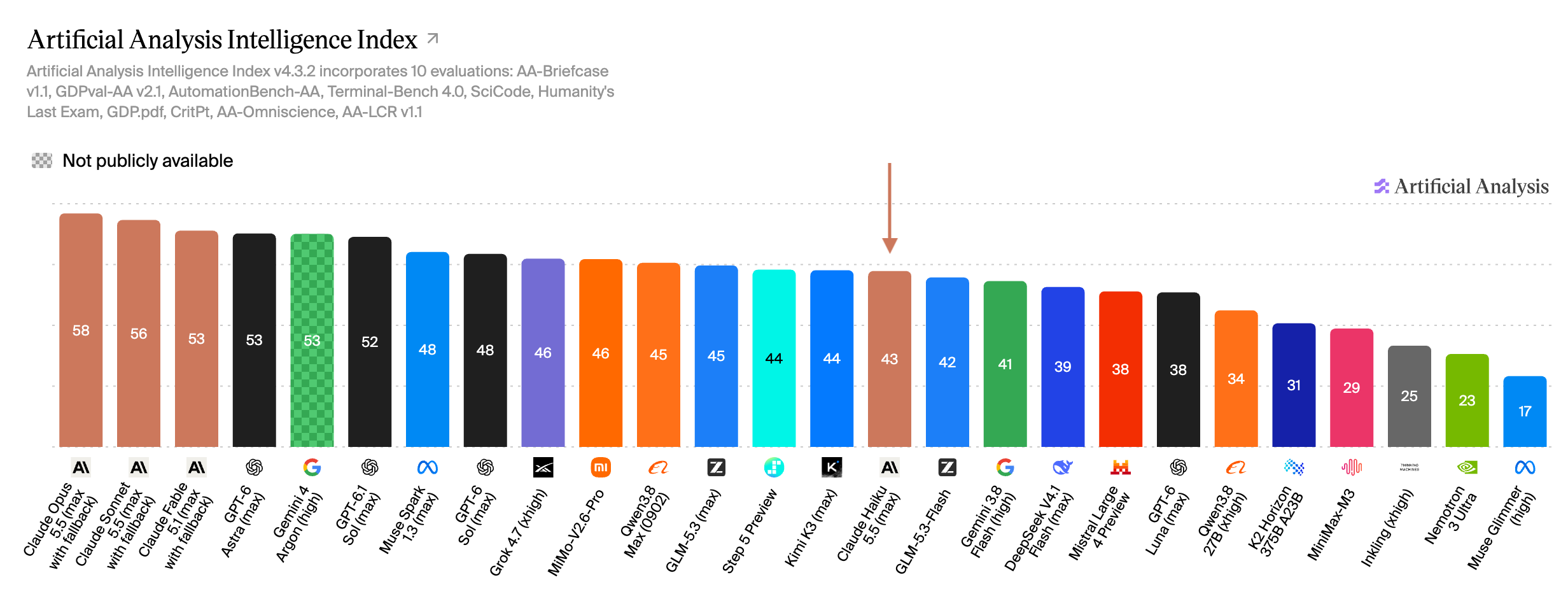
Artificial Analysis gave Haiku 5.5 a score of 43 on its Intelligence Index, placing it between Kimi K3 and GLM-5.3-Flash, and ahead of Gemini 3.8 Flash and GPT-6 Luna. Its results support Anthropic’s claims of improved efficiency, although Haiku 5.5 is still behind GPT-6 Luna. Artificial Analysis also found that Haiku 5.5 is now Anthropic’s fastest model and ranks third overall for speed.
Introducing Mistral Large 4
Mistral, a French AI company, has introduced its largest model to date: Mistral Large 4, also known as Le Chonk (I love that name), a multimodal model with 1 trillion parameters. Mistral says the model can compete with leading open-weight models, performing particularly well in coding, cybersecurity, visual reasoning and business tasks, and even outperforming proprietary models on some benchmarks. The company also says Mistral Large 4 was trained entirely on European infrastructure and supports more than 160 languages. The model is currently available through a preview API, with open weights expected by the end of October.
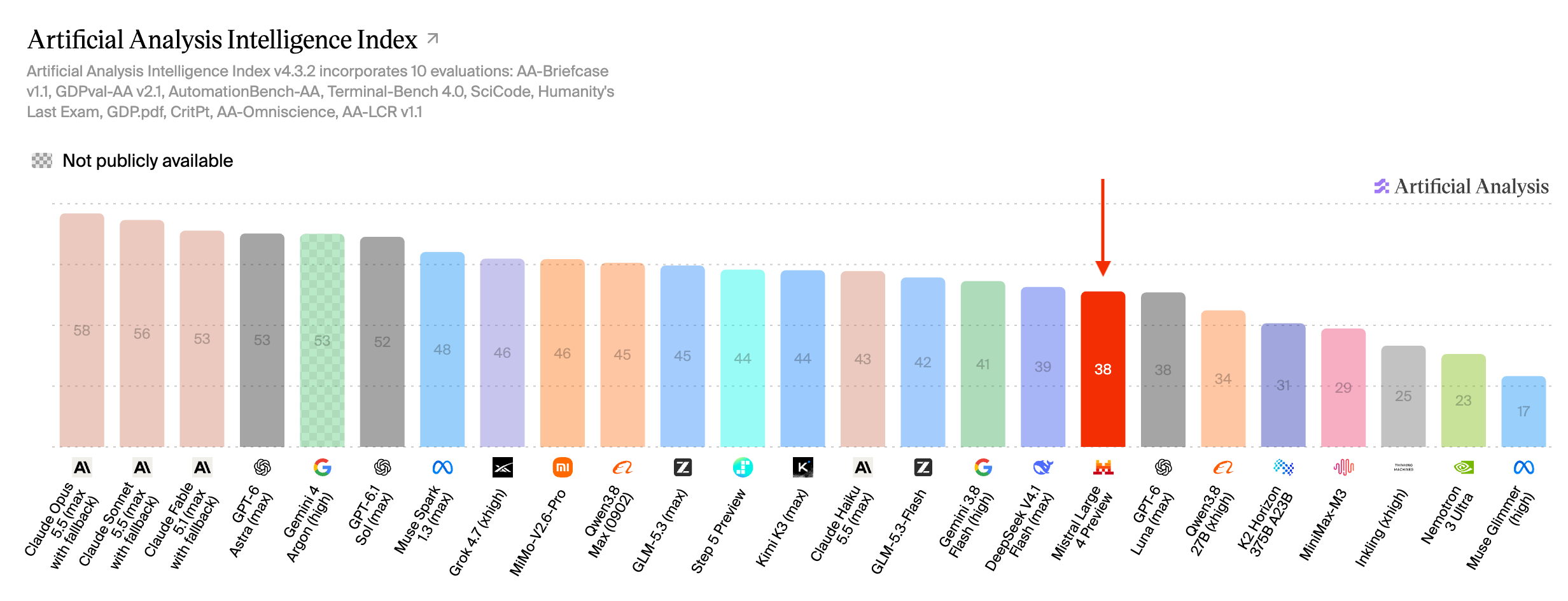
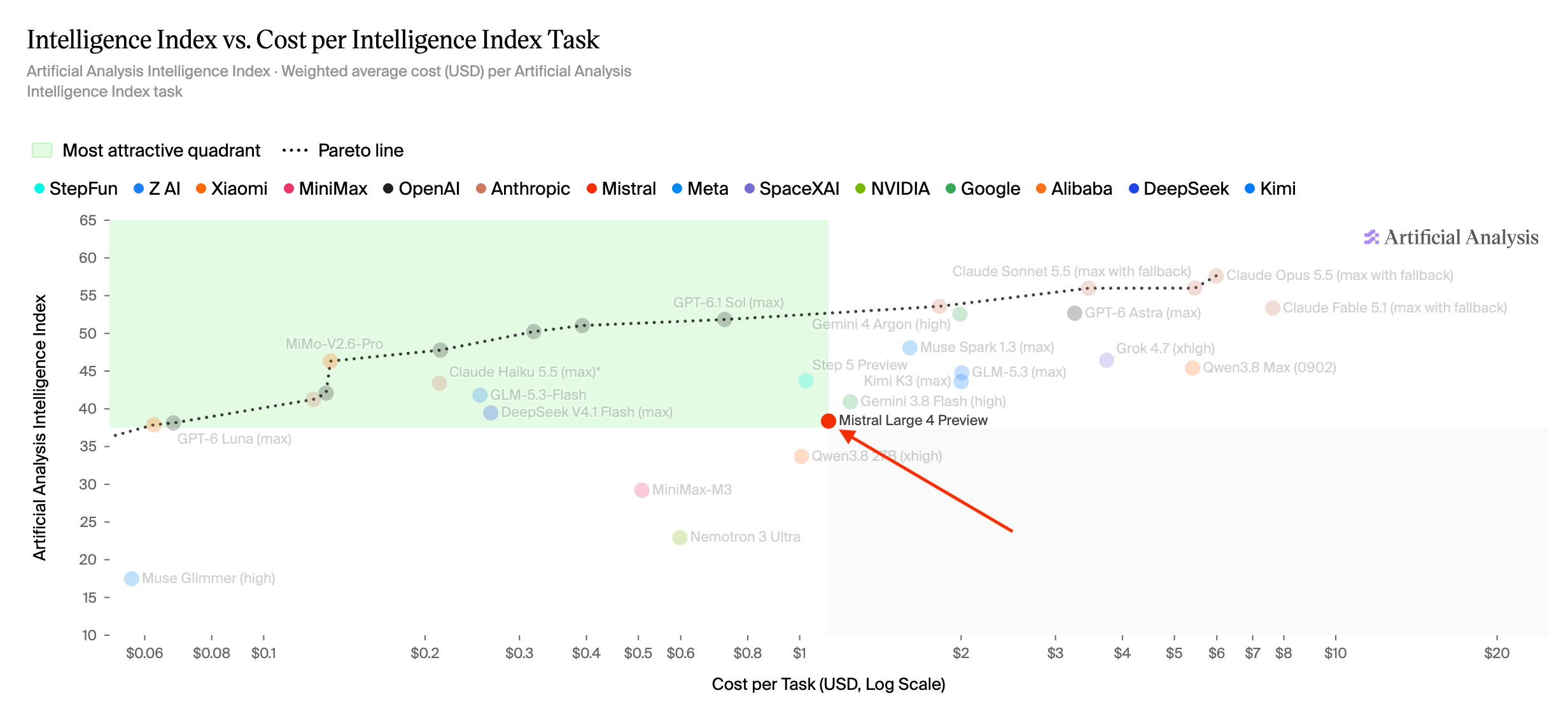
Artificial Analysis largely backs up these claims, but with some caveats. Large 4 scores 38 on its Intelligence Index, making it the strongest model developed outside the US and China. It performs especially well in cybersecurity, scoring 82% on CyberGym-E2E. However, it still falls behind the top AI models in overall intelligence, while its inference costs are more than four times higher than those of similarly capable Chinese open-weight models.
GPT‑6 and Intelligent UI for everyone
Intelligent UI is a new ChatGPT capability that turns text-based answers into more visual and interactive experiences. Instead of relying on text alone, GPT-6 can generate charts, diagrams, maps, calculators and other interactive tools directly within a conversation. OpenAI says the feature is designed to make information easier to understand, help users explore complex topics and create experiences tailored to their needs.
Build live dashboards and animate explainers with Claude
Anthropic has introduced two new tools for Claude: Dashboards and Motion. Dashboards lets users create live, automatically updating data dashboards using simple text prompts, with no coding required. Motion turns text, charts and ideas into editable animations and videos, making it easier to create presentations, explainers and product demos. Both tools are currently in beta, with Dashboards available on all paid plans, while Motion is available on Team and Enterprise plans only.
Anthropic to invest $100 million to train AI engineer talent
Anthropic is investing $100 million in its new Claude Frontier Academy with the goal of training 10,000 engineers by the end of 2027 to help companies integrate AI into their operations. The programme will combine simulated enterprise deployments, residency-style training and certification, as demand for AI engineering talent rises across industries.
Oracle, Broadcom and SpaceX Seek Blockbuster Debt Deals to Pay for AI Chips
According to The Wall Street Journal, Oracle, Broadcom and SpaceX are turning to Wall Street investors to fund the rising cost of chips and data centres. Broadcom is seeking over $50 billion to support OpenAI’s custom chips, while SpaceX is exploring $40 billion in financing for Nvidia chips. Oracle is pursuing a similar deal.
TSMC’s September sales surge year-over-year as AI drives chip demand
TSMC reported record September sales of $16.03 billion, up 54.6% from a year earlier. The growth was driven by strong demand for AI chips, as tech companies continue to invest heavily in AI infrastructure.
OpenAI: Our approach to EU text provenance rules
OpenAI is introducing text watermarking to meet the requirements of the EU AI Act. Eligible ChatGPT and Codex outputs in the EU will be watermarked, while API customers worldwide can opt in. The watermark works similarly to Anthropic’s approach, introduced about two months ago, where a secret key guides the model’s word choices to create a hidden statistical pattern in the output text.
OpenAI says watermarking has no meaningful impact on model performance, but it becomes much less reliable once the text is edited. In one test, replacing 25% of words with synonyms reduced detection from about 92% to 17%. OpenAI will also offer a text detector, but access will initially be restricted to approved researchers and expert organisations.
SynthID Detector
Google DeepMind has launched SynthID Detector, a tool that checks images, audio and video for invisible AI watermarks. It works by detecting whether content has been watermarked with SynthID and currently supports content from Google, OpenAI, NVIDIA and Kakao, with Apple support coming soon. Google stresses that a positive result suggests the content was AI-generated or altered, but the absence of a watermark does not prove a human made it, so it is recommended to treat results as one signal rather than definitive proof.
GPT-6.1 Sol Ultrafast is out
OpenAI has enabled Ultrafast mode for GPT-6.1 Sol in the API, Codex and ChatGPT Work. The company says Ultrafast delivers near-Astra intelligence at speeds up to 8x faster than standard Sol. That speed, however, does not come cheap. Access to Ultrafast in ChatGPT and Codex requires the new Pro 500 plan, which offers 25 times the usage of Plus and, as the name suggests, costs $500 per month.
Google: Introducing the Gemini agent
At Gemini at Work 2026, Google announced Gemini Agent, an AI assistant that can work across enterprise applications, collaborate with other agents and execute workflows using business context. Google also introduced industry-specific solutions for financial services and legal teams, alongside expanded security and governance controls.
Fired OpenAI Researchers Ask Company to Preserve Visibility Into AI Reasoning
Three former OpenAI employees, who were fired last week for allegedly sharing confidential information with a third-party AI safety group, urged the company to work more closely with independent safety auditors and safeguard its ability to monitor advanced AI models’ reasoning. In a letter to OpenAI’s board, they warned that weakening oversight could heighten the risk of catastrophic AI failures and said their dismissals had discouraged staff from raising concerns. OpenAI said it agreed with their safety recommendations but insisted the firings were for policy violations, not speaking out.
Anthropic’s Amodei made $18 million last year, middle of the tech CEO pack
Reuters got another peek at Anthropic’s IPO filing and found out how much Dario Amodei made last year: $18 million, largely through stock and other equity-based compensation. That puts him roughly in the middle of the pay range for CEOs of major US technology companies. The upcoming IPO, which could value Anthropic at more than $2 trillion, would likely add many more millions to his wealth. Amodei and his fellow co-founders have pledged 80% of their personal Anthropic equity to charitable causes.
Nvidia’s $20 billion Groq deal faces lawsuit alleging startup’s stockholders were shortchanged
Groq’s two former engineers filed a lawsuit against the company alleging that its $20 billion licensing and talent deal with Nvidia “squeezed out” stockholders. The lawsuit claims Groq’s board had conflicts of interest and approved the deal without the required stockholder vote, costing investors billions. Groq called the case meritless and said the agreement delivered “exceptional value.”
Manus raises more than $500M in first funding round since Meta exit
Butterfly Effect, the company behind AI agent startup Manus, has raised more than $500 million after Meta's $2 billion-plus acquisition was blocked by Chinese regulators. Led by Boyu Capital and IDG Capital, the funding round reportedly values Manus at around $4 billion, twice Meta’s original offer.
TypeSafe AI raises Series A
TypeSafe, the company that released Jev and kickstarted the wave of decision models, has raised $870 million in a Series A funding round led by Andreessen Horowitz, putting the company at a $7.5 billion valuation.
AI computing startup Lambda to raise $4B ahead of planned IPO
Lambda is raising up to $4 billion at a $14.5 billion valuation ahead of a planned 2027 IPO, the Wall Street Journal reports. According to documents seen by the WSJ, Lambda’s backlog has surged to $50 billion, but $35 billion of that comes from a deal with Anthropic, raising concerns about its heavy reliance on a single major customer.
Musk’s Grok Bot will use Anthropic’s Claude, Midjourney and Suno models
SpaceX’s Grok Bot will use rival AI models, including Anthropic’s Claude Opus 5.5, Midjourney and Suno, alongside its own models, Elon Musk has said. Grok Bot will now switch between different models to deliver better results across different tasks.
Google froze its open source bug bounty program due to a ‘significant rise’ in AI submissions
Even Google cannot keep up with the volume of AI-generated submissions to its open-source bug bounty programme and is pausing it until early 2027. The surge overwhelmed engineers and maintainers, and most automated reports proved invalid or contained hallucinated vulnerabilities.
An Anthropic AI model sent a false homicide tip to Philadelphia police
One of Anthropic’s models reportedly submitted a false tip about an unsolved murder to Philadelphia police on 18 July, but the company did not discover the incident until 28 September. The AI sent the fabricated information through a homicide tip line while interacting with randomly selected websites during a test. Police never saw the tip because it was flagged as spam.
Meta’s Muse AI Agent Is Building a Dossier On You
In a development that should surprise no one given Meta’s long history of collecting detailed user data, its new personal AI assistant, Muse, is building dossiers on the people who use it. TIME reports that Muse creates continuously updated profiles of users and the people they mention, tracking relationships, goals, preferences, and even which kinds of prompts are most effective at influencing their behaviour.
Open source hardware for your Muse
Meta wants people to build devices around Muse, so it has open-sourced an SDK and other development tools. Some of the ideas Meta has suggested include using Muse on a Raspberry Pi to control smart devices, building a Tamagotchi-style gadget with Muse inside, or creating a TV stick for Muse to put things up on the big screen.

OpenAI is putting ads inside ChatGPT’s image generation
OpenAI has announced a new visual ad format in ChatGPT, giving brands more ways to showcase their products and services, alongside better tools to measure ad performance and manage brand safety. Testing will begin in the US in October for Free and Go users.
Anthropic Subscriptions Offer 5x+ More Value Than OpenAI
The guys at SemiAnalysis asked themselves which AI subscription offers the best bang for the buck, and then set out to find the answer. They bought and tested plans from OpenAI, Anthropic, Meta, SpaceXAI, MiniMax, Moonshot, Z.ai, Cursor, and Cognition, and found that Anthropic offers the best overall value, delivering five times or more the value of OpenAI in some comparisons. In the newsletter and accompanying video, they walk through their methodology, explain the different types of tokens, and show how your choice of model and usage patterns affect what you actually get for your money.
Introducing Playground: Create and play custom games
Playground is Google’s new experimental AI-powered gaming platform, which lets users create, customise, play and share browser-based games using simple text prompts, all without writing any lines of code. The platform supports multiplayer, leaderboards and a community gallery, with free and paid creation options. Playground is currently available only to US users aged 18 and over.
In Race With U.S., China Struggles to Recruit Foreign A.I. Researchers
Despite efforts to attract foreign AI researchers through new visas and generous grants, China continues to struggle to recruit international talent, according to a new study. The US remains the preferred destination, with 30 Chinese AI researchers working in America for every one moving in the opposite direction. However, China is increasingly retaining domestic talent and strengthening its AI research capabilities, while tighter US immigration policies could erode America’s long-term advantage.
EmbeddingGemma 2
Google has released EmbeddingGemma 2, a small, open-source AI model built on Gemma 4 that supports search and retrieval across text, code, images, audio and video directly on devices, without needing the cloud. Google says it outperforms some much larger models while using less memory and storage space. The model is available on Hugging Face and Kaggle.
Nano Banana 2.1
Nano Banana 2.1 is Google DeepMind’s latest AI image generation and editing model, which the company says offers improved image quality, more accurate instruction following, greater character consistency and better text rendering. It also improves performance in complex visual design, infographics and multi-image editing. Nano Banana 2.1 is available through Gemini, Google AI Studio, the Gemini API and other Google products.
MAI-Code-1.1-Flash: Better, faster, at a quarter of the cost
Microsoft has announced MAI-Code-1.1-Flash, an upgraded version of its AI coding model. According to Microsoft, it delivers 25% faster token streaming, uses 25% fewer tokens and costs a quarter as much as its predecessor, while improving performance on coding benchmarks. Microsoft says MAI-Code-1.1-Flash can run locally (although you’ll need a machine with more than 120GB of RAM). Experimental access will be available in GitHub Copilot across the GitHub Copilot app, GitHub Copilot CLI, and Visual Studio Code by the end of the month.
Aleph Alpha releases Kolibri
German AI company Aleph Alpha has launched Kolibri, a sovereign large language model built for critical applications in government and industry. According to the company, the model combines advanced AI capabilities, including agentic workflows and tool calling, with a strong focus on data sovereignty, transparency and regulatory compliance. Aleph Alpha also says Kolibri was developed and trained entirely in Europe and can be deployed securely on infrastructure controlled by the organisations using it.
PewDiePie unveils ‘uncensored’ Ajax AI model built to run on home PCs
I did not expect PewDiePie to be a champion of open AI, but here we are. This week, he announced the launch of Ajax, an “uncensored” AI model that runs on home PCs instead of relying on the cloud. Built using Alibaba’s Qwen model, Ajax powers Odyssey, his self-hosted AI assistant that can handle tasks like browsing the web and managing emails and calendars, while keeping users’ data private. PewDiePie also claims OpenAI banned him twice for distilling its models to help train his own.
OpenAI releases 722 math manuscripts
OpenAI has publicly released 722 mathematical manuscripts produced by an unreleased internal model, covering 372 families of research results drawn from roughly 4,000 open problems. Many include Lean formalisations, while others remain unverified and may contain errors. Some mathematicians say these proofs do not meet the field’s standards yet. OpenAI says it will continue adding formal proofs, corrections and revised versions.
OpenAI Is Pissing Off a Bunch of Mathematicians—Again
In this article, WIRED speaks with mathematicians who are frustrated with how OpenAI and Anthropic are using the field to show off their models’ capabilities. It describes an OpenAI-hosted event where mathematicians asked the company to present its AI-generated proofs in proper scientific papers rather than through blog posts or social media, but that request was apparently ignored. While mathematicians welcome AI’s potential to advance research, they want companies to be more transparent, respect established scientific practices and give proper credit to researchers.
▶️ Over 2B tokens per day massive NVIDIA DGX station from Gigabyte (24:39)
Patrick from STH gets his hands on the Gigabyte W775-V10-L01, a monster AI workstation packing an NVIDIA Blackwell Ultra GPU and a 72-core NVIDIA Grace CPU, and that’s just the beginning. With 252 GB of HBM3 GPU memory offering 7.1 TB/s of bandwidth and 496 GB of LPDDR5X CPU memory at up to 396 GB/s, it can fit GLM-5.3-Flash, a 321B-parameter model, and run it at over 100 tokens per second, all while staying quiet and fitting under a desk. The price, unsurprisingly, is just as extreme: $100,000 or more.
🤖 Robotics
Robotics Startup RobCo Hits $1 Billion Valuation
German robotics startup RobCo has doubled its valuation to more than $1 billion after a $40 million share sale. The company develops AI-powered industrial robots, including its new self-learning robot Alfie, which is designed to automate repetitive factory work.
Waymo locks in $5B loan from Blackstone, PIMCO to fuel robotaxi expansion
Waymo has secured $5 billion in its first loan deal to support the growth of its self-driving taxi services. The deal follows a $16 billion funding round in February that valued the Alphabet-owned company at $126 billion. Waymo currently operates in 15 US markets and plans to expand into London and Tokyo.
Boston Dynamics appoints former Amazon exec Rohit Prasad as new CEO
Boston Dynamics has appointed Rohit Prasad as its new CEO. Prasad previously served as senior vice president and head scientist for Alexa and artificial general intelligence at Amazon.
ANYbotics launches Shift to streamline robot fleet operations, scale inspections
ANYbotics has launched Shift, a cloud platform that brings robot fleet management, AI-powered inspection analysis, plant mapping and maintenance-system integration into one place. Built around its ANYmal robots, Shift is designed to turn inspection data into faster maintenance decisions, helping industrial operators reduce downtime, improve safety and streamline preventive maintenance.
Deliveroo is putting delivery robots on the pavements of five UK towns
Deliveroo has partnered with US robotics company Coco Robotics to use its wheeled robots for deliveries. The rollout will begin in Canary Wharf in London this month, with Milton Keynes, Leeds, Stockton-on-Tees and Nottingham to follow in the coming weeks and months. Initially, only a small number of orders from a handful of merchants will be delivered by robots.
▶️ Why ABB Is Betting on Robot Arms Over Humanoids (1:01:12)
In this episode of Automated Podcast, Brian Heater speaks with ABB’s Andie Jiang about the future of industrial robotics and how physical AI, advanced sensing and digital twins are expanding automation. She highlights the need to balance innovation with productivity, safety and cost, as well as the limitations of humanoid robots, labour shortages and the growing importance of workforce upskilling and human-robot collaboration.
🧬 Biotechnology
Zuckerberg’s Biohub Partners With DOE, NIH to Invest $1.8 Billion in Biological Data for AI Models
Biohub, a nonprofit co-founded by Mark Zuckerberg, is working with US federal agencies and other partners to invest $1.8 billion in AI-ready biological data. The Energy Department will contribute more than $500 million over five years, while the National Institutes of Health will provide datasets and other resources backed by more than $500 million in existing federal investment. Biohub says the initiative could improve understanding of disease and help uncover new paths to cures.
AlphaProteo generates novel proteins for biology and health research
Google DeepMind introduces AlphaProteo, an AI system that designs proteins that bind to specific targets, helping speed up drug discovery and medical research. AlphaProteo has shown better results than existing methods, including in research related to cancer and COVID-19. While some challenges remain, the technology could make developing new treatments and diagnostic tools faster and more effective.
💡Tangents
Huawei and Qualcomm Announce Broad Patent License Agreement
Huawei and Qualcomm have signed a multi-year patent licensing agreement covering 5G, computing, AI, networking and other technologies, alongside Qualcomm’s purchase of certain Huawei patents in the US. The deal remains subject to regulatory approval.
▶️ The state of the tech industry in 2026 (29:38)
In this video, Gergely Orosz, the guy behind the excellent The Pragmatic Engineer newsletter, gives his State of the Software Engineering Industry in 2026 report. Unsurprisingly, a lot of his observations are about AI and how agentic coding has changed the way we write code. AI agents are reshaping development workflows, allowing smaller teams to ship faster, but also creating new challenges around code quality, productivity and engineering leadership. Despite all this, Orosz argues that strong engineering fundamentals still matter, with planning, testing, teamwork and deep domain knowledge becoming more valuable than ever.
Thanks for reading. If you enjoyed this post, please click the ❤️ button and share it!
A big thank you to my paid subscribers, to my Patrons: whmr, Florian, dux, Eric, Preppikoma and Andrew, and to everyone who supports my work on Ko-Fi. Thank you for the support!