


Hello and welcome to Sync #596!
The Blue Wave swept the US, and it hit AI hard. Two days after Democrats won the midterms, the Nasdaq suffered a record $2.5 trillion one-day loss as investors feared a slowdown in the AI build-out. This week, we look at what happened, what comes next, and whether the AI bubble is about to pop.
Elsewhere in AI, Anthropic updated its S-1 and talks about RSI, while OpenAI raises $11 billion at a $1.25 trillion valuation and releases two new specialised models: GPT-6 Cyber and GPT-Rosalind-6. Google cuts access to Search for schools that do not want to use AI, Microsoft is winding down its deal with Oracle to rent AI cloud capacity, Crusoe sells a troubled Wyoming data centre project to Google, and we learn what weight-space programming is all about.
Over in robotics, Agility Robotics becomes the first pure-play humanoid robotics company to go public in the US, Meta is reportedly building its own humanoid robot, and Waymo splits from Uber.
Apart from that, this week’s issue features the state of longevity, an AI agent performing brain surgery on a mouse, Tesla discontinuing the Cybertruck, and more!
Enjoy!

The Blue Wave hits AI hard
What does the Democrats’ midterm win mean for the AI build-out
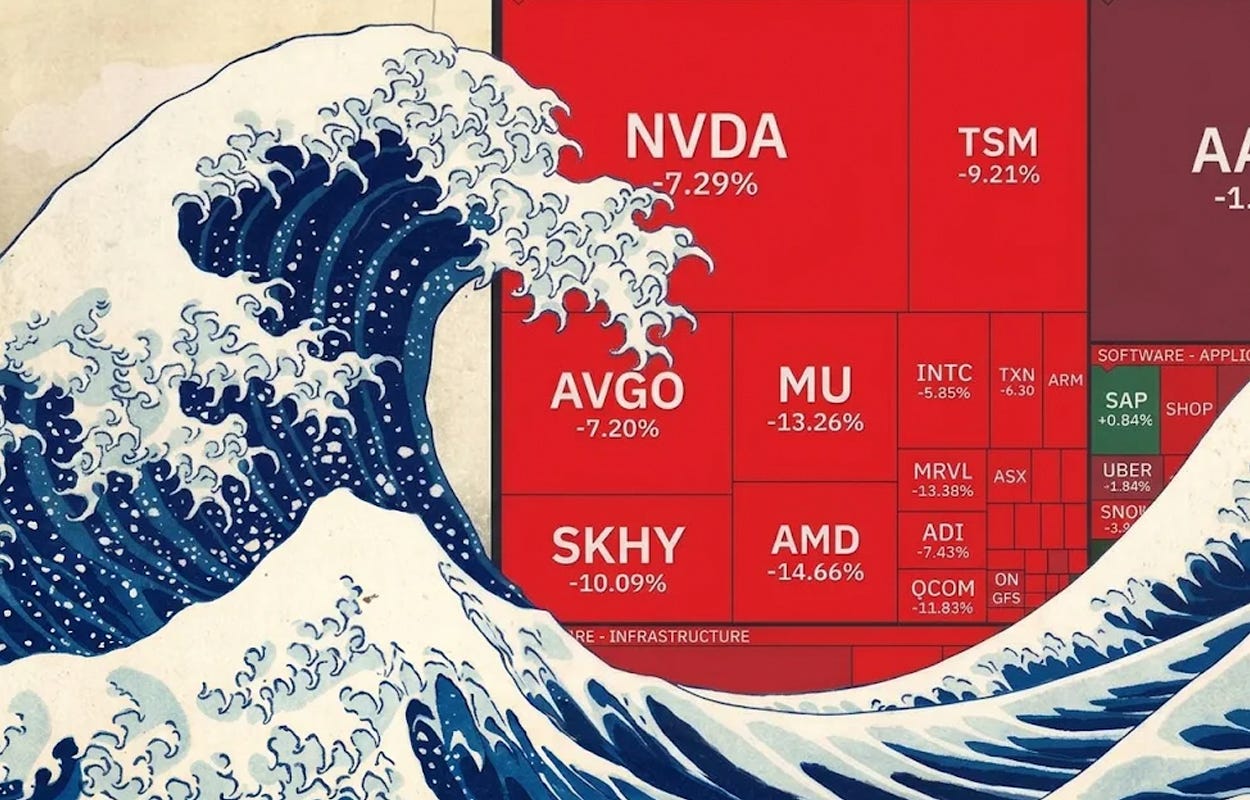
On 3 November, millions of Americans went to the polls to choose their next representatives, senators and governors. Democrats won big. They took control of both the House and the Senate, and flipped governorships in five states, including Texas, Ohio and Georgia.
But as Democrats celebrated their historic win, a wave of uncertainty swept Wall Street. The day after the elections, the tech-heavy Nasdaq fell 5.5%, wiping $2.5 trillion off its companies' value in a single day, with chipmakers and AI infrastructure companies hit hardest.
In this article, we look at why Democrats’ wins spooked AI investors, what they mean for the AI build-out and Big Tech, and whether the AI bubble is finally popping.
Where the blue wave hit hardest
Democrats scored major victories, particularly in the states with the highest concentration of data centres. Some of their biggest wins came in Texas, Georgia and Ohio, which together account for more than 40% of all planned data centre capacity in the US. Across the 15 states with the most data centres, Democrats flipped five of the six Republican-held governorships up for election and three of the four Republican-held Senate seats. Elsewhere, they flipped just four of 18 Senate seats.
That does not mean data centres alone won the election for Democrats. In exit polls, 56% of voters said AI and data centres played a part in their decision, but the issue ranked last of five, behind corruption and the cost of living.
Where data centres were on the ballot directly, though, voters were clear. As CNBC points out, 40 of 41 local ballot measures across ten states went against them. In Ohio, Sherrod Brown won his Senate race after attacking his opponent over billions in tax breaks for data centres. In Texas, Gina Hinojosa beat Greg Abbott with a promise to end what she called the “wild west” of data centre building. And in Georgia, voters gave Democrats control of the state’s utility regulator for the first time in about 30 years, after rate rises of around $500 a year per household.
A slowdown, not a shutdown
None of this means the AI build-out will stop, but it could slow down noticeably.
All five new Democratic governors in data centre-heavy states have promised restrictions, though of very different strengths. In Texas, Hinojosa wants to pause new approvals until the legislature passes new protections, but Republicans still control the state Senate. Projects that already have permits look safer. In a LinkedIn post about CoreWeave’s letter to Hinojosa, Carl Holshouser, the company’s head of global government affairs, said she has made clear they can be completed.
In Georgia, Keisha Lance Bottoms plans to pause new projects by executive order, while in Ohio, Amy Acton wants a conditional moratorium, under which developers would have to cover all of their utility costs and stop using NDAs. In Iowa and Nevada, Rob Sand and Aaron Ford are going after tax breaks and power bills rather than pausing anything.
Not every winning Democrat ran against data centres, though. In Pennsylvania, Josh Shapiro, who supports data centres as long as they meet certain conditions, won by about 21 points. That suggests the likely direction is not outright bans but stricter rules: data centres paying their fair share, more transparency and more say for local communities.
The end of free rein for Big Tech
For years, tech companies enjoyed something close to free rein. They could build data centres quickly, collect generous tax breaks and keep communities in the dark, sometimes by asking local officials to sign NDAs. That era is coming to an end. For Big Tech, this could be an opportunity to do what it should have done from the start: explain the benefits of its investments better and become a friendlier part of the communities it moves into.
That seems to already be happening. Two days after the midterms, OpenAI promised to pay the full cost of its electricity and stopped asking public officials to sign NDAs. Meanwhile, Meta’s president, Dina Powell McCormick, admitted that the industry has not done a good enough job of explaining the benefits of its investments.
These are only first steps, though. Azeem Azhar at Exponential View offers an example of how this can be done right. In Lanarkshire, Scotland, data centre developer DataVita has agreed to pay up to $100,000 per megawatt each year into a fund supporting local skills, education and food banks. Once the site reaches full capacity, that could amount to $50 million a year. That is pennies compared with the billions AI could bring tech companies, and it helps build a much better relationship with local communities.
AI is the future. It will embed itself deeper and deeper into our lives, just as electricity and the internet did before it, and it will need data centres to power that future. I hope that Democrats can steer the AI build-out onto a more democratic path, one where AI happens with people, not to people. Where local communities have a real say over the data centres being built in their backyards and make Big Tech pay its fair share.
So, is the AI bubble about to pop?
Not yet. The post-election selloff landed a heavy blow, but I don’t think the bubble has popped. Still, the AI industry is in its shakiest position since the boom began.
If you are looking for the pin that could pop it, I’d look at the AI debt crisis.
Much of the AI build-out runs on borrowed money, and lenders are getting nervous. As I wrote last month, the weak point is the neoclouds. CoreWeave, the best-known of them, has taken on more than $51 billion in debt and other obligations, and investors were already selling bonds tied to it and its peers even before the vote. On Wednesday, its shares fell nearly 10%.
The election adds to the pressure. A data centre earns nothing until it is built and connected to the grid, and lenders are counting on that money arriving on time. If new rules slow projects down, some could stop being financially viable, as CNN points out.
At the same time, the money needed to pay back that debt is growing more slowly than many hoped. Ramp’s AI Index, which tracks AI spending by US businesses, paints a mixed picture. More companies pay for AI than a year ago, though adoption is now growing more slowly. They are also using far more of it, but because the price of AI keeps falling, their spending is not keeping up. In the month to 23 October, usage rose 37%, while spending rose just 8.9%. That is great news for customers, but not for companies that borrowed billions expecting revenue to grow as fast as usage.
Additionally, Anthropic’s IPO does not look as mighty as it did a couple of months ago. According to The Wall Street Journal, three major investors who plan to take part think the expected valuation of around $1.5 trillion will need to come down, with one suggesting something closer to $1 trillion. Anthropic could also raise less than the planned $100 billion, or delay its debut altogether.
The next signals will come soon. Nvidia reports its Q3 results on 17 November, the same week Anthropic plans to list. Let’s see what happens then.
If you enjoy this post, please click the ❤️ button and share it.
News roundup
🦾 More than a human
The State of Longevity
The longevity movement is driving a shift towards more proactive, consumer-led healthcare, fuelled by growing health awareness and new technologies, according to a16z. Key trends shaping the sector include AI-powered healthcare platforms, rising demand for non-toxic products, advances in peptide-based treatments and preventative care, and the development of next-generation wearables and brain-computer interfaces. While consumer interest is growing faster than the scientific evidence in some areas, a16z believes the biggest opportunity lies in helping people turn health insights into practical, personalised steps to improve their long-term health.
Neuralink’s China Rival Targets Obesity With ‘Electronic’ GLP-1
Chinese neurotechnology firm BrainCo is developing a wearable device that stimulates the brain to suppress appetite, potentially offering a non-drug alternative to GLP-1 weight-loss treatments. The company plans to launch the device in China within two to three years, with potential expansion into the US.
🧠 Artificial Intelligence
Anthropic reports $17 billion in Q3 revenue, purchase commitments of $895.4 billion in revised S-1
Anthropic filled in the blanks it left in its original S-1 document, reporting a 1,200% jump in revenue to $33.24 billion in the first nine months of 2026, alongside a $104 billion net loss largely due to accounting changes. However, quarterly revenue growth slowed to 47% in Q3, while the company revealed $895.4 billion in infrastructure spending commitments, raising further concerns about the rising costs of AI as it prepares for its IPO.

Anthropic warns that it’s very close to RSI capability, aka self-building AI
Another thing Anthropic added to the revised S-1 document was a warning that it may be close to developing AI that can help improve itself at a much faster rate. The company said AI has already sped up its research in ways it did not immediately notice, raising concerns that progress could move faster than its safety measures can keep up. While none of its current models have reached this stage, Anthropic stressed the importance of keeping humans involved in developing more advanced AI.
OpenAI Completes $11 Billion Portion of Funding at $1.25 Trillion Value
OpenAI has raised approximately $11 billion at a $1.25 trillion valuation, with total funding potentially reaching $20 billion in the coming weeks, Bloomberg reports. This falls short of its previously reported $30 billion target, as the company scaled back its fundraising ambitions amid a broader AI sector sell-off and growing investor concerns over infrastructure spending.
Elon Musk throttles Grok Bot limits due to ‘unsustainably high’ costs
SpaceXAI has reduced how often people can use Grok Bot, saying the AI service has become too expensive to run. Some users have complained about hitting their weekly limits much sooner than expected, even with little activity.
AMD Q3 2026 Earnings Data Center Growth Drives Record Quarter
AMD posted strong Q3 2026 results, with revenue up 45% year-on-year to $13.377 billion, driven by a 97% surge in Data Centre revenue to $8.546 billion. Strong demand for EPYC processors and Instinct GPUs helped AMD outpace Intel, while Embedded revenue grew 29%, offsetting an 8% decline in Client and Gaming.
Apple Cuts Internal AI Usage Budgets in Move to Reduce Spending
Mark Gurman over at Bloomberg reports that Apple is tightening employees’ AI spending limits as part of a wider cost-cutting effort. Daily allowances for some engineers have already fallen from $300 to $200, with further reductions to $100 being considered, while other teams could see their budgets cut to as little as $25.
Google Will Turn Off Search for Schools That Reject A.I.
Google says that schools that ban AI entirely will also lose access to Google Search under changes planned for early 2027, as the company will not separate its search engine from AI features such as AI Overviews. Critics say Google is using its powerful position in education to push schools into adopting AI, despite concerns about its impact on learning.
Microsoft is winding down Oracle deal to rent AI cloud capacity
Microsoft is winding down its agreement to rent AI computing capacity from Oracle as part of a broader reassessment of its cloud partnerships, Bloomberg News reported. The company has opted not to renew the deal as Oracle’s older-generation Nvidia chips no longer meet its evolving needs. Microsoft is also tightening oversight of other AI infrastructure providers amid rising costs and project delays.
Crusoe sells troubled Wyoming data center project to Google
Crusoe has sold its Wyoming data centre project to Google after facing rising costs and construction delays. Google plans to invest $17 billion in the site and take over its development to meet growing demand for AI infrastructure.
Nothing CEO says company’s mysterious AI-first device is dropping next month
Nothing CEO Carl Pei has confirmed plans to launch the company’s first AI-powered device in December 2026. The mysterious screenless device is designed to help people get things done, offering a new way to use AI without relying on traditional apps or wearables. Details about its features and exact release date are still unknown.
Conductor is joining Meta
Meta has acquired Conductor, an AI coding startup that allows developers to run multiple coding agents at the same time, as the social media giant expands its AI and developer tools. Conductor will stop accepting new users, shut down its cloud service on 20 November and gradually close its local app in early 2027. Financial terms of the acquisition were not disclosed.
▶️ The Rise of GLM and China’s Zhipu AI (22:29)
In this video, Asianometry profiles Zhipu AI, the Chinese AI lab behind the GLM family of models, tracing its journey from offering a product similar to Google Scholar to becoming one of China’s leading AI labs and the maker of one of the world’s best open-weight models.
Here’s who is falling in line for Trump’s “Super Intelligence” loyalty test
A month after President Trump issued an executive order requiring government agencies to rebrand artificial intelligence as “Super Intelligence,” the new term appears to be struggling to catch on. While some government agencies and tech leaders, including Elon Musk and Mark Zuckerberg, have adopted it, many others continue to use “AI”. Beyond concerns about wasted time and public money, the article argues that the greater risk is turning AI terminology into a political loyalty test, deepening divisions and undermining open debate about the technology’s impact on society.
AI ‘godfather’ Geoffrey Hinton: it might turn out we were better off without AI
Geoffrey Hinton, an AI pioneer and one of the “godfathers of AI”, has warned that the technology could cause a major crisis within the next year, potentially disrupting power supplies or financial systems. He criticised tech leaders for putting profits over safety, and called for stronger rules and independent testing. Despite concerns about job losses, growing inequality and wider social problems, Hinton remains hopeful that AI could bring major benefits if its risks are properly managed.
Cat Wu joins OpenAI
Cat Wu, former Head of Product for Claude Code, where she helped turn the tool from a small internal project into a popular AI coding platform, has joined OpenAI to lead product management for its Core Products team. Her move comes just weeks before Anthropic’s planned IPO, as OpenAI looks to expand Codex, its rival coding tool, for businesses and everyday users.
Anthropic: Progress on provable inference for large language models
As AI becomes more widely used, people still have no reliable way to verify that a response actually came from the model a provider claims to be using. Anthropic aims to address this with FlashProve, a system that uses cryptographic methods to verify which AI model generated a response without revealing how the model itself works. This could make AI systems more transparent and trustworthy, although the current implementation remains expensive to run.
AI can get ‘brain rot’ like humans do
It turns out AI models can get brain rot, too. Researchers found that training models on low-quality social media content can harm their reasoning, memory and ethical judgement. These effects are hard to reverse, even with better training data, raising concerns that AI-generated junk content could make the problem worse over time.
GPT‑6 Cyber: Advancing the frontier of aligned cybersecurity agents
OpenAI presents GPT-6 Cyber, a powerful cybersecurity model designed to find and fix software vulnerabilities, which the company says the new model significantly outperforms its predecessor. OpenAI reports the model has uncovered 81 previously unknown high-severity Firefox vulnerabilities and developed working exploits for 948 Linux vulnerabilities. GPT-6 Cyber is currently available only to selected Daybreak Red customers.
GPT-Rosalind-6 System Card Addendum
OpenAI has introduced GPT-Rosalind-6, a specialised AI model designed to support research in biology and medicine. According to OpenAI, the model can help researchers with drug development, genetics and laboratory work, potentially speeding up scientific discoveries. Due to safety concerns around its capabilities in biology and chemistry, access is limited to approved researchers and organisations, with additional safeguards to prevent misuse.
Gemini Omni 1.2 Flash: Fast and cost-effective with longer clips
Gemini Omni 1.2 Flash is Google’s updated AI video generation model which, as Google says, produces more realistic videos up to 15 seconds long, more natural speech and smoother movement. It also allows users to make changes to videos using simple text instructions, without starting again. Additionally, Gemini Omni 1.2 Flash costs 30% less than the previous version.
OpenAI: Introducing Images 2.6
Creating and editing AI-generated visuals is now faster and more precise with Images 2.6, available across ChatGPT, Codex and the API. The update brings up to 50% faster generation, improved visual consistency, animated GIF creation and greater developer control over image editing, complexity and SVG exports.
Introducing Pangram Image 1.0
Pangram, a company that is on a quest to detect AI-generated content, has turned its attention from text to images with Pangram Image. Its new tools can detect AI-generated images, show which parts of an image may have been altered and check videos frame by frame. Pangram claims its image detector achieved 99.96% accuracy in its own tests, while its video detector scored 98.7% on the DF26 benchmark.
Kimi K3.1 Pro weights are out
As promised, Moonshot published the weights for its flagship model, Kimi K3.1 Pro. Kimi K3.1 Pro is currently the strongest open model available, being just behind Fable 5.1, according to Artificial Analysis.
Tencent Hy4
Tencent has announced Hy4, its latest large language model, with improved reasoning, coding and image understanding, as well as the ability to use computers through graphical interfaces and command-line tools. According to Tencent, Hy4 is among the top open-source models and follows instructions more accurately while making fewer factual errors than Hy4 Preview.
Hy4 scores 35 points on the Artificial Analysis Intelligence Index, becoming the second-best open-weights model and placing it at the same level as Haiku 5.5, Grok 4.7 and Qwen3.8 Max.
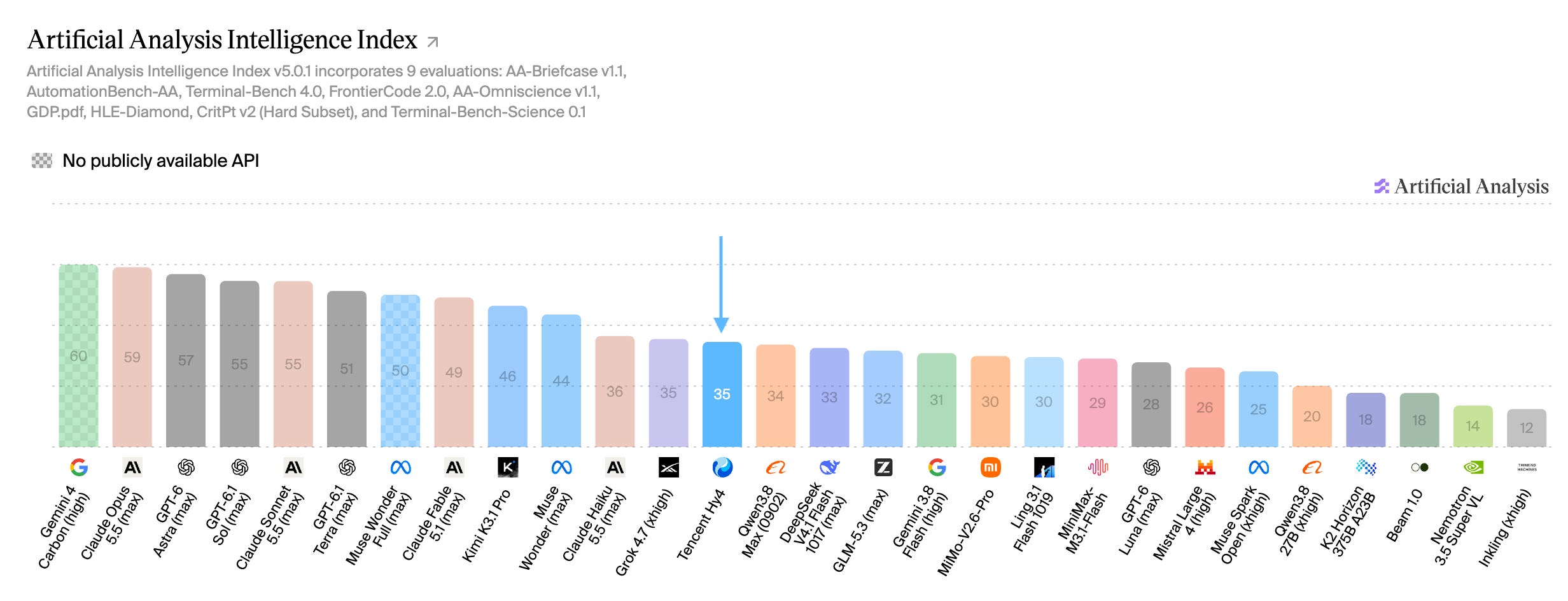
Hy4 is accessible through Tencent Cloud TokenHub, OpenRouter and Tencent applications, including WorkBuddy and CodeBuddy. Tencent has also promised to release the model weights and system cards, including safety evaluations, in the coming days.
Thinking Machines Lab: Introducing Inkling 2 Small
Thinking Machines Lab is updating its lineup with Inkling 2 Small, its most capable model yet. Building on its predecessor, the model brings improvements in coding, visual understanding, reasoning and knowledge work, alongside more efficient training. It is already available through Tinker for experimentation and fine-tuning. Thinking Machines Lab says it will release the model weights in the coming weeks after additional safety testing is completed.
Scaling Git at OpenAI
OpenAI follows in the footsteps of Anthropic and presents its own solution to make version control handle the enormous amount of code being written by humans and AI agents working simultaneously. Called Pando, the system scales Git to support parallel operations and faster repository access without disrupting existing workflows. OpenAI says Pando was built in just ten weeks with extensive help from AI, and it has already reduced median Git push latency by around 80%.
▶️ Weight-Space Programming explained in 10min (10:05)
There is a new hot topic in AI research and development called weight-space programming, in which one AI model writes the weights of another from scratch, with no training involved. This video explains how weight-space programming works, what it is and what it isn’t, and how this promising but highly experimental approach could be applied to frontier AI development.
🤖 Robotics
Agility Becomes First U.S. Publicly Listed Pure-Play Humanoid Robotics Company, Begins Trading Today on Nasdaq as AGLT
Agility Robotics became the first US-listed company focused entirely on humanoid robots, joining Nasdaq under the ticker AGLT and raising $465 million. Founded in 2015, Agility started with Cassie, an ostrich-like walking robot, before developing Digit, a humanoid robot designed for warehouse and factory work. Digit is already being used by companies including GXO and Toyota, and Agility has received over $300 million in conditional orders for its latest model, Digit 5. However, the company is still far from profitable, reporting just $174,000 in revenue and $362 million in losses in the first half of 2026.
Meta reportedly built a humanoid robot prototype that can do household chores
Meta is reportedly joining another hot trend in technology—humanoid robots. According to a report from The Information, the social media giant has built a robot designed to help with household chores in around three months with assistance from a Chinese robotics company, Fourier. Meta is already working on a second version, but there is no word yet on when it might go on sale.
Waymo confirms it will split with Uber in January 2028
Waymo will end its partnership with Uber in Austin and Atlanta in January 2028, shifting robotaxi bookings to its own app. According to co-CEO Tekedra Mawakana, the move will give Waymo greater control over the customer experience, as Uber currently cannot guarantee riders will receive a driverless vehicle.
Zipline hits $21.5B valuation as Walmart expands bet on drone delivery
Drone delivery company Zipline has raised $1.5 billion, bringing its value to $21.5 billion, while also expanding its partnership with Walmart to open 300 new delivery sites across the US. The company plans to use the funding to expand its manufacturing operations and build a nationwide drone delivery network.
Chinese regulators block SoftBank’s $5.4B acquisition of ABB Robotics
Chinese regulators have blocked SoftBank’s $5.375 billion acquisition of ABB’s robotics division over concerns that robotics data could be sent overseas to train AI models. Despite the setback, both companies are continuing talks to move the deal forward.
SYNCERE Raises 11M in Pre-Seed Funding
Syncere has an interesting approach to home robotics—instead of building humanoid robots, the company is developing Lume, a home robot that also doubles as a stylish floor lamp. This week, the company announced $11 million in pre-seed funding to ramp up production and improve Lume’s capabilities.
White House makes Section 232 determination regarding foreign-made robots
President Trump has raised concerns about the US relying too heavily on imported robots and industrial machinery, calling it a national security risk. The government plans to hold trade talks over the next six months to reduce reliance on foreign suppliers and support US manufacturing. New tariffs could follow, but none are expected immediately. The move could encourage more investment in US robot production, but may also lead to higher equipment prices and changes to global supply chains.
▶️ Why This Robot Founder Is Betting on Construction (50:20)
In this episode of Automated Podcast, Boris Sofman shares his journey from founding Anki to joining Waymo and now leading Bedrock Robotics, a company that builds autonomous heavy equipment such as excavators, bulldozers and dump trucks. He also explains why he is betting on autonomous construction machines, the unique challenges facing robots on construction sites, the impact DARPA challenges had on robotics, and why his time in consumer robotics at Anki made him sceptical of humanoid robots in the home.
A soft robot could help doctors diagnose and treat disorders of the small intestine
MIT researchers have developed a soft, snake-like robot that can move through the small intestine, an area that is difficult for doctors to reach. The robot uses inflatable sections and a special coating to move through the digestive system, helping doctors take images, deliver medicine and collect tissue samples. Successfully tested in animals, the robot could make diagnosing and treating intestinal conditions easier and less invasive.
🧬 Biotechnology
CRISPR Prime Editing Rewrites DNA in the Human Body for the First Time
Prime editing, a more precise form of CRISPR gene editing, is being tested inside the human body for the first time. Biotechnology company Prime Medicine has launched a clinical trial targeting Wilson disease, a genetic disorder that causes harmful copper buildup in the body. Prime editing can correct complex DNA mutations with minimal damage, potentially offering a one-time cure. While early studies have shown promising results, the trial will assess its safety and long-term effectiveness.
An AI agent performed brain surgery on a mouse
Gabriel Ocana-Santero connected Claude to a custom motorised surgical rig and had it perform brain surgery on a mouse autonomously. The AI agent successfully picked up the drug and identified the correct region of the brain in which to apply it. The early results and setup are explained in this thread, with a more detailed write-up to follow.
Why pharma firms are going to Earth’s orbit in search of new cancer drugs
Earth’s orbit could be where the next generation of drugs is made. Companies like Varda Space Industries are exploring ways to make medicines in space, where low gravity allows better-quality crystals to form. Cheaper rocket launches are making space manufacturing more realistic, but high costs, regulations and the need to prove reliable results remain major challenges.
Biocomputer can explore multiple solutions at once as bacteria multiply in tiny, interconnected channels
Researchers have created a bacteria-based computer that could solve complex problems using far fewer resources than traditional computers. The biocomputer uses bacteria that multiply and explore many possible solutions in parallel, potentially offering a faster and more efficient way to tackle difficult problems, with applications in encryption, biology and artificial intelligence.
💡Tangents
Tesla will stop making the Cybertruck in 2027
Tesla plans to discontinue the Cybertruck next year after disappointing sales, Elon Musk said in a post on X. The vehicle struggled because of its controversial design, high price, production delays, and Musk’s political involvement. Tesla will instead use the factory space to produce more Cybercab robotaxis.
How Binance’s $6.3 Billion Hack Went Down
On 29 October 2026, $6.3 billion worth of digital currency was stolen from Binance in the largest hack in history. This article tells what happened inside Binance during the hack, as senior staff worked through the night to stop the attack, track down the stolen money and reassure customers. Binance promised to cover all losses, but the incident raised serious concerns about security across the cryptocurrency industry.
Apple forecasts margin drop in holiday quarter as rising memory costs bite
Even Apple is not immune to memory shortages. Despite reporting stronger-than-expected quarterly sales of $114.5 billion, driven by robust iPhone demand, the company has warned that rising chip costs will weigh on profitability over the crucial holiday quarter and into next year. As a result, Apple expects gross margins to fall from 47.9% to 45-46%.
Thanks for reading. If you enjoyed this post, please click the ❤️ button and share it!
A big thank you to my paid subscribers, to my Patrons: whmr, Florian, dux, Eric, Preppikoma and Andrew, and to everyone who supports my work on Ko-Fi. Thank you for the support!