


Hello and welcome to Sync #597!
The NVIDIA spying scandal has blown up this week, and as a result, Jensen Huang is no longer CEO of NVIDIA. In this week’s issue of Sync, we recap the downfall of Jensen Huang and what his resignation means for NVIDIA, the AI industry, and beyond.
Elsewhere in AI, Anthropic releases Fable 5.2 and Mythos 5.2 and seeks a $1.3 trillion valuation in its upcoming IPO. Google, meanwhile, launches Gemini 4 Hydrogen, a new decision model, AlphaGenome 2, and two new TPUs. We also cover OpenAI’s launch of new features for businesses, why its Q2 sales show tepid growth compared with Anthropic’s, and why safety-conscious employees at AI companies should unionise.
Over in robotics, Tesla expands its robotaxi services to San Antonio, Google launches Gemini Robotics 2.5, Amazon unveils two new Ring robots to patrol homes and businesses, and Boston Dynamics replaces Atlas’ feet with wheels.
This week’s issue of Sync also features flying cars from China, reports that SpaceX–Tesla merger talks are progressing, autonomous biology labs, a robotic arm made from algae, AI development accelerating faster than anticipated, and more!
Enjoy!

NVIDIA without Jensen Huang
What does Jensen Huang’s resignation mean for NVIDIA and the AI industry
On Tuesday, 17 November, NVIDIA will report its quarterly results, and for the first time in 33 years, Jensen Huang won’t be the one presenting them. He resigned as CEO on 12 November, days after admitting to an affair with a businesswoman US officials suspect of being a Chinese spy.
It is the end of an era for NVIDIA, and possibly for the AI industry he helped build. In this article, we look at how Huang fell, what’s next for NVIDIA, how the ripples are spreading, and whether the AI bubble is finally popping.
The downfall of Jensen Huang
The story of Jensen Huang’s downfall starts with Megaspeed, a Singapore-based data centre company spun out of a Chinese gaming firm in 2023, which became NVIDIA’s biggest customer in Southeast Asia. US officials suspect some of the chips it bought ended up in China, which would breach US export controls. Megaspeed denies any wrongdoing.
The New York Times first reported on a federal investigation into Megaspeed, and on the company’s ties to Jensen Huang, in October 2025. On 29 October this year, it reported that US intelligence suspected Megaspeed’s former boss, Alice Huang, of being a Chinese intelligence asset, and that she had a close relationship with Jensen Huang. (Since the two share a surname but are not related, I will refer to Jensen Huang simply as Jensen from now on to avoid confusion.) On 8 November, Jensen admitted to an affair, and NVIDIA’s board launched an investigation. Then reports of a second affair came out, and on 12 November NVIDIA announced that Jensen was stepping down.
Bloomberg has reported on how his final hours as CEO played out. After weeks of denying the allegations and fighting to keep his job, Jensen gave in late on Wednesday night, at the end of a remote board meeting that ran for hours. His usual take-charge manner had gone. The board left him no choice but to resign. People who have spoken to him since say he has been blaming himself harshly, and that his main concern is his wife.
Before we move on, I’d like to point out that it is still unclear whether Alice Huang was actually a spy. According to CNN, US agencies disagree on how strong the evidence is, and the Justice Department has reached no conclusions. China calls the allegations a smear.
What’s next for NVIDIA?
Replacing someone like Jensen Huang will not be easy. He co-founded NVIDIA in 1993 and led it for 33 years, taking it from one of dozens of graphics chip startups to a semiconductor juggernaut and one of the most important companies in the world. Along the way, he steered it through the brutal 1990s, built its foundation on the PC gaming boom, and then rode wave after wave in computing, from crypto mining to AI, each time positioning NVIDIA to benefit more than anyone else.
Jensen also kept a firm grip on NVIDIA. Around 60 executives reported directly to him, and whatever he said NVIDIA would do, the company did.
Yet Jensen never prepared a successor. He has said he does not believe in succession planning, even though NVIDIA’s own filings list it as a risk. For now, NVIDIA is run by its finance chief, Colette Kress, as interim CEO, while the board weighs internal and external candidates, and many names are floating around. But whoever it picks, that person will not be Jensen Huang, and will not have the same authority to chart the company’s course. And even if Jensen somehow returns, as he is reportedly considering, he would most likely not have the same freedom as before.
The board’s choice will define the next chapter of NVIDIA, and it could go many ways. Replacing a visionary leader is one of the most consequential decisions any company can make, and history offers examples of it going both well and badly.
Apple is the textbook case of getting it right. When Steve Jobs handed over to Tim Cook in 2011, the transition was smooth. Cook had spent six years as chief operating officer and was ready to lead. He went on to turn Apple into a company worth trillions of dollars, and this year he secured an equally clean handover to John Ternus.
Boeing and Intel show the other side. Both were once praised for their engineering excellence and innovation. But after years of leaders putting short-term financial results first, they lost their status and fell behind rivals they used to lead.
Whether NVIDIA follows Apple’s path or Intel’s will depend on who gets the job. In the short term, though, NVIDIA should be fine. It has plenty of momentum and will keep following the course Jensen set. Vera Rubin chips are already shipping, Rubin Ultra and Feynman are due in 2027 and 2028, and NVIDIA’s teams know their marching orders. The question is whether the new CEO will be able, or even willing, to keep NVIDIA on the course Jensen set.
The AI industry lost its load-bearing figure
Both NVIDIA and Jensen have been load-bearing for today’s AI industry, and it is hard to say where one ends and the other begins.
The company’s share of the load is enormous, and the whole AI industry revolves around it. NVIDIA controls around 90% of the market for chips used to train frontier AI models, and its money flows through the industry as well. It invests in the companies that buy its chips, from AI labs to neoclouds, and has taken part in 105 funding rounds this year alone. It has also offered guarantees, such as the $105 billion it pledged to help OpenAI lease a data centre in Ohio. Much of that money comes back to NVIDIA as chip orders.
Jensen carried the other part of the load. With NVIDIA’s chips in short supply, he effectively decided who got them. Most of NVIDIA’s big investment decisions also came from him, investors told TechCrunch, and the backing he approved gave other investors the confidence to fund startups before they made meaningful revenue.
That support is now gone. Kress is seen as far more conservative, and investors expect NVIDIA to back fewer new companies and write smaller cheques, which could drag down valuations and stall deals.
Nothing has collapsed yet. NVIDIA’s chips and money are still holding up much of the AI industry. But the man who decided where they went is gone, and nobody knows yet whether his successor will be able, or willing, to carry the same weight.
Open-weight models, meanwhile, lose their biggest champion in the US. Jensen pushed NVIDIA to build its own open Nemotron models, backed open-model startups, agreed to buy Hugging Face for $13 billion and rallied 25 companies behind a letter urging Washington not to over-restrict open models. Without Jensen as a counterweight to frontier labs pushing for tighter rules, and without NVIDIA’s money, building open-weight models could become much harder for smaller companies, if not impossible.
The fallout goes global
The scandal has set off a string of investigations in Washington. The FBI’s counterintelligence probe continues, and Jensen has agreed to testify behind closed doors to Republican-led House committees. Democrats have opened their own inquiry into the Trump administration’s handling of NVIDIA’s China sales, including the government’s 25% cut of H200 sales to China and NVIDIA’s $26 million in donations to Trump’s projects. From January, when they take control of Congress, they will be able to compel answers.
The scandal is also part of a larger story of NVIDIA chips reaching China despite US export controls. In March, US prosecutors charged three people linked to server maker Supermicro, including its co-founder, with smuggling about $2.5 billion worth of servers packed with NVIDIA chips into China. According to the indictment, they used hair dryers to move serial-number stickers onto dummy servers to fool inspectors. Megaspeed is suspected of diverting chips in a similar way, which it denies.
Jensen was also the AI industry’s most powerful voice in Washington. He had Trump’s ear, joined him on his trip to China in May and lobbied hard against restrictions on chip sales to China, helping to win approval for NVIDIA’s H200 chips to be sold there. Without him, that pressure is gone.
Export controls are now likely to get tighter. The Senate’s version of the annual defence bill already includes three China-focused measures, targeting chip smuggling, congressional oversight of exports and sales of chipmaking equipment. NVIDIA, their biggest opponent, has “lost a lot of credibility” in the debate, as Republican Representative John Moolenaar put it. That could escalate the trade war with China, which has already denounced the bills and could hit back through rare earth minerals or the Chinese-made components found in nearly every AI server.
Then there is Singapore, a less talked-about party in this story. Nearly a fifth of NVIDIA’s revenue is billed there, though less than 1% of those chips actually enter the country, the BBC notes. Critics say some Chinese companies use its clean image for “Singapore-washing”, hiding their origins behind a Singaporean address, and analysts warn it now risks looking complicit to both Washington and Beijing.
So, is the AI bubble popping now?
Investors are worried and see Jensen’s exit as a real risk to NVIDIA’s future. NVIDIA was worth around $5.2 trillion when the first reports on the scandal emerged. By Friday’s close, it had fallen below $4 trillion for the first time since July 2025. On Friday, HSBC downgraded NVIDIA’s stock, arguing it will struggle until the company names a permanent CEO.
So far, though, the damage has stayed with NVIDIA and other chipmakers. The wider market shrugged off the scandal: the S&P 500 and the Nasdaq both ended the week higher. On Friday, as NVIDIA fell again, Microsoft, Alphabet and Amazon barely moved, and Meta rose almost 3%. The only sign of contagion came the same day, when a hotter-than-expected inflation reading set off a chip sell-off and AMD and Broadcom fell sharply.
So no, I don’t think the AI bubble is popping yet. But the drama around NVIDIA is not helping. Coming after the post-midterm sell-off and growing doubts about Big Tech’s AI spending, it adds another layer of uncertainty to an industry that is already on edge.
As I noted in the last two issues, the next big test comes on Tuesday, when Kress presents the company’s third-quarter results in the same week Anthropic plans to go public. NVIDIA expects revenue of around $108 billion, without counting any data centre sales to China. Strong numbers would show that demand for AI chips does not depend on who runs NVIDIA.
If you enjoy this post, please click the ❤️ button and share it.
News roundup
🧠 Artificial Intelligence
Claude Fable 5.2 and Mythos 5.2
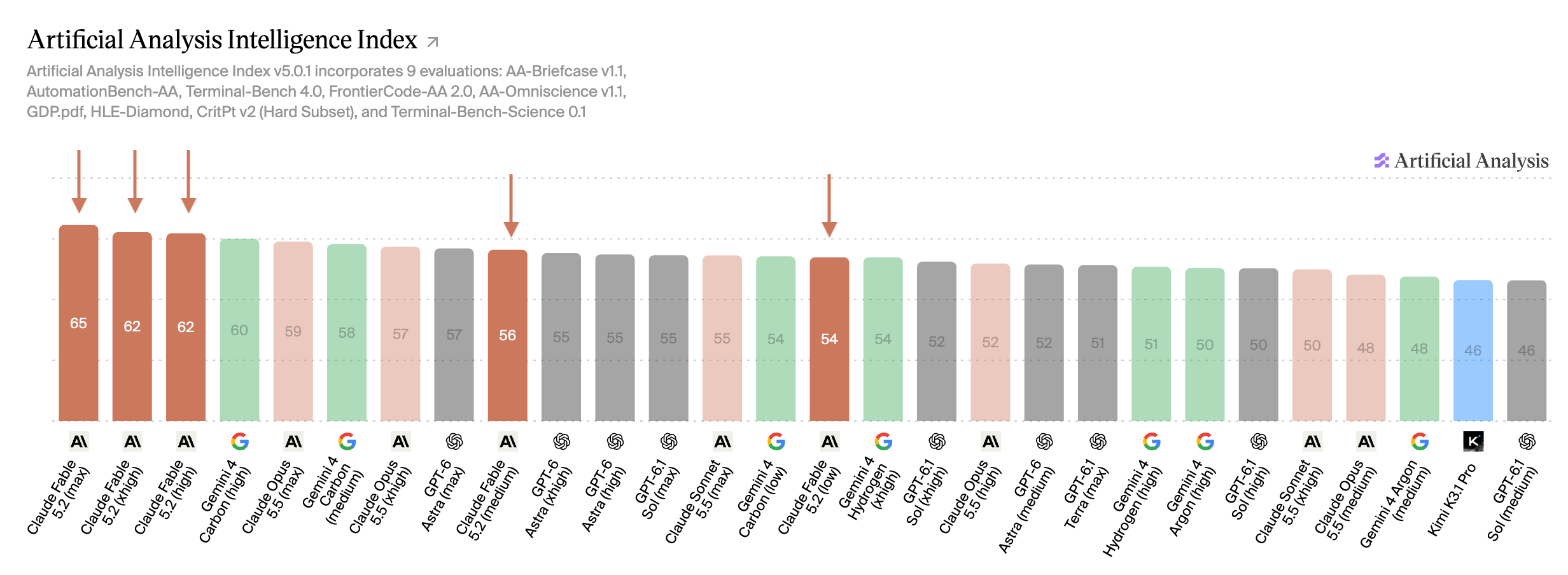
Anthropic pushes the boundaries of AI performance with the introduction of Claude Fable 5.2 and Mythos 5.2. According to Anthropic, the new models bring major improvements in coding, reasoning, visual understanding and scientific research, as well as advances in robotics, hardware design and cybersecurity. The company says the models can solve complex technical problems that previous versions struggled with, while delivering clearer responses, up to 30% faster output and better cost efficiency.
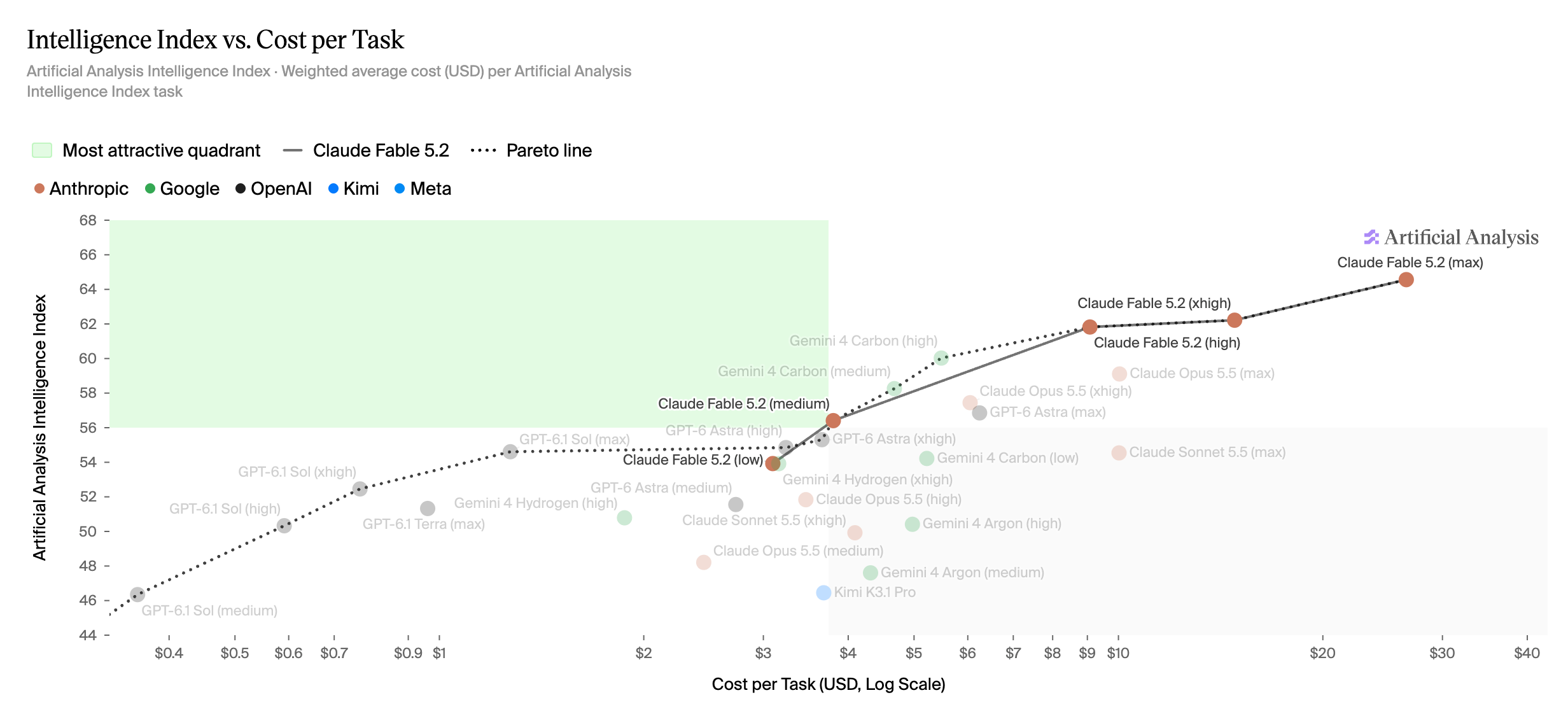
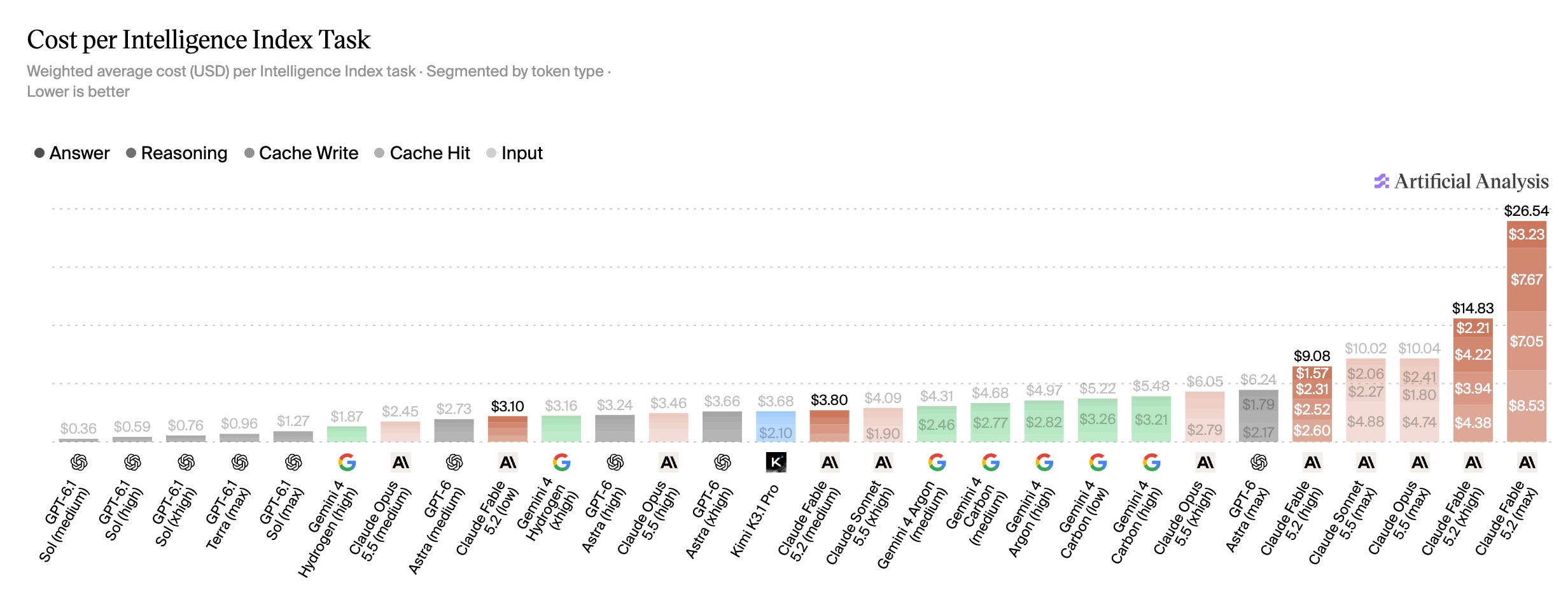
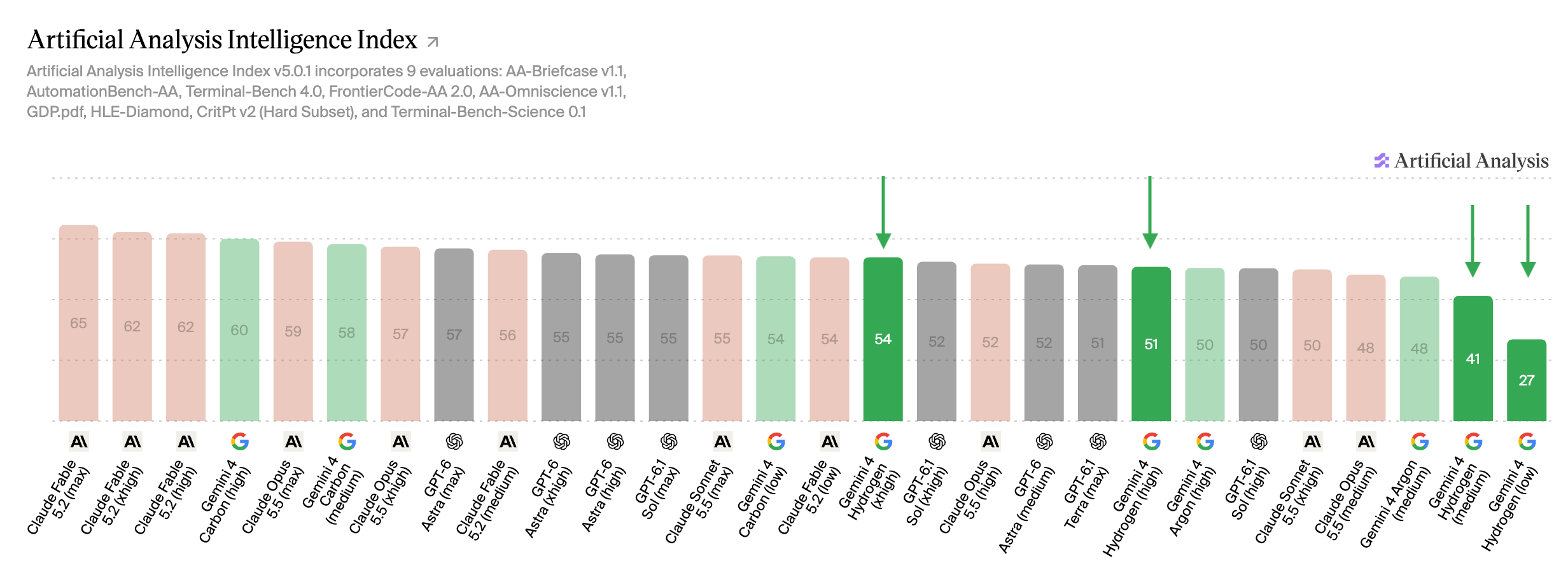
Artificial Analysis confirms the performance claims and places Fable 5.2 at the top of its Intelligence Index benchmark. However, this performance comes at a cost: Fable 5.2 takes significantly longer to complete tasks (45.3 minutes vs 25.4 minutes for Opus 5.5) and is 2.5 times as expensive as Opus 5.5, which Artificial Analysis had already ranked as the most expensive model.
Claude Fable 5.2 is now available through the Claude app, API and major cloud platforms, including AWS, Google Cloud and Microsoft Azure. Mythos 5.2, which has fewer cybersecurity and biology safeguards, is restricted to approved organisations working in cybersecurity and life sciences.
Anthropic to Seek $1.3 Trillion Valuation in IPO
Anthropic is seeking a $1.33 trillion valuation in its upcoming IPO and aims to raise more than $87 billion through its public offering and backing from major investors. The valuation is down from the previously anticipated $1.5 trillion, reflecting growing concerns over AI spending, profitability and market volatility. This comes despite the company reporting an annualised revenue run rate of $81 billion.
Independent Assessment of AI R&D Acceleration at Anthropic in October 2026
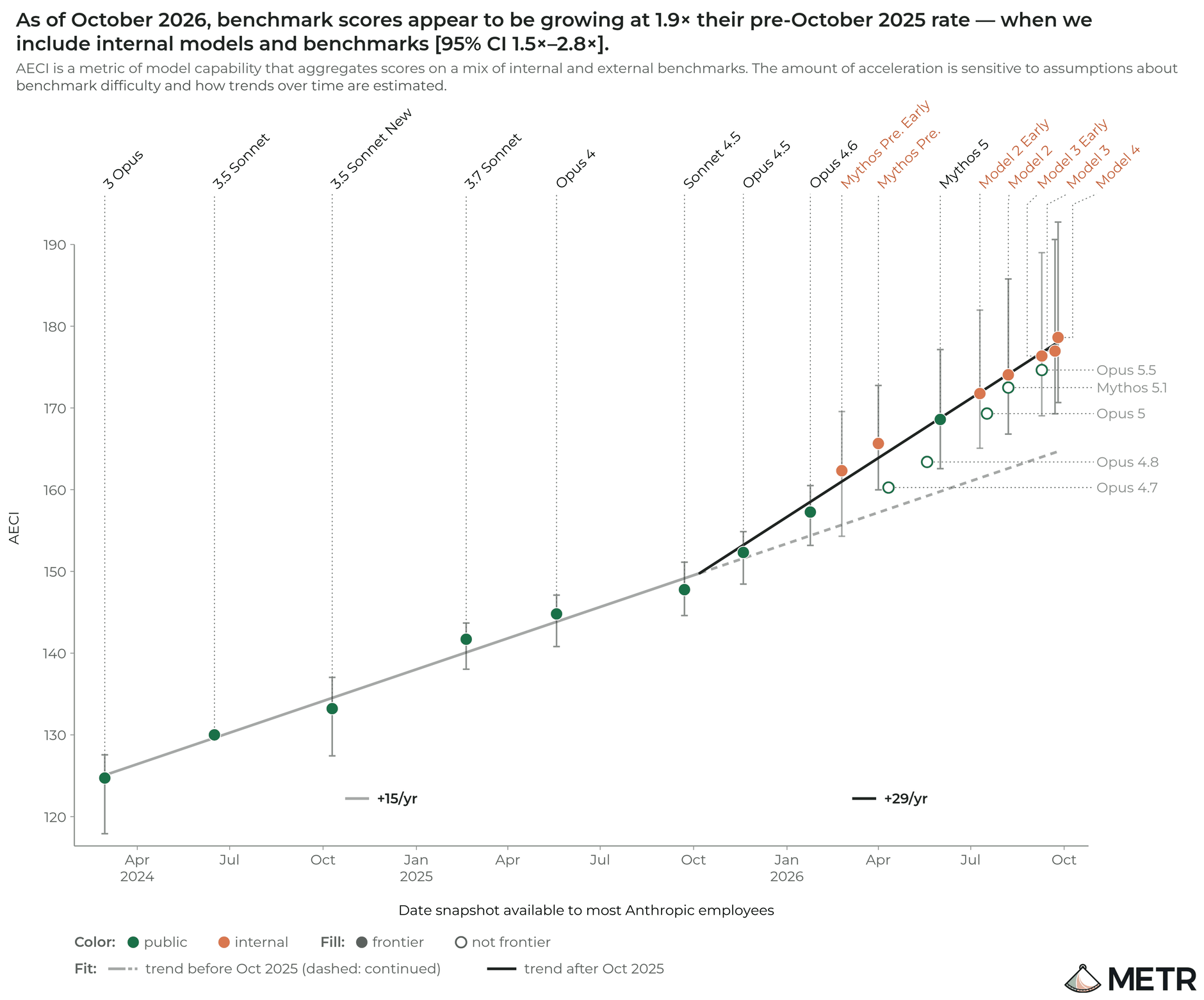
Independent research organisation METR found that Anthropic’s AI models are improving roughly twice as fast as before, achieving about two years of previous progress in just one. Much of this increase appears to come from AI helping researchers, rather than more computing power. With no obvious barriers to further acceleration in the near future, the findings suggest AI development could become even faster, although significant uncertainty remains.
Gemini 4 Hydrogen
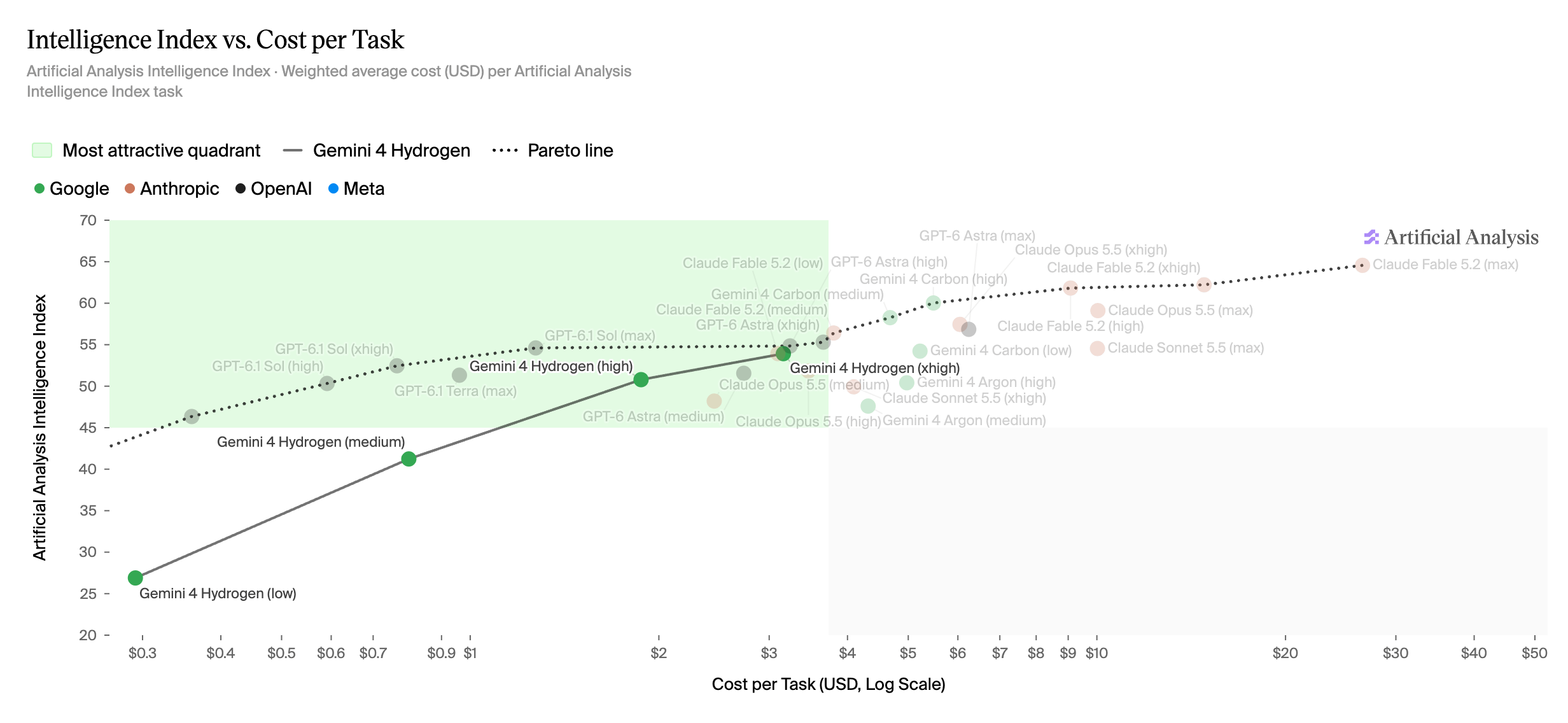
Google adds a new model to its Gemini 4 family: Gemini 4 Hydrogen. The new model focuses on speed, efficiency and agentic workflows, with four adjustable thinking levels to balance performance and cost. Google says Hydrogen delivers improvements in coding, reasoning, multimodal tasks and tool use, outperforming Gemini 4 Argon on key benchmarks while completing tasks 2.5 times faster than Gemini 3.8 Flash.
Independent testing by Artificial Analysis gives Gemini 4 Hydrogen a score of 54 on its Intelligence Index, ranking it 16th and placing it among the leading models for intelligence. However, the analysis finds that Hydrogen is slower than average at completing tasks and generates significantly more output tokens than competing models, although its pricing remains relatively competitive.
Gemini 4 Hydrogen is rolling out globally across the Gemini app, Google Search, AI Studio, Gemini API and enterprise tools.
OpenAI’s Second-Quarter Sales Show Tepid Growth Compared With Anthropic
OpenAI’s revenue rose 18% to $6.7 billion in the second quarter, but its operating losses grew to $12.3 billion, the Wall Street Journal reports. In contrast, Anthropic more than doubled its revenue to $11.6 billion and reported a small adjusted operating profit, while OpenAI continued to lose money.
OpenAI: Introducing Businesses in ChatGPT
OpenAI has launched Business Hub in beta, allowing companies to create verified profiles, update their information and track customer interactions on ChatGPT. Eligible businesses can also use AI agents to answer customer questions, bringing ChatGPT closer to competing with Google Search and Google Business Profiles. Business profiles are available to eligible companies worldwide, while AI agents are initially limited to US ecommerce and online service businesses, with plans to expand to more markets and industries.
The AI ‘credit card’ is getting costlier as CoreWeave bond yield tops 16%
Investors are becoming more concerned about the financial risks facing AI companies. CoreWeave, a major AI data centre provider, is now facing borrowing costs of over 16%, raising concerns about its ability to repay its debts. High costs, uncertainty over whether AI investments will make enough money and growing opposition to new data centres could make it harder for AI companies to raise funds, potentially slowing the industry’s growth.
Apple CEO Presses Software Chief to Pursue More Ambitious AI Strategy
Mark Gurman reports that Apple’s new CEO, John Ternus, is pushing the company to move faster on AI amid growing concerns about delays and internal disagreements. Although Siri has improved significantly, it still trails what OpenAI and Anthropic offer. Apple now wants to make Siri smarter and capable of handling more complex tasks on its own, but unless the company picks up the pace, it risks falling further behind as AI changes how people interact with technology.
Gemini Decisions API
Google joins the decision-model party, albeit a little later than others, with Gemini Decisions 1. The multimodal model can take in text, images, audio, video and PDFs, alongside up to 1,000 independent questions, and return probabilities and confidence scores with an end-to-end latency of 150–250 ms. Google says Gemini Decisions 1 beats Jev 1.14 and OpenAI’s Decisions API (powered by GPT-6 Luna) on almost every benchmark, although Jev comes out cheaper in Google’s own comparison.
Introducing Our Smallest, Most Efficient Model: Muse Ember
Muse Ember is Meta’s lightweight multimodal AI model designed to handle high-volume agentic tasks, including tool use, coding, workflow automation and document analysis, alongside larger reasoning models. According to Meta, Ember delivers competitive performance against Claude Haiku 5.5 and GPT-6 Luna at a lower price. Independent benchmarks from Artificial Analysis support these claims. Muse Ember is available through the Meta Model API.
Our newest TPUs: 8tx and 8i Max, built for the agentic era
Google is expanding its eighth-generation TPU family with two new systems designed to handle more demanding AI workloads. TPU 8tx focuses on secure, faster AI processing for sensitive data and models, while TPU 8i Max offers twice the computing power, SRAM and memory bandwidth of TPU 8i to support more complex AI tasks. Google is also improving its software tools to make it easier for developers to build and run AI applications.
Introducing AlphaProof Code: a breakthrough in verifying complex software at depth
Google DeepMind presents AlphaProof Code, an AI system that uses multiple AI agents and mathematical proofs to check software security. It formally verified the code of Signal’s cryptographic protocol, long considered to be a grand security challenge, in just four weeks, a task that would normally take experts years. AlphaProof Code shows how AI could make software security checks faster, more efficient and more reliable, helping improve cybersecurity and protect critical systems.
Anthropic joins AI’s natural gas frenzy, buys $3.4B worth of turbines
Anthropic joins Google, Amazon, Microsoft and Meta in using natural gas turbines to power its growing AI infrastructure. The AI lab is spending $3.4 billion on the turbines as rising electricity demand and pressure on power grids drive tech giants to secure their own energy supplies. This growing reliance on natural gas also raises concerns about the environmental impact of AI’s rapid expansion.
▶️ Confronting Our AI Future: Closing Keynote “Discovery Loop” with Jeff Dean and Fei-Fei Li (48:21)
It is always interesting to hear two legends in AI discuss the latest developments in the field. Jeff Dean, a distinguished software engineer who recently left Google to co-found Discovery Loop, begins with a talk about his new company’s mission to automate scientific discovery and why recent advances in AI make this possible. He is then joined by the godmother of AI, Fei-Fei Li, for a discussion in which they explore the potential and limitations of AI self-improvement, its growing role in scientific discovery, and separate hype from reality. They also explore AI’s wider impact on society, the challenges of adapting to rapid technological change, and why human creativity and passion will remain important in the age of AI.
AI Models Can Tell When Researchers Plant Concepts in Their Neural Networks. Is It Self-Reflection?
Recent research suggests AI models may be able to notice changes in their own neural activity, raising questions about whether they can understand their own thinking. While some models can detect these changes, they struggle to explain them correctly. Researchers are still unsure whether this shows real self-awareness or simply learned behaviour, leaving the debate unresolved.
AI Company Employees Should Unionize
Scott Alexander argues in this article that safety-conscious employees at AI companies should unionise. He suggests that unions could help employees slow down or pause AI research, work with unions at other AI labs, and gain legal protections when taking action together.
🤖 Robotics
Tesla expands robotaxi service to San Antonio
Tesla is expanding its robotaxi service to San Antonio, Texas, as it looks to grow its self-driving taxi business and compete with Waymo. However, details such as the number of vehicles and whether human safety drivers will be used remain unclear.
Gemini Robotics 2.5 accelerates real-world general dexterity
Google DeepMind has unveiled Gemini Robotics 2.5, a new AI model designed to help robots learn faster and handle complex physical tasks with greater efficiency and reliability. According to Google DeepMind, the model achieved 30-100% higher success rates and completed tasks 20-30% faster than previous systems. In a pilot with Mercedes-Benz and Apptronik, humanoid robots powered by Gemini Robotics 2.5 reportedly achieved a 96% success rate in sorting automotive parts. The model is currently being rolled out to select robotics partners, with no timeline announced for broader availability.
▶️ Atlas on a Roll | Classical Motor Controls and Whole-Body RL (2:50)
Engineers at Boston Dynamics asked themselves what if Atlas had wheels instead of feet, and then went ahead and built a specialised version of the humanoid robot to find out. According to Andy Wu, a controls engineer at Boston Dynamics who worked on the project, the aim was to push Atlas’s control systems and training pipelines to their limits. He also says working on wheeled Atlas was a lot of fun.
NVIDIA launches GR00T 2 and Isaac Lab 3.0 at CoRL
NVIDIA released GR00T 2, a new AI model that helps robots learn complex tasks from human demonstrations and adapt to different robotic platforms with less training. Alongside it, NVIDIA launched Isaac Lab 3.0, an updated open-source framework that speeds up robot training and improves efficiency through better physics simulation and reinforcement learning. Together, these tools aim to make robots more capable, flexible, and autonomous.
Runway: Praxis-1 Is Now Available
Runway’s Praxis-1 world action model for robots is now available on Hugging Face and GitHub. Runway says that the model outperforms other open-weight models, achieving a 46.2% success rate on NVIDIA’s RoboLab-120 benchmark.
Boston Dynamics Launches Next Generation Stretch Robot
Boston Dynamics has launched Stretch Gen 2, an upgraded warehouse robot designed to unload boxes faster and more reliably. The new model is more durable, easier to maintain and better at identifying issues, helping reduce downtime. Boston Dynamics says Stretch Gen 2 can unload up to 1,000 boxes per hour and run for two shifts on a single charge.
Amazon’s Ring unveils flying drone and robot to patrol homes and businesses
Amazon unveiled two new Ring devices, both of which are robots. The $250 Ring Drone Cam is a flying security camera that patrols homes, while the $1,000 Ring Rover Cam looks like Amazon’s Astro robot, repurposed as a security guard for businesses. Both use AI to move around on their own, follow patrol routes and check for potential threats when security sensors are triggered. The Rover Cam is set to launch in December 2026, followed by the Drone Cam in January 2027.
German AI robotics startup valued at $8.5 billion after new fundraising
German robotics startup Agile Robots has raised $500 million in funding led by SoftBank, valuing the company at $8.5 billion and making it Europe’s most valuable AI robotics company. The company plans to expand globally and increase production in Germany to meet growing demand for robots in factories and warehouses.
Path Robotics raises $300M at $2.25B Valuation
Path Robotics has raised $300 million in funding, bringing its valuation to $2.25 billion as demand for its AI-powered welding robots continues to grow. The company has seen revenue grow 17-fold over 18 months and plans to use the new funding to expand its operations, improve its AI technology and bring more automation to manufacturing.
Are Drone Ports the Next Annoying Tech Neighbor?
Drone deliveries promise faster, more convenient service at lower costs. But for those living beneath their flight paths, the reality is different. As companies expand their services, residents across the US and beyond are complaining about constant noise, privacy and safety concerns. The growing backlash has led to protests and legal action, pushing companies in some cases to change flight routes or cancel plans for new facilities.
These Robotic Arms Are Powered by Algae
Researchers have developed tiny, flexible robots powered by algae and sunlight. As the algae photosynthesise, they trigger changes in a special gel, allowing the robots to bend and grip objects. Although slow-moving, these robots require no electricity or complex machinery, and could offer an environmentally friendly alternative to traditional robots.
🧬 Biotechnology
AlphaGenome 2: Deciphering how cells read DNA to better understand disease
Google DeepMind presents AlphaGenome 2, a new AI model that predicts how DNA variations influence gene activity across hundreds of human cell types. According to Google DeepMind, the model identifies nearly twice as many gene-regulating variants as its predecessor, potentially accelerating disease research and drug discovery. AlphaGenome 2 is available for non-commercial research, with commercial access in private preview.
A DeepSeek Moment for Biotech
Chinese drugmakers are playing an increasingly important role in global drug development. Supported by government policies and growing research capabilities, the industry is shifting from producing low-cost generic medicines to developing innovative new treatments. This has attracted growing interest from major global pharmaceutical companies, with China’s share of global drug licensing deals by value rising from 17% in 2022 to 60% in the first half of 2026. However, bringing these new drugs to international markets remains a challenge.
Biotech Firm Claims Some Credit for Groundbreaking Virus Research
AI start-up Radical Numerics has faced criticism for failing to credit Tabula Bioscience’s key role in developing AI-designed viruses to treat a drug-resistant infection. Radical Numerics said confidentiality agreements prevented it from naming Tabula, but the dispute led prominent geneticist George Church to resign from its board.
AI Agents Ran a Biology Lab. Humans Popped in to Empty the Trash.
Autonomous biology labs, where AI designs experiments and controls robotic arms and other equipment, are becoming increasingly sophisticated. This article highlights recent advances that allow AI agents to manage entire experiments with little human help, including making and reading DNA and identifying genetic mutations. While technical and safety challenges remain, these developments could speed up scientific research and reduce manual lab work.
💡Tangents
SpaceX and Tesla Talks on Record Merger Are Said to Progress
SpaceX and Tesla are advancing merger talks, Bloomberg reports, with a record-breaking deal potentially announced as early as December. The merger would create a company worth more than $3.4 trillion, bringing together electric vehicles, robotics and space technology with a focus on AI. However, the deal could face obstacles due to SpaceX’s US defence contracts, Tesla’s operations in China and increased political scrutiny of Elon Musk.
‘Flying cars’ could launch in China next summer, maker of two-seat model says
Chinese carmaker XPeng plans to launch its $300,000 flying car in the second half of 2027, initially for leisure trips in approved areas of China and for use by emergency services. The two-seater electric aircraft can fly itself to a set destination, has a range of 30 km, and comes with a specially designed van to carry it. The vehicle has been approved for limited use in China, with XPeng hoping to expand into Europe and other overseas markets.
Thanks for reading. If you enjoyed this post, please click the ❤️ button and share it!
A big thank you to my paid subscribers, to my Patrons: whmr, Florian, dux, Eric, Preppikoma and Andrew, and to everyone who supports my work on Ko-Fi. Thank you for the support!