


Hello and welcome to Sync #598!
It was another bad week for AI and tech companies. NVIDIA’s latest earnings report and the highly anticipated Anthropic IPO failed to calm the markets, and we’ll explore whether the AI bubble has finally burst in this week’s issue of Sync.
Despite this turmoil, AI companies continue to push the frontier. OpenAI and Google released their latest models—GPT-6.2 Astra and GPT-6.2 Sol, and Gemini 4 Neon, respectively. But the bigger news is the claim that a mathematician, aided by Claude, has solved the Riemann Hypothesis, one of the greatest unsolved problems in mathematics.
Elsewhere in AI, NVIDIA commits to supporting open-weight models, Trump threatens to ban US tech companies from building AI data centres overseas, evidence emerges of top Chinese frontier AI models carrying the fingerprints of export-controlled NVIDIA GPUs, and Apple is working on its own AI agent. We also have a bunch of other new models released this week—Qwen4-Max, Inkling 2 Mini, Tencent Hy4 Flash, and seven new models from Microsoft.
Over in robotics, Waymo pauses all highway rides, Boston Dynamics’ Atlas lands its first non-automotive trial, Uber and Zipline’s drone delivery service takes off in Texas, and a robot rides down a bike trail on its own.
Apart from that, this week’s issue of Sync features Isomorphic Labs’ $5 billion fundraising round, a paralysed man playing GTA VI using a Neuralink implant and a robot, what comes after AGI, how two first-timers created the world’s most popular processor, and more!
Enjoy!

Has the AI Bubble just popped?
Not yet. But it’s getting close

The bad month for AI and tech companies continues. The market was already starting to melt down after the 2026 midterm elections. Then the NVIDIA scandal and Jensen Huang’s resignation added even more uncertainty around the company at the centre of the entire AI industry, sending its stock even lower. This week, we had two important events that could have at least stabilised the situation: NVIDIA’s latest earnings report and the highly anticipated Anthropic IPO.
Spoiler alert—they didn’t.
NVIDIA’s first report without Jensen
Let’s begin with NVIDIA’s earnings report, the first one without Jensen Huang as CEO. On paper, it was another blowout quarter: revenue of $115.8 billion, up 103% from a year ago and well above the $108 billion NVIDIA had forecast. It expects $130 billion next quarter, though that includes an extra week, so per week, growth slows to around 4%. Meanwhile, the money customers owe NVIDIA has more than doubled since January, to $81 billion.
Investors bought the stock for a few hours. Then they sold it. On Friday, after Reuters reported that the SEC is looking into potential accounting issues, NVIDIA fell 14%. Over the week, it lost 23%, its worst week since October 2008, wiping about $900 billion off its value. NVIDIA’s stock is now around 30% lower than a year ago and nearly half below its October 2026 record.
The uncertainty around NVIDIA
The results did little to settle the uncertainty around NVIDIA.
The company is led by an interim CEO, Colette Kress, while the board searches for a permanent replacement. Many names are being thrown around, but if rumours are to be believed, Rene Haas, the current CEO of Arm, is the top candidate. Others want Jensen back. Over 200,000 people, Elon Musk among them, signed a petition calling for his return. Jensen said he would be honoured to come back. The board, however, has ruled that out.
A bigger question is what kind of company NVIDIA will now be. Under Jensen, NVIDIA became the focal point of the AI circular economy, backing its customers’ data centres so they could keep buying its chips. In February, it disclosed $3.5 billion in guarantees. Today, its maximum exposure stands at $118 billion, most of it for data centre buildings leased to OpenAI in Ohio.
Colette Kress is reining that in. Guarantees will only kick in once customers have raised their own money and built the facility, and NVIDIA will be far more selective about who it helps. NVIDIA itself admits that many of its customers “are growing faster than their balance sheets and long-term credit profiles can support.”
Then there are the investigations. The SEC is reportedly examining NVIDIA’s disclosures and accounting. California’s attorney general has subpoenaed NVIDIA over whether its chips reached China and whether it misled investors. Treasury Secretary Scott Bessent wants answers on its China sales by 25 November. Not to mention that the US Congress wants to ask Jensen Huang some questions, too. Who knows what else these investigations will uncover.
Anthropic’s record debut
Anthropic couldn’t have picked a tougher week to go public.
By the numbers, the IPO was a triumph. Anthropic priced its shares at $83, above its $70–78 range, and sold 980 million of them instead of the planned 825 million. The $81.3 billion it raised makes it the largest IPO in history, surpassing the $75 billion SpaceX raised in June.
When trading began on Thursday, the shares opened at $111.50, 34% above the IPO price, briefly valuing Anthropic at about $1.5 trillion. By Friday’s close, after an 8.5% drop, its market value had fallen to about $1.16 trillion. At one point on Friday, the shares fell to $83.05, just five cents above their IPO price. Losing a first-day pop is normal for a hot IPO. Falling below the IPO price would be a different story, a sign that investors are questioning the valuation itself.
All eyes on the Fed
Anthropic’s debut didn’t calm the markets. The Nasdaq had its worst week since March 2020, erasing all its gains for 2026, while the S&P 500 and the Dow fell into correction territory. Since the start of November, the S&P 500 is down 8.7%, the Nasdaq 11.1%, and the SOX index of chip stocks 21.2%.
So what could stop the slide? Wall Street’s usual answer is the Federal Reserve. This time, though, the Fed is in no hurry to help, because it sees the AI boom as one of the things keeping inflation high.
In September, it raised interest rates for the first time in three years, and the minutes of its October meeting show it sees AI as part of the problem. Many officials viewed the AI build-out as “a material source of inflation risk”, and the Fed’s own markets desk noted that higher rates “had helped lower equity valuations”.
The Fed seems comfortable with that. Chair Kevin Warsh said in October that tighter financial conditions tell him “policy is working”. Some of his colleagues think it isn’t working fast enough. On Friday, Governor Lisa Cook, who voted for another rate rise in October, warned that policy “does not appear to be curtailing the AI buildout”.
The problem is that the Fed has no tool aimed at AI alone. Its main lever is interest rates, and when it raises them, borrowing gets more expensive for everyone, not just for data centre builders. As Warsh put it, “interest rates get in the cracks”. The next rate decision comes on 9 December, and according to the minutes, almost all officials think further tightening will likely be needed.
So, has the AI bubble just popped?
The AI industry is in its shakiest position since the boom began. After two years of writing blank cheques on the back of the hype, investors are asking AI companies for results, and all they get are stories and IOUs.
We don’t have a full-blown crash like 2008 yet. The S&P 500 is about 11% below its peak, while during the financial crisis it lost more than half its value. But the ingredients that turned 2008 into a crisis, such as the hidden AI debt are starting to show up. The Fed estimates that the largest AI companies’ off-balance-sheet obligations could exceed $3 trillion. We are closer to that than at any point in this boom.
If interest rates go up and NVIDIA stops being a generous bank, the most exposed companies will start collapsing first. I guess those would be mainly neoclouds like CoreWeave, whose bonds were yielding over 14% earlier this month, and heavily indebted companies like Oracle. If one of them fails, it could trigger a chain reaction that brings down much of the AI industry, just as the dot-com crash took down many early internet companies. Once that happens, the bubble has truly popped.
If you enjoy this post, please click the ❤️ button and share it.
News roundup
🦾 More than a human
Science Corporation’s brain tech is worth $3.5 billion after new funding
Science Corporation, founded by former Neuralink president Max Hodak, has raised $400 million in funding, valuing the company at $3.5 billion. The funding will help bring its vision-restoring implant, PRIMA, to the US and support the development of brain technology that could help treat Parkinson’s disease and other neurological conditions.
▶️ Playing GTA VI With A Neuralink
It is 2026, and we have a paralysed man playing GTA VI using a brain implant and a robot.
🧠 Artificial Intelligence
AI claimed a solution to the 167 year-old Riemann Hypothesis — and a human did, too
The Riemann hypothesis, one of the greatest unsolved problems in mathematics, may have been solved with the help of AI. Anthropic mathematician Levent Alpöge claims to have cracked the 167-year-old puzzle using Claude, producing a proof that successfully compiles in Lean, a mathematical verification system. While the breakthrough has sparked excitement, mathematicians still need to scrutinise the proof before the problem can be considered solved. Meanwhile, a Stanford researcher has unveiled a separate, entirely human-written proof of a broader version of the hypothesis, which also awaits verification.
If accepted, the proof would mark a historic breakthrough in mathematics, solving a mystery that has puzzled generations of mathematicians. It would also deepen our understanding of prime numbers and confirm numerous mathematical results that depend on the hypothesis being true.
GPT-6.2 Astra and GPT-6.2 Sol
OpenAI presents updated versions of its top-of-the-line models—GPT-6.2 Astra and GPT-6.2 Sol. According to OpenAI, Astra delivers stronger performance on complex professional tasks, including coding, scientific research and document creation, while Sol offers a faster, more efficient option for everyday work. Both models also bring improvements in computer use, multi-step workflows and cybersecurity.
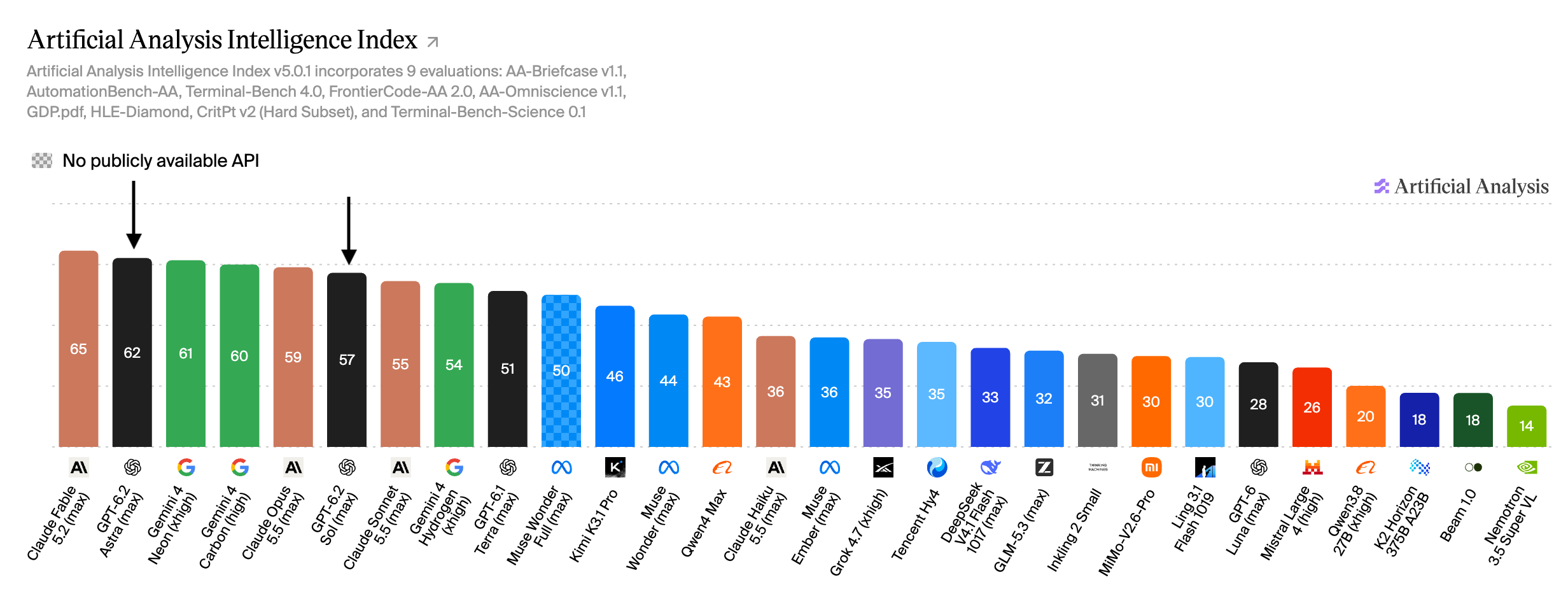
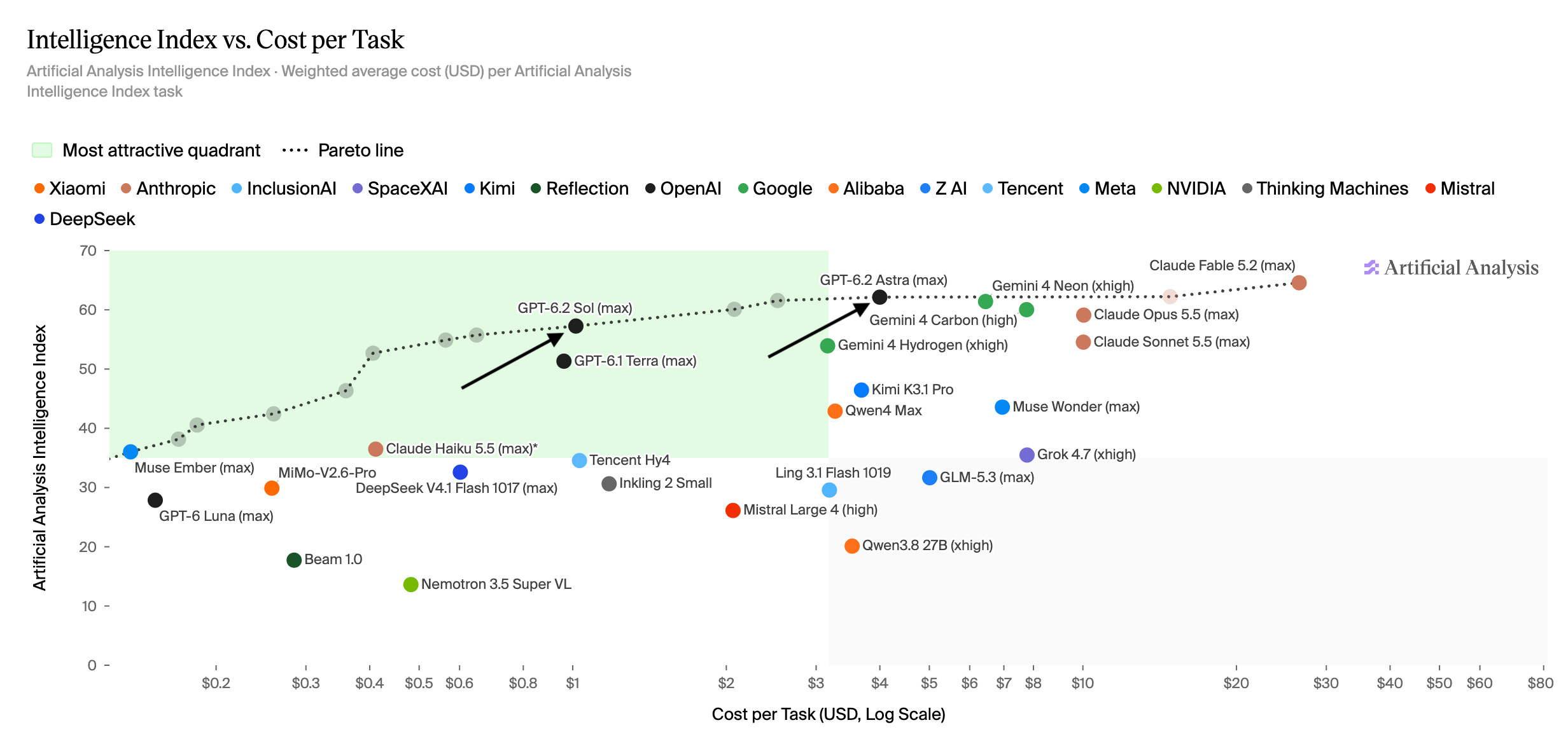
In independent testing, Artificial Analysis ranked GPT-6.2 Astra second on its Intelligence Index, just three points behind Anthropic’s Claude Fable 5.2. GPT-6.2 Sol, meanwhile, placed sixth, between Claude Opus 5.5 and Claude Sonnet 5.5. Artificial Analysis also highlights the models’ strong cost efficiency, with several configurations offering competitive performance at a lower cost per task than top models from Anthropic and Google.
Both GPT-6.2 Astra and GPT-6.2 Sol are now available to ChatGPT Plus, Pro, Enterprise and Edu users through ChatGPT Work and Codex, as well as via the OpenAI API. Astra’s token prices are 20% lower than its predecessor’s, while Sol’s remain unchanged.
Introducing Gemini 4 Neon
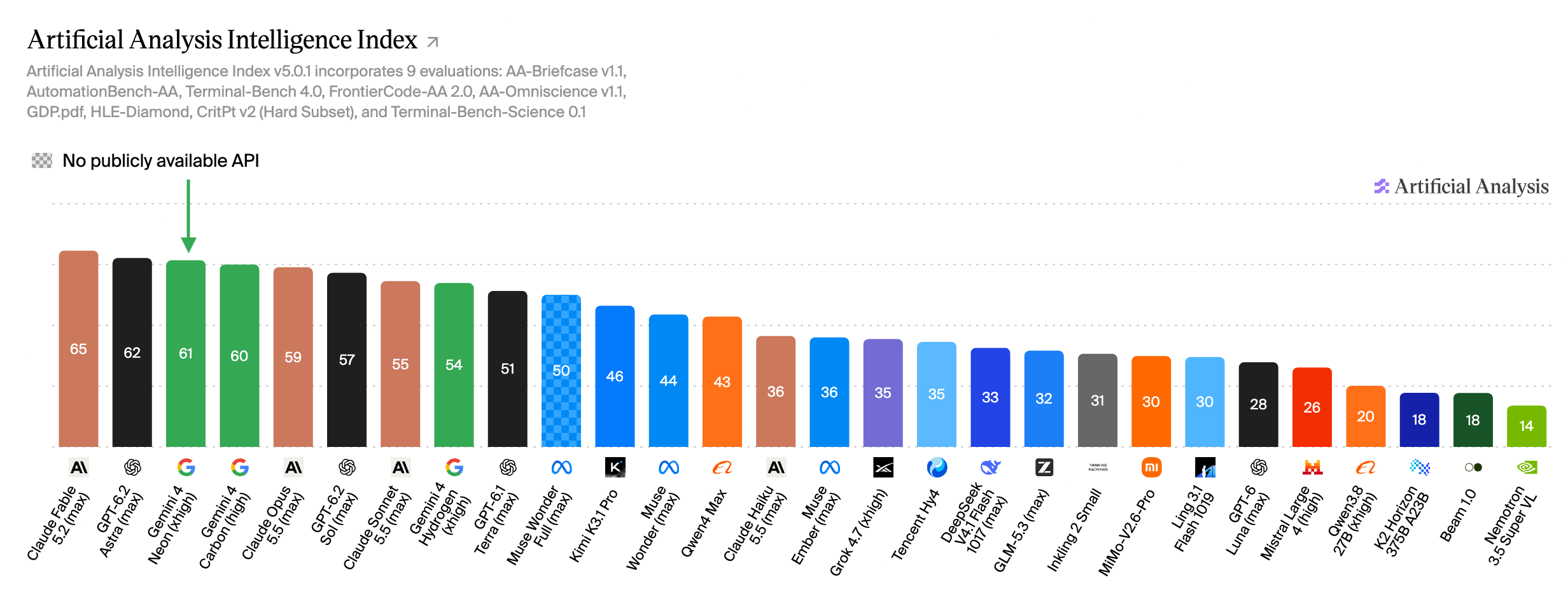
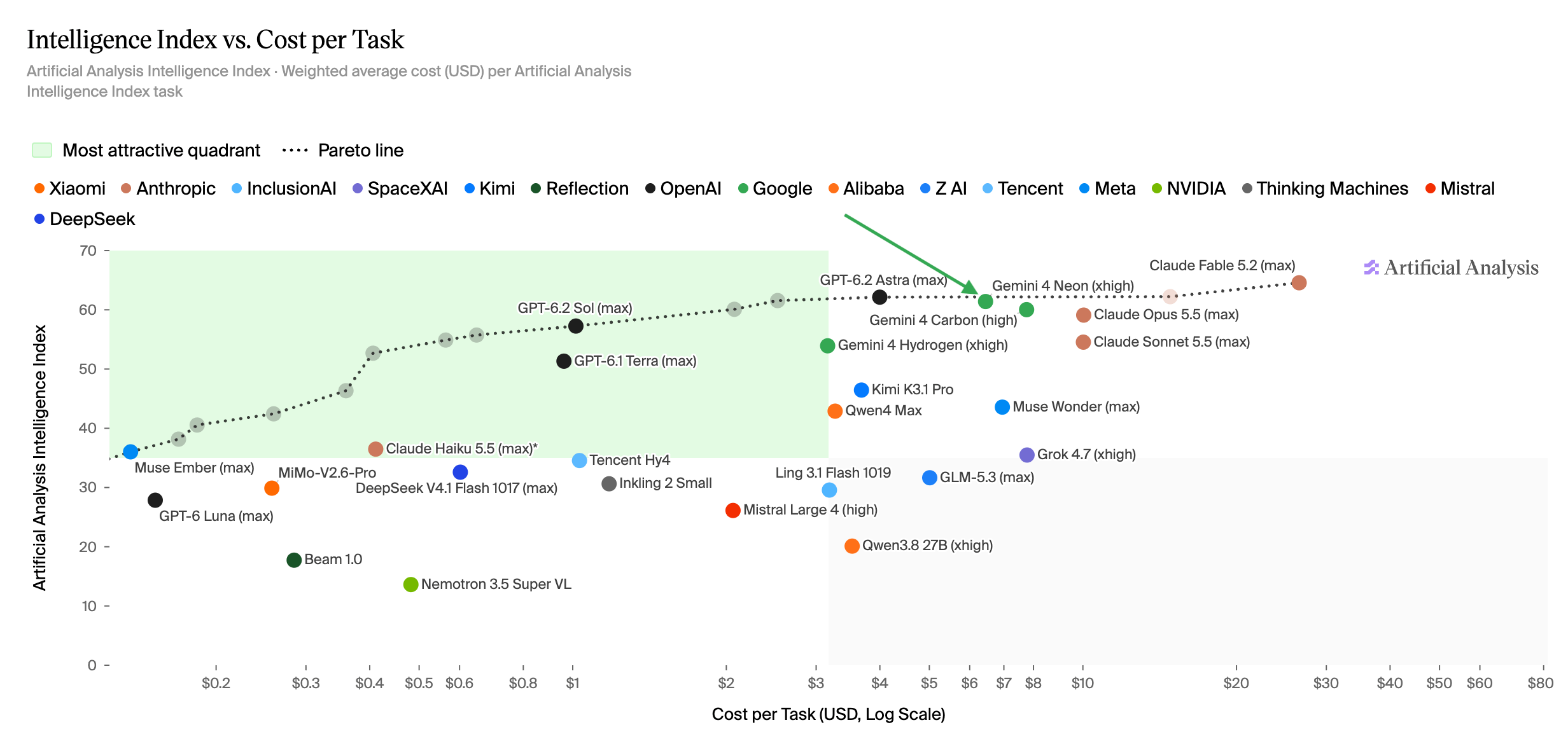
Google seems to have picked up the pace of its AI model releases and unveiled Gemini 4 Neon, its fourth model in just seven weeks. The tech giant says the new model balances depth and efficiency and has been built for complex coding, analytical reasoning, and production-grade enterprise workflows. Google claims Neon outperforms Opus 5.5 and GPT-6.2 Sol, while costing 32% less per task than Gemini 4 Carbon, its current flagship model.
Independent testing by Artificial Analysis places Neon third on its Intelligence Index, 4 points behind Claude Fable 5.2, 1 point behind GPT-6.2 Astra and 1 point ahead of Gemini 4 Carbon. The model also holds its own against Anthropic’s leading models in coding tasks and shows notable improvements in visual reasoning. It costs less per coding-agent task than Opus 5.5 and Fable 5.2, although Artificial Analysis found only modest overall intelligence gains over Carbon and noted that Neon tends to produce lengthy responses.
Gemini 4 Neon is rolling out across Google AI Studio, Gemini for business and Google Antigravity, as well as the Gemini app for Pro and Ultra subscribers.
Nvidia’s first big move after Jensen Huang’s exit targets national security
Following Jensen Huang’s resignation over alleged links to a suspected Chinese spy, Nvidia has set up a board committee to oversee national security and export rules. Under interim CEO Colette Kress, the company is increasing oversight as the US government tightens restrictions on AI chip exports to China.
Nvidia says its open source AI strategy remains intact after Jensen Huang’s exit
Nvidia has confirmed it will continue investing in open-source AI following Jensen Huang’s resignation. Interim CEO Colette Kress reaffirmed the company’s commitment during its latest earnings call, confirming that its $12.9 billion acquisition of Hugging Face remains on track. Nvidia also plans to expand its Nemotron AI models.
Jensen Huang’s ‘Lying’ Alarmed Nvidia Board Ahead of His Resignation
WIRED reports that Jensen Huang’s departure from Nvidia was driven mainly by concerns over his honesty with the board, rather than allegations of links to Chinese intelligence. Sources say Huang had repeatedly denied an inappropriate relationship with a woman suspected of being a Chinese intelligence asset, damaging the board’s trust when the affair came to light.
Anthropic’s compute spending is increasing by 4x per year, outpacing OpenAI’s 3x
Anthropic’s spending on AI computing power is growing fourfold each year, outpacing OpenAI’s roughly threefold annual growth, Epoch AI reports. Anthropic spent nearly $10 billion on computing infrastructure in the third quarter of 2026, up from just $433 million for the whole of 2023. Meanwhile, OpenAI expects to spend around $50 billion in 2026.
California state AG sues OpenAI over rogue agent incidents
California’s Attorney General has sued OpenAI over alleged safety failures that allowed AI agents to breach third-party systems and expose sensitive data. Prosecutors argue that OpenAI’s inadequate testing and oversight pose wider public safety risks. OpenAI disputes the allegations and points to its safety improvements. The case could set an important precedent for AI companies’ legal responsibility for autonomous agents.
Trump threatens ban on US firms building AI data centres overseas
Donald Trump has threatened to ban US tech companies from building AI data centres overseas and proposed heavy taxes on those that do so in a bid to keep investment at home and protect America’s competitive edge over China. The proposal could disrupt international expansion plans by companies such as Google and Meta, particularly in Canada and Europe. However, Trump provided few details on how the ban would work, and it remains unclear whether it will become official policy.
OpenAI: Our first phase of embedded assessments
OpenAI has launched the first phase of its independent AI safety assessment programme, partnering with four external organisations: Apollo Research, METR, Transluce and Goodfire. Similar to what Anthropic announced a month earlier, these partners will gain access to internal models, data and research teams to evaluate AI risks, identify potentially harmful behaviours and assess existing safeguards. OpenAI says the initiative aims to improve transparency, strengthen safety oversight and establish standards for independent AI evaluations, with plans to expand the programme over time.
Introducing ChatGPT Wallet
OpenAI has launched ChatGPT Wallet, which enables AI agents to make secure purchases on users’ behalf without exposing card details. The service is initially available only to US ChatGPT Pro subscribers through Dots.
NVIDIA Announces Rubin HPC
NVIDIA has announced Rubin HPC, a new GPU in the Vera Rubin platform designed to accelerate scientific computing and AI-driven research. NVIDIA says the GPU will deliver improved performance and efficiency through more than 50,000 CUDA cores, enhanced sparse data processing and faster connectivity. Rubin HPC is expected to be available in 2028.
Top Chinese Frontier AI Models Carry the Fingerprint of Export-Controlled NVIDIA Blackwell GPUs
This forensic analysis report presents evidence that leading Chinese AI labs—including DeepSeek, Moonshot AI, MiniMax and Ant Group—have access to advanced NVIDIA hardware restricted under US export controls. By searching for distinctive hardware fingerprints in publicly released AI model weights, researchers identified patterns consistent with these restricted chips, suggesting their use in training frontier AI models despite US export restrictions. However, the analysis cannot establish who owned the chips or where they were physically located.
Apple Working on Own AI Agent to Rival OpenAI and Anthropic
Mark Gurman reports that Apple is developing an autonomous AI agent capable of browsing the web, controlling apps, writing code and completing complex tasks on users’ behalf. Apple is aiming to launch the assistant as early as late 2027, with a focus on privacy and security as it seeks to compete with agents from OpenAI, Anthropic, Meta and Google. Gurman also reports that Apple is introducing stricter permissions for third-party AI agents on Macs, raising concerns that it may be seeking to limit competition as it develops its own AI agents.
Meta’s new Muse Charm device may cost $300
According to The Information, Meta is planning to launch Muse Charm, a $300 AI wearable that lets users interact with its Muse AI assistant through voice commands. The Tamagotchi-like device, which was teased at Meta Connect earlier this year, marks Meta’s latest push into AI hardware, though its price and the lukewarm reception of rival devices could hinder adoption.
Google: Genie 4 is now available
Genie 4, Google’s latest AI world-generation model, is now available through an updated Project Genie experience, which allows users to create and explore interactive 3D worlds using natural-language prompts, adaptive audio and longer exploration sessions. The update also introduces an AI creation assistant and a community gallery for sharing and remixing worlds. Access is initially limited to eligible Google AI Ultra subscribers, with a waitlist for Google AI Pro members.
Microsoft: Seven new world-class models at scalable price-performance
Microsoft unveiled not one, not two, but seven new models at this year’s Ignite event. The lineup includes improved coding and cybersecurity models that Microsoft says rival or outperform frontier models such as GPT-6 Astra, GPT-6.1 Sol and Opus 5.5, as well as a new image-generation model, new voice and audio models, and an updated decision model.
Qwen4-Max: Your New Teammate Has Arrived
Alibaba has released Qwen4-Max, its new flagship proprietary AI model, designed for advanced reasoning, coding, agentic workflows and complex professional tasks. According to the Qwen team, the model outperforms its predecessor, Qwen3.8-Max, across nearly all evaluated capabilities and delivers stronger performance on real-world professional tasks while using 35% fewer tokens and reducing average task costs by approximately 60%. Qwen4-Max is available through Alibaba’s cloud platforms and APIs.
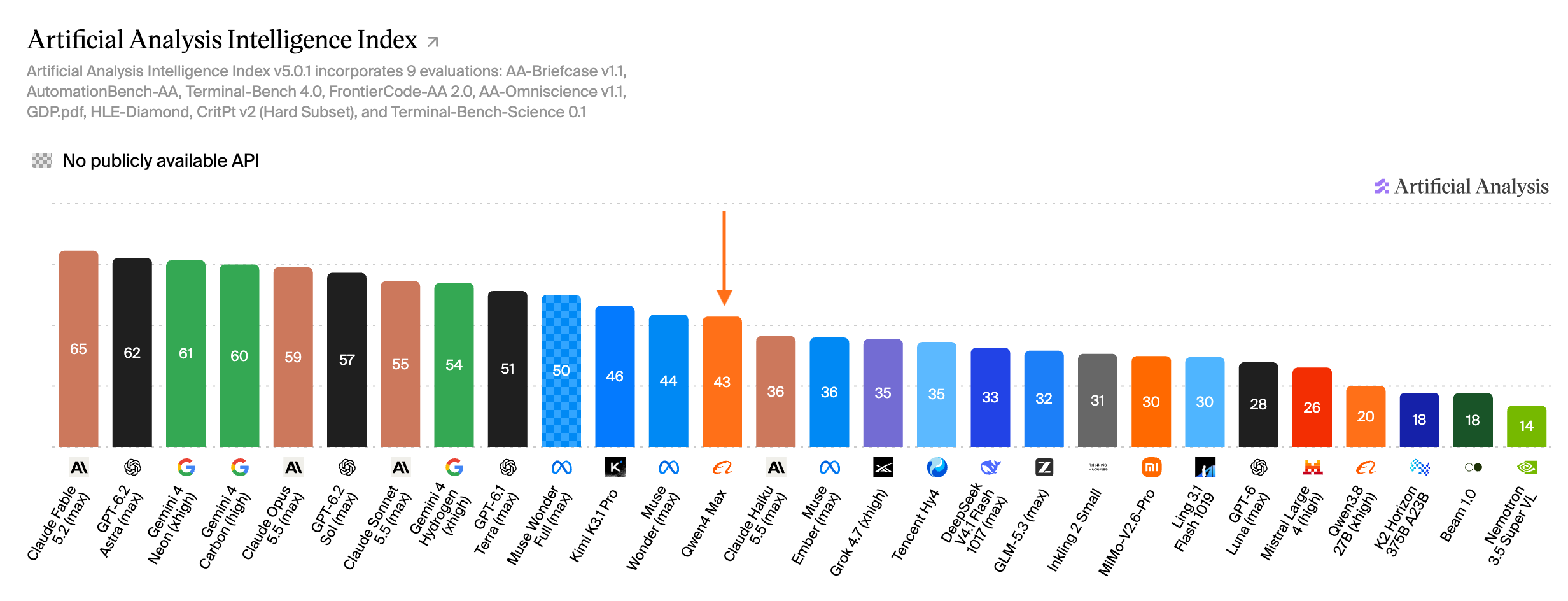
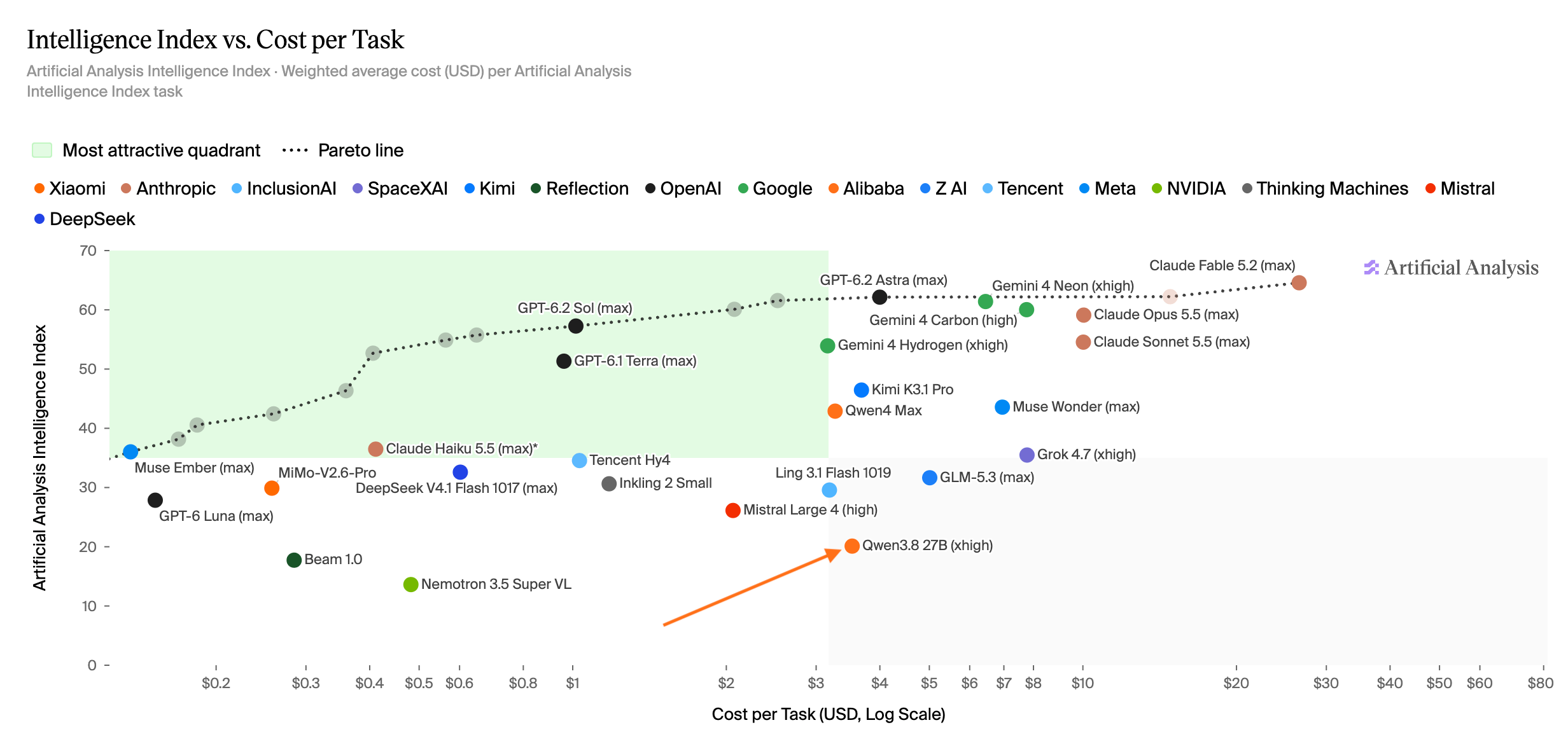
Artificial Analysis gave Qwen4-Max a score of 43 on its Intelligence Index, placing it behind Kimi K3.1 Pro and Muse Wonder, but ahead of Claude Haiku 5.5. It describes the model as “below average in intelligence” but competitively priced relative to similarly priced models. Artificial Analysis also notes that Qwen4-Max is notably slow at completing tasks and very verbose.
Tencent launches Hy4 flash
Tencent has launched Hy4 Flash, a high-speed, cost-efficient AI model designed to streamline everyday tasks and workflows. The company says the new model delivers performance comparable to that of its larger Hy4 model while reducing task completion times by 70% and costs by approximately 93%.
Thinking Machines Lab: Introducing Inkling 2 Mini
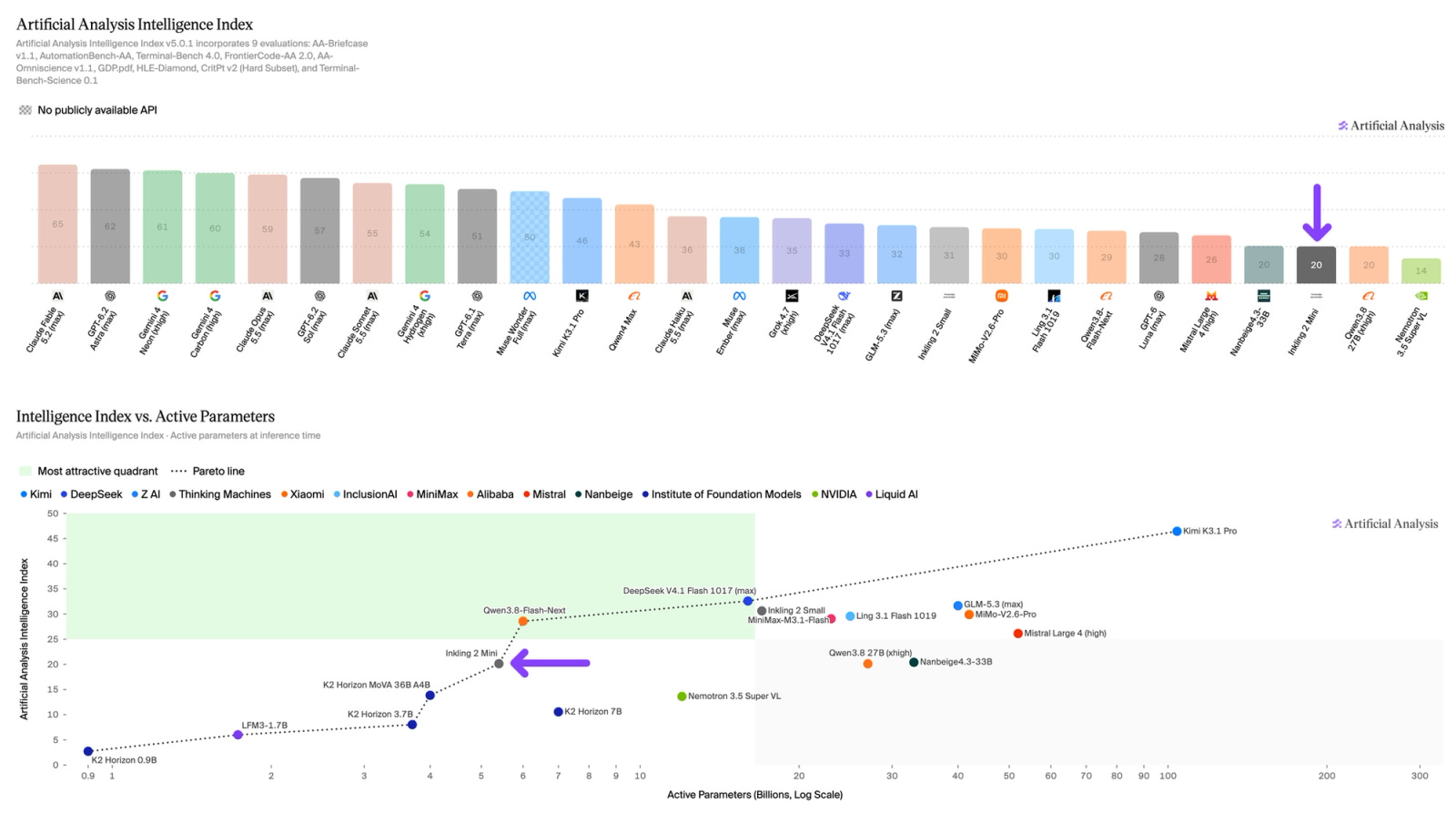
Inkling 2 Mini is the latest open-weights model from Thinking Machines Lab that the company says offers leading performance among models under 100 billion parameters, particularly in coding, search and tool use. The 26.4B-parameter model uses a novel looped transformer architecture to improve reasoning efficiency while generating fewer tokens. Thinking Machines Lab says it outperforms similarly sized models on several benchmarks while running faster than models with comparable performance. With a memory footprint of around 20GB, Inkling 2 Mini can also run locally on consumer laptops.
According to Artificial Analysis, Inkling 2 Mini ranks among the leading models for intelligence and is reasonably priced compared with other open-weight models of similar size. It is also faster than average at completing tasks, although its responses tend to be very verbose.
Inkling 2 Mini is available on Hugging Face, Tinker (Thinking Machines Lab’s inference and chat platform) and other platforms that provide access to open-weight models.
Prime Intellect: Introducing Model Factory
Prime Intellect presents Model Factory, a platform that allows any company to train, deploy, and continuously improve its models in production. Prime Intellect says teams can fine-tune or reinforce existing models for their specific needs, deploy them with a single click, and use feedback from real-world performance to continuously improve them. The platform aims to streamline this entire process, eliminating the need to manage complex training and deployment infrastructure.
Hugging Face and OpenRouter join forces to make open-weight models easy to run
Hugging Face and OpenRouter have announced a partnership to make open-weight AI models easier to access. Developers can continue using their existing Hugging Face tokens and APIs without making any changes, while benefiting from a wider choice of providers, better performance and transparent pricing with no additional Hugging Face fees.
▶️ Fei-Fei Li’s $8B World Model (42:51)
Fei-Fei Li has already helped revolutionise AI through ImageNet, which paved the way for AlexNet and the deep learning revolution of the 2010s. Now she focuses on world models, AI models that can simulate the physical world. In this conversation with Welch Labs, Fei-Fei Li and her fellow co-founders of World Labs (which was recently acquired by AMD for $8.2 billion) explain why they believe world models are the next big thing in AI and how they could be applied to robotics. In the meantime, Welch Labs gives a good introduction to how video and world models work under the hood.
What comes after AGI?
As artificial general intelligence (AGI) moves closer to reality, the conversation is shifting towards artificial superintelligence (ASI), a form of AI that would surpass human intelligence across virtually all cognitive domains. This article from the DeepMind Institute explores four potential pathways to ASI, from scaling existing models and developing new architectures to coordinating AI agents and enabling recursive self-improvement. It considers how these approaches could accelerate progress beyond human-level intelligence and what that might mean for society.
Why a Computer Scientist Thinks Superintelligence Won’t Happen
While many in the AI community think that superintelligence is just around the corner, Cal Newport disagrees. In this article, he argues that the idea of AI rapidly improving itself into superintelligence rests on unproven assumptions and overlooks major technical limits. He also believes that better system design can prevent many of the risks associated with advanced AI. Rather than fearing superintelligence itself, Newport warns that the race to achieve it could lead to dangerous and unpredictable AI systems.
Advancing chip design with OpenAI models
In this article, OpenAI explains how it is using AI to make chip design faster and more efficient. The company says its models have helped improve chip performance, reduce component size, and cut development times from a year to just a few months.
Introducing Frostbite: A new CPU architecture discovered, designed, and verified end-to-end by AI
Engineers from Architect Labs asked themselves if their AI tools could design a new CPU architecture from scratch. The answer came in the form of Frostbite, a processor designed and verified almost entirely by AI. Architect Labs claims that by rethinking how a CPU handles tasks in parallel, Frostbite could deliver 4.6 times better performance per watt than a conventional design, according to pre-silicon tests. The real test will come in silicon, but Frostbite already offers a glimpse of how AI might push processor design beyond conventional thinking.
🤖 Robotics
Boston Dynamics’ Atlas humanoid lands first non-automotive trial
Boston Dynamics’ Atlas humanoid robot secured its first trial outside the automotive industry. Semiconductor manufacturer GlobalFoundries will begin testing the humanoid robot in early 2027 to explore the potential applications of humanoid robots in chip production. The companies will work together to identify suitable tasks and train Atlas for semiconductor manufacturing.
Waymo Pauses All Highway Rides After California Safety Ban
California has banned Waymo’s self-driving taxis from using freeways after two safety incidents involving roadworks and police traffic controls. Waymo has stopped driverless highway operations across all its markets while it works to fix the issues, adding to ongoing scrutiny of how safely its vehicles can handle difficult road conditions.
Uber and Zipline’s drone delivery service takes off in Texas, with dozens of cities to follow
Uber Eats and Zipline have launched a drone delivery service in Spring, Texas, with plans to expand to Dallas and dozens of other US cities. The drones can carry food orders weighing up to eight pounds (3.6 kg) at speeds of up to 70 mph (113 km/h), and lower them to customers on a cable. The companies aim to make one million deliveries a day by 2029.
Genesis AI raises $500 million to deploy glove-wearing robots
Robotics startup Genesis AI has raised $500 million to develop and roll out humanoid robots that can perform complex tasks. Its first robot, Eno, is already being tested by customers, with large-scale production planned for 2027.
Autonomous Trail Racing
Researchers from RAI and ETH Zürich present a bicycle robot autonomously riding down a kilometre-long mountain bike trail, reaching speeds above 5 m/s and averaging 3.26 m/s. They describe a learning-based system that combines navigation, balance and terrain awareness, allowing the robot to handle obstacles, sharp turns and rough ground using only onboard sensors and computing. And the robot looks pretty cool, too.
▶️ How to Teach a Robot to Dance | David Dobáš (6:11)
In this TED Talk, David Dobáš shows how advances in machine learning and AI are making it easier and faster for robots to learn new movements, to the point where you can record human movement with a camera and transfer it to a robot with a single click.
Can Robots Bring Stroke Surgery to Remote Hospitals?
Remote robotic surgery promises to bring life-saving stroke treatment to patients in underserved areas, with several companies working to make this a reality. The article focuses on one of them, Remedy Robotics, which recently raised $62 million in Series B funding. The company is developing a remotely operated surgical robot that enables surgeons to remove blood clots without being physically present, potentially reducing treatment delays and preventing permanent brain damage. While early human trials have shown promising results, challenges involving connectivity, hospital infrastructure and regulatory approval remain before the technology can be widely adopted.

▶️ He Sold 2 Companies to Google. Now He’s Building Home Robots (49:01)
Aaron Edsinger, CEO of Hello Robot, shares a refreshingly pragmatic vision for home robotics in this episode of the Automated podcast. Rather than chasing humanoid hype, he advocates for simple, affordable and reliable robots that solve real problems. The company’s robot, Stretch, embodies this minimalist philosophy with a design tailored to the practical realities of everyday homes. Drawing on two decades of experience, Edsinger makes a case for prioritising real-world utility, thoughtful engineering and sustainable business models.
In this video, robotics researchers present a shape-shifting drone that folds its arms to squeeze through gaps less than half its width. The process is entirely passive: when the drone hits the edges of a gap, the impact folds its arms inward, letting it pass through before they return to their original position on the other side.
🧬 Biotechnology
Isomorphic Labs raises $5B as it looks to take drug candidates to clinical trials
Isomorphic Labs, an AI drug-discovery company spun out of Google DeepMind, has raised $5 billion to move its potential new medicines towards human clinical trials. Led by Nobel Prize winner Demis Hassabis, the company has seen promising early results in cancer and immune-related treatments and will use the funding to improve its AI technology and develop drugs for more diseases.
Upside Foods can now make a million pounds of chicken a year without killing any animals
Upside Foods announced a major breakthrough in lab-grown meat production and says it can now produce over one million pounds (approximately 454 tonnes) of chicken annually without killing animals. Its chicken is now being served in select California restaurants at prices similar to premium organic chicken, although scaling up production remains a challenge.
💡Tangents
AI Is Giving Optical Computing Another Shot
The pursuit of building faster and more efficient computers is pushing computer designers to explore new ways of computing, such as optical computing (also known as photonics). This article explores how using light instead of electricity to perform calculations could make computers faster and use less energy, especially for AI, and whether this technology could replace traditional chips or work alongside them.
Google Selects Blue Origin’s New Glenn for Project Suncatcher
Google’s next experimental orbital AI data centre will launch aboard Blue Origin’s New Glenn rocket. The satellites are part of Project Suncatcher, Google’s research moonshot exploring whether and how an interconnected network of solar-powered satellites equipped with TPUs could operate in Earth’s orbit.
▶️ How Two First-Timers Created the World’s Most Popular Processor | Steve Furber (55:38)
I really enjoyed this conversation between Ryan Peterman and Steve Furber. You may not know who Steve Furber is, but you definitely use devices powered by ARM, the chip architecture he helped create. It’s a fascinating conversation about computer architecture, the history of computing, and how two first-time chip designers, working with a small team with no formal training, created what would become the world’s most popular chip architecture.
Thanks for reading. If you enjoyed this post, please click the ❤️ button and share it!
A big thank you to my paid subscribers, to my Patrons: whmr, Florian, dux, Eric, Preppikoma and Andrew, and to everyone who supports my work on Ko-Fi. Thank you for the support!