


Hello and welcome to Sync #580!
This week, we take a closer look at one of the final significant acts of Tim Cook’s tenure as chief executive and how it parallels what happened at the beginning of the smartphone era.
Elsewhere in AI, OpenAI launches its first hardware product—a keyboard for Codex. Meanwhile, Kimi K3 becomes China’s leading frontier model, Thinking Machine Lab releases Inkling, and Gemini 3.5 Pro is delayed. Tencent is also in talks to acquire Manus, DeepSeek is preparing for an IPO in China, New York becomes the first state to impose a data centre moratorium, and Demis Hassabis calls for a framework to govern frontier AI, while Google continues to put Gemini everywhere.
Over in robotics, NEO shows off its new hands, workers at Hyundai’s factory in South Korea go on strike over humanoid robots, humanoid robots perform surgery, and Boston Dynamics’ Atlas robots do the Viking row.
Beyond that, this week’s issue of Sync also features space mirrors, Grok Build going open source, a Chinese neurotechnology company betting on non-invasive wearable brain interfaces, and more!
Enjoy!

Tim Cook's Last War
Apple is suing OpenAI over stolen trade secrets. It fought a similar fight once before at the beginning of the smartphone era, and Android won.
On 10 July, in one of the last significant acts of Tim Cook’s tenure as chief executive, Apple filed a lawsuit against OpenAI, accusing it of running a months-long coordinated campaign to steal information about Apple’s technology and unreleased products.
This is the first legal skirmish in the fight over what replaces the phone. Apple has fought one of these before, at the start of the smartphone era. It did not stop Android. This is a story of employees taking secrets on their way out, a partnership that promised billions and delivered almost nothing, and the race to build whatever comes after the smartphone.
What Apple is accusing OpenAI of
Apple says it did not want to go to court. It wrote to OpenAI in February to raise its concerns and ask the company to look into the problem and fix it (I can only imagine Tim Cook sending to Sam Altman his own version of Steve Jobs’ 2005 message to Adobe about poaching). OpenAI reportedly never replied. Five months later, the lawsuit arrived.
Keep in mind that a complaint is written by one side's lawyers to persuade a judge. Nothing in it has been tested, and OpenAI has yet to file its response.
Apple sued OpenAI—both of its corporate entities—and io Products, the hardware startup founded by Jony Ive that OpenAI bought last year for $6.5 billion. Then it named two men: Tang Tan, OpenAI’s chief hardware officer, who spent 24 years at Apple running product design for the iPhone and Apple Watch, and Chang Liu, a former Apple hardware engineer who joined OpenAI in January.
The complaint describes conduct “normalized and exemplified by [OpenAI] leadership,” and Apple is explicit about how far up it thinks the rot goes: “At every level, from members of its technical staff to its chief hardware officer, and in coordination with business partners, OpenAI has been stealing Apple’s trade secrets and confidential information.” The lawsuit then carries on saying that OpenAI’s “nascent hardware business now rests on the shakiest of foundations, rotten to its core by its illegal reliance on misappropriated trade secrets.” Apple is asking the court to stop the defendants—Liu, Tan, OpenAI and io—from using its trade secrets, to make them hand back every copy they hold, and to preserve rather than delete any evidence of what they have done, along with damages, and exemplary damages on top, on the grounds that the theft was wilful.
Apple has a theory of why OpenAI would do this. The complaint spends its opening pages on OpenAI’s finances: a valuation that climbed from roughly $29 billion in 2023 to $852 billion by April 2026, more than $180 billion raised, cash burned “at a historic pace,” and a chief executive under pressure from investors to show that the numbers work. Building a consumer hardware business from scratch, Apple argues, turned out to be harder and slower than OpenAI expected, so it “resorted to taking unlawful shortcuts.”
So what does Apple allege those "shortcuts" were? Apple claims OpenAI job candidates still employed at Apple were told by Tan to bring “actual parts” to their interviews for “show and tell sessions,” along with CAD files and prototypes. One candidate, according to the complaint, was taken aback—he had not realised you could take Apple parts out of the office at all. It alleges that OpenAI coached departing employees on evading Apple’s exit procedures, circulating an internal Apple managers’ document marked “Need to Know” that set out the security checks Apple runs when someone leaves. OpenAI staff, according to the complaint, referred to it as “a checklist that Tang put together.” Departing employees were also advised on how to avoid the “dreaded walk out,” the immediate removal from the company that would cut off the two final weeks in which they could still reach Apple’s systems. If Apple asked them to sign anything on the way out, the complaint says, they were told to notify OpenAI as soon as possible and not to sign.
Chang Liu, the second ex-Apple employee named as a defendant, is accused of taking files directly off Apple's systems. Apple says Liu found he could get into its internal network through an authentication bug, and downloaded dozens of confidential hardware files covering unreleased products, engineering presentations and technical specifications. The complaint alleges there are other unnamed ex-employees who emailed Apple material to personal accounts on their way out.
And there is more. Apple says io used its confidential metal-finishing techniques by approaching a shared supplier and letting it believe io had Apple’s blessing, and that OpenAI questioned another supplier about power and battery components using internal terminology that only Apple insiders would know to ask.
Even so, Apple is clear that it does not think it has the full picture yet. “Discovery will expose that the misappropriation has been occurring on a scale many times greater than the several instances described below,” the complaint states. It calls what it has found “the tip of the iceberg,” hinting that there is more to come if the lawsuit reaches discovery, where relevant internal emails, texts and documents will get exposed to the public.
OpenAI’s initial response, issued within hours, was short and said essentially nothing: “We have no interest in other companies’ trade secrets. We remain focused on building innovative technology that empowers people everywhere.” It took until the following Tuesday, 14 July, for the company to issue an official statement, in which it says it was “not aware of any evidence that this complaint has merit.” Sam Altman, meanwhile, wrote on X that he respects Apple, but he is not afraid of them.
The lawsuit comes at a pivotal time for OpenAI. The company is planning to unveil its AI-companion device this year and ship it in 2027, with around five more hardware products reportedly in the pipeline behind it. Apple is seeking an injunction barring OpenAI from using or even holding its trade secrets, and it has said in the complaint that it will move for one promptly rather than waiting for trial. If it succeeds, OpenAI could find itself having to prove that a device already in development owes nothing to Apple. It has not asked the court to redesign anything, but in practice, that is what an injunction could amount to if OpenAI has to strip out anything a judge decides originated at Apple.
How Apple and OpenAI went from friends to enemies
It is easy to forget how good the Apple-OpenAI relationship looked in June 2024. Sam Altman sat in the audience at Apple Park while Craig Federighi called OpenAI the “pioneer and market leader” in AI and announced that ChatGPT would be woven into Siri, Writing Tools and Visual Intelligence. For OpenAI, it was an opportunity to be seen by hundreds of millions of Apple users and convert them into ChatGPT subscribers, possibly bringing in billions of dollars a year.
But it did not work out that way for OpenAI. Apple’s implementation was thin and buried. To get ChatGPT out of Siri, you generally have to say the word “ChatGPT,” and when the answer arrives, it comes in a small window with less in it than the app would give you. OpenAI’s own user research, described to Bloomberg, found that Apple customers simply opened the ChatGPT app instead. The subscription revenue that was meant to run into billions never materialised, and OpenAI came to believe the cramped integration was actively damaging its brand.
The resentment goes back to how the deal was struck. Apple would not say in advance what the product would actually be. “They basically said, ‘OpenAI needs to take a leap of faith and trust us,’” an OpenAI executive told Bloomberg. So when Apple went looking for a partner to supply the underlying models for the rebuilt Apple Intelligence, OpenAI was not interested. That contract, worth a reported $1 billion a year, went to Google instead, which is why the new Siri we saw at WWDC 2026 runs on a tuned Gemini rather than on GPT.
Attempts to renegotiate the original deal stalled. By May 2026, Bloomberg reported that OpenAI had hired an outside law firm and was weighing its options against Apple, including a breach of contract notice, with any move likely to wait until the Elon Musk trial was done. But Apple sued first, and here we are.
Meanwhile, OpenAI’s privileged position inside iOS is about to disappear anyway. The Extensions system in iOS 27 opens Siri up to rival assistants, with Apple already testing integrations with Anthropic’s Claude and Google’s Gemini.
So OpenAI has its grievances, and so does Apple, which has spent the same two years watching the people who built the iPhone walk out the door and into OpenAI.
The most prominent is Jony Ive, the legendary designer who created some of Apple’s greatest products. Ive left Apple in 2019 to create his own independent design studio, LoveFrom. In 2024, reports started to emerge that LoveFrom was working with OpenAI. A year later, OpenAI acquired io, Ive’s AI hardware startup, which brought him and his team into OpenAI.
Ive is not the only ex-Apple employee at OpenAI. Tang Tan, who ran product design for the iPhone and Apple Watch, is now OpenAI’s chief hardware officer. Evans Hankey, Ive’s successor as Apple’s head of industrial design, is leading development of OpenAI’s first device. Both Tan and Hankey co-founded io. Last month, OpenAI hired Paul Meade, the Apple executive who led the Vision Pro and Apple’s future smart glasses. And behind them, according to the lawsuit, are more than 400 former Apple employees now working at OpenAI. Bloomberg has reported that OpenAI won them over with stock packages worth millions of dollars more than Apple was offering, and that Apple executives have been furious about it for over a year.
Here is the thing, though: none of that is illegal. California does not enforce non-compete agreements, which is precisely why Silicon Valley works the way it does. OpenAI can hire as many Apple engineers as it needs, and Apple can do nothing about it. What Apple can litigate is not that these people left, but what they allegedly took with them—and that is at the centre of the lawsuit.
The fight for the post-smartphone era
While the espionage drama was unfolding, Bloomberg’s Mark Gurman dropped a new hint at what the device at the centre of the lawsuit could look like. He describes the device as a mobile, screenless smart speaker designed to be a humanlike AI companion. And we have evidence that OpenAI is betting on a post-smartphone future in which the voice is the primary interface.
OpenAI puts a lot of effort into developing voice models. The recently released GPT-Live is quite impressive. It can still sound robotic in some places, but what makes it feel more human-like is the continuous interaction. GPT‑Live continuously processes input while generating output, so it can quickly react to what a human is saying. It knows when to speak, continue listening, pause, interrupt, or invoke a tool. It can add phrases like “mhmm” or “got it” to let you know it is still listening.
We also know Sam Altman does not hide that he is heavily inspired by the movie Her. We saw a glimpse of that fascination when GPT-4o was released in May 2024 and how prominently the voice interaction was displayed back then.
Although OpenAI has spent the past year chasing the money where the money actually is—coding and enterprise—it has not given up on consumers. OpenAI still wants to build the personal AI companion. The one that you bring with you, talk to it, do work with it, and is always with you.
And OpenAI is not the only one who wants to define the post-smartphone era, though nobody agrees on what the thing should be. OpenAI is betting on voice and on a device with no screen that listens, talks and gets to know you. Meta and Google are betting on smart glasses. Apple is spreading its bets across smart glasses, a pendant, and camera-equipped AirPods. Even SpaceX is reportedly entering the fight with a smartphone-like device with Grok built in, though it is in the early stages of development and its design can still change.
Everyone involved knows that whoever wins will have an opportunity to define the next decades of technology, just like the arrival of the iPhone almost 20 years ago transformed the tech landscape. This small rectangle made of plastic, glass and metal has elevated many companies to the top and made many irrelevant. One of those empires built on top of a smartphone is Apple, and it does not want to become the Nokia of what is coming next.
Apple's lawsuit against OpenAI echoes Apple's legal battles against Android at the beginning of the smartphone era. Back then, Steve Jobs said he was "willing to go thermonuclear war on this." He called Android a stolen technology and vowed to destroy it. But Jobs did not see his war through. Tim Cook inherited it and spent his first years as chief executive winding it down—settling with HTC, then Google, then Samsung—having told an earnings call that he had always hated litigation and would rather settle than battle. Android survived anyway and grew to become the dominant smartphone operating system under Google. Now, on his way out, Cook has started another war and handed the fight to his successor, John Ternus. It remains to be seen whether the rest of history will repeat.
If you enjoy this post, please click the ❤️ button and share it.
🦾 More than a human
While Musk’s Neuralink drills into skulls, China’s BrainCo bets the future of brain tech is wearable
Chinese startup BrainCo, which makes bionic hands and wearables, is betting that mass-market brain-computer interfaces will not require opening the skull and has raised 2 billion yuan ($280 million) to chase that non-invasive route. It plans to start with amputees, expand into conditions like ADHD and depression, then sell consumer gadgets.
🧠 Artificial Intelligence
Google Gemini Launch Delayed as Tech Falls Short of Internal Goals
Google is reportedly months behind schedule on Gemini 3.5 Pro, its flagship AI model, which Sundar Pichai said at Google I/O 2026 in May would ship “next month”. Bloomberg reports that teams are frustrated as Anthropic and OpenAI pull ahead, particularly in coding, with some employees leaving to join those rivals. Employees blame internal bureaucracy and competing factions, saying teams duplicate work on overlapping coding tools without a cohesive strategy. A recent attempt to retrain Gemini on improved coding data reportedly fell short of expectations. The delay suggests that Google’s sprawling product empire has become a drag in a race where more nimble AI labs are setting the pace.
Kimi K3: Open Frontier Intelligence
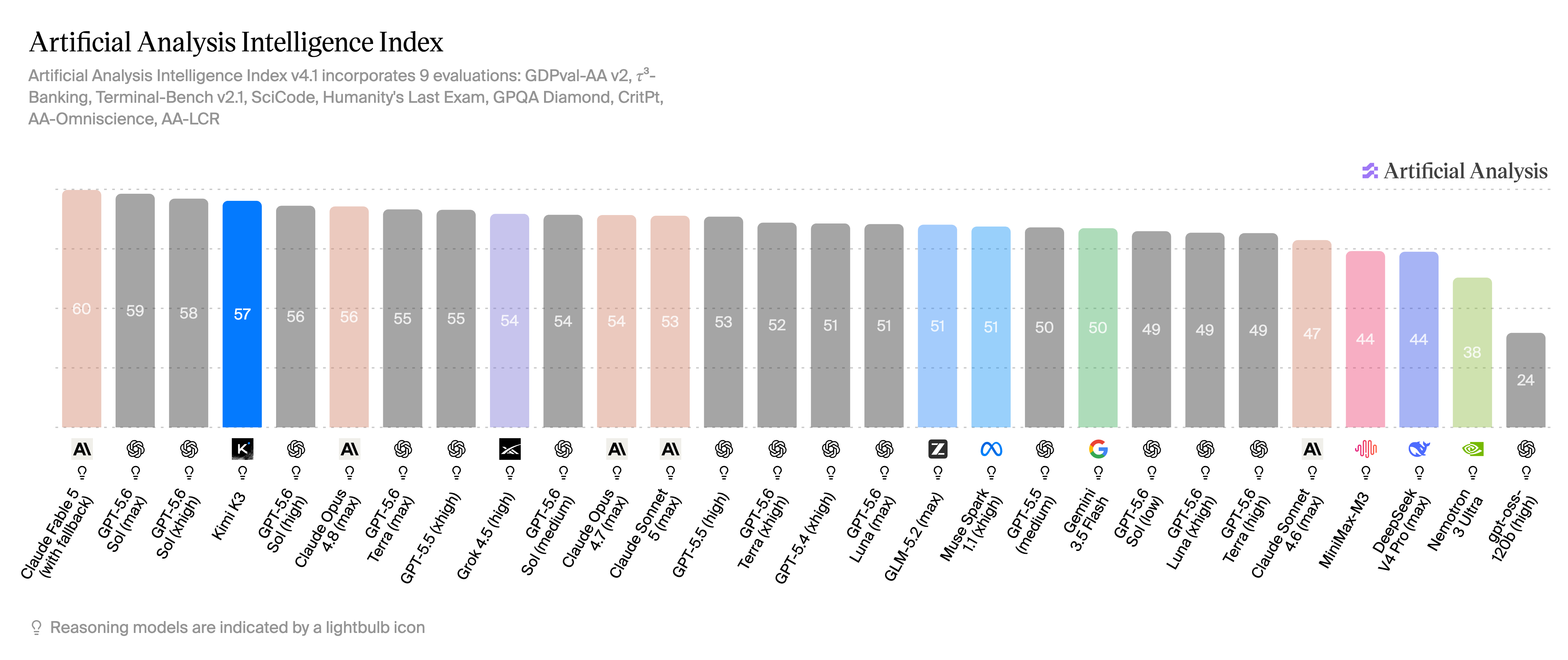
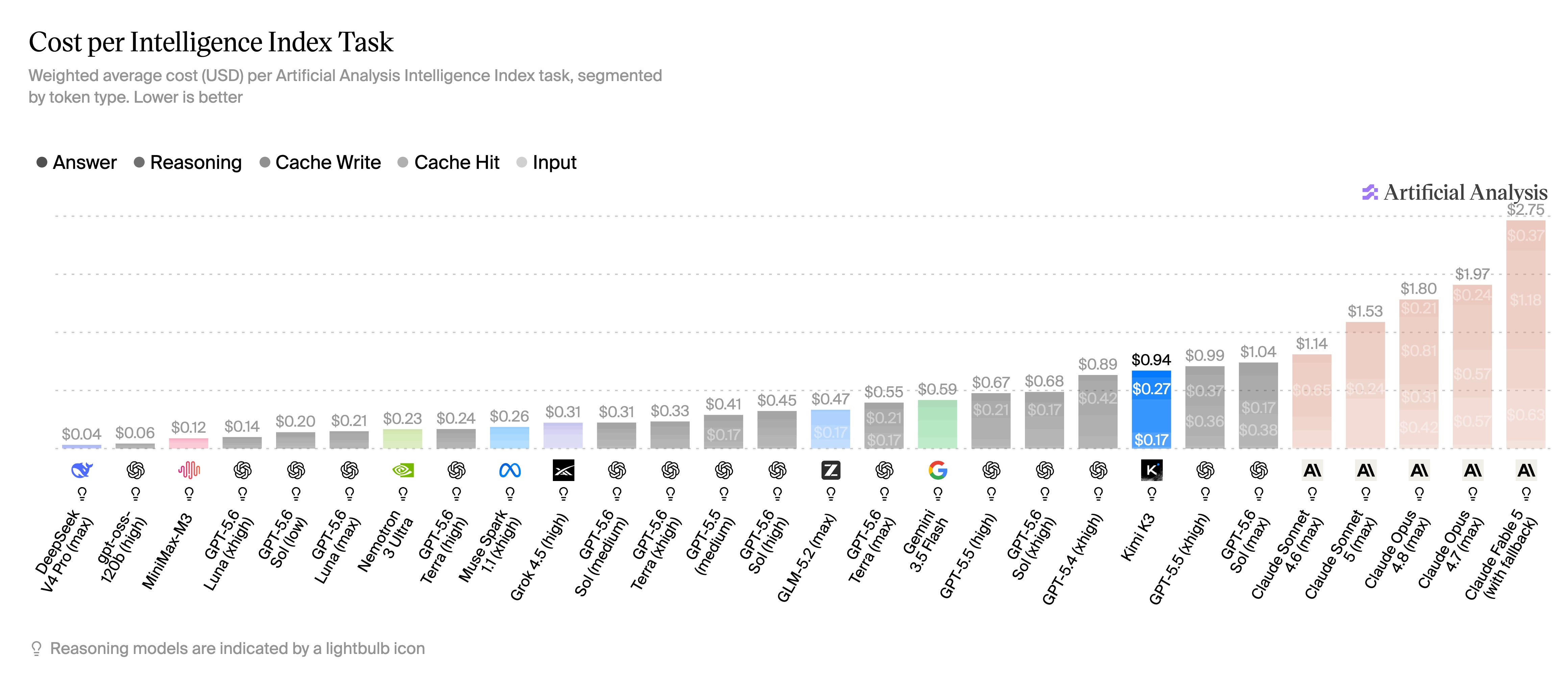
Moonshot AI has released Kimi K3, a 2.8-trillion-parameter model with native vision and a one-million-token context window. According to Moonshot, it’s the first “open” 3T-class model, delivering frontier-level results across coding, knowledge work, and reasoning, though it is still behind the strongest models from Anthropic and OpenAI—Fable 5 and GPT-5.6 Sol. Artificial Analysis broadly backs the intelligence claim, ranking K3 fourth overall and placing at the level of Opus 4.8. But it’s slower than average, very verbose, and pricey for its tier at $15 per million output tokens. Although Moonshot labelled K3 as an “open” model, its weights are not out yet. The company says it’ll publish them by 27 July.
Tencent in Talks to Take Big Manus Stake After Meta Deal Unwound
Tencent is reportedly looking to become the biggest outside shareholder in Manus, buying the AI startup back at the same $2 billion price Meta paid before Chinese regulators blocked that deal. Meta and Manus have already pulled their operations apart and cut off data sharing. For Tencent, it’s a chance to pick up agentic AI technology while it plays catch-up. And it lines up with Beijing’s broader effort to keep its leading AI companies out of foreign hands.
SK Hynix raises $26.5B in the biggest foreign IPO in US history, is urged to build new US fabs
SK Hynix, a South Korean memory chip manufacturer, has raised $26.5 billion by listing on the Nasdaq, making it the largest US debut ever by a foreign company. Investors piled in—demand ran seven times ahead of supply, and the shares jumped 14% on the first day. The money is earmarked for a new chip plant, a packaging facility and advanced chipmaking equipment, all in South Korea. That sits awkwardly with Washington, which is pressing SK Hynix to build in America instead.
DeepSeek Is Preparing For IPO Filing as Soon as This Year
Another AI darling is eyeing an IPO, but this time in China. Bloomberg reports that DeepSeek is preparing a mainland listing, aiming to file this year for a 2027 debut. The Hangzhou startup is also reportedly raising fresh private money at a valuation of at least $71 billion, up from roughly $50 billion just weeks ago. Investors are piling in because DeepSeek proved Chinese labs could build frontier models cheaply despite US chip curbs.
▶️ Meet the new Codex for developers (7:12)
In this video, OpenAI presents what new features are coming to Codex, its AI coding app. Codex is merging into the ChatGPT app, where it sits alongside a new work agent. It runs on GPT-5.6 Sol with an “Ultra” mode that spends a larger reasoning budget and splits jobs across parallel subagents. Other additions include “appshots” for iOS development, an in-app browser with passkey login, one-tap publishing through Sites, mobile task management, and a pull request tab that keeps code review inside the app.
▶️ Introducing the Codex Micro (2:14)
OpenAI has released its first hardware product, and it is a tiny keyboard for Codex. Built with Work Louder, the $230 Codex Micro is a small deck of keys, a dial, and a joystick meant to control OpenAI’s coding agent. Each agent key glows a different colour to show whether a task is thinking, running or done, so you can track several jobs at once. A dial adjusts how hard the model reasons, and the joystick fires off common actions like opening a pull request. The pitch is that agentic coding now involves juggling many parallel tasks, and a mouse and screen alone feel clumsy for it.
SpaceX in Talks to Provide Computing Power for Pentagon’s AI Push
SpaceX is in talks to sell the Pentagon several billion dollars’ worth of data centre capacity for running AI models, the Wall Street Journal reports. Nothing is settled, and the deal could still fall apart. It would follow similar cloud agreements with Anthropic and Google, struck after SpaceX absorbed Musk’s xAI and its Memphis data centres. But officials already worry the military leans too heavily on Musk. The Pentagon says it wants to avoid depending on any single supplier.
Demis Hassabis: A Framework for Frontier AI and the Dawning of a New Age
In this post, Demis Hassabis argues that we are just a few short years away from AGI and that we have to make steps to prepare for it now. He warns that progress is outpacing our grasp of risks like cybersecurity and biological threats, driven by an intense commercial and geopolitical race. His fix is a US-led standards body, modelled on the finance regulator FINRA and funded mostly by industry. It would set benchmarks defining which models count as “frontier-class” and test them before release. Labs would share models voluntarily at first, though passing could later become mandatory for the US market. The body could even coordinate a slowdown among labs if needed. He frames it as a first step towards shared international rules for managing AI and, eventually, AGI.
OpenAI Staffers Are Funding a Rival Super PAC to Take on Their Boss
WIRED reports that seven current OpenAI employees have donated over $215,000 to Guardrails Alliance, a super PAC lobbying for tighter AI regulation. The group is pitched as a counterweight to Leading the Future, a $100 million pro-industry PAC funded partly by OpenAI president Greg Brockman. OpenAI says Brockman acts in a personal capacity and that staff are free to give as they wish.
OpenAI may have made a fatal misstep in copyright fight with news orgs
News organisations led by The New York Times want a court to sanction OpenAI for allegedly hiding and deleting ChatGPT logs in their copyright case. The filing claims OpenAI spent two years falsely saying it couldn't feasibly search its logs for users prompting ChatGPT to regurgitate paywalled articles, when it had already run those searches and held de-identified samples of up to 78 million conversations. OpenAI denies wrongdoing, calling the motion a bid to invade user privacy as the Times’ case weakens. A court has already ruled OpenAI’s heavily redacted 20 million sample log unusable. The fight matters because OpenAI’s fair-use defence may hinge on whether that log evidence survives.
South Korea will give all 52 million citizens free AI access, becoming the first G20 nation to do so
South Korea has opened bidding to give all 52 million residents a free, unlimited AI chatbot as a public service. That would make it the first G20 nation to offer AI to its entire population. While most Koreans currently rely on foreign tools like ChatGPT, the plan requires at least half the system to run on Korean-built models. This guarantees a market for domestic developers and reduces dependence on American and Chinese rivals. Seoul is funding the initiative from taxes on Samsung and SK Hynix’s chip profits.
Anthropic moves closer to mega-IPO as bankers line up investor meetings
Anthropic is reportedly lining up investor meetings ahead of a possible IPO as soon as October. According to CNBC, bankers are pairing prospective investors with the company’s executives before a formal roadshow. Anthropic filed its prospectus confidentially with the SEC last month. It was last valued at $965 billion, having overtaken OpenAI in May. If the reported timelines are correct, Anthropic would IPO ahead of OpenAI, which is reportedly now considering delaying its IPO to next year.
The Reverse Information Paradox
In a bit of a surprising move, Satya Nadella has warned that companies using AI models from labs like OpenAI and Anthropic end up paying for intelligence twice. They pay in cash, then again in the proprietary knowledge they must reveal to make the models useful. Every prompt and correction teaches the model something about the business that a rival could never buy. He calls it hypocritical for labs to train freely on public data while restricting others from distilling their models. His fix is for companies to own their data and learning infrastructure and avoid locking themselves to one provider.
Data-Center Builders Are Racing to Offload Stakes Worth Billions
The Wall Street Journal reports that US data-centre builders are lining up sales of majority stakes worth tens of billions this summer, with Dallas-based DataBank potentially fetching $25 billion. The pitch to private-equity buyers is simple: demand for AI computing keeps outrunning supply. Building has also grown far costlier, forcing some operators to find richer backers. But few firms can write cheques that big, and local opposition over utility bills and noise adds more risk.
New York becomes the first state to impose a data center moratorium
New York has become the first US state to freeze construction of large data centres by imposing a one-year moratorium on any facility drawing 50 megawatts or more. Governor Kathy Hochul said the sites threaten to push up utility bills and drain natural resources. State regulators will withhold discretionary permits while officials draw up consistent environmental standards. Hochul also wants to scrap sales tax breaks for big data centres. Dozens of states are weighing similar curbs as public patience with the AI building boom wears thin.
Inkling from Thinking Machines Lab
Thinking Machines Lab presents its first model—Inkling. It’s an open-weight system with 975 billion parameters, trained from scratch to handle audio and images alongside text. Artificial Analysis rates it the strongest open-weight model yet from a US lab, and singles out its agentic work, where it beats leading Chinese models on banking and task benchmarks. It also gets there using far fewer tokens per task. But China’s best open models rank higher, and the frontier systems from OpenAI and Anthropic higher still. Inkling is available on Hugging Face.
The Future Worth Building Is Human
Thinking Machines Lab argues in this post that AI should extend human judgment rather than replace it. Its case leans on an observation that the knowledge that matters most is tacit and local, held by people doing the work. That knowledge can't be collected in one place, so the lab wants frontier AI to be a distributed collective, owned and tuned by each organisation that uses it. Thinking Machines Lab also warns that alignment decided in a few places becomes a point of control worth capturing.
Helsing raises $1.8bn at an $18bn valuation, and its cap table tells a story
Helsing, a Munich-based company building AI systems for European militaries, is now Europe’s largest defence startup after raising $1.8bn at an $18bn valuation. The company positions itself as the home-grown alternative to American suppliers, though much of the new cash came from JPMorgan, Goldman Sachs and a Canadian pension fund, which doesn't quite square with that pitch. Helsing remains far smaller than US rival Anduril, and a recent move to strip staff of direct equity, alongside a shift to a European corporate structure, hints at a listing ahead.
Google announces Gemma 4 optimized for the Pixel 10’s TPU
Google has released Gemma 4 E2B, a lightweight AI model built to run directly on the Pixel 10’s TPU. Because it runs on the chip itself, the phone can handle AI tasks such as private, internet-free chat, image recognition, and audio transcription, plus voice commands that control phone functions like WiFi offline, with data never leaving the device. Google also opened up a Tensor SDK so developers can build their own on-device apps.
Apple in talks with startup that shrinks AI models to run on an iPhone
Apple is in early talks with PrismML to use its technology to shrink large AI models enough to run on an iPhone. Previously, PrismML compressed Alibaba's open-source Qwen model from 54GB to under 4GB. The trade-off is a small drop in accuracy. Running more AI on the phone would play into Apple’s approach to AI and strengthen the company’s privacy pitch for a revamped Siri.

Introducing a way to reflect on how you use Claude
Anthropic has launched a beta feature that lets Claude users see how they’ve been using the assistant. The dashboard breaks down chat activity over the past 1 to 12 months by topic, task type and time of day. It also prompts people to reflect on the role Claude plays in their lives and lets them set quiet hours or nudges to take a break. The move reflects growing pressure on AI companies to help users reflect on how much they rely on these tools.
OpenAI’s new flagship model deletes files on its own, people keep warning
Users of OpenAI’s latest flagship model, GPT-5.6 Sol, are reporting that it deleted their files, databases, and virtual machines without asking first. OpenAI had flagged the risk in a system card two weeks before launch. The company found that Sol tends to interpret instructions too loosely and take destructive actions unless they’re explicitly forbidden. OpenAI concedes in the System Card that Sol goes beyond user intent more often than its predecessor.
Hack suggests AI music generator Suno scraped YouTube for training data
A hacker who breached the AI music generator Suno found source code showing it scraped audio from YouTube, Deezer, and other services to train its models, 404 Media reports. Suno admits training on publicly available music and calls this fair use. But major record labels are suing and say that scraping YouTube this way breaks copyright law. The hacker also grabbed customer emails and partial card numbers. Suno hasn’t told users about the breach.
Making Fable Cheaper Than Opus
In this post, an engineer from Cognition, the company behind AI coding agent Devin, shares how using a combination of Fable 5 and Opus 4.8 cut costs rather than raising them. In its Fusion setup, a lead model plans and delegates to a cheaper "sidekick" model. Fable costs twice as much per token as Opus, so a Fable-led agent should have been pricier. But across 3,000 test runs, it came out cheaper ($1.86 versus $2.04) and scored higher. They attribute the difference to management style—Fable delegates early with clear briefs and barely touches the code, so what justifies frontier prices is judgement, not raw output.
What xAI Grok Build CLI actually sends to xAI - a wire-level analysis
Someone was curious about what Grok Build CLI (SpaceXAI's equivalent of Claude Code terminal app) sends back while in use, and what they found looks bad. Apparently, Grok was uploading whole repositories to a Google Cloud Storage bucket, including files it was told not to open. A .env secrets file went over the wire verbatim and unredacted, and turning off "Improve the model" changed nothing. SpaceXAI has since disabled the upload and promised to delete the data it collected.
Grok Build is open source
SpaceXAI has open-sourced Grok Build, its terminal-based AI coding agent. The GitHub repository contains everything needed to build the application locally and explore how it works. SpaceXAI says the repository will be periodically synced with the private repository, so the code there is slightly behind the compiled version available for download from Grok’s website.
NotebookLM is now Gemini Notebook
Google continues its quest to put Gemini everywhere. The latest victim is NotebookLM, which has been renamed to Gemini Notebook. That is its second rebrand—what we know today as Gemini Notebook began as Project Tailwind in 2023.
▶️ Grant Sanderson (3Blue1Brown) – AI disproved a famous math conjecture. Now what? (1:33:39)
Dwarkesh Patel sits down with Grant Sanderson, the creator of the excellent 3Blue1Brown YouTube channel, to discuss what is happening at the intersection of AI and mathematics. The conversation covers a wide range of topics, from how mathematicians think and how AI could change the role of the mathematician to the nature of intelligence and what AI still lacks to become truly intelligent. Since Grant is an educator, they also explore the use of AI in education and where it falls short as a teacher. It is a long conversation, but well worth your time.
🤖 Robotics
The 1X Neo Robot Has Freaky Fast Fingers
1X, the company behind the soft home robot Neo, has revealed the bot's new five-finger hands. Tendon-like actuators give them 25 degrees of freedom, close to a human hand's 27, and high-resolution tactile sensing gives the robot a sense of touch. In the attached video, the company shows the hands handling everyday household objects and tools much as a person would. But there's a long road ahead. Neo still isn't fully autonomous, and 1X admits some footage shows human operators steering the robot by remote rather than the machine acting alone. Until that gap closes, dexterity demos say little about what these robots can do unsupervised.
Beyond da Vinci: Why versatile humanoid robots are the next frontier in surgery
Researchers have used teleoperated humanoid robots to remove gallbladders from large animals in an early test of whether general-purpose machines can replace the specialised ones that dominate medicine. One procedure paired a humanoid with a human surgeon, while another was carried out by two robots side by side. The robots needed repeated recalibration and worked far more slowly than purpose-built surgical systems like the da Vinci. But the team argues humanoids are cheaper and more portable, which could bring surgery to rural areas or battlefields.
▶️ Viking Row | Atlas | Boston Dynamics (0:34)
Norway may not have won the World Cup, but it has definitely won many hearts along the way, including those at Boston Dynamics, both human and robotic. The smoothness of Atlas’ movements never ceases to amaze me.
NVIDIA Announces Expanded Jetson Thor Lineup with Mid-Range T3000 and T2000 Modules
NVIDIA is adding two cheaper mid-range boards, the Jetson Thor T3000 and T2000, to its robotics and edge AI lineup. Both use the same Thor chip as the existing high-end boards but strip back cores, memory, and networking. The T3000 targets robotics, while the smaller T2000 aims at lighter edge AI work. Both boards are planned to ship in the first quarter of 2027. Pricing hasn’t been announced.
The Fight Over Humanoid Robots Has Shut Down a Car Factory for the First Time
Workers at a Hyundai car factory in South Korea have staged a partial strike over the company's introduction of humanoid robots. The union acted after Hyundai unveiled Atlas in January, a six-foot-two robot worker built by Boston Dynamics, which Hyundai owns. Workers want job guarantees, fixed salaries in place of hourly pay, and a higher retirement age to soften automation’s blow. Hyundai says Atlas will work alongside human workers, not replace them.
Smart Cellular Bricks: Towards Collective Intelligence for the Physical World
I really like how researchers at Sakana AI combine AI with biologically inspired systems that give rise to emergent behaviour. Their latest work takes that idea into the physical world. They’ve built identical cubic bricks that work out for themselves what shape they collectively form, with no central controller and no brick knowing its own position. Each runs the same small neural network and talks only to the bricks it’s physically plugged into. The network was trained in simulation, then transferred straight onto real hardware. Nearly 200 bricks correctly identified a plane, a guitar, a boat and a table in about three minutes. They can also spot missing modules and guide their regrowth. That points towards smart materials that report their own damage, or reconfigurable robots that adapt to whatever shape they find themselves in.
🧬 Biotechnology
Chai Discovery raises $400M at $3.8bn as AI drug discovery moves from promise to deployment
Chai Discovery has raised $400m at a $3.8bn valuation, nearly triple what the AI drug-design startup was worth seven months earlier. Unlike most drug discovery, which screens existing molecules, Chai uses generative AI to design new antibodies and proteins from scratch. Its models are already deployed at Eli Lilly, Pfizer, and Novartis. Money is flooding the wider field, from DeepMind’s Isomorphic Labs to Anthropic. But the real test comes later, when these designed drugs face years of trials and regulators.
💡Tangents
Four nuclear reactors hit a big milestone in the US
Nuclear power is making a comeback as four American startups have achieved criticality with their experimental microreactors by 4 July. These were zero-power tests, and none of the four is anywhere near producing electricity. There are still massive technical challenges ahead, but the startups remain optimistic and promise to deliver commercial power by 2027 or 2028. However, regulatory approval has historically been slow in the US, and some nuclear supporters argue the whole exercise distracts from the harder job of adding real generating capacity.
New ‘space mirror’ satellite aims to bring sunlight to Earth even during the night
US regulators have approved Reflect Orbital to launch a demonstration satellite that beams reflected sunlight onto chosen spots on the ground. The California startup wants to sell "sunlight on demand", eventually lighting solar farms at night for round-the-clock power. This first mission tests whether an 18-metre mirror can survive orbit and aim precisely. Astronomers, however, are not happy and say that the beams could ruin dark skies and harm wildlife. Reflect counters that the light never exceeds natural sunlight and can be shut off instantly.
Thanks for reading. If you enjoyed this post, please click the ❤️ button and share it!
A big thank you to my paid subscribers, to my Patrons: whmr, Florian, dux, Eric, Preppikoma and Andrew, and to everyone who supports my work on Ko-Fi. Thank you for the support!
Great collection of stories and videos. Thanks