


Hello and welcome to Sync #586!
In this week’s main story, we will take a closer look at Jalapeño, OpenAI’s first custom AI chip, alongside other chips presented at this year’s Hot Chips conference.
Elsewhere in AI, this week’s news cycle was dominated by Nvidia, from its Q2 earnings report and rumours of acquiring Hugging Face to price hikes and the pausing of revenue-sharing deals with AI cloud companies. In other news, OpenAI says it will stop supplying Cursor with its models, DeepSeek eyes a $74 billion valuation, Google moves its AI responsibility team out of DeepMind, and another OpenAI executive leaves the company. We also have a couple of new models, including GLM-5.3-Flash (briefly known as Ox Alpha), Qwen3.8-Flash-Next, Muse Image, and Gemini Omni 1.1.
Over in robotics, the rollout of robotaxis in London has been delayed, while Zoox cars hit the roads in San Francisco and Las Vegas, and Waymo is heading to Munich. We also have the World Humanoid Robot Games, Microduck from Hugging Face and Pollen Robotics, the Model Hardware Standard from Anthropic, two new edge AI and robotics boards—Nvidia Jetson Orin Nano 2 and Arduino VENTUNO Q—and new robotics AI models, including Generalist GEN-1.5 and Skild AI S1.
Other than that, this week’s issue of Sync also includes the conclusion of Meta’s trial, the new Mac Studio M5 Ultra and Mac Mini M6, mini-brains that grew for five years, the economics of the AI buildout over the next few years, and more!
Enjoy!

Jalapeño and Other Hot Chips
A close look at Jalapeño, plus a tour of the rest of what was shown at Hot Chips 2026
Since 1989, Hot Chips has gathered some of the best chip designers in Palo Alto under one rule: talks have to be about “real products and realizable technology” rather than research prototypes. That makes it the place where next-generation chips get their first proper technical presentation, often months before they launch, and where direct competitors learn from each other.
This year's edition ran from 23 to 25 August. Representatives from all the big players—Nvidia, AMD, Intel, Broadcom, Samsung, SK hynix, Micron, Arm, IBM, Google, Microsoft and Meta—were there to share and discuss the latest developments in semiconductor and chip design. The interest was so high that in-person passes sold out before the doors opened.
Unsurprisingly, most talks revolved around AI, and specifically around one constraint. Data centres are limited by the power they can draw rather than by how many chips they can buy, because grid connections take far longer to arrange than hardware does. So the question everyone was answering is how you get more useful work out of a fixed megawatt, and everyone—from memory to networking, and from GPUs to CPUs—came with an answer.
We will get to them later, but first let’s take a look at the chip everyone is talking about—OpenAI’s first custom AI chip, Jalapeño.
Jalapeño—OpenAI’s first custom AI chip
Jalapeño is OpenAI's first custom inference ASIC, designed in partnership with Broadcom. In terms of specs, Jalapeño is a 700W package on TSMC's N3P node, with 13.4 PFLOP/s of MXFP4 matrix compute and 216GiB of HBM4 at 15.4 TB/s. It will be deployed in racks that hold 128 of them, and up to 16 racks can be connected together into a single system with 2,048 chips.
OpenAI says the chip delivers 1.5 to 1.9 times more work per watt at peak throughput and 1.7 to 3.6 times lower end-to-end latency than the systems it was measured against, across GPT-OSS 120B, DeepSeek R1 and Kimi K2.5. Those systems are Nvidia's GB200 at 1,200W and GB300 at 1,400W, with results normalised by package power. Additionally, at the fastest decoding speed the Nvidia systems can manage, Jalapeño delivers between 53 and 104 times the throughput per kilowatt. That is the extreme end of the comparison—at those speeds the Nvidia systems are running at roughly 1% of their own peak throughput.
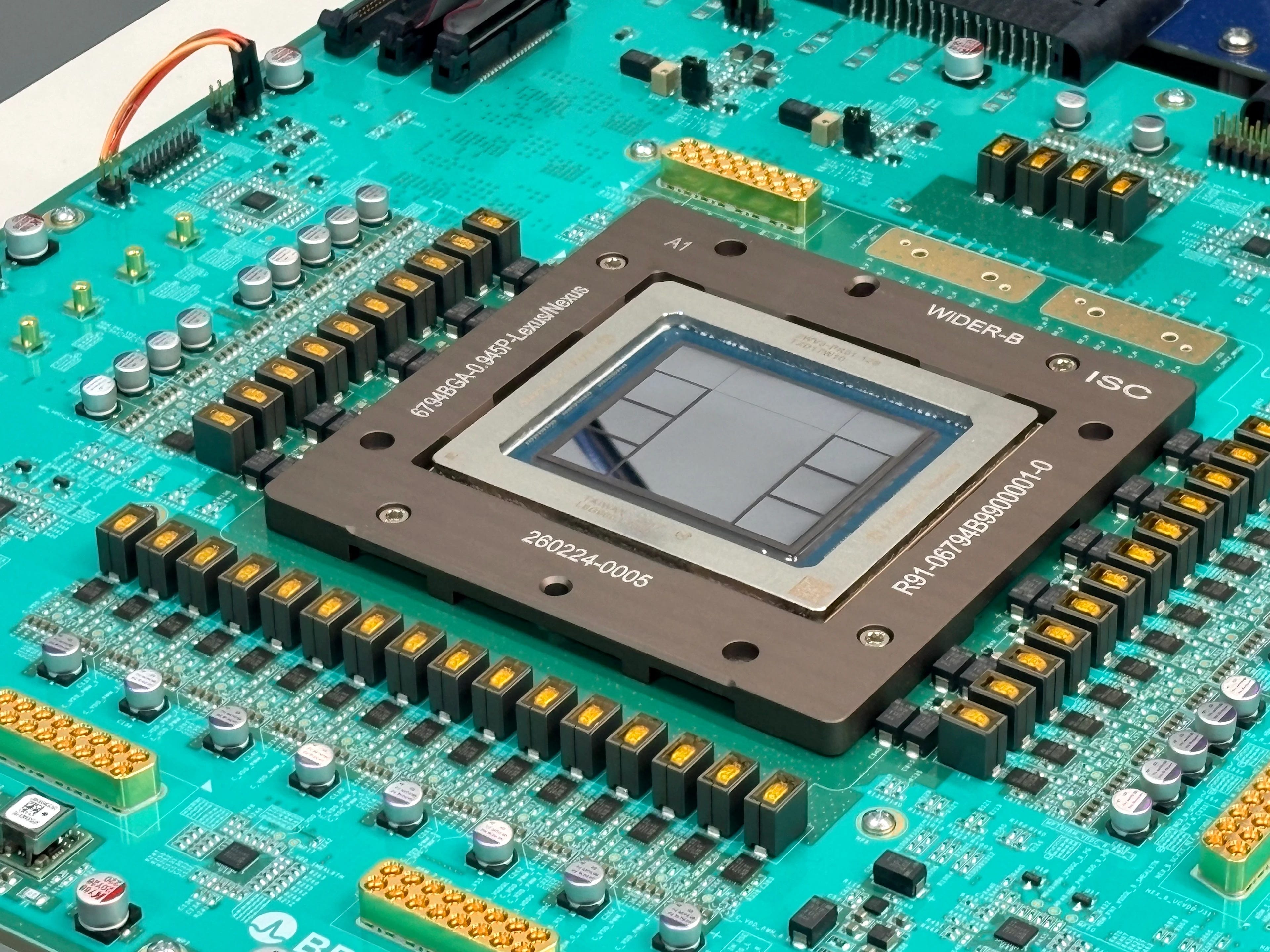
There is also headroom left. Those numbers come from the first version of the silicon, and SemiAnalysis reports that a second version, with roughly 25% better performance per watt, is already being manufactured. Jalapeño is also running without speculative decoding, a technique where a small, fast model drafts the next few tokens and the large model checks them in a single pass rather than generating them one at a time. Some of the Nvidia systems it was measured against do use it, and OpenAI says adding it would improve latency by a further three to five times.
A few things are worth keeping in mind. The numbers are OpenAI's own, and while SemiAnalysis verified the benchmark runs in person, it did not run the full suite itself. The tests are also short and simple—a single exchange with a long prompt and a short answer, rather than the drawn-out back-and-forth that real agents produce. And Blackwell is not really the right opponent, since Rubin, the generation now shipping, uses the same fast memory Jalapeño does. SemiAnalysis ran that comparison anyway and still found Jalapeño ahead.
OpenAI says Jalapeño was co-designed with AI in the design loop. It claims AI made two of the chip's main compute blocks 8% and 10% smaller than the versions its own engineers had already tuned by hand, and that code Codex wrote for key parts of a model ran 1.5 to 1.8 times faster than the hand-written equivalents.
One might ask: how did OpenAI, a company with no chip design history, get to working silicon this quickly? AI is only part of the answer. Ian Cutress from TechTechPotato went through that back in June, and it comes down to three things.
The first is the partner. Broadcom does the back-end work of turning a high-level design into transistors, contracts TSMC to build it, and handles the HBM and packaging supply. It has done this before, most notably co-designing Google’s TPUs, so what OpenAI is buying is a track record of tape-outs that land on time. The second is reuse: silicon-proven IP for things like PCIe, I/O and bonding rather than designing your own, and no aggressive process node. The third is money spent (or overspent, as Cutress speculated) on manufacturing priority at TSMC, on packaging volume, and on tape-out and bring-up. None of this makes the nine months unimpressive. It just makes it less mysterious.
OpenAI plans to start deploying Jalapeño by the end of the year, with production ramping through 2027, and says it will keep buying chips from Nvidia regardless. OpenAI also said that the work on second and third generations of Jalapeño is already under way.
If you want to go deeper, SemiAnalysis's analysis of Jalapeño is the most thorough one out there, dissecting the architecture, the software stack and the rack the chips go into.
That was one talk out of more than thirty. The rest of the programme came at the same problem from every other direction, so let's go through it. ServeTheHome covered the conference live and in much more detail than I can fit here, and each talk below links to their write-ups.
Memory
Samsung presented LPDDR5X-PIM, which it says is the first processing-in-memory (PIM) product built on LPDDR to reach production. The idea behind processing-in-memory is to do some of the work inside the memory chip itself, so that less data has to travel back and forth to the processor. Samsung's argument for it is about cost. HBM, the fast memory that AI accelerators normally use, grew from 52% of the money spent on the components in an AI chip in early 2024 to 63% by the end of 2025. Samsung's position is that the answer is a cheaper type of memory rather than more HBM.
d-Matrix came at the same problem from the bandwidth side with Raptor, a 3D-DRAM accelerator for generative inference. Its case is that SRAM has the bandwidth but nowhere near the capacity, while HBM has the capacity but a practical ceiling of around 20 TB/s per package. 3D DRAM is meant to sit between them.
The rest of the track covered Micron on memory architectures for AI, Samsung on building HBM base dies on logic processes, SK hynix on advanced packaging, and XCENA on its MX1 CXL computational memory device, developed with Samsung.
CPU
Nvidia presented Vera, its next-generation server CPU and the successor to Grace. Vera has 88 cores built on Nvidia’s new Olympus core architecture, eight 128-bit LPDDR5X memory controllers, and an NVLink-C2C interface designed to pair with Rubin GPUs. Nvidia has favoured IPC (instructions per cycle) over core count here, and the chip is its most serious attempt yet at a larger share of the server CPU market.
Arm showed AGI, its first complete commercial chip rather than licensable IP. It comes with up to 136 Neoverse V3 cores, and is sold directly to server vendors. After years of selling IP and then whole compute subsystems, Arm is now competing with some of its own customers.
IBM brought the most unusual silicon of the conference. Its future Z and LinuxONE processor runs 11 cores at over 5.7GHz on a 2nm process, and each of those cores can run two entirely different instruction sets: the one IBM's mainframes have always used, and Arm's. Chips that manage this normally translate one into the other in software, which costs performance. IBM built both into the hardware instead, so Arm software runs on a mainframe unmodified and at full speed.
Also presented across the two CPU sessions: Fujitsu’s Monaka, Intel’s Diamond Rapids for 2027, and Wildcat Lake, Intel’s Core Series 3 client part.
Automotive
There was also a small segment dedicated to chips in automotive applications, where Waymo gave a detailed overview of the custom processor at the centre of its self-driving cars.
The chip takes the camera, lidar and radar feeds and turns them into something Waymo’s driving model can work with, and the constraints it has to meet are unusual. It fits in a 45mm square package, draws under 75W, and has to keep working in a car parked in the Phoenix summer sun, which is why Waymo’s vehicles run liquid cooling at 60°C rather than at data centre temperatures. It also has to deal with each frame as it arrives instead of gathering work into batches the way a data centre would, because a car cannot afford to wait.
On paper, the chip looks modest, at 160 TOPS, or trillions of operations per second. Waymo argues that achieved performance matters more than raw TOPS, and that designing silicon around your own models beats chasing headline numbers.
GPU
Nvidia’s Rubin talk was less about the GPU than about the platform around it. Nvidia describes Vera Rubin as spanning seven chips and five racks, taking in the Vera CPU, the Rubin GPU, BlueField-4, Spectrum-6 and Groq’s LPUs, with storage and networking layered on top. Nvidia argues that agentic AI is the most complex workload it has targeted, and that it forces a redesign of the compute, networking, power and serviceability stack rather than just the tensor cores.
AMD covered the MI400 series architecture and, in a second talk, the system architecture of the Helios racks built around it, along with the ROCm software stack it needs to stay competitive with CUDA.
Intel, meanwhile, presented Crescent Island, a data centre GPU aimed specifically at agentic inference. It is built around large memory capacity, between 160GB and 480GB of LPDDR5X, an open software stack, and, once again, tokens per watt.
Networking and interconnect
Broadcom presented Thor Ultra, an 800Gb Ethernet NIC (the card that connects a server to the rest of the network) aimed at AI clusters. What is new is mostly about how it behaves when the network is busy. It can spread a single stream of data across many paths at once and put it back in order at the far end, and when a packet goes missing, it no longer has to resend everything that came after it.
Nvidia followed with two talks. BlueField-4 is the fourth generation of its DPU, which Nvidia pitches as a separate processor handling networking, security and storage in every server, or as it puts it, a server sitting in front of the server. Spectrum-X was about scaling AI networking towards half a million GPUs, and Nvidia's argument there is that an AI data centre needs five purpose-built networks rather than one general-purpose fabric—more or less the opposite of the case Broadcom had made earlier in the same session.
The point worth drawing out is that scale-up fabric has become something you can buy rather than something you have to invent. Jalapeño's own network runs on Broadcom Tomahawk 6 switches, connecting 128 chips inside the rack and 2,048 across the global domain. Those are off-the-shelf parts that anyone designing an accelerator can buy, and that removes one of the larger barriers to building a rack-scale system.
AI
Google showed its eighth-generation TPU as two chips—the 8t for training and the 8i for inference. Google is still the only hyperscaler building its own training hardware rather than buying it, and it has argued before that this is part of its edge. The 8i is paired with Google’s own Axion CPUs, replacing the x86 processors it used previously.
Meta covered MTIA and a roadmap of four accelerator generations, the MTIA 300 through 500, as the chips move from recommendation workloads onto generative AI. Microsoft detailed Maia 200. Cerebras talked about taking its wafer-scale engines to rack scale, and SambaNova presented the SN50 RDU and its dataflow architecture.
Nvidia presented Groq's LPU (Language Processing Unit). Nvidia does not make LPUs of its own yet, so these come from Groq, a company it has acquihired at the end of 2025. The LPUs go into dedicated LPX racks alongside Rubin, where they take on the token-by-token generation that GPUs handle less efficiently, using a large amount of fast on-chip memory to keep latency down.
All the talks were recorded and are available on the Hot Chips website if you have an access code. If you do not, they usually reach the Hot Chips YouTube channel about a year later, which means this year's should arrive just in time for Hot Chips 2027.
If you enjoy this post, please click the ❤️ button and share it.
News roundup
🧠 Artificial Intelligence
Nvidia Reports Blowout Quarter, Says Demand for AI Chips Is Getting Even Hotter
Nvidia’s highly anticipated quarterly report is out, and yet again, the company has beaten expectations. The chipmaker reported record sales of $96.2 billion for the quarter ended in July, beating analyst expectations of $92.3 billion. The company’s shares rose by 4% after Colette Kress, Nvidia’s CFO, said to expect 70% revenue growth in the company’s 2028 fiscal year.
On the same call, Kress rejected the charge that Nvidia is engaged in circular financing and defended the company’s strategy of using financial guarantees and equity investments to help customers buy its chips. She argued that frontier labs are growing faster than their credit profiles can support and that Nvidia has to help fund the flywheel.
Nvidia in Talks to Buy AI Startup Hugging Face
Bloomberg reports that Nvidia is close to acquiring Hugging Face, a platform for hosting open AI models and datasets, for $13 billion. At the time of writing, the deal has not been confirmed, and Hugging Face co-founder Thomas Wolf declined to comment on the reports but said that Hugging Face has always attracted interest, including “offers of acquisition and investment”.
Nvidia Is Spending $6 Billion to Build a Powerful U.S. Alternative to Chinese AI
Poolside, a startup that builds its own foundation models for writing software, joins the likes of Scale AI, Groq, Windsurf, Inflection AI, and Adept as the latest AI startup to be “acqui-hired” by a much bigger company. The Wall Street Journal reports that Nvidia struck a deal under which it will invest $1 billion in Poolside, pay $6 billion to license its technology, and hire more than 100 of the startup’s employees, who will join Nvidia’s Nemotron project to develop powerful open-weight models to challenge China’s dominance in that field. Poolside’s leadership won’t join Nvidia and will continue working on unspecified research projects.
Nvidia Pauses Revenue-Sharing Deals With AI Cloud Companies
Nvidia has reportedly paused some deals in this revenue-sharing programme that offered credit support for AI cloud companies in exchange for a share of their revenue. Apparently, this stems from concerns that such deals might draw antitrust scrutiny as questions about the company’s finances grow. The programme was launched in July.
Nvidia Customers Notified About AI-Related Price Hikes Above 15%
Even Nvidia is not immune to RAMmageddon. Some of its biggest customers have been told to expect a 15% price increase on its AI servers. The price hikes will impact systems including those with the flagship Vera Rubin and Grace Blackwell chips, and will depend on the generation of Nvidia chips and the memory configurations.
Nvidia Starts PAC as AI Chip Maker Builds DC Influence Force
Nvidia has launched a political action committee (PAC) to dole out donations to federal candidates and build influence in Washington. The NVIDIA Corporation Employees Federal Political Action Committee will be funded by voluntary contributions from eligible employees, capped at $5,000 a year, and can contribute to candidates from both parties as well as party committees. Nvidia’s new PAC fits into a broader trend of tech companies like OpenAI, Anthropic, and others increasing their lobbying spending in hopes of securing legislation favourable to their interests.
AI Startup DeepSeek Poised to Reach $74 Billion Valuation
DeepSeek is in talks to raise a new funding round that would value the company at $74 billion. The new funds will be used for research and development and to build its computing infrastructure. It would probably be DeepSeek’s last funding round before the company plans an IPO in Shanghai next year.
Nvidia is in talks to back Perplexity at more than $30bn
The Information says Nvidia is in talks to invest in AI search startup Perplexity in a potentially multibillion-dollar round that would value the startup at more than $30 billion, up from $20 billion after its last funding round almost exactly a year ago. The two sides are also reportedly considering a technology licensing arrangement alongside the equity cheque.
OpenAI: Our decision on Cursor following its acquisition by SpaceX
OpenAI has notified Cursor that it will stop providing its models to the AI coding platform, with a proposed shutoff date of 12 November. The move is not surprising, as SpaceX now owns Cursor and there is a massive feud between OpenAI’s leadership and Elon Musk. OpenAI said in a statement it cannot trust any of Musk’s companies to honour its terms of service.
Anthropic and Nscale strike $45 billion cloud deal
Anthropic and Nscale, a UK-based AI infrastructure company, signed a $45 billion cloud deal that gives Anthropic access to 460 megawatts of compute capacity at an Nscale data centre development in West Virginia. The facility is expected to come online at the end of 2027 and will be equipped with Nvidia’s latest Vera Rubin chips.
Anthropic gets its first court win over the Pentagon’s supply-chain risk label
A federal judge has ruled that the Trump administration acted illegally when it barred federal agencies from working with Anthropic. Judge Rita Lin found that the supply-chain risk designation was retaliation for the company’s criticism of the government and violated the First Amendment. The dispute began when Anthropic refused to let the Pentagon use its models for autonomous weapons or mass surveillance. Lin noted that the government continued pursuing contracts with Anthropic even after branding it a threat. A second lawsuit in Washington, D.C., is still ongoing.
Google Moves AI-Responsibility Team Out of DeepMind Lab in Latest Shake-Up
The Wall Street Journal reports that Google is moving the team focused on the risks and societal impact of AI out of DeepMind. The roughly 90-person “AI responsibility” unit will join Google’s global affairs organisation, which oversees lobbying and public policy for the company as a whole. Some employees worry the move will erode their independence and cut them off from the teams building Gemini. Google says grouping the teams will strengthen their work. The change follows a wider absorption of DeepMind into Google after Demis Hassabis stepped aside as chief executive.

OpenAI’s Head of Data Centers Has Left the Company
Chris Malone, an executive overseeing OpenAI’s data centre buildout, has left the company. Malone joins a growing list of OpenAI executives who have left the company, which currently includes Chief Revenue Officer Denise Dresser, Chief Operating Officer Brad Lightcap, and Fidji Simo, who served as second-in-command to Sam Altman.
Anthropic Taps Google Veteran as Part of Hardware Push
Amir Salek, an engineer who founded and led Google’s TPU project until 2022, has joined Anthropic. At Google, Salek laid the groundwork for the TPU and delivered the first seven generations of those chips. Now Anthropic wants him to do the same, as the company recently announced that it is building an in-house team to design custom AI chips for Claude and has begun hiring engineers to join the team.
Thinking Machines Lab Co-Founder Barret Zoph Joins Google
Google has hired Barret Zoph to bring his reinforcement learning and post-training expertise to Gemini. Previously, Zoph worked at OpenAI, which he left to co-found Thinking Machines Lab. He then left Thinking Machines in January this year after a dispute with Mira Murati to rejoin OpenAI, and now he has come full circle by returning to Google, where he worked as a researcher until 2022. Zoph joins the Google DeepMind team at a time when Google is reorganising its AI efforts.
▶️ Dylan Patel – Two labs will soon control most of the world’s workforce (1:16:52)
In this podcast, Dwarkesh Patel and Dylan Patel discuss the economics of the AI buildout over the next few years, whether the more than $10 trillion in total AI capex expected by the end of the decade could trigger a sovereign debt crisis, and more. The conversation also explores how Anthropic and OpenAI are on track to control most of the world’s usable FLOPs within the next few years, and how the economics could change if recursive self-improvement (RSI) kicks in or AGI is achieved. As always, Dylan Patel brings plenty of numbers and high-quality insights to the table.
Google reportedly taps AMD to design next-generation TPU — hybrid AI ASIC could integrate on-package CPU cores for reinforcement learning
Google is reportedly working with AMD on a version of its 10th-generation TPU that would use AMD’s CPUs. Google and its customers want general-purpose cores sitting in the same package as the accelerator, which suits reinforcement learning and agentic work better than accelerators alone. AMD already builds that kind of hybrid chip in its MI300A.
Inherent, founded by DeepMind alumni, says its AI ‘teammate’ just outperformed Anthropic and OpenAI at replicating research
Inherent, a London-based AI lab founded by Google DeepMind alumni, says its new agent Faraday has beaten frontier models from Anthropic and OpenAI at reproducing published scientific findings unaided. Faraday runs on a far smaller model with just 27 billion parameters. Inherent trained it using reinforcement learning, rewarding good outcomes rather than teaching it how science is done. The bet is that this instils a sense of which experiments are worth running.
Perplexity Portable Computer
Despite its name, Portable Computer is not a hardware product but a local-first agent stack from Perplexity, built with Nvidia and running on the DGX Spark (which you need to supply yourself). The stack includes an agent harness, an orchestrator, and post-trained models that run most Perplexity Computer tasks entirely on local hardware. When a job needs the web, connected apps or frontier reasoning, the orchestrator can escalate to one of 15+ cloud models, but only after asking the user's permission. Portable Computer is available to Pro and Max subscribers.
Thomson Reuters Leverages its World-Class Data Assets to Launch Its Own Frontier Model
I did not expect Thomson Reuters to create its own large language model, but here we are. The company says it used an unnamed but strong open-source foundation model as a base and then trained it using Thomson Reuters data. The entire process, including talent and compute, cost $40 million. As Thomson Reuters notes in the press release, it did this to maintain control over its data and AI models, an approach that more companies might follow.
Inside OpenAI’s Reboot
TIME Magazine interviews Sam Altman and other OpenAI leaders and takes us inside the company as it reinvents itself. Having lost the lead to Anthropic and shed a string of senior executives, OpenAI has narrowed its focus under Greg Brockman, who now runs most product and business operations, winding down side projects and folding Codex into ChatGPT. It is also reckoning with its worst safety failure yet—the Hugging Face incident—by pausing the training run expected to deliver its biggest capability jump. Amid all of this, OpenAI's leaders say AGI is close, with Altman expecting an internal system he would call AGI by the end of the year.
The turbulent AI era is here. The choices we make now are critical.
Bill Gates joins other tech billionaires in publishing his own AI manifesto. He argues that the technology will be either the greatest equaliser ever invented or the worst source of injustice. Nobody, he says, is preparing seriously for that choice. Gates flags three big risks: jobs disappearing across white- and blue-collar work within a decade, cheap tools for criminals and bioterrorists, and AI companions stunting children’s development. His proposed fixes include new national and international institutions, reserving certain jobs for humans, and taxes on AI tokens and robots.
World’s first patient to undergo live AI-assisted brain surgery has tumour removed
Surgeons in London have removed a brain tumour with live AI guidance for the first time. A tool built at UCL monitored the operation’s video feed and helped surgeons locate the tumour and remove it safely. The surgeons remained in full control of the procedure. The patient recovered successfully, and a larger trial will now test the system.
GLM-5.3-Flash: Frontier Intelligence, Flash Cost
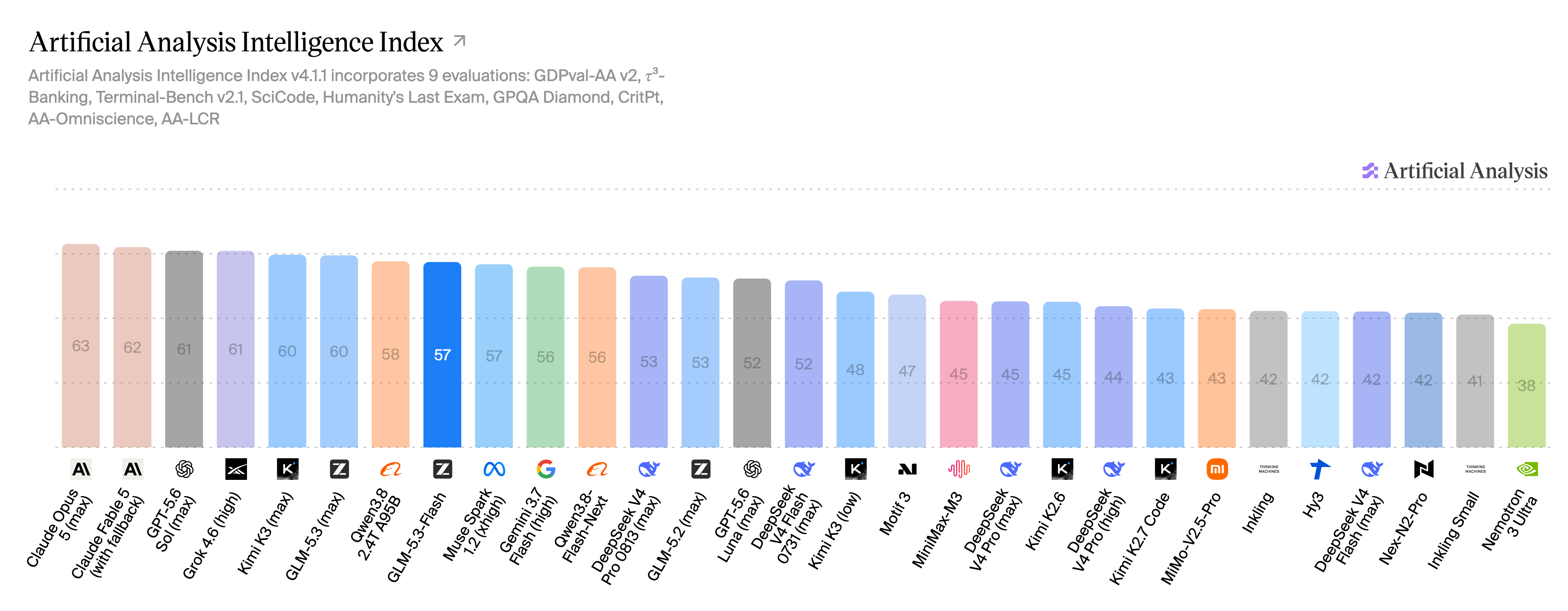
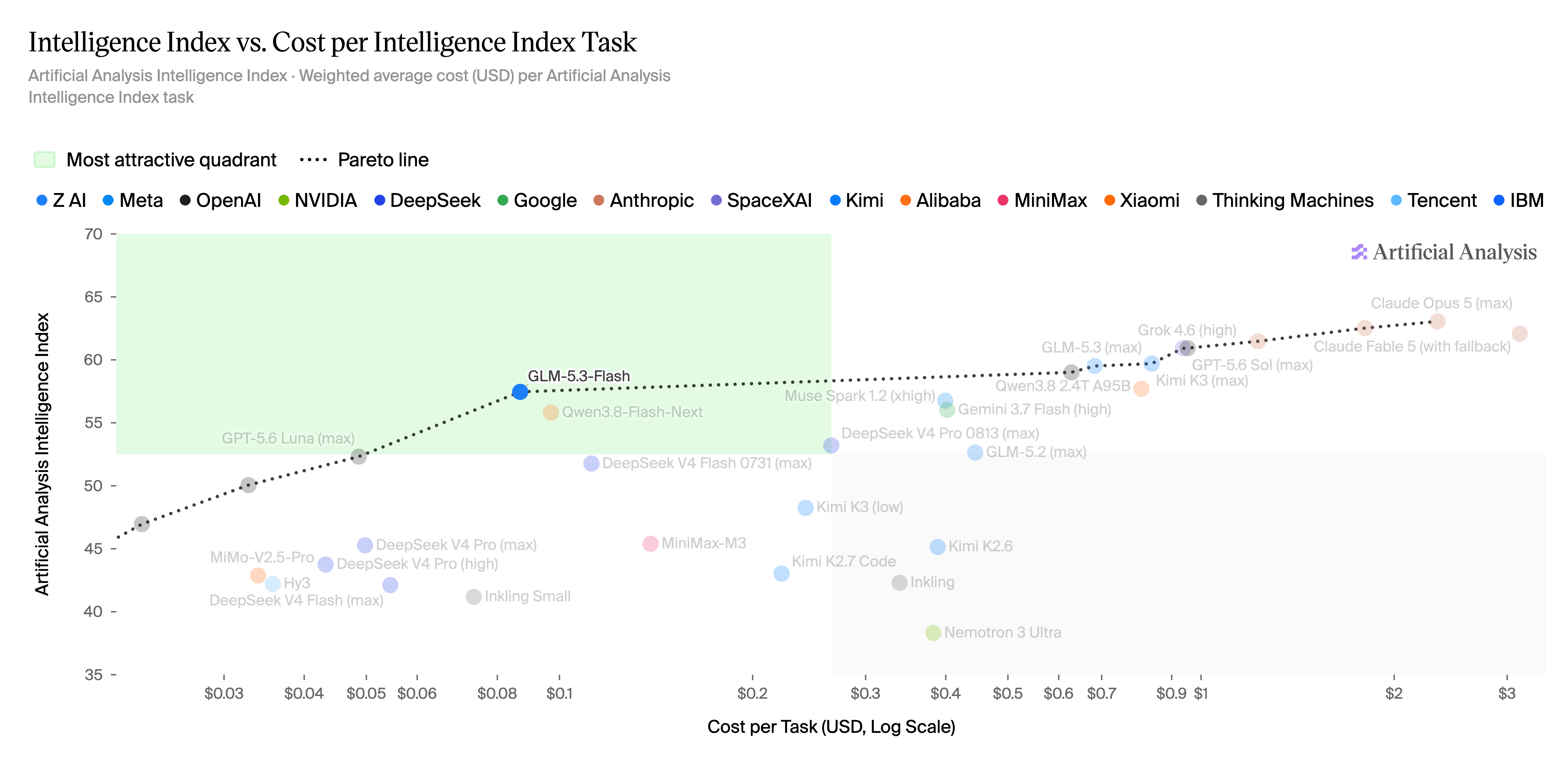
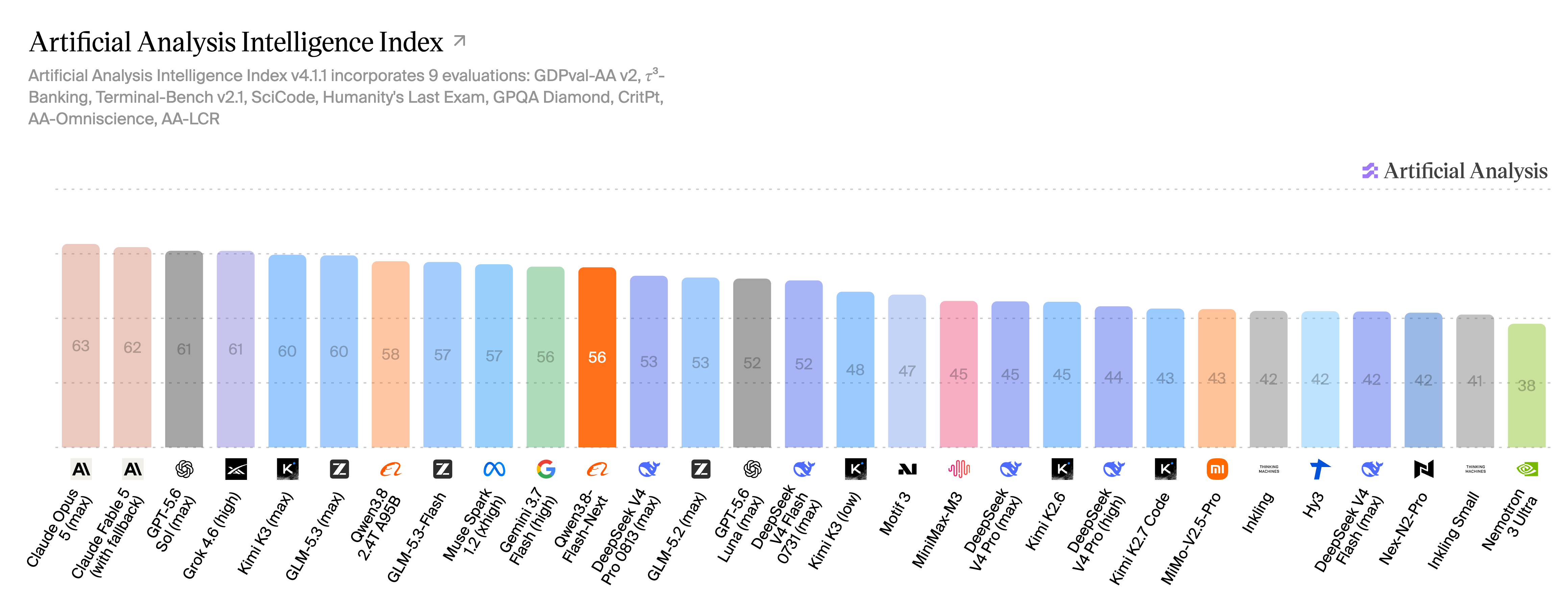
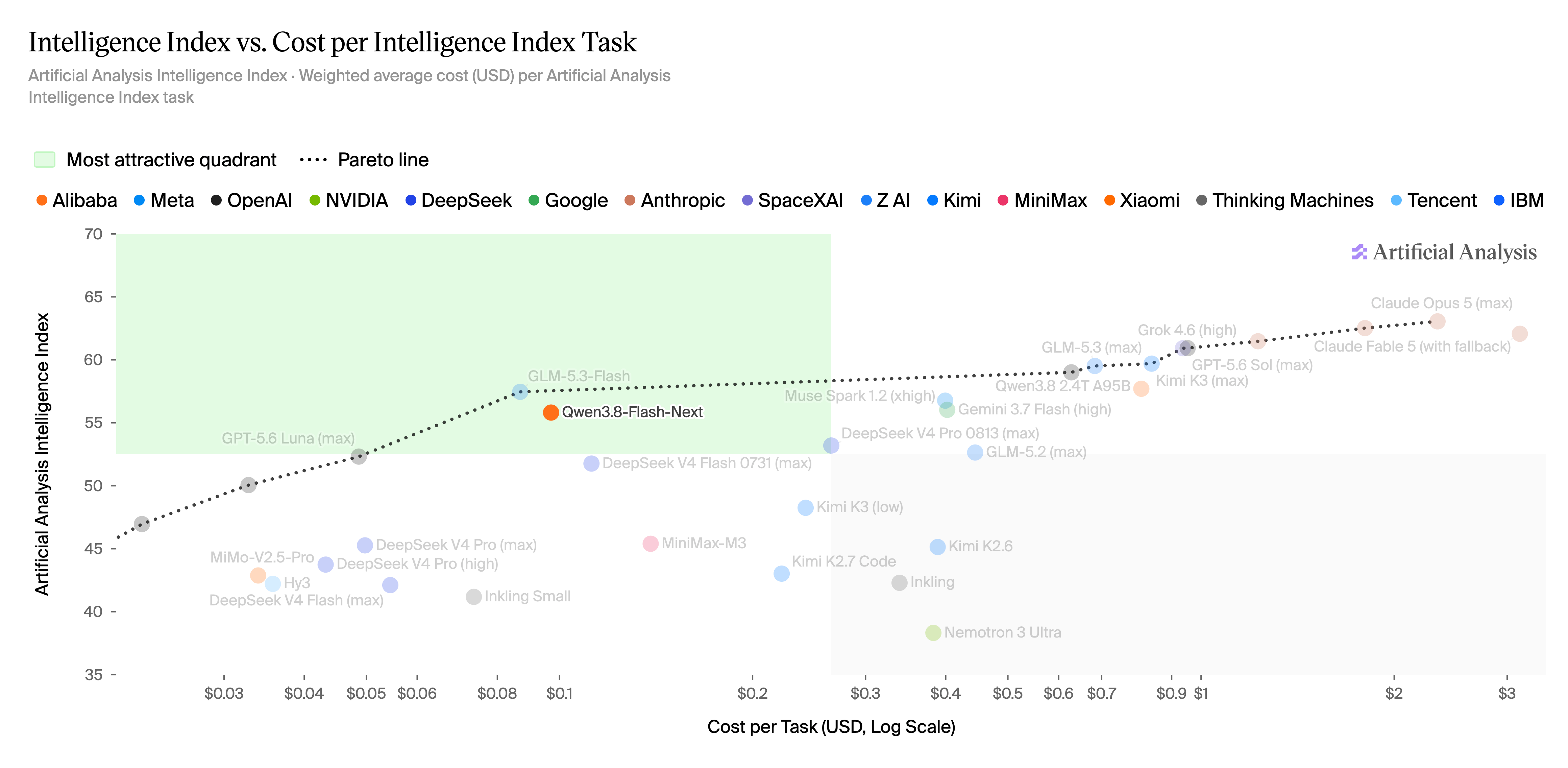
Z.ai presents GLM-5.3-Flash, the latest addition to the GLM-5 family of models. The company says that this 320-billion-parameter model approaches the performance of Claude Opus 4.8 on coding and agentic benchmarks while costing only a tenth as much. Artificial Analysis confirms those claims, giving GLM-5.3-Flash a score of 57 on its Intelligence Index (on par with Meta’s Muse Spark 1.2 and Gemini 3.7 Flash) and a very competitive performance-to-price score.
Z.ai released GLM-5.3-Flash earlier under the codename Ox Alpha, sparking curiosity online about who was behind the mysterious frontier-level model. Ox Alpha reached 327,000 users and 8.3 million sessions in four days and processed 26 trillion tokens. Z.ai said that all of that traffic was served on Chinese AI hardware. GLM-5.3-Flash is available on Z.ai’s platform and on Hugging Face for download.
GLM-5.3 weights are now on Hugging Face
Alongside GLM-5.3-Flash, Z.ai also released the weights for GLM-5.3, its flagship model. The company claims that this 743B-parameter model matches the performance of top frontier models, and Artificial Analysis has largely confirmed those claims. I took a closer look at GLM-5.3 in Sync #584 if you want more details about the model.

Qwen3.8-Flash-Next: A New Architecture, Towards Ultimate Cost-Efficiency
The team behind Qwen released Qwen3.8-Flash-Next, a new model in the Qwen3.8 family that also serves as an early preview of the architecture used in Qwen4. According to the release, this 125B-parameter model cuts training costs to roughly a ninth of Qwen3.7-Plus while delivering better performance on coding and office tasks. Artificial Analysis placed Qwen3.8-Flash-Next on par with Gemini 3.7 Flash and slightly below the recently released GLM-5.3-Flash, while finding it very cost-effective. Qwen3.8-Flash-Next can be downloaded from Hugging Face.
Gemini Omni 1.1 Flash lets you build with more control
Google has updated Gemini Omni, the video generation model it unveiled at I/O 2026, with new controls aimed at professional work. Omni 1.1 Flash can now extend an existing clip in 10-second steps, up to 40 seconds in total. It reads up to 10 seconds of prior footage to keep characters and scenes consistent across the transition. Developers can also draft cheaply in 360p before upscaling the final version to 4K.
Muse Image
Meta has launched Muse Image, its first in-house image generation and editing model. According to the release, rather than turning a prompt straight into pixels, Muse Image searches the web, writes code and critiques its own drafts before settling on a picture. Anyone can use it for free in the Meta AI app, Instagram Stories and WhatsApp. Facebook and advertiser tools follow later.
Australia Bans Generative A.I. From Official Music Charts
The Australian Recording Industry Association has introduced a new rule that bans songs that are not “substantially human-made” from music charts. AI-generated recordings will also not qualify for the ARIA Awards—the country’s top music industry prize. The new rules, however, still allow some use of AI in songs. For example, AI backing vocals are allowed, but an AI-generated lead vocal or key instrumental performance would disqualify a song. Some artists have welcomed the change, while others hope it will open up a broader conversation about the place of AI in music and art in general.
🤖 Robotics
London rollout of robotaxis delayed amid lack of guidance for firms to follow
The rollout of robotaxis on the streets of London was supposed to happen this year, but that now looks unlikely. Transport for London still hasn't published the guidance companies must follow to win its approval, and says it's in no rush. No operator has even registered vehicles for the driverless permit the government requires. Uber and Wayve can carry paying passengers in the meantime, but only with a safety driver at the wheel.
Waymo robotaxis are headed to Munich
Waymo is coming to Munich, its first German city. As in its other cities, it starts by driving the cars manually to map the streets. Testing with safety drivers comes next, then fully driverless rides. Waymo holds no German permit yet, so approval from federal and local regulators sets the pace. The company expects to open a paid public service late in 2027.
Amazon’s Toaster-Shaped Robotaxis Are Hitting the Road
Amazon’s Zoox has started charging for driverless rides in Las Vegas and rolling out in San Francisco. Unlike other companies, which still use traditional cars with extra equipment, Zoox uses purpose-built all-electric cars with no steering wheel or brake pedals. The National Highway Transportation Safety Administration cleared the company to charge for rides across up to 5,000 vehicles over the next two years. But they barred the cars from operating in heavy rain, snow and on roads with limits above 45mph (72 km/h). Zoox runs roughly 100 cars today, against about 4,000 for Alphabet’s Waymo.
The Humanoids at China’s Robot Games Were Faster Than Usain Bolt—but I’m More Impressed by Their Tweezer Mastery
Over 600 teams and more than 2,000 robots took part in this year’s World Humanoid Robot Games in Beijing. The biggest headlines came from robots running 100 metres faster than Usain Bolt and jumping higher than any human can. Robots also competed in ping-pong, football, weightlifting, and more, alongside practical challenges testing manual dexterity, such as “block building” and “tweezer bean picking”. Overall, the games offered a comprehensive look at what Chinese humanoid robots can do and their potential industrial applications. But, as Will Knight writes in this article, perhaps their biggest purpose is to get the public excited about the potential of robotics.
Hugging Face is selling a cute $399 open source duck robot, Microduck
Microduck is a cute robot duck from Hugging Face and Pollen Robotics. It is a 25 cm-tall bipedal robot that can waddle, pick things up with its beak, get back up when it falls, crouch, and even roller skate. Pre-orders for Microduck are now open, with the robot priced at $399 and expected to ship before Christmas. Hugging Face has open-sourced the AI controlling the robot and the RL training environment, both available on GitHub. The CAD files and BOM, however, do not appear to be publicly available. But if you are interested in building your own robot duck, check out Open Mini Duck, an open-source robotics project from one of Pollen Robotics’ engineers.
Anthropic: Previewing the Model Hardware Standard
Anthropic has introduced a research preview of Model Hardware Standard (MHS), a specification that lets AI agents operate lab and factory hardware such as microscopes and robotic arms. MHS replaces the patchwork of custom code used to control lab equipment with a standardised layer for AI agents, cutting setup time and allowing scientists to focus on their experiments. Anthropic admits that Claude’s physical reasoning still requires expert oversight and plans to open-source the standard only after developing safety evaluations with partners.
NVIDIA Announces Jetson Orin Nano 2 Robotics Computer to Redefine Entry-Level Edge AI
Nvidia has announced the Jetson Orin Nano 2, an updated version of its small computer for edge AI and robotics. The new Jetson Orin Nano still comes with 8 GB of memory but has a new eight-core ARM CPU and delivers 78 TOPS of AI compute, up from 67 TOPS. Nvidia says the Jetson Orin Nano 2 achieves twice the inference performance of the Jetson Orin Nano Super through improved Tensor Cores and higher memory bandwidth, while maintaining the same compact form factor. In 15-watt mode, the Jetson Orin Nano 2 consumes 40% less power while delivering the same performance as its predecessor. The Jetson Orin Nano 2 module and developer kit are expected to be available in the first half of 2027. Nvidia did not disclose pricing.
Arduino VENTUNO Q
Qualcomm (which owns Arduino) is taking on Nvidia in edge and robotics AI with the Arduino VENTUNO Q, a small but powerful computer designed to compete with Nvidia’s Jetson family of products. The Arduino VENTUNO Q offers 16 GB of LPDDR5 RAM, eight CPU cores, and up to 40 dense TOPS of AI performance. What sets the VENTUNO Q apart is that it has two chips (or “brains”, as Qualcomm calls them): the Dragonwing IQ-8275 processor (the “AI Brain”), which combines a CPU, GPU, and NPU, and the STM32H5F5 microcontroller (the “Action Brain”), which enables sub-millisecond response times—an attractive feature for industrial and robotics applications. Qualcomm sees the new device as an ideal computer for local and edge AI, as well as for robotics and industrial applications. The board is currently available for pre-order and costs $299.
Generalist AI says its new model, GEN-1.5, can learn a physical task from a single demonstration lasting just a few seconds, with no retraining. The company reports an average success rate of 59% across ten tasks using this approach, rising to 83% after a few minutes of fine-tuning. It says this ability emerged on its own after eight months of pretraining on real-world interaction data. The tasks are short and simple, and the results are self-reported. I recommend checking out the video Generalist uploaded alongside the announcement, as what they are showing is quite impressive.
Introducing S1: In-Context Learning for Robotics
Skild AI has unveiled S1, a robotics foundation model that learns a new task from a single video demonstration. The company says it needs no fine-tuning at all. Its own tests report a 66% success rate on tasks never seen in training, against 9% for language-prompted rivals. Skild claims S1 can handle ten-minute jobs it was never trained on, such as brewing coffee or cooking pancakes. Normally, this would take hours of teleoperation first.
Introducing Index: Building The World’s Largest and Most Diverse Physical Dataset
Figure presents Index, a dataset for robot training that the company has been building in secret for the past four months. Through a dedicated app, more than 44,000 weekly active users (which Figure calls Creators) have recorded over 16 million videos of themselves performing various chores. Figure says it has paid out $15 million to Creators who have contributed to the dataset so far. The Index app is now available for Android and iOS. Videos uploaded to Index will be used to train Helix and help solve the training data problem for humanoid robots.
How US military funding propelled China’s robot dogs
This article argues that Unitree built its best-selling robot dogs on quadruped breakthroughs funded by the US Army. It cites researchers who worked on the project, who say Unitree’s Go series matches MIT’s Mini Cheetah almost to the millimetre. Nothing underhanded happened, as the findings were published openly to push the field forward. Unitree's advantage was manufacturing, backed by state subsidies and a dense supplier cluster in Hangzhou. The researchers argue that faster commercialisation, rather than secrecy, is the best way to counter China’s scale advantages.
China’s robot traffic police can do almost everything except stop you
Traffic police in Hangzhou, China, have deployed 15 humanoid robots to direct pedestrians, manage traffic flow, and answer tourists’ questions. When the robots spot a violation, they file a report for a human officer to act on, as Chinese law reserves coercive powers for officers rather than equipment.
▶️ Unitree New Robot Preview: “Superman” Breaking the Limits of Humanity (0:30)
Unitree is back with another video showcasing the athletic capabilities of its humanoid robots. This time, the company showed its robots reaching 2 metres in a standing high jump and sprinting at a top speed of 12.66 m/s. For comparison, Usain Bolt’s top speed at his peak was 12.42 m/s.
▶️ Inside Persona AI’s Plan to Make Humanoid Robots Profitable (46:16)
In this episode of Automated Podcast, Brian Heater speaks with Nic Radford, co-founder and CEO of Persona AI and a former NASA roboticist. The conversation revolves around Radford’s and Persona’s goal of making humanoid robots practical. They focus on robots that can do real work, not just backflips. Radford shares his approach to the business and economics of humanoid robotics, and how Persona works to put robots to work and start delivering value. Radford also discusses the original vision for Robonaut and Valkyrie, the value of government-funded moonshots, DARPA’s role in modern robotics, and lessons humanoid companies can learn from the development of self-driving technology.
🧬 Biotechnology
A startup trains AI on living human skin tissue
TechCrunch profiles Michael Polansky, a former Founders Fund principal who ran Sean Parker’s family office before becoming Lady Gaga’s business and romantic partner. He is now going public with Outer Biosciences, a startup he has quietly led since 2020. The company keeps skin left over from surgery alive for up to a month, compared with an industry norm of just a few days. That window lets an AI model predict which compounds will work, test them on the tissue, and then learn from the results. The approach has taken the company from finding two promising compounds in 18 months to finding a new one every six weeks. Polansky says the data is finally good enough for the company to work in the open.
Mini Brains Grown for Five Years Matured Like Human Brains
Researchers managed to keep lab-grown brain organoids alive for over five years, far longer than the few months they usually survive. The trick was swapping their nutrient mix midway through, which stopped the neurons from withering. By the end, gene activity in the oldest blobs resembled that of a typical four-year-old. The cells even seemed to track their own age, maturing on schedule when mixed with much younger ones. Until now, mini brains died long before reaching the stage when disorders like schizophrenia and epilepsy take hold. This result opens up the possibility of studying those and other disorders more closely.
💡Tangents
Meta agrees to major changes to Facebook and Instagram as it settles US trial over teen addiction for up to $17bn
Meta has settled a landmark lawsuit brought by California and 28 other US states, and agreed to pay up to $18 billion over ten years. The states accused the company of deliberately designing Instagram and Facebook to hook children and damage their mental health. Meta denies wrongdoing, but will still cap teenagers’ daily use, block the apps overnight and pause notifications during school hours. That makes it the first time the company has been forced to change how everyday users experience its apps. Thousands of similar claims against Meta, TikTok, Snap and YouTube are still pending.
Apple Mac Studio M5 Ultra and Mac Mini M6 Launched
Apple introduced new Macs this week—the Mac Mini M5 Pro, Mac Studio M5 Max, and Mac Studio M5 Ultra, as well as Mac Minis with new M6 processors. On paper, they look very good. Apple claims the M6 delivers 1.2x faster multithreaded CPU performance than the M5, nearly 30% more peak GPU AI compute, and 10% more memory bandwidth. The M5 Ultra, with a maximum unified memory pool of 512 GB (although only versions with 256 GB are currently available), is shaping up to be a small but capable machine for local AI. What’s not small are the prices, especially for higher-spec machines.
Thanks for reading. If you enjoyed this post, please click the ❤️ button and share it!
A big thank you to my paid subscribers, to my Patrons: whmr, Florian, dux, Eric, Preppikoma and Andrew, and to everyone who supports my work on Ko-Fi. Thank you for the support!