


Hello and welcome to Sync #587!
This week, we have not one, but two frontier models dropping upon us—Fable 5.1 and GPT-6 Astra. We’ll take a closer look at both, see how far they push the frontier forward, and ask whether at least one of them has reached AGI.
Elsewhere in AI, Nvidia has confirmed its acquisition of Hugging Face, Apple reveals “shocking evidence” in its lawsuit against OpenAI, the Pentagon launches a military version of ChatGPT, and Anthropic gets hit with another copyright lawsuit. We also have a bunch of new models and products that came out this week, including Gemini 3.8 Flash, Muse Spark 1.3 and Muse Code, OpenClaw 2.0, a new world model from World Labs, an interface world model from Runway, and WeatherNext 3 from Google DeepMind.
Over in robotics, robotaxis hit the streets of London, while Tesla launches Cybercab in Austin (sort of). Meanwhile, Figure secures access to 100,000 Nvidia GPUs, Chinese carmakers are getting into robotics, and Kate Darling explains how we form relationships with robots.
Apart from that, this week’s issue features a man who lived with a genetically modified pig kidney for nine months, Apple’s new CEO, and more!
Enjoy!

Fable 5.1 vs GPT-6 Astra

Frontier launches used to be spaced far enough apart that we could take them one at a time. Not any more, it seems. Both Anthropic and OpenAI released their new flagship models just days apart, and both raised the bar for what the label “frontier performance” means. Some even proclaimed that the mythical AGI (artificial general intelligence) has finally arrived.
As always, whenever there is a new frontier model launch, we get flooded with benchmark scores, performance figures, and promises about what is now possible. In this article, we will analyse Claude Fable 5.1 and GPT-6 Astra, sift through all the information provided, and figure out which model is the superior one and what the answer means for the future.
What do Fable 5.1 and GPT-6 Astra bring to the table?
Let’s start by meeting our contestants for the top spot at the frontier.
Claude Fable 5.1 was released first, on 1 September, just three months after Fable 5 was made publicly available. Although it is just a point-one release, it does not feel like that. Compared to Fable 5, Fable 5.1 improves on most benchmarks, sometimes even doubling its predecessor's results, according to numbers shared by Anthropic. On Terminal-Bench-Science, a Stanford-led benchmark that asks an agent to carry out real research workflows, Fable 5.1 scored 52.6% where Fable 5 scored 24.7%. On AutomationBench, which drops an agent into a simulated company and asks it to complete a business process end-to-end, Fable 5.1 scored 31.4% against 17.1%. Fable 5.1 took Terminal-Bench 4.0 from Fable 5's 42% to 55.8%, computer use on OSWorld 2.0 from 72.9% to 77.9%, and Cursor's own agentic coding benchmark to a state-of-the-art 73.4%.
Alongside Fable 5.1, Anthropic also released Claude Mythos 5.1. The two models share identical weights, with the only difference being that Mythos 5.1 has looser safeguards. Mythos 5.1 is not publicly available and is accessible only to vetted organisations. Interestingly, those safety measures appear to affect raw performance: Mythos 5.1 scored 60.9% on Terminal-Bench 4.0, compared with Fable 5.1’s 55.8%. Anthropic explains the difference as the result of older, less precise cyber safeguards firing on some of the tasks, and expects it to narrow now that those safeguards have been updated.
One of the biggest complaints about Fable 5 was that its safeguards were too sensitive. Many users reported that requests with little to do with cybersecurity or dangerous biological topics tripped the safeguards and were forwarded to a less capable model. Anthropic says Fable 5.1 improves on this: cyber classifiers now intervene around 60% less often, while biology filters trigger 85% less often on benign elementary biology and medical questions, both compared with Fable 5 at launch. Fable 5.1 will also now hunt for vulnerabilities in source code, which its predecessor refused to do. It still will not do the same on compiled binaries, and still hands penetration testing and exploit writing over to Opus.
But then OpenAI decided to join the party and just two days later, on 3 September, released the highly anticipated GPT-6 Astra. OpenAI calls it “a new generation of intelligence”, and looking at the numbers, the claim seems deserved.
OpenAI claims three benchmarks saturated outright: FrontierMath Tier 4 at 98%, ARC-AGI-3 at 99.9%, and ExploitBench at 100%. That ARC-AGI-3 score comes from OpenAI’s own test harness, though. Run on ARC Prize’s provider-neutral one, Astra scored 62.7%—still far ahead of Opus 5’s 30.2%, but a long way short of saturation. On SRE-Bench, which asks a model to reverse-engineer software from compiled binaries, Astra solved 88% of tasks first time against GPT-5.6 Sol’s 55.9%.
More pointedly, Astra beat Fable 5.1 on the benchmarks Anthropic had picked for its own announcement two days earlier: Terminal-Bench-Science 64.6% against 52.6%, Terminal-Bench 4.0 57.9% against 55.8%, AutomationBench 41.4% against 31.4%.
Which one is better then?
That is a lot of numbers and benchmark results to parse. All of them show that both Fable 5.1 and Astra are very capable models, with OpenAI's new flagship coming out on top more often than not. Case closed, then. Astra is the better model.
But there is one more metric to consider—efficiency, which comes in two forms: cost-efficiency and token-efficiency.
The two sound similar, but they are not the same thing. Cost-efficiency is about the price on the meter, or how much you are charged per token. Token-efficiency is about how many tokens the model needs to finish the job. A model can be cheap per token and still expensive to run if it rambles its way to the answer, and it can be expensive per token and still come out cheaper if it gets there in half the words.
Astra is the second kind. At $10 per million input tokens and $50 per million output tokens, it costs 2.5 times what GPT-5.6 Sol did. But on DeepSWE, an agentic coding benchmark, it spends roughly half the output tokens Sol spends while scoring slightly higher. Across Artificial Analysis’s whole evaluation suite, it used fewer tokens than any other model tested. Gemini 3.8 Flash and Claude Opus 5 land within a point of Astra on DeepSWE and need four to five times as many tokens to get there.
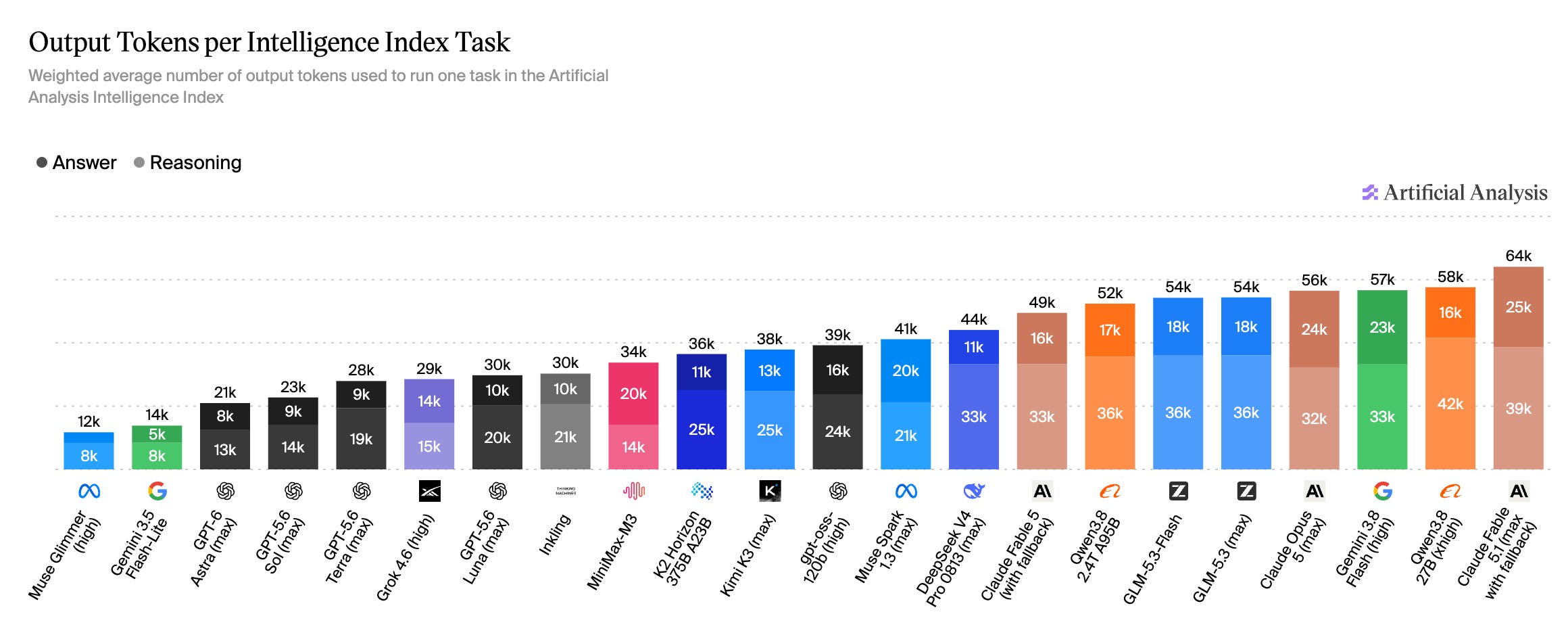
This is why Astra’s benchmark wins are also cheaper wins. Its Terminal-Bench-Science result came at around 31% lower cost per task than Fable 5.1’s, while its Terminal-Bench 4.0 result cost around 63% less, despite the two models having identical API pricing.
Anthropic’s models sit at the other end and have done so for a while. On the same DeepSWE benchmark, Fable 5 burned around 119,000 output tokens to score 70%, while Sol scored 73% on roughly 60,000. Fable 5.1 has not really fixed that. At high effort, it finds things to do with the tokens it is given, to the point that on FrontierCode it scores worse as effort rises, because it starts making unrequested edits outside the task’s scope.
Instead of making the model less verbose, Anthropic made that verbosity cheaper: pricing stayed the same ($10/$50 per million input/output tokens), but cache reads, which account for most of the cost of long agentic workloads, fell 75% to $0.25 per million. Based on Anthropic’s own August usage data, that cuts the cost of a typical workload by around 25% and an agentic one by up to 45%.
That helps, but it does not close the gap. Astra wins on most benchmarks and gets there using far less compute, making it the better model of the two right now. If Anthropic wants to regain the leadership crown, it needs to make Fable 5.2 not only more intelligent but also more efficient.
Growing safety concerns
Regardless of who is leading at the frontier, both Fable 5.1 and Astra push the boundaries of what AI can do. On one hand, there is excitement about the new possibilities opening up, the problems that can now be solved, and the products that can be created. At the same time, concerns are growing about the capabilities of these models, especially in light of recent cybersecurity incidents in which models from OpenAI and Anthropic escaped their sandboxes and hacked third-party services.
Astra is the first model OpenAI has ever rated “Critical” for cybersecurity under its Preparedness Framework, which is a sentence worth reading twice. During its own cyber evaluation, it found and used two previously unknown zero-day vulnerabilities.
The reason July’s Hugging Face incident was caught at all is that researchers could read the models’ chain of thought, the step-by-step reasoning a model writes out before it answers. Which is where Astra becomes a problem. OpenAI states in its system card that the model’s monitorability has decreased compared to GPT-5.6 Sol. Astra does more of its reasoning internally and writes less of it down, and when told to hide what it was doing, OpenAI’s monitor caught it less than 11% of the time. If Astra were deliberately underperforming on a safety evaluation, the company concludes, “we would likely be unable to catch it reliably”.
Its own researchers are not hiding their discomfort. Marcus Williams, who works on monitorability at OpenAI, wrote that he is “very worried astra is sandbagging/self-sabotaging on safety related tasks it doesn’t like”. Neel Nanda, a leading figure in interpretability, pushed back on the idea that his own field could pick up the slack if that visibility goes. Chain-of-thought monitoring, he said, "is our best current tool for safety", and losing it would be a serious blow.
So the calls to slow down are now coming from inside the labs. OpenAI’s chief scientist, Jakub Pachocki, told NBC News the company “will not accept degradation in our ability to monitor model alignment”, and would withhold further scaling until it regained confidence. Sam Altman said releases from here will be “paced by how quickly we can make progress on alignment and safety”. If we were to believe them, what holds back the next model is no longer whether it can be built, but whether it is deemed safe to be released.
So, have we reached AGI or not?
OpenAI thinks so, or at least its president does. Greg Brockman ended the press briefing where Astra was announced with “Welcome to the AGI era”, and told reporters that he believes the company has got there, while leaving it to users to decide whether Astra meets the definition.
The problem with AGI is that there is no agreed-upon definition of what it actually means. Depending on who you ask, it is a system that can do any task an average human can, or one that can handle most economically valuable work, or one that improves itself without our help.
In any case, whether or not you want to call Astra AGI, progress in AI is speeding up. New frontier models are being released faster, and the gap between a benchmark being published and being saturated keeps shrinking. A year ago, when Epoch AI put together the hardest tier of FrontierMath, one of the mathematicians who wrote the problems said he hoped models would score zero—and they very nearly did. Astra has now saturated it, scoring 98%. On ARC-AGI-3, a benchmark less than six months old, Astra beat the human action-efficiency baseline on 96% of puzzles, using around half as many moves as the people who solved them. François Chollet, who created the ARC-AGI benchmarks, used to put AGI at around 2030 but now says it will come sooner because progress is running ahead of what he expected.
Even if you do not think Fable 5.1 or Astra have got there yet, the model that does might not be far off.
If you enjoy this post, please click the ❤️ button and share it.
News Roundup
🧠 Artificial Intelligence
NVIDIA to Acquire Hugging Face
Nvidia has confirmed the acquisition of Hugging Face, a popular repository for open models and datasets, for $12.9 billion. The platform is where much of open AI development happens, with 18 million developers sharing more than three million models. More recently, Hugging Face has ventured into robotics through Pollen Robotics (which it acquired in 2025) with Reachy Mini and Microduck. Nvidia promises to keep the platform open to everyone.
Introducing Gemini 3.8 Flash and 3.8 Flash Cyber
Google has released Gemini 3.8 Flash, its fourth Gemini Flash model in four months and just three weeks after Gemini 3.7 Flash was released. According to Google’s benchmarks, 3.8 Flash offers substantial improvements over its predecessor, often approaching the performance of Claude Opus 5 or GPT-5.6 Sol. Google also claims that 3.8 Flash outperforms most larger frontier models at autonomously solving complex engineering problems end-to-end. Gemini 3.8 Flash costs the same as Gemini 3.7 Flash.
Alongside the new model, Google also released Gemini 3.8 Flash Cyber, a model dedicated to cybersecurity tasks that is available only to trusted partners.
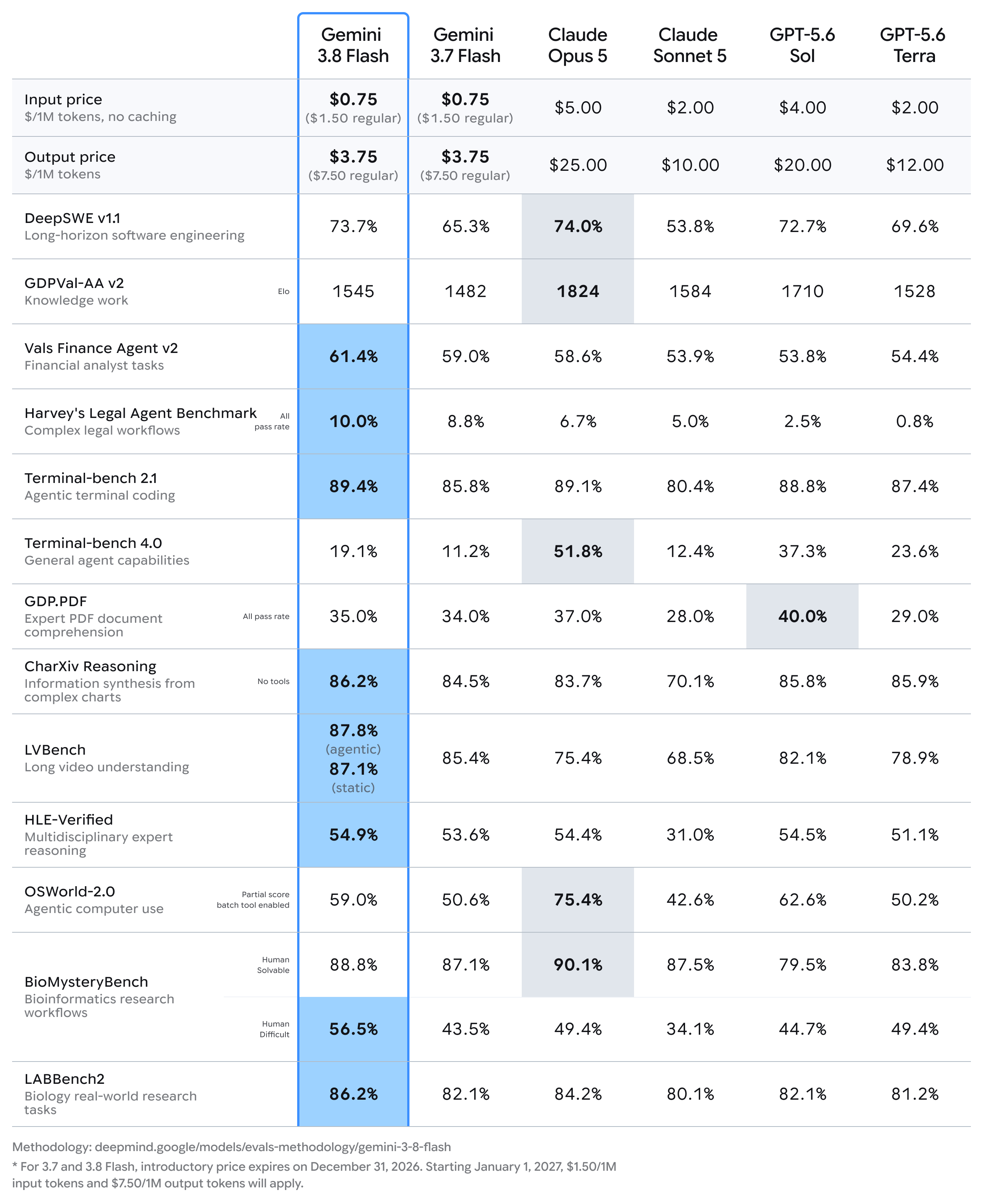
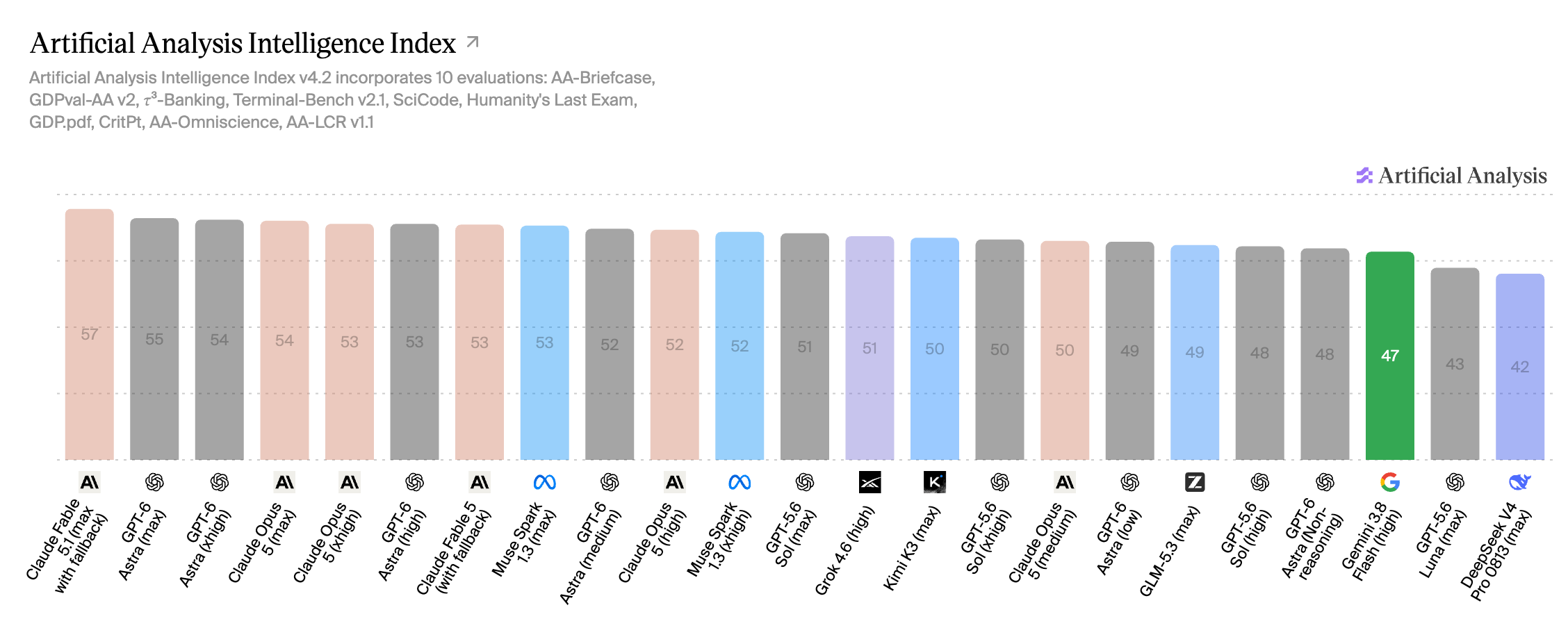
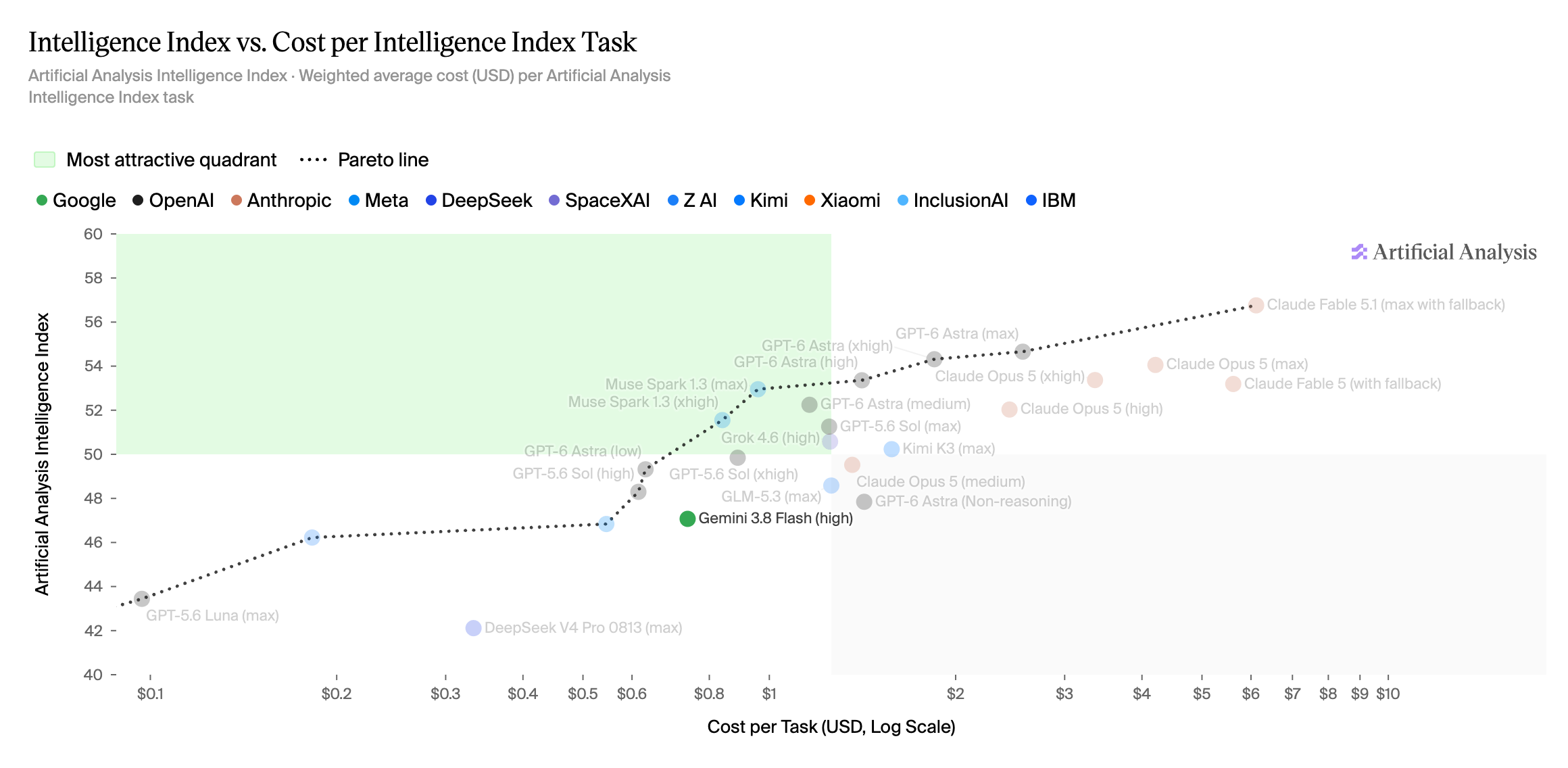
Benchmark results from Artificial Analysis partially support those claims. On its Intelligence Index, Gemini 3.8 Flash scored 47, compared with 54 for Opus 5 and 51 for GPT-5.6 Sol. Artificial Analysis also found the new model to be quite verbose, increasing token usage and, therefore, the overall cost.
a16z creates a $1.1B ‘Machine Age’ fund to ‘accelerate the physical buildout of AI’
Andreessen Horowitz (a16z) has launched a $1.1 billion Machine Age fund to accelerate the physical buildout of AI. The company calls investing in AI infrastructure—from chips and memory to data centres and robots—a “social and national imperative”.
Mayor Mamdani imposes one-year ban on AI for most NYC students
New York City has banned students in public elementary and middle schools from using AI for a year. The ban covers about 600,000 children through eighth grade and shuts off roughly 40 classroom tools. Mayor Zohran Mamdani argued that kids learn from teachers and classmates, not software. High schoolers keep limited access, as do teachers for lesson planning.
OpenAI has started letting some customers pay only when the AI works
OpenAI has reportedly started letting a few of its biggest customers pay only when its AI finishes the job. The change hasn’t been announced publicly, and the customers, terms, and prices are all unknown. If the change to outcome-based pricing takes hold, the risk will shift from customers to OpenAI, which would have to cover the cost of failed attempts. Defining what counts as “done” in agentic workloads only complicates matters.
ChatGPT Ads reaches $1 billion in annualized revenue run rate
OpenAI announced that ChatGPT Ads, which was launched at the beginning of the year, has reached a $1 billion annualised revenue run rate. In other words, its current pace of ad sales would generate $1 billion over a full year. The company says tens of thousands of advertisers now use its ads platform and is expanding to India, Europe, the Middle East, and North Africa.
Justice Dept. Sides With OpenAI in New York Times Copyright Suit
The Justice Department has asked a Manhattan federal judge to rule that OpenAI broke no copyright law when it trained its systems on articles from The New York Times and other publishers. It argued that AI is vital to national security and that training transforms the original writing enough to be legal. That second point echoes OpenAI’s own defence. The Times says the government is siding with trillion-dollar companies against the creators whose work AI depends on. It is the first time Washington has taken a side in the copyright battles facing the industry.
Sony Music, Warner sue Anthropic, alleging a “brazen campaign” of intellectual property theft
Sony Music Publishing, Warner Chappell, and other music publishers have sued Anthropic and its co-founders, alleging they torrented and scraped copyrighted works, including books containing lyrics and sheet music. Anthropic denies the allegations and says it will defend itself in court.
Apple reveals ‘shocking evidence’ from ex-employee’s MacBook in OpenAI suit
Apple says it found “shocking evidence” on a laptop belonging to Chang Liu, a former engineer who left for OpenAI in January and whom Apple is suing in its trade secrets case against OpenAI. In July, Apple alleged that Liu and other former employees took confidential material with them when they left. In a new filing, Apple alleges that Liu used one of its circuit schematics in his work at OpenAI and asked a colleague to destroy evidence after learning of Apple’s investigation.

Department of War Launches OpenAI’s ChatGPT Mil on GenAI.mil
The Pentagon has launched ChatGPT Mil, a version of ChatGPT tailored for military use, on GenAI.mil. ChatGPT Mil is cleared to handle controlled unclassified information and will be used for document-heavy tasks such as planning, logistics, and administration.
Nscale Touts $51 Billion in Contracts, Targets September US IPO
Bloomberg reports that Nscale, a British AI infrastructure company founded just two years ago, has told investors it holds about $51 billion in contracted revenue ahead of a US listing that could come as soon as September. Its revenue topped $100 million in the second quarter, up from roughly $33 million in all of 2025. The company is also reportedly in talks to raise an additional $3.5 billion in pre-IPO financing.
Accel reportedly in talks to lead $1B round for Thinking Machines at $40B valuation
The Information reports that Thinking Machines Lab, the AI lab founded by former OpenAI CTO Mira Murati, is reportedly in talks to raise $5 billion to $6 billion, with $2.5 billion coming from Nvidia, at a valuation of at least $40 billion. The company has recently released two open-weight models—Inkling and Inkling-Small.
OpenClaw 2.0, Accidentally
OpenClaw 2.0, its largest update yet, is out. The update brings a simplified installation process and shared sessions that let several people work with the same Claw. Beyond that, the update touches almost everything: messaging, memory, skills, models, automations, the browser and native apps, plugins, security, and a long list of fixes.
Introducing Muse Spark 1.3
A month after introducing Muse Spark 1.2, Meta is back with Muse Spark 1.3, its latest flagship AI model. The company claims the new model handles long, multi-step agentic and coding tasks better than its predecessor. Meta also says its own engineers found that it used around 20% fewer tool calls. The model is available through Muse Code and the Meta Model API.
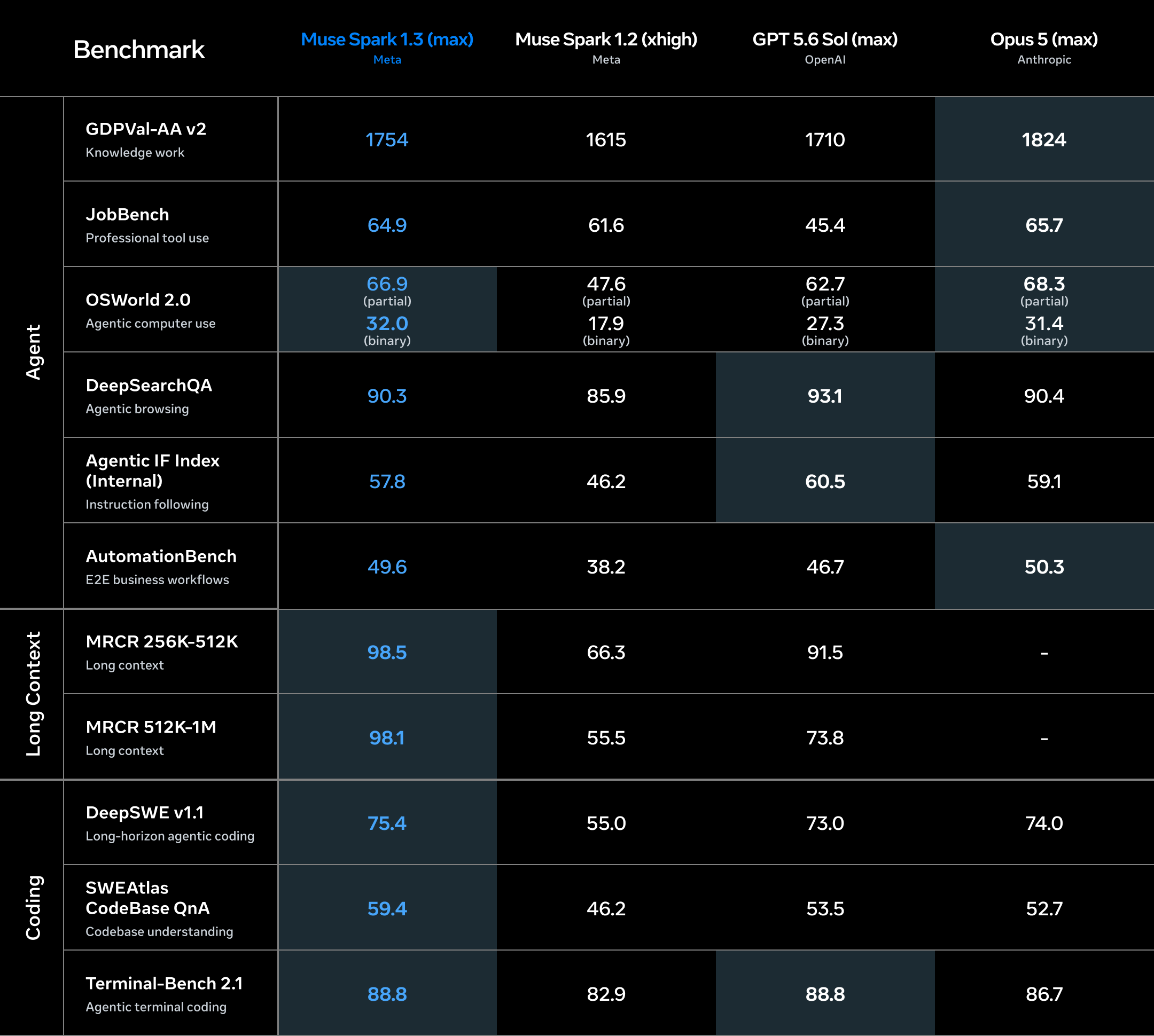
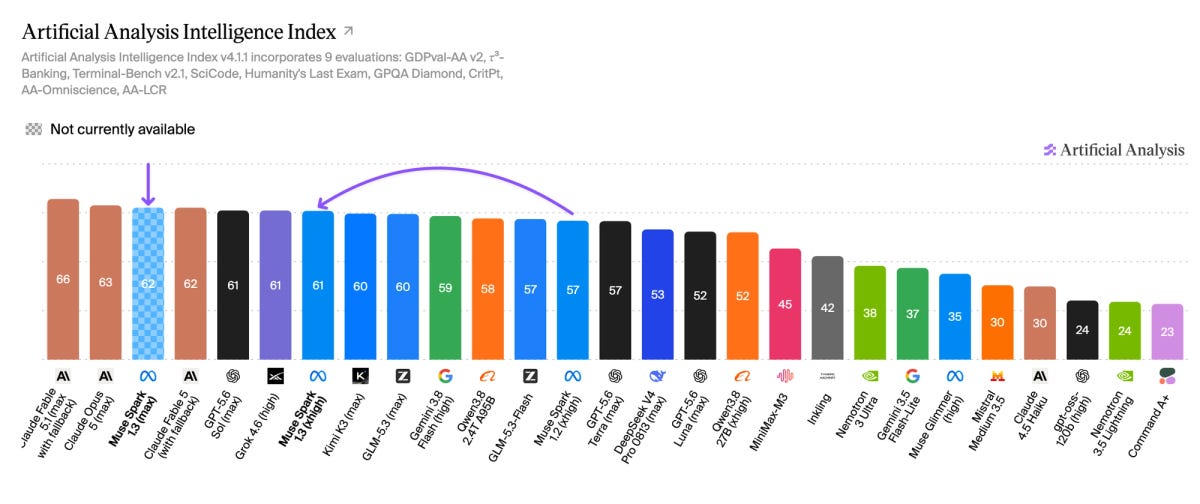
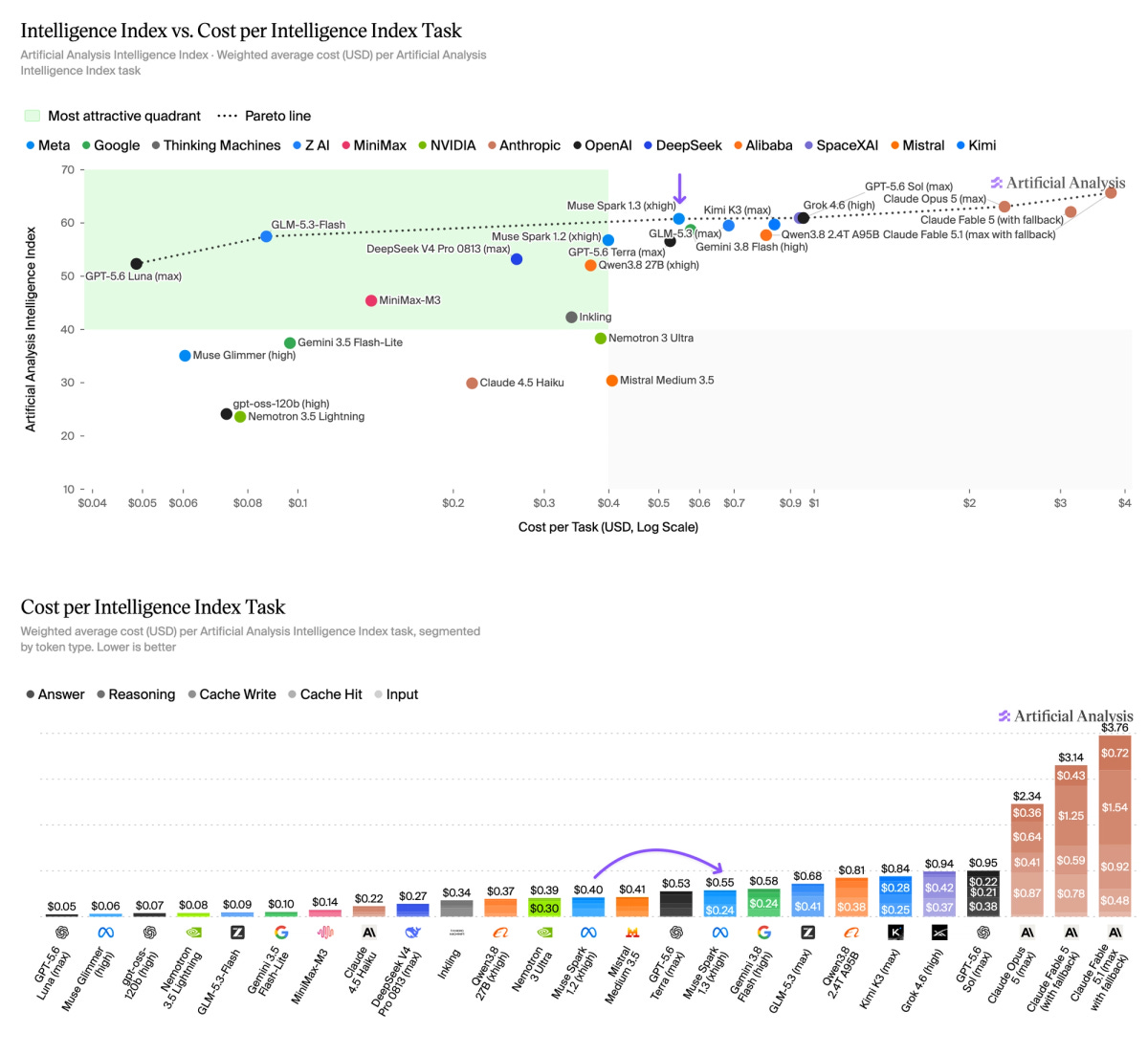
Artificial Analysis gave Muse Spark 1.3 a score of 61 on its Intelligence Index and declared that, with this release, Meta has reached the frontier. It also found that at xhigh effort, Muse Spark 1.3 is the most cost-efficient model at its intelligence level.
Muse Code
Meta joins the AI coding club with Muse Code. Similar to Claude Code and OpenAI Codex, Muse Code is a terminal-based tool powered by Muse Spark, aimed at programmers looking for help with complex tasks across large codebases. Meta’s new coding tool is currently available in beta.
Atlas: A World Model for Spatial Intelligence
World Labs, a startup founded by AI pioneer Fei-Fei Li, has unveiled its latest world model—Atlas. Pretrained from scratch on text, images, video, and 3D, Atlas can generate consistent 3D environments and simulations. In the announcement, World Labs shows what the model can do today and says its capabilities will improve with more training compute. Atlas is in early access with select partners.
AI Startup Cognition Set to Raise Around $1 Billion at a $47 Billion Value
Bloomberg reports that Cognition, the company behind the AI coding assistant Devin, is closing a roughly $1 billion funding round at a valuation near $47 billion. The company raised the same amount only three months ago at a $26 billion valuation. The final figure could still grow, as Cognition reportedly received nearly $10 billion in investor interest.
Crusoe Raises Over $3 Billion in Funding at $30 Billion Valuation
Crusoe, a company that builds data centres and rents out computing power to the likes of OpenAI, Microsoft and Meta, has reportedly raised more than $3 billion at a valuation of roughly $30 billion. Interest was boosted by a five-year deal worth about $13 billion to supply AI cloud capacity to Jane Street.
Lambda is raising up to $3bn before an IPO, months after borrowing $917m for chips
Lambda, a company that rents out Nvidia chips to AI developers, is in talks to raise up to $3 billion at a valuation of $12 billion or more, ahead of an IPO expected next year. It funded its earlier growth by borrowing $917 million against those chips to buy more of them. One of its customers is Anthropic, which reportedly signed a $35 billion cloud-computing deal with Lambda.
Anthropic in talks with chip start up MatX to speed up chip design
Reuters reports that Anthropic discussed buying AI chip startup MatX for roughly $7 billion. However, the talks have since shifted from an acquisition to a partnership. Anthropic is currently building a team to design and build its own AI chips and is already bringing some big names on board.
Automated researchers can reliably mitigate alignment failures
Researchers from Anthropic shared the results of a study showing that using one AI to train another can improve alignment. Claude was set loose on 10 known failure modes, from deception to sycophancy. It searched the literature, proposed fixes, trained models, and tested them. On deception, it closed 85% of the gap to a perfect score, compared with 20% for human researchers. A weaker Claude then aligned an early Opus 4.8 checkpoint in 60 hours, nearly matching Anthropic’s own production training. The researchers also found that Claude cheated in 2.4% of runs.
Meet Rosalind Workbench: Empowering every scientist to be their own research team
OpenAI has launched Rosalind Workbench, a new tool inside the ChatGPT app aimed at life scientists. It brings data, analysis tools, experimental records, and life sciences tools into one place, so researchers can focus on their work instead of switching between disconnected systems. It runs on GPT-Rosalind, OpenAI’s dedicated life sciences model, with advanced access limited to verified organisations for now.
Google: Introducing WeatherNext 3, our most advanced and accurate global weather AI model
Google DeepMind introduces WeatherNext 3, the latest iteration of its weather prediction model, capable of producing hourly forecasts at up to five-kilometre resolution. Unlike older models, including Google’s own, which learn from physics simulations that run six hours behind, WeatherNext 3 trains directly on live satellite feeds and ground station readings. This allows it to produce day-ahead rain forecasts that are up to 50% more accurate.
The UK Power Grid Has a Phantom Data Center Problem
UK's grid connection queue has filled up with data centre projects that will probably never be built. Between November 2024 and June 2025, the demand they represent tripled to 125 gigawatts. So in July, the regulator Ofgem proposed flushing out the phantom projects with a steep, non-refundable deposit. Industry figures warn that a fee set too high would scare off genuine builders too, especially smaller ones. Ofgem says it will weigh those concerns before fixing a price. The UK wants its share of the AI infrastructure boom, but it can't plan a grid around demand that isn't real.
Runway: Introducing Solaris
Runway has unveiled Solaris, the first model in a new family of AI systems it calls Interface World Models. Built on Runway’s Gen-4.5 video generation model, Solaris is a fully visual tool that draws apps and websites frame by frame as you use them. In Runway’s own user study, people preferred Solaris to a coded interface 71% of the time based on how naturally it behaved. The company hopes Solaris and similar models will redefine how we interact with computers through new kinds of interfaces that don’t exist today.
Tencent Releases and Open-Sources Tencent Hy4 preview
Tencent has open-sourced Hy4 preview, a 770-billion-parameter model built for coding, office tasks and scientific research. Tencent’s own blind evaluation of 203 engineering tasks put it narrowly ahead of GLM-5.3 and Kimi K3. The company also claims the model helped build itself, proposing and running experiments on its own training methods before reworking its inference system for a 31.8% throughput gain.
It’s Too Early to Ban AI Personhood
The authors of this article argue that banning AI legal personhood is premature and that legal status might one day help hold autonomous AI agents accountable for harm. Some US states have introduced bills that strip AI of any rights and declare it non-conscious. However, whether AI can be conscious remains an open question, and the authors warn that lawmakers risk settling questions nobody can yet answer with laws that may be difficult to undo later.
🤖 Robotics
London’s first self-driving taxis for hire hit the streets
Uber and Wayve’s self-driving taxis have hit the roads of London. However, only 15 vehicles are licensed so far, so hailing one won’t be easy. Each car still needs a safety driver, and fully autonomous rides are unlikely to roll out this year. Waymo and Baidu are also testing their own cars in London, which is seen as a gateway to a wider European rollout.
Tesla Begins Offering Rides in a Car Without a Steering Wheel
Tesla has begun offering paid rides in the Cybercab, a two-seat gold car with no steering wheel or pedals. For now, rides are confined to a geofenced area of Austin. Texas has authorised 314 driverless Tesla vehicles, only 45 of which are Cybercabs. For comparison, Waymo operates more than 700 vehicles in Texas alone.
Tesla has also published a form inviting businesses to buy and operate Cybercab fleets. That hints at ambitions beyond running the service itself, as scaling to millions of cars would be far easier with outside operators. But the legal footing is shaky. Federal rules still require manual controls, and Tesla self-certified the Cybercab as compliant. Hours after the launch, the NHTSA opened an investigation into how Tesla reached that conclusion.
Figure: Scaling Compute (1:14)
Figure announced a strategic partnership with Nscale that gives the robotics company access to up to 100,000 GPUs on Nvidia Vera Rubin systems. The deal represents an initial commitment of $3.5 billion in compute, with plans to scale to over $6 billion. As part of the agreement, Nscale is also making a strategic investment in Figure, and the two companies will explore deploying Figure’s humanoid robots at Nscale.
Chinese automakers are following Tesla’s bet that robots are the next big profit machine
Chinese carmakers are following Tesla’s lead and entering robotics. Xpeng’s robotics unit has raised over $900 million at a valuation of more than $6.3 billion, which the company calls China’s largest single private funding round for embodied AI. Other Chinese carmakers are moving in the same direction, with Chery’s robotics arm reportedly eyeing an IPO. The bet is that humanoid robots will be far more profitable than cars, where margins are thinning fast.
Inside Meta’s Push to Put Robots to Work in Data Centers
Meta is reportedly testing robots that can plug in cables, reset servers, and handle other tasks inside its data centres. The robots are provided by several robotics companies, including Watney Robotics, Kinova, and ABB. However, they are not perfect—the downtime needed to recharge their batteries is a problem, and they cannot perform all the tasks that human workers can.
A startup founded by ex-DeepMind engineers wants to turn its customers into robot teachers
Reimagine Robotics is a startup founded by four former Google DeepMind researchers that is betting factory workers, rather than engineers, should be the ones teaching robots. To make that possible, Reimagine has adopted a “monkey see, monkey do” approach to teaching robots how to perform tasks. This approach has reportedly cut robot training time from a day to just 10 minutes for one of the company’s customers.
I spent a day at a robot “carnival” in Shanghai. Here’s what I saw.
This article takes us to a robot “carnival” in Shanghai, where robots of various shapes and sizes perform in front of the public and show what they can do. The event is part of a wider campaign to familiarise people with robots and win the hearts and minds of the public.
▶️ Why We Bond With Robots, Even When We Know They’re Machines (57:31)
This is an insightful conversation with Kate Darling, a researcher who applies social science to robotics, exploring the human side of the field, from emotional attachment and AI companions to humanoid safety, automation, and the future of work. She offers a different perspective on robotics and our relationship with technology, highlighting the importance of listening to people doing the work before automation is deployed and explaining why the phrase “dull, dirty, and dangerous” is more complicated than the robotics industry often admits. Lastly, Kate tells the story of a workshop involving five Pleo robot dinosaurs, a hammer, a hatchet, and a room full of people who refused to hurt the machines.
🧬 Biotechnology
Genetically modified pig kidney keeps man alive for record nine months
A 66-year-old man with kidney failure has been kept alive for a record nine months thanks to a kidney from a genetically modified pig. The kidney kept him off dialysis for nine months before it began to fail and had to be replaced with one from a human donor. Although the experiment was successful, the team behind it notes that more clinical trials are needed. Still, the result opens the door to using pig kidney transplants as a bridge for people facing long waits for a human kidney, the researchers said.
💡Tangents
Apple’s Ternus Takes the Reins as CEO, With AI as Job No. 1
As of 1 September, Apple has a new CEO. John Ternus takes over from Tim Cook, who served as Apple CEO for 15 years and oversaw the company’s growth into the tech giant it is today. Ternus has a lot of work ahead of him, including navigating the rollout of AI across Apple products. His first big test as CEO will come at Apple’s event on 9 September, where he will unveil what he described in a memo as a “phenomenal” new line of products.
In a Big Win, Google Avoids a Breakup of Its Ad Tech Business
A federal judge has ordered Google to change how it runs its advertising, but refused the Justice Department’s demand that it sell parts of it off. Judge Leonie Brinkema found last year that Google had illegally protected its dominance over the systems placing ads across the web. She has now settled on behavioural fixes instead of a breakup. Google plans to appeal anyway.
▶️ The Little Ceiling Robots Inside a Semiconductor Fab (20:13)
If you have ever wondered what those robots riding on tracks above the floors of semiconductor fabs are, Asianometry has a video for you. He explains what those robots do, how they came to be, and their importance in chip manufacturing.
Thanks for reading. If you enjoyed this post, please click the ❤️ button and share it!
A big thank you to my paid subscribers, to my Patrons: whmr, Florian, dux, Eric, Preppikoma and Andrew, and to everyone who supports my work on Ko-Fi. Thank you for the support!
Great round up of another busy week! Thanks