


Hello and welcome to Sync #593!
This week, Meta somehow returned with two new models: one reaching the frontier and another becoming the best Western open model. That made me ask whether Meta is back in the AI race.
Elsewhere in AI, Character.AI filed for bankruptcy, AI-exposed tech stocks had a bad week, and OpenAI found a spy. Meanwhile, Anthropic reported a jump in revenue, Epic Games went all-in on AI, Google’s SynthID was broken, Anthropic embedded independent AI safety evaluators inside the company, and warned about self-replicating malicious AI.
Over in robotics, Google showed how well Gemini 4 Argon can control robots, Waymo is heading to Canada, and Boston Dynamics showed how Atlas is built.
Apart from that, this week’s issue features Tesla’s new rocket-powered Roadster, a brain-computer interface restoring sight, how the rise of agentic AI is increasing demand for CPUs, the first person to use an AI-generated voice in the UK Parliament, and more!
Enjoy!

Meta is back in the AI race, just not the one everyone else is running
For a while now, I’ve had a draft of an article titled “How Meta lost the AI race” sitting in my drafts. Meta’s recent moves have made me reconsider it.
Meta began the AI race as an unlikely champion of open-weight models with its Llama family. But the disappointing Llama 4 and the benchmark-maxxing controversy around it ended that chapter, and the open-model lead passed to Chinese labs. What followed was a near-total rebuild of Meta’s AI effort. Mark Zuckerberg went on a hiring spree, offering nine-figure pay packages to lure in top AI talent. It culminated in the $14.3 billion deal with Scale AI that brought its founder, Alexandr Wang, to lead the newly formed Meta Superintelligence Labs.
Six months ago, that effort produced Muse Spark, the first of Meta’s new Muse models. Last week, Meta released two more, and they made me ask a question I didn’t expect to ask: Is Meta back in the AI race?
Muse Wonder reaches the frontier
On 12 October, Meta unveiled Muse Wonder and its bigger sibling, Muse Wonder Full, its most capable models to date. Both are built for what Meta calls personal and professional agents. Meta highlights two abilities in particular. Active Memory lets the model carry what it knows about you across conversations and recall the right details when they become relevant. Active Focus keeps it working towards a goal, trying different approaches when it gets stuck and checking in before doing anything important.
Artificial Analysis places Wonder Full in the top three on six of the ten tests in its Intelligence Index, and on coding agents it matches Claude Code running Sonnet 5.5. Its weak spot is general knowledge, where it still trails the best models from Anthropic, OpenAI, and Google, though it partly makes up for it by rarely making things up.
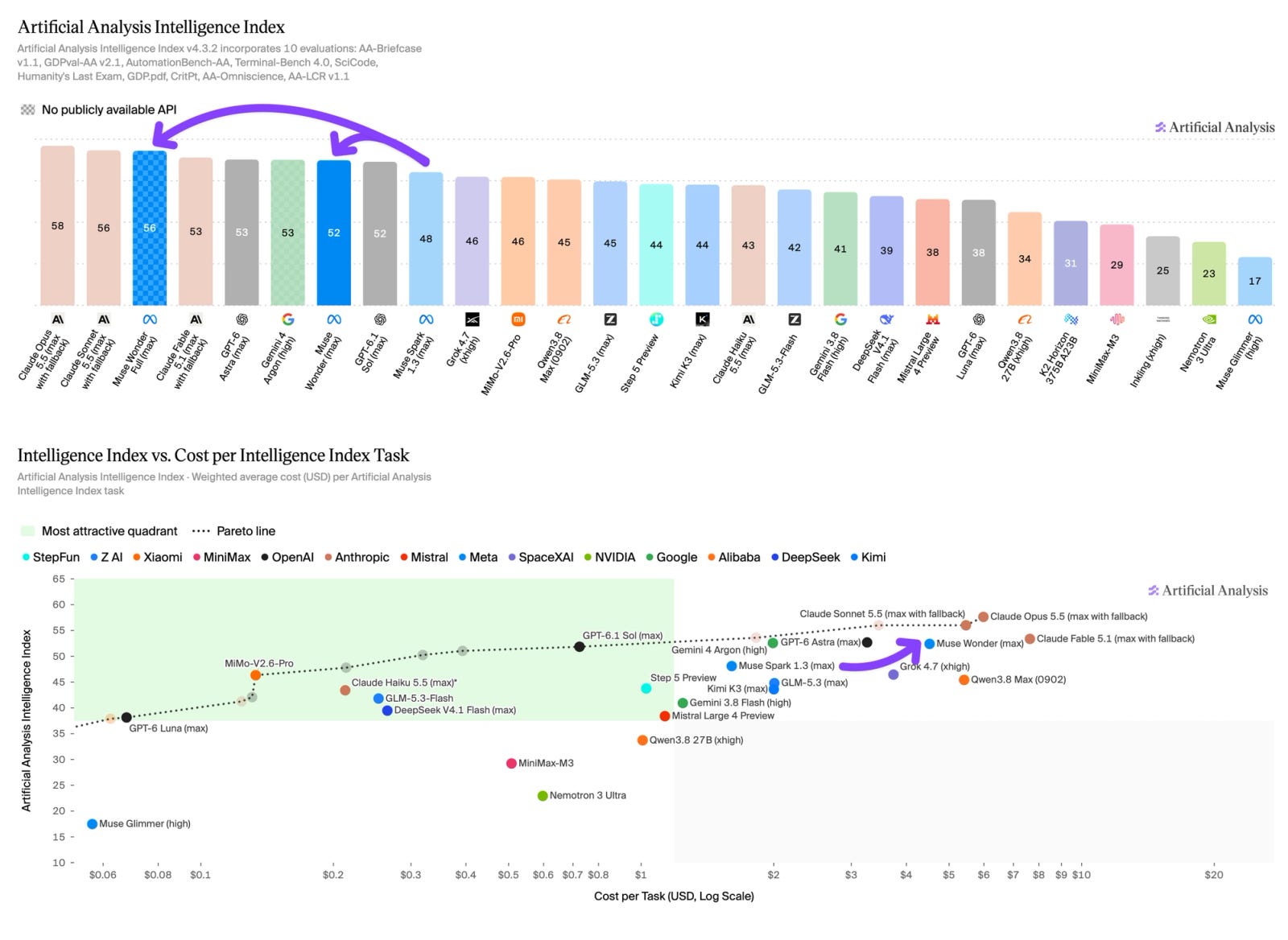
Muse Wonder costs $4 per million input tokens and $20 per million output tokens, the same as Claude Opus 5.5 and several times what Meta charged for Spark 1.3. Wonder Full is available only to Muse Code subscribers.
When I wrote about Muse last month, I said Spark 1.3 was close to the leading frontier models. With Muse Wonder, Meta is no longer just close. It is not leading the frontier, but it is there.
Back to open models
Three days after releasing Muse Wonder, Meta returned to its open-weight roots with Muse Spark Open, which it calls “the most capable US open-weight model to date”. It is a big model, with 816 billion parameters (42 billion of them active at any time) and a 1-million-token context window, built for coding and agentic work.
Artificial Analysis gives Muse Spark Open 39 points, the best result for an open-weight model from the US and the West as a whole. It edges out the recently released Mistral Large 4, which scored 38, although Mistral won’t release its weights until the end of October. Muse Spark Open ranks only 10th among large open-weight models, though, so the Chinese labs still lead. It is also expensive for an open model, and its licence limits commercial use.
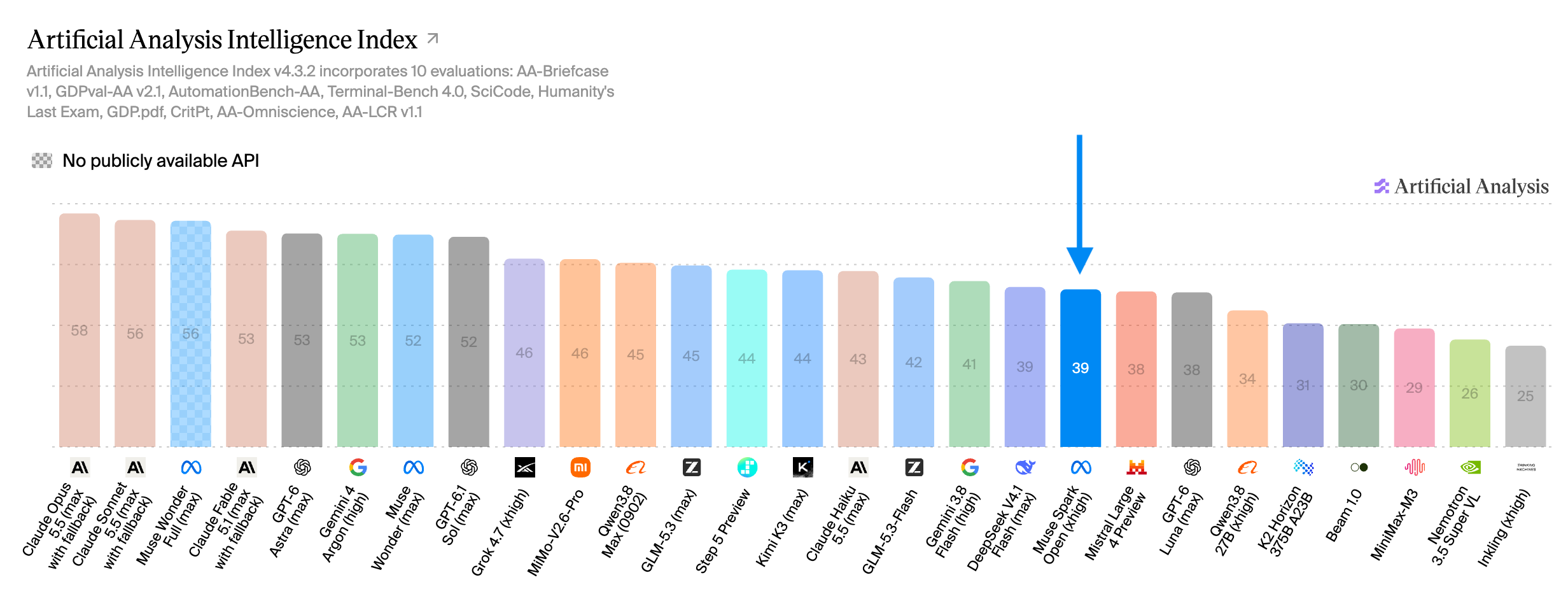
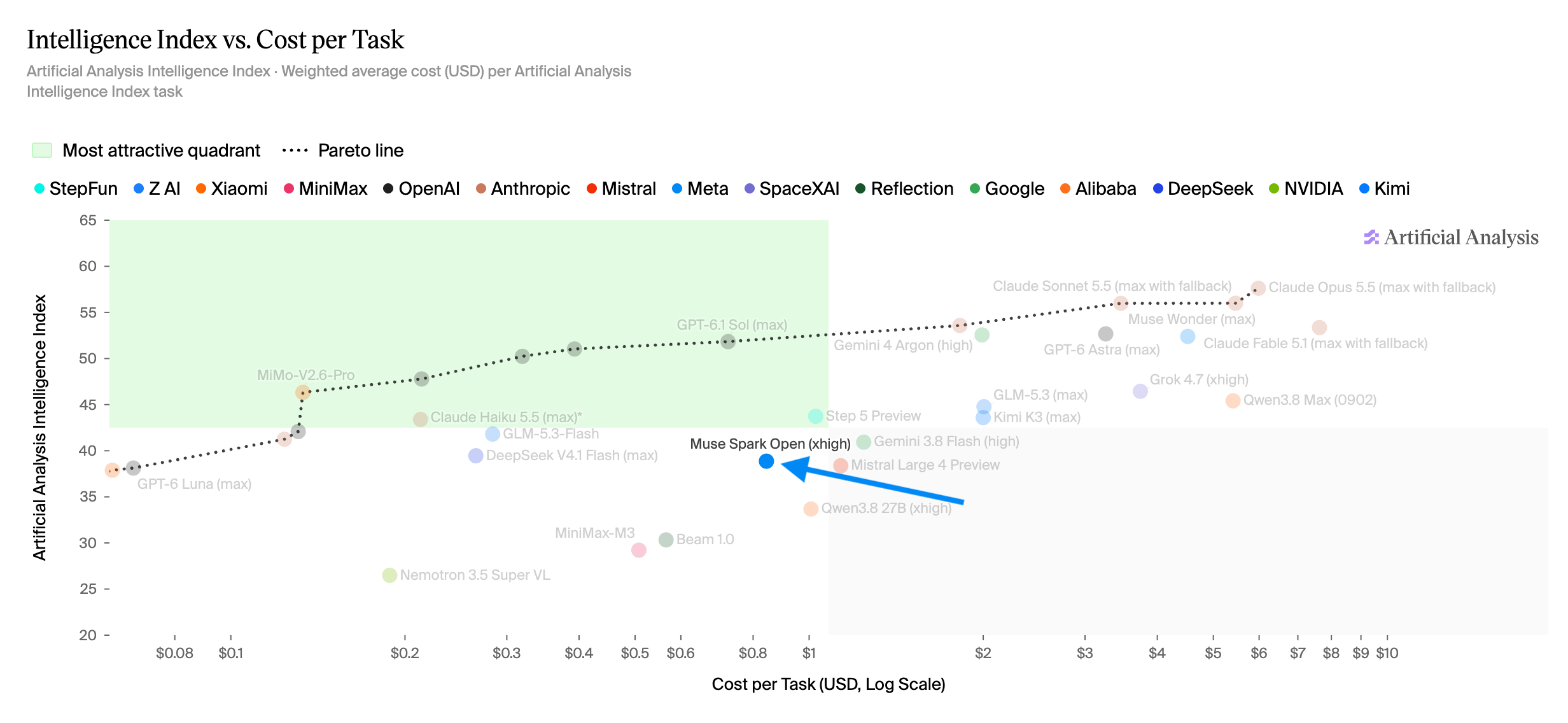
Still, it fills a real gap. Until now, if you needed a capable open model, your best options were Chinese. Muse Spark Open gives companies that want, or are required, to use an American or a non-Chinese model a genuine alternative. If Meta keeps improving it, Muse Spark Open could challenge Chinese labs for the open-weights lead.
Bet on personal intelligence
Meta now has all the pieces a big tech company needs to compete in AI: frontier models, open models, the Meta Model API and its own coding tool, Muse Code. On paper, it can go on to challenge OpenAI and Anthropic. But in practice, I don’t see Meta becoming a leading AI company.
Meta’s focus is on Muse, its personal AI agent that launched on 8 September. Muse can shop, book and handle everyday tasks on your behalf, and it will soon run on Muse Wonder. Everything else is built to help Meta win the race for personal intelligence. That’s the course Zuckerberg set for the company and, frankly, it’s the only niche where Meta has a real chance of winning. It is a market made for a company whose apps reach 3.5 billion people, and Meta got there first, perhaps a little too eagerly. According to The New York Times, Zuckerberg ordered Muse’s launch despite internal safety concerns, after a small startup called Instinct began taking off with a similar agent. Meta disputes that account.
So far, the gamble seems to be paying off. Muse reached 5 million US downloads in 22 days, compared with 56 days for ChatGPT, and BNP Paribas estimates it had passed 10.4 million downloads by 16 October. But there are signs of cooling. Daily downloads fell by about 8% in early October, and Meta’s own heavy advertising is doing much of the lifting. Muse is also tiny next to ChatGPT’s 1.2 billion weekly users and Gemini’s roughly 1 billion monthly users.
Meta won’t have the market to itself, either. OpenAI has dots, Instinct has just raised $1 billion, and OpenClaw remains a formidable open-source alternative. Google launched Gemini Spark back in May, although it keeps it behind a $100/month subscription. Apple will have its own answer too, if it can first sort out Siri.
Will the billions pay off?
All of this rests on spending on a scale few companies have ever attempted. Meta expects capital expenditure of $130–145 billion this year, roughly double what it spent in 2025. It is financing some of its biggest data centres through joint ventures, such as one with BlackRock, that keep the debt off its own balance sheet. In the second quarter, its free cash flow fell to just $784 million, down from $8.55 billion a year earlier.
Even Zuckerberg admits it was a leap of faith. On the Cheeky Pint podcast, he recalled asking Wang, “You sure this is going to work?” before committing what he guessed would be $100 or $200 billion. Wang’s answer, in short, was that nobody could promise it would.
Unlike OpenAI and Anthropic, Meta can fund such huge bets from its own pocket. The AI frontier labs need enterprise customers because they have nothing else to pay for their compute. Meta has an advertising business that brought in $59.4 billion in the second quarter alone, up 27% year on year, and it credits AI for much of that growth. In a way, AI already pays for itself at Meta.
So the question is not whether AI pays off for Meta, but whether spending on this scale does. That depends on Muse becoming a real business, through transaction fees, subscriptions and, sooner or later, ads. Anthropic has shown that selling AI to businesses works. Meta now has to prove there is a consumer route as well.
So, is Meta back in the AI race? Yes, but it is running a race of its own. It is the frontrunner in a category that has barely begun and has yet to prove it can make money. We may get the first signs of whether that was the right bet on Wednesday, when Meta reports its Q3 results, and over the coming months, as we see whether people stick with Muse once the novelty wears off. For now, my draft of “How Meta lost the AI race” stays in the drawer. But I’m not deleting it just yet.
If you enjoy this post, please click the ❤️ button and share it.
News roundup
🦾 More than a human
A New Anti-Aging Drug Looks to Turn Back the Clock on Skin Age
Biotech company Rubedo Life Sciences has developed an experimental cream designed to combat skin ageing by targeting damaged “zombie” cells. Early trials showed promising results, with participants’ skin appearing biologically two years younger on average after four weeks, alongside reduced inflammation and improved collagen levels. The treatment could also help with sun damage, psoriasis and hair loss, although further research is needed to establish its long-term effectiveness and visible anti-ageing benefits.
Science Corporation implants its vision-restoring chip in its first Stargardt disease patient
Science Corporation has implanted its PRIMA vision-restoring chip in its first patient with Stargardt disease, an inherited condition causing progressive vision loss. Paired with camera-equipped glasses, the implant has already enabled the patient to recognise letters and read words. Although currently limited to a narrow field of black-and-white vision, the technology offers promise for treating previously untreatable forms of blindness.
U.N. Warns Against Technology Used to Read Citizens’ Minds
The United Nations has warned that rapid advances in neurotechnology could threaten fundamental human rights by enabling governments to access and manipulate people’s thoughts. While the technology offers significant medical benefits, concerns over its use by law enforcement and private companies have prompted calls for stronger regulations to protect brain data, privacy and freedom of thought.
🧠 Artificial Intelligence
Character.AI files for bankruptcy
Character.AI, a platform that lets users create and interact with AI-powered characters, has filed for Chapter 11 bankruptcy amid mounting legal challenges, high operating costs and difficulties monetising its large user base.
Founded in 2021 by former Google engineers Noam Shazeer, a co-author of the famous Attention is all you need paper, and Daniel De Freitas, the startup quickly gained popularity and raised more than $193 million in funding. In 2024, Google struck a $2.7 billion licensing and “acqui-hire” deal that brought both founders back to the company. Disney has now agreed to acquire some of Character.AI’s assets for $20 million. The platform could still shut down if no buyer is found.
New Cracks in AI Trade Push Wall Street to Worst Week Since June
It wasn’t a good week for tech companies, as concerns about the AI boom, rising borrowing costs and stubborn inflation triggered a sharp sell-off. The Nasdaq fell 4.5%, while AI cloud provider CoreWeave lost 25% and Dell plunged 22% over the week. Chipmakers including NVIDIA, Broadcom, Micron and AMD also came under pressure, alongside tech giants Amazon and Alphabet. Investors are increasingly concerned that higher borrowing costs could make the enormous sums being spent on AI harder to sustain, potentially slowing investment and weighing on the wider US economy.
FBI arrests OpenAI employee accused of planting hidden recording device in conference room
What a timeline we are living in… OpenAI has called in the FBI after allegedly catching one of its own employees hiding a recording device in an executive meeting room at its San Francisco office. The employee was fired and arrested, with authorities suspecting he was trying to secretly record sensitive discussions about OpenAI’s technology. OpenAI says there is no evidence that its AI models, source code or customer data were stolen.
Anthropic Says Revenue Jumped 45% to $16.8 Billion in Third Quarter
Anthropic executives told investors that the company’s third-quarter revenue surged 45% to $16.8 billion, The New York Times reports. Despite strong growth and adjusted profitability, investors remain concerned about rising interest rates, the sustainability of AI investment, competition from cheaper Chinese models and Dario Amodei’s calls for tighter AI safety measures. Anthropic is preparing for a potentially record-breaking IPO that could raise more than $100 billion and value the company at $2 trillion, which is seen as a major test of investor confidence in the wider AI industry.
Anthropic assigned highest junk credit rating in June
Anthropic secured a BB+ credit rating from Kroll Bond Rating Agency in June, just one notch below investment grade, the Financial Times reports. The rating puts the AI company close to receiving a financial seal of approval that would make it easier and cheaper to borrow money and attract investors as it prepares to go public. With plans to spend more than $500 billion on computing infrastructure over the next decade, access to cheaper financing could become increasingly important as Anthropic funds its rapid expansion.
Gemini 4 Argon is now globally available
Google’s newest flagship model, Gemini 4 Argon, is now globally available. Although it did not top all performance benchmarks, Gemini 4 Argon is a respectable comeback from Google, with significant improvements in reasoning, coding, scientific research and complex professional tasks. Developers and enterprises can access the model through Google AI Studio and the Gemini API, while eligible Google AI Pro and Ultra subscribers can use it in the Gemini app, AI Mode in Search and Google Antigravity.
Anthropic: An update on independent evaluators
Anthropic is following through on Dario Amodei’s proposal to embed independent evaluators inside AI labs, granting six researchers from AI safety nonprofit METR employee-level access to its internal systems and safety processes. The researchers will independently assess Anthropic’s models and safety practices and publish their findings without the company’s approval, subject to restrictions on sensitive information.
AI’s quiet safety gatekeepers are stepping into the spotlight
OpenAI and Anthropic have recently promised to bring independent evaluators into their labs to check their AI safety practices. In this article, CNBC takes a closer look at these evaluators and the challenges they face. Key questions include who will pay for their work, how much access they will get and whether they can remain truly independent. The article also looks at whether government oversight will be needed to make sure these checks are effective.
Anthropic: AI models may be capable of self-replicating without access to a datacenter
Anthropic’s research suggests that AI models could soon autonomously replicate across internet-connected devices, potentially creating a new form of decentralised, adaptive malware that is difficult to detect and eliminate. Experiments show that AI models can already carry out much of this process, with smaller models potentially achieving full autonomy by the end of 2026. While this threat has yet to materialise in the real world, the findings highlight growing cybersecurity risks and the need for stronger defences.
Judge orders OpenAI to turn over hiring records in Apple trade secrets case
A US judge has ordered OpenAI to share hiring and interview records with Apple as part of a lawsuit accusing OpenAI of stealing trade secrets through former Apple employees. The court also approved access to private messages and interviews with three former Apple staff now at OpenAI, but rejected Apple’s broader requests for information about OpenAI’s hardware development.
OpenAI Computing Chief to Depart
OpenAI’s head of computing capacity, Sachin Katti, is leaving after roughly a year. Katti helped secure major computing deals with AWS, Nvidia and other partners. Former xAI executive Uday Ruddarraju will take over OpenAI’s computing strategy. Katti joins a growing list of high-profile executives who have departed OpenAI in recent months, including former applications CEO Fidji Simo, COO Brad Lightcap, chief revenue officer Denise Dresser and head of data centres Chris Malone.
OpenAI’s London staff receive average of £2.3m per person annually
The Guardian reports that OpenAI’s London office had 110 employees in 2025, with an average pay package of £2.3 million, more than double the previous year and 58 times the UK median salary. UK staff collectively received £87 million in salaries and £168 million in shares, although top AI researchers earned significantly more. OpenAI is continuing to expand its London presence as a major international research hub.
NVIDIA Commits $250 Million to Advance UK Agentic Safety and Security Research Over the Next Five Years
NVIDIA has committed $250 million over five years to advance UK research into AI safety and security, providing computing resources to leading institutions including the University of Oxford, UCL and Imperial College London. The initiative will support research into secure autonomous AI agents, robotics safety and emerging AI risks.
CoreWeave credit default swaps hit distress levels as investors sour on AI debt
Investors are growing increasingly concerned about CoreWeave, an AI computing company that has taken on more than $51 billion in debt and financial commitments to fund its rapid expansion. Despite the company’s assurances that future customer revenues will cover its costs, fears about its ability to repay its debts are mounting.
Jev: For the builders AND dreamers
TypeSafe AI has released a new version of its decision model, Jev 1.14.0, which adds image support, a new data type for the model to use and a longer context window. The update also improves performance, cost-to-intelligence ratio, and reduces error rates.
Microsoft-Decision-1
Microsoft joins the decision model party with Microsoft-Decision-1. The company claims its model is more accurate and faster than any other model in this category. Microsoft-Decision-1 is available on Microsoft Foundry and OpenRouter.
FLUX 3 Image Klein
Black Forest Labs presents FLUX 3 Image Klein, a new open-weight AI model for image generation and editing that combines high-quality results with fast performance and efficient local deployment. The model supports native 4K output, precise image editing and up to 10 reference images, and can run on consumer GPUs with just 8GB of VRAM. FLUX 3 Image Klein is available via Black Forest Labs’ API or can be downloaded from Hugging Face for self-hosting and fine-tuning.
Google Harness²: Recursive Agent Harnessing for an Open World
Developed by researchers at Northwestern University and Google Cloud AI Research, Harness² is a framework for recursively improving AI agents without modifying their underlying models. By optimising prompts, memory, tools and workflows through experimentation and feedback, it enables continuous improvement, delivering significant performance gains across coding, web and office tasks. Harness2 is open source and available on GitHub.
▶️ Agentic AI and Why Everyone Wants CPUs Again (53:40)
Everyone needs and wants GPUs to run AI models, but as Ian Cutress argues in this talk, the rise of agentic AI workflows is also increasing demand for CPUs. He introduces the main players in the space and explains how new CPU designs, memory technologies and advanced chip packaging could help support increasingly complex AI systems. He also discusses the challenge of balancing CPUs and GPUs, keeping costs under control and designing ever more complex chips.
Introducing AMD Helion, Agentic AI Compute at Rack Scale
AMD has unveiled Helion, an open rack-scale infrastructure platform designed for agentic AI workloads. Combining EPYC processors with optional Instinct GPUs, it offers flexible, cost-efficient configurations for hyperscale data centres and enterprises. Expected to launch in November 2026, Helion positions AMD as a more open and customisable alternative to NVIDIA’s tightly integrated AI infrastructure, with a greater emphasis on flexibility and efficiency than GPU-centric computing.
Microsoft’s latest custom chip: Maia 300
Microsoft has unveiled Maia 300, its latest in-house AI chip, as it looks to reduce reliance on Nvidia and cut the cost of running AI services. Set to roll out in 2027, the chip is designed for AI inference workloads and promises 40% more tokens per megawatt than leading GPU-based systems.
IMF says AI investment keeps global growth around 3% but brings massive disruption
IMF Managing Director Kristalina Georgieva said surging AI investment is helping sustain global economic growth at around 3% and particularly benefiting Asian economies. However, she warned that AI could disrupt up to 40% of jobs worldwide and 60% in advanced economies, raising concerns about employment, education and taxation.
Epic Games Delays Disney Project, Asks Developers to Use More AI
Bloomberg’s Jason Schreier reports that Epic Games is taking an “AI-first” approach to developing a new shooter featuring Disney’s Marvel and Star Wars characters—a game the company has delayed indefinitely after development progressed more slowly than expected. Developers have reportedly been instructed to use AI tools to generate all code and artwork, with humans overseeing the process. The move reportedly surprised and concerned staff.
Palantir CTO says the Pentagon has already replaced Anthropic’s AI
Palantir CTO Shyam Sankar said the Pentagon has replaced Anthropic’s AI with models from OpenAI, Google, xAI and others without disrupting military operations. He dismissed concerns over AI risks as exaggerated and highlighted its ability to accelerate military targeting while keeping humans in control. Sankar also disputed reports linking AI overreliance to a deadly US strike on an Iranian school, suggesting human error was more likely.
Multi-Agent Self-Supervision
In this post, researchers from Japanese AI lab Sakana describe a new approach to making AI models smarter through collaboration. Their method, called Multi-Agent Self-Supervision (MASS), brings together multiple AI agents to tackle complex research tasks, learn to work together more effectively, and use their discoveries to improve the underlying model. Early results suggest this approach could help AI systems solve problems better and continuously improve themselves without relying on a more advanced AI to guide them.
Reverse-SynthID
Someone has reverse-engineered SynthID, Google’s invisible watermark for images generated by Gemini. In the repo, they explain how the watermark works and describe a method for modifying watermarked images so they look unchanged to humans while dramatically reducing the chance of being flagged as AI-generated.
Redesigning source control at Anthropic
To deal with the growing strain AI-generated code places on Git, Anthropic created Scion, a scalable source control system built in just five months with Claude’s assistance. This post explores Scion’s architecture, how it improves performance and reduces infrastructure costs, and the lessons learned from building source control for AI coding agents.
Amazon introduces 2 new AI products from Bee: Bee Frontier and Bee Eclipse
Amazon is expanding its personal AI device line-up with Bee Frontier, a wearable assistant, and Bee Eclipse, a magnetic smartphone accessory. Both devices use AI to turn conversations into summaries, reminders and actionable insights, and add Alexa+ integration and personalised shopping features. They are the first new Bee products since Amazon acquired the startup in 2025.
The first person to use an AI-generated voice in the UK Parliament
Disability rights campaigner Baroness Campbell has become the first person to use an AI-generated voice in the UK Parliament, during a House of Lords debate on the government’s plans for social care. She used a voice model from ElevenLabs that, as she says, sounds like her, but clearer and a little bit younger.
🤖 Robotics
As part of a campaign promoting Gemini 4 Argon, Google showed how its latest flagship model performs across various fields, including robotics. The company says Gemini 4 Argon can control robots, create realistic simulations and improve performance through self-learning. It also claims the model leads the Embodied Reasoning (ERQA) benchmark, which tests a model’s ability to understand and solve physical and spatial problems in 3D environments, outperforming other frontier models such as Opus 5.5 and GPT-6 Astra.
Waymo’s robotaxis are headed to Canada
Waymo, Alphabet’s self-driving car company, announced that it is expanding into Canada after receiving approval to test autonomous vehicles in Toronto. The company will start by mapping roads with human-driven cars, then move to autonomous testing and, eventually, a public robotaxi service. Canada is Waymo’s third international market, after Japan and the UK.
The Start-Up That Wants to Build ‘Microrobots’ With A.I.
The New York Times profiles Atomic Machines, a California start-up developing an AI-powered manufacturing system it calls a “matter compiler”, which translates digital designs into physical devices. Founded by former Uber executive Jeff Holden, the company has already produced an ultra-small, fast and energy-efficient electrical switch that could improve power management in data centres. By combining AI-driven materials research with automated manufacturing, Atomic Machines hopes to transform how physical products are made and enable advances in areas such as robotics and medicine.
▶️ Machine, Assemble, Repair: How We Build Atlas | Boston Dynamics (5:56)
Boston Dynamics takes us inside the factory where it builds its humanoid robots, from the in-house CNC shop to the assembly lines where the machines are put together. One interesting thing we learned in this video is that it takes about one day to build a single robot, and the company plans to scale production to one robot per hour next year.
AI drone outpaces former world champions using one camera and no GPS
Researchers at Delft University of Technology have developed a racing drone that can reach speeds of 100 km/h and outperform world champion human pilots. Using just one camera, motion sensors and a small onboard computer, the drone can navigate complex courses without GPS. Its AI system reacts quickly and controls the motors directly, allowing it to fly at high speeds with remarkable precision.
🧬 Biotechnology
Colossal Biosciences announces new AI platform to help accelerate de-extinction efforts
Colossal Biosciences has unveiled GenoMorph, a new AI platform designed to accelerate efforts to revive extinct species, particularly the dodo. By analysing genetic data and physical traits from living birds, the technology has identified around 2,300 potential gene-editing targets, helping researchers overcome the scarcity of ancient DNA. Combined with advances in genetic engineering, the platform could make de-extinction research faster and more precise, with wider applications in conservation, agriculture and healthcare.
Cancer Vaccines Are the N.I.H.’s Next ‘Big Bet’
The US National Cancer Institute is launching a major initiative to accelerate the development of personalised cancer vaccines that train the immune system to target a patient’s tumour. Encouraging early results across several cancers have raised hopes for a breakthrough in treatment, although larger trials are still needed. The initiative aims to make these vaccines widely available within 7 to 10 years.
Giraffe Bio aims its bespoke biomolecules at the looming copper shortage
As global copper demand races ahead of supply, with a potential 25% shortfall by 2040, Giraffe Bio is betting on bioengineered compounds to squeeze more copper out of existing mines. Produced using engineered microbes and tailored to specific minerals, these compounds could boost copper recovery by up to 5% while reducing reliance on harmful chemicals used in traditional mining processes. The same technology could also be applied to other valuable minerals, including gold and silver.
💡Tangents
Tesla’s New Roadster Takes Flight After Nearly a Decade of Delays
After 9 years of waiting and delays, Tesla finally revealed the new Roadster. And it did it in style. The company claims the car can accelerate from 0 to 100 km/h (60 mph) in just one second and reach speeds above 370 km/h (230 mph). It also demonstrated its rocket-powered capabilities, using compressed-air thrusters to launch itself into the air and jump over five other Tesla vehicles. Elon Musk said production will begin in 2028, although pricing and road legality remain unclear.
Thanks for reading. If you enjoyed this post, please click the ❤️ button and share it!
A big thank you to my paid subscribers, to my Patrons: whmr, Florian, dux, Eric, Preppikoma and Andrew, and to everyone who supports my work on Ko-Fi. Thank you for the support!
Great round up in another busy week. Thank you.
Conrad, the consumer business you describe makes me want to test a booking that needs changing. If Muse can handle the alteration as smoothly as the original purchase, that gives the customer a reason to return. It could also matter to the economics: a transaction fee goes less far if a person has to untangle the awkward cases. Repeat use and the cost of those exceptions would tell us quite a lot together.