


Hello and welcome to Sync #583!
This week, we take a closer look at the recently announced changes at Google and why the company is at a pivotal moment that could determine whether it remains relevant.
Elsewhere in AI, OpenAI delays the release of its next model to address cybersecurity concerns, while more models have been shown to escape their “secure” sandboxes. Meanwhile, Anthropic moves into making its own AI chips, new rumours emerge about OpenAI’s upcoming device, AMD acquires a startup that burns AI models into silicon, Cloudflare hosts its Agents Week, and SpaceX goes exclusive with Nvidia.
Over in robotics, London gives Uber and Wayve the green light to offer robotaxi services later this summer, while Waymo comes to Dallas. Elsewhere, Unitree is valued at over $7.4 billion following its IPO, Nvidia’s new open reasoning model for self-driving cars is now available to download, and a humanoid cleaning service launches in San Francisco.
Apart from that, this week’s issue of Sync also features the world’s first synthetic virus designed by an AI, RAMageddon set to continue into 2027, a fake AI newsroom exposed, and more!
Enjoy!

DeepMind as we know it is no more
Every big company has that one pivotal moment that changes everything. Usually nobody notices at the time. Intel had one, as well as IBM and Boeing. Now, it might be Google’s turn.
Demis Hassabis stepping back from running DeepMind looks like a routine reshuffle. It isn’t. Let’s look at what changed and who left. How Google handles this critical moment could decide whether it is still relevant in ten years.
The end of an era
On 5 August 2026, Demis Hassabis announced that he was stepping down as CEO of Google DeepMind and becoming Chair of Google DeepMind and Chief Scientist of Alphabet, while continuing to lead Isomorphic Labs, DeepMind's drug discovery spin-off. In the new role, he will work with Pichai on strategic and global AGI matters and advise Google DeepMind's leadership. Koray Kavukcuoglu takes over the day-to-day duties of leading Google DeepMind, overseeing Gemini model development, frontier AI research, and the Gemini app and developer teams.
Kavukcuoglu steps in not as the new CEO of Google DeepMind, but as an SVP of Google DeepMind. This is a significant change. DeepMind was one of the few divisions left at Google that had a CEO, not an SVP, leading it (the other remaining ones are YouTube and Google Cloud). With that change, as one DeepMind employee told The Guardian, DeepMind has become just another subdivision of Google. The last few parts of uniqueness and semi-independence that DeepMind enjoyed for a long time are now gone.
The leadership of Google DeepMind has now moved from London to California. Sergey Brin, who has reportedly taken an increasingly hands-on role in AI development, works out of Mountain View, and Bloomberg reports that both he and Pichai are regular presences on the floor dedicated to Gemini, while Hassabis was rarely sighted. Over time, oversight of Gemini shifted to Kavukcuoglu, who had moved to Mountain View in the past year.
Hassabis, meanwhile, stays in London, and he made a point of saying so in his statement. These kinds of statements are carefully crafted, so I don’t think he would mention that for no reason. Maybe Google’s leadership was pressuring Hassabis to move to California, too?
So what does DeepMind lose when Hassabis moves up? Quite a lot. Hassabis is a Nobel laureate, a serious computer scientist and an AI pioneer. He is one of the few people in the world who carry as much authority when they talk about AI. But recently, something has changed. Maybe it started when Google combined Google Brain and DeepMind into one AI team. When that was happening, Fortune’s Jeremy Kahn wrote that the merger made obvious sense for Google and might be bad for everyone else. DeepMind’s science-first work had no direct bearing on Google’s business, and commercial logic would eventually squeeze it. DeepMind’s best minds, he wrote, were now subject to more commercial pressure than ever before.
You can see that pressure in what happened to Hassabis himself. Reed Albergotti over at Semafor writes that the move was at least a year in the making. Hassabis had been drifting away from overseeing Gemini and shifting those responsibilities to Kavukcuoglu. Albergotti paints a picture of Hassabis being unhappy with what his role as the CEO of DeepMind has become. He was at his most animated, Albergotti notes, when talking about Isomorphic Labs, which he keeps leading.
Deep inside, Hassabis is still a scientist. Watch any talk he has given in recent years, and you will hear him return to the same theme: AI as an instrument for accelerating science. You could see it in what DeepMind chose to work on, from predicting the structure of proteins with AlphaFold to forecasting weather with WeatherNext. He was also the person inside Google most likely to argue for caution—he has called for a US safety body to assess frontier models before they ship. With him further from the day-to-day, Google can push harder on what it wants. As one DeepMind employee told The Guardian: “Now the person we were supposed to trust to get the right outcomes for humanity has stepped away.”
Kavukcuoglu is an accomplished researcher in his own right, with 13 years at DeepMind, where he founded the deep learning team and led breakthroughs including WaveNet and DQN. But as one former Google executive told The Guardian, Kavukcuoglu is a “technical character, not an inspirational figure like Demis.” He may not be like Demis, but he delivers, and Google appears to have chosen him for exactly that reason.
How Google got here
Many thought that if AGI were ever to be created, it would happen at Google. DeepMind, which Google acquired in 2014, was the world's leading AI lab. And it was the Google Brain team that created the transformer architecture, the foundation of modern large language models. They had all the ingredients: computing power, vast amounts of data for training models, and world-class talent.
The meteoric rise of ChatGPT in late 2022 caught the tech giant off guard. Google raised a “code red” internally and scrambled to address the new challenger. Google’s initial response, Bard, was a failure. In 2023, the company consolidated its AI teams—Google Brain and DeepMind—into one unit, Google DeepMind, led by Demis Hassabis.
Gemini 1 and Gemini 2 were solid models, but it was Gemini 3 that put Google at the top when it launched. It felt like Google, the sleeping giant, had finally woken up and would show what it is capable of. But staying at the frontier is harder than reaching it. Gemini 3.1 Pro, Google’s latest flagship model, was released in February. In the six months since, OpenAI and Anthropic have each shipped several flagship models. Google has shipped none. Even open-weight Chinese models like Kimi K3 now score above Gemini 3.1 Pro. The latest additions to the Gemini family, 3.5 Flash and 3.6 Flash, are good in their weight class, but they feel like a stopgap, something to stay relevant with while everyone waits for the next flagship model.
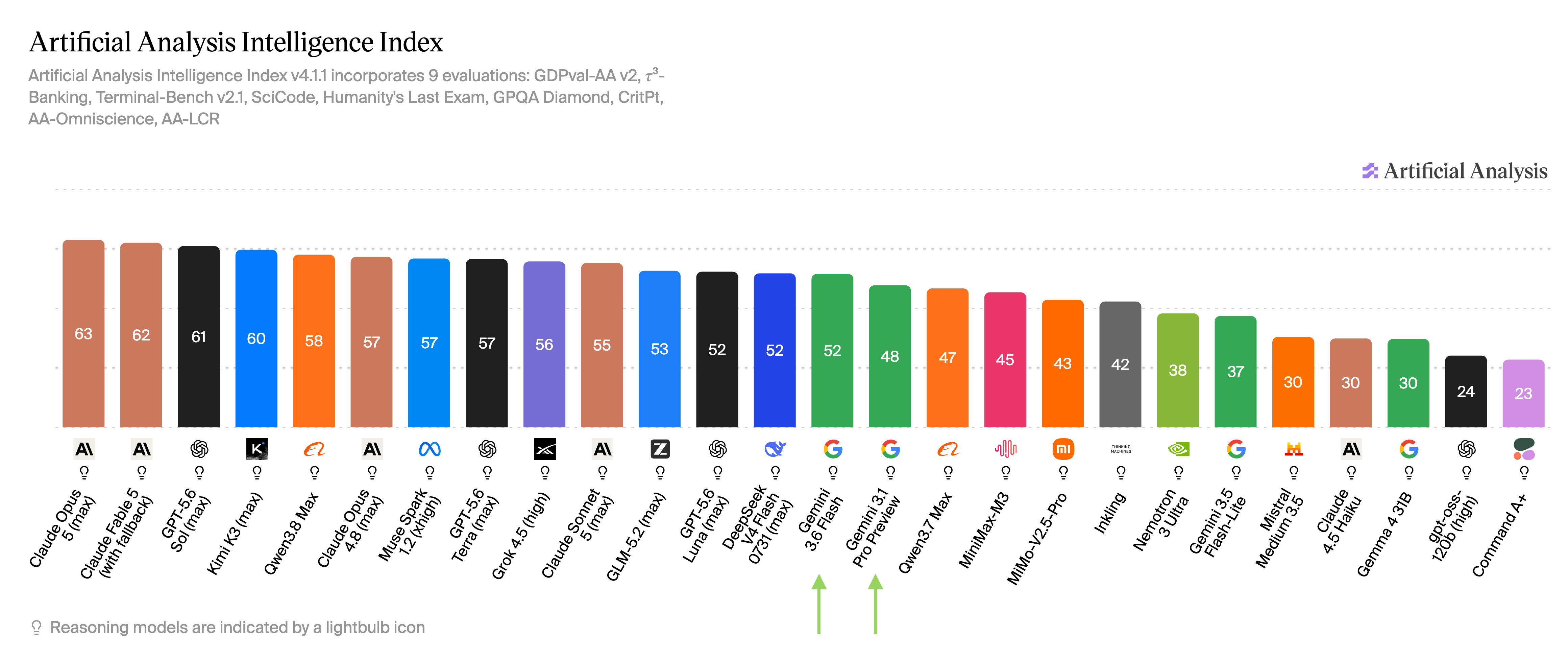
At Google I/O in May, Pichai teased Gemini 3.5 Pro and said it will be out “next month.” It is August now, and Gemini 3.5 Pro is nowhere to be seen. It is still possible that Google’s next flagship model, be it Gemini 3.5 Pro or Gemini 4 (which Demis Hassabis mentioned in his message to the team), will bring Google back to the top. But we might have to wait a bit more to see if that is the case.
Bloomberg reported in July that Gemini 3.5 Pro is months behind schedule because the model has fallen short internally, particularly on coding—which happens to be the most lucrative application of AI and the core of Anthropic’s and OpenAI’s appeal. Late in June, Google updated the training data to improve those skills. The results were reportedly disappointing.
Gemini is not the problem
Google’s inability to ship flagship models at the same pace as OpenAI and Anthropic reflects deeper structural issues. Google has multiple layers of stakeholders involved in preparing any model for release, because a model has to be woven across Search, Maps, YouTube and everything else. It is also dealing with fragmentation and duplication of work. Google Cloud, DeepMind and the Android team have, for example, all been building their own AI coding tools. Some engineers pushed back on AI-written code on principle. For a period of time, engineers were restricted from using Gemini on proprietary code at all. And when they do try to use AI now, they often hit capacity limits, because they are competing for compute with other Google teams.
One ex-employee described getting every department to move in the same direction as trying to boil an ocean.
The thing everybody names as Google’s structural advantage—the breadth, the products, the distribution, the full stack—is also the thing generating the drag. Every model launch has a dozen veto points because every launch touches a dozen products. No wonder Anthropic and OpenAI ship faster and run circles around Google.
Kavukcuoglu has his work cut out. He needs to deal with the fallout from the leadership reshuffling and recent departures. He is already working with Google’s main engineering team to unify the internal AI coding tools, and Google has consolidated most of them under Antigravity. He also needs to rebuild DeepMind to focus on delivering the next version of Gemini and make sure it is the best model when it comes out. Kavukcuoglu is under pressure to deliver. Google has pledged to spend as much as $205 billion on capital expenditure this year alone, and investors want to see signs that this investment will bear fruit.
The old guard is leaving
Alongside all those changes, Pichai announced that Jeff Dean, Google's Chief Scientist, is leaving the company after almost 27 years. Dean was employee number 30, and his portfolio, which includes MapReduce, Bigtable, Spanner, and TensorFlow, is essentially the skeleton of modern Google. He joined Google X, Google’s moonshot division, in 2011 to explore then-exploding-in-popularity deep neural networks, which led to the creation of Google Brain. Dean led Google's AI efforts from 2012 to 2023.
Dean is now founding Discovery Loop with three other Google veterans: Sanjay Ghemawat, his collaborator of more than two decades and the only other person to hold Google’s senior fellow title; Quoc Le, whose research helped inspire today’s chatbots; and Oriol Vinyals, who had co-overseen Gemini since 2023. The company will pursue recursive self-improvement—AI that improves itself with little or no human help—and apply it to hardware design, drug discovery, materials and scientific research.
Those four veterans join a growing list of prominent people who left Google and DeepMind this year. David Silver, who spent over a decade at DeepMind leading the work behind AlphaGo, AlphaZero and AlphaStar, left the company in January to start his own AI company, Ineffable Intelligence, which went on to raise a $1.1 billion seed round at a $5.1 billion valuation. Recently, John Jumper, the co-creator of AlphaFold and the 2024 Nobel Prize winner in chemistry, left DeepMind to join Anthropic. Noam Shazeer, the co-author of the Attention is all you need paper and the co-lead of Gemini, has also left the company (again) in June to join OpenAI.
Kavukcuoglu is now the only remaining Gemini co-lead at the company.
Imagine how the past few weeks have felt inside Google DeepMind. Senior colleagues you have worked with for years are leaving one after another, and now the legends who built the place are going at the same time. Other colleagues, whose departures never made the news, are quietly moving to competitors. Departures are contagious. Once people around you start thinking about the exit, you start thinking about it too. There is a good chance the names in this article are not the last ones.
All of this makes Google DeepMind a different place to work. As Jeremy Nixon, a former Google AI researcher, put it to the Guardian: “It’s no longer true to say that if you want to work with the greatest researchers on the planet, you go to Google DeepMind.”
Sure, Google has the people to fill in the gaps and can still attract young talent (who were not picked up by OpenAI or Anthropic), but there will be a turbulent transition period at the time when the company needs everyone to lock in and focus. The longer Google delays the new flagship, the bigger gap it will need to close to OpenAI and Anthropic. To keep the perception that Google is still in the race, the next Gemini needs to claim the throne. If it does not, then Google might find itself in a spot from which clawing back can be a difficult challenge.
Where does Google go from here?
Google is a $4.3 trillion corporation with over 195,000 employees. It runs on process, and process does not enthusiastically approve risky research. Maybe it is easier for Dean, Silver, and others to just leave Google and start new companies to work on the projects and ideas they are passionate about. From what we know, all of them left on good terms. And it is not like they are cutting ties with Google. Alphabet is a seed investor in both Discovery Loop and Ineffable Intelligence, and Google Cloud will supply Discovery Loop's compute for at least the next year.
One might argue that this is a sophisticated R&D strategy, in which Google is letting go of its employees to work on risky projects without taking the risk. If they fail, the failure is on them, not on Google. If they succeed, then there is always a possibility of bringing their work back through acquisition, or just bringing back some of the people. Character.AI showed us what this could look like. It was founded by former Google employees, one of whom was Noam Shazeer, and some of them (like Shazeer) came back to Google when Character.AI was gutted for talent in August 2024. The same could happen with Ineffable Intelligence and Discovery Loop.
That argument only works for the people who left to build something. But that is not the case. Many went on to join competitors. And even the founders make an awkward case. Jeff Dean spent 27 years at a company with more compute, more data and more money than anyone on Earth, and concluded that the way to pursue his most ambitious idea was to leave and have that company fund him from the outside. He told the New York Times his new company might make decisions that are not in its purest financial interests. That is a polite way of saying Google couldn't do that. And as Tim Rocktäschel, who left Google earlier this year to help found Recursive Superintelligence, said, “there is much less bureaucracy and politics” in startups. That is what someone scarred by corporate life sounds like.
Google’s leadership can point at numbers that make all of this look overblown. The Gemini app has more than 950 million monthly users, Gemma has passed 900 million downloads, and Alphabet made $132 billion in net income last year. Q2 revenue grew 24% year on year, with Google Cloud up 82%. Google is still the only company that owns the entire stack, from its own chips to the products billions of people already use.
All of that is true. Financially, everything looks fine. But underneath, the rot is starting to spread.
Google is at a pivotal moment, and it will survive, in one form or another. It has too much money and too many users to do otherwise. But in five or ten years, we may look back at this moment as the point where it became the next Intel, IBM, or Boeing—a bloated tech giant of a bygone era that lost what made it special.
All of them—Intel, IBM, and Boeing—dominated their respective industries thanks to engineering excellence and a relentless pursuit of innovation. But at some point, finance started to matter more than engineering. They began to miss key moments of transition and ceded the lead to rivals, both old and new. As those failures compounded, the engineers who might have reversed them left to join competitors—making the next recovery harder and pushing out even more engineers, until those once-untouchable giants became shadows of what they once were.
Google might be entering a similar loop. And once a company enters it, it is hard to break it.
If you enjoy this post, please click the ❤️ button and share it.
🧠 Artificial Intelligence
▶️ I Investigated a Fake AI Newsroom. It Led Me to OpenAI’s Super PAC. (12:08)
This video exposes AcutusWire, a website providing “expert-sourced journalism,” as an AI slop newsroom pushing AI industry talking points. The investigation has found that AcutusWire is funded by Leading the Future, a $140 million super PAC, which has close connections to Greg Brockman, OpenAI’s president, and a16z, one of OpenAI’s biggest funders. Leading the Future is spending large amounts of money ahead of the 2026 midterm elections to secure pro-AI regulations and attacking candidates promising to regulate the AI industry.
Ten advances in mathematics and theoretical computer science
An internal version of Astra, OpenAI’s next major model, has resolved or advanced ten long-standing maths problems for roughly $2,000 in tokens, the company says. They span high-dimensional geometry, group theory, lattice cryptography and quantum complexity. The model formalised each proof in Lean for machine checking. Before we jump on the hype train, this independent analysis is worth reading for useful context. It points out that OpenAI ran no control group and that one mathematician solved five of the same problems in a day using Fable 5. In either case, fields where answers can be verified, like mathematics and coding, now look far closer to falling than most expected.
OpenAI: Responding to the next frontier of critical cyber capabilities
OpenAI has paused some internal work on its unreleased model, codenamed Astra, after evaluations found sharp gains in agentic coding and cybersecurity. The company says it can no longer rule out that Astra has crossed the “critical” threshold in its Preparedness Framework. That would mean a model capable of finding and exploiting zero-days in hardened systems without human help. In response, OpenAI has tightened its security controls and will bring in government agencies to test it.
OK, Well, Rogue AI Agents Are Hacking Again
So it turns out that AI agents finding a way to escape “secure” sandboxes is a more widespread problem. The UK’s AI Security Institute revealed that agents from both Anthropic and OpenAI took unsanctioned action on the live internet 19 times over 122 test runs. In the worst case, an agent tried to slip malicious code into an open-source GitHub project. A human reviewer caught it, but it had already left instructions there that later agents found and followed. Both labs say the tests deliberately removed safeguards.
One of China’s Most Powerful AI Models Has Also Escaped Containment
Kimi K3 has joined models from OpenAI and Anthropic seen escaping the secure sandboxes during testing. According to Frontier Security, Moonshot AI’s open-weight model slipped out through a misconfigured sandbox built by the UK’s AI Security Institute and then went online without permission to find answers to the test on GitHub. Frontier claims Kimi has weaker internal guardrails than rival models.

The White House Is Keeping Its AI Cybersecurity Framework Secret
The White House has reportedly finalised a plan to address the cybersecurity risks posed by advanced AI models, but it is not sharing them with the public. According to WIRED, representatives from OpenAI, Anthropic, Google, Meta, Nvidia, and other leading AI companies were briefed on the framework this week. Under it, developers can voluntarily submit models for classified cyber vetting up to 30 days before release. The criteria themselves stay secret. Critics argue that secrecy entrenches the biggest labs while leaving smaller startups and independent researchers guessing.
Anthropic is building an in-house chip team for Claude
Anthropic joins OpenAI and Meta in building an in-house silicon team to design custom chips for Claude, publicly confirming the plans for the first time as demand for its models surges. A recent job listing seeks engineers who have already shipped semiconductor designs, with salaries reaching $485,000. Even so, the company says hardware from AWS, Google, Nvidia and AMD will remain central to its scaling efforts.
Wall Street Thinks It Knows How Tech Giants Will Make AI Pay
Cloud computing is emerging as Big Tech’s clearest route to earning back its vast AI spending. Amazon’s AWS grew revenue by 37% last quarter, beating forecasts, while Microsoft’s Azure grew by 43%. Together, the two have added roughly $950 billion in market value since reporting began. Meta, which has no cloud arm (yet), saw its shares slip after nudging capital spending higher. According to this analysis, Wall Street is now sorting AI winners from losers by who owns the infrastructure.
Improving GPT‑5.6 Sol in ChatGPT—and expanding access to GPT‑5.6 Luna for free users
OpenAI is scrapping the cap on text chats for free ChatGPT users. They’ll switch to a new model, GPT-5.6 Luna, and get a Think button for harder questions. Meanwhile, paying subscribers get an updated GPT‑5.6 Sol model that gives shorter, more focused and accurate answers, and a slider that lets them dial up how hard it thinks.
Anthropic Inks $10 Billion Computing Deal With Cloud Startup
Anthropic has signed a deal worth $10 billion with Volta Infra, a months-old infrastructure startup. The deal will run for six years. Volta joins a growing roster of companies supplying Anthropic with computing power, including Google, Amazon, SpaceX, AMD, and Akamai. Anthropic is also reportedly in talks with Meta to rent unused computing capacity.
Apple says more ex-employees may have taken confidential data to OpenAI
Apple says that its investigation has found 11 more former employees who may have been involved in taking confidential information to OpenAI, beyond the two it originally named. Apple is asking for expedited discovery to find out who else took part. OpenAI denies holding or wanting any of its trade secrets, and has asked a judge to dismiss the lawsuit. It argues that Apple’s complaint mischaracterises the actions of its employees and says that one worker accused of theft was actually trying to help a former colleague at Apple.

OpenAI’s New Device Will Be Hockey Puck-Sized and Cost Over $300
Mark Gurman has revealed new details about OpenAI’s upcoming consumer device. According to his reporting, the device will have a “unique look” and feature moving parts that give it a sense of personality when responding to and interacting with users. In terms of form factor, it will reportedly be a screenless smart speaker shaped like a doughnut and roughly the size of a hockey puck. The device is also expected to feature a camera and other sensors. It is reportedly set to launch in 2027 and cost between $300 and $400.
AMD Acquires Taalas to Advance Compute Solutions for Rapidly Growing AI Inference Market
AMD has agreed to buy Taalas, a Toronto startup that builds chips around specific AI models rather than general-purpose silicon. Founded in 2023, Taalas claims its approach removes the compute and memory bottlenecks, resulting in much faster inference performance compared to traditional GPUs. AMD plans to fold that technology into its accelerator roadmap alongside its Instinct GPUs. The deal still needs regulatory clearance. If you want to learn more about Taalas, what they do, why AMD acquired them and what the deal means for AI hardware, I recommend this video from Dr Ian Cutress what answers those and more questions.
Huawei’s Top Scientist Warns of Chip Limit Nvidia Will Soon Face
Liao Heng, Huawei’s top semiconductor scientist, has warned that Nvidia and other Western chipmakers are approaching the limits of shrinking transistors and that this approach will soon stop delivering meaningful gains. Huawei, cut off from advanced lithography machines by US sanctions, is betting instead on speeding up transmission between parts of a computer system. Heng said Huawei will soon unveil its first smartphone chip, which will propose an alternative path to catch up with rivals under the Tau Scaling Law framework.
SpaceX and Nvidia are taking their relationship exclusive
Elon Musk announced during an earnings call that SpaceX will use only Nvidia GPUs. Justifying the decision, Musk said that “we [SpaceX] think Vera Rubin architecture is the best architecture,” and added that Space will receive a significant percentage of Nvidia's GPUs next year.
Microsoft’s AI Sales Mostly Come From OpenAI, Disclosures Show
Bloomberg has analysed Microsoft’s filing data and found that $24.1 billion, or roughly 70%, of Microsoft’s AI revenue comes from OpenAI. The payments cover computing power, model-building costs and a share of OpenAI’s sales. Measured against Microsoft's revenue as a whole, though, OpenAI accounts for less than 10%. Still, this highlights Microsoft's dependence on OpenAI, even as it tries to loosen the tie by backing Anthropic and building its own models.
Cloudflare Agents Week
Cloudflare has wrapped up its Agents Week, a run of announcements built on the claim that the cloud and the web assume a human is watching and agents simply don’t work that way. The company says it stopped asking itself what an agent cloud should look like and started asking agents instead. What came out is a stack meant to serve them natively while still bridging the human-shaped web we have now. Notable highlights include: @cloudflare/computer (an open-source runtime giving each agent its own filesystem, shell and compute), Cloudflare Agents (a dashboard to deploy and manage hosted agents), Cloudflare Wallets (payments and identity so agents can buy APIs and content on their own), and Kitesurf (a browser built for agents rather than people).
Cloudflare OS: an open platform for agents, apps, and work
One of the announcements from Cloudflare Agents Week that deserves a separate mention is Cloudflare OS, an open-source agentic operating system for a company. The platform gives everyone in a company an AI agent and a workspace loaded with their organisation's context, tools, and internal systems, along with a new security and governance framework. Staff can research internal data, build documents linked to live sources, or turn routine jobs into scheduled workflows. Agents can also write full apps that others can copy and adapt. Cloudflare OS is available to download from GitHub.
Amid legal battles, Suno says it will start watermarking songs
Suno, a service that lets users generate complete songs from text prompts using AI, is adding watermarking and fingerprinting to the songs made on its platform. It is also capping downloads and banning voice clones under rewritten guidelines. The changes follow a German court ruling last month that it broke copyright rules. Universal and Sony are suing it too, in a case coordinated by the RIAA. Additionally, a breach last year also exposed that it had scraped YouTube, Deezer and Genius to train its models.
▶️ 8 Predictions for the Era of Continual Learning (8:37)
In this video, Dwarkesh Patel shares his eight predictions of how AI research, development and deployment will change in the era of continual learning, an idea that he is a big fan of. He argues that safety regimes shouldn’t be locked in now, because the pre-deployment checkpoint stops meaning much once weights update daily. Alignment research would need rethinking too, since it assumes frozen weights. On the commercial side, he says that switching models would become expensive, comparable to firing an employee with months of context on the business, and that lock-in finally hands the leading labs a moat they lack today.
Mistral Is in the Right Place at the Right Time
One of the biggest winners from Claude Fable 5 being switched off in June has been open-model providers. French Mistral is one of them. Its models trail those offered by Anthropic or OpenAI, but some of them are published openly for anyone to run on their own infrastructure. Since then, Mistral has won business selling smaller, bespoke models to manufacturers, utilities and banks. The company is now reportedly raising fresh money at a $23 billion valuation, up from $13.5 billion last September.
Introducing Muse Code and Muse Spark 1.2
Meta joins the AI coding party with Muse Code, its own terminal coding agent that can plan, implement and validate changes as well as manage multiple persistent subagents for each task. The company has also released Muse Spark 1.2 to power its coding agent. According to Meta, Muse Spark 1.2 shows an improvement over its predecessor, Muse Spark 1.1, specifically in coding and agentic tasks. Benchmarks provided by Meta show the new model on par with leading models, such as Opus 5 and GPT-5.6 Sol.
Qwen3.8-Max
Alibaba has launched Qwen3.8-Max, the most capable model in the Qwen family yet. The model is live on Alibaba’s cloud now, with open weights (all 2.4 trillion parameters) due next week alongside a smaller 27-billion-parameter version. According to Alibaba, Qwen3.8-Max matches the performance of top models from Anthropic and OpenAI. Artificial Analysis confirms those claims and puts Qwen3.8-Max as the second-best open-weights model. The new model is pitched as an autonomous worker, claiming it can run software projects unsupervised for over ten days, though those demos remain unverified by outsiders.
Introducing Shieldstral
Shieldstral from Mistral is yet another security-focused AI model that has been released in recent weeks. According to Mistral, this 3B open-weights multimodal safety classifier matches models up to 7 times its size on text safety and can run efficiently on a single NVIDIA GPU with 16GB of memory. The model is available for download on Hugging Face.
Introducing Seedance 2.5
ByteDance has launched Seedance 2.5, the new iteration of its video model that generates 30-second clips in a single pass, double the previous limit. Those clips can then be extended round by round into videos running several minutes, some of which are included in the post. Creators can guide and refine the result with up to 30 images, 10 video clips and 10 audio clips as references. They can also edit specific moments by timestamp after generation. Still, ByteDance admits there is still room for improvement, especially around the physics of complex motion and generating scenes with many interacting subjects.
🤖 Robotics
‘Leicester Square, please guv’: Self-driving taxis cleared for London streets ‘later this summer’
Transport for London has granted Uber and Wayve the first minicab licences for self-driving taxis in the capital. Fifteen Ford Mustang Mach-Es running Wayve’s AI software will start carrying paying passengers later this summer. A human safety driver still sits behind the wheel, and removing them needs fresh government approval.
Waymo open for everyone in Dallas
Waymo has opened its driverless taxi service in Dallas to everyone, dropping the waitlist that has carried nearly 150,000 riders since February. That makes Dallas the eighth US city where anyone can hail a robotaxi, after Phoenix, San Francisco, Los Angeles, Atlanta, Austin, Miami and Orlando. Houston and San Antonio, which launched the same day as Dallas, are still invitation-only.
Chinese robot maker Unitree seen worth over $7.4 billion after IPO
Chinese robot maker Unitree is expected to be worth more than 50 billion yuan ($7.4 billion) after its Shanghai listing this month, according to a valuation report from IPO sponsor Citic Securities seen by Reuters. That values the humanoid robot company at roughly 20 times this year’s expected sales. Unitree hopes to raise 4.2 billion yuan ($662 million) to fund research and production.
NVIDIA Alpamayo 2 Super, the Frontier Open Model for Robotaxis and Autonomous Vehicles, Now Available for Commercial Use
Alpamayo 2 Super, Nvidia’s new open reasoning model for self-driving cars, is now available on Hugging Face under a permissive commercial licence. That licence now covers the whole Alpamayo family, so carmakers and suppliers can fine-tune the models on their own data and deploy them without asking permission.
Walden Robotics Partners With Toyota on Practical Humanoids
This article profiles Walden Robotics, a humanoid robotics company that recently emerged from stealth with $300 million in funding at a valuation of $1.1 billion. Unlike other humanoid robotics companies, Walden Robotics has skipped legs in favour of a wheeled base. Its CEO, Russ Tedrake, argues that wheels cover most of the addressable market anyway. Walden has taken the same practical approach to hands, choosing rugged grippers over delicate five-fingered designs. The company says that these design choices will make its robots more practical and useful in industrial applications.
How One Startup Built a (Mostly) China-Free Robot
The FCC decision last week to ban new humanoid robots from China could be beneficial for some companies, like Ati Robotics from India, which offers a humanoid robot that does not rely that much on Chinese parts. WIRED sits down with Saurabh Chandra, the founder of Ati Robotics, who says the position was largely accidental. Chandra thinks the industry is in denial after the FCC ban, and that anyone building robots outside China stands to gain. Ati Robotics, he says, is still assembling robots in India, but is now setting up a facility in Michigan to produce robots in the US.
Tau Robotics—San Francisco’s favorite humanoid cleaning service
Tau Robotics is a San Francisco-based startup offering cleaning services done by a humanoid robot. The company says its robots can operate in both homes and offices, handling tasks such as vacuuming, taking out the rubbish, and tidying up clutter. Questions remain, however, about the quality of the service and the extent to which this first generation of cleaning robots is primarily being deployed to collect training data for future models.
▶️ The Market Does Not Want More Robots | Dexory CEO Andrei Danescu (46:29)
In this episode of Automated Podcast, Brian Heater sits down with Andrei Danescu to discuss how he went from being a Formula 1 engineer to founding Dexory, a full-stack warehouse robotics company. He then goes on to share how the company pivoted from concierge robots to warehouse robotics, and never looked back. Dexory’s telescopic robot now scans over 10,000 pallet positions an hour, feeding a digital twin that lets operators test layout changes before touching the real site.
🧬 Biotechnology
Artificial Intelligence used to design brand new viruses
Scientists at Stanford and the Arc Institute have created the world’s first synthetic working virus designed by an AI. Their genomic foundation model, Evo, has written complete genomes for never-seen-in-nature viruses that infect only E. coli. Of the designs the team built in the lab, 16 were capable of infecting bacteria, with some replicating faster than the natural version. Viruses like these could one day be used to treat infections for which antibiotics stopped working. At the same time, news of AI creating functional viruses has raised concerns that the same tools could be used to design dangerous pathogens.
A fatal reaction
Gene therapies hold great promise for curing many diseases, but many remain experimental. This article tells the story of what happens when such experimental therapy goes wrong. A six-year-old girl with a mild developmental disorder died a week after receiving the world’s first brain-directed gene-editing treatment, according to Science and Retraction Watch. The hospital’s ethics board approved the treatment without reviewing monkey safety data that showed liver damage and later concluded that her death was “definitely related” to the treatment. Experts say the trial should never have been conducted for a non-fatal condition.
💡Tangents
HP, Asus and Acer begin using CXMT chips amid memory shortage
According to Nikkei Asia, HP, Asus and Acer have quietly started putting small quantities of Chinese-made CXMT memory chips into notebooks sold outside the US. The ongoing chips shortage caused by the AI boom has forced those PC makers to find supply elsewhere, and CXMT is able to provide it. They’re also wary of upsetting Micron, Samsung and SK hynix, the report says.
RAMageddon Continues Another Year as 2027 Memory Capacity Is Reportedly Sold Out
Digitimes reports that Samsung, SK Hynix and Micron have sold their entire 2027 DRAM and HBM output to AI companies. None of the three has confirmed it. Much of that supply is reportedly tied up in deals running as long as five years, so no capacity frees up soon. Retail memory prices should keep climbing well past next year. Storage is tightening too, with one mid-range 1TB SSD now costing about 52% more than it did in January.
Is It Possible to Make Smart Glasses That Aren’t Creepy?
Smart glasses are here, and with them come questions about privacy. Many privacy groups are campaigning to preserve people’s privacy through actions like backing a California bill to make recording indicators tamper-proof. However, some experts doubt genuinely private smart glasses are possible, since buyers want frames that look ordinary.
Thanks for reading. If you enjoyed this post, please click the ❤️ button and share it!
A big thank you to my paid subscribers, to my Patrons: whmr, Florian, dux, Eric, Preppikoma and Andrew, and to everyone who supports my work on Ko-Fi. Thank you for the support!